Category: Uncategorized

  • BHP says “divest from us”!

    1 of 48
    Why this ad?
    650% + Investment Returnswww.The-Best-Investments.com – Recession Proof Alt. Investments- Huge Profits- Free Insider’s Guide!

    BHP says “divest from us”!

    Inbox
    x
    Charlie Wood – 350.org Australia <charlie@350.org>
    2:02 PM (2 minutes ago)

    to me

    Dear Friend,

    No, that subject line wasn’t a typo. According to BHP Chairman Jac Nasser: BHP Billiton will not be investing in wind and solar… that’s just not us….so if you want us to invest in those companies, cash in your shares today.” 

    Like and share our infographic if you agree this is absurd:

    When it comes to climate change, BHP says it’s a “a dream company to invest in.” In fact, at last week’s AGM, Chairman Jac Nasser said: “We’ve recognised for some time that climate change is a big strategic risk…we’re not blindfolded to risks ahead of us.”

    Yet, in addition to dismissing clean energy, BHP is the third largest coal miner in the world and among the top twenty greenhouse gas emitters globally, its climate policy is six years old and it recently withdrew its support for Australia’s carbon price. To top it off, BHP recently rejected Shell Executive turned climate advocate Ian Dunlop’s bid to join their board and help them chart a path out of climate catastrophe.

    A “dream company”…..prepared for climate risks? In your dreams!

    It shouldn’t come as any surprise then that climate change dominated BHP’s AGM last week nor that a senior BHP advisor recently criticized their stance on climate change.

    Yet most of us are investing in this climate dinosaur through our superannuation.

    Australian super funds invest a massive US$20 billion in BHP. This means that they – and most importantly you – can play a huge role in getting BHP to divest from its fossil fuel investments and stop fuelling the climate fire.

    Tell your super fund how you feel about your retirement nest-egg sitting in a climate dinosaur. 

    And know that you have the weight of authority on your side. As BHP dismisses renewables, Australian renewables are already cheaper than new coal and gas. As BHP fossicks for more fossil fuels, institutions like Goldman Sachs, the International Energy Agency, HSBC, Citi, Bernstein and the IMF point to their risks.

    As the managers of your retirement savings, super funds should be investing in companies that care about our future not companies that are trashing it.

    Stand up to BHP’s climate inaction – enlist your super fund today.

    Yours for a clean energy future,

    Charlie, Blair, Aaron, Simon, Josh on behalf of 350 Australia


    350.org is building a global movement to solve the climate crisis. Connect with us on Facebook and Twitter, and sign up for email alerts. You can help power our work by getting involved locally, sharing your story, and donating here. To change your email

  • Mildura faces wipeout in sea-level rise, study claims

    Tuesday November 26, 2013
    Larger / SmallerNight Mode

    Mildura faces wipeout in sea-level rise, study claims

    By  Allan Murphy

    Nov. 26, 2013, 3:30 a.m.

    • AWASH: Rising sea levels are expected to impact on inland Australia, including Mildura. Image: National GeographicAWASH: Rising sea levels are expected to impact on inland Australia, including Mildura. Image: National Geographic

    MUCH of Sunraysia, including Mildura­ city, would be wiped out by rising sea levels caused by global­ warming, according to a study published­ by National Geographic.

    Although the phenomenon could take thousands of years, maps released­ by the US-based magazine show that South Australia’s Lake Eyre would become a large inland sea, while many lower Murray River towns and cities would be awash.

    Sea levels could rise by almost 70 metres if Earth’s ice melted and flowed into the oceans and seas, and with Mildura only 50 metres above sea level, it would be among numerous tri-state regions under threat.

    Ouyen has an above-sea level height of 56m, Wentworth 38m and Renmark 31m, making the three corners of their respective states vulnerable.­

    Some scientists predict that it would take more than 5000 years for all the ice to melt, however the National Geographic maps forecast that coastal cities of Adelaide, Melbourne, Sydney, Darwin and Perth would be devastated by the sea rises.

    Experts have predicted that sea levels could rise by 60 centimetres or more by the end of this century as world temperatures continue to rise.

    For more of this story, purchase your copy of Tuesday’s Sunraysia Daily 26/11/2013.

    Local News

    Heavy price to pay

    Heavy price to pay

    FAMILY violence costs the Australian­ taxpayer between $2 million and $6 million per person over the course of …

    $7 million project starts

    $7 million project starts

    PRELIMINARY building works started at Mildura Base Hospital yesterday,­ with the site foreman and his team surveying ahead …

    Featured News

    Heavy price to pay

    Heavy price to pay

    FAMILY violence costs the Australian­ taxpayer between $2 million and $6 million per person over the course of …

  • When Climate Change and Property Rights Collide

    When Climate Change and Property Rights Collide

    November 25, 2013

    Anthony Flint, Virginian – Pilot

    flood

    Flooding in the wake of Hurricane Wilma in Key West, Fla. (Marc Averett, Creative Commons)
    Advertisement

    As coastal cities continue to face the potentially expensive threat of increasingly volatile weather, storm surge and sea level rise associated with climate change, building resilience has become a top planning priority. But resilience has multiple dimensions. It means not only building things, like flood gates and hardened infrastructure, but also keeping natural systems such as wetlands free of development – and, in many cases, deciding not to rebuild in the most vulnerable places. Therein lies an evolving and complex issue affecting private property rights.

    From at least the turn of the 20th century, the Supreme Court has wrestled with a basic question: When does land use regulation constitute a taking, requiring compensation for property owners under the Fifth Amendment of the U.S. Constitution? Since the 1920s, the essence of the rulings has been that government has considerable leeway in its power to regulate land use.

    In 2005 in Kelo v. City of New London, the high court affirmed the state’s power to use eminent domain for economic development in the 21st century.

    In June 2013, however, a decision on a Florida development project seemed to indicate a subtle shift in another direction. In Koontz v. St. Johns River Water Management District, the justices ruled 5-4 that government was overzealous in imposing mitigation requirements on developers as conditions for building permits.

    Coy Koontz Sr., who had wanted to build a small shopping center on his property, objected to a Florida water management district’s demands that he pay for off-site wetlands restoration to offset environmental damage caused by the construction. Koontz claimed that the requirements constituted a taking for exceeding a “rough proportionality” between the requirements and the scope of damages caused by the development. In 2011, the Florida Supreme Court rejected Koontz’s argument, but in June the high court ruled that the mitigation requirements on the builder went too far.

    The ruling alarmed some environmentalists and groups such as the American Planning Association, who feared new limits on the government’s ability to control development and impose requirements to restore and conserve natural areas. The concern extended to coastal metropolitan regions preparing for the impacts of climate change, such as New York City, which in May proposed a model $20 billion plan that is a mix of strategies for living with water and keeping it out. Property rights experts speculated that developers could cite the Koontz case as justification to refuse to pay into a fund for such initiatives.

    At a broader level, the question remains: After an event like Hurricane Sandy, is government within its rights to forbid rebuilding or to modify regulations in order to prevent new building? The legal answer is essentially yes, according to Jerold Kayden, an attorney and professor at Harvard University’s Graduate School of Design.

    Particularly as more data become available on sea level rise and storm surge, government has the legal right to restrict owners from building on a vacant lot that is subject to flooding and sea level rise or from rebuilding a home that has been destroyed. But, Kayden said, “politically, it’s another story.”

    New York and New Jersey represent two different approaches to post-Sandy reconstruction. New York Gov. Andrew Cuomo and New York City Mayor Michael Bloomberg called for a mix of rebuilding and “strategic retreat,” while New Jersey Gov. Chris Christie focused on allocating money to residents so they could rebuild on parcels battered by the storm – even when the property remained in harm’s way.

    The city of Boston, meanwhile, has begun to require waterfront developers to prepare for rising seas and storm surge by relocating mechanicals from basements to higher floors, among other measures.

    While property rights lawsuits over reconstruction and restrictions on new building in coastal areas will no doubt continue to proliferate, Pratap Talwar, principal at the Thompson Design Group, has presented an alternative in long-range planning that could help prevent such conflicts from arising. He detailed the case study of Long Branch, N.J., which overhauled its planning process several years ago to include tougher standards but also a fast- track process for development that satisfied the guidelines. Long Branch, Talwar said, was the one mile of New Jersey shore that weathered Sandy relatively intact.

    Anthony Flint is a fellow at the Lincoln Institute of Land Policy, a think tank in Cambridge, Mass. This column originally appeared in Land Lines magazine.

  • Arctic Storms, Warming Mean More Methane Released

    Arctic Storms, Warming Mean More Methane Released

    • Published: November 24th, 2013
     877  230  283  1

    Repost This

    Underneath the Arctic Ocean sits a large reserve of methane, a potent greenhouse gas. Understanding how much of that is making it to the atmosphere is an important but relatively new area of research. The latest findings published on Sunday in Nature indicate that more could be escaping than previously thought, thanks in part to stormy weather.

    The East Siberian Arctic Shelf is a swath of land underneath the shallows of the East Siberian Sea, which is part of the Arctic Ocean. It stretches for 2 million square miles and contains large deposits of methane hydrates, which are frozen deposits of highly concentrated methane.

    Canadian and American Coast Guard ships on a survey of the Arctic.
    Credit: DVIDSHUB/Flickr

    When the hydrates melt, they turn into methane gas, a greenhouse gas that is 25 times more potent than carbon dioxide. Methane hydrates are found throughout the world’s oceans but generally under hundreds of feet of water. That means as they melt, there’s more time for the gas to disperse and mix with the surrounding ocean water. But because the East Siberian Arctic Shelf is much shallower, with an average depth of 150 feet, there’s more of a chance for that methane gas to reach the surface. That’s why understanding how much methane is stored in the shelf and if those stores are stable is so important to climate researchers.

    Some scientists suggested earlier this year that a massive release of methane from the shelf, referred to as a “methane bomb,” could cause abrupt climate change and cost the global economy $60 trillion. That claim has been met with much skepticism, in part because the amount of methane the shelf is currently releasing and the conditions it’s stored under aren’t fully understood. The remoteness, logistics and inclement weather have impeded scientists’ research access to the region until fairly recently and data has been sparse.

    That, however, is beginning to change.

    “In 2003, we started from zero observational data on methane available for this area,” Natalia Shakhova, an Arctic researcher at the University of Alaska and lead author of the new study, said. Her previous work built a body of evidence for how methane leaked from the seabed while her new study refines the numbers a bit more and finds that strong storms can help stir methane up the water column quickly and release it into the atmosphere.

    Shakhova has spent the past decade compiling data on the East Siberia Arctic Shelf through research cruises and flyovers of the region. She published initial results in 2010, which showed that methane has been escaping at hot spots where vents have formed from a combination of geothermal heat as well as warmer river water flowing into the region. Those results showed that 7 teragrams of methane is bubbling to the surface annually. That’s roughly the equivalent of 10 percent of the methane emissions from U.S. oil and natural gas production and transmission in 2012.

    The new research refined those results, showing the amount of methane reaching the surface is more than double those previous estimates. In all, Shakhova and her colleagues estimate that 17 teragrams are escaping each year, though the new study says the estimates are likely on the conservative end. Shakhova said those totals are on par with emissions from the Arctic tundra.

    One of the reasons for the revised estimates was more rigorous measurements using an unmanned underwater vehicle with advanced sonar technology. It provided a clearer image of the seafloor and the amount of methane escaping from vents.

    Shakhova’s research also shows that annual bottom water temperatures have increased 0.9°F over the past 14 years while summer temperatures have increased 1.8°F over the same period. That’s due in large part to increased runoff from rivers, which generally have warmer water than the Siberian Sea. Other research has pegged that increase at 7 percent from 1936 to 1999.

    A sonar image showing the location of methane vents in a portion of the East Siberian Arctic Shelf.
    Click image to enlarge. Credit: Shakhova et al., 2013

    Another method Shakhova and her colleagues used to update their estimates involved taking methane measurements before and after storms passed over the shelf. The Siberian Sea has up to 70 stormy days annually when winds can help churn deeper water toward the surface.

    Shakhova measured the amount of methane before and after storms in both the water column and atmosphere. After storms, methane was greatly reduced in the water column, indicating storms were helping ventilate methane into the atmosphere more rapidly.

    “We should have much more concerns regarding subsea permafrost than we previously had,” Shakhova said about her results.

    At the same time, she downplayed tying the research to the methane bomb theory espoused earlier this year, saying there’s not enough evidence to make that connection.

    David Archer, a carbon cycle expert at the University of Chicago agreed. “In order to ignite an Arctic methane bomb you would have to ramp up (emissions) by a factor of 10 or 100 very quickly, and there’s no evidence or any proposed mechanism that could make it blow up that quickly,” he said in an email. Archer also said that while the new research shows more methane is being emitted from the area than previously thought, it still represents only about 3 percent of global methane emissions from natural and human sources.

    Related Content
    Greenland Mega Canyon Sends Water to the Sea
    Accelerated Warming Driving Arctic into New, Volatile State
    In Rapidly Changing Arctic, U.S. Playing Game of Catch-Up
    Melting Permafrost Will Boost Temps, But Not Quickly
    Greenland Ice Melt Near Critical ‘Tipping Point’
    Arctic Warming is Altering Weather Patterns, Study Shows
    Follow the author on Twitter @blkahn or @ClimateCentral. We’re also on Facebook & other social networks.

    Comments

    By john harkness
    on November 24th, 2013

    Thanks for covering this important development. Note that the abstract says that they found what had been the permafrost at the surface of the seabed had been “entirely melted.” That permafrost cap that had been holding methane down in the areas they studied, it is gone, and the methane below is flowing quite freely out.

    By Stephen Salter (Edinburgh, Scotland , EH9 3JL)
    on November 25th, 2013

    The “25 times more potent” figure for the ratio of warming relative to CO2 is based on integrating over 100 years.  Because of the short half life the immediate effect is much more.  In the first year after release it could be ten times greater.

    By Trucker Mark (Broomfield)
    on November 25th, 2013

    This is a really big problem and could lead to a phenomenon known as abrupt climate warming.

    Just in September the IPCC raised to level of climate damage that methane releases can do from 25 times as bad as carbon dioxide to 86 times as bad.

    http://arctic-news.blogspot.com/2013/10/abrupt-climate-change.html

    How many of us know just how warm that it was in the Arctic this past summer?  In both Anchorage and Fairbanks it was the warmest summer on record, by far.

    Fairbanks had 36 days of over 80 degrees including 5 days of over 90 degrees this past summer, as opposed to a normal of only 11 days per summer.

    October, 2013 then saw 14 new record daily high temperatures in Fairbanks, half of them by more than 25 degrees above normal too.

    Both permafrost and shallow depth methyl hydrates melted in record amounts this past summer and continued melting well into the fall, releasing huge amounts of methane into the Arctic atmosphere.

    For instance, the high temperature in Fairbanks was 53 degrees on October 28th, and to the southeast of town the high reached 62 degrees, as opposed to a normal of 19 degrees.

    This link contains scientific information on the record amount of Arctic methane released even that late in the fall.

    http://arctic-news.blogspot.com/2013/11/locating-sources-of-worlds-highest-methane-levels.html

    Just so that we are all aware, it will take about 6 months for the released methane to fully circulate through the atmosphere, so next spring and summer could be a lot warmer than normal too.

    Name (required):
    Email (required):
    City/State/Zip:
    Enter the word “climate” in the box below:

    [+] View our comment guidelines.

    Please note: Comment moderation is enabled. Your comment will not appear until reviewed by Climate Central staff. Thank you for your patience.

  • Production and Royalty Declines in a Natural Gas Well Over Time


    Home » Royalty » Decline of Natural Gas Well Production and Royalties Over Time

    Production and Royalty Declines in a Natural Gas Well Over Time

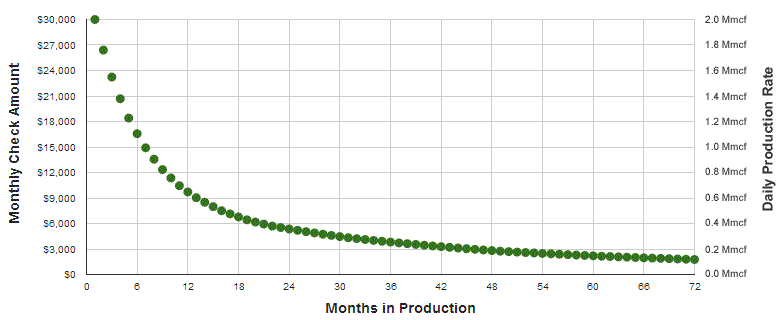
    The production rate of a natural gas well will decline over time and that will cause royalty rates to fall unless prices increase.
    natural gas well production chart

    This graph shows how the monthly royalty rate and daily natural gas production rate of a hypothetical gas well can decline during the first six years of production. It was constructed using an initial production rate of 2 million cubic feet per day, a natural gas price of $4/mcf and a royalty rate of 12.5%. The left axis shows the amount of the monthly royalty check and the horizontal axis shows the months of production. The right axis shows the production rate in millions of cubic feet per day. The well starts with a rapid production rate and high royalty checks. These decline rapidly during the first year and by the end of the first year they have dropped by nearly 70%. The production rate declines in each successive year and at the end of the six year period the production is down to a little over 0.1 million cubic feet per day and the royalty check is down to about $1750. This is a drop of nearly 94%! Eventually, the well will yield so little gas that it will be uneconomical to operate and will be abandoned. This curve is a hypothetical example and your well could do better or worse. The rate of decline varies from well to well. Production of natural gas from shales is a relatively new technology. There is not enough long-term experience to accurately predict the long-term productive life a well in the shale gas formations of the United States.

    Declining Royalty Payments are Normal

    Lots of property owners who signed a lease in one of the natural gas shale plays such as the Marcellus, Barnett, Haynesville, Fayetteville, Bakken, Utica and Eagle Ford are now receiving monthly or quarterly royalty payments. Many of these people were pleasantly surprised with the size of their first royalty check — but then shocked to see the size of subsequent checks fall rapidly.

    There was nothing wrong with their well. Sharp declines are normal.

    Royalty Calculator:   Estimate your royalty payments!

    Why Do Royalty Payments Decline?

    Royalty payment declines occur because the amount of natural gas produced from nearly every continuously-produced shale gas well decreases steadily over time. When a new well is drilled it penetrates a rock unit with abundant gas, sometimes under pressure. These new wells can yield at a very high rate, but over time – as gas escapes from the well – the pressure in the formation goes down. The result is a well with a lower rate of yield. The graph at the top of this page shows the production and royalty rate decline for a hypothetical well during its first six years of production.

    Notice how the decline is very rapid during the first year and then followed by slower but continuous decreases. The well shown in this graph had an initial yield of about 2.0 million cubic feet per day but twelve months later the yield had dropped nearly 70% – to about 0.65 million cubic feet per day.

    The result was a huge income drop for the property owner and the company that drilled the well!

    Expect Declining Royalties

    Production declines this severe are common in unconventional natural gas wells drilled in shale. If you have a new well or have recently leased your property it might be a good idea to be very conservative with your long-term royalty expectations.

    Your income from that well is going to fall rapidly at first and eventually decline to zero.

    Some wells do not show the same sharp decline as this example. Other wells decline more rapidly. Information from the decline curve above is summarized in Table 1 in the right column.

    Other Variables that Change Royalties

    Other variables can cause a change in the amount of royalties paid on a well. The price of natural gas has taken wild swings over the past several years, moving from a high monthly average of $11.00 down to a low approaching $2.00 (see graph in the right column). Changes in the price of gas will significantly modify royalty payments.

    The United States currently has a glut of natural gas as a result of new technologies that extract gas from shale. This abundance of natural gas has kept prices low and has some companies willing to invest billions of dollars to build liquefied natural gas export facilities that will allow United States natural gas to be shipped to Asian and European markets where prices are higher.

    As more and more wells are drilled the only thing that can remove the downward pressure on natural gas prices is an enormous increase in natural gas use or export. This could happen. The federal government has approved a number of natural gas export terminals. Natural gas currently has a cost advantage over oil-derived fuels in vehicles. Utilities are starting to convert power plants from oil and coal to natural gas. These new uses of natural gas are occurring but not spreading rapidly.

    Well Depletion and Closure

    Eventually the yield of a well will decline so much that the income from the gas is less than the expenses required to maintain the well. At that point the well will be closed. Sometimes depleted wells are sealed and other times they are turned over to the property owner who may have a use for the small amount of gas that still flows.

    The Useful Life of a Well

    Horizontal drilling and hydraulic fracturing have been used to produce natural gas from shale for less than a decade in most parts of the United States. However, some general statements can be made about the productive life of a typical well. As described above, these wells will yield at a rapid rate immediately after drilling and the yield will decline rapidly during the first year and then more slowly over time.

    The yield during the first month after completion will reveal how valuable the well will be. Lower yield wells produce one to two million cubic feet per day. Many wells yield between three and five million cubic feet per day, but gigantic wells could produce as much as twenty million cubic feet per day. The more the well yields in the first month the more valuable it generally will be over time.

    The typical well might yield as much as half of its gas in the first five years of production. Wells might then continue to produce for a total of twenty to thirty years but at lower and lower production rates. Caution with production and royalty expectations is recommended because long-term experience from shale formations in the United States is not available.

    The Red Queen of the Oil and Gas Industry

    Oil and gas companies who drill some of the first wells in a new natural gas area usually do not have a way to deliver their gas to market. To obtain delivery they must enter into contracts with a natural gas pipeline company. The oil and gas company promises to provide a specific amount of gas per day and the pipeline company promises transmission capacity.

    Imagine that an oil and gas company drills fifty wells during their first year in a new shale play. They contract with a pipeline company who will transmit that gas to market. One year after these wells are drilled their production rate has fallen by 60 to 80%. So, to meet the amount of gas promised to the pipeline the oil and gas company must drill at least 30 to 40 new wells to make up for the drop in production. At the end of the second year the company has first year production drops on all of its new wells and second year production drops on all of the wells drilled in the first year. This forces the oil and gas company to drill, drill, drill to keep up with its promise to the pipeline.

    Many people in the oil and gas industry call this the “Red Queen Effect”. It is named after a character in Lewis Carroll’s Through the Looking-Glass novel. The Red Queen lectures Alice: “Now, here, you see, it takes all the running you can do, to keep in the same place. If you want to get somewhere else, you must run at least twice as fast as that!”

    Throttling New Wells?

    In the early days of horizontal drilling and hydraulic fracturing of shale it was customary practice to allow the well to produce at full capacity as soon as it was placed on line. This produced rapid income for the company and maximized the numbers in their next shareholder report.

    Recent experiments suggest that throttling the production of a new well might result in a longer productive lifetime for the well and a greater total recovery of gas. The theory behind this is that rapid initial production allows the pore spaces in the shale to deflate unevenly. Pores near the well collapse first as the gas rapidly moves to the well and that causes more distant gas to be trapped within the formation. Slowing the production rate allows the pores to deflate more evenly and allows an orderly, more efficient and more complete gas recovery.

    This idea remains to be proven but some producers are starting to apply it. A second reason to throttle the gas is that it allows the company to better plan its production and drilling rates, match them to transmission capacity and avoid the demands of the Red Queen.

    New Gas from Future Technologies?

    Current technologies are recovering a very small percentage of the natural gas that is held in the rocks. During the next twenty to thirty years new methods for extracting gas from the Earth could be developed. It is possible that these new methods could be used to rework existing wells and renew their productivity. Only time will tell.