Category: Uncategorized

  • Sustainability movement will fail unless it creates a compelling future vision

    Sustainability movement will fail unless it creates a compelling future vision

    We will only create prosperity within planetary boundaries if we start to really believe it is possible, writes Jo Confino
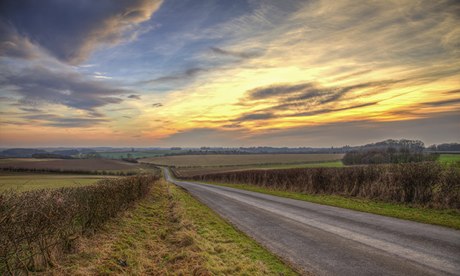
    An evening sunset

    We need to look further into the horizon and develop a new narrative for sustainabilty, argues Jo Confino Photograph: Alamy

    “It’s all a question of story. We are in trouble now because we don’t have a good story” – Thomas Berry

    The greatest risk to the sustainability movement is that it is struggling and so far failing to articulate a vision of a future that is both prosperous while remaining within planetary boundaries.

    Until it is able to showcase a plausible paradigm shift, then no-one is going to feel safe letting go of the current system that is driving us towards the edge of an environmental and social abyss.

    This goes to the very heart of the explanation why large businesses are doing no more than incremental tinkering with their operations and also explains the growing evidence that corporate sustainability is hitting a plateau; companies just don’t know where else to go before they have to start challenging their core business model and that is scaring the shit out of them.

    Even leaders such as Unilever are unable, within the current framework, to articulate a future that does not include continued growth; in its case, a doubling of its size by 2020. Even if it also meets its ambitious objective of halving its environmental impacts, that’s still no overall emissions reduction.

    The lack of a credible alternative also explains the sense of disconnection that many feel to the scale of the sustainability challenges we face. I was at the annual CEOs meeting a few weeks ago of the World Business Council for Sustainable Development listening to a talk by Johan Rockstrom, head of the Stockholm Resilience Centre.

    His portrayal of the environmental and social disaster we are hurtling towards should have had all the senior executives weeping into their handkerchiefs. But there were no tears and precious little mention of his warning as the conference progressed.

    How could that possibly be? Because our minds don’t allow us to look to the far horizon when we can’t see more than a few steps ahead so instead we tend to look down at our feet. This explains why even environmental catastrophes only hold our attention for so long.

    It is true that there are a number of interesting sustainability initiatives such as the circular economy and a growing number of cross-sector collaborations. But none of these offers a truly systemic solution.

    At its worst, this means that sustainability professionals are essentially operating in the dark, frantically seeking to change the world without really understanding whether ultimately their initiatives or projects are causing more harm than good.

    So what can we do about this? What I am hearing from numerous experts is that we need to find a new narrative that creates a sense of confidence to take more radical steps.

    This was also the conclusion of a day-long experiential roundtable of 24 diverse global experts I chaired recently in Copenhagen. We discussed more than a dozen key sustainability solutions, ranging from natural capital valuation to education initiatives, but what was felt to be most important was being able to tell the story of the future we all want and which we believe is feasible.

    Let’s be honest; we are not there yet. Who among you is really able to convincingly describe a world which is both economically prosperous and has conquered the numerous challenges of runaway consumption, population growth, climate change, extreme poverty, resource scarcity, ecosystem collapse an the loss of biodiversity?

    We talk about moving beyond GDP as a measure of success but which politicians in their right mind are going to welcome the idea of a steady-state economy?

    Just look at what has happened after a few years of economic downturn; unemployment social upheaval and a revival of fascism. How are we going to avoid even greater dislocation and conflict by moving to an entirely new form of capitalism.

    Doug Tomkins, the radical environmentalist, told me: “We need to do a proper systemic analysis of the system we are in. We introduced a mega economic technology called capitalism which brings with it a structure and imposes a certain behaviour on society.

    “Capitalism is based on a notion and a logic of growth. It goes nuts when it starts to contract. There’s a small body of thinkers who are looking into this, and of course, there has been systemic analysis made of capitalism going way back to Marx and Engels. From that new analysis I believe that we will be much better informed to make specific and detailed strategies on how to get out of this predicament. But it takes a long time. Big paradigm shifts have taken centuries.

    “People say about Bhutan’s focus on wellbeing: ‘they’re irrelevant as they’re just a little kingdom out there in the foothills of the Himalayas. How are we going to deal with the overdeveloped nations and highly industrialised nations?’ Of course, it’s a different scale but what it does is it simply opens up the imagination that this kind of thinking is possible and that’s a little step in the right direction.”

    So who are some of the thinkers focusing their minds on creating a new narrative? There’s Tim Jackson, the author of Prosperity without Growth, and think tanks such as the New Economics Foundation.

    Another is John Fullerton’s Capital Institute, which is developing the idea of regenerative capitalism, which will make the sustainability of today look even more outdated than the CSR of a decade ago.

    Fullerton says: “Dana Meadows suggested that the most important leverage point for enabling system change is to change the paradigm, or belief structure, within which a system operates. We must evolve beyond the outdated mechanistic worldview and impossible exponential growth paradigm which defines contemporary economics and finance, to a regenerative paradigm grounded in the holistic ecological or living systems worldview of contemporary science.”

    Fullerton identifies eight elements of regenerative capitalism, ranging from the recognition of the sacredness of life and the need for entrepreneurialism to shared prosperity and resiliency.

    Whilst some of these are already being incorporated into many small-scale initiatives, Fullerton argues that this new thinking can only be embedded in large companies if there is a fundamental transformation in the finance sector.

    This would involve, amongst other measures, finance being grounded in a culture of service, whilst also valuing relationships over transactions and transparency over complexity.

    From where we currently stand this all may look hopelessly optimistic and we have seen examples in the past of the slow pace of change, such as Copernicus and Galileo spending uncomfortable lives trying to replace the outdated notion that the sun revolved around the earth with a heliocentric model of the universe.

    But as Fullerton says: “That isn’t to say that paradigm shifts can’t happen quickly. The end of apartheid in South Africa, and the fall of the Berlin Wall are but two contemporary examples illustrating how the impossible can become the inevitable seemingly overnight when belief systems change.”

    So let’s get on with building and mainstreaming this new narrative for as Rob Cameron, executive director of SustainAbility said to me the other day: “Above all else, we need to move from an era of change to a change

  • Climate change: when ignorance is a recipe for disaster

    Climate change: when ignorance is a recipe for disaster

    Date
    November 12, 2013
    Peter Hartcher

    Sydney Morning Herald political and international editor

    View more articles from Peter Hartcher


    <i>Illustration: John Shakespeare</i>Illustration: John Shakespeare

    The Philippines had several days’ notice that a super typhoon was on its way and it warned its people long and often. Many evacuated. But, for an estimated 10,000 who today lie dead, there was no defence against its brute force.

    As tropical cyclone Haiyan continued across the South China Sea to assault Vietnam, where the government had evacuated some 900,000 people in anticipation, one question being asked is whether it is the strongest on record.

    The answer? Based on the estimate by the US military’s installation on Hawaii, the Joint Typhoon Warning Centre, it was the most powerful recorded cyclone to make landfall. It hit the Philippines with sustained winds of 305km/h to 315km/h.

    People stand among debris and ruins of houses destroyed after Super Typhoon Haiyan battered Tacloban city in central Philippines. Click for more photos

    Typhoon Haiyan slams the Philippines

    People stand among debris and ruins of houses destroyed after Super Typhoon Haiyan battered Tacloban city in central Philippines. Photo: Reuters

    Japan’s Meteorological Agency, however, estimated it to be much weaker, at some 230km/h. That wouldn’t put it in the top 10. There were no direct observation points on the Philippines to settle the matter. But to the dead, and to the living who must try to rebuild from economic damage estimated by Bloomberg Industries at $US14 billion, it is a distinction without a difference.

    Advertisement

    Another question being asked is whether climate change has contributed to the cyclone’s ferocity.

    It is a pregnant moment to ask. Negotiators from around the world are starting to arrive in Warsaw for the next round of United Nations talks on climate change. This round will culminate at the end of 2015 in new commitments on carbon emissions covering the years beyond 2020.

    Australia is sending an official and not a minister; the Abbott government is preoccupied. The new Parliament opens on Tuesday and Abbott’s first priority is to try to repeal the carbon tax.

    ”Haiyan should be a five-alarm wake-up call for negotiators in Warsaw and the capitals that sent them here,” writes Jamie Henn – co-author of the book Fight Global Warming Now and co-founder of 350.org – for US news website The Huffington Post. ”Climate change is loading the dice for extreme weather events like Haiyan.”

    But some climate activists have developed an unfortunate habit of latching on to every weather-related disaster as a promotional device for their agenda.

    This is a subject too important to be left to the hysteria of frustrated carbon activists or to what former prime minister John Howard ”instinctively” feels may be exaggerations.

    So is it true? The Rosetta Stone for interpreting climate developments is the methodical work of the thousands of scientists who contribute to the Intergovernmental Panel on Climate Change. The global framework of negotiations is based on its findings. It has a high degree of confidence that anthropogenic or man-made global warming is real and damaging.

    Last year the IPCC issued a report, Managing the Risks of Extreme Events and Disasters to Advance Climate Change Adaptation. In its summary for policymakers, it reports: ”There is evidence that some extremes have changed as a result of anthropogenic influences, including increases in atmospheric concentrations of greenhouse gases.”

    Fair enough. But, specifically on tropical cyclones like Haiyan, it finds: ”The uncertainties in the historical tropical cyclone records, the incomplete understanding of the physical mechanisms linking tropical cyclone metrics to climate change and the degree of tropical cyclone variability provide only low confidence for the attribution of any detectable changes in tropical cyclone activity to anthropogenic influences.

    ”Attribution of single extreme events to anthropogenic climate change is challenging … There is low confidence in any observed long-term (i.e., 40 years or more) increases in tropical cyclone activity (i.e., intensity, frequency, duration) after accounting for past changes in observing capabilities.”

    In other words, the state of knowledge is that man-made climate change has not made any clear difference to tropical cyclone activity.

    But what of the future as the planet warms? ”Average tropical cyclone maximum wind speed is likely to increase, although increases may not occur in all ocean basins,” the IPCC reports. ”It is likely that the global frequency of tropical cyclones will either decrease or remain essentially unchanged.”

    But that’s not the end of the story. Climate change might not have made cyclones more frequent or more intense. But it is having other effects that threaten to be force multipliers for cyclones.

    The IPCC report again: ”It is very likely that mean sea-level rise will contribute to upward trends in extreme coastal high water levels in the future … There is high confidence that locations currently experiencing adverse impacts such as coastal erosion and inundation will continue to do so in the future due to increasing sea levels, all other contributing factors being equal.

    ”The very likely contribution of mean sea-level rise to increased extreme coastal high water levels, coupled with the likely increase in tropical cyclone maximum wind speed, is a specific issue for tropical small island states.”

    The chief meteorologist for the Weather Channel in the US, Paul Walsh, asked to summarise the effect of climate change on Haiyan, told CNBC: ”I wouldn’t say that climate change is a direct contributor to this. That’s something that’s still being discussed.

    ”But one of the things that makes these storms, particularly for the US east coast, more potentially damaging is that sea levels are rising and continuing to rise and even smaller storms can have a devastating impact.”

    In other words, climate change is working to make ordinary weather patterns more dangerous. It doesn’t seem to be happening through any direct causal link to cyclones. But it doesn’t need to. A rising sea level will intensify the power of cyclonic winds to create bigger storm surges, according to the IPCC.

    Man-made climate change is real and dangerous. Is it causing more or bigger cyclones? There’s no evidence that it is. But, again, it’s a distinction without a difference. Because it’s making normal cyclones more damaging. Rising sea levels will supercharge them.

    There is no need for exaggeration and there is no excuse for inaction.

    Peter Hartcher is the international editor.

    Ads by Google

    Get 3 Solar Quotes

    Solar-Power-Australia.com.au

    Compare 3 Solar Installers. Save Time & Money Now!

    Compare Health Funds

    iselect.com.au/Compare_Health_Fund

    Are Your Health Fund Costs Rising? Compare Health Fund Policies Today!

    Mining Engineering Books

    www.bookshop.unsw.edu.au

    SME Handbook $324 UNSW Bookshop

    144 comments so far

    • A balanced article, except that it overlooks the increase in wind speed records. Only two weeks ago a seemingly ordinary autumn storm over Western Europe broke the existing speed record at 195 km per hour. Wind gusts of 380 km per hour have been observed a few hours before landfall of typhoon Haiyan. We should not, cannot wait for another decade of painstaking scientific research to come to the conclusion that the top wind speeds in these storms are on the increase!
      STEEP WORLDWIDE CARBON PRICING NOW!

      Commenter
      rob de laet
      Location
      salvador brazil
      Date and time
      November 12, 2013, 12:26AM
      • STEEP… ? Did I miss something??

        Commenter
        Wha?!
        Location
        Date and time
        November 12, 2013, 5:54AM
      • Steep me!! Is that right?? I just can’t steep it out. I’m going back to steep.

        Commenter
        hodster
        Date and time
        November 12, 2013, 6:39AM
      • Good luck with global carbon pricing.
        I m sure climate change is first priority for Indians Chinese who r hard at work lifting millions of people out of poverty and into middle class. NOT.
        Australia is not the global policeman and has no right to give a lecture to others on benefits of carbon tax. Leave that to UN to come to an agreement.

        Commenter
        Goodluck jonathon
        Date and time
        November 12, 2013, 6:44AM
      • What to expect from the climate change negotiations in Poland – absolutely nothing. There is no chance that the delegates will do enough to significantly change the trajectory of our climate – we are off for the trip of a lifetime; where ever our climate goes, we will follow.

        We refuse to admit that our efforts are futile,
        Our response to reality nothing more than puerile.
        Like Canute, we stab at the climate change wave,
        In our determined efforts this world to save.
        Most things suggest that climate change is here,
        Yet, our desperate reaction nothing more than fear.

        Commenter
        Howe Synnott
        Location
        Sydney
        Date and time
        November 12, 2013, 6:48AM
      • Yes, you did!!!!

        Commenter
        Lesm
        Location
        Balmain
        Date and time
        November 12, 2013, 6:52AM
      • Great if all this real then let’s do something REAL to stop it. Do not fool yourself that $10-20 a week for which compensation was going to be given was going to stop the CO2 emission. No try $100-200 a week per person to stop the CO2 emission that are being caused by YOUR lifestyle. That is right it is not big industry that is the problem it is OUR lifestyle. Unless you are prepared to make REAL changes Peter get off your high horse. Giving up 2 coffees a week just does not cut it !

        Fact. Bob Brown has a lifestyle that places him in the top 5% of CO2 emitters. Happy to pay for this analysis to be done scientifically but sure Bob will not accept the offer. Offer is open to Christne as well ( love your DIAMOND ear rings Christne whichdirty mine did they come from)

        Commenter
        abc
        Location
        Date and time
        November 12, 2013, 7:28AM
      • Quickly someone throw big bundles of money at the wind!

        Commenter
        MyPetMonkey
        Location
        Sydney
        Date and time
        November 12, 2013, 7:42AM
      • @Howe Synnot

        How much carbon did you generate just to type that and submit it? If anyone commenting on this column had any regard for the environment, they would have turned their PC off as soon as they had finished reading the article.

        Myself? I have no regard. So I will be posting comments on SMH for the rest of the day, the end result being a net contribution to greenhouse gases. Sure I feel guilty, but I’m taking a leaf out of the larger economies handbook: no care taken, no responsibility accepted.

        Commenter
        Malik the magic sheep
        Location
        Perth
        Date and time
        November 12, 2013, 8:08AM
      • @ Rob,

        The article clearly shows how convoluted the assumptions for climate change are, the data is often incomplete and the time of accurate record keeping is minimal when we look at global weather patterns which have occurred over thousand year cycles.

        This assumption that foreign governments must put carbon taxes in place is ludicrous and wishful thinking of the west. Can you seriously see people in developing countries give up affluence over extreme green ideals, I.e a chance to make bucket loads of money over none at all.

        The zealous preaching from the religion of climate change very often fails to understand basic human behavior and base their arguements on alarmist predictions. Whilst sipping champagne, snacking on smoked salmon and enjoying their already aquired affluence.

        Commenter
        Jack
        Date and time
        November 12, 2013, 8:18AM

    More comments

    Advertisement

    Featured advertisers
    &lt;!– UI NOTE: Make iframed content accessible: –&gt; &lt;a href=”http://assets.betterbills.com/widgets/CT-ACT.html”&gt;View these special offers by BetterBills.&lt;/a&gt;

    Read more: http://www.canberratimes.com.au/comment/climate-change-when-ignorance-is-a-recipe-for-disaster-20131111-2xccy.html#ixzz2kNvlPrmV

  • Board Chair of Global Footprint Network,

    Dear NEVILLE,
    As the Board Chair of Global Footprint Network, I wanted to take a moment to reflect as the end of 2013 draws nearer. As I look back on our first 10 years, there are so many achievements that we can be proud of.Thank you so much.

    Your support has helped us accomplish many great things over the past decade. Here are a few highlights:

    • The Ecological Footprint method – in widespread use by national and regional governments, corporations, and NGOs – has contributed to an on-going paradigm shift in managing environmental assets.
    • Over a million people every year use our Ecological Footprint calculator to measure their personal Footprint.
    • Our annual Earth Overshoot Day campaign is educating the public about our planet’s ecological limits. More than 200 million people on the internet alone learned about the Earth’s annual limits during Earth Overshoot Day 2013.
    • Our researchers calculate the Ecological Footprint and biocapacity for 234 countries every year, using 6,000 data points for each country in our National Footprint Accounts. This data set serves as the basis for the myriad Ecological Footprint analyses conducted at all scales all over the world.
    • Eleven nations have officially adopted the Ecological Footprint – with more on the way.

    We need your help to take our work even further.

    National governments, international agencies like the United Nations, states, regions and the business community are seeking our advice and decision making tools as we grapple with an uncertain future on this planet. The risks of damaging or depleting our planet’s natural resources are becoming increasingly clear.

    Donate Now

    It has never been easier for you to help make a difference.

    Our partners at the Skoll Foundation and Huffington Post have launched a crowd funding challenge that highlights our award-winning social entrepreneurship. When you give to us online through this campaign until November 22, your donation makes us eligible for a matching gift. And you also increase our visibility among important stakeholders around the world. So please click the link to give as much as you can. And share our campaign with others in your social networks so that your friends and family can learn about the work you are supporting.

    Of course, you can also continue to donate securely online. When you donate $50 or more annually, you are automatically enrolled as a “Friend of Global Footprint Network,” and included in our most important events, announcements, and progress reports.

    With your support, our impact can be even greater in 2014.

    Having you on our team makes our exciting and important work a tangible reality throughout the world. We are grateful to have earned your continued trust and commitment to our vision.

    With warmest regards,


    Terry Vogt
    Chair, Board of Directors


    P.S. Your support today will help us accelerate the shift towards a sustainable economy.

  • Bandt raises bushfires climate link again

    News

    Bandt raises bushfires climate link again

    AAP Steve Lillebuen – November 17, 2013, 1:24 pm

    Greens deputy leader Adam Bandt has warned the deadly Black Saturday disaster could be repeated every two years unless the federal government takes global warming seriously.

    Mr Bandt was accused of politicising the NSW bushfires tragedy last month when he linked climate change with the crisis.

    He again raised the politically charged point on Sunday ahead of a debate on the carbon tax repeal.

    He told a climate change rally in Melbourne that the 2009 Victorian fires, which killed 173 people, could happen far more frequently.

    “Unless we get global warming under control, the kind of horrific tragedies that we saw during Black Saturday might start happening once every two years here in Victoria,” he told a crowd of thousands.

    Prime Minister Tony Abbott has described attempts to link bushfires with climate change as “complete hogwash” and a “bizarre” argument, given Australia has always had bushfires.

    But Mr Bandt accused the coalition of not taking real action on climate change.

    “Yes, (Mr Abbott) is right that we have always been a country prone to bushfires, but I say, why the hell would you wish more of them on us?” he said.

    “That is what is in store unless we get global warming under control.”

    Labor opposition environment spokesman Mark Butler and Tim Flannery of the Climate Council also addressed the crowd.

    No one from the coalition spoke, but organisers said they were invited.

    The event was one of hundreds throughout Australia as part of a national day of action.

    United Firefighters Union secretary Peter Marshall attended the event.

    He said he believed in the link between bushfires and climate change.

    “There is no sceptic at the end of a fire hose,” he said.

  • Book Review: Global warming and oceans, a 21st century perspective

    Book Review: Global warming and oceans, a 21st century perspective

    Ocean Circulation and Climate belongs on every climate geek’s holiday wish list
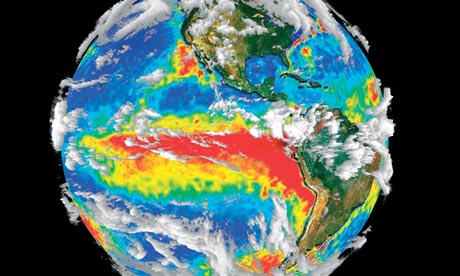
    El Nino gathering over the Pacific Ocean

    A new book summarizing much of what we know about oceans and the role they play in shaping our Earth’s climate was just published. For researchers like myself, we often become fixated with learning the newest facts or reading the latest studies in our fields. Every so often, however, it is necessary to take a step back and provide a retrospective look at how our knowledge has developed with time. Such a retrospective was just provided by some of the world’s most qualified oceanographers. It is an update to a legendary text that was first printed in 2001.

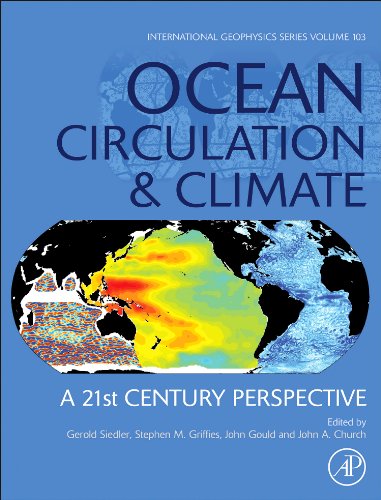
    The cover of Ocean Circulation and Climate The cover of Ocean Circulation and ClimateThis is the second edition of “Ocean Circulation and Climate – Observing and Modelling the Global Ocean” published in 2001 at the end of the World Ocean Circulation Experiment (WOCE). During the 1990s WOCE built on the availability of a new generation of altimeter satellites and carried out the first global scale study of the role of the oceans and their circulation in earth’s climate. WOCE’s primary objective was “to develop models useful for predicting climate change and to collect the data necessary to test them”.
    Since WOCE there has been enormous further progress both on ocean observations and modeling. The Argo array of profiling floats (a technological development started during WOCE) now routinely monitors the temperature and salinity of the upper ocean. The series of altimeter satellites continues. These strands now allow a better understanding of the inherent variability of the ocean not available in 2001. In parallel, the relentless increase in computational power permits better representation of crucial ocean processes. The new book has been produced simultaneously with the preparation of the 2013 IPCC WG1 5th assessment report and provides useful and up-to-date background on ocean-related issues central to the IPCC’s assessment.

    The remarkable progress in this area of ocean science since the turn of the century means that many of our present-day modeling and observational capabilities could only have been dreamed about in the 1990s. Thus the book, subtitled “A 21st Century Perspective”, is both timely and important. It contains 31 chapters that span the present state of knowledge. The 78 authors provide a truly international perspective as recognized experts in their respective fields. Eight were also authors of the IPCC WG1 AR5, which was released this fall, including Thomas Stocker (Chairman of WG1) who wrote the first chapter, “The Oceans as a Component of the Climate System”.

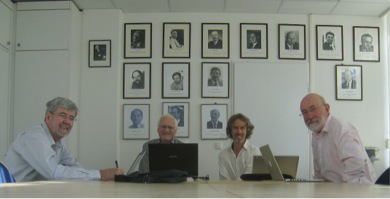
     Editors of Ocean Circulation and Climate The editors of Ocean Circulation and ClimateThree of the editors, Gerold Siedler (Germany), John Gould (UK) and John Church (Australia), were editors of the first edition and were joined by Stephen Griffies (USA) to provide additional expertise on modeling. All are internationally recognized experts in their respective fields.


    The introduction provides a great justification for the text,

    “Were it not for the ocean’s ability to absorb substantial amounts of heat and carbon, the effects of worldwide anthropogenic climate change would be much larger. The ocean is therefore already an important mitigating element in the Earth System”

    As a part-time ocean scientist myself, and a self-described ocean nerd, this may be the first item on my Christmas list.

  • Climate Change To Shrink Animal And Plant Habitats Dramatically, Study Forecasts


    Climate Change To Shrink Animal And Plant Habitats Dramatically, Study Forecasts

    Reuters  |  Posted: 05/12/2013 1:00 pm EDT  |  Updated: 05/13/2013 11:28 am EDT

    1,105
    381
    76
    6993
    Get Green Newsletters:

    * More than half of all plants, a third of animals at risk-study

    * Rapid peak in greenhouse gas emissions could reduce impacts

    By Environment Correspondent Alister Doyle

    OSLO, May 12 (Reuters) – The habitats of many common plants and animals will shrink dramatically this century unless governments act quickly to cut rising greenhouse gas emissions, scientists said on Sunday after studying 50,000 species around the world.

    The scientists from Britain, Australia and Colombia said plants, amphibians and reptiles were most vulnerable as global temperatures rise and rainfall patterns change.

    About 57 percent of plants and 34 percent of animal species were likely to lose more than half the area with a climate suited to them by the 2080s if nothing was done to limit emissions from power plants, factories and vehicles, they wrote in the journal Nature Climate Change.

    Hardest hit would be species in sub-Saharan Africa, Australia, the Amazon and Central America.

    “Climate change will greatly reduce biodiversity, even for many common animals and plants,” lead author Rachel Warren of the University of East Anglia in England said. The decline would damage natural services for humans such as water purification and pollination, she said.

    But the scientists said governments could reduce the projected habitat loss by 60 percent if global greenhouse gas emissions peaked by 2016 and then fell. A peak by 2030 would cut losses by 40 percent.

    Only 4 percent of animals, and no plants, were likely to benefit from rising temperatures and gain at least 50 percent extra territory, the study said.

    However, some experts said while it was clear that global temperatures were rising, forecasting the effect on plants and animals was often unreliable as species range was difficult to check.

    DIFFICULT BALANCE

    Some past studies have indicated that creatures such as bats, hares or opossums may be more able to adapt to new climates than believed. Yet many species of frogs and toads are suffering worse declines in numbers than projected by computer models, apparently because a fungal skin disease is aggravating the effects of global warming.

    “It’s very difficult to get the right balance between crying wolf and examining the facts,” said Carsten Dormann, professor at the Helmholtz Centre for Environmental Research in Germany, who was not involved in the study. “We simply don’t know if these assessments are correct.”

    The scientists said: “Over half of common plants and one third of the animals could see a dramatic decline this century due to climate change.” They said their findings were “probably conservative” as they did not take account of factors that could exacerbate declines, such as pests or diseases.

    Almost 200 governments have agreed to limit global warming to less than 2 degrees C (3.6F) above pre-industrial times. They plan to agree, by the end of 2015, a deal to curb emissions.

    Global average surface temperatures have risen by 0.8 degree C (1.4F) since the Industrial Revolution.

    The amount of carbon dioxide, a greenhouse gas, in the atmosphere topped 400 parts per million for the first time since measurements began in 1958, the U.S. National Oceanic and Atmospheric Administration said on Friday.

    A U.N. panel of climate scientists says it is at least 90 percent likely that human activities, rather than natural variations, are the main cause of warming since about 1950.

    For the report: (http://dx.doi.org/10.1038/nclimate1887) (Reporting By Alister Doyle; Editing by Janet Lawrence)

    Also on HuffPost:

    Connect The Dots On Climate Change