Category: Uncategorized

  • Ban says people feel ‘planet’s wrath’ over warming

    Ban says people feel ‘planet’s wrath’ over warming

    By Alister Doyle and Nina Chestney

    WARSAW Tue Nov 19, 2013 11:37am EST

    • inShare
    • Share this
    • Email
    • Print
    (L-R) Christiana Figueres, executive secretary of the U.N. Framework Convention on Climate Change (COP), U.N. Secretary General Ban Ki-moon and Polish Prime Minister Donald Tusk listen to Polish Environment Minister Marcin Korolec during the COP19 conference at the National Stadium in Warsaw November 19, 2013. REUTERS/Kacper Pempel

    (L-R) Christiana Figueres, executive secretary of the U.N. Framework Convention on Climate Change (COP), U.N. Secretary General Ban Ki-moon and Polish Prime Minister Donald Tusk listen to Polish Environment Minister Marcin Korolec during the COP19 conference at the National Stadium in Warsaw November 19, 2013.

    Credit: Reuters/Kacper Pempel

    (Reuters) – People around the world are feeling the “wrath of a warming planet”, U.N. Secretary-General Ban Ki-moon said on Tuesday, urging almost 200 governments to take tougher action to reach a deal in 2015 on fighting global warming.

    Ban told environment ministers at climate talks in Warsaw they had a steep climb ahead to agree to cut rising greenhouse gas emissions that scientists say fuel more extreme weather.

    The Warsaw talks are struggling to lay the foundations for a new global accord, meant to be agreed in 2015 and enter into force from 2020, that looks likely to be a patchwork of pledges by national governments rather than a strong treaty.

    Many developed nations are more focused on spurring sluggish economic growth than fixing global warming, despite scientists’ increased certainty that human emissions will cause more heatwaves, droughts, floods and rising sea levels.

    Developing nations, led by China and India, insist that the rich must continue to lead while they focus on ending poverty.

    “All around the world, people now face and fear the wrath of a warming planet,” Ban said, referring to extreme weather events such as Typhoon Haiyan that killed more than 3,900 people in the Philippines this month.

    Current pledges for curbing global warming were “simply inadequate”, Ban said. “Here, too, we must set the bar higher.”

    He said governments needed to step up aid to help poor nations slow their rising emissions of greenhouse gases and to adapt to the impacts of warming.

    GLIMMERS OF HOPE

    No major nations have set tougher national goals for cutting greenhouse gases in Warsaw. Japan disappointed many last week by saying it was watering down goals for 2020 after closing its nuclear industry after the 2011 Fukushima disaster.

    A report by 49 experts in 10 nations on Tuesday said that carbon dioxide emissions from burning fossil fuels will rise to a record 36 billion tonnes (1 tonne = 1.102 metric tons) this year.

    “I am deeply concerned that the scale of our actions is still insufficient to limit global temperature rise to below 2 degrees Celsius from pre-industrial levels,” he said.

    Governments agreed the 2C ceiling in 2010 as a maximum permitted to prevent dangerous change. Temperatures have already risen by about 0.8 C (1.4F) from before the Industrial Revolution of the 18th century.

    Ban said there were some signs of hope, pointing to actions by governments, business, cities and farmers to cut emissions.

    Ban has invited world leaders to attend a summit at U.N. headquarters in New York on September 23, 2014. “I ask all who come to bring bold new announcements and action,” he said.

    Polish Prime Minister Donald Tusk, whose country has been skeptical of tougher EU climate targets, urged better cooperation.

    “The match is won by the team. In order to win, players have to collaborate,” he said, in a tent set up on what is usually the pitch in Warsaw’s main soccer stadium.

    (
  • The Caribbean’s Fastest and Slowest-Growing Populations

    The Caribbean’s Fastest and Slowest-Growing Populations

    November 18, 2013 | 5:01 am | Print

    By the Caribbean Journal staff

    We continue our series on the World Bank’s Caribbean data by looking at another statistic: population growth.

    We’ve already looked at the Caribbean’s richest countries by GDP per capita, by population density, by life expectancy and by age of population.

    So what are the Caribbean’s fastest-growing populations?

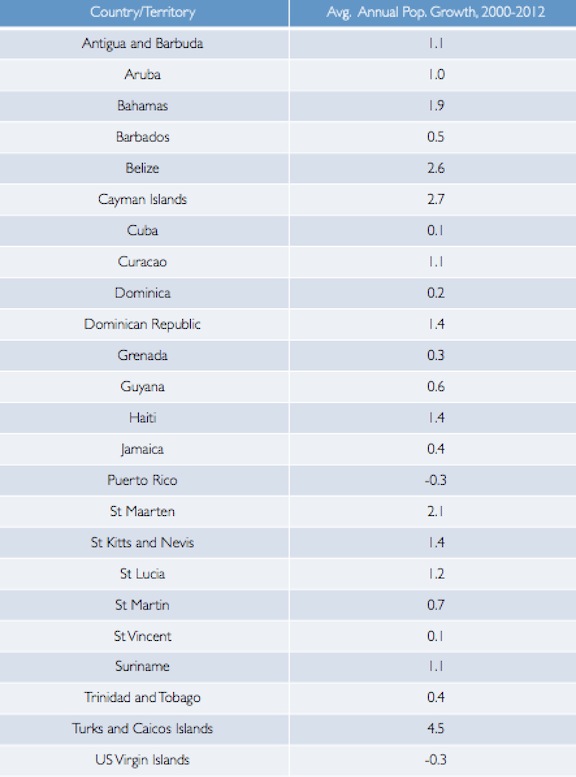
    According to the World Bank, the fastest-growing population in the region is one of the tiniest: the Turks and Caicos Islands, which has seen an average annual growth of 4.5 percent from 2000 to 2012.

    Second was the Cayman Islands, which saw an average annual growth rate of 2.7 percent from 2000 to 2012.

    Among sovereign Caribbean countries, it’s Belize that has the highest growth rate, at 2.6 percent, followed by the Bahamas at 1.9 percent.

    Two US territories were the only populations that saw negative growth — Puerto Rico, with -0.3 percent population growth over the period, and the US Virgin Islands, also at -0.3 percent.

    Note: as has been the case with most of this series, data on several French Caribbean territories and British Overseas territories was not included in the World Bank’s report.

    See below for the full data table by country/territory

  • Ocean acidification set to spiral out of control

    Ocean acidification set to spiral out of control

    Published 18 November 2013 Media coverage Leave a Comment

    [WARSAW] The continued release of greenhouse gases into the air is set to bring about huge changes to land ecosystems as they are forced to adapt to rising temperatures.

    But the marine world — which is just as integral to human existence yet receives little attention during climate negotiations — will endure a similarly tumultuous time as emissions rise, scientists say.

    “Changing oceans will cause massive destruction of coral reefs, which, with their rich biodiversity, are the jungles of the sea,” says Luis Valdes, the head of ocean science at UNESCO’s Intergovernmental Oceanographic Commission (IOC-UNESCO), and co-author of a forthcoming report into ocean acidification.


    This is expected to hit marine species used for food and have knock-on effects on coastal communities, especially in developing countries.

    Business-as-usual carbon dioxide emissions will lead to the acidity levels of oceans rising by 170 per cent by 2100 compared with pre-industrial levels, according to a report to be launched next week at COP 19 (Conference of the UN Framework Convention on Climate Change).

    The report will be published jointly by the International Geosphere-Biosphere Programme, the IOC-UNESCO and the Scientific Committee on Oceanic Research.

    As carbon dioxide levels in the atmosphere rise, some of this extra carbon is absorbed by the oceans and converted into acidic compounds.

    While some organisms such as seagrasses and phytoplankton will likely thrive in increasingly acidic waters, most will not be so lucky.

    Coral reefs and shellfish — both important sources of food — will be hit hard, with higher acidification levels predicted to halt all new further growth of reefs by the end of the century.

    It will be poor coastal communities, especially those in small island states whose existence revolves around coral reefs and fishing, which will bear the brunt of this change, says Valdes.

    “Poor communities are more dependent on the sea and have fewer options to mitigate effects if their current lifestyles become unsustainable,” he adds.

    Creating marine reserves to provide a safe environment away from human pressures to ease species’ transition to this altered world may be a way to minimise the damage, but ultimately the only way to prevent major problems is to halt the carbon emissions, says Valdes.

    But their effect on marine habitats is often absent from climate negotiations and Valdes calls for policymakers to pay more attention to the issue over the next week in Warsaw.

    Jan Piotrowski, SciDevNet, 15 November 2013. Article.

    Rate this:

    Rate This

    Share this post!

  • The rapid pickling of the world’s oceans affects more than just shellfish »

    Ocean acidification set to spiral out of control

    Published 18 November 2013 Media coverage Leave a Comment

    [WARSAW] The continued release of greenhouse gases into the air is set to bring about huge changes to land ecosystems as they are forced to adapt to rising temperatures.

    But the marine world — which is just as integral to human existence yet receives little attention during climate negotiations — will endure a similarly tumultuous time as emissions rise, scientists say.

    “Changing oceans will cause massive destruction of coral reefs, which, with their rich biodiversity, are the jungles of the sea,” says Luis Valdes, the head of ocean science at UNESCO’s Intergovernmental Oceanographic Commission (IOC-UNESCO), and co-author of a forthcoming report into ocean acidification.


    This is expected to hit marine species used for food and have knock-on effects on coastal communities, especially in developing countries.

    Business-as-usual carbon dioxide emissions will lead to the acidity levels of oceans rising by 170 per cent by 2100 compared with pre-industrial levels, according to a report to be launched next week at COP 19 (Conference of the UN Framework Convention on Climate Change).

    The report will be published jointly by the International Geosphere-Biosphere Programme, the IOC-UNESCO and the Scientific Committee on Oceanic Research.

    As carbon dioxide levels in the atmosphere rise, some of this extra carbon is absorbed by the oceans and converted into acidic compounds.

    While some organisms such as seagrasses and phytoplankton will likely thrive in increasingly acidic waters, most will not be so lucky.

    Coral reefs and shellfish — both important sources of food — will be hit hard, with higher acidification levels predicted to halt all new further growth of reefs by the end of the century.

    It will be poor coastal communities, especially those in small island states whose existence revolves around coral reefs and fishing, which will bear the brunt of this change, says Valdes.

    “Poor communities are more dependent on the sea and have fewer options to mitigate effects if their current lifestyles become unsustainable,” he adds.

    Creating marine reserves to provide a safe environment away from human pressures to ease species’ transition to this altered world may be a way to minimise the damage, but ultimately the only way to prevent major problems is to halt the carbon emissions, says Valdes.

    But their effect on marine habitats is often absent from climate negotiations and Valdes calls for policymakers to pay more attention to the issue over the next week in Warsaw.

    Jan Piotrowski, SciDevNet, 15 November 2013. Article.

    Rate this:

    Rate This

    Share this post!

    0 Responses to “Ocean acidification set to spiral out of control”

    1. Leave a Comment

    Leave a Reply

    Subscribe to the RSS feed

    Subscribe to Ocean acidification by

  • Will you help us deliver a wake up call message?

    Why this ad?
    How To Do Energy Healing?www.SilvaMindBodyHealing.com – Learn How to Rapidly Heal Yourself Get Your Free Report Now…

    Will you help us deliver a wake up call message?

    Inbox
    x
    Bill McKibben – 350.org <350@350.org>
    9:42 PM (13 minutes ago)

    to me
    Images are not displayed. Display images below – Always display images from 350@350.org

    Friends,

    When we last sent you an email about the Typhoon in the Philippines, we didn’t yet have a picture of what the impacts would look like.

    Now we do. It looks like this.

    In a reasonable world, Typhoon Haiyan would be the wakeup call that jolts world leaders meeting in Poland for UN climate talks into decisive action. Depressingly, the message isn’t yet getting through, which is why the Filipino delegation, and many allies, have embarked on a fast to underline the immense, immediate needs facing the victims of this storm.

    For our part, we’re bringing thousands on thousands of messages of solidarity with Philippines climate leaders from around the world to the halls of the UN climate talks. This is our way of showing intransigent politicians that the world is counting on them to stand with the victims of Typhoon Haiyan and take real action.

    Our team in Warsaw will deliver the messages alongside the Philippines delegation later this week, and it’s my hope that they’ll be carrying yours when they do. Click here to send a wake up call message on behalf of the Philippines.

    Due to the overwhelming destruction of infrastructure and communication systems, the relief effort in the hardest hit places is only just beginning. In addition to sending that message, can you pitch in to support our friends in the Philippines as they recover from this unprecedented storm, if you’re able?

    This Thursday, the penultimate day of UN talks, people will be gathering in climate justice for the Philippines vigils across the globe, to send the message we’re standing with the Philippines even if they won’t.

    Yeb Sano, the lead Filipino negotiator at the UN Talks, has been fasting for 7 days in a brave protest of the inaction and delay in the face of climate disaster. And his courage is contagious: we’re hearing from people around the world who are fasting with him in solidarity.

    The full account of the destruction won’t be known for a while yet, but the message of Typhoon Haiyan already couldn’t be clearer. It doesn’t feel quite right to look for good in moments like these, but there is at least a glimmer of hope that such a tragedy will cut through the fog of politics and reveal the urgency of this crisis.

    I fear it will only happen if we push however, and so push we will.

    Many thanks,


  • Magma Boils Beneath Antarctic Ice

    Magma Boils Beneath Antarctic Ice

    17 November 2013 1:00 pm

    0 Comments

    Shaky work. A polar engineer maintains one of the seismic monitoring stations used in the research.Jeremy Miner

    Shaky work. A polar engineer maintains one of the seismic monitoring stations used in the research.

    Marie Byrd Land is a desolate region of Antarctica buried deep beneath the West Antarctic Ice Sheet. But while the surface of Earth may be frozen, underneath is a different story. Historic eruptions have punctured the ice sheet, creating a chain of volcanoes amid the ice. Now, researchers have shown that molten rock still stirs deep underground. Only the largest eruptions could melt all the ice above them and poke through to the surface, but even smaller eruptions could potentially cause global sea level to rise, although no one knows how big the rise might be.

    The curiously named Executive Committee Range is a series of volcanoes in Marie Byrd Land lying in a roughly straight line, with the volcanoes becoming progressively younger as one heads south from Whitney Peak, which is between 13.2 million and 13.7 million years old, to Mount Waesche, which formed in the last 1 million years. The crust is thinned by the West Antarctic Rift System, a series of giant rift valleys beneath the ice sheet, and erupted lava from underground magma chambers has burst through the ice repeatedly over geological history as the plates moved over the top. No one knew whether magma was still stirring underneath the Executive Committee Range, however, until seismic monitoring stations were installed on the ice between 2007 and 2010.

    Researchers built the stations to study the shifting crustal blocks of the West Antarctic Rift System. But seismologist Amanda Lough of Washington University in St. Louis in Missouri and colleagues in California, Pennsylvania, Colorado, Texas, Washington, and Ohio found another use. They noticed a series of small earthquakes, mainly occurring during two “seismic swarms” in January and February 2010 and March 2011. These earthquakes were unusual: The ground was shaking much more slowly during the quakes than one would expect from the plates grinding against each other.

    Lough worked out the origin of these tremors. “I looked at two different types of waves that come in—the P wave, which is the primary wave, and the S wave, which is the secondary wave,” she says. Her calculations revealed that the waves had come from 25 to 40 kilometers below Earth’s surface and were centered around a point 55 kilometers south of Mount Waesche—approximately the point the volcanic activity should have reached if it had continued the linear trend of volcanoes to the south. The exact cause of these deep quakes is not understood, but they are thought to result from the movement of magma deep below active or soon-to-be active volcanoes. Scientists have recorded them around other active volcanoes in Hawaii, for example, sometimes around the time of eruptions.

    Geomagnetic data and radar mapping by Lough’s colleagues confirmed the presence of magmatic activity within the rocky crust. They found that the area showed a slightly higher magnetic field than the surrounding area and that there was a bump in the crust—common signals of magmatic activity. Radar mapping also indicated a layer of volcanic ash embedded in the ice. The team thinks this probably came from an eruption of Mount Waesche about 8000 years ago—very recent geological history. There is no evidence of an actual eruption since then, but, because magma is still moving deep under the Earth, an eruption could occur at any time, the team reports online today in Nature Geoscience.

    The current center of volcanic activity is covered by at least 1 kilometer of ice, and it would take an exceptionally large eruption to melt all this. But an eruption could make its presence felt in subtler ways. As fresh snow adds to their own mass, ice sheets flow downward into the sea. By melting the base of the ice sheet, an eruption could speed up this flow, potentially raising the level of the ocean. No one knows how significant such a rise might be.

    Any effect on the ice sheet above, and thus any effect on the oceans, would probably be quite small, says glaciologist Robert Bindschadler of the NASA Goddard Space Flight Center in Greenbelt, Maryland, who was not involved in the work. Still, he says, a proper study is needed to find out how significant volcanic activity could be to future sea levels. “It’s a wild card.”

    Posted In: