Category: Uncategorized

  • Ocean acidity Q&A: scientists warn of growing threat to life

    Ocean acidity Q&A: scientists warn of growing threat to life

    Published 15 November 2013 Media coverage Leave a Comment

    The acidity of the world’s oceans is increasing at an “unprecedented rate”, scientists say, warning that seawater will be 170 per cent more acidic by 2100 if current trends continue.

    The study was led by the International Biosphere-Geosphere Programme, and follows a meeting of 500 of the world’s leading experts on ocean acidification last year. Their findings will be formally presented in Poland next week.

    What is happening?

    The BBC reports a fundamental change in the chemistry of the world’s oceans, which have become 26 per cent more acidic since the start of the industrial revolution. Earlier this month, the International Programme on the State of the Ocean found that the rate and speed of change in the ocean was greater than previously thought, and warned that some seawater will become uninhabitable for some organisms within decades.


    Why are acidity levels rising?

    The authors of the State of the Ocean report say, with “very high confidence”, that acidification is being caused by carbon dioxide emissions resulting from human activity. They say these changes are already measurable, and that the legacy of fossil fuel emissions will be felt for centuries.

    Why is increasing acidity a problem?

    Acidification matters not just because it changes the pH level of the ocean, but also because of the impacts it would have on the ecosystem. Many shell-forming marine organisms are very sensitive to changes in pH, while acidification also harms marine creatures that rely on calcium carbonate to build coral reefs. An expert quoted by the BBC said that molluscs would struggle to survive at the pH level predicted for 2100. Professor Jean-Pierre Gattuso of the French national research agency CNRS warns that changes to tiny organisms and molluscs can have a “cascading impact on the whole food chain.”

    What are the potential consequences?

    Professor Gattuso says some of the effects of rising acidity are already being seen in pteropods – sea snail-like organisms – in the Southern ocean, which have suffered shell erosion. The Arctic and Antarctic are currently suffering most from rising acidity, since cooler waters there hold more carbon dioxide. By 2020, scientists expect that species which build their shells from calcium carbonate will retreat from the polar regions. By 2100, the predicted acidity levels would affect tropical coral reefs as well as colder waters. The authors of the State of the Oceans study say the knock-on economic effects could be huge. Ban Ki-moon, the Secretary General of the UN, has described oceans as “integral to all of humanity” and said that their degradation would influence virtually all aspects of life on the planet.

    What is the evidence for these predictions?

    Scientists can predict what might happen if a certain level of acidity occurred by studying areas – such as those near CO2 vents and volcanoes – that already have raised levels of acidity. Research at these deep sea vents suggests that around 30 per cent of the ocean’s biodiversity could be lost by the end of this century if this pace of change continues.

    What can be done to address the problem?

    Scientists say that reducing CO2 emissions is “the only way to minimise long-term, large-scale” risks associated with acidification. Wendy Broadgate, the deputy director of the International Geosphere-Biosphere Programme, told website Science Daily that reducing other “stressors” such as pollution and overfishing, could help to reduce the impact of ocean acidification by building resistance into the ecosystem. Experts say that attempts to reduce ocean acidity by adding large volumes of crushed limestone to the water would be expensive and impractical on the necessary scale. The UN says that there is currently “no global international instrument specifically dedicated to addressing ocean acidification”, but that the Convention of the Law of the Sea requires states to protect and preserve the marine environment. ·

    The Week, 14 November 2013. Article.

    Rate this:

    Rate This

    Share this post!

    0 Responses to “Ocean acidity Q&A: scientists warn of growing threat to life”

    1. Leave a Comment

    Leave a Reply

    Subscribe to the RSS feed

    Subscribe to Ocean acidification by

  • Greenland’s Ice Is MELTING? (PHOTOS)

    • The Tipping Points

    Greenland’s Ice Is MELTING? (PHOTOS)

    By Devin Brown Published: Nov 15, 2013, 5:28 PM EST weather.com

    • Share
    • Tweet
    • 0

    1 / 178

    Tim Elam works on deploying the Ice Diver, which if successful will melt its way through the ice with electrical heating. (Joe Raedle/Getty Images)

    Could what’s happening with the melting of the Greenland Ice Sheet create a domino effect and push the entire climate system out of balance? Tipping Points host Bernice Notenboom is on a mission to discover whether or not the recent changes in climate around the world is affecting the Greenland Ice Sheet, and if the Sheet itself is approaching a dangerous tipping point.

    The moulins are a huge and obscure factor in Greenland’s journey to a dangerous tipping point. moulins are large channels of fresh melt water flowing across the ice sheet, and have the potential to destabilize entire climate systems. Glacial streams of melt water accumulate in moulins. According to Dr. Alan Hubbard from Aberystwyth University’s Centre for Glaciology, the water gets to the base of the ice sheet and kind of hydraulically lifts the ice sheet up, up to a meter, at any one time when that water accumulates creating a large impact on the sheet itself.

    For more on moulins and the other factors threatening the Greenland Ice Sheet tune in to Tipping Points, Saturday 9/8c only on The Weather Channel.

    Play Video

    Overlay

    Ice Turning Black

    Autoplay
    On
    Off
    • Ice Turning Black Ice Turning Black


    Share Your Comment

    More from The Weather Channel

  • 4 Reasons for the 72-hour Beach Advisory

    4 Reasons for the 72-hour Beach Advisory

    What exactly happens in this 72-hour period that magically turns water that can give you diarrhea, an eye infection, bronchitis or worse into water safe for human contact?

    Posted by Michelle Mowad (Editor) , November 15, 2013 at 12:31 PM
    patch
    Patch file photo.
    Patch file photo.

    Written by Christina S. Johnson/California Sea Grant at Scripps Institution of Oceanography

    Surfers know that they should stay out of the water for at least 72 hours after it rains to avoid getting sick.

    This is especially true after a “first flush” storm, the first heavy rain of the season, when an accumulation of grit, grime and pathogens built up during the dry season are carried in runoff, storm drains and rivers to the beach, and perhaps your favorite surf spot.

    “We’ve done the monitoring and we know bacteria counts spike after it rains and go back to normal, in general, in 72 hours,” said Keith Kezer, an environmental health specialist with San Diego County’s Beach and Bay Monitoring Program.

    But what exactly happens in this 72-hour period that magically turns water that can give you diarrhea, an eye infection, bronchitis or worse into water safe for human contact?

    Kezer listed four processes that naturally reduce “fecal indicator” bacteria counts, which when elevated trigger beach closures. We thought we’d share, as an interesting FYI, since the rainy season and the good surf will soon be upon us.

    Here they are:

    1. Dilution. Harmful bacteria that are swept into coastal waters in a pulse of runoff are dispersed and diluted by ocean currents. “The solution to pollution is dilution” was the old adage. Notably, enclosed beaches, which are less exposed to ocean currents, may have high fecal indicator bacteria counts for 10 days after a rain, according to a recent UCLA study.
    2. Ultraviolet radiation. Sunlight kills a lot of bacteria.
    3. Seawater. Salt is also lethal to some microbes.
    4. Predation. Bacteria are part of the food chain and are grazed on by free-living protozoans and other microbes. It’s a microscopic jungle out there.

    California Sea Grant is currently funding research that is looking to develop the next generation of water-quality testing technologies, including a better understanding of viral pollution, which is not currently monitored at beaches.

    Below are two of our ongoing research projects, summarized with contact information for the lead investigators.

    In-situ Detection of Indicator Organisms by Digitization and Concentration in Microfluidic Picoliter Droplets
    R/CONT-219 Feb. 2013–Jan. 2014
    Sindy Tang, SU, 650-723-5385, sindy@stanford.edu

    The researcher has designed but not fully tested an intensely high-tech approach for monitoring low concentrations of pathogenic bacteria in water samples. In the method, water samples are mixed with probes that enzymes in bacteria convert to a fluorescent-colored product. Picoliter (trillionth-of-a-liter) droplets are formed from this mixture and the brightly colored drops are then counted to estimate bacterial concentrations. The key step in the approach is the ability to form the droplets, within which a single cell will have a very high effective concentration, on the order of 10^9 cfu/mL. Besides amplifying the pathogenic signal, the approach also reduces the assay time for detecting bacteria, which is critical for protecting public health. The main objective of this proof-of-concept project is to demonstrate the ability to form the droplets and count cells for the fecal indicator bacteria Escherichia coli and Enterococcus sp. The method’s accuracy will be verified for samples with known cell counts. The scientist will also characterize the rate at which color intensity builds in “incubating” droplets, as a function of droplet size, to identify an optimal drop size and assay time for the bacteria. The enzyme-substrate probe technology to be employed in this project has been approved and is expected to become adopted by the EPA. Outcomes from this project will further efforts to quantitatively measure low concentrations of water-borne pathogens through a technique that “packages” the EPA method in picoliter containers.

    Noroviruses in Coastal Waters: Implications for Seafood Cultivation and Human
    Health
    R/CONT-216 Feb. 2012–Jan. 2014
    Stefan Wuertz, UCD, 530-754-6407, swuertz@ucdavis.edu
    Karen Shapiro, UCD, 530-754-6144, kshapiro@ucdavis.edu
    Woutrina Miller, UCD, 530-219-1369, wamiller@ucdavis.edu

    Fragments of single-stranded RNA known as noroviruses are the leading cause of food-borne
    disease outbreaks in United States, according to the Centers for Disease Control. Though
    outbreaks usually occur in small areas of high population density, such as nursing homes or
    cruise ships, the scientists leading this project have detected the virus in all types of freshwater discharges, including rural runoff. This project will investigate whether livestock or other animals may be capable of carrying and spreading the viruses. Researchers will also test whether noroviruses are present in coastal waters of Central California at concentrations that pose a human health risk. Field work will focus on detecting the viruses in seawater and suspended aggregates formed in estuaries and the marine environment. Also of interest is the degree to which local mussels accumulate the viruses and their correlation with concentrations of zoonotic pathogens (e.g., Cryptosporidium, Giardia, and Salmonella) and fecal indicator bacteria. The anticipated outcome of the project is an improved assessment of the presence, or absence, of noroviruses along Central California, and a first estimate of the level of risk the pathogens pose to those who consume raw shellfish grown or harvested locally.

  • Methane Emissions “Through The Roof” As Arctic Melts Faster Than Predicted: Arctic Study Group

    Methane Emissions “Through The Roof” As Arctic Melts Faster Than Predicted: Arctic Study Group

    arcitic sea iceArctic methane emissions this month were recorded at historic-high levels, causing great concern among climatologists, who cite rapidly melting Arctic sea-ice and warming oceans as the main causes.

    As reported in the blog Arctic News, ”huge amounts of methane are now escaping from the seabed of the Arctic Ocean, penetrating the sea ice, and entering the atmosphere, in a process that appears to be accelerating, resulting in levels as high as 2662 ppb (at 14384 feet altitude) on November 9, 2013.” Experts generally agree that this amount is roughly twice the globally ‘safe’ level.

    Another study group, the Alamo Project, said, “Greenhouse gases are escaping the permafrost and entering the atmosphere at an increasing rate – up to 50 billion tons each year of methane, for example — due to a global thawing trend. This is particularly troublesome because methane heats the atmosphere with 25 times the efficiency of carbon dioxide. The release of all this stored carbon could change climate in the Arctic in ways researchers have yet to fully understand.”

    Methane is one of most potent greenhouse gasses on earth — it is called “the canary in the coal mine” of climate change. It traps more heat in the atmosphere, more rapidly, than carbon. Since 1750 (the dawn of the coal-burning industrial revolution), atmospheric methane has increased by 150%.  The recent increase, however, has reached levels not seen on earth in almost 500,00o years according to the Intergovernmental Panel on Climate Change (IPCC).

    The current rate of methane emissions are a sign that dangerous “climate feedback loops” are underway.

    Huge amounts of methane lay trapped under the frozen waters of the Arctic — perfectly safe while they lay dormant and frozen. The dramatically warming Arctic ocean, however, has begun to “thaw” the methane gas, which then rises through the ocean and is released into the atmosphere. The Arctic Methane Emergency Group (AMEG) explains this in terms of “climate change feedback” loops — a cascade of events which compound each other. (For examples of many of the other climate change feedback loops now occurring, see this excellent overview by University of Arizona professor Guy McPherson.)

    One of the principal players in climate change feedback loops is Arctic sea ice. Scientists have become increasingly alarmed at the rate of sea ice melting. Last year, Arctic sea-ice melted down to the lowest level ever recorded. (Attributable, mostly, to human initiated greenhouse gas emissions). Scientists predicted, at the time, that the Arctic could become entirely ice free as early as 2020 – with dramatic implications for climate change.”We are on the edge of one of the most significant moments in environmental history as sea ice heads towards a new record low,” said John Sauven, director of Greenpeace UK, at the time. “The loss of sea ice will be devastating, raising global temperatures that will impact on our ability to grow food and causing extreme weather around the world.”

    This month’s readings, however, are even more worrisome. The recent AMEG report suggests that the current “catastrophic” explosion of methane emissions will further increase the climate feedbacks so dramatically that Arctic sea ice may, indeed, “disappear completely” as early as September 2014.

    Peter Wadhams, Professor of Ocean Physics at the University of Cambridge, put the importance of arctic sea ice in perspective:

    The present thinning and retreat of Arctic sea ice is one of the most serious geophysical consequences of global warming and is causing a major change to the face of our planet.  The scientific community has drawn attention to the risk of dangerous climate change if the world does not reduce emissions of carbon dioxide – a worthy and critical objective. However, I wish to point toward a much more immediate problem that does not seem to be recognised among the climate change community at large: This is the problem of rapid retreat of Arctic sea ice, and likely consequence of catastrophic methane feedback.

    In summary: Rapidly warming temperatures have accelerated the melt of sea ice and permafrost, which in turn has now begun to cause the release of huge amounts of methane — which will cause even greater atmospheric warming.

    And what’s the industry’s response to a melting arctic and the dramatic implications this holds for climate change? Always ready for opportunity, Shell last week announced new plans to drill for oil in the newly navigable Arctic waters north of Alaska.

    Photo Credit: NASA Goddard Photo and Video / Foter.com / CC BY

    How much is your roof worth with solar panels?

    Profit from your roof space: find local deals on solar in your area, eliminate your power bill, and join the solar revolution.

    Print Friendly

    Tags: , , , , , ,

    About the Author

    Don Lieber’s writing and research has been published by the United Nations, The Associated Press, The International Campaign to Ban Landmines, The Coalition to Stop the Use of Child Soldiers, E-The Environmental Magazine and others. He contributes regularly to PlanetSave.com.

    Read more at http://planetsave.com/2013/11/15/methane-emissions-roof-arctic-melts-faster-predicted-arctic-study-group/#RSXxccvWzeQUH4x1.99

  • 2013 is seventh hottest year, rising seas worsen typhoon

    2013 is seventh hottest year, rising seas worsen typhoon

    Reuters Alister Doyle and Michael Szabo – November 14, 2013, 9:23 am

    2013 is seventh hottest year, rising seas worsen typhoon
    2013 is seventh hottest year, rising seas worsen typhoon

    WARSAW (Reuters) – This year is the seventh warmest since records began in 1850 and rising sea levels caused by climate change are aggravating the impact of storms such as Typhoon Haiyan in the Philippines, the World Meteorological Organisation (WMO) said.

    More greenhouse gases in the atmosphere meant a warmer future, and more extreme weather, was inevitable, WMO Secretary-General Michel Jarraud said in a statement during November 11-22 climate talks among almost 200 nations in Warsaw.

    The WMO said the first nine months of the year tied with the same period of 2003 as seventh warmest, with average global land and ocean surface temperatures 0.48°C (0.86°F) above the 1961-1990 average.

    “This year once again continues the underlying, long-term trend,” towards higher temperatures caused by global warming that are causing more heatwaves and downpours, Jarraud said.

    Runners pass a heat danger warning sign during the AdventurCORPS Badwater 135 ultra-marathon race. Photo: Getty.

    The WMO said it was likely to end among the top 10 warmest years since records began in 1850.

    Extreme events include super typhoon Haiyan, one of the most intense in history that smashed into the Philippines last Friday, it said. [ID:nL4N0IX5SO] The WMO said, however, that it was impossible to blame climate change for individual storms.

    “The jury is still out on whether tropical cyclones will become more frequent in the future,” Jeremiah Lengoasa, deputy WMO Secretary-General, told a news conference.

    He pointed to wide uncertainties about how they form.

    SEA LEVEL RISE

    But sea level rise, caused by melting ice and an expansion of water as it warms, is worsening storm surges and had been especially rapid in the western Pacific Ocean, driven by local changes in winds and sea currents.

    One tidal gauge at Legaspi in the Philippines showed a rise of 35 cms (14 inches) in average sea levels from 1950-2010, against a global average of 10 cms, WMO data showed.

    President Benigno Aquino said the death toll from the recent typhoon and flooding was closer to 2,000 or 2,500 than the previously reported figure of 10,000.

    Other extremes this year have included record heatwaves in Australia and floods from Sudan to Europe, the WMO said. Japan had its warmest summer on record.

    Apparently bucking a warming trend, sea ice around Antarctica expanded to a record extent. But the WMO said: “Wind patterns and ocean currents tend to isolate Antarctica from global weather patterns, keeping it cold.”

    The WMO said 2010 was the warmest year on record, ahead of 2005 and 1998.

    In September, The United Nations’ Intergovernmental Panel on Climate Change (IPCC) raised the probability that manmade greenhouse gas emissions, largely from burning fossil fuels, were the main cause of warming since 1950 to at least 95 percent from 90 in a previous assessment in 2007.

    The IPCC said the pace of temperature rises at the Earth’s surface has slowed slightly in recent years in what the panel called a “hiatus” that may be linked to big natural variations and factors such as the ocean absorbing more heat.

    The Warsaw talks are working on a long-term deal to confront global warming, which is due to be agreed in 2015 in Paris. Many developed nations are reluctant to step up action at a time when their economies are under strain.

    A thermometer in the sun on the sidewalk indicates a temperature of 120 degrees Fahrenheit during a New York heatwave. Photo: Getty.

    Separately, Christiana Figueres, head of the U.N. Climate Change Secretariat, rejected calls by environmentalists for her to drop plans to speak at a “world coal summit” in Warsaw on November 18-19 to promote cleaner uses of the fossil fuel.

    She said she shared their concern about pollution. “That is precisely why I will be going to speak directly to an industry that must change quickly,” she wrote in a letter. Poland generates about 90 percent of its electricity from coal.


    Explore More

  • The demographics growth challenge

    The demographics growth challenge

    Posted by Unconventional Economist in Australian Economy on November 15, 2013 | 13 comments

    ScreenHunter_185 Nov. 08 08.22

    By Leith van Onselen

    After spending the better part of three years warning about the adverse consequences of Australia’s ageing population, it’s good to see Business Spectator’s new economics writer, Callam Pickering, take up the mantle:

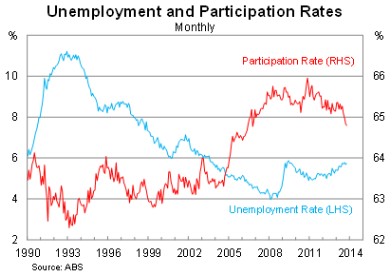
    Australia’s labour market participation rate has fallen sharply over the past few months and is now at its lowest level in seven years. But that pales by comparison with the expected decline resulting from ‘baby boomers’ retiring and the population ageing.

    The participation rate – the share of working age population in the workforce – is a key measure of labour market and economic health. Since peaking towards the end of 2010, the participation rate has declined by 1.2 percentage points to be at its lowest level since October 2006. Part of this is a reflection of weaker labour market conditions, transitional industries and a non-mining sector that could generously be characterised as subdued. But there is also a longer-term trend pushing the participation rate down: an ageing population…

    ScreenHunter_295 Nov. 15 14.03

    A lower participation rate affects most aspects of an economy, including growth, health care expenditure and government revenue. An economy’s output is a function of its resources (labour, capital, land, technology etc) and how those resources are utilised. An ageing population directly reduces the share of productive labour resources in the economy. It also reduces the tax base and GST revenues, given older Australians also consume a lower share of their income/wealth. Combined with rising health costs, the result is a government less able to provide the integral services that an ageing community requires…

    With the possible exception of climate change, the ageing population is the biggest economic challenge that the country faces over the next few decades. The best way to mitigate the problems of an ageing workforce is to increase the fertility rate, boost migration or raise the retirement age. But the reality is that Australians will have to accept lower growth, productivity and standard of living.

    I agree with everything that Pickering has said, except for the suggestion that increasing immigration will help mitigate the ageing conundrum. Immigration only helps to delay population ageing by pushing the problem onto future generations (whilst creating potential problems in other areas). Indeed, when the current batch of migrants inevitably grow old and retire, Australia will find itself in exactly the same position, with policy makers once again seeking to kick-the-can down the road via more immigration.

    Ultimately, the best way to alleviate pressures from an ageing population is to: 1) seek out policies that boost Australia’s productivity; and 2) expand labour force participation (e.g. by raising the retirement age). But even with concerted action in these areas, Australia’s employment-to-population ratio will continue to decline, lowering growth and living standards in the process.

    unconventionaleconomist@hotmail.com