Category: Uncategorized

  • The biggest Australian bank financing fossil fuels. Time to act.

    1 of 34
    Why this ad?
    650% + Investment Returnswww.The-Best-Investments.com – Best Recession Proof Investments- Huge Profits/ Low Risk-Free Guide!

    The biggest Australian bank financing fossil fuels. Time to act.

    Inbox
    x
    Charlie Wood – 350.org Australia <charlie@350.org>
    5:36 PM (1 hour ago)

    to me
    Images are not displayed. Display images below – Always display images from charlie@350.org

    Dear friend,

    Firstly, a quick reminder about our Peaceful Direct Action Training this Thursday – a great opportunity to start directing some of that fantastic energy generated by yesterday’s rallies! Now to the focus of this email….

    As we speak, our largest commercial bank – ANZ – is progressing plans to finance a massive open-cut coal mine that will cook the climate and destroy a forest. Please keep reading to find out how you can take action and help stop this happening.

    Aside from the climate impacts, Maules Creek Mine, in NSW’s Leard State Forest, will dump thousands of tonnes of coal dust onto neighbouring communities, lower the water table by several metres and destroy the last remnants of critically endangered woodland in Australia…forever.

    But it doesn’t end with Maules. Over the past five years, ANZ has loaned over $2.3 billion to new coal and gas export projects along the eastern seaboard, including $1.1 billion to projects in our very own national icon – the Great Barrier Reef. This finance would help to unlock the Galilee Basin and double Australia’s coal exports.

    As ANZ pursues its fossil fuel agenda, analysts from Citi, Goldman Sachs, the International Energy Agency, HSBC, the IMF and more highlight the growing risks that fossil fuel investments pose.

    Over the past six months, 350.org and Market Forces members have given ANZ the opportunity to come to the table. Hundreds of you have told ANZ that you don’t support their damaging lending practices and have invited them to change. The response? Business-as-usual.

    So, if ANZ won’t listen to its own customers or the advice of respected financial analysts, what will make them care about the dangerous world they’re fuelling?

    ANZ has come under fire over dodgy projects in the past so they’re sensitive to their brand going under the microscope again. But if they won’t listen, then that’s what we’ll have to do…

    • On December 14 and 16, join dozens of ANZ customers to publicly close your account in protest of the Bank’s support for the fossil fuel industry.
    • Then, on December 18, join us at ANZ’s AGM in Brisbane to tell shareholders about the dangerous world that ANZ is funding.

    It’s time to show ANZ that we won’t stand silently as they play havoc with our future.

    Join us next month to close your account or attend the AGM and let’s put the fire out once and for all!

    Yours with thanks,

    Charlie, Blair, Aaron, Josh, Simon and the whole 350.org Australia

  • ‘Reverse’ El Ninos to increase in frequency

    ‘Reverse’ El Ninos to increase in frequency

    By a staff reporter

    Unusual El Ninos, like those that led to the extraordinary super El Nino years of 1982 and 1997, will occur twice as often under even modest global warming scenarios, new research finds.

    The collaborative study published in Nature, led by authors from the ARC Centre of Excellence for Climate System Science, has for the first time revealed the cause of these events.

    These unusual El Nino events differ from the more common kind in that sea surface temperatures start warming in the west of the Pacific Basin and spread eastwards, the authors find. Under normal El Ninos, ocean surface temperatures first warm in the cold eastern Pacific and then expand west, in the direction of the Trade Winds and the ocean currents along the equator.

    “These unusual El Ninos appeared for the first time in the available record sometime after the mid 1970s,” said lead author, Dr Agus Santoso.

    Scientists have struggled to explain why they occurred and if the frequency would change in the future.

    “The most common theory used to explain these unusual El Ninos was that competing air and ocean feedbacks drove the direction of the warming,” Dr Santoso said.

    “But if this was true, La Ninas would have propagated in the same direction. Observations show they do not.”

    In a world first, the researchers found the key to the mystery was the weakening of westward flowing currents along the Equator in the Pacific Ocean. As these currents weakened and even reversed, it allowed the heat during these unusual El Nino events to spread more easily into the eastern Pacific.

    La Nina events didn’t behave in a similar way, because the currents are strong and flow to the west.

    Importantly, using observations and climate models, the researchers were able to determine what this could mean for the future frequency of these unusual El Ninos.

    “Using observations we demonstrated the likely role of the weaker currents in the unusual behavior,” Dr Santoso said.

    “These currents are well represented in a number of climate models. Using these models we confirmed, even under modest global warming scenarios, these unusual El Nino events doubled in frequency. “

    Past experience shows that these Super El Nino events bring more than just unusual weather conditions – they matter for people and economies.

    The 1982 and 1997 events led to highly unusual weather events worldwide causing disruption in fisheries and agriculture costing tens of billions of dollars and leading to the deaths of tens of thousands of people. During the 1982 event, in the US alone crop losses were estimated at $US10-12 billion (the equivalent of $US24-26 billion in current terms).

    “While more frequent eastward propagating El Ninos will be a symptom of a warming planet, further research is underway to determine the impact of such events in a climate that is going to be significantly warmer than today,” said co-author, Dr Wenju Cai, a senior scientist at CSIRO.

    Related articles

  • Parts of Australia reaching threshold where it is impossible for normal life to continue because of the heat, says climate impacts researcher

    climate code red


    Parts of Australia reaching threshold where it is impossible for normal life to continue because of the heat, says climate impacts researcher

    Posted: 16 Nov 2013 01:45 PM PST

    Some parts of Australia, such as Darwin, and some farms and factories, are likely to be  unviable in a 4°C hotter world, according to climate impacts research by Dr. Liz Hanna, from the Australian National University’s National Centre for Epidemiology and Population Health.
    Paul Brown of Climate News Network reports from the UN climate talks in Warsaw.

    UN bodies and health authorities are being advised to prepare for a world temperature rise of 4°C because scientists no longer believe that politicians are capable of holding the temperature rise below the internationally agreed limit, 2°C above pre-industrial levels.

    Mark Maslin, professor of climatology at University College in London, was speaking at a conference here which also heard that some parts of the world were already in danger of becoming too hot for humans to inhabit.

    Science and health professionals were invited by the Global Climate and Health Alliance to assess this bleak future for the human race at the end of the first week of climate talks, where little progress has been made to slow global warming.

    Wrong kind of politicians

    Professor Maslin said: “We are already planning for a 4°C world because that is where we are heading. I do not know of any scientists who do not believe that. We are just not tackling the enormity of the task we face to keep it below the agreed 2°C danger threshold.

    “If we had the kind of politicians we really need we could still put in place policies that can save the planet from going over the danger level. But there is no evidence at the moment that we have that quality of politicians, so we all have to be prepared for the most likely scenario, which is a 4°C rise in temperature. If we do not prepare to adapt we simply won’t be able to.”

    Professor Maslin said that scientists were in a Catch 22 situation. They wanted to tell politicians that it was still possible to save the planet and had shown how to do it in the last Intergovernmental Panel on Climate Change report, released in September. At the same time scientists were aware that there was not the political appetite to deal with the problem.

    He said all UN bodies were now being advised to prepare for a rise of 4°C, because there is no evidence to show that the world is prepared to turn away from the present pathway of rising carbon emissions.

    Currently the temperature has risen 0.8°C on pre-industrial levels, and with the increase this year to 400 parts per million of carbon dioxide in the atmosphere it will rise further towards the 2°C threshold.

    Professor Maslin said: “I think everybody outside the scientific arena has underestimated the size of the problem.”  The average American emits 16 tons of carbon dioxide a year, the average UK citizen 8 tons and the average Chinese 5 tons.

    Every country, he said, had to reduce their citizens’ emissions to 2 tons per person to avoid dangerous climate change. “That is a big ask, particularly for a country like China which is still growing fast.”

    Dr. Liz Hanna, from the Australian National University’s National Centre for Epidemiology and Population Health, said parts of her country were already reaching the threshold where it was impossible for normal life to continue because of the heat.

    Killing their workers

    She said the Australian Government was ignoring climate change and still expecting places like Darwin (* see note) to expand. But that was unlikely because they would soon become untenable.  “If employers ask people to continue to work in temperatures above 37°C, they will be killing them in increasing numbers,” she said.

    Dr Hanna said humans were well suited to living in cool conditions and felt comfortable in temperatures between 20°C and 23°C because their muscles produced heat from within.

    But in parts of Arizona, Australia and India temperatures were reaching – and for days staying above – the thermal maximum of endurance, which was around 37°C, the core heat of the human body.  Above that temperature, and sometimes below, depending on the combination of heat, humidity and air speed, keeping cool put too much strain on the heart and people began to die.

    She said that she was studying how human societies could survive such daytime temperatures and continue to work. “There could be some night working, or people could work, rest in cool rooms, and then work again, but their productivity would drop and it would be economically unviable to have factories or farms in such conditions.”

    Her researches were focusing on how to keep essential services like farming, police, ambulance, district nurses, construction and mining going in a warming world. “Obviously these people will be risking their lives if they continue to try and work outside when the ambient temperature is above 37°C,” she said.

    * Darwin note: Penny Whetton, David Karoly et al. report in “Australia’s climate in a 4°C world” (Chapter 2 of “Four degrees of global warming”, edited by Peter Christoff, Earthscan) of spatial analogues for various Australia cities. That is, with the warming, what other place would now have a similar climate to the one expected for that city with 4°C of warming?  For example, the analogues for Dubbo (temperate zone) on the NSW western slopes in the “hot dry scenario” are Tom Price, Yuendumu and Hermannsburg, which have grassland verging into desert.  they report that: “In some cases, analogues for the new climates of Alice Springs and Cairns can only be found beyond Australia. Those for Darwin are unlikely to exist anywhere on the planet.”

  • Five warning signs Tony Abbott is turning Australia into a reckless charco-state

    Five warning signs Tony Abbott is turning Australia into a reckless charco-state

    Is Australia a risk of becoming the coal equivalent of a petro-state. Here are five warning signs.
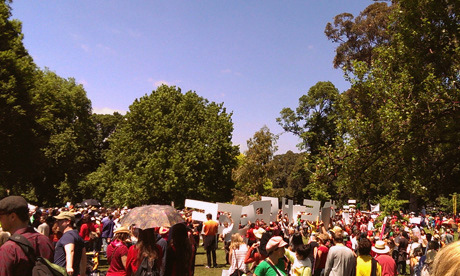
    Save the Reef supporters at the Climate Action Day rally in Melbourne, 17 November 2013.

    Save the Reef supporters at the Climate Action Day rally in Melbourne, 17 November 2013. Photo by Alex White.

    Today, tens of thousands of people around Australia rallied for action on climate change.
    The rallies were organised by a coalition of environmental and social advocacy groups, including the Australian Conservation Foundation, the United Firefighters Union, and Get Up, in protest to the Abbott government’s moves to scrap the carbon price, abolish the Clean Energy Finance Corporation, cut funding for the CSIRO, ignoring the Climate Change Authority on carbon pollution emissions, and much more besides.

    This week, federal parliament sat. We finally were able to see the shape of the Abbott-led Liberal-National government. The extent of their climate denialism is becoming more evident.

    It seems that Abbott is intent on turning Australia into a charco-state — a nation that pursues economic riches from coal, gas and other fossil fuels no matter the social or environmental cost. A charco-state is the coal equivalent of a petro-state, a country where the economy is dominated by oil interests and where the government is both highly dependent on oil tax revenues and deeply infiltrated by oil-industry interests.

    Australia is at risk of becoming a charco-state. Here are five warning signs.

    1. Ignoring the Climate Change Authority’s recommendation on carbon pollution reductions

    The Climate Change Authority is an independent body created to advise the government on carbon pollution reduction targets and other mitigation initiatives. At the end of October, the Authority released its draft report into reduction targets. As Lenore Taylor reported at the time, the Authority’s report found at the existing 5% reduction target was “not a credible option”, and recommended increasing the targets to 15% or 25%.

    In its draft report, the authority says the Coalition’s own agreed conditions for a tougher target have now been met. It says a 5% target leaves Australia “lagging behind” other countries, and sticking to the low target would leave Australia facing a near-impossible emissions reduction task after 2020.

    A 5% target would “require implausibly rapid acceleration of effort beyond 2020”, the authority says. And, at least under the current emissions trading scheme, moving to a 15 or 25% target could be done at a “relatively small cost”.

    Abbott’s response was to dismiss the report, and firmly stick to the inadequate 5% target. Fairfax reported that Abbott said: “We have made one commitment and one commitment only, which is to reduce our emissions by 5 per cent.”

    However, the Liberal-National government’s only climate policy is the laughable “direct action” policy, which would see an increase in emissions and massive payments made to big polluters. The “direct action” climate policy could only have been created by people who don’t believe in climate change, and who do not want action taken to address it.

    Abbott’s secondary comments on the CCA’s report was to refer to global binding targets — the only condition where he would consider a higher carbon pollution reduction target. However, Abbott is also committed to stymieing global action.

    2. Australia “missing in action” at COP Warsaw climate negotiations

    Abbott and his government have turned their back on supporting global action on climate change. This is best demonstrated by the decision not to send a minister to the United Nations climate negotiations in Warsaw. This decision was deemed “puzzling” by former executive secretary of the UNFCCC Yvo de Boer. The Guardian’s Adam Vaughan reported de Boer saying: “I cannot remember a previous occasion when a major player in this process has not been represented at ministerial level at the high level segment of the talks.”

    The UK’s former top climate diplomat at the foreign office, John Ashton, told the Guardian that the decision by Australia was puzzling. “We are now in the phase of building momentum [towards a climate deal in Paris]. We are now in a critical two years, we won’t get another bite of the cherry.” Against that backdrop, he said that “for a major player not to send an elected representative is a pretty puzzling decision”.

    He added: “If people draw the conclusion that that this is a country that would rather stick to a business a usual approach rather than building a low-carbon growth model compatible with [temperature rises of] 2C, no one should be surprised.”

    Australia was also awarded the title of “Fossil of the Day” on the first day of the negotiations, by dint of Abbott’s decision to not put forward any new finance commitments.

    Of course, if you understand that Abbott and his government do not accept the climate science, and that they want to keep Australia addicted to coal, then their decision becomes more understandable. Abbott does want to lock in a “business as usual approach”, where the coal and mining lobby runs his government by proxy. Which explains why Abbott is also dismantling support for Australia’s renewable energy sector.

    3. Starving Australia’s renewable energy industries

    Hidden in the bills to abolish the carbon price are provisions that are aimed at starving investment in renewable energy. The Australian Renewable Energy Agency (ARENA) will have its funding cut by by $435 million over the next three years, putting at risk projects that use technologies like large-scale solar, marine, geothermal and energy storage.

    Kane Thornton, the deputy CEO of the Clean Energy Council, an industry body with more than 600 members that includes AGL and Pacific Hydro (hardly left-wing activist organisations), said in a statement:

    “ARENA has enjoyed bi-partisan support since its establishment, recognising the importance of developing new technologies in delivering a cleaner, smarter and lower-cost energy system – and the major benefits in jobs and investment that follow,” Mr Thornton said.

    “The government gave repeated commitments on its support for ARENA prior to the election and it is disappointing that the agency is now facing a significant budget reduction…

    This unstable policy environment has had a clear impact on major technology innovators, developers and financiers, who will understandably be questioning their future in Australia.”

    The gutting of this funding serves to highlight whose interests this government really serves. Before the election, reported Tristan Edis, Greg Hunt “repeatedly reassured stakeholders and this publication that the Coalition ‘fully supports ARENA’.”

    4. Handing over environmental powers to the states

    Last month, Tony Abbott announced that he had signed a memorandum of understanding with the Liberal-National government in Queensland, that would “streamline” environmental approvals. What this means is that the Queensland government can approve projects that would normally require federal approval under environmental laws. You can read the MOU here (pdf), which states:

    Consistent with the objects of the MoU, Queensland will become responsible for assessing projects for the purpose of the EPBC Act to reduce duplication between jurisdictions, and – within 12 months – approving projects, when an approval bilateral agreement has been signed.

    Of course, the Newman government in Queensland has a terrible record on the environment. A report in 2012 by The Global Mail highlighted the deeply embedded climate skepticism, and the ideological commitment to coal mining and export. Since his election in March 2012, he has overseen the rapid dismantling of Queensland’s environmental laws.

    Newman has offered a glimpse of how he, given greater control, would steward Queensland’s areas of natural beauty. For example, he has publicly lobbied for development in the fragile Great Barrier Reef area, for which there are about 45 development proposals in the pipeline. And dredging work in the Gladstone area, which has already led to changes in environmental standards, is supported by the state government.

    Abbott has willingly handed over federal environmental assessment powers to a government who has openly stated that “we are in the coal business”. The other recently elected government that is in the coal business is the Abbott government.

    A range of environment groups have condemned this decision. Australian Conservation Foundation CEO Don Henry said “There does not appear to be a veto power for the commonwealth in what has been proposed. We believe it is illegal for the commonwealth to wash its hands of its responsibilities.” The Guardian’s Lenore Taylor reported Henry again:

    “Previous Queensland governments have tried to allow oil drilling on the Great Barrier Reef and major developments on Great Barrier Reef Islands. The Commonwealth Government has had to step in to protect the values of the reef on a number of occasions. The World Heritage provisions of Australia’s federal environmental laws provide these protections, ensure the national interest is pursued in decision-making, and make sure the national government is able to meet its obligations under the World Heritage Convention,” Henry wrote on the day the Queensland and federal governments signed the MOU.

    “The Queensland Government will make decisions from a Queensland perspective. It is responsible to the population of Queensland, not Australia as a whole. We believe there is a very high danger that the Queensland government will undertake environmental approvals on the Commonwealth’s behalf that will threaten the universal values of the Great Barrier Reef World Heritage Area. The Queensland government is not a party to the World Heritage Convention and as such its decision-making will not adequately reflect the responsibilities of the Australian government as a signatory to the World Heritage Convention.”

    5. Demonising climate action as “socialism”

    Tony Abbott made international headlines when he brought up Cold War era rhetoric to attack the carbon price and climate action, describing it as “socialism”. The language was used in Cabinet document, according to a report by The Australian, decrying contributions to global aid funds to assist developing nations adapt to or mitigate the impact of climate change.

    This is not the first time he has done this. In 2011, he described the carbon price as “socialism masquerading as environmentalism”, and he repeated this nonsense at the Tasmanian Liberal Party’s conference at the end of October, saying “Let’s be under no illusions the carbon tax was socialism masquerading as environmentalism.”

    Statements like these are worrying, not just because they demonise legitimate action to reduce climate change or to adapt to it, but also because they reveal the extremist, fringe thinking of Tony Abbott and his cabinet. It uncovers the growing influence of the Tea Party, who denounce almost all government spending or activity as “socialism”.

    Senior Liberal-National government ministers and influential backbenchers are cosy-ing up to senior Tea Party Republicans. Fairfax reported on the 14th of October that the finance minister, Mathias Cormann met with Tea Party leaders and organisations, including groups that fund anti-climate misinformation campaigns, when he was shadow finance minister:

    Senator Cormann’s last meeting in Washington during a 2011 trip was with Grover Norquist, the prominent president of the Americans for Tax Reform, which asks political candidates to put in writing that they will oppose ”any and all tax increases”. Mr Norquist is also a board member of the National Rifle Association.

    Senator Cormann also met six members of the Heritage Foundation, a tax-exempt think tank. The foundation’s political offshoot, Heritage Action for America, has guided efforts to withdraw funding on US President Barack Obama’s flagship healthcare policy, the Affordable Care Act.

    Senator Cormann then met Matt Kibbe and Wayne Brough, of the Tea Party group Freedom Works.

    One of the topics of conversation, according to Cormann’s parliamentary report on the tax-payer funded trip was to talk to these Republican and right-wing groups about “the likely approach in the US to emissions trading”.

    Right-wing figures like Grover Norquist relish in shock-tactics, such as equating Nazism to socialism, and accusing President Obama of being a “European-style socialist”. Meanwhile, Jim deMint, the Heritage Foundation’s president, equated the Affordable Care Act (more commonly known as Obamacare) with “socialism”:

    Heritage Foundation president and former Senator Jim DeMint suggested to a town hall audience in Wilmington, Delaware Thursday that health care programs like Medicare and Medicaid are “un-American” and built on the principles of “socialism and collectivism.”

    “I cannot think of anything that’s more un-American than national government-run health care,” DeMint said. “Those who believe in those principles of socialism and collectivism we’ve seen over the centuries, they see as their holy grail taking control of the health care system.”

    Though DeMint was referring specifically to the Affordable Care Act, a law the Heritage Foundation is urging Congress to defund in next month’s continuing resolution, his comments could also apply to existing programs that have more direct government involvement than the ACA.

    Mathias Cormann isn’t the only Liberal senator visiting Tea Party extremists. Key Abbott supporter and outspoken climate skeptic Senator Cory Bernardi also went on a trip to the US, to meet with the Heartland Institute. Bernardi was a key player in the destabilisation campaign against Malcolm Turnbull in 2009 during the senate deliberations over the ill-fated carbon pollution reduction scheme.

    This kind of language has only one purpose: to delegitimise and demonise supporters of the carbon price.

    Since being elected only a few months ago, Abbott has started the systematic dismantling of scientific bodies and structures that would research or raise public awareness about the risks of run-away climate change.

    He has spurned the recent United Nations multilateral climate negotiations by refusing to send a minister to represent Australia.

    He has abolished or is seeking to abolish bodies that fund renewable energy projects and independent research into climate change.

    He has handed over significant powers designed to protect the environment to a state government committed to fast-tracking the rapid expansion of coal and gas projects.

    He has invoked extremist, Cold War rhetoric to demonise conservationists and environmentalists.

    A petro-state is one where “the economy is dominated by oil and the government highly dependent on its revenues — so much that it distorts the rest of the economy as well as the political system. Petro-states typically have weak institutions, a high-concentration of wealth and power in the hands of a few, and deep economic and political inequality.” A charco-state is the coal equivalent.

    Are these signs that Australia is at risk of becoming a charco-state? Tell me what you think in the comments.

    Green light

    close

    Sign up for the Green light email

    The most important environment stories each week including data, opinion pieces and guides.

    Sign up for the Green light email

    Southern crossroads weekly archives

    Nov 2013 Previous
    M T W T F S S
    28 29 30 31 1 2 3
    4 5 6 7 8 9 10
    11 12 13 14 15 16 17
    18 19 20 21 22 23 24
    25 26 27 28 29 30
  • Bandt raises bushfires climate link again

    Bandt raises bushfires climate link again

    AAP Steve Lillebuen – November 17, 2013, 1:24 pm

    Greens deputy leader Adam Bandt has warned the deadly Black Saturday disaster could be repeated every two years unless the federal government takes global warming seriously.

    Mr Bandt was accused of politicising the NSW bushfires tragedy last month when he linked climate change with the crisis.

    He again raised the politically charged point on Sunday ahead of a debate on the carbon tax repeal.

    He told a climate change rally in Melbourne that the 2009 Victorian fires, which killed 173 people, could happen far more frequently.

    “Unless we get global warming under control, the kind of horrific tragedies that we saw during Black Saturday might start happening once every two years here in Victoria,” he told a crowd of thousands.

    Prime Minister Tony Abbott has described attempts to link bushfires with climate change as “complete hogwash” and a “bizarre” argument, given Australia has always had bushfires.

    But Mr Bandt accused the coalition of not taking real action on climate change.

    “Yes, (Mr Abbott) is right that we have always been a country prone to bushfires, but I say, why the hell would you wish more of them on us?” he said.

    “That is what is in store unless we get global warming under control.”

    Labor opposition environment spokesman Mark Butler and Tim Flannery of the Climate Council also addressed the crowd.

    No one from the coalition spoke, but organisers said they were invited.

    The event was one of hundreds throughout Australia as part of a national day of action.

    United Firefighters Union secretary Peter Marshall attended the event.

    He said he believed in the link between bushfires and climate change.

    “There is no sceptic at the end of a fire hose,” he said.

  • Doomsday scenario wipes out whole countries as waters rise 216 feet

    Doomsday scenario wipes out whole countries as waters rise 216 feet

    By Western Morning News  |  Posted: November 16, 2013

    The worst-case scenario: if all the ice melted, sea levels would rise to cover large areas of eastern England and northern Europe. The pale blue line denotes the existing coastlinesThe worst-case scenario: if all the ice melted, sea levels would rise to cover large areas of eastern England and northern Europe. The pale blue line denotes the existing coastlines

    Comments (1) Vast swathes of the Westcountry would be swamped by rising seas if all the Earth’s ice was to melt, new interactive maps show.

    The Doomsday scenario, albeit in 5,000 years’ time, was painted by National Geographic in a series of interactive maps demonstrating the catastrophic effect of a mass ice melt.

    It is estimated that the loss of some five million cubic miles of ice – 80 per cent of which is in the East Antarctica ice sheet alone – would lead to a sea level rise of about 216 feet.

    The maps show the global consequences with continental coastlines being totally redrawn and entire cities engulfed.

    In Europe, cities including London and Venice would be submerged, as would the whole of the Netherlands and most of Denmark. It would also cause the Mediterranean to expand and swell the Black and Caspian seas.

    In the Westcountry, a swathe of the north Cornwall and Devon coast would be lost as well as parts of the south and east Devon shore. The largest ingress would be across Somerset. The Scillies – highest point, Telegraph on St Mary’s, is 160ft above current sea level – would vanish completely.

    Over on the other side of the UK, water would surge miles inland on the South East and East coasts.

    Scientists have estimated that it could take 5,000 years for temperatures to rise enough to melt all the ice on the planet. The largest concentrations of ice on Earth are found in Greenland and Antarctica.

    A spokesman for the Met Office, based in Exeter, said warming of the Earth had seen global sea levels rise by 1.7mm per year over the last century. The rate had accelerated to 3mm per year since the early 1990s.

    Latest reports to the Intergovernmental Panel on Climate Change (IPCC), he said, showed waters rose 19cm between 1901 and 2010.

    “Broadly speaking about half of that is due to melting ice from various sources,” he explained. “The other half is due to thermal expansion, sea water expanding as it gets warmer.

    “The National Geographic maps appear to show one component of sea level rise that we could see over time.”

    The spokesman said there was “no specific research” on the impact of sea level rises on the UK.

    However, he said studies of Hurricane Sandy, the massive storm which caused vast damage in the United States in 2012, showed increased water levels would make the future impact of such events worse.

    The National Geographic maps show parts of Asia, including China and Bangladesh would be completely flooded, with water claiming land occupied by some 760 million people based on current population levels.

    The entire Atlantic seaboard in the United States would vanish, wiping out Florida and the Gulf Coast.

    Australia would gain a new inland sea but would lose much of the narrow coastal strip where four out of five people now live.

    National Geographic said even without the flood waters, the Earth’s rising heat “might make much of it uninhabitable.” It said: “If we burn all the Earth’s supply of coal, oil, and gas, adding some five trillion more tonnes of carbon to the atmosphere, we’ll create a very hot planet with an average temperature of perhaps 80 degrees Fahrenheit (27C) instead of the current 58 (14C).”