Category: Uncategorized

  • FAULTLINES WEAVING THEIR WAY ACROSS SOUTHERN AUSTRALIA

    FAULTLINES WEAVING THEIR WAY ACROSS SOUTHERN AUSTRALIA

    Geoscientists identify seismic activity in Southern Australia including the  Flinders Ranges

    Earthquake Hazzard Map of Australia

    Australia is not as geologically stable as many think. Despite popular belief, Australia is a geologically active continent with moving fault-lines, regular seismic activity, and a long history of mountain making, said internationally respected geologist, Associate Professor Malcolm Wallace from the School of Earth Sciences at the University of Melbourne.

    We have discovered substantial evidence of ancient and current mountain building on this continent, and seismic activity which commenced 10 million years ago and continues to this day,”  Associate Professor Wallace said.

    “Two separate geological studies have concluded that an area from Adelaide to south-east Victoria is seismically active and the next ‘big one’ could endanger lives and infrastructure”.

    “There are numerous young faultlines weaving their way across southern Australia, including one that goes right around the perimeter of Adelaide.  There are also young faultlines running through the Mornington Peninsula outside Melbourne, the Strzelecki Ranges in Victoria and the Flinders Ranges in South Australia.

    Fault Lines Located in Australia Map data source courtesy : Geoscience Australia

    Fault Lines Located in Australia Map data source courtesy : Geoscience Australia

    The University of Melbourne geologists have uncovered evidence that parts of  South-eastern Australia recently stirred from their geological slumber and are in an active mountain building phase. These mountains are being shaped by earthquakes, some reaching greater than 6 on the Richter scale.

    Submission: Seismic hazards SA
    [The area between Quorn and Leigh Creek has the highest number of seismic events (considered to be related to zones of crustal weakness)]

    SA earthquake hazard map of region surrounding location marked by the black square. The yellow, brown, and red dots represent earthquakes (Geoscience Australia)

    “Their seismic activity is generated by tectonic plates pushing up against each other on a daily basis, so it is critically important that scientists and emergency management agencies know of their whereabouts and the potential risks they pose – this is where geoscientists play a crucial role.”

    “Some faults around Adelaide have moved slabs of the continent up to 30 metres in the last one million years,” says ARC Professorial Fellow, Mike Sandiford.

    “When these big quakes reoccur, they have the potential to cause catastrophic damage to cities such as Melbourne, Adelaide, and the La Trobe Valley area, which straddle some of these major faults lines,” says Professor Mike Sandiford also from the School of Earth Sciences at the University of Melbourne, who conducted one of the studies.

    Possibly, the most dramatic indication of this geological stirring, which the studies estimate began suddenly about ten million years ago, can be found in the landscape of the Mount Lofty Ranges near Adelaide.

    “A typical earthquake of magnitude 6.0 might produce a displacement of about one metre. Thirty metres is equivalent to 30-50 big earthquakes in the last million years,” he says.

    Other areas of intense mountain building have been around Victoria’s Otway Ranges, Mornington Peninsula and Strzeleckis. In some of these areas, similar uplift and erosion over the last 10 million years have thrust chunks of Australia upwards in the order of one kilometre.

    The big earthquake still building South East Australia Epicentres of Australian earthquakes in the period 1859 to 1992 with magnitudes of ML4 or greater.(Illustration courtesy AGSO)

    Tectonic movements have pushed the Otways 250 metres higher in the last three million years, and The Selwyn fault, which runs from Mt Martha, on Victoria’s Mornington Peninsula, east to the Dandenong Ranges has possibly produced six metres of uplift in the last 100,000 years.

    “This is potentially six big earthquakes,” says Sandiford.  “We are still trying to determine the slip rates along these fault lines, but our evidence so far suggests that we  should expect, on any one of the major faults, a large earthquake every 10-20,000 years. The estimated return period of a quake greater than 6.0 in south-east Australia is about 30 years, but none have been recorded in the last 100 years,” he says.

    Associate Professor Malcolm Wallace has undertaken significant research on the environmental and climatic evolution of the southern Australian margin. His research on greenhouse/icehouse climate and environmental evolution of Victoria for the last 80 million years has formed an important geological analogue for future climate change in Victoria.

    Associate Professor Wallace was the recipient of the prestigious Geological Society of Australia (Victoria Division) Selwyn Medal for 2008.  The Medal, named in honour of Sir Alfred Selwyn, an eminent Victorian pioneering geologist and founder of the Geological Survey of Victoria. recognises significant ongoing or former contributions of high calibre to any field of Victorian geology.

    Induced seismicity – Wikipedia

    Related Posts

    Waking a Sleeping Giant:  Human-induced Earthquakes
    By Johnny Kilroy on January 21, 2010

    Mining leases and Mineral Tenements in South Australia
    Primary Industries SA (PIRSA)

    The risk of volcanic eruption in mainland Australia   E. B. Joyce (CSIRO)

    Abstract
    The young volcanoes of the Australian mainland are made up of the Newer Volcanic Province of Victoria and southeast South Australia (NVP), and a number of separate provinces in far north Queensland.

    These volcanic fields are similar in age, and in their numerous scattered scoria and lava cones, extensive basalt flows, and maar/tuff ring eruptions of phreatic origin.

    Australian volcanologists and seismologists now agree that youthful ages imply the possibility of further activity.

    Post Mortem on Solomon Islands 8.1 Earthquake/Tsunami of 2007
    By Gary Robbins, UNION-TRIBUNE STAFF WRITER

    NASA report:

    The massive magnitude 8.1 earthquake that jolted the Solomon Islands on April 1, 2007, permanently changed the shoreline on Ranongga Island, west of the epicenter. New beach was added to the western shore of the island when the earthquake lifted the island as much as three meters, exposing near-shore coral reefs, (Australian Broadcasting Corporation).

    NASA: The Earth split like a zipper.

    USGS summary:

    At least 40 people killed, an undetermined number missing and several villages destroyed by the earthquake and tsunami. About 300 homes, schools and a hospital were destroyed at Sasamunga and about 500 houses were damaged at Gizo….

    The latest Daily Live World Seismic activity Reports

    Could Exxon-Mobil Works Have Tripped Indonesian Tsunami?
    by Paul Noel, JAH, Sterling D. Allan and Mary-Sue Halliburton


  • Is this Tibet’s big chance?

    his Tibet’s big chance?

    Ben Margetts – Avaaz.org

    To Me
    Today at 7:52 AM
    Dear friends,

    Tibetans risk being beaten or shot if they refuse to fly the Chinese flag. But now China needs international support to get elected to the UN Human Rights Council. Let’s build a massive outcry showing the world hasn’t forgotten Tibet. Sign now:

    Tibetans who refuse to fly the Chinese flag above their homes risk being beaten or shot in the latest attempt to break their spirits. But now is the best moment in ages to bring hope to Tibet’s proud, but desperate people.

    China’s leaders are mounting an intense campaign to draw a veil over their rights abuses and persuade governments to vote them onto the UN Human Rights Council. So if enough of us shine a light on what’s going on in Tibet — squashing an ancient religion, banning journalists, dawn arrests — we can get China to back away from its hard-line policy to be sure of getting the 97 votes it needs.

    Let’s show the Tibetan people that the world hasn’t forgotten them. China is feeling the heat as 13 governments just called them out on human rights in Tibet. Sign to stand with Tibet, then share this with everyone. When one million have signed we’ll deliver it to crucial UN delegations, and make it massive in the media:

    https://secure.avaaz.org/en/stand_with_tibet_loc/?bBYMjdb&v=30949

    Pressure on China is mounting. In an unprecedentedly strong show of support, Canada, Czech Republic, France, Germany, Japan, New Zealand, Poland, US, UK, Switzerland, Sweden, Iceland and Austria just called on China to protect freedom of assembly, religion and association in Tibet. This request arrives just days after a Spanish court indicted China’s former President for genocide in Tibet!

    The situation is really dire. More than 120 people have taken their own lives by setting themselves on fire to protest the suffocation of the Chinese occupation and hundreds of thousands of Tibetans have been wiped out. China’s ongoing policies systematically suppress the Tibetan language, force people from their homes, and strictly control the Tibetans’ movement and religion.

    China’s failed policies hurt China too, but having dug themselves in this deep, they need pressure to change course. This is the week that change can start. If enough of us speak up while China is under the global microscope, we can make sure our governments know we haven’t forgotten Tibet. Sign now and tell everyone — let’s build the biggest petition ever for Tibet and demand they hold China to account:

    https://secure.avaaz.org/en/stand_with_tibet_loc/?bBYMjdb&v=30949

    Proud Tibetans are struggling against China’s brutal rule and long for change, but they can’t do it alone. No one can create changes that big alone.

    That’s why we’ve come together for Tibet before. Let’s make this the moment where the whole world commits to the survival of the Tibetan people.

    Our community was made for this moment.

    With hope,

    Ben, Alice, Patricia, Alex, Ricken, Emily, Sayeeda and the whole Avaaz team

    SOURCES

    UN criticises China’s rights record at Geneva meeting (BBC)
    http://www.bbc.co.uk/news/world-asia-china-24611657

    Dalai Lama Says China Has Turned Tibet Into a ‘Hell on Earth’ (New York Times)
    http://www.nytimes.com/2009/03/11/world/asia/11tibet.html

    Spain probes Hu Jintao ‘genocide’ in Tibet court case (BBC)
    http://www.bbc.co.uk/news/world-europe-24490004

    Four Tibetans Shot Dead as Protests Spread in Driru County (Radio Free Asia)
    http://www.rfa.org/english/news/tibet/shoot-10112013200735.html

    China denounces Spanish court’s Tibet case against ex-president (Reuters)

  • More photographs of the aftermath of the Kedarnath debris flow disaster disaster

    29 October 2013

    More photographs of the aftermath of the Kedarnath debris flow disaster

    Posted by dr-dave

    Last week I posted one of the images kindly provided by Vaibhav Kaul of the aftermath of the Kedarnath disaster.  These were taken on a recent visit by Vaibhav to the area, on foot of course – a truly epic journey.  He has kindly allowed me to post more of them here.  For reference, it is worth looking at the earlier post in which I reconstructed the events of that day in June, and the one in which I blended eye-witness reports with an overall narrative.

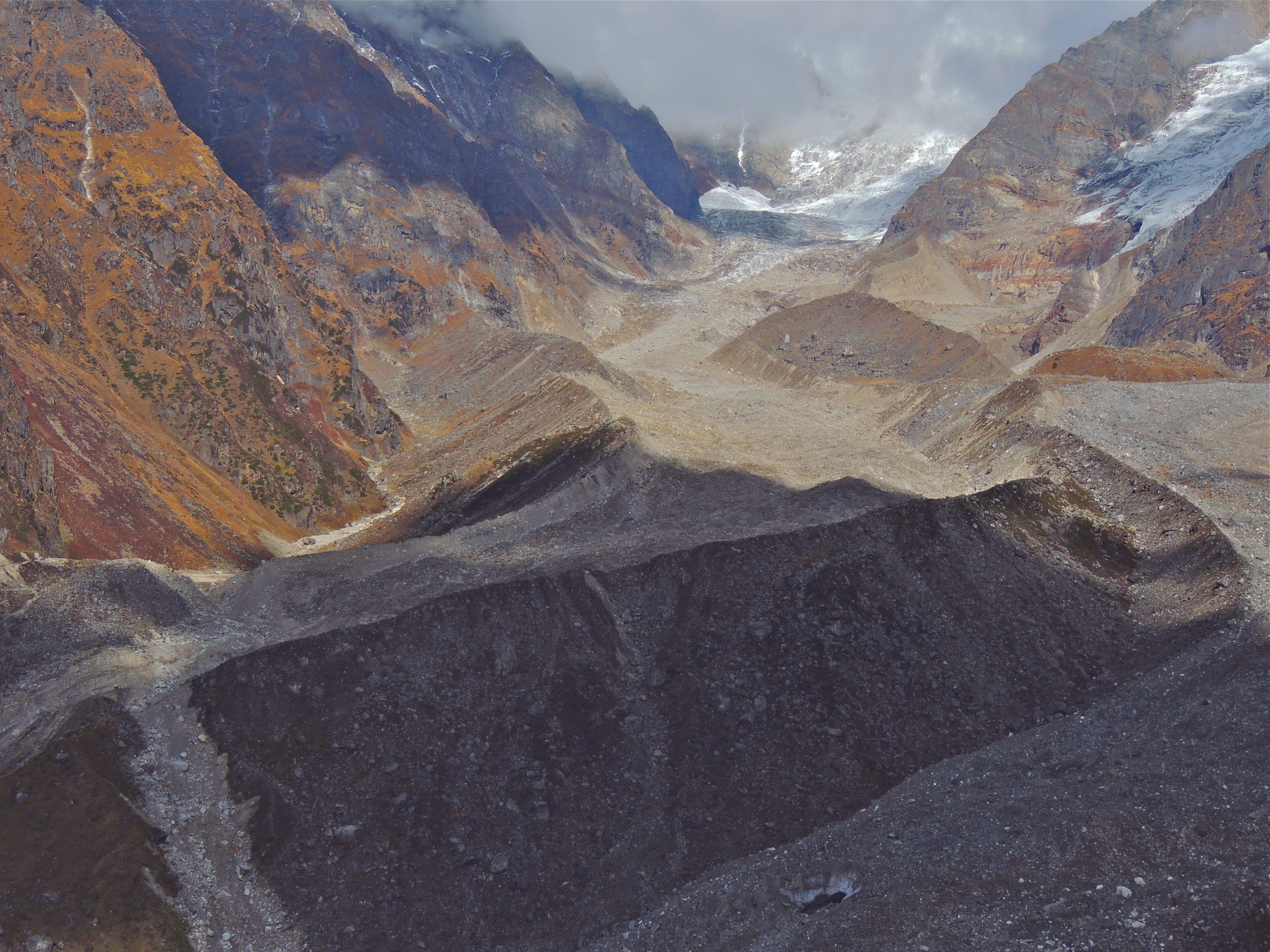
    The Chorabari Glacier source of the second debris flow

    The source of the second, more damaging debris flow, was a breach in the glacial moraine that formed a dam to create a temporary lake, known as Chorabari Tal (Gandhi
    Sarovar), on the flank of the glacier.  This image shows one of the two tongues of the glacier.   The valley on the left side of the image on the flank of the glacier is that of Chorabari Tal (Gandhi Sarovar).  The breach is clearly visible, as is the path that the water followed:

    Chorabari Glaciers, Kedarnath 14

    Courtesy and copyright of Vaibhav Kaul

    ..

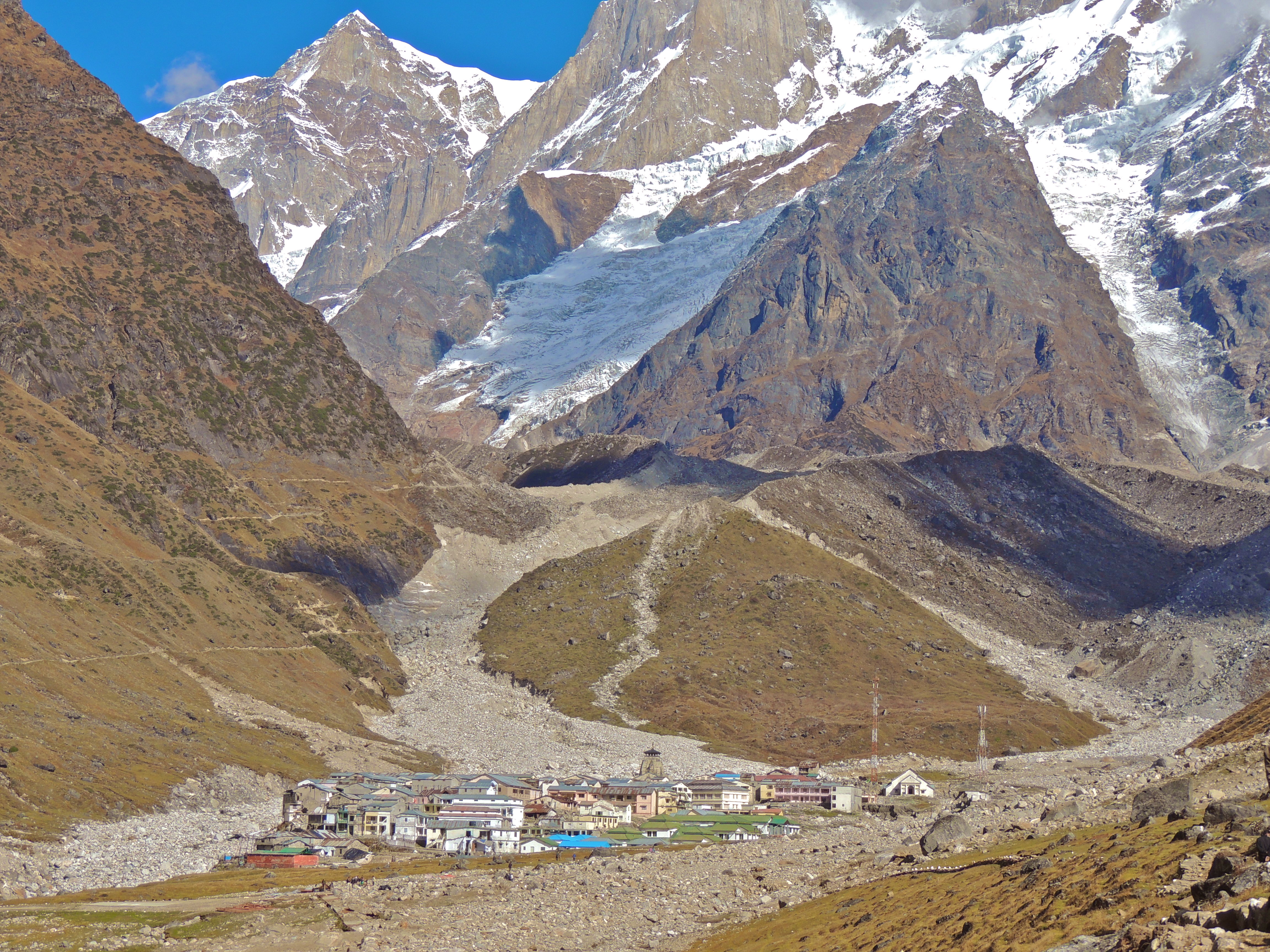
    The track of the second debris flow

    Viewed from below the town, the track of the main debris flow down the slope above the town is very clear.  Most of the water and debris flowed down the left side of the image, a smaller component over-spilled the ridge to flow down towards the right side.  The flows recombined above the town:

    Chorabari Glaciers, Kedarnath Town 2

    Courtesy and copyright of Vaibhav Kaul

    ..

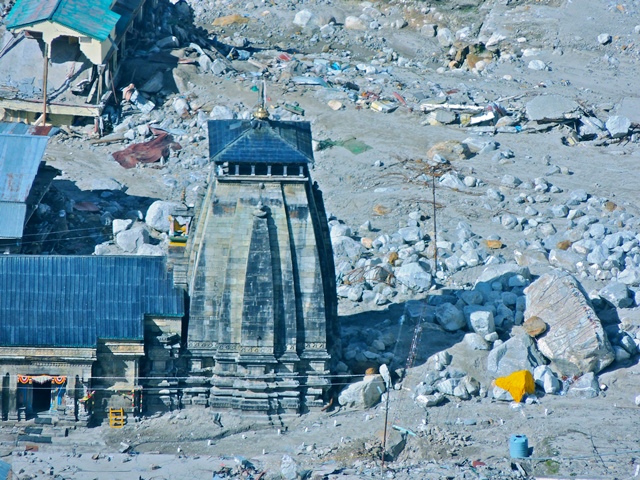
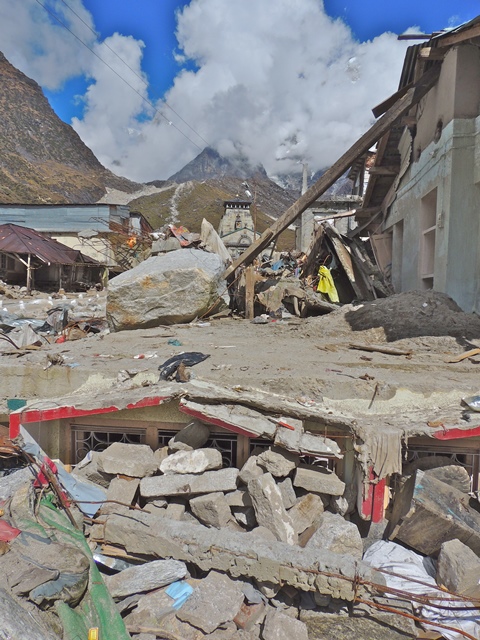
    The impact on the town

    The debris flow then struck the town with devastating consequences.  At the upslope end of the town was located the temple, which escaped with comparatively minor damage.  This is probably due to a combination of an extremely robust structure and, possibly, the protective effects of a boulder immediately upstream of the main building:

    Kedarnath photos

    Courtesy and copyright of Vaibhav Kaul

    ..

    Downstream the buildings were far less fortunate:

    Kedarnath photos

    Courtesy and copyright of Vaibhav Kaul

    Effects below Kedarnath

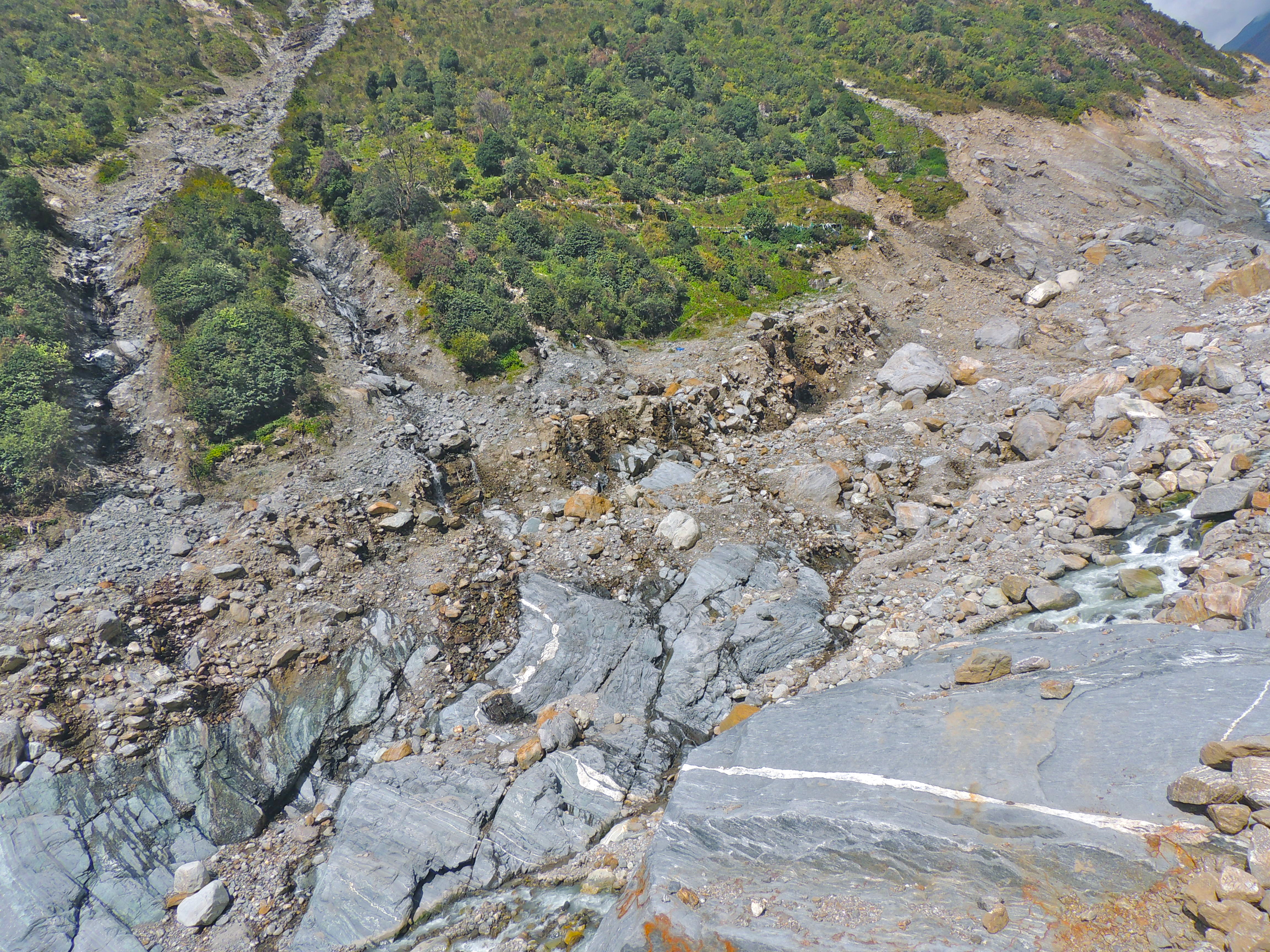
    The debris flow then passed down through the valley below the town, where the effects of the debris flow were devastating.  This is the channel upstream of the small village of Rambara – note the slope failures on the flanks of the channel triggered by undercutting by the main flow:

    Upstream of Rambara

    Courtesy and copyright of Vaibhav Kaul

    ..

    Rambara destroyed

    The most shocking impact of this disaster is the effect on Rambara.  This is Rambara before the debris flow (source):

    Rambara photo

    Source: http://www.sacredyatra.com/kedarnath-pictures.html

    ..

    This is the site of the village now:

    Rambara Devastated 2

    Courtesy and copyright of Vaibhav Kaul


    Posted in: landslide images

  • A Global Ban on Left-Wing Politics

    5 of 36
    Why this ad?
    Master’s in Project Mgmttua.edu.au/Project_Management – Study Online at Torrens University. Request Information Right Now!

    Monbiot.com

    Inbox
    x
    George Monbiot news@monbiot.com via google.com
    6:07 PM (1 hour ago)

    to me

    Monbiot.com


    A Global Ban on Left-Wing Politics

    Posted: 04 Nov 2013 12:25 PM PST

    That’s what the new rules being smuggled into trade agreements are delivering.


    By George Monbiot, published in the Guardian 5th November 2013

    Remember that referendum about whether we should create a single market with the United States? You know, the one that asked whether corporations should have the power to strike down our laws? No, I don’t either. Mind you, I spent ten minutes looking for my watch the other day, before I realised I was wearing it. Forgetting about the referendum is another sign of ageing. Because there must have been one, mustn’t there? After all that agonising over whether or not we should stay in the European Union(1), the government wouldn’t cede our sovereignty to some shadowy, undemocratic body without consulting us. Would it?

    The purpose of the Transatlantic Trade and Investment Partnership is to remove the regulatory differences between the US and European nations. I mentioned it a couple of weeks ago(2). But I left out the most important issue: the remarkable ability it would grant big business to sue the living daylights out of governments which try to defend their citizens. It would allow a secretive panel of corporate lawyers to overrule the will of parliament and destroy our legal protections. Yet the defenders of our sovereignty say nothing.

    The mechanism is called investor-state dispute settlement. It’s already being used in many parts of the world to kill regulations protecting people and the living planet.

    The Australian government, after massive debates in and out of parliament, decided that cigarettes should be sold in plain packets, marked only with shocking health warnings. The decision was validated by the Australian supreme court. But, using a trade agreement Australia struck with Hong Kong, the tobacco company Philip Morris has asked an offshore tribunal to award it a vast sum in compensation for the loss of what it calls its intellectual property(3).

    During its financial crisis, and in response to public anger over rocketing charges, Argentina imposed a freeze on people’s energy and water bills (does this sound familiar?). It was sued by the international utility companies whose vast bills had prompted the government to act. For this and other such crimes, it has been forced to pay out over a billion dollars in compensation(4).

    In El Salvador, local communities managed at great cost (three campaigners were murdered) to persuade the government to refuse permission for a vast gold mine which threatened to contaminate their water supplies. A victory for democracy? Not for long perhaps. The Canadian company which sought to dig the mine is now suing El Salvador for $315m – for the loss of its anticipated future profits(5).

    In Canada, the courts revoked two patents owned by the US drugs firm Eli Lilly, on the grounds that the company had not produced enough evidence that they had the beneficial effects it claimed. Eli Lilly is now suing the Canadian government for $500m, and demanding that Canada’s patent laws are changed(6).

    These companies (and hundreds of others) are using the investor-state dispute rules embedded in trade treaties signed by the countries they are suing. The rules are enforced by panels which have none of the safeguards we expect in our own courts(7,8). The hearings are held in secret. The judges are corporate lawyers, many of whom work for corporations of the kind whose cases they hear. Citizens and communities affected by their decisions have no legal standing. There is no right of appeal on the merits of the case. Yet they can overthrow the sovereignty of parliaments and the rulings of supreme courts.

    You don’t believe it? Here’s what one of the judges on these tribunals says about his work. “When I wake up at night and think about arbitration, it never ceases to amaze me that sovereign states have agreed to investment arbitration at all … Three private individuals are entrusted with the power to review, without any restriction or appeal procedure, all actions of the government, all decisions of the courts, and all laws and regulations emanating from parliament.”(9)

    There are no corresponding rights for citizens. We can’t use these tribunals to demand better protections from corporate greed. As the Democracy Centre says, this is “a privatised justice system for global corporations.”(10)

    Even if these suits don’t succeed, they can exert a powerful chilling effect on legislation. One Canadian government official, speaking about the rules introduced by the North American Free Trade Agreement, remarked, “I’ve seen the letters from the New York and DC law firms coming up to the Canadian government on virtually every new environmental regulation and proposition in the last five years. They involved dry-cleaning chemicals, pharmaceuticals, pesticides, patent law. Virtually all of the new initiatives were targeted and most of them never saw the light of day.”(11) Democracy, as a meaningful proposition, is impossible under these circumstances.

    This is the system to which we will be subject if the transatlantic treaty goes ahead. The US and the European Commission, both of which have been captured by the corporations they are supposed to regulate, are pressing for investor-state dispute resolution to be included in the agreement.

    The Commission justifies this policy by claiming that domestic courts don’t offer corporations sufficient protection because they “might be biased or lack independence.”(12) Which courts is it talking about? Those of the US? Its own member states? It doesn’t say. In fact it fails to produce a single concrete example demonstrating the need for a new, extra-judicial system. It is precisely because our courts are generally not biased or lacking independence that the corporations want to bypass them. The EC seeks to replace open, accountable, sovereign courts with a closed, corrupt system riddled with conflicts of interest and arbitrary powers.

    Investor-state rules could be used to smash any attempt to save the NHS from corporate control, to re-regulate the banks, to curb the greed of the energy companies, to renationalise the railways, to leave fossil fuels in the ground. These rules shut down democratic alternatives. They outlaw left-wing politics.

    This is why there has been no attempt by our government to inform us about this monstrous assault on democracy, let alone consult us. This is why the Conservatives who huff and puff about sovereignty are silent. Wake up people, we’re being shafted.

    www.monbiot.com

    References:

    1. https://www.gov.uk/government/speeches/eu-speech-at-bloomberg

    2. http://www.theguardian.com/commentisfree/2013/oct/14/obamacare-trade-superversion-subversion-threat-state

    3. http://www.mccabecentre.org/focus-areas/tobacco/philip-morris-asia-challenge

    4. http://corporateeurope.org/trade/2013/06/transatlantic-corporate-bill-rights

    5. http://democracyctr.org/wp/wp-content/uploads/2013/05/Under_The_Radar_English_Final.pdf

    6. https://www.techdirt.com/articles/20130723/05101823898/eli-lilly-decides-it-was-not-greedy-enough-now-suing-canada-500-million.shtml

    7. http://democracyctr.org/wp/wp-content/uploads/2013/05/Under_The_Radar_English_Final.pdf

    8. http://www.citizen.org/eli-lilly-investor-state-factsheet

    9. http://corporateeurope.org/trade/2012/11/chapter-4-who-guards-guardians-conflicting-interests-investment-arbitrators

    10. http://democracyctr.org/wp/wp-content/uploads/2013/05/Under_The_Radar_English_Final.pdf

    11. http://www.thenation.com/article/right-and-us-trade-law-invalidating-20th-century?page=0,5


    5 of 36
    Why this ad?
    Master’s in Project Mgmttua.edu.au/Project_Management – Study Online at Torrens University. Request Information Right Now!

    Monbiot.com

    Inbox
    x
    George Monbiot news@monbiot.com via google.com
    6:07 PM (1 hour ago)

    to me

    Monbiot.com


    A Global Ban on Left-Wing Politics

    Posted: 04 Nov 2013 12:25 PM PST

    That’s what the new rules being smuggled into trade agreements are delivering.


    By George Monbiot, published in the Guardian 5th November 2013

    Remember that referendum about whether we should create a single market with the United States? You know, the one that asked whether corporations should have the power to strike down our laws? No, I don’t either. Mind you, I spent ten minutes looking for my watch the other day, before I realised I was wearing it. Forgetting about the referendum is another sign of ageing. Because there must have been one, mustn’t there? After all that agonising over whether or not we should stay in the European Union(1), the government wouldn’t cede our sovereignty to some shadowy, undemocratic body without consulting us. Would it?

    The purpose of the Transatlantic Trade and Investment Partnership is to remove the regulatory differences between the US and European nations. I mentioned it a couple of weeks ago(2). But I left out the most important issue: the remarkable ability it would grant big business to sue the living daylights out of governments which try to defend their citizens. It would allow a secretive panel of corporate lawyers to overrule the will of parliament and destroy our legal protections. Yet the defenders of our sovereignty say nothing.

    The mechanism is called investor-state dispute settlement. It’s already being used in many parts of the world to kill regulations protecting people and the living planet.

    The Australian government, after massive debates in and out of parliament, decided that cigarettes should be sold in plain packets, marked only with shocking health warnings. The decision was validated by the Australian supreme court. But, using a trade agreement Australia struck with Hong Kong, the tobacco company Philip Morris has asked an offshore tribunal to award it a vast sum in compensation for the loss of what it calls its intellectual property(3).

    During its financial crisis, and in response to public anger over rocketing charges, Argentina imposed a freeze on people’s energy and water bills (does this sound familiar?). It was sued by the international utility companies whose vast bills had prompted the government to act. For this and other such crimes, it has been forced to pay out over a billion dollars in compensation(4).

    In El Salvador, local communities managed at great cost (three campaigners were murdered) to persuade the government to refuse permission for a vast gold mine which threatened to contaminate their water supplies. A victory for democracy? Not for long perhaps. The Canadian company which sought to dig the mine is now suing El Salvador for $315m – for the loss of its anticipated future profits(5).

    In Canada, the courts revoked two patents owned by the US drugs firm Eli Lilly, on the grounds that the company had not produced enough evidence that they had the beneficial effects it claimed. Eli Lilly is now suing the Canadian government for $500m, and demanding that Canada’s patent laws are changed(6).

    These companies (and hundreds of others) are using the investor-state dispute rules embedded in trade treaties signed by the countries they are suing. The rules are enforced by panels which have none of the safeguards we expect in our own courts(7,8). The hearings are held in secret. The judges are corporate lawyers, many of whom work for corporations of the kind whose cases they hear. Citizens and communities affected by their decisions have no legal standing. There is no right of appeal on the merits of the case. Yet they can overthrow the sovereignty of parliaments and the rulings of supreme courts.

    You don’t believe it? Here’s what one of the judges on these tribunals says about his work. “When I wake up at night and think about arbitration, it never ceases to amaze me that sovereign states have agreed to investment arbitration at all … Three private individuals are entrusted with the power to review, without any restriction or appeal procedure, all actions of the government, all decisions of the courts, and all laws and regulations emanating from parliament.”(9)

    There are no corresponding rights for citizens. We can’t use these tribunals to demand better protections from corporate greed. As the Democracy Centre says, this is “a privatised justice system for global corporations.”(10)

    Even if these suits don’t succeed, they can exert a powerful chilling effect on legislation. One Canadian government official, speaking about the rules introduced by the North American Free Trade Agreement, remarked, “I’ve seen the letters from the New York and DC law firms coming up to the Canadian government on virtually every new environmental regulation and proposition in the last five years. They involved dry-cleaning chemicals, pharmaceuticals, pesticides, patent law. Virtually all of the new initiatives were targeted and most of them never saw the light of day.”(11) Democracy, as a meaningful proposition, is impossible under these circumstances.

    This is the system to which we will be subject if the transatlantic treaty goes ahead. The US and the European Commission, both of which have been captured by the corporations they are supposed to regulate, are pressing for investor-state dispute resolution to be included in the agreement.

    The Commission justifies this policy by claiming that domestic courts don’t offer corporations sufficient protection because they “might be biased or lack independence.”(12) Which courts is it talking about? Those of the US? Its own member states? It doesn’t say. In fact it fails to produce a single concrete example demonstrating the need for a new, extra-judicial system. It is precisely because our courts are generally not biased or lacking independence that the corporations want to bypass them. The EC seeks to replace open, accountable, sovereign courts with a closed, corrupt system riddled with conflicts of interest and arbitrary powers.

    Investor-state rules could be used to smash any attempt to save the NHS from corporate control, to re-regulate the banks, to curb the greed of the energy companies, to renationalise the railways, to leave fossil fuels in the ground. These rules shut down democratic alternatives. They outlaw left-wing politics.

    This is why there has been no attempt by our government to inform us about this monstrous assault on democracy, let alone consult us. This is why the Conservatives who huff and puff about sovereignty are silent. Wake up people, we’re being shafted.

    www.monbiot.com

    References:

    1. https://www.gov.uk/government/speeches/eu-speech-at-bloomberg

    2. http://www.theguardian.com/commentisfree/2013/oct/14/obamacare-trade-superversion-subversion-threat-state

    3. http://www.mccabecentre.org/focus-areas/tobacco/philip-morris-asia-challenge

    4. http://corporateeurope.org/trade/2013/06/transatlantic-corporate-bill-rights

    5. http://democracyctr.org/wp/wp-content/uploads/2013/05/Under_The_Radar_English_Final.pdf

    6. https://www.techdirt.com/articles/20130723/05101823898/eli-lilly-decides-it-was-not-greedy-enough-now-suing-canada-500-million.shtml

    7. http://democracyctr.org/wp/wp-content/uploads/2013/05/Under_The_Radar_English_Final.pdf

    8. http://www.citizen.org/eli-lilly-investor-state-factsheet

    9. http://corporateeurope.org/trade/2012/11/chapter-4-who-guards-guardians-conflicting-interests-investment-arbitrators

    10. http://democracyctr.org/wp/wp-content/uploads/2013/05/Under_The_Radar_English_Final.pdf

    11. http://www.thenation.com/article/right-and-us-trade-law-invalidating-20th-century?page=0,5


  • Happy hour: Obama orders climate planning just in time for the weekend

    Happy hour: Obama orders climate planning just in time for the weekend

    By

    Obama signing something important.
    White House

    President Obama signed an executive order on Friday morning designed to prepare the country for climate-related disasters. (Didn’t anyone tell him we were busy recovering from the unnatural disaster that Halloween wreaks on our nation’s glycemic response?) The order comes on the dragging heels of Obama’s Climate Action Plan unveiled in June, at a time when Congress has mastered the Zen art of shooting down any sane climate-related proposaleven when it was their idea in the first place. Obama, impatient with the Flat Earthers, serves us up a chilling dish of executive truth:

    The impacts of climate change — including an increase in prolonged periods of excessively high temperatures, more heavy downpours, an increase in wildfires, more severe droughts, permafrost thawing, ocean acidification, and sea-level rise — are already affecting communities, natural resources, ecosystems, economies, and public health across the Nation. These impacts are often most significant for communities that already face economic or health-related challenges, and for species and habitats that are already facing other pressures.

    According to the administration, natural disasters cost the U.S. more than $100 billion in 2012. That includes damage from Superstorm Sandy, severe drought impacts on farmers, and the priciest fire season in recent memory. For the sake of our bank statements, if nothing else, it is time to invest in some real solutions.

    The order calls on federal agencies to consider natural infrastructure that can serve the double-purposes of sequestering carbon and buffering communities from storms and heat waves. There is also an emphasis on collecting “authoritative, easily accessible, usable, and timely data, information, and decision-support tools on climate preparedness and resilience,” which will be available for public browsing on the ever-popular data.gov website.

    But perhaps the biggest thing to come out of the order is a bipartisan (though largely Democratic — hello, token Republican, Gov. Eddie Calvo of Guam!) task force that will spend the next year hunting up ideas to improve resilience in U.S. communities — as well as a huge inter-agency Council on Climate Preparedness and Resilience, filled out by the senior officials of more than 30 departments of the federal government.

    Over the coming year, the task force will develop a list of recommendations for ways that Uncle Sam can help encourage responsible, resilient development in communities around the country, which it will in turn pass off to the council, which will in turn collate and enact changes throughout the rank and file of the federal agencies.

    Whew. Sounds like a big job — but luckily it’s Friday, so we can all take a breather, enjoy some unseasonably warm weather, and get to work preparing for a better future on Monday.

    Amelia Urry is Grist’s intern.

  • Leaked IPCC report: Humans are adapting — but hunger, homelessness, and violence lie ahead

    Leaked IPCC report: Humans are adapting — but hunger, homelessness, and violence lie ahead

    By

    Drought-afflicted cornfield
    Shutterstock

    If you are anything like us, you’re waiting for the Intergovernmental Panel on Climate Change to publish the next installment of its epically important assessment report with bated breath. Rejoice: The waiting is over, thanks to an intrepid sneak who leaked the doc ahead of schedule.

    The latest leak gives us a peek at the second quarter of the most recent assessment (it’s the fifth assessment report since 1990 by the world’s leading climate change authority). The document, scheduled to be unveiled in March, deals with the severity of climate impacts and worldwide efforts to adapt to it.

    Now, technically we’re supposed to wait until the final draft is officially published before sharing its contents with you climate-news-hungry readers. But we just can’t resist: Here is our summary of some of the upcoming report’s key findings, accompanied by a boilerplate warning: Despite being marked “final draft,” these conclusions could change between now and the official release in March.


    Global warming will probably kill a whole lot of people

    As the world heats up, heat waves, fires, and crop-withering droughts will leave heavy casualties in their wake. (Then again, fewer people will die of frostbite. Har!) Overall, though, the authors of the report have “high confidence” that any world health benefits will be overwhelmed by negative impacts.

    “The most effective adaptation measures for health in the near-term are programs that implement basic public health measures such as provision of clean water and sanitation, secure essential health care including vaccination and child health services, increase capacity for disaster preparedness and response, and alleviate poverty,” the authors note.

    Meanwhile, climate change is expected to exacerbate wars and violent protests. It will do that by fostering the types of problems that traditionally lead to violence: poverty and economic shocks. That in turn will shape national security policies. “[C]hanges in sea ice, shared water resources, and migration of fish stocks, have the potential to increase rivalry among states,” the report says.

    There’s plenty of danger to go around

    The type of climate risks vary widely in different parts of the world, but the report authors conclude that certain threats are widespread. They include the risks of death and disruption in low-lying coastal zones; dangers of food insecurity, with risks of starvation greatest among the world’s poor; “severe harm” risks of flooding in cities; the collapse of ocean and land ecosystems and the food they provide; and deaths and illnesses caused by heat waves.

    Hundreds of millions of people will be affected by flooding, with many of them driven from their homes by the end of the century. The majority of those affected will live in Asia. Certain low-lying developing countries and island states (like Tuvalu) face very high impacts from rising seas (like, uh, disappearing altogether).

    Farming gets harder

    The biggest impacts from climate change will be felt on farms, which will endure worsening water shortages and will have to deal with shifting growing ranges. That’s going to make it harder to feed the world its staples of wheat, rice, and corn. Climate change could reduce yields of these crops by as much as 2 percent each decade for the rest of the century, and that will coincide with rising demand for food by growing populations. But if farms and agricultural systems proactively adapt to global warming, they could actually reap a rare benefit and increase yields by as much as 18 percent compared with today’s harvests.

    Climate change is helping some farming regions, especially those close to the poles, but “[n]egative impacts of climate change on crop and terrestrial food production have been more common than positive impacts.”

    Animal Planet will get really boring

    Species of plants and animals are more likely to go extinct as the weather goes haywire, and polar ecosystems and coral reefs are especially vulnerable to ocean acidification.

    Governments the world over are developing plans and policies for adapting to the changing climate

    In North America, most climate adaptation work is occurring at the municipal level, with much of the region’s climate planning focused on energy and infrastructure impacts. In Africa, “most” national governments are initiating adaptation systems. In Europe, adaptation efforts are focused mostly on managing coastal, water, and disaster risks. In Asia, adaptation efforts are focused on managing water resources. Australia, New Zealand, and surrounding islands are planning for sea-level rise, with residents and regional governments in southern Australia preparing for ongoing water shortages. In Central and South America, efforts to conserve wild places and native cultures as the climate changes are becoming increasingly common. Residents of the Arctic have a long history of adapting to changing weather patterns, but “the rate of climate change and complex inter-linkages with societal, economic, and political factors represent unprecedented challenges.”

    Better late than never

    Reducing greenhouse gas emissions over the next few decades could “substantially reduce risks of climate change” during the second half of the 21st century, when the planet is expected to really go bonkers.

    John Upton is a science fan and green news boffin who tweets, posts articles to Facebook, and blogs about ecology. He welcomes reader questions, tips, and incoherent rants: johnupton@gmail.com.