Category: Uncategorized

  • PETER LLOYD: A remote town in Western Australia has recorded the country’s hottest October in history.

    rsday, October 31, 2013 18:50:00

    PETER LLOYD: A remote town in Western Australia has recorded the country’s hottest October in history.

    This month, Fitzroy Crossing in the Kimberley has had an average maximum temperature of 42 degrees. It’s the highest for October in any Australian town since records began.

    Caitlyn Gribbin reports.

    CAITLYN GRIBBIN: The outback WA town of Fitzroy Crossing is home to about 1,200 very sweaty people.

    Aaron Jacobs thinks over the past month he’s seen most of them at the local pool he manages.

    AARON JACOBS: Oh, it’s relentless (laughs). You don’t really get too much of a chance to cool off. I mean, your minimums get down to, say, 26. So, you know, six o’clock in the morning you walk out and it’s still quite warm. And your evenings sit up around 35. You just really don’t get that break.

    CAITLYN GRIBBIN: The Kimberley town is infamous for its sweltering weather. It’s already held the record for the hottest October in Australia – that was set in 2002.

    But this record-breaking October surprised even the most experienced weather observers.

    Glenn Cook is from the Bureau of Meteorology.

    GLENN COOK: Fitzroy Crossing’s had a very warm October and in fact their average maximum temperature for the month has been 42 degrees exactly and that actually breaks the Australian record for the hottest October on record anywhere in the country.

    Essentially our records started in the late 1800s and early 1900s and no particular location has recorded a maximum temperature across the whole month of 42 degrees since our records began.

    CAITLYN GRIBBIN: Local Indigenous woman Joelene Cotterill says the heat is challenging for people who live in the Aboriginal community out of town.

    JOELENE COTTERILL: At the moment we haven’t got too much of our water holes around the rivers. Gets very difficult for people who don’t have vehicles or anything ’cause then, you know, they can’t go anywhere. They’re just stuck in your household. Poor darlings. All you see mostly is they’re all just outside their verandahs, kneeling with the taps on, trying to cool down.

    Like not really so much worried about the weather itself, but if you haven’t got too much water holes around, there’s not much you can do.

    CAITLYN GRIBBIN: Belinda Bonfield, who’s originally from Queensland, works in an air-conditioned building, so feels pretty lucky.

    BELINDA BONFIELD: For me it’s been pretty easy ’cause I’m in the office during the day, but for people out there in the heat it’s very hot. The kids are not wanting to walk to school, they’re wanting to get driven to school. Fair enough. They come home pretty exhausted in the afternoon.

    We moved over from Queensland eight years ago now, so we’ve acclimatised to Fitzroy weather but certainly the kids – I’ve got four children and they certainly have felt the heat in the last (inaudible).

    CAITLYN GRIBBIN: The Bureau’s Glenn Cook again.

    GLENN COOK: The last time the record was broken was by Fitzroy Crossing back in 2002, so it’s taken 11 years to break that record again. And with temperatures rising around the world and around Australia, that’s the sort of thing we’d expect to see.

    CAITLYN GRIBBIN: What other Australian towns are also in the running to, maybe one day, beat Fitzroy Crossing to this record?

    GLENN COOK: It’s hard to see anywhere beating Fitzroy Crossing because Fitzroy Crossing and the community to the west, Camballin, have had that record since the ’60s and it’s fairly unlikely, I guess, apart from some very unusual event, for anyone else to break this record.

    CAITLYN GRIBBIN: Fitzroy Crossing pool manager Aaron Jacobs says he’s in the right place to deal with the heat.

    AARON JACOBS: This is definitely the best job in the community to have in these extreme events.

    CAITLYN GRIBBIN: What temperature is the water in the pool when it’s at least 40 degrees outside?

    AARON JACOBS: The water temp sits around 31 degrees and if you add bubbles, it’s pretty much a spa. You can really feel it once you start doing some laps. You can actually feel yourself sweating while you’re doing laps.

    CAITLYN GRIBBIN: You’re sweating while you’re in the water?

    AARON JACOBS: Yes, you can feel it. Once you do about four laps, you start picking up that heart rate and you can really start to sweat. It’s quite difficult to put up with sometimes.

    PETER LLOYD: And they still have summer to look forward to. That’s the Fitzroy Crossing pool manager, Aaron Jacobs. Our reporter is Caitlyn Gribbin.

  • Study to focus on Arctic after Greenland Sea found to have warmed 10 times faster than global ocean

    Study to focus on Arctic after Greenland Sea found to have warmed 10 times faster than global ocean

    ABC By Phoebe McDonald – November 2, 2013, 4:57 pm

    A crew member lowers a CTD probe - which measures conductivity and temperature - into the Greenland Sea.
    ABC A crew member lowers a CTD probe – which measures conductivity and temperature – into the Greenland Sea.

    Scientists have revealed plans to examine temperature changes in the Arctic Ocean after a long-term study found the Greenland Sea is warming 10 times faster than the global ocean.

    Scientists from Germany’s Alfred Wegener Institute (AWI) analysed temperature data from the Greenland Sea between 1950 and 2010.

    Their results show that during the past 30 years water temperatures between two kilometres deep and the ocean floor have risen by 0.3 degrees Celsius.

    Dr Raquel Somavilla Cabrillo, AWI scientist and lead author of the study, says researchers are surprised by the results.

    “For a long time it was considered that the deep Arctic region was in a stationary state …[but] much more than we thought is changing,” she said.

    Dr Somavilla says that the contribution from the Greenland Sea to global rising sea levels is greater than expected, and that scientists must now examine the Arctic Ocean in more detail to fully understand how the world’s oceans react to climate change.

    “Because the changes in temperature are so fast – faster than the average of the rest of the ocean – then the contribution [to rising sea levels] is larger than expected for this region,” she said.

    “That is the reason that we have to look to the rest of the Arctic, because it may be similar, and then we will have to recalculate the contribution of the whole area.”

    Dr Somavilla says warmer water has been flowing from the Arctic Ocean into the Greenland Sea and the new research will focus on this area.

    Degree of warming a cause for concern

    Dr Somavilla says the Arctic region is a leading indicator of climate change.

    “It has one of the highest sensitivities to climate warming, that is clear,” she said.

    “It is suffering sea ice retreat, sea surface temperature is warming faster than in other areas, so the sensitivity is higher than in other places.”

    She says a deep water temperature increase of 0.3 degrees Celsius may sound like a small number, but it needs to be seen in relation to the large mass of water that has been warmed.

    “The amount of heat accumulated within the lowest 1.5 kilometres in the abyssal Greenland Sea would warm the atmosphere above Europe by 4 degrees Celsius,” she said.

    “The Greenland Sea is just a small part of the global ocean. However, the observed increase is 10 times higher than the temperature increase in the global ocean on average.”

    Dr Somavilla says deep oceans are heat buffers for climate warming and have the capacity to regulate temperature increases experienced on land.

    “The warming that we can expect as a result of the increase in greenhouse gas concentration in the atmosphere can be accumulated in the atmosphere, in the upper layers of the ocean or in the deep ocean,” she said.

    “We have to keep in mind, that 90 per cent of all this warming that we are generating is accumulated in the ocean.”

    Temperature increases related to convection and inflowÂ

    Dr Somavilla says the rise in temperature is caused by the inflow of warmer water from the Arctic Ocean as well as the cessation of deep convection in the Greenland Sea.

    “Until the early 1980s, the central Greenland Sea has been mixed from the top to the bottom by winter cooling at the surface making waters dense enough to reach to sea floor,” she said.

    “This transfer of cold water from the top to the bottom has not occurred in the last 30 years.

    “After the ’80s it seems that winter heat losses – how much heat is lost from the ocean to the atmosphere – has decreased.

    “The waters at the surface are lighter during the wintertime than before. They don’t reach the necessary density to reach the bottom of the Greenland Sea.”

    Dr Somavilla says observations made during the last 100 years reveal rates of deep convection in the Greenland Sea are cyclical.Â

    “There were previous cycles when deep convection was more intense or less intense. But it seems that this cycle is the longest of all of them and the temperature increase has also been the highest of all them,” she said.

    She says if current trends continue the density, temperature and salinity levels of deep water in the Greenland Sea will reach the same levels of those in the Arctic Ocean.

    “The Greenland Sea is getting lighter … It will reach the same density of the waters that are coming in,” she said.

    “When they reach the same density we don’t know what will happen. [Temperature and salinity] are the same. They will keep increasing until they reach the same level … [then] they will probably continue rising, but at other rates,” she said. Â

    The AWI study was published in the journal Geophysical Research Letters.

  • Warming report sees violent, sicker, poorer future

    Warming report sees violent, sicker, poorer future

    — Nov. 2, 2013 5:37 PM EDT

    You are here

    Home » Business » Warming report sees violent, sicker, poorer future

    WASHINGTON (AP) — Starvation, poverty, flooding, heat waves, droughts, war and disease already lead to human tragedies. They’re likely to worsen as the world warms from man-made climate change, a leaked draft of an international scientific report forecasts.

    The Nobel Peace Prize-winning Intergovernmental Panel on Climate Change will issue a report next March on how global warming is already affecting the way people live and what will happen in the future, including a worldwide drop in income. A leaked copy of a draft of the summary of the report appeared online Friday on a climate skeptic’s website. Governments will spend the next few months making comments about the draft.

    “We’ve seen a lot of impacts and they’ve had consequences,” Carnegie Institution climate scientist Chris Field, who heads the report, told The Associated Press on Saturday. “And we will see more in the future.”

    Cities, where most of the world now lives, have the highest vulnerability, as do the globe’s poorest people.

    “Throughout the 21st century, climate change impacts will slow down economic growth and poverty reduction, further erode food security and trigger new poverty traps, the latter particularly in urban areas and emerging hotspots of hunger,” the report says. “Climate change will exacerbate poverty in low- and lower-middle income countries and create new poverty pockets in upper-middle to high-income countries with increasing inequality.”

    For people living in poverty, the report says, “climate-related hazards constitute an additional burden.”

    The report says scientists have high confidence especially in what it calls certain “key risks”:

    —People dying from warming- and sea rise-related flooding, especially in big cities.

    —Famine because of temperature and rain changes, especially for poorer nations.

    —Farmers going broke because of lack of water.

    —Infrastructure failures because of extreme weather.

    —Dangerous and deadly heat waves worsening.

    —Certain land and marine ecosystems failing.

    “Human interface with the climate system is occurring and climate change poses risks for human and natural systems,” the 29-page summary says.

    None of the harms talked about in the report is solely due to global warming nor is climate change even the No. 1 cause, the scientists say. But a warmer world, with bursts of heavy rain and prolonged drought, will worsen some of these existing effects, they say.

    For example, in disease, the report says until about 2050 “climate change will impact human health mainly by exacerbating health problems that already exist” and then it will lead to worse health compared to a future with no futher warming.

    If emissions of carbon dioxide from the burning of coal, oil and gas continue at current trajectories, “the combination of high temperature and humidity in some areas for parts of the year will compromise normal human activities including growing food or working outdoors,” the report says.

    Scientists say the global economy may continue to grow, but once the global temperature hits about 3 degrees Fahrenheit warmer than now, it could lead to worldwide economic losses between 0.2 and 2.0 percent of income.

    One of the more controversial sections of the report involves climate change and war.

    “Climate change indirectly increases risks from violent conflict in the form of civil war, inter-group violence and violent protests by exacerbating well-established drivers of these conflicts such as poverty and economic shocks,” the report says.

    Pennsylvania State University climate scientist Michael Mann, who wasn’t part of the international study team, told the AP that the report’s summary confirms what researchers have known for a long time: “Climate change threatens our health, land, food and water security.”

    The summary went through each continent detailing risks and possible ways that countries can adapt to them.

    For North America, the highest risks over the long term are from wildfires, heat waves and flooding. Water — too much and too little — and heat are the biggest risks for Europe, South America and Asia, with South America and Asia having to deal with drought-related food shortages. Africa gets those risks and more: starvation, pests and disease. Australia and New Zealand get the unique risk of losing their coral reef ecosystems, and small island nations have to be worried about being inundated by rising seas.

    Field said experts paint a dramatic contrast of possible futures, but because countries can lessen some of the harms through reduced fossil fuel emissions and systems to cope with other changes, he said he doesn’t find working on the report depressing.

    “The reason I’m not depressed is because I see the difference between a world in which we don’t do anything and a world in which we try hard to get our arms around the problem,” he said.

    ___

    Online:

    The Intergovernmental Panel on Climate Change: http://www.ipcc.ch/

    ___

  • Greens candidate Scott Ludlam wins Senate spot after WA recount

    Greens candidate Scott Ludlam wins Senate spot after WA recount

    Updated 8 min ago

    Still of Greens Senate candidate Scott Ludlam giving press conference
    PhotoGreens candidate Scott Ludlam has won a WA Senate spot after a recount, but the result is expected to be challenged in the Court of Disputed Returns.

    ABC News 24

    Greens candidate Scott Ludlam has won a Federal Senate spot after a WA recount, while Labor and Palmer United Party candidates have missed out.

    The results announced this afternoon, which will be challenged in court, resulted in a change to the final two seats.

    Australian Sports Party candidate Wayne Dropulich claimed the fifth spot, while Mr Ludlam claimed the final seat.

    Earlier in the recount it emerged that the Australian Electoral Commission (AEC) had lost 1,375 votes, which remain missing.

    Labor’s Louise Pratt and Palmer United Party’s (PUP) Dio Wang have missed out on a seat.

    PUP leader Clive Palmer says the missing votes cost his candidate a seat and he intends to launch a challenge through the Court of Disputed Returns.

    Labor’s WA secretary, Simon Mead, has also confirmed the party will lodge an appeal against the decision.

    In announcing the results this afternoon, AEC spokesman Phil Diak said the next step was the formal declaration of the poll, which will take place on Monday.

    Mr Diak says the AEC will closely examine the Senate outcome and any potential challenges.

    He says the investigation into the missing votes, led by former Australian Federal Police commissioner Mick Keelty, is now starting.

    “So we’ll be looking at those things,” Mr Diak said. “But from here, we will be declaring the poll and then returning the the writs to the State Government of Western Australia.”

    ‘I’m delighted with the outcome’: Ludlam

    Mr Ludlam has welcomed the results of the recount after earlier missing out.

    “I would like to thank the work of the Electoral Commission and in particular, my scrutineers,” he said at a press conference.

    “I’m delighted with the outcome.”

    Mr Ludlam also warned that the Senate race may not be over yet.

    “We know of course that other parties are likely to take a very close look at the numbers,” he said.

    “They obviously would be keeping their options open.

    “The Electoral Commission also indicated that they may consider a referral to the Court of Disputed Returns.

    “Hopefully this allows us to get on with our jobs with a degree of certainty. But I’m also well aware there could be a few twists and turns in this yet.”

    Shortly after the announcement Greens leader Christine Milne congratulated Mr Ludlam.

    Congratulations @senatorludlam fantastic result for the Greens in WA recount but the saga is not over yet

    — Christine Milne (@senatormilne) November 2, 2013

    Palmer vows court challenge

    In a statement, Mr Palmer said his party would challenge the results and the loss of ballots was either incompetent or criminal.

    “The AEC has got this wrong on so many levels, which I’ve been saying for the last eight weeks,” the statement said.

    “How they can lose 1,375 votes is simply beyond belief and demonstrates incompetence or criminal conduct.

    “The original count should stand as it is the only count where we’ve had a full count of all votes.”

    Deputy Labor leader Tanya Plibersek earlier said WA residents would be disappointed with the missing votes.

    “I think that there’s a level of exhaustion really in the West at the number of times that people have had to go to the polls here recently over the last few years,” he said.

    “But I would just caution against imagining that this is something that is common or happens all the time, we need to take a sober and sensible approach to what happens next.”

    Yesterday, the Federal Government said it was unlikely “skulduggery” was behind the

  • Mellting permafrost eroding Siberian coasts

    Ice-Blog

    Climat

    Ice-Blog

    Climate Change in the Arctic & around the globe

    Melting permafrost eroding Siberian coasts

    Rising summer temperatures and dwindling Arctic sea ice are eroding the cliffs of Eastern Siberia at an increasing pace. Scientists from AWI, the German Alfred Wegener Institute and the Helmholtz Centre for Polar and Marine Research have been evaluating data and aerial photographs of the coastal regions from the last 40 years. As the sea ice recedes more and more from year to year, the cliffs are being undermined by waves. At the same time, the land surface is beginning to sink.

    This graphic, courtesy of AWI, shows the interaction between permafrost melt, wave action and coastal erosion

    Disappearing island

    The research documents warming summers. While the temperatures during the period looked at were higher than zero degrees Celsius on an average of 110 days per year, the scientists counted a total of 127 days in the years 2010 and 2011. In 2012, the number of days with temperatures above freezing increased to 134.The number of summer days on which the sea ice in the southern Laptew Sea vanishes completely is also on the increase. “During the past two decades, there were, on average, fewer than 80 ice-free days in this region per year. During the past three years, however, we counted 96 ice-free days on average. Thus, the waves can nibble at the permafrost coasts for approximately two more weeks each year,“ says AWI permafrost researcher Paul Overduin.

    Coastal erosion has caused considerable damage in Arctic areas, including Point Barrow

    Not only a problem in Siberia

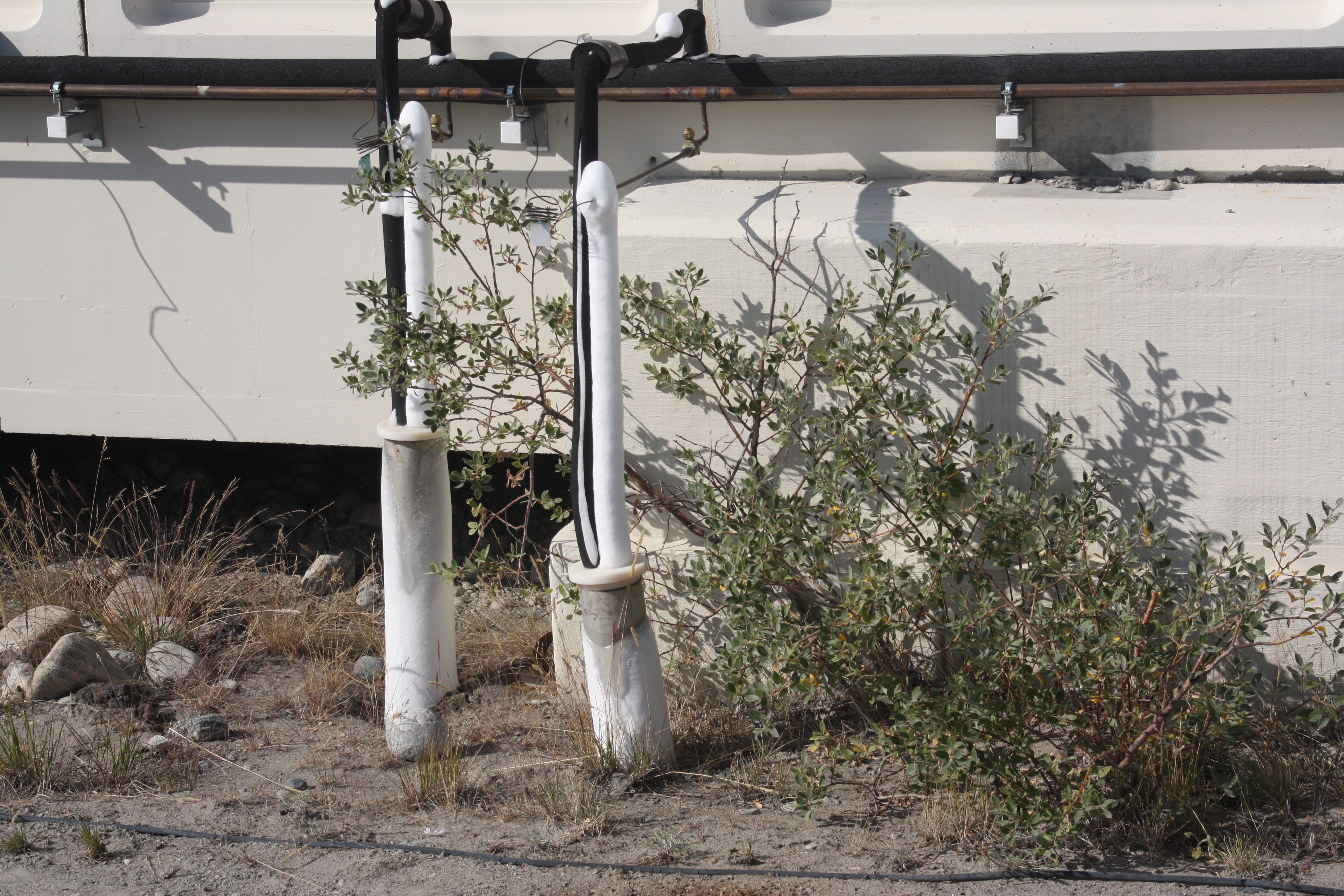
    Sea ice plays an important role in protecting coasts from waves. When this barrier is not there, the waves dig deep and erode land away. I saw the results of this first-hand during a trip to Barrow, Alaska, in 2008. I visited sites at Point Barrow, the northernmost point of the United States, where villages had been washed into the sea. On a trip to Greenland in 2009, I was amazed to see buildings being artificially cooled to avoid them sinking into the ground as warming temperatures melt the permafrost.

    System to cool the foundations of a building in Kangerlussuaq, Greenland

    In the area of Siberia investigated by the German scientists, high cliffs protect the coastline. As the permafrost melts above and waves cut in from below, the cliffs are undermined and break off.

    The erosion does not only have an impact on land. It also washes material into the sea, changing the quality of the water. Depending on the kind of erosion and the particular structure of the coast, between 88 and 800 tons of plant-, animal, and microorganism-based carbon are currently washed into the sea per year and kilometer of coastline – materials which were previously sealed in the permafrost, according to the AWI researchers. Once in the water, carbon may turn into carbon dioxide and, as a result, contribute to the acidification of the oceans.

    The studies were conducted as part of the PROGRESS project which is funded by the German Federal Ministry of Education and Research. PROGRESS is the acronym for Potsdamer Forschungs- und Technologieverbund für Naturgefahren, Klimawandel und Nachhaltigkeit (Potsdam Research Cluster for Georisk Analysis, Environmental Change and Sustainability).

    www.earth-in-progress.de.

    Date

    October 31, 2013 | 1:46 pm

    Share Add to FacebookAdd to TwitterAdd to Google+

    Feedback

    Write a Comment

    No comments yet.

    Leave a comment


    Melting permafrost eroding Siberian coasts

    Rising summer temperatures and dwindling Arctic sea ice are eroding the cliffs of Eastern Siberia at an increasing pace. Scientists from AWI, the German Alfred Wegener Institute and the Helmholtz Centre for Polar and Marine Research have been evaluating data and aerial photographs of the coastal regions from the last 40 years. As the sea ice recedes more and more from year to year, the cliffs are being undermined by waves. At the same time, the land surface is beginning to sink.

    This graphic, courtesy of AWI, shows the interaction between permafrost melt, wave action and coastal erosion

    Disappearing island

    The research documents warming summers. While the temperatures during the period looked at were higher than zero degrees Celsius on an average of 110 days per year, the scientists counted a total of 127 days in the years 2010 and 2011. In 2012, the number of days with temperatures above freezing increased to 134.The number of summer days on which the sea ice in the southern Laptew Sea vanishes completely is also on the increase. “During the past two decades, there were, on average, fewer than 80 ice-free days in this region per year. During the past three years, however, we counted 96 ice-free days on average. Thus, the waves can nibble at the permafrost coasts for approximately two more weeks each year,“ says AWI permafrost researcher Paul Overduin.

    Coastal erosion has caused considerable damage in Arctic areas, including Point Barrow

    Not only a problem in Siberia

    Sea ice plays an important role in protecting coasts from waves. When this barrier is not there, the waves dig deep and erode land away. I saw the results of this first-hand during a trip to Barrow, Alaska, in 2008. I visited sites at Point Barrow, the northernmost point of the United States, where villages had been washed into the sea. On a trip to Greenland in 2009, I was amazed to see buildings being artificially cooled to avoid them sinking into the ground as warming temperatures melt the permafrost.

    System to cool the foundations of a building in Kangerlussuaq, Greenland

    In the area of Siberia investigated by the German scientists, high cliffs protect the coastline. As the permafrost melts above and waves cut in from below, the cliffs are undermined and break off.

    The erosion does not only have an impact on land. It also washes material into the sea, changing the quality of the water. Depending on the kind of erosion and the particular structure of the coast, between 88 and 800 tons of plant-, animal, and microorganism-based carbon are currently washed into the sea per year and kilometer of coastline – materials which were previously sealed in the permafrost, according to the AWI researchers. Once in the water, carbon may turn into carbon dioxide and, as a result, contribute to the acidification of the oceans.

    The studies were conducted as part of the PROGRESS project which is funded by the German Federal Ministry of Education and Research. PROGRESS is the acronym for Potsdamer Forschungs- und Technologieverbund für Naturgefahren, Klimawandel und Nachhaltigkeit (Potsdam Research Cluster for Georisk Analysis, Environmental Change and Sustainability).

    www.earth-in-progress.de.

    Date

    October 31, 2013 | 1:46 pm

    Share Add to FacebookAdd to TwitterAdd to Google+

    Feedback

    Write a Comment

    No comments yet.

    Leave a comment


  • Russia and Ukraine have blocked the creation of the world’s largest ocean sanctuaries around Antarctica…

    Dear INGA,

    Russia and Ukraine have blocked the creation of the world’s largest ocean sanctuaries around Antarctica… again. This has demonstrated their sheer lack of political will to protect the last ocean wilderness on earth.

    This comes a mere three months after Russia and Ukraine pulled the rug out from underneath negotiations in Germany. These two states continue to steadily erode the genuine efforts of other countries to protect these waters for future generations.

    Unlike Russia and Ukraine, we have the will and determination to keep up the fight to protect these pristine waters and the thousands of species that call it home. We know that you do too. Share the above picture with your friends and family and ask them to Join The Watch today.

    There is no doubt the 25 Members of CCAMLR (the Commission for the Conservation of Antarctic Marine Living Resources) feel the public pressure and know the world is watching their every move. Because of our campaign, countries like South Korea, Norway and Chile are becoming more and more supportive of Southern Ocean marine protection. Now we need to escalate public support and you are the agents to make this happen.

    The two ocean sanctuary proposals that CCAMLR failed to pass were a US and New Zealand proposal for the Ross Sea, known as the most intact marine ecosystem left on earth, and a proposal from Australia, France and the EU for an East Antarctic ocean sanctuary.

    While this is a major disappointment, our hopes remain strong for 2014. Stay tuned.


    Steve Campbell, Campaign Director
    The AOA Team