Category: Uncategorized

  • How governments bemoan the problem but keep stoking the fires.

    Climate Breakdown

    Posted: 04 Oct 2013 01:33 AM PDT

    How governments bemoan the problem but keep stoking the fires.


    By George Monbiot, published in the Guardian 28th September 2013

    Already, a thousand blogs and columns insist that the Intergovernmental Panel on Climate Change’s new report is a rabid concoction of scare stories whose purpose is to destroy the global economy. But it is, in reality, highly conservative.

    Reaching agreement among hundreds of authors and reviewers ensures that only the statements which are hardest to dispute are allowed to pass. Even when the scientists have agreed, the report must be tempered in another forge, as politicians question anything they find disagreeable: the new report received 1855 comments from 32 governments(1), and the arguments raged through the night before its launch(2).

    In other words, it’s perhaps the biggest and most rigorous process of peer review conducted in any scientific field, at any point in human history.

    There are no radical departures in this report from the previous assessment, published in 2007; just a great deal more evidence demonstrating the extent of global temperature rises, the melting of ice sheets and sea ice, the retreat of the glaciers, the rising and acidification of the oceans and the changes in weather patterns(3). The message is both familiar and shattering: “it’s as bad as we thought it was.”

    What the report describes, in its dry, meticulous language, is the collapse of the benign climate in which humans have prospered, and the loss of the conditions upon which many other lifeforms depend. Climate change and global warming are inadequate terms for what it reveals. The story it tells is of climate breakdown. This is, or so it seems, a catastrophe we are capable of foreseeing but incapable of imagining. It’s a catastrophe we are singularly ill-equipped to prevent.

    The IPCC’s reports attract denial in all its forms: from a quiet turning away – the response of most people – to shrill disavowal. Despite –  or perhaps because of – their rigours, the IPCC’s reports attract a magnificent collection of conspiracy theories: the panel is trying to tax us back to the stone age or establish a Nazi/Communist dictatorship in which we are herded into camps and forced to crochet our own bicycles. (And they call the scientists scaremongers …).

    In the Mail, the Telegraph and the dusty basements of the internet, today’s report (or a draft leaked a few weeks ago) has been trawled for any uncertainties or refinements that could be used to discredit the process(4,5). The panel reports that on every continent except Antarctica, manmade warming is likely to have made a substantial contribution to the surface temperature(6). So those who feel threatened by the evidence ignore the other continents and concentrate on Antarctica, as proof that climate change caused by fossil fuels can’t be happening.

    They make great play of the IPCC’s acknowledgement that there has been a “reduction in surface warming trend over the period 1998–2012”(7), but somehow ignore the fact that the past decade is still the warmest in the instrumental record. They manage to overlook the panel’s conclusion that this slowing of the trend is likely to have been caused by volcanic eruptions, fluctuations in solar radiation and natural variability in the planetary cycle. Were it not for manmade global warming, these factors could have made the world significantly cooler over this period(8). That there has been a slight increase in temperature despite them shows the extraordinary power of the human contribution.

    But denial is only part of the problem. More significant is the behaviour of powerful people who claim to accept the evidence but keep stoking the fires. This week the former Irish president Mary Robinson added her voice to a call that some of us have been making for years: the only effective means of preventing climate breakdown is to leave fossil fuels in the ground(9,10). Press any minister on this matter in private and, in one way or another, they will concede the point. Yet no government will act on it.

    As if to mark the publication of the new report, the department for business, innovation and skills has now plastered a giant poster across its groundfloor windows: “UK oil and gas: Energising Britain. £13.5bn is being invested in recovering UK oil and gas this year, more than any other industrial sector.” The message couldn’t have been clearer if it had said “up yours.”

    This is an example of the way in which all governments collaborate in the disaster they publicly bemoan. They claim to accept the science and to support the intergovernmental panel. They sagely agree with the need to do something to avert the catastrophe it foresees, while promoting the industries that cause it.

    It doesn’t matter how many windmills or solar panels or nuclear plants you build if you are not simultaneously retiring fossil fuel production. We need a global programme whose purpose is to leave most coal and oil and gas reserves in the ground, while developing new sources of power and reducing the amazing amount of energy we waste.

    But, far from doing so, governments everywhere are still seeking to squeeze every drop out of their own reserves, while trying to secure access to other people’s. As more accessible reservoirs are emptied, energy companies exploit the remotest parts of the planet, bribing and bullying governments to allow them to break open unexploited places: from the deep ocean to the melting Arctic. And the governments who let them do it weep sticky black tears over the state of the planet.

    www.monbiot.com

    References:

    1. http://www.climatechange2013.org/ipcc-process/

    2. http://www.theguardian.com/environment/2013/sep/26/ipcc-climate-report-slow-progress

    3. http://www.climatechange2013.org/images/uploads/WGIAR5-SPM_Approved27Sep2013.pdf

    4. http://www.dailymail.co.uk/news/article-2420783/Worlds-climate-scientists-confess-Global-warming-just-QUARTER-thought–computers-got-effects-greenhouse-gases-wrong.html

    5. http://www.telegraph.co.uk/earth/environment/climatechange/10310712/Top-climate-scientists-admit-global-warming-forecasts-were-wrong.html

    6. Page 13, Summary for Policy Makers. http://www.climatechange2013.org/images/uploads/WGIAR5-SPM_Approved27Sep2013.pdf

    7. Page 10.

    8. http://www.climatecodered.org/2013/09/is-global-warming-in-hiatus-not-if-you.html

    9. http://www.theguardian.com/environment/2013/sep/23/fossil-fuel-reserves-left-in-ground

    10. http://www.monbiot.com/2007/12/11/rigged/

  • “Unequivocal” 350 org

    “Unequivocal”

    Inbox
    x
    May Boeve – 350.org <team@350.org>
    11:23 PM (9 hours ago)

    to me
    Images are not displayed. Display images below – Always display images from team@350.org

    Dear friends,

    An important new climate science report was just released, and the results aren’t exactly cheerful.

    The new report is long and dense, so we thought we would summarize it here. Since we’re quite fond of science and numbers at 350.org — after all, we’re named after the safe level of carbon dioxide in the atmosphere — we wanted to share a few of the key numbers from the new climate report:

    • 95-99%: that’s the level of certainty that scientists have that humans are causing the world to heat up. To put that into context, that’s the same level of certainty scientists have that cigarettes cause cancer. That’s what scientists call “unequivocal”. The debate on the basics of climate science is over.
    • 1 Trillion: the global “carbon budget” in metric tons. That’s the amount of CO2 we can release into the atmosphere while keeping global warming under 2 degrees Celsius — what many scientists have identified as a red line for our planet. We’ve already burned through about half of that carbon budget.  Translation: we need action. ASAP.
    • 1,2,3: the ranking of the last three decades as the “warmest decades in recorded history.” In other words: the planet is heating up, and we’re breaking new climate records every day.

    But there are a few numbers you should know about climate change that aren’t in the latest report — numbers that give us reason for hope:

    • 100%: that’s the expected growth in global installed solar power over the next two and a half years! That’s a doubling our solar capacity in a mere 30 months. The renewable energy revolution has begun.
    • 20,000: that’s the number of events, protests, and rallies we’ve organized at 350.org. We’re everywhere, and we’re active.
    • 100,000: that’s the number of new activists to have joined 350’s global network in the last few months. We’re growing — and fast.
    And this month we’re taking these stories of success, as well as the terrifying maths of climate change, across Europe to launch the Fossil Free Europe movement. As we’ve done in USA and Australia, we’re going to push prominent institutions across the continent – like churches, cities, and universities – to divest from fossil fuels. We’re going after the fossil fuel industry’s social capital the world over because their business model is wrecking the planet.

    This work will not be easy, but I believe in people power. I think social movements can force the kinds of major societal changes needed to halt climate catastrophe. That’s why I’m so proud of what we’re doing at 350.org with our partners all over the world. This new climate report has made one thing completely clear: we need to act boldly, quickly, and all together.

    Let’s do it,

    May Boeve for the whole team 350.org

    P.S. Our social media team made this great graphic about the new report — can you take a moment to share it on Facebook?


    One important note: some scientists criticize these reports for being both too conservative and behind the curve. The group behind the report — the “Intergovernmental Panel on Climate Change” or “IPCC” — is a collaboration of 800 climate scientists around the world. The body is considered the foremost global authority on climate science, and integrates the research of more than 9,000 studies. But because of the size, scope, and consensus-based nature of these reports, they are often “lowest common denominator” science, and there’s a pattern of them underestimating the scale and severity of climate change and its impacts. You can learn more about this at this Wikipedia article.

    More Info and Resources 

    U.N. Climate Panel Endorses Ceiling on Global Emissions – The New York Times

    What 95% certainty of warming means to scientists – AP Article

    IPCC climate report: human impact is ‘unequivocal’ –  The Guardian

    Chart: 2/3rds of Global Solar PV Has Been Installed in the Last 2.5 Years – GreenTech

    Climate Change 2013: The Physical Science Basis – IPCC


    350.org is building a global movement to solve the climate crisis. Connect with us on Facebook and Twitter, and sign up for email alerts. You can help power our work by getting involved locally, sharing your story, and donating here. To change your email address or update your contact info, click here.

    To stop receiving emails from 350.org, click here.

  • Ocean warming and acidification deliver double blow to coral reefs

    Ocean warming and acidification deliver double blow to coral reefs

    Published 4 October 2013 Media coverage Leave a Comment

    The dual threats of ocean acidification and anthropogenic warming have the potential to wreak havoc on marine life over the coming decades. Corals require acid-sensitive calcium carbonate for structure and heat-sensitive symbionts for sustenance, so they seem to have the most to lose from a warmer, more acidic ocean. Indeed, numerous studies have already indicated that calcifying organisms, including corals, would be among the worst to suffer.

    Although many studies have looked at heat and acidification, few have addressed the possible synergistic effects of these processes on intact coral reefs. To that end, a team of Australian researchers exposed patches of coral reefs to varying seawater temperature and pH conditions associated with a range of CO2 emission scenarios. Their findings, though nuanced, do not bode well for the long-term well-being of coral reefs.


    At its core, the study aimed to answer two questions with important ramifications for the future of coral reefs. First, how do current reef calcification rates compare to those of pre-industrial conditions? Second, will reefs respond differently to a possible future in which emission growth continues unabated versus one in which growth is moderately curbed?

    Setting up the experiment

    In order to better understand how corals—as members of a community rather than individuals—might respond to future conditions, the authors “built” replicate patches by piecing together species collected from the Great Barrier Reef. (The Reef doubled as the control, or reference, site for their experiment.) The coral reef patches were composed of a mixture of hard corals, macroalgae, vertebrates, and invertebrates, all of which were collected locally from a shallow depth. The underlying sediments and structure were made up of the skeletons of corals, calcareous algae, foraminifers (shelled amoeba-like protists), and mollusks.

    Each patch was placed in a separate enclosed tank, and a continuous supply of warm/cold seawater and CO2 was piped in. The tank lids were clear to let sunlight to come in. A buoy at the reference site allowed them to monitor daily and monthly variability in temperature and partial pressure of CO2. They then incorporated this natural variability into their experiment.

    The four emission scenarios they picked matched those used by several Intergovernmental Panel on Climate Change modeling studies. The first two correspond to pre-industrial and present-day conditions, while the latter two correspond to the low and high ends of future emission scenarios. Pre-industrial conditions were simulated by lowering the present-day seawater temperature (~24.3 to 27.8°C, depending on monthly variability) and increasing pH (~8.1) by 1°C and 0.1 unit, respectively. For the lower end of the future scenarios, which assumes some level of emission reductions, the temperature and pH were increased and lowered by 2°C and 0.2 unit, respectively. For the higher end, which assumes unabated or “business-as-usual” emission growth, the temperature and pH were increased and lowered by 4°C and 0.4 unit, respectively. Three replicate patches were assembled for each emission scenario.

    Prior to beginning their observations, the authors gave the coral reef patches two and a half months to acclimate to the various treatment conditions by slowly mixing more treatment water with water from the inner reef. The experiment then ran throughout most of the austral summer, when temperatures and partial pressures of CO2 are expected to be highest. Calcification rate and net primary productivity measurements were made over several days on three separate occasions.

    The results

    As expected, the coral reef patches reacted differently to each emission scenario. Incidences of coral bleaching and mortality varied widely, with the highest number occurring in the business-as-usual emission scenario and the lowest occurring in pre-industrial conditions. Most corals had already begun to pale by the beginning of November under business-as-usual conditions, while corals in the reduced emission and control scenarios only began to experience widespread bleaching by early February.The level of bleaching observed in the control scenario was similar to that observed in the Great Barrier Reef reference site.

    While many corals were able to rebound from their bleaching episodes, those growing in the reduced and business-as-usual emission scenarios were much more likely to die. But those in pre-industrial conditions had little to rebound from. Only one thermally sensitive coral species experienced bleaching in that scenario.

    Net primary productivity rates varied by month but were generally highest in December and lowest in November. Surprisingly, they showed little to no variation across the four experimental treatments, suggesting that some members of the patch may be able to pick up the slack as others falter.

    Calcification rates, on the other hand, were strongly correlated with each treatment. Rates were consistently negative during the business-as-usual scenario, indicating the active loss of calcium carbonate from the reef. They were positive, though only slightly so, under the reduced emission conditions. The rates were higher and highest during the control and pre-industrial emission scenarios, respectively. Carbonate dissolution rates were highest at night, particularly under the business-as-usual scenario, but they also increased during the reduced and control emission scenarios as summer progressed. The authors attribute this to higher nocturnal CO2 concentrations from aerobic respiration.

    Taken together, these results demonstrate that, yes, coral reefs are likely to respond differently to varying future emission scenarios, with higher emissions resulting in higher mortality and decalcification rates. The fact that coral reef patches fared much better in the pre-industrial emission scenario than in the control scenario suggests that coral reefs have not had enough time to adapt to the relatively minor changes in seawater temperature and pH that have occurred over the past century. This matters, because some researchers have postulated that corals and their symbionts may be able to co-evolve in order to adapt to an even more hostile future ocean.

    While their collective outlook seems decidedly bleak, there is some indication that certain coral species are already better equipped to deal with decreasing seawater pH, while others may actually benefit from rising temperatures. Coral reefs are found in shallow waters around the world—and even at depth—so there is likely to be a high degree of variability in how different species and assemblages are able to cope and adapt to changing environmental conditions.

    PNAS, 2013. DOI: 10.1073/pnas.1302701110  (About DOIs).

    Science, 2011. DOI: 10.1126/science.1204794

    Jeremy Jacquot, ars technica, 30 September 2013. Article.

    Rate this:

    Rate This


  • Coal seam gas opponents to challenge federal approval of Santos project

    Coal seam gas opponents to challenge federal approval of Santos project

    Greg Hunt waives full environmental assessment as activists vow to ramp up protests against ‘free-for-all mining’

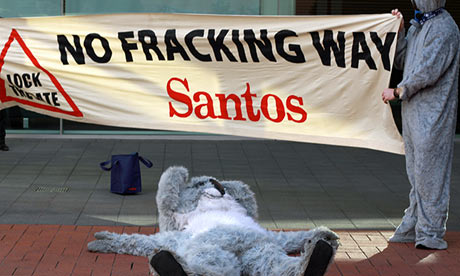
    coal seam gas protest santos

    Environmental groups are concerned the Santos-led coal seam gas development could endanger koalas in the Pilliga forest. Photograph: Josh Coates/AAP

    Anti-coal seam gas campaigners are gearing up to launch legal action over the decision by the federal government to approve an exploration project in the Pilliga forest in New South Wales.

    The federal environment minister, Greg Hunt, has decided that the Santos-led development does not require full assessment under the national Environment Protection and Biodiversity Conservation Act.

    Hunt has, however, added several conditions for the coal seam gas pilot project, requiring that construction cease during breeding season if the threatened Pilliga mouse, regent honeyeater or koala are found in pre-clearance surveys.

    Santos will have to monitor groundwater, but it will be allowed to fell 400 hollow-bearing trees and remove up to 235 orchids.

    The project, which will involve the drilling of 36 pilot production wells in the state forest, has enraged environmentalists and community groups.

    More than 3,800 submissions over the development were sent to the government, most in opposition to Santos’s plans. Opponents claim Hunt should assess the project under the “water trigger” legislation that requires all development that may impact the water table be scrutinised by the federal government.

    There are also concerns the project will harm threatened species, including recently discovered stygofauna – ancient water-cleansing micro-organisms that dwell beneath the ground.

    Carmel Flint, co-ordinator of anti-CSG group Lock the Gate Alliance, told Guardian Australia that community activists would ramp up protests in the wake of Hunt’s decision.

    “This decision will raise alarm bells throughout the country among communities who want to have a say over coal and unconventional gas mining,” she said. “This was a big test for the new federal environment minister and it’s a huge worry that he’s decided to go ahead with it without further assessment.

    “I think you’ll see much greater community activism and response to this. A lot of people will be looking at this closely and getting legal advice. A number of community groups will be looking at legal action over it.

    “There are genuine legal questions as to how [Hunt] reached this conclusion. He’s approved the destruction of threatened species without any assessment, which is contrary to the Environment Protection and Biodiversity Conservation Act.

    “Given the rhetoric from the likes of [energy minister] Ian Macfarlane recently, it isn’t hugely surprising. But I think the government will find there is a deep and broad opposition to the free-for-all mining they are proposing.”

    One of the submissions to the government, from a hydrologist, Andrea Broughton, questioned the groundwater modelling done by Santos before the project starting.

    “I would’ve liked to have seen a proper environmental assessment done,” she told Guardian Australia. “The model is based on a serious lack of data. The groundwater monitoring isn’t in place to know whether the water table will be impacted.

    “Santos says there will be a 0.5m drawdown in the water level over the next 500 years. I find that very hard to believe.”

    Santos said it welcomed the government’s decision and insisted that its decision to refer the project for approval shows its commitment to transparency.

    “Although our own independent assessment indicated the exploration program would not activate the ‘water trigger’, we wanted to be completely transparent with regard to our initial exploration and appraisal program,” said Sam Crafter, a company spokesman.

    “We believed the referral was the sensible way to ensure the predicted impacts on water resources had been thoroughly assessed by all the relevant bodies.”

    Crafter added that all of the assessment work done so far, along with the government’s decision, demonstrates the project won’t have a major environmental impact.

    Green light
  • Institute head: Caspian Sea level may rise two metres after 2020

    Institute head: Caspian Sea level may rise two metres after 2020

    inShare
    Institute head: Caspian Sea level may rise two metres after 2020
    3 October 2013, 15:33 (GMT+05:00)

    Azerbaijan, Baku, Oct. 3 / Trend I. Isabalayeva /

    It is predicted that after 2020 the Caspian Sea level will rise by up to two metres, acting director of the Institute of Geography of the Azerbaijani National Academy of Sciences Ramiz Mammadov told Trend today.

    According to him, currently there are no critical changes in the Caspian Sea level.

    “The Caspian Sea level is lowering,” he said. “In particular, it went down by 15-20 centimetres. The specialists call it a period of stabilisation as the lowering of the sea level by 15 to 20 and even 30 centimetres will not cause any economic or social damage.”

    He stressed the Caspian Sea level has relatively stabilised since 1995. This period will last until 2020.

    “There is an assumption that after 2020 the sea level will rise by up to two metres,” he said. “But we are not 100 per cent sure.”

    He also expressed his views as to the information of the sea rising.

    “Temporary shoreline changes are connected with the winds,” he said. “If the wind is blowing from the sea, it drives the water on to the shore and vice versa. This process cannot be called a change in the sea level.”

    The sea level is measured in those places where external factors cannot influence it, for example closed bays, Mammadov said.

    Do you have any feedback? Contact our journalist at agency@trend.az

    Tags: Caspian Sea

  • Let’s be honest – the global warming debate isn’t about science

    Let’s be honest – the global warming debate isn’t about science

    The scientific evidence on human-caused global warming is clear. Opposition stems from politics, not science.

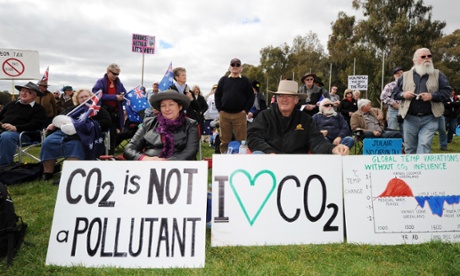
    Anti-carbon tax protesters in Canberra.

    Anti-carbon tax protesters in Canberra, motivated by politics, not science. Photograph: Torsten Blackwood/AFP/Getty

    The 2013 Intergovernmental Panel on Climate Change (IPCC) report states with 95 percent confidence that humans have caused most, and probably all of the rapid global warming over the past 60 years. Approximately 97 percent of climate experts and peer-reviewed climate science studies agree.

    There are of course open questions yet to be answered by climate scientists – precisely how sensitive the climate is to the increased greenhouse effect, for example. But even in a best case, low sensitivity scenario, we’re headed for dangerously rapid climate change if we continue on our current business as usual path. And the worst case scenario, which is just as likely as the best case scenario, would mean we’re headed for a global catastrophe.

    The IPCC warns that if we want to avoid very dangerous climate change, we’re on track to blow through our allowed carbon budget in as little as two to three decades if we continue on our current path of relying on fossil fuels. If we’re lucky and the low sensitivity scenario is accurate, perhaps we’ll have an extra decade or two, but even in this best case scenario, we’re on an unsustainable climate path.

    Politically biased media climate coverage is not a coincidence

    The scientific evidence is what it is, and it has no political bias. The same is not true of the media outlets that cover the topic. It’s not a coincidence that politically conservative tabloids and newspapers like the Daily Mail, Telegraph, Australian, and Wall Street Journal spend a disproportionate amount of time amplifying the voices of the less than 3 percent of climate contrarian scientists, as well as many non-scientist contrarians.

    It’s certainly not the case that David Rose has some brilliant insight into the state of climate science that climate scientists don’t have. He and his fellow climate contrarians simply approach the question backwards. They start from their political ideological opposition to climate solutions and work backwards, seeking out cherry picked evidence to justify their predetermined conclusions, thus ignoring the 97 percent of inconvenient scientific evidence. This climate contrarianism ideological bias is illustrated in a new study, summarized by Graham Readfearn:

    “if you’re a conservative who believes the world runs best when businesses operate in a “free market” with little government interference, then the chances are you don’t think human-caused climate change represents a significant risk to human civilisation.”

    Let’s debate the solutions

    Even if you’re not convinced by the scientific evidence, you should support taking action to mitigate global warming. What if you’re wrong, as the body of scientific evidence indicates is the case? There is unquestionably a possible scenario in which our greenhouse gas emissions cause harmful and potentially catastrophic climate damages.

    I know what contrarians are thinking – what if I’m wrong, and we end up wasting money deploying green technologies, cleaning the air and water and transitioning away from limited fossil fuel resources in the process? That’s why we need everyone helping to craft the best possible solutions to maximize the economic benefit of this inevitable transition.

    Take the USA as a prime example. The Obama Administration recognizes the need to reduce greenhouse gas emissions, but Republicans in Congress refuse to even consider any climate legislation. As a result, government greenhouse gas regulations are the only available option. From an economic perspective, it’s far from an ideal solution, but because the Republican Party won’t participate in crafting better legislation, we’re forced to implement less than ideal solutions.

    The situation in Australia and Canada is even worse, with politically conservative parties running the governments and refusing to take any action to achieve serious greenhouse gas emissions reductions. The new Australian Prime Minister has even vowed to eliminate Australia’s carbon pricing system.

    Are you a supporter of the free market? Then advocate for allowing the free market solve the problem by pricing greenhouse gas emissions. The debate should be about how to best achieve greenhouse gas emissions reductions with maximum economic benefit.

    To utilize the free market by pricing carbon emissions, the main options are a carbon cap and trade system or a carbon tax. Then there’s the question of what to do with the revenue generated by the emissions price. Some options include reducing the federal deficit, funding green technology research and deployment, lowering other taxes, and returning the funds directly to the citizens. A growing number of Republicans in the USA favor the latter, revenue neutral carbon tax approach.

    British Columbia has a revenue-neutral carbon tax, offset by decreases in income taxes, and the system enjoys broad support from 64 percent of citizens. The province’s economy is doing well and its greenhouse gas emissions are falling. They’ve shown that a well-crafted climate solution can work.

    We need conservatives to be constructive, not obstructive

    Ultimately this climate ‘debate’ is not about science. The scientific evidence is crystal clear that humans are causing rapid global warming. The longer we wait to do something about it, the more climate change we commit ourselves to, and higher the chances are for a climate catastrophe. From a risk management perspective, failing to take action to reduce greenhouse gas emissions is just plain stupid. Opposition to climate action isn’t about the science, it’s about the politics and policies.

    So let’s debate those policies. The more input we have from different political and ideological perspectives, the better crafted the solutions will be. After all, Republicans came up with the concept of cap and trade as an alternative to government regulation of pollutants, and it was a good, successful idea.

    Denying the science and obstructing the solutions will only make the problem worse. It also results in climate solutions that are far from ideal, like US government greenhouse gas regulations instead of legislation allowing the free market to solve the problem. We need everyone on board to help craft the best possible climate solutions and help grow the economy in the process.

    Climate change is a situation that fits the adage “you’re either part of the solution or you’re part of the problem.” Be part of the solution.

    Green light

    close

    Sign up for the Green light email

    The most important environment stories each week including data, opinion pieces and guides.

    Sign up for the Green light email