Category: Uncategorized

  • This is a final email from me as this campaign is now complete!

    A final thank you + how to support The Climate Council

    Inbox
    x
    Cameron Neil via CommunityRun camneil76@gmail.com via controlshiftlabs.com
    2:57 PM (18 minutes ago)

    to me

    Hi everyone

    This is a final email from me as this campaign is now complete!

    All 5,295 of you joined me in calling for a citizen-funded Climate Commission – and now we have one, The Climate Council. Thank you and kudos on showing your support and helping to make this happen! Because of people like you, The Climate Council has already raised close to $1 million to continue its important work.

    You can financially support The Climate Council here – with a one-off donation or a weekly or monthly contribution via credit card, cheque or direct debit: https://secure.climatecouncil.org.au/.

    You can volunteer your time and skills to The Climate Council by filling in the form here: https://docs.google.com/forms/d/1nqhDf-Yj_2xoqf2wYSiG0Koz5OfGpVRsk7rb2e68sXg/viewform?edit_requested=true (note that they have been indundated with offers of assistance and may take a few weeks to get back to you!).

    To keep up with the work of The Climate Council and stay informed on the latest developments in the climate science and its implications for us, visit their website and connect with them via email or social media: http://climatecouncil.org.au/.

    Once again, thanks for lending your voice to this campaign.

    Cameron

    You received this email because you signed the petition ‘We’ve done it! Your ‘citizen-funded Climate Commission’ = the new Climate Council!’. If you don’t want to receive emails from the ‘We’ve done it! Your ‘citizen-funded Climate Commission’ = the new Climate Council!’ campaign in the future, please unsubscribe.

  • From: Ricken Patel – Avaaz.org Sent: Friday, 4 October 2013 1:09 PM Subject: what happened after I signed the petition?

    —– Forwarded Message —–
    From: Ricken Patel – Avaaz.org <avaaz@avaaz.org>
    Sent: Friday, 4 October 2013 1:09 PM
    Subject: what happened after I signed the petition?
    Dear amazing community,I often get asked by Avaazers, “what happens after I sign a petition?” And the truth is, a HECK of a lot! Every Avaaz campaign springs from a massive global mandate, and then zeroes in on the best way for our voices to win. Here’s just two of our victories from the last few weeks:

    Remember when 2 million of us came together to stop the flogging of a 15-year old rape victim in the Maldives? Her sentence has been quashed! Here’s what our team did to win:

    Maldives ad
    Our ads threatened the profits of officials who owned parts of the tourism industry
    1. Spoke for hours with the Maldivian Attorney-General and Ministers and emailed the President at his personal account.
    2. Commissioned opinion polls showing massive support for reforms to protect girls. And wrote an Op-Ed in a major national paper.
    3. Persuaded a top Islamic scholar to speak out against flogging.
    4. Threatened to run an ad (right) in tourism publications, affecting the country’s major industry.
    5. Visited the Maldives and the location where the girl was held, pressing officials directly.

    Ahmed Shaheed, former Foreign Minister of the Maldives said “The Avaaz contribution was the spearhead of the campaign to overturn the flogging sentence; a petition signed by millions, a country visit, a public opinion survey, and persistent follow-up all proved irresistible.”

    Another example: Remember how almost 2 million of us rallied to stop the Maasai tribe in Tanzania from being kicked off their land for a hunting reserve? Last week, the Prime Minister announced they could stay! The petition provided a powerful basis for what the team did next:

    Maasai
    Maasai women gather to protest the eviction. Photo by Jason Patinkin
    1. Got CNN and the Guardian to visit the Maasai and break the wider story to the world.
    2. Advised Maasai elders on their campaigning strategy.
    3. Flooded Ministers and the President with messages — forcing a debate in cabinet and Parliament.
    4. Ran a hard hitting newspaper ad in an influential paper which publicly shamed the government.
    5. Persuaded diplomats worldwide to raise the issue — embarrassing the government.
    6. Financially supported Maasai elders to travel to the capital where they gathered to ‘occupy’ land outside of the Prime Minister’s office for weeks, refusing to leave until he met them.
    Education cheque
    Gordon Brown said: “A million dollars has been raised via the brilliant Avaaz.org, in just a few days.”Brazil Open Vote
    Key Brazilian Senator joins Avaaz “open vote” naked protest sending a clear message: “we have nothing to hide”

    The victory belongs to the Maasai people, but our community helped them win by making this a global issue the government could no longer ignore. This hopefully ends a 20 year land battle!!

    Of course, our community does a LOT more than petitions. Last week, we raised a $1 million challenge grant in a few days to donor governments to put Syrian refugee kids in school. At a UN meeting, I was able to put a cheque on the table and issue the challenge on behalf of over 40,000 Avaaz donors. UN Education Envoy Gordon Brown, who chaired the meeting, called our community’s effort a “magnificent and impactful intervention” in getting other governments to give!

    And often it’s not the Avaaz team but our community that does the direct lobbying. For example in Brazil, we’re inches away from winning a massive fight to end the shady practice of ‘secret voting’ in the Congress. Our huge push helped win the vote in the lower house and right now, Senators’ telephones are ringing off the hook as Avaaz members across Brazil use our online calling tool to directly tell them to stop this corruption — experts say a win is likely in days!

    It’s this unique magic mix between a gigantic and spirited community of citizens able to speak out, donate, and lobby, and a small team of top notch advocates able to take smart, strategic actions at the highest level with democratic legitimacy, that makes our campaigns increasingly unstoppable.

    If we keep believing in each other, and growing in size and in commitment, there’s no limit to the good we can do in the world. Thank you so much for the honour and the joy to be part of and serve this community. It’s something truly precious we have here — let’s keep building Avaaz.

    With love and appreciation,

    Ricken and the team

    PS — You might not know that Avaaz is different from just about every other global organization in that we are 100% funded and guided by our community. Every campaign we run is first polled and tested to a random sample (you might think of it as a jury) of our community, that tells us exactly how the whole the community will react. I may be the CEO, but you’re my boss. If you don’t like something (and I don’t mean 51% like it, but 81% like it) then our team go back to the drawing board and come up with a better option for you. We have never, ever, broken this rule. So at the end of the day, it is your wisdom, the collective wisdom of our community, matched with the smartest suggestions the team hears from you and come up with ourselves and from our partners and experts, that determines what we do every single day.

    When you add to that the fact that 100% of our funding comes from small online donations (we strictly refuse any donations from corporations, governments, foundations, and even individual donations over 5000 Euros), I think Avaaz may be one of the purest organisational expressions of people-powered change in the world today. Make that an organisation served by a beautiful team of wonderfully talented and deeply committed people that I wish I could introduce you all to, and we’ve got a kind of magic that can build the world we dream of.

    PPS — If you want to chip in to help keep it all going, click here: https://secure.avaaz.org/en/october_reportback_a/?bBYMjdb&v=29778


    Avaaz.org is a 26-million-person global campaign network
    that works to ensure that the views and values of the world’s people shape global decision-making. (“Avaaz” means “voice” or “song” in many languages.) Avaaz members live in every nation of the world; our team is spread across 18 countries on 6 continents and operates in 17 languages. Learn about some of Avaaz’s biggest campaigns here, or follow us on Facebook or Twitter.

    You are getting this message because you signed “Join Avaaz!” on 2012-06-22 using the email address ngarthurslea@yahoo.com.au.
    To ensure that Avaaz messages reach your inbox, please add avaaz@avaaz.org to your address book. To change your email address, language settings, or other personal information, contact us, or simply go here to unsubscribe.

    To contact Avaaz, please do not reply to this email. Instead, write to us at www.avaaz.org/en/contact or call us at +1-888-922-8229 (US).

    Click here to Reply or Forward
  • Researchers Find Historic Ocean Acidification Levels: ‘The Next Mass Extinction May Have Already Begun’

    Researchers Find Historic Ocean Acidification Levels: ‘The Next Mass Extinction May Have Already Begun’

    By Katie Valentine on October 3, 2013 at 4:41 pm

    An Elkhorn coral bleached by record-hot water in 2005.An Elkhorn coral bleached by record-hot water in 2005.

    CREDIT: AP/NOAA

    The oceans are more acidic now than they’ve been at any time in the last 300 million years, conditions that marine scientists warn could lead to a mass extinction of key species.

    Scientists from the International Programme on the State of the Ocean (IPSO) published their State of the Oceans report Thursday, a biennial study that surveys how oceans are responding to human impacts. The researchers found the current level of acifification is “unprecedented” and that the overall health of the ocean is declining at a much faster rate than previously thought.

    “We are entering an unknown territory of marine ecosystem change, and exposing organisms to intolerable evolutionary pressure,” the report states. “The next mass extinction may have already begun.”

    Acidification causes major harm to marine ecosystems, especially coral, which has a hard time building up its calcium carbonate skeleton in acidic water. Coral reefs serve as nurseries to many young fish, so they’re essential both to ecosystem health and the survival of the fishing industry. If temperatures rise by 2 degrees C, the study found, coral may stop growing altogether, and may start to dissolve at 3 degrees C. Similarily, acidic ocean waters can hamper shellfish larvae’s ability to grow shells. Acidification is already hurting the shellfish industry — in the U.S., northwestern and East Coast shellfish industries have struggled to adapt to increasingly acidic waters. And pteropods, tiny sea snails that are a keystone species in the Arctic and are an essential food source for many birds, fish and whales, are also threatened by acidity — they too require strong calcium carbonate shells to survive.

    It’s not just acidification that’s threatening the oceans, either — the report found the oceans are facing a “deadly trio” of stressors, with warming waters and decreasing oxygen also majorly affecting marine ecosystem health. Warming waters coupled with ocean acidification are posing increasingly severe threats to Antarctic krill, which play a vital role in the Antarctic marine food chain, and are also helping lead to huge outbreaks of jellyfish. And as water temperatures rise, coral is increasingly vulnerable to bleaching.

    Meanwhile, depletion of oxygen is caused by two things: climate change and nutrient runoff, mostly from agriculture, the report stated. Scientists have predicted ocean oxygen content could experience a decline of between 1 and 7 percent by 2100. The impacts of this decrease in oxygen and increase in “dead zones” or areas with no oxygen, are varied, but include a decrease in habitat for large ocean predators such as tuna and marlin that have high oxygen requirements. Dead zones, as their name suggests, are deadly to creatures on the ocean floor, who aren’t able to escape to more oxygen-rich waters. Since the 1960s, the number of dead zones have doubled every ten years, according to the report.

    The report urged world governments to take fast action to ensure temperatures don’t rise past 2 degrees C. Current limits, it warned, weren’t enough to ensure the health of coral reefs, since there is will be a time lag of several decades between a decrease in levels of atmospheric CO2 and the levels of dissolved CO2 in the ocean. It also found overfishing is still causing major declines in key ocean species. At least 67 percent of fish stocks are being overfished, the report found, but stricter oversight and monitoring of commercial fishermen and giving more control of fisheries to local communities would help decrease overfishing. Indeed, some local governments have been successful in stopping depletion of fish in their waters. When one Mexican town banned fishing, it saw its marine biomass increase by 463 percent while fishing improved in regions just outside the preserve.

    Yet even if governments take the suggested steps, the report notes, they must do more to save the oceans as we know them.

    “Ultimately, however, [these measures] must be undertaken within a wider re-evaluation of the core values of human society and its relationship to the natural world on which we all rely,” it states. “The future of humanity and the future of the ocean are intertwined.”

  • Iranian Scientists Simultaneously Convert Carbon Dioxide, Methane to Useful Chemicals

    Iranian Scientists Simultaneously Convert Carbon Dioxide, Methane to Useful Chemicals
    Iranian Scientists Simultaneously Convert Carbon Dioxide, Methane to Useful Chemicals

    TEHRAN (FNA)- Iranian researchers succeeded in the simultaneous conversion of carbon dioxide and methane to useful chemicals at low temperature through photocatalytic reaction by using titanium dioxide nanoparticles deposited on stainless net.

    CO2 and CH4 are considered as the most important greenhouse gases and they play an important role in increasing the problems caused by greenhouse effect and also in global warming. The simultaneous decomposition of CO2 and CH4 can be suggested as an appropriate solution to reduce the concentration of greenhouse gases in the earth’s atmosphere.

    Among the methods that decompose the stable molecules of CO2 and CH4, those that operate at lower temperatures are most favored. Semi-conductive catalysts have recently attracted the attention of scientists due to their photocatalytic activity to initiate and carry out reduction-oxidation (redox) reactions. The conversion of CO2 is a reduction reaction while the conversion of CH4 is an oxidation one. The use of ultraviolet light to overcome the thermodynamic ban in some undesirable reactions can be useful from the thermodynamic points of view.

    In this research, the simultaneous conversion of carbon dioxide and methane to useful chemicals at high temperature through photocatalytic reaction was investigated by using titanium dioxide nanoparticles deposited on stainless net.

    Results showed that the photocatalytic system produced in this research had very desirable performance at laboratorial scale. It is considered an important step towards the production of a photoreaction with the ability to convert carbon dioxide and atmospheric methane to chemicals at industrial scale.

    Results of the research have been published in details in March 2013 in Journal of the Taiwan Institute of Chemical Engineers, vol. 44, issue 2, pp. 239-246.


  • Scientists have warned that climate change has sent the health of oceans “spiralling downward” faster than previously thought

    Ads by Google

    Scientists have warned that climate change has sent the health of oceans “spiralling downward” faster than previously thought.

    A key international assessment of climate change last week revealed the oceans are absorbing much of the warming and unprecedented levels of carbon dioxide caused by human activity such as burning fossil fuels.

    Now experts are warning the impact of rising greenhouse gases combined with a range of other problems is far graver than previously thought.

    Oceans are being hit by decreasing oxygen levels caused by climate change and increased nutrient run-off from agriculture and sewage, and are becoming more acidic as more carbon dioxide dissolves into the sea, both of which harm wildlife.

    Warming, as the oceans absorb much of the extra energy being trapped by greenhouse gases, is set reduce seasonal sea ice and lead to changes to sea layers, which will also cause lowering of oxygen levels.

    Warming will also lead to increased venting of methane, a potent greenhouse gas, from the Arctic seabed, experts from the International Programme on the State of the Ocean (IPSO) and the International Union for Conservation of Nature (IUCN) said.

    The “deadly trio” of warming, de-oxygenation and acidification is seriously affecting how productive and efficient the ocean is, with impacts throughout the chain of marine life, the scientists said.

    In addition, continued overfishing is damaging the resilience of the oceans, and despite improvements in some areas, fisheries management is failing to halt the decline in key species and prevent harm to important marine ecosystems.

    Last year the UN’s Food and Agriculture Organisation (FAO) found that 70% of world fish populations were unsustainably exploited, and almost a third of those (30%) had collapsed to less than 10% of unfished levels.

    The scientists called for urgent action to limit temperature rises to less than 2C above pre-industrial levels.

    They warned that current targets for carbon emission reductions are not enough to ensure coral reefs on which humans and wildlife depend survive increasingly acidic oceans.

    Potential knock-on effects of climate change in the oceans such as methane releases from the melting permafrost and coral dieback could lead to worse consequences for humans and nature than presently expected.

    The scientists also called for effective management of fishing, which favoured small-scale fisheries, taking steps such as eliminating subsidies that back more fishing vessels than fisheries can support, and banning the most destructive gear.

    And there needs to be “fit for purpose” global systems for governing the high seas, the experts said.

    Oxford University professor Alex Rogers, scientific director of IPSO, said: “The health of the ocean is spiralling downwards far more rapidly than we had thought.

    “We are seeing greater change, happening faster, and the effects are more imminent than previously anticipated.

    “The situation should be of the gravest concern to everyone, since everyone will be affected by changes in the ability of the ocean to support life on Earth.”

    The IUCN’s professor Dan Laffoley said: “What these latest reports make absolutely clear is that deferring action will increase costs in the future and lead to even greater, perhaps irreversible, losses.

    “The UN climate report confirmed that the ocean is bearing a brunt of human-induced changes to our planet. These findings give us more cause for alarm – but also a road map for action. We must use it.”

    Additional reporting PA

    You Might Also Like

    The Economics Of Solar Power in Australia [infographic]
    The Economics Of Solar Power in Australia [infographic]
    (SolarQuotes.com.au)
    Palmer possess the power

    Play Video
    Palmer possess the power
    Play Video
    What Australians are Buying on Impulse (Infographic)
    Ads by Google

    News in pictures

    World news in pictures

    From the blogs

    Children’s Book Blog: Recommended read – The Weasel, Puffin, Unicorn, Pig, Lobster Race by James Thorp and Angus Mackinnon

    Every month or so I recommend a children’s book that either hasn’t or isn’t likely to get the media …

    Dish of the Day: Interview with Ellie Grace

    Ellie Grace, co-author of Kitchen & Co: Colourful Home Cooking Through The Seasons talks with J…

    From Christopher Isherwood to Charles Dickens: Tales from the Soho Literary Festival

    At a buzzing Soho Literary Festival, Christopher Isherwood’s lifelong partner recalls his time with …

    A few thoughts on Louis Vuitton, as Paris closes.

    I love a train-spotting fashion collection. The Louis Vuitton show contained echoes from Marc Jacobs…

    Video from around the web

    Population pains for Western Australia

    Play Video
    Population pains for Western Australia
    (Yahoo!7 News Video)
    Killer wasps leave dozens dead

    Play Video
    Killer wasps leave dozens dead
  • IPCC report makes US meteorologist cry – and give up flying

    IPCC report makes US meteorologist cry – and give up flying

    Man who broke down in tears and shared his pain on Twitter is liked and loathed for his pledge to do his bit for climate

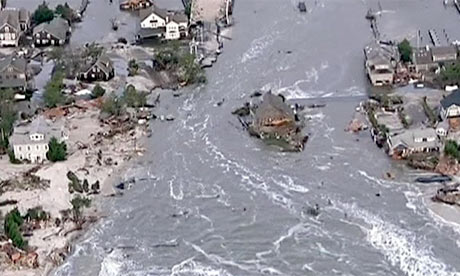
    An ariel view of flooding caused by hurricane Sandy in New Jersey 2012

    An ariel view of flooding caused by hurricane Sandy in New Jersey. Meteorologist Eric Holthaus has been flooded with email about how individuals should respond to climate change. Photograph: guardian.co.uk

    A meteorologist who broke down in tears, mused about a vasectomy, and vowed to give up air travel in the wake of the blockbuster report from the UN’s Intergovernmental Panel on Climate Change (IPCC) has found himself at the centre of a storm about personal responses to climate change.

    Since his emotional musings on Twitter, meteorologist Eric Holthaus has been flooded with email about how individuals should respond to climate change.

    Some were openly hostile. “I’ve had a couple hundred people send emails or tweets that said: ‘if you really want to reduce your carbon footprints why not commit suicide’?” Holthaus told the Guardian. But others were supportive of the no-fly pledge, saying they were inspired to give up meat, or take other carbon-cutting actions.

    Holthaus, who gained a large following during hurricane Sandy, estimates he flew 75,000 miles last year, much of that to Ethiopia where he is involved in a climate project.

    He has followed climate change for years, as a blogger for the Wall Street Journal and now at Quartz.

    But he said he was overwhelmed by the IPCC pronouncing for the first time that humans were now only decades away from being locked into a course of dangerous climate change. He also despaired at the inertia in UN climate talks, which are unlikely to produce global action before 2020.

    On his way home from San Francisco, Holthaus tweeted: “I just broke down in tears in boarding area at SFO [San Francisco airport] while on phone with my wife. I’ve never cried because of a science report before.”

    Two minutes later, Holthaus tweeted again: “I realised, just now: this has to be the last flight I ever take. I’m committing right now to stop flying. It’s not worth the climate.”

    He said: “It felt like a hopeless moment to me to be completely honest. At that moment it hit me, as a citizen of the planet and as a human, not as a scientist.

    “In the absence of a global coordinated carbon policy, I think it is going to be up to individuals, cities, and corporations to take action.”

    In his case, Holthaus said flying was by far the largest source of carbon emissions. Much of it was for work, but he also flew from his home in Wisconsin to holidays in Tanzania and California. He realised his carbon footprint from flying far outweighed his savings from sharing a car, recycling, or giving up meat.

    “I was thinking the flying was all for a good cause. It is not going to matter but I think that kind of thinking is dangerous when we are at the global tipping point,” he said. “When I saw I could reduce my carbon footprint with one action, for me it was a step I was willing to take.”

    Did Holthaus go too far? Fox News, predictably, in a segment this week labelled him a “kook” and said the “meteorologist’s meltdown” discredited climate science.

    Andrew Freedman, who writes at Climate Central, said on his Twitter feed that while he respected Holthaus’s work: “I wonder if his overall reaction to the #IPCC report hurts his ability to credibly report on #climate.”

    But Holthaus said he could live with the criticism.

    “Is my credibility increased or reduced? I don’t know but I would argue that I am talking from a stronger standpoint now that I am practicing what I preach a little more,” he said.

    And he does not entirely rule out getting on a plane again one day. “Let’s say, heaven forbid, my mother was in a car accident and I needed to be in hospital today. Of course I would fly,” he said. “I don’t have any plans to ever fly again but if there was an emergency like that than I would. My point is that there is a lot of discretionary travel by airplanes that produces a lot of emissions, whether people are taking vacations or business travel.”

    Green light

    close

    Sign up for the Green light email

    The most important environment stories each week including data, opinion pieces and guides.

    Sign up for the Green light email