Category: Uncategorized

  • Tackling Climate Change ‘Would Save Millions of Lives’

    News Section

    Stories from Climate Central’s Science Journalists and Content Partne

    Tackling Climate Change ‘Would Save Millions of Lives’

    • Published: September 30th, 2013
     101  67  10  2

    Repost This

    By Damian Carrington, The Guardian

    Tackling climate change would save millions of lives a year by the end of the century purely as a result of the decrease in air pollution, according to a new study.

    Cutting air pollution from curbing fossil-fuel use could prevent millions of premature deaths – even without factoring in the impact of other climate impacts such as more extreme weather and sea-level rise.
    Credit: Simon Forsyth/Flickr

    The study is published as scientists from around the globe gather in Stockholm to thrash out final details of a landmark assessment of climate science. Their final report is due to be released on Friday, September 27 and will set out projections of wide-ranging impacts of global warming from droughts to floods to sea-level rise.

    The research suggests that the benefits of cuts to air pollution from curbing fossil-fuel use justify action alone – even without other climate impacts such as more extreme weather and sea-level rise.

    “It is pretty striking that you can make an argument purely on health grounds to control climate change,” said Jason West, at the University of North Carolina at Chapel Hill, whose work is published in Nature Climate Change.

    West’s team compared two futures, one in which climate change is stabilized by aggressive cuts in greenhouse gas emissions and one in which emissions are not curbed. The scientists then modeled how this affected air pollutants and the consequent effects on health.

    They found that 300,000-700,000 premature deaths a year would be avoided in 2030, 800,000 – 1.8 million in 2050 and 1.4 million to 3 million in 2100. By mid-century, the world’s population is expected to peak at around 9 to 10 billion.

    A key finding was that the value of the health benefits delivered by cutting a ton of carbon dioxide (CO2) emissions was $50-$380, greater than the projected cost of cutting carbon in the next few decades. The benefits do not accrue from reductions in CO2 per se but because of associated pollutants released from burning fossil fuels.

    It is possible to reduce pollutants in fossil fuel emissions more cheaply without switching to low carbon sources of power – for example with scrubbers on coal plants that remove nitrous oxides and sulfur oxides; or by cars switching from diesel to petrol – but the authors say it is striking that the value of health benefits outweigh the costs of cutting carbon.

    The benefits were particularly great in China and east Asia, where the value of health improvements was between 10 and 70 times greater than the cost of reducing emissions. “The benefits in north America and Europe are still pretty high, but in east Asia you have a very high population exposed to very bad air pollution, so there are lots of opportunities for improvement there,” said West.

    The research analyzed how cutting emissions from coal-fired power plants, cars and other sources reduced levels of small pollution particles (PM2.5) which increase heart attacks, strokes and lung cancer and of ozone, which causes respiratory illnesses.

    Unlike previous studies, which have tended to focus on specific countries or regions, the new study took a global perspective. “Air pollution does not stop at the border,” said West. “If China reduces pollution, people outside of China benefit as some pollution travels across the Pacific or the other way into south-east Asia.”

    Another key difference of the new work was including future population increases and the rising longevity of people, which means they are more likely to be affected by cardiovascular diseases, rather than dying young from infectious diseases. The ranges in the estimates of premature deaths avoided and the economic benefits arise from the relative uncertainty of how people’s health responds to air pollution and the range of valuations used for lives, with the U.S. Environmental Protection Agency using a value of $7 million per life, while the European Union uses $2 million per life.

    The wider assessment from the Intergovernmental Panel on Climate Change due on September 27, its first since 2007, will play a crucial role in the international negotiations towards a global deal to tackle global warming in 2015. West said: “Climate change is a long-term problem and the benefits of any action taken by one country are shared out among all: both of these things make reaching and an agreement difficult. But the air pollution co-benefits are local, tangible and near term, with air quality improving within weeks. That strengthens the argument for taking action.”

    Reprinted from The Guardian with permission.

    Comments

    Name (required):
    Email (required):
    City/State/Zip:
    Enter the word “climate” in the box below:

    [+] View our comment guidelines.

    Please note: Comment moderation is enabled. Your comment will not appear until reviewed by Climate Central staff. Thank you for your patience.

  • A Beginner’s Guide to the IPCC Climate Change Reports

    A Beginner’s Guide to the IPCC Climate Change Reports

    The first installment of the fifth Intergovernmental Panel on Climate Change report was published on Friday, Sept. 27, with more sections to be rolled out over the next year. The IPCC’s broad conclusions have been remarkably consistent since the first report was published in 1990, although details have evolved.

    By Will Dietrich-Egensteiner

    David Yarrow Photography

    October 2, 2013 7:00 AM Text Size: A . A . A

    First Assessment Report, 1990

    The Intergovernmental Panel on Climate Change was founded in 1988 to review the best research on climate change, evaluating both the risks and potential policy solutions. The First Assessment Report was released two years later.

    Surface temperature: The panel predicted in one scenario that, if 1990’s levels of emissions remained constant, the mean global temperature would increase by an average of about 0.3 degrees C per decade. This would be a more rapid increase than the globe had experienced during the past 10,000 years and would result in a rise of 3 degrees C by the end of the 21st century.

    Sea level rise: The report predicted that sea level would rise by 6 centimeters per decade over the next century under a “business as usual” scenario, in which greenhouse gas emissions were kept at 1990 levels. This rise would be caused mainly by thermal expansion of the ocean and the melting of some land ice. A 30- to 50-centimeter sea-level rise—which the panel said could happen by 2050 under the highest emission scenarios—would threaten low islands and coastal zones. A 1-meter rise by 2100 would have major ramifications, rendering some island countries uninhabitable, displacing tens of millions of people, threatening low-lying urban areas, flooding productive land, contaminating freshwater supplies, and seriously altering coastlines.

    IPCC notes: The projected changes in temperature and precipitation suggested to the IPCC that climatic zones could shift several hundred kilometers toward the poles over the next 50 years. Flora and fauna would lag behind, finding themselves in different environments, resulting in greater productivity for some species and population declines for others.

    The IPCC also included a note saying that, because response processes were poorly understood, as the climate warmed there could be an overall increase in natural greenhouse gas abundances, and that climate change outcomes would likely be more severe than what the report was predicting.

    Second Assessment Report, 1995

    Surface temperature: The Second Assessment Report (SAR), published in 1995, included adjusted estimates for the global temperature increase. The report projected an increase in global mean surface temperature of about 1 to 3.5 degrees C by 2100, with the midline estimate being a 2-degree rise. This was about a third lower than the midline projection published in the 1990 report. However, the IPCC noted, even if greenhouse gas concentrations were stabilized by the end of the century, the temperature would continue to increase.

    Sea level rise: The SAR was more conservative than earlier predictions in terms of sea level rise. Midrange models from the second report suggested that the sea level would rise by 50 cm by 2100, compared to 1995, less than the 1-meter threshold that had been predicted in 1990.

    Popular Mechanics notes: The SAR raised the question of increased spending on air conditioning and refrigeration as global temperatures climbed. The Environmental Protection Agency currently estimates that if America’s climate were to warm by 1.8 degrees Fahrenheit, the energy demand for cooling would increase by 5 to 20 percent. These changes in energy consumption would likely require costly improvements and adjustments to the energy infrastructure. According to the EPA, a national temperature increase of 6.3 to 9 degrees Fahrenheit would require additional electric generating capacity of about 10 to 20 percent by 2050, costing hundreds of billions of dollars.

    Third Assessment Report, 2001

    Surface temperature: The Third Assessment Report’s (TAR) predictions regarding global temperatures were for bigger increases than those foreseen in the second report. Summarizing all scenarios addressed in the TAR, the global mean temperature was expected to rise by 1.4 to 5.8 degrees C by 2100. The panel said that this change was due mainly to lower projected sulfur dioxide emissions. (Particulate matter in the atmosphere can block incoming solar radiation, leading to a cooling effect.)

    Sea level rise: The projected rise in sea level decreased from the 1995 report. Despite the higher projected temperature increase, the TAR predicted a rise of only 0.09 to 0.88 meters by 2100, primarily due to improvements in the climate models and a smaller predicted contribution from melting ice sheets and glaciers.

    Emissions: As carbon-dioxide emissions increased, the TAR said, the oceans and terrestrial ecosystems—which act as sinks, absorbing greenhouse gases—would not be able to keep up. More carbon dioxide would be left in the atmosphere, and by 2100 the IPCC’s carbon cycle models projected atmospheric concentrations of CO2 between 540 and 970 parts per million, 90 to 250 percent above the preindustrial level of the year 1750.

    IPCC notes: The TAR included some bleak predictions about global warming’s effect on human health. Regions where the transmission of malaria and dengue occur would spread past the 40 to 50 percent of the world they already affect. More frequent heat waves, along with increased humidity and urban air pollution would cause a spike in heat-related deaths and illnesses. More frequent flooding would result in additional health problems. These negative effects would be most severe in poorer countries.

    Popular Mechanics notes. According to the World Health Organization, malaria death rates have actually plummeted since 2000, decreasing by more than 25 percent globally due to improved prevention measures. Dengue fever, however, has become more prevalent, with 2.5 billion people currently living in regions at risk of infection.

    Fourth Assessment Report, 2007

    Surface temperature: The projections for the rise in global temperature rose again in the Fourth Assessment Report (AR4). The range of temperature increase by end of the 21st century was 1.1 to 6.4 degrees C across all scenarios. Should the temperature increase more than 2.5 degrees C beyond the mean 1999 temperature of 15.6 degrees C, the IPCC said it had “medium confidence” that 20 to 30 percent of known animal and plant species would be at increased risk of extinction. If the global average temperature increase exceeded 3.5 degrees C, models suggested that there would be extinctions of 40 to 70 percent of known species.

    Sea level rise: The IPCC’s panels continued to home in on a more accurate picture of projected sea level rise. The fourth report predicted a 0.18- to 0.59-meter increase across all scenarios by 2099, compared with the TAR predictions of 0.09 to 0.88 meters. In 2007, the IPCC didn’t incorporate the effect of glacial dynamics, pending more research, so the estimate of sea-level rise was considered conservative. The report also estimated with “high confidence” that by mid-century, water availability would increase at high latitudes and decrease at mid latitudes and in the tropics.

    In some projections, Arctic late-summer sea ice disappeared almost entirely by the latter part of the 21st century. If global average warming were to continue for millennia at temperatures greater than 1.9 to 4.6 degrees C above preindustrial levels, the Greenland ice sheet would disappear almost entirely. This alone would eventually cause the sea level to rise by about 7 meters.

    Emissions: Global greenhouse gas emissions were likely to spike, the report predicted, rising 25 to 90 percent between 2000 and 2030.

    IPCC notes: The report predicted that world’s oceans would become more acidic, with a reduction in ocean pH levels between 0.14 and 0.35 units during the 21st century. This was expected to have the greatest negative impact on shell-forming organisms, such as coral reefs, and their dependent species.

    The report also predicted that extreme weather events, such as droughts, floods, and cyclones would occur more frequently and with greater intensity, and that these could spur increased incidences of wildfires and salinization of irrigation water and other freshwater systems.

    Fifth Assessment Report, 2013

    Surface temperature: The release of the IPCC’s Fifth Assessment Report (AR5) on Friday gives us the most up-to-date look at research into climate change. According to the report, the temperature at the Earth’s surface has warmed more in each of the past three decades than in any other 10-year span since 1850. This is true even though surface temperature warming has slowed in the past decade. The IPCC’s Thomas Stocker said in a press release that global temperature increase by the end of the 21st century will likely exceed 2 degrees C, with the range of estimates running anywhere from 0.3 to 4.8 degrees C based on 2005 numbers. The IPCC reports with very high confidence that the Arctic region will continue to warm faster than the globe overall.

    Sea level rise: The current IPCC assessment predicts that sea-level rise will accelerate. The most modest projections in the AR5 have the sea level rising by 0.26 to 0.55 meters by 2100 above 1986 levels, with an estimated rise of 0.52 to 0.98 meters in the more extreme scenario. The IPCC predicts with “medium confidence” that, by the end of the 21st century, the globe’s total volume of glaciers, excluding the ice caps, will decrease anywhere from 15 to 85 percent.

    Emissions: The 15 climate models the IPCC used for the AR5 projected widely divergent cumulative carbon-dioxide emissions from 2012 to 2100, ranging from 140 to 1910 gigatonnes.

    IPCC notes: Even if we were to halt our CO2 emissions immediately, this IPCC report states, many of the effects of continued carbon-dioxide emissions would be irreversible for hundreds or thousands of years. Depending on the scenario, it says, about 15 to 40 percent of emitted CO2 would remain in the atmosphere longer than 1000 years.

  • Polar Opposites: Why Climate Change Affects Arctic & Antarctic Differently

    Polar Opposites: Why Climate Change Affects Arctic & Antarctic Differently

    Tanya Lewis, LiveScience Staff Writer   |   October 02, 2013 12:56pm ET
    17
    11
    1

    Share

    6
    Arctic sea ice
    A satellite image of Arctic sea ice snapped on Sept. 12, 2013.
    Credit: NASA’s Goddard Space Flight Center Scientific Visualization Studio

    The sea ice around Antarctica reached a record high in August of 7.2 million square miles (18.6 million square kilometers) — the greatest extent observed since recordkeeping began in 1979.

    But as Antarctic sea ice grows, the sea ice of the Arctic is shrinking dramatically. The Northern ice cap reached a record low of 1.32 million square miles (3.42 million square km) in September 2012, due to warming air and waters.

    If the Earth is warming, and both ends of the planet are affected by climate change, why, then, are the two poles showing such different trends?


    For one thing, the North Pole and South Pole have fundamentally different geography. Antarctica is a huge icy continent surrounded by a ring of sea ice, whereas the Arctic ice cap floats on the ocean. And unlike Arctic ice, Antarctic sea ice is seasonal — it forms in winter and melts almost completely in summer. Strong circumpolar winds may be compacting and thickening the Antarctic ice. But the Arctic ice is much more vulnerable to ocean warming, and summer storms only speed up the thaw. [10 Things You Need to Know About Arctic Sea Ice]

    Antarctic ice thickening

    Recent trends show Antarctica’s Southern Ocean is warming. “Why would sea ice be increasing?” Jinlun Zhang, an oceanographer at the University of Washington’s Applied Physics Laboratory, in Seattle, asked in a statement. “Although the rate of increase is small, it is a puzzle to scientists.”

    Zhang and colleagues created a model that suggests strong winds swirling around the South Pole are responsible for the icy expansion. The winds make the sea ice move faster, causing it to deform into thick ridges that are harder to melt, Zhang told LiveScience. The bunching of the ice creates regions of thinner ice and open water. In winter, these areas lose heat from the water more easily, so more ice forms. In summer, the sun warms the water, but there is very little ice to melt.

    Scientists don’t know what could be causing these powerful winds. Some have suggested the ozone hole over the Southern Hemisphere could be changing wind patterns in the jet stream over Antarctica, pushing clouds toward the South Pole.

    Most climate models say the Antarctic sea ice should be decreasing, but a slight increase is within the realm of natural variability, said climate scientist Julienne Stroeve of the National Snow & Ice Data Center (NSIDC).

    “Antarctica is quite cold, and even 5 degrees Celsius [9 degrees Fahrenheit] of warming is not going to make much of a difference,” Stroeve told LiveScience.

    That same amount of warming would affect the Arctic dramatically.

    Massive Arcticmelts

    As the Arctic sea ice undergoes massive summer melts, the ocean absorbs more of the sun’s energy, causing the ocean water to further heat up.

    The Arctic is becoming more like the Antarctic, in that the sea ice cover is seasonal, Stroeve said.

    In August 2012, a giant summer cyclone churned up the Arctic sea ice, breaking it into pieces that melted more easily. Other storms have had the opposite effect, injecting snow and cool air above the shrinking North Pole. But as global warming increases the number of severe storms, scientists fear more record melts may be ahead. And that melt has consequences.

    The shrinking ice is affecting not just the polar bears that have received so much attention, but the entire ecosystem, Stroeve said. Less ice means more sunlight and warmer waters in summer, but less insulation and cooler waters in winter. The changes will affect the plankton at the base of the food chain, their predators, and so on up to the top of the chain, affecting polar bears and humans.

    What’s less clear is when the Arctic ice might disappear completely. Most studies measure the extent of sea ice, because that can be seen from satellites. But a better metric would be sea ice thickness, Stroeve said.

    Given the extensive Arctic ice melt, many climate scientists are turning their attention to the impacts on climate and weather patterns.

    The growth in Antarctic sea ice does not contradict global warming trends seen in the Arctic. “There’s still a lot of natural climate variability,” and sometimes, natural trends and climate change are out of phase with each other, Stroeve said.

    Follow Tanya Lewis on Twitter and Google+. Follow us @livescience, Facebook & Google+. Original article on LiveScience.

  • More Bad News For Fracking: IPCC Warns Methane Traps Much More Heat Than We Thought By Joe Romm on October 2, 2013 at 11:56 am

    More Bad News For Fracking: IPCC Warns Methane Traps Much More Heat Than We Thought

    By Joe Romm on October 2, 2013 at 11:56 am

    Methane leaks in Boston area. Yellow indicates methane levels above 2.5 parts per million. Via NY Times.Methane leaks in Boston area. Yellow indicates methane levels above 2.5 parts per million. Via NY Times.

    The Intergovernmental Panel on Climate Change (IPCC) reports that methane (CH4) is far more potent a greenhouse gas than we had previously realized.

    This matters to the fracking debate because methane leaks throughout the lifecycle of unconventional gas. Natural gas is, after all, mostly methane (CH4).

    We learned last month that the best fracked wells appear to have low emissions of methane, but that study likely missed the high-emitting wells that result in the vast majority of methane leakage. Back in August, a NOAA-led study measured a stunning 6% to 12% methane leakage over one of the country’s largest gas fields — which would gut the climate benefits of switching from coal to gas.

    We’ve known for a long time that methane is a far more potent greenhouse gas than carbon dioxide (CO2), which is released when any hydrocarbon, like natural gas, is burned.

    But the IPCC’s latest report, released Monday (big PDF here), reports that methane is 34 times stronger a heat-trapping gas than CO2 over a 100-year time scale, so its global-warming potential (GWP) is 34. That is a nearly 40% increase from the IPCC’s previous estimate of 25.

    The global warming potential (GWP) of methane over 20 years and 100 years, with and without climate-carbon feedbacks (cc fb). Via IPCC.The global-warming potential (GWP) of methane over 20 years and 100 years, with and without climate-carbon feedbacks (cc fb). Via IPCC.

    Amazingly, the EPA has been using a GWP of 21 for its estimate of how methane compares to carbon dioxide — a figure that is nearly twenty years out of date. That means methane is a whopping 60% stronger than EPA calculates in its GHG inventory. Back in April, EPA finally said it was thinking about raising the GWP — to 25!

    EnergyWire (subs. req’d) reports:

    “The IPCC presents the scientific consensus, so its conclusions are inherently conservative,” said Hugh MacMillan, senior researcher with Food and Water Watch. “It’s bizarre that the EPA is just now moving to adopt the GWPs from 2005. Is the agency going to wait until 2025 to use these new GWPs?”

    If a new GWP of 34 were adopted, the contribution of methane to U.S. emissions would significantly increase.

    The revised number means fracking is worse for the climate than we thought and the benefit of replacing coal with fracked gas is lower than we thought. “There is a very real sense in which using dated numbers downplays the problem [from the] oil and gas industry,” MacMillan said.

    Significantly, although the 100-year GWP is by far the most widely used, the IPCC drops this mini-bombshell 86 pages into the report:

    There is no scientific argument for selecting 100 years compared with other choices (Fuglestvedt et al., 2003; Shine, 2009). The choice of time horizon is a value judgement since it depends on the relative weight assigned to effects at different times.

    The IPCC reports that, over a 20-year time frame, methane has a global warming potential of 86 compared to CO2, up from its previous estimate of 72. Given that we are approaching real, irreversible tipping points in the climate system, climate studies should, at the very least, include analyses that use this 20-year time horizon.

    Finally, it bears repeating that natural gas from even the best fracked wells is still a climate-destroying fossil fuel. If we are to avoid catastrophic warming, our natural gas consumption has to peak sometime in the next 10 to 15 years, according to studies by both the Center for American Progress and the Union of Concerned Scientists.

  • The Changing Party Composition of the Senate

    October 03, 2013

    The Changing Party Composition of the Senate

    The two tables below summarise the party composition of the old and new Senate, and also show the change in Senate representation for each state. Results are pending a declaration of the result in Western Australia, the declaration having been delayed by a re-count request.

    Changing Party Composition of the Senate
    Continuing 2013 Election Senate Composition
    Party Senators Until 30 June Post 1 July Current New Change
    Coalition 16 18 17 34 33 -1
    Labor Party 13 18 13 31 26 -5
    Greens 6 3 3 9 9 ..
    Nick Xenophon .. 1 1 1 1 ..
    Democratic Labour Party 1 .. .. 1 1 ..
    Palmer United Party .. .. 3 .. 3 +3
    Family First .. .. 1 .. 1 +1
    Liberal Democratic Party .. .. 1 .. 1 +1
    Motoring Enthusisats Party .. .. 1 .. 1 +1

    The table below summarises the changing composition of Senators from each state and territory.

    Changes in Senate Membership by State/Territory
    NSW Labor Senators Bob Carr and Doug Cameron re-elected, third Senator Ursula Stephens defeated
    Coalition Senators Marise Payne (Liberal), John Williams (National) and Arthur Sinodinos (Liberal) re-elected
    David Leyonhjelm (Liberal Democratic Party) elected
    Net change Liberal Democrats gain one seat from Labor on 1 July 2014
    VIC Labor Senators Gavin Marshall and Jacinta Collins re-elected, third Senator Mehmet Tillem defeated. Tillem was elected by the Parliament of Victoria on 21 August to replace David Feeney who resigned to successfully contest Batman at the House of Representatives election. Tillem has yet to be sworn in, but will take his seat at the first sitting despite his defeat and hold it until 30 June 2014.
    Liberal Senators Mitch Fifield and Scott Ryan re-elected. third Liberal candidate Helen Kroger defeated
    Janet Rice (Green) elected
    Ricky Muir (Australian Motoring Enthusiasts Party) elected
    Net Change Greens gain a seat from Labor and Australian Motoring Enthusiasts gain a seat from the Liberal Party on 1 July 2014.
    QLD Labor Senator Claire Moore re-elected, John Hogg did not contest election, Mark Furner defeated and new Senator Chris Ketter elected
    LNP Senator Ian Macdonald re-elected, Ron Boswell and Sue Boyce did not contest election, while James McGrath and Matthew Canavan are newly elected
    Glenn Lazarus elected for Palmer United Party
    Net Change Palmer United Party gain a seat from Labor on 1 July 2014.
    WA Liberal Senators Michaelia Cash and David Johnston were re-elected, Alan Aggleston did not contest election and Linda Reynolds was elected in his place
    Labor Senator Louise Pratt re-elected, Mark Bishop did not contest election and Joe Bullock was elected in his place
    Green Senator Scott Ludlam defeated
    Zenhya Wang (Palmer United Party) elected
    Net Change Palmer United Party gain a seat from the Greens on 1 July 2014
    SA Labor Senator Penny Wong re-elected, Don Farrell defeated
    Liberal Senators Cory Bernardi and Simon Birmingham re-elected
    Independent Senator Nick Xenophon re-elected
    Green Senator Sarah Hanson-Young re-elected
    Bob Day (Family First) elected
    Net Change Family First gain a Senator from Labor on 1 July 2014
    TAS Labor Senators Catryna Bilyk and Carol Brown re-elected, third Senator Lin Thorp defeated
    Liberal Senators David Bushby and Rickard Colbeck re-elected
    Green Senator Peter Whish-Wilson re-elected
    Jacqui Lambie (Palmer United Party) elected
    Net Change Palmer United Party gain a seat from Labor
    ACT Labor Senator Kate Lundy re-elected
    Liberal Senator Gary Humphries was defeated for party pre-selection and Zed Seselja has been elected as the new Liberal Senator.
    Net Change nil. Territory Senators do not have fixed terms, instead taking their seats at the first sitting of the new Parliament.
    NT Labor Senator Trish Crossin did not contest the election after being replaced as Labor candidate. Nova Peris is the newly elected Labor Senator.
    Country Liberal Senator Nigel Scullion was re-elected
    Net Change nil. Territory Senators do not have fixed terms, instead taking their seats at the first sitting of the new Parliament.

    Posted by on October 03, 2013 at 11:34 AM | Permalink

    Comments

    Post a comment

    Comments are moderated, and will not appear until the author has approved them.

    Comment below or sign in with Typepad Facebook TwitterGoogle+and more…
  • Waves in the bathtub Why sea level rise isn’t level at all

    Waves in the bathtub
    Why sea level rise isn’t level at all
    January 10, 2010
    posted by Dr. Amber Jenkins
    16:00 PST
    Waves in the bathtub


    Josh Willis

    From Dr. Josh Willis, NASA/Jet Propulsion Laboratory oceanographer

    Rubber duck in bath.

    This famous climate scientist I know used to always begin his talks on sea level rise by showing a cartoon of a bathtub. A faucet would fill up the bathtub, representing water coming from melting glaciers and ice sheets, and then a small campfire would add heat, causing the water to expand. It was a nice way of getting people to think about the causes of sea level rise. But you might guess that the real ocean is a bit more complicated than the cartoon lets on. And you’d be right. Even though it’s sometimes convenient to think of the ocean as a great big bathtub, where turning on the tap at one end raises the water level in the whole tub, real sea level rise doesn’t quite happen that way. To understand why, you first have to realize that ‘sea level’ isn’t really level at all.

    There are lots of reasons why the oceans are not level. For example, vast ocean currents like the Gulf Stream in the Atlantic Ocean and the Kuroshio in the Pacific actually reshape the ocean surface, causing it to tilt. As the planet heats up, changes in the prevailing winds (which drive most of these ocean currents) cause changes in the currents, reshaping our ocean and changing local sea level as a result.

    Just as global warming does not raise land temperatures evenly, global ocean warming is not the same everywhere around the globe. Some regions of the oceans are heating up faster than others, and because warm water takes up more space than cold water, those regions experience faster sea level rise.

    Finally, the water locked away in the great ice sheets of Greenland and Antarctica also shapes the ocean surface. As the ice sheets melt and lose water to the oceans, our entire planet feels the effects. The movement of mass from the ice sheets to the oceans very slightly shifts the direction of Earth’s rotation. This, along with changes in the gravitational pull of the ice sheets on the oceans, will reshape sea levels further still.

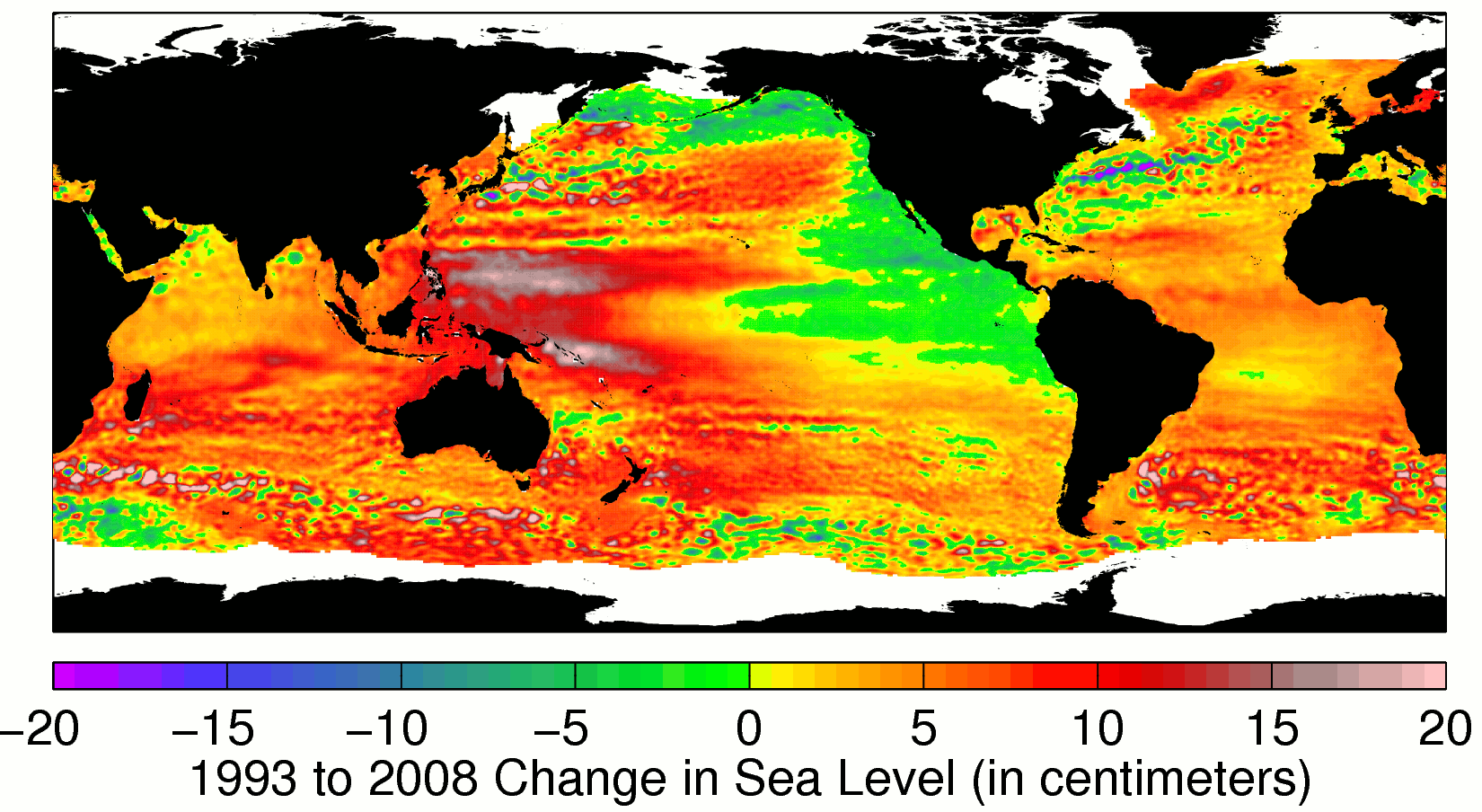
    So sea level rise is complicated, and the bathtub analogy just doesn’t cut it. Given all that, the image below is not that surprising. It shows how sea levels changed between 1993 and 2008 (yellow and red show rising sea levels, blue and green show falling). Since the early 1990s, space satellites have given us a bird’s-eye view of sea level change. They tell us that that sea level, averaged over the whole planet, has gone up by about 4.5 cm (1.8 inches) since 1993 — clear evidence of global warming. (To recap: global warming causes a) ocean water to warm up, expand, and take up more space; and b) glaciers to melt which add more water to the oceans.) But the patterns of sea level change tell a much more complicated story.

    Most of the regional variations seen over this 16-year trend are related to changes in the ocean currents rather than the movement or melting of ice. Australia for example, where 80% of the population lives near the coast, has seen sea levels rise much more quickly than the rest of the planet. Meanwhile, along the California coast, sea level has stayed steady or even fallen a bit.

    The question is whether these regional differences are part of natural climate cycles, or an effect of global warming? The answer is probably both, and scientists around the world are working hard to tell the difference.

    So where does all this leave my friend’s bathtub analogy? High and dry, of course.

    The change in the world’s sea level between 1993 and 2008. Black areas are land; colored are the oceans. Yellow and red regions show rising sea level, while green and blue regions show falling sea level. White regions are missing data during parts of the year. Nearly everywhere, sea level is rising, and the global average is clearly rising fast. But the patterns of sea level change (the regional variations) are complicated. </br></br>Credit: Altimeter data products include data from TOPEX/Poseidon, Jason-1 and Jason-2 and other satellites. Data products come from Ssalto/Duacs, distributed by Aviso, with support from CNES. The change in the world’s sea level between 1993 and 2008. Black areas are land; colored are the oceans. Yellow and red regions show rising sea level, while green and blue regions show falling sea level. White regions are missing data during parts of the year. Nearly everywhere, sea level is rising, and the global average is clearly rising fast. But the patterns of sea level change (the regional variations) are complicated.

    Credit: Altimeter data products include data from TOPEX/Poseidon, Jason-1 and Jason-2 and other satellites. Data products come from Ssalto/Duacs, distributed by Aviso, with support from CNES.

    Editor’s note: If you’re interested in how sea level is changing around the globe check out our Climate Time Machine and Sea Level Viewer.