Category: Uncategorized

  • Why do sea levels not rise uniformly around the world?

    While reading the article Hawaii’s Beaches Are in Retreat, and Its Way of Life May Follow on The New York Times’s website, I was surprised to find out that sea levels do not rise around the world at a uniform rate. Assuming that the global warming is true (I think there’s enough credible evidence for it – but I don’t want a debate on the veracity of global warming – therefore, just assume it’s true), what may be the reason for the non-uniformity?

    asked May 15 ’12 at 15:35

    1 Answer

    up vote 5 down vote accepted

    There’s a good article about this at http://climate.nasa.gov/blogs/index.cfm?FuseAction=ShowBlog&NewsID=239. Since it’s a NASA blog I assume it’s reasonably trustworthy. The key points are:

    • ocean currents and the prevailing wind patterns cause water build ups in some areas
    • ocean temperatures vary and higher temperature areas have higher levels because the water density is lower
    • the weight of ice sheets affect the Earth’s axis of rotation and the water distribution

    I must admit I’m not sure about the last of these as it seems to me it would be a very small effect. Finally, another longer term effect I’ve seen mentioned in some discussions is that land rises as it’s freed from the weight of the ice. The north of the UK is still rising, and the south still sinking, after the ice melted at the end of the last ice age.

    answered May 15 ’12 at 15:59
    John Rennie
    54.5k13996
    Wrt your third point, I think the issue is also that some pieces of land rise due to less ice sheets elsewhere. So the apparent sea level rise at those locations is less. – Bernhard May 15 ’12 at 17:00
    @Bernhard sort of. What happened during the last glacial was that the crust under the ice sheets was pushed down by IIRC several hundred meters while crust south of the icesheets rose by a similar amount. With the ice sheets gone the crust is flexing back to its pre-glacial shape. in the extreme case, part of northern Canada is rising almost 2cm/year. In coastal areas mean sea level rises or falls with the movement of the crust. en.wikipedia.org/wiki/Post-glacial_rebound – Dan Neely May 16 ’12 at 17:46
    There’s very small (0.7ms/century) shift in the length of the day due to mass distribution changes. I doubt this is enough to affect the distribution of the ocean meaningfully. – Dan Neely May 16 ’12 at 17:47

  • From Tim Flannery (Climate Council)

    4:09 PM (3 hours ago)

    to me
    Images are not displayed. Display images below – Always display images from info@climatecouncil.org.au
    Dear INGA,Thank you so much for your support!

    In just a few days, over 30,000 of us have banded together to power the new Climate Council. It’s the biggest crowdfunding project ever in Australia (at least that we’ve been able to find). So far we’ve already raised $969,000 together! That’s about half the annual budget we had at the Government-funded Commission.

    Thanks to you, we’ve been able to get straight back to it.

    You’ve probably read about the world’s largest climate science body releasing the IPCC report this week. We spent most of the last week analysing the report, and talking to media across the country about what it means.

    The full report is over 2,000 pages, so here are three quick ways to get up to speed:

    READ: our five minute summary of the latest science.

    SHARE: our infographic to update friends and family.

    TUNE IN: for a personal briefing tomorrow at 6.30pm. As a Founding Friend of the Council, we’d love to give you a chance to talk directly with one of the world’s experts, Climate Councillor Prof. Will Steffen. Join us at 6.30pm AEST tomorrow, Thursday October 3, for a live video discussion on our website. Email with any questions you’d like Prof. Steffen to address.

    Thank you so much for making this all possible. When we put out the call for support last week we had no idea whether the public would respond. In just a few days, so many of you extraordinary people contacted us to chip in donations, or volunteer your help. The Climate Council is powered by you and it’s already making waves around the world – we’ve been contacted by so many scientists overseas who are inspired to help and support us.

    Your support means that we’ll be able to keep providing independent, expert information on climate change. Perhaps most importantly, it brought us together: a community of over 30,000 Australians — and growing by the day — who can keep working together.

    On behalf of the team and all the Councillors, thank you.
    Tim Flannery

    PS – It’s not too late to donate and support the council. At the moment we are up to $969,000. Can you help take us to $1million by sharing this email with your friends and family? Our new, improved donation page is https://secure.climatecouncil.org.au


    You’re receiving this because you signed up for updates from the Climate Council.

    Reply
    Forward
    Click here
  • PUP to be a power in Senate

    PUP to be a power in Senate

    AAP By Lisa Martin – October 2, 2013, 7:13 pm

    Mining magnate Clive Palmer’s political party looks set to hold the balance of power when the new Senate takes shape next July.

    The coalition will have 33 senators but needs six more votes to pass legislation.

    Labor with 26 seats and the Greens with nine – possibly 10 after a recount – are likely to vote together to oppose government plans.

    Both parties oppose repealing the carbon tax, which Prime Minister Tony Abbott has at the top of his legislative priorities.

    The coalition would need to seek support from the eight senators on the crossbench, including five independent/micro party senators.

    They’re independent Nick Xenophon (SA), Democratic Labor Party John Madigan (Vic) and three newcomers: Liberal Democratic Party David Leyonhjelm (NSW), Australian Motoring Enthusiasts Party Ricky Muir (Vic) and Family First’s Bob Day (SA).

    The other newcomers are Palmer United Party (PUP) senators Glenn Lazarus from Queensland, Jacqui Lambie from Tasmania and probably Zhenya Wang from Western Australia.

    However senator-elect Wang is facing a partial vote recount in WA, requested by the man he seems to have ousted on preferences – Australian Greens senator Scott Ludlam.

    Mr Abbott will be able to count on the PUP senators, Mr Day and Senator Madigan since all have publicly opposed the carbon tax.

    But Mr Abbott may have tough negotiations ahead with Senator Xenophon, Senator-elect Muir, and Senator-elect Leyonhjelm.

    Senator Xenophon supports the repeal of the tax but wants it replaced by a model developed by Frontier Economics, which rewards low-emission industries and punishes high-emission polluters.

    The Liberal Democratic Party’s policies state that, should evidence become compelling that global warming is due to human activity, the party would favour market-based options.

    The Australian Motoring Enthusiast Party’s stance is not clear.

    Its environmental policy is to support a balanced approach towards sustainability of the environment and the use of the environment, both for the survival of mankind and for the unimpeded recreational use of the environment.

    However, the party also advocates removing the need for government to waste time on the introduction of “nanny-rules” to protect ourselves from ourselves.

    Mr Abbott’s signature paid parental leave scheme may pass parliament before the changeover next year, if he agrees to the Greens push for a $50,000 payout cap.


  • Australia’s warmest 12-month period on record, again

    Climate change and variability

    Australia’s warmest 12-month period on record, again

    Australia’s warmest September on record

    Australia’s record for warmest 12-month period has been broken for a second consecutive month. This continues a remarkable sequence of warmer-than-average months for Australia since June 2012.

    September 2013 was easily Australia’s warmest September on record. The national average temperature for September was +2.75 °C above the long-term (1961–1990) average, which also sets a record for Australia’s largest positive anomaly for any monthly mean temperature. The previous record of +2.66 °C was set in April 2005.

    The mean temperature for Australia, averaged over the 12 months from October 2012 to September 2013, was 1.25 °C above the long-term average. This was also 0.17 °C warmer than any 12-month period prior to 2013.

    The previous record, set over September 2012 to August 2013, was +1.11 °C above the long-term average, and the record preceding the current warm spell was +1.08 °C, set between February 2005 and January 2006.

    Temperatures for the calendar year to date (January to September) have also been the warmest on record, at 1.31 °C above the long-term average, well above the figure set for January to September 2005 (+1.07 °C). 2005 currently holds the record for Australia’s warmest calendar year.

    The past 18 months have been characterised by widespread heat across Australia. The mean temperature has been above average over the entire continent.

    October 2012 to September 2013 mean temperature deciles for Australia showing 12-month temperatures were the highest on record for 39% of Australia.October 2012 to September 2013 mean temperature deciles for Australia showing 12-month temperatures were the highest on record for 39% of Australia.

    In the past 12-month period a large number of mean temperature records have fallen across Australia including:

    • Australia’s warmest month on record (January)
    • Australia’s warmest September on record
    • Australia’s largest positive monthly anomaly on record (September)
    • Australia’s warmest summer on record (December 2012 to February 2013)
    • Australia’s warmest January to September period on record
    • Australia’s warmest 12-month period on record (broken twice, for the periods ending August and September)
    • Indeed, Australia’s warmest period on record for all periods 1 to 18 months long ending September 2013

    Two significant daily maximum temperature records were also set this year:

    • Australia’s hottest summer day on record (7 January)
    • Australia’s warmest winter day on record (31 August)

    The periods inclusive of September 2013 have also resulted in numerous State and Territory mean temperature records including:

    • Warmest September on record for South Australia, Victoria, New South Wales, Queensland and the Northern Territory
    • Largest positive monthly anomaly on record for South Australia and Queensland (September)
    • The warmest January to September period on record for South Australia, Victoria, New South Wales and the Northern Territory, and also for Melbourne, Sydney and Adelaide
    • The warmest 12-month period on record for South Australia, the Northern Territory, and southern Australia

    In addition to these records, and those set during the heat events of January and autumn, many individual stations have set records for early season heat or September record highs.

    Generally above-average temperatures have persisted with few breaks since September 2012. The period has been characterised by long periods of warmer-than-average days and a distinct lack of cold weather. Nights have also been warmer than average, but less so than daytime temperatures.

    Every calendar month since September 2012 has recorded temperatures at least 0.5 °C above average, with eight of those thirteen months topping 1.0 °C above average including January, April, May, July, August and September of 2013. Widespread record warmth has also been recorded in the oceans around Australia.

    Monthly mean temperature anomalies for September 2012 to September 2013Monthly mean temperature anomalies for September 2012 to September 2013.

    The Remainder of 2013

    The year-to-date temperature anomaly is currently so large that mean temperatures during the remaining three months of 2013 only need to be slightly above average for the year to set a new calendar year record. An anomaly of just +0.24 °C for the remainder of the year (i.e. October to December) will result in 2013 equalling the record held by 2005. Zero anomalies for the last three months of the year will result in 2013 finishing as the second-warmest year on record.

    It also remains possible that the 12-month mean temperature record will be equalled or broken again before the end of the year, for the periods ending October, November and/or December.

    The Bureau’s latest seasonal outlook indicates that both maximum and minimum temperatures are most likely to be above average over most of Australia. The outlook for warmer-than-average temperatures over the remainder of the year is consistent with the Bureau’s knowledge of background temperature trends, and the well-above-average sea surface temperatures that currently surround Australia. Australian temperatures are now on average more than 1 °C warmer than during the 1950s.

    Running means for Australian temperature anomalies for 12-month periods ending September 2013. Vertical grid lines mark 12-month periods commencing January 1920, January 1930, etc.
    Running means for Australian temperature anomalies for 12-month periods ending September 2013. Vertical grid lines mark 12-month periods commencing January 1920, January 1930, etc.

  • The IPCC report: busting the climate myths

    The IPCC report: busting the climate myths

    Updated Mon 30 Sep 2013, 7:02am AEST

    The release of the IPCC Fifth Assessment Report provides details that stamp out the myths and distortions of those trying to discredit climate science. Has the Earth stopped warming over the past 15 years? The answer is an emphatic no, writes Will Steffen.

    The highly anticipated IPCC Fifth Assessment Report has generated much media interest. A good deal of this, however, has consisted of earlier media reports and articles that broke the embargo on the release of any information from the draft IPCC report.

    Such media efforts, based on leaked versions of the IPCC draft, were often aimed at distorting, misrepresenting or undermining the IPCC’s assessment. This type of media coverage frequently states or infers that the warming of the Earth has stopped and thus action on climate change can be slowed or de-prioritised.

    This isn’t the first time we’ve seen such behaviour. The appearance of the “Climategate” hacked emails in advance of the 2009 Copenhagen climate conference was designed to discredit the mainstream climate science community and hijack the narrative on climate science. So seeding doubt and promulgating misleading science is nothing new.

    Now that the IPCC report has been finalised and released, we can analyse, based on the actual substance of the report, these earlier myths and misleading claims.

    So has the Earth stopped warming over the past 15 years? The answer, based on the reputable science contained in the IPCC report, is an emphatic NO!

    Here are the facts:

    The Earth has warmed significantly over the last century, and particularly strongly since 1970 up to the present. The global average air temperature has risen by 0.89 degrees Celsius over the 1901-2012 period, and the decade 2001-2010 was the warmest on record.

    But global average air temperature is only a very small part of the warming story, as the atmosphere absorbs only 3 per cent of the additional heat trapped by the increasing concentration of greenhouse gases. By far the biggest player in the climate system is the ocean.

    Over 90 per cent of the warming since the mid-20th century has occurred in the ocean, and the heat content of the ocean has risen steadily since about 1970 with no pause or slowing of the rate over the past 15 years. That is really the “smoking gun” of warming. But there is even more evidence of a strongly warming Earth.

    The ice cover over the Arctic Ocean is decreasing rapidly, at a rate of about 4 per cent per decade since 1979. Such rapid ice loss is unprecedented in the last 2,000 years.

    Sea level has risen by 19 cm over the 1900-2010 period. This observed rate of rise over the past century is unusually high in the context of the last 2,000 years.

    Glaciers and ice sheets around the world are shrinking and losing mass. The combined rate of mass loss from the large polar ice sheets on Greenland and Antarctica was about 350 billion tonnes per year for the period 2002-2011, and is accelerating.

    It is even more telling that the rate of sea-level rise, the rate of decrease of Arctic sea ice extent, and the rate of mass loss from Greenland and Antarctica have all increased in the period from the 1990s to the present, compared to earlier periods. This is exactly the opposite of what one would expect if warming of the Earth is slowing or has stopped.

    All of this evidence points to the continued strong warming of the Earth since the mid-20th century up to the present, in stark contrast to the erroneous reports purported to be based on leaked drafts of the IPCC assessment.

    A second example of distortion and misrepresentation is the claim that, according to the IPCC, the climate is less sensitive to increases in greenhouse gas concentrations in the atmosphere than was earlier thought. The IPCC has said no such thing. Here are the facts:

    The range of estimated climate sensitivity in the Fifth Assessment Report, 1.5-4.5C per doubling of atmospheric carbon dioxide concentration, is slightly larger than that reported in the 2007 report (2.0-4.5C). The 0.5C decrease in the lower end of the range reflects estimates using the records of atmosphere and ocean temperature change in the contemporary period.

    Estimates of climate sensitivity using climate model simulations and observational records from past climate changes (for example, the transition of the Earth from the last ice age to the present warm period) give estimates towards the mid and upper end of the range, while methods based on contemporary observations give estimates towards the lower end of the range. The IPCC gives no estimate of a “most likely” value of climate sensitivity.

    In summary, there has been no significant change in our estimate of climate sensitivity since the publication of the IPCC Fourth Assessment Report in 2007.

    So much for the myths and distortions of those trying to discredit climate science. What actually are the key messages of the IPCC Fifth Assessment Report?

    1. There is stronger evidence that the Earth’s climate is warming – rising air and ocean temperature, loss of mass from glaciers and ice sheets, and rising sea level.
    2. Scientists are more certain than ever that most of the warming since 1950 has been caused by human activities, primarily the emission of carbon dioxide from fossil fuel combustion.
    3. A warming climate is influencing the frequency and severity of many extreme weather events and is changing rainfall patterns, creating risks for human well-being, the economy and the environment.
    4. Stabilising the climate system will require substantial and sustained reductions of carbon dioxide emissions, and those of other greenhouse gases.

    As the Climate Commission, and now the Climate Council, often say – this is the critical decade to get on with the job of reducing emissions quickly and deeply.

    Professor Will Steffen is executive director of the ANU Climate Change Institute and a member of the Australian Climate

  • Climate change study finds Australia suffers more than most G20 countries

    Climate change study finds Australia suffers more than most G20 countries

    Exposure worsens rapidly, with stresses on water increasing and the cost of natural disasters running second only to China

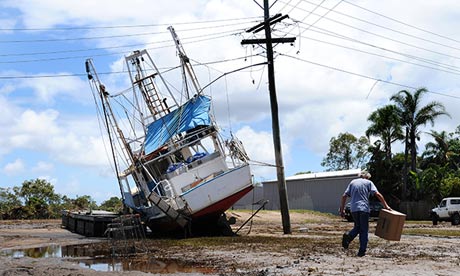
    Cyclone

    Cyclone damage in Queensland, where Bundaberg flooded in February. Photograph: Sabrina Lauriston/AAP

    Australia‘s exposure to climate change has worsened more rapidly than in any other major economy in the past two years, with stresses on water supplies increasing and the cost of natural disasters running second only to China, a report has found.

    The study, compiled by HSBC, found that temperatures in Australia had risen faster than in any other G20 country over the past two years – up by 0.39C to 18.9C on a decade average basis. Deterioration in water resources is also a major issue, with Australia, along with Saudi Arabia, experiencing the worst increases.

    HSBC concluded that India, China, Indonesia, South Africa and Brazil are the countries most vulnerable to climate change, based on the challenges posed by climate change and their ability to respond to them.

    However, Australia’s position appears to be worsening, with the country now placed as the fifth worst in the G20 for climate change exposure, down five places from HSBC’s last climate report in 2011. This separate ranking is based on a country’s exposure to temperature increases, water stresses and extreme events.

    HSBC said that this downgrading was largely due to Australia’s G20-leading temperature increase, although it is clear that water stresses and natural disasters have also taken their toll.

    Australia’s water resources per capita have dropped 6.8% in the past two years, according to the report. Meanwhile, Australia spends 0.24% of GDP on recovery from disasters caused by natural events such as floods and cyclones, second only to China (0.30%).

    According to the report, damage caused by natural disasters hit $US260bn in the decade to 2012.

    On Friday, the International Climate Change Partnership’s authoritative climate change report revealed that Australia was on course for a 6C temperature increase on its warmest days by 2100. Australia can also expect to lose many bird, reptile and mammal species, as well as the Kakadu wetlands in the Northern Territory.

    Nathan Fabian, CEO of the Investor Group on Climate Change, told Guardian Australia that climate change posed a significant economic challenge to Australia.

    “The transition to a clean energy economy is a major issue for Australia as it is way too emissions intensive than it should be,” he said. “This provides a high degree of economic exposure.

    “Our research has also shown that key sectors which Australia invests in, such as mining and minerals, manufacturing and transport, all have significant physical vulnerabilities which we expect to be more severe by 2030.

    “That means businesses have to build resilience within assets and adapt by relocation if possible. It’s a critical issue for Australian companies and it’s starting to filter into conversations in boardrooms.”

    Daily email

    close

    Get the Guardian’s daily Australia email

    Our editors’ picks for the day’s top news and commentary delivered to your inbox every weekday.

    Sign up for the daily email

    • Get £11 off the Guardian and Observer  
      Sign up now and instantly receive vouchers for £11 off the Guardian and Observer papers. Redeemable for today’s paper and every paper for two weeks.
      Get your voucher

    Today’s best video

    Guardian Bookshop