Category: Uncategorized

  • It’s time to connect the dots between rising sea levels and rebuilding

    September 23, 2013 Commentary

    It’s time to connect the dots between rising sea levels and rebuilding

    hero
    This Oct. 30, 2012 aerial file photo shows flooding on the New Jersey shoreline caused by Superstorm Sandy. (AP Photo/U.S. Air Force, Master Sgt. Mark C. Olsen, File)
    Chris Sturm, of NJ Future

    By Chris Sturm, of NJ Future

    Setting aside debates about climate change, it’s no secret that sea levels are rising in New Jersey. Some Research scientists at Rutgers University expect sea levels to rise 17 inches by 2050 and 44 inches by 2100.

    This means that, as time goes on, more and more low-lying coastal areas will be completely underwater. Effects will be magnified during storm events, increasing the severity of flooding in coastal and bay areas. By 2100 Atlantic City, for example, is predicted to experience floods every year or two as severe as those that today happen only once a century.

    What’s been kept under wraps, though, is whether the state’s Sandy rebuilding efforts will acknowledge sea-level rise and help New Jersey’s towns, counties, and infrastructure agencies to plan accordingly.

    Perhaps the most obvious place to address the risks posed by sea-level rise is the state’s Hazard Mitigation Plan (HMP). This plan, required as a condition of receiving federal disaster aid, must assess our vulnerability to an array of natural and human-made hazards and recommend ways to minimize future harm. So far, no public information has been released on the planning effort, which must be completed by April 2014, so there’s no indication whether sea-level rise will be included.

    The same question applies to a parallel effort at the county level. The Christie administration is directing nearly $3 million of federal rebuilding aid to allow 14 counties to update their own hazard mitigation plans. This investment in mitigation planning could mark a turning point in how New Jersey prepares for disasters. But, like the state HMP, we don’t yet know whether the grants will require countywide plans to incorporate projections for rising sea levels and identify areas likely to be either underwater or inundated by storm surge. It’s hard to imagine how plans can keep homes, businesses, and infrastructure out of harm’s way without such a vulnerability assessment.

    Finally, a similar situation is playing out for a local grant program. The Christie administration has made $5 million available to towns and counties through its post-Sandy planning assistance grant program. But so far, the words “sea-level rise” have not been included in this effort, nor has the state provided localities any guidance on how best to assess risks. The administration is also granting funds to six universities to evaluate targeted flood-mitigation strategies in areas affected by Superstorm Sandy that may be vulnerable to future flooding, but it has not explained how this effort will be integrated with other required and voluntary planning efforts.

    In contrast, neighboring state governments offer tools and guidance to their communities to help them protect constituents from sea level rise and other climate impacts. New York State’s Reconstruction Rising offers $25 million in grants and a toolkit for assessing sea-level rise out to the year 2100. Connecticut has released a Climate Preparedness Plan and is creating a climate resiliency research center to help coastal communities. To the south, Delaware has assessed its vulnerability to climate change and offers its communities free climate preparedness training, while Maryland’s initiatives include new sea level rise projections to help decision makers plan.

    Ironically, several New Jersey institutions make available excellent planning tools, including Rutgers University’s NJ Flood Mapper and Getting to Resilience tools, the Department of Environmental Protection’s Coastal Community Vulnerability Assessment and Mapping Protocol, and the forthcoming sea-level rise web tool and analysis from Princeton-based Climate Central. However, the state’s rebuilding efforts have not yet acknowledged these tools.

    Local governments ravaged by Hurricane Sandy are scrambling to get residents and business owners back on their feet, and also to make sure they won’t be damaged when the next storm hits. Communities need all the help they can get to be “smarter than the next storm,” and all the ones after that. Now is the time for state government to connect the dots between rising sea levels and rebuilding, so that its investments in planning are not wasted.

    _____________________________________________________

    Chris Sturm is the Senior Director of State Policy for NJ Future. This essay first appeared on NJ Spotlight, an independent online news service on issues critical to New Jersey, makes its in-depth reporting available to NewsWorks.

  • Mud Volcano? Weird Island Appears After Pakistan Earthquake

    Mud Volcano? Weird Island Appears After Pakistan Earthquake

    Becky Oskin, OurAmazingPlanet Staff Writer   |   September 24, 2013 06:28pm ET
    612
    94
    5

    Share

    1
    Pakistan earthquake
    The highest intensity shaking is marked in orange, near the epicenter of the Sept. 24 Pakistan earthquake.
    Credit: USGS

    A new island emerged from the ocean offshore of the city of Gwadar, Pakistan, after a strong magnitude-7.7 earthquake shook the country this morning (Sept. 24).

    The mound appears to be 20 to 40 feet (6 to 12 meters) high and 100 feet (30 m) wide, DIG Gwadar Moazzam Jah, a district police officer, told Pakistan’s Geo News. It rose out of the sea at a spot located about 350 feet (100 m) from the coast, he said.

    The news sparked lively chatter among geologists, who debated whether the hill was a landslide, a fault scarp or even a hoax. A fault scarp marks vertical displacement along a fault, anything from a small step to a huge, steep cliff.


    Scientists are still far from consensus, but many think that Pakistan’s newest piece of land may be a mud volcano.

    Geologist Bob Yeats, an expert on Pakistan’s earthquake hazards, said he’s waiting until he hears from his colleagues in Pakistan (it’s currently night there) before judging the case. The two most likely possibilities are a landslide or a mud volcano, Yeats told LiveScience’s OurAmazingPlanet.

    Gwadar island
    A new island offshore of the city of Gwadar in Pakistan appeared after today’s (Sept. 24) magnitude-7.7 earthquake.
    Credit: Geo news

    Yeats said Gwadar is several hundred kilometers southwest of the earthquake’s epicenter, making it highly unlikely that the new island is a fault scarp.

    “[The island] is a long way from where they reported the earthquake. We’re looking at two different things,” said Yeats, an emeritus professor at Oregon State University.

    A mud volcano is a likely possibility because Gwadar’s coastline already has several of the gurgling, steamy cones, both onshore and at sea. One suddenly popped up where sea level was 30 to 60 meters (100 to 200 feet) deep on Nov. 26, 2010, creating an island. NASA satellites snapped a photo of the birth. [7 Ways the Earth Changes in the Blink of an Eye]

    And in 1945, the magnitude-8.1 Makran temblor triggered the formation of mud volcanoes offshore of Gwadar, according to a study on mud volcanoes in Pakistan published in 2005. A recent study in the journal Nature Geoscience also suggests the 1945 earthquake released tons of methane from the seafloor.

    Get ready to rumble

    Mud volcanoes appear when sediments like silt and clay become pressurized by hot gas trapped underground. A subduction zone beneath Pakistan supplies the tectonic activity that heats and holds the gas. The Arabian and Eurasian tectonic plates collide offshore of Pakistan, forming a subduction zone, but today’s earthquake was onshore and mostly strike-slip — each side of the fault moved horizontally.

    Mud volcanoes burble up during earthquakes because the shaking releases mud and water that are trapped beneath barriers in seafloor sediments.

    “For example, a clay or shale layer can be impermeable, but if fractured during an earthquake, could release mud and water that was under pressure below the layer. Or a water-rich clay layer could undergo liquefaction that would be released along fractures in the sediments,” explained James Hein, a senior scientist with the U.S. Geological Survey in Santa Cruz, Calif. “Some think the island was there before the earthquake, and that would be very easy to check by looking at satellite photos of that area taken the week prior,” he said.

    Arabian sea mud volcano
    A new island formed by a mud volcano emerged offshore of Balochistan, Pakistan on Nov. 26, 2010, and the same spot about a year before it emerged.
    Credit: NASA Earth Observatory

    But Geologist Dave Petley, a landslide expert, thinks the island’s low, arcuate (or bow) shape — as seen in the few pictures released so far — suggests a rotational landslide, rather than a conical mud volcano. A rotational landslide moves along a rupture surface that is curved or concave, like the inside of a spoon.

    “We will need to wait until the morning to know. It is really very strange, and the pictures are just too indistinct to be able to tell,” said Petley, a professor at Durham University in the United Kingdom.

    The Arabian Sea isn’t the only spot on Earth to spout mud and gas when jiggled by earthquakes. In Japan, the town of Niikappu on the island of Hokkaido sports mud volcanoes that erupt after earthquakes, reports a study published in 1997 in the Journal of the Geological Society of Japan.

    The world’s most notorious mud volcano, Indonesia’s Lusi, destroyed a town in 2006. It may have been caused by an earthquake or by drilling operations nearby.

    Earthquakes also rattle geysers and real volcanoes. The 2002 Denali earthquake in Alaska changed the spurting schedule of Yellowstone National Park’s famous geysers for several months. And seismic shaking can sometimes cause a surge in eruptions at nearby volcanoes after an earthquake.

    Email Becky Oskin or follow her @beckyoskin. Follow us @OAPlanet, Facebook & Google+. Original article on LiveScience’s OurAmazingPlanet.

  • Antarctica’s underwater ice loss is more significant that scientists thought

    Antarctica’s underwater ice loss is more significant that scientists thought

    Sea ice loss remains a concern.


    Antarctica’s underwater ice loss is more significant that scientists thought
    Science Recorder | Rick Docksai | Wednesday, September 25, 2013

    Antarctica’s ice shelves have an “Achilles’ heel,” and it’s the melting that’s taking place beneath the surface, not on the surface, according to an international climate study newly published in the journal Nature Climate Change. The study urges scientists to pay more attention to sub-shelf melting, which in some glaciers accounts for 90% of the continent’s ongoing annual ice loss.

    Jonathan Bamber, a professor with the University of Bristol’s School of Geographical Sciences, coauthored the study with colleagues at Utrecht University and the University of California. The researchers relied on a combination of satellite data and computer-model simulations to track the present and future melting that the Antarctic glaciers’ surfaces and undersides are undergoing. The simulations repeatedly showed that what’s going on beneath the surface is as important as—if not more important than—any ice loss that scientists have been witnessing taking place aboveground.

    This underwater ice loss affects some ice shelves more than others. Bramber and his colleagues can already pinpoint some of the more affected ice shelves by looking at the current extent of their ice loss. Further research may quantify the underwater melt levels of many more.

    That Antarctica is losing ice is certainly not news to climate scientists. Topographic data collected over the last few decades has made clear that surface-level iceberg production and melting has been causing extended trends of continental ice shrinkage in much of the continent.

    That shrinkage amounted to about 70 gigatons of the continent’s land ice a year from 1992 through 2011. The continent’s sea ice made some shrinkages in many areas, as well, coupled with a few smaller increases in a few others as a direct result of the melting. This led to some slight increases in a few areas of the continent’s sea ice—increases that, while too small to compensate for the larger losses, still fueled some false claims by a few climate-change skeptics that “Antarctica’s ice is expanding.”

    Overall ice loss is not only happening, but there is even more of it taking place sub-surface than researchers may have thought, Bramber and his colleagues conclude. This challenges conventional thinking in that researchers over the last few decades have primarily focused on the surface-level processes of icebergs forming and breaking away from the main ice shelves. This, they believed, was the main driver of long-term ice loss.

    Bramber and his colleagues encourage scientists to reconsider. Recognizing the role of subsurface melting, which in many cases may be far larger than that of iceberg breakage, may be critical to a more precise understanding of how ice sheets may interact with oceans and the changing climate in the decades to come.


    Did we miss something? Send us tips, press releases, or ideas for stories: tips@sciencerecorder.com
  • Commonwealth customers: It’s time to divest 350.org

    Commonwealth customers: It’s time to divest

    Inbox
    x
    Charlie Wood – 350.org Australia <charlie@350.org>
    12:52 PM (1 hour ago)

    to me
    Images are not displayed. Display images below – Always display images from charlie@350.org

    Dear friend,

    Have you heard? Prime Minister Tony Abbott wants to change the law so that consumers like you and me can’t run divestment campaigns against companies that engage in environmentally destructive activities.

    Over the past six months, Market Forces and 350.org have been working hard to expose the Big 4 Bank’s multi-billion dollar support for the fossil fuel industry.

    More than 2800 of you have signed our open letter and you’ve pledged to shift over $42 million of your money if the Big Banks don’t stop funding damaging fossil fuel projects.

    Now it’s time to turn these pledges into action. There’s a reason Prime Minister Abbott wants to stop divestment campaigning – he knows it works. It’s time we show him just how well it works.

    Starting in October, we’ll be supporting our Melbourne members to close their ANZ accounts. And in early November, we’ll support Commonwealth Bank customers in Sydney, Brisbane, Canberra, Melbourne and Perth to do the same. We’ll be providing information to help you choose a bank that doesn’t invest in the fossil fuel industry.

    If you’re a Commonwealth Bank customer and you’re ready to switch banks, then register for one of the following events:

    We’ll be organising activities for other cities and banks in due course. Register your interest here.

    It’s time to seize our consumer power for good and show the Big 4 that we won’t stand by as they fund the destruction of our local communities, ecosystems and climate. This will also demonstrate why laws protecting our right to boycott environmentally destructive companies need to be protected.

    If you care what your money’s doing, then join us in the growing divestment movement.

    Warmest wishes,

    Charlie on behalf of 350.org Australia and Julien on behalf of Market Forces


    P.S. Here’s the news that the Abbott Government wants to make environmental boycotts illegal. These plans, if they even get up, won’t take effect until at least next year, so you’re safe if you choose to participate in our upcoming activities.

    P.P.S. There’s still time to register for our ANZ action in Melbourne. Sign up here.


    350.org is building a global movement to solve the climate crisis. Connect with us on Facebook and Twitter, and sign up for email alerts. You can help power our work by getting involved locally, sharing your story, and donating here. To change your email address or update your contact info, click here.

  • Is climate change already dangerous? (4): Tipping points and climate modelling

    Is climate change already dangerous? (4): Tipping points and climate modelling

    by David Spratt

    Fourth in a series

    A tipping point may be understood as a step change, or passing of a critical threshold, in a major earth-climate system component, where a small perturbation (a small push or change) unleashes a bigger change in the component.  Potsdam Institute Director, Prof. Hans Joachim Schellnhuber, says that tipping points “identify the most vulnerable components (tipping elements) of the Earth System, the critical warming thresholds where the respective Earth System elements flip into a qualitatively new state”.  These elements include ecosystems, major ocean and atmospheric circulation patterns, the polar ice sheets, and the land- and ocean-based carbon stores.

    This process is often tied to positive feedbacks, where a change in a component leads to other changes that eventually “feed back” onto the original change to amplify it.  The classic case in global warming (or, in reverse, cooling) is the ice-albedo feedback, where decreases (increases) in the ice cover area change surface reflectivity (albedo), trapping more (less) heat and producing further ice loss (gain).
    In some cases, passing one threshold will trigger further threshold events, for example where substantial releases from permafrost carbon stores increase warming, releasing more permafrost carbon but also pushing other systems, for example parts of the Antarctic ice sheet, past a threshold point.

    Once a tipping point is crossed, it is irreversible (under natural conditions) within certain time frames, so the consequence is to significantly affect the earth’s climate and ecosystems, for example by raising temperatures or greenhouse gas levels, or changing the efficiency of the land and ocean carbon sinks.  Given enough time and the right conditions, most processes (but not extinctions, for example) can be reversed.

    In a period of rapid warming, most major tipping points once crossed (ice sheet loss, large-scale land carbon store releases such as permafrost) are irreversible on human time frames running to a few generations, principally due to the longevity of atmospheric CO2 (several thousand years). Large-scale human interventions in slow-moving earth system tipping points might allow a tipping point to be reversed (for example, a large-scale atmospheric CO2 drawdown program, or solar radiation management).

    There is discussion, for example, that Arctic sea-ice loss is “easily reversible” in a cooling world, but that is easier said than done.  That would require greenhouse gas levels to be reduced significantly, below the level equivalent to the temperature at which the sea-ice system tipped in 2007, to produce a sufficiently cooler world.  This would be around 300–325 ppm CO2, compared to the present level of 400 ppm, so it is not so “easy” in the real world.

    The scientific literature on tipping points is relatively recent, with a significant contribution by Lenton, Held et al. in 2008 on “Tipping elements in the Earth’s climate system” in an issue of the journal Proceedings of the National Academy of Sciences devoted to the subject. However, our knowledge is limited because “a system-level understanding of critical Arctic processes and feedbacks is still lacking” (Maslowski, Kinney et al.) and “no serious efforts have been made so far to identify and qualify the interactions between various tipping points” (Schellnhuber).

    Climate models are not yet good at dealing with tipping points. This is partly in the nature of tipping points, where a particular and complex confluence of factors suddenly change a climate system characteristic and drives it to a different state. To model this, all the contributing factors and their forces have to well identified, as well as their particular interactions, plus the interactions between tipping points. Duarte, Lenton et al. conclude that “complex, nonlinear systems typically shift between alternative states in an abrupt, rather than a smooth manner, which is a challenge that climate models have not yet been able to adequately meet”.

    The classic case was the Arctic sea ice “big melt” in 2007. Many models, including those on which the 2007 IPCC report had relied to conclude that Arctic sea-ice was pretty much likely to remain till the end of the century, did not fully capture the dynamics of sea-ice loss. Thus when in 2007 the summer sea-ice extent dropped radically compared to previous years, some model-oriented researchers exclaimed that the Arctic was melting “a hundred years ahead of schedule”.

    Even today, papers are still being published with modelling that suggests a sea-ice free Arctic will not occur till mid-century. Given the observations, it’s difficult not to conclude that given a choice between their models and real-world observations, some modellers will always choose the former.

    In an overview of the current state of Arctic climate research, Maslowski, Kinney et al. conclude that: “Model limitations are hindering our ability to predict the future state of Arctic sea ice”, and that the majority of general climate models (GCMs) including those used in IPCC (2007) “have not been able to adequately reproduce observed multi-decadal sea-ice variability and trends in the pan-Arctic region”, and their ensemble mean trend in September Arctic sea-ice extent “is approximately 30 years behind the observed trend”.

    For example, what would be the impact of a sea-ice-free Arctic summer and the consequent amplified regional warming on the stability of the Greenland Ice Sheet (GIS)? Research does not yet provide a robust framework for considering such questions, yet most scientists if asked for their expert elicitation would probably say that it is hard to imagine the GIS doing anything other than melting at an accelerating rate and passing a critical tipping point in such circumstances.

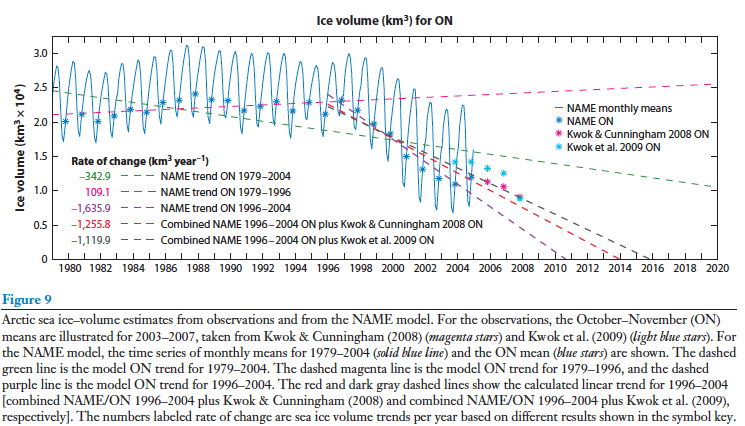
    The sea-ice model that has performed best (acronym NAME), is one of a new range of more specialised regional climate models developed by Dr Wieslaw Maslowski and colleagues. Maslowski is highly regarded, in part because his position at the American Naval Postgraduate School has given him unique access to half a century of Arctic sea-ice thickness scans from polar US military submarines. Maslowski told BBC News:

    In the past… we were just extrapolating into the future assuming that trends might persist as we’ve seen in recent times. Now we’re trying to be more systematic, and we’ve developed a regional Arctic climate model that’s very similar to the global climate models participating in IPCC assessments. We can run a fully coupled model for the past and present and see what our model will predict for the future in terms of the sea ice and the Arctic climate.

    He emphasizes “the need for detailed analyses of changes in sea ice thickness and volume to determine the actual rate of melt of Arctic sea ice”, and concludes that:

    The modeled evolution of Arctic sea ice volume appears to be much stronger correlated with changes in ice thickness than with ice extent as it shows a similar negative trend beginning around the mid-1990s. When considering this part of the sea ice–volume time series, one can estimate a negative trend of −1,120 km3 year−1 with a standard deviation of +/-2,353 km3 year−1 from combined model and observational estimates for October–November 1996–2007. Given the estimated trend and the volume estimate for October–November of 2007 at less than 9000 km3, one can project that at this rate it would take only 9 more years or until 2016 +/-3 years to reach a nearly ice-free Arctic Ocean in summer. Regardless of high uncertainty associated with such an estimate, it does provide a lower bound of the time range for projections of seasonal sea ice cover.

    The point cannot be emphasised enough that the best-performing Arctic sea-ice model projects 2016 +/-3 years to reach a nearly ice-free Arctic Ocean.

    Arctic sea ice volumes estimates from observations and from the NAME model
    (Maslowski, Kinney et al., 2012, Figure 9)

    The non-linear problem still plagues many Arctic GCMs, and indeed parts of the IPCC process which largely excludes tipping points and carbon cycle feedbacks from consideration, exemplified by the 2007 IPCC’s reticence on sea level rises. Several fundamental projections found in IPCC reports have consistently underestimated real-world observations in at least eight key areas.  In its February 2007 report on the physical basis of climate science, the IPCC said that Arctic sea-ice was responding sensitively to global warming: ‘While changes in winter sea-ice cover are moderate, late summer sea-ice is projected to disappear almost completely towards the end of the twenty first century.’ And apparently the forthcoming 2013 IPPC AR5 has omitted consideration of permafrost feedbacks – another glaring example of that body’s scientific reticence (Romm, 2012).

    • Concluding post: Summing up

    No comments:


    Post a Comment


    Subscribe to: Post Comments (Atom)

    RECEIVE NEW POSTS BY EMAIL (1-2 per week)

  • Wind and Rain Belts to Shift North as Planet Warms: Redistribution of Rainfall Could Make Middle East, Western US and Amazonia Drier

    Wind and Rain Belts to Shift North as Planet Warms: Redistribution of Rainfall Could Make Middle East, Western US and Amazonia Drier

    Sep. 23, 2013 — As humans continue to heat the planet, a northward shift of Earth’s wind and rain belts could make a broad swath of regions drier, including the Middle East, American West and Amazonia, while making Monsoon Asia and equatorial Africa wetter, says a new study in Proceedings of the National Academy of Sciences.


    Share This:

    The study authors base their prediction on the warming that brought Earth out of the last ice age, some 15,000 years ago. As the North Atlantic Ocean began to churn more vigorously, it melted Arctic sea ice, setting up a temperature contrast with the southern hemisphere where sea ice was expanding around Antarctica. The temperature gradient between the poles appears to have pushed the tropical rain belt and mid-latitude jet stream north, redistributing water in two bands around the planet.

    Today, with Arctic sea ice again in retreat, and the northern hemisphere heating up faster than the south, history could repeat itself. “If the kinds of changes we saw during the deglaciation were to occur today that would have a very big impact,” said the study’s lead author, Wallace Broecker, a climate scientist at Columbia University’s Lamont-Doherty Earth Observatory.

    Marshaling climate data collected from around the world, from tree-rings, polar ice cores, cave formations, and lake and ocean sediments, Broecker and study coauthor, Aaron Putnam, a climate scientist at Lamont-Doherty, hypothesize that the wind and rain belts shifted north from about 14,600 years ago to 12,700 years ago as the northern hemisphere was heating up.

    At the southern edge of the tropical rain belt, the great ancient Lake Tauca in the Bolivian Andes nearly dried up at this time while rivers in eastern Brazil slowed to a trickle and rain-fed stalagmites in the same region stopped growing. In the middle latitudes, the northward advance of the jet stream may have caused Lake Lisan, a precursor to the Dead Sea in Jordan’s Rift Valley, to shrink, along with several prehistoric lakes in the western U.S., including Lake Bonneville in present day Utah.

    Meanwhile, a northward shift of the tropical rains recharged the rivers that drain Venezuela’s Cariaco Basin and East Africa’s Lake Victoria and Lake Tanganyika. Stalagmites in China’s Hulu Cave grew bigger. Evidence for a stronger Asian monsoon during this time also shows up in the Greenland ice cores.

    The process worked in reverse from about 1300 to 1850, the study authors hypothesize, as northern Europe transitioned from the relatively warm medieval era to a colder period known as the Little Ice Age. Ocean circulation slowed, and sea ice in the North Atlantic Ocean expanded, the climate record shows. At the same time, rainfall declined in Monsoon Asia, leading to a series of droughts that have been linked to the decline of Cambodia’s ancient Khmer civilization, China’s Ming dynasty and the collapse of kingdoms in present day Vietnam, Myanmar and Thailand.

    In the southern hemisphere, the reconstruction of glacier extents in New Zealand’s Southern Alps suggests that the mid-latitudes may have been colder during medieval times, supporting the idea of a temperature contrast between the hemispheres that altered rain and wind patterns.

    A similar migration of Earth’s wind and rain belts happens each year. During boreal summer, the tropical rain belt and mid-latitude jet stream migrate north as the northern hemisphere heats up disproportionately to the south, with more continents to absorb the sun’s energy. As the northern hemisphere cools off in winter, the winds and rains revert south.

    Sometimes the winds and rains have rearranged themselves for longer periods of time. In the 1970s and 1980s, a southward shift of the tropical rain belt, attributed to air pollution cooling the northern hemisphere, is thought to have brought devastating drought to Africa’s Sahel region. The tropical rain belt has since reverted back, and may be moving north, the study authors say, as suggested by a number of recent droughts, including in Syria, northern China, western U.S., and northeastern Brazil.

    Consistent with the study, at least one climate model shows the tropical rain belt moving north as carbon dioxide levels climb and temperatures warm. “It’s really important to look at the paleo record,” said Dargan Frierson, an atmospheric scientist at University of Washington whose modeling work supports the authors’ hypothesis. “Those changes were huge, just like we’re expecting with global warming.”

    The study authors acknowledge that their hypothesis has some holes. In the past, changes in sea ice cover drove the temperature gradient between the two hemispheres while today rapidly rising industrial carbon emissions are responsible. So far, there is also no clear evidence that ocean circulation is increasing in the North Atlantic or that the monsoon rains over Asia are strengthening (though there is speculation that sulfate aerosols produced by burning fossil fuels may be masking this effect).

    As air pollution in the northern hemisphere declines, temperatures may warm, creating the kind of temperature contrast that could move the winds and rains north again, said Jeff Severinghaus, a climate scientist at Scripps Institution of Oceanography who was not involved in the study.

    “Sulfate aerosols will probably get cleaned up in the next few decades because of their effects on acid rain and health,” he said. “So Broecker and Putnam are probably on solid ground in predicting that northern warming will eventually greatly exceed southern warming.”

    Share this story on Facebook, Twitter, and Google:

    Other social bookmarking and sharing tools:


    Story Source:

    The above story is based on materials provided by The Earth Institute at Columbia University.

    Note: Materials may be edited for content and length. For further information, please contact the source cited above.


    APA

    MLA

    The Earth Institute at Columbia University (2013, September 23). Wind and rain belts to shift north as planet warms: Redistribution of rainfall could make Middle East, Western US and Amazonia drier. ScienceDaily. Retrieved September 24, 2013, from http://www.sciencedaily.com­ /releases/2013/09/130923155540.htm?utm_source=feedburner&utm_medium=email&utm_campaign=Feed%3A+sciencedaily%2Fearth_climate%2Foceanography+%28ScienceDaily%3A+Earth+%26+Climate+News+–+Oceanography%29

    Note: If no author is given, the source is cited instead.

    Search ScienceDaily

    Number of stories in archives: 143,410

    Find with keyword(s):
    Enter a keyword or phrase to search ScienceDaily’s archives for related news topics,
    the latest news stories, reference articles, science videos, images, and books.

    Recommend ScienceDaily on Facebook, Twitter, and Google:

    Other social bookmarking and sharing services:


    Interested in ad-free access? If you’d like to read ScienceDaily without ads, let us know!

    Social Networks


    Follow ScienceDaily on Facebook, Twitter,
    and Google:

    Recommend ScienceDaily on Facebook, Twitter, and Google +1:

    Other social bookmarking and sharing tools:

    Breaking News

    … from NewsDaily.com

    In Other News …

    Science Video News


    North American Monsoon

    Traveling to the coast of Western Mexico, U.S. researchers are studying the North American Monsoon, which brings humid air and heavy rain by blowing. …  > full story

    Strange Science News


    Free Subscriptions

    … from ScienceDaily

    Get the latest science news with our free email newsletters, updated daily and weekly. Or view hourly updated newsfeeds in your RSS reader:

    Feedback

    … we want to hear from you!

    Tell us what you think of ScienceDaily — we welcome both positive and negative comments. Have any problems using the site? Questions?