Category: Uncategorized

  • Norris, Garth (R. Oakeshott, MP)

    Norris, Garth (R. Oakeshott, MP) <Garth.Norris@aph.gov.au>
    1:26 PM (24 minutes ago)

    to Garth

    Good afternoon,


    I have received a number of inquiries since the announcement of Rob’s retirement regarding the continuation of work at the federal level to address the ongoing coastal erosion issues at Old Bar.


    Given the effort that has gone into getting this issue on to the political agenda federally, we are determined to ensure the incoming Member for Lyne has all the information he needs (sadly, there are no female candidates!) to pick up where we have left off. To this end, I have written a cover note with the attached briefing and attached it to the inch-thick file we have containing the various reports and correspondence we have kept over the past five years in relation to this issue.  The file does not contain correspondence from individual constituents, ensuring your privacy is protected, but rather reports from government, council, Worley Parsons etc. and formal correspondence from the Old Bar Beach Sand Replenishment Group.


    We encourage you to continue pressuring your local MPs on this issue and sincerely thank you for the time, effort and energy you have invested in trying to achieve the best possible outcome for your community. On a personal note, it has been a great privilege to work with all of you.

    Best wishes,

    Garth


    Garth Norris

    Electorate Officer

    Lyne Electorate Office

    Ph. 6584-2911

    Fax. 6584-2922

    E: garth.norris@aph.gov.au


  • EPA orders air pollution controls for fracked gas wells

    EPA orders air pollution controls for fracked gas wells

    By Renee Schoof – McClatchy Newspapers

    WASHINGTON —

    Air pollution from thousands of natural gas wells that are “fracked” every year will be reduced under regulations that the Environmental Protection Agency issued on Wednesday.

    It’s the first time the EPA has required air pollution controls at hydraulically fractured, or fracked, wells. The new rule targets smog-forming volatile organic compounds and air toxics that increase cancer risks. The same equipment also would trap methane, a potent heat-trapping gas in the atmosphere.

    President Barack Obama has called for expansion of natural gas production with fracking, but he has said it should be done without harming health and safety. While water pollution has gotten most of the attention, natural gas production, processing and delivery also produce large amounts of air pollution.

    The rule mainly would require companies to capture the burst of emissions that occurs as a well is being prepared for commercial production.

    Beginning in 2015, all fracked wells will be required to use “green completions.” The process involves truck-mounted equipment that captures the waste that flows for about three to 10 days after water, sand and chemicals are injected into a well. The captured gas and liquid hydrocarbons can be separated, treated and sold.

    Fort Worth, Texas, and other cities already require green completions, as do Colorado and Wyoming. The EPA estimates the equipment is used voluntarily in about 50 percent of wells today.

    “This levels the playing field,” said EPA air administrator Gina McCarthy. She said the rule was designed to promote responsible production of natural gas and to protect the public, and it will “do it in a way that more than pays for itself.”

    The American Petroleum Institute, the industry’s lobby group, had argued that the EPA underestimated the cost of the equipment and had asked for an exemption for many wells. The EPA didn’t grant that exemption but accepted the industry’s request for more time to build the equipment needed for green completions.

    The institute had no immediate comment about costs because it needed to review the details, said spokesman Carlton Carroll. “We were pleased that they recognized the need for a phase-in period,” he said.

    But the Western Energy Alliance, another trade group, said in a statement that the EPA overestimated the benefits and underestimated the costs of compliance. It said the rule would result in minimal environmental benefit and higher energy costs.

    Environmental groups said the benefits were broad.

    “These important rules start to cut down on air pollution that harms people living near wells, creates smog and warms the climate,” David McCabe, senior scientist with Clean Air Task Force, said in a statement. “They are a solid start, but we need to keep working to reduce pollution from the gas industry all the way from the well to the customer. People who live near compressors and equipment already in use need to see their air cleaned up as well. Unfortunately, these rules won’t do that.”

    The new rule doesn’t address much of the pollution from compressor stations, storage tanks and other equipment used in the natural gas industry.

    The Natural Resources Defense Council in a statement said it welcomed the requirement for green completions but was disappointed that they wouldn’t be required for 2 1/2 years, arguing that the equipment to capture the emissions could be built in less time.

    During the phase-in period until 2015, companies that don’t use green completions voluntarily will be required to burn off the gas instead. Large flares, up to 80 feet tall, burn off much of the volatile organic compounds, one of the components that make smog, but they produce nitrogen oxides, another smog-forming pollutant.

    The EPA’s McCarthy said that the requirement for flaring during the phase-in period before 2015 would “significantly help” reduce the smog that forms from natural gas production. Green completions, required for all wells after Jan. 1, 2015, will reduce smog more because, unlike flaring, it adds no additional pollutants, she said.

    The EPA said that green completions reduce the volatile organic compounds released to the air by nearly 95 percent.

    The Natural Resources Defense Council said in a report last month that green completions were only one of a number of technologies that should be required to control emissions of methane, the main component of natural gas, and other pollutants.

    The new regulation reduces methane as a co-benefit of reducing the other pollutants. McCarthy said that the EPA had no plans for more extensive requirements for methane reductions. Methane is 25 times more potent than carbon dioxide, the primary greenhouse gas, in driving climate change.

    The EPA was under a court order to issue the new pollution standards. The agency is required to review them every eight years by law. The existing standards were issued in 1985. Environmental groups sued the agency in 2009, saying it had failed to review the standards. The U.S. District Court for the District of Columbia required the EPA to take final action by Tuesday.

    (email: rschoof(at)mcclatchydc.com)
  • Global dimming

    Global dimming

    Posted by: Global Warming in NEWS 14 hours ago 0 6 Views

    Global dimming is an environmental phenomenon is much less known, but real, comes as a result of air pollution that occurs from the burning of fossil fuels for internal combustion engines in the industry and residences.

    Will collect and store the heat produced by the sun in our atmosphere, which made a kind of pollution called particulate emissions, especially sulfur dioxide, soot and ash also by the release of carbon dioxide. When these particles in the atmosphere absorb solar energy and reflect sunlight, which bound to the surface of the earth and take them into space.

    Particle pollution also changes the properties of the clouds form as “brown clouds” that are more reflective and produce less precipitation than their white counterparts. The reduction in the heat reaches the earth’s surface as a result of the two methods is what the researchers called global dimming.

    This phenomenon sounds like an ironic savior to climate change problems. It is believed that global dimming caused the droughts in Ethiopia in the 1970s and 80s where millions died, because the northern hemisphere oceans were not warm enough to allow rain formation.

    Global dimming is also hiding the true power of global warming: This phenomenon occurs due to impurities without limits greenhouse gas emissions, rapid warming has been observed and human health has been compromised without omitting disaster ecological, as indicated by the heat wave in Europe in 2003, the thousands killed by people occupied.

    How big a problem is global dimming? … According to studies done at the University of Columbia is a reduction of about 4% of the amount of solar radiation reaching the earth’s surface over a period 1961-1990, a time when the particulate emissions began to rise worldwide.

    However, a 2007 study by the National Aeronautics and Space Administration (NASA) found a decreasing level of the phenomenon of global dimming since 1990, probably due to the stringent standards adopted against pollution caused by the U.S. and Europe since that time.

    Click here to submit your review.


    Submit your review
    * Required Field


    Related Posts

    2013-08-27

  • Help us say goodbye to coal

    1 of 2
    Why this ad?
    iStockphoto20% Off – Today Only! – Save 20% off Credits at iStockphoto!

    Help us say goodbye to coal

    Inbox
    x
    Charlie Wood – 350.org Australia <charlie@350.org>
    10:02 AM (7 minutes ago)

    to me

    Dear friends,

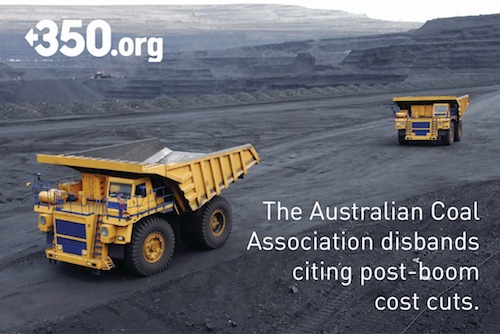
    In case you hadn’t heard, the Australian Coal Association (ACA) disbanded last week and their CEO Nikki Williams (who characterized Bill McKibben as a “threat to our economy”) has lost her job.

    A sign of decline, this is also a last-ditch effort by the industry to consolidate its power. In being absorbed by the Minerals Council, the ACA’s lobbying power will be centralised and it’ll be harder to tell what they’re up to.

    [click on this infographic to like and share it with friends]

    But, as the coal industry starts to wane, it’s critical that we keep them in the spotlight. That’s why, as we approach the season where companies hold their Annual General Meetings (AGM), we’re joining forces with friends in the climate movement to pressure the big banks and fossil fuel companies to come clean.

    If you’re someone with shares or simply someone who cares – we need you. Click here to volunteer to ask questions or attend actions during this year’s AGM season

    We’ll be shining a light on fossil fuel investments and asking how investors plan to exit an industry that is playing havoc with our communities, ecosystems and the climate.

    And we have the numbers on our side…

    • As the industry scrambles to increase its output, Australia is now swimming in a glut of coal and prices are at their lowest in four years.
    • Coal price forecasts are dropping by the day and production cuts are imminent. According to Goldman Sachs, investing in coal is an increasingly risky business.
    • It’s no wonder then that major investors like the World Bank and the European Investment Bank are restricting their funding of new coal.
    • Nor is it surprising that BHP will no longer fund new coal and, along with Rio Tinto, is starting to divest from its existing coal operations.
    • In fact, $US29 billion worth of coal projects have been deferred.
    • As the industry’s decline gains momentum, it’s time we turned our attention to the new kid on the block – renewables – which, compared to new coal and gas in Australia, are already cheaper and offer far more jobs.

    But, as Gandhi reminds us, a win seldom comes without a fight. Over the coming months, the industry will be lobbying hard to undermine Government regulation.

    That’s why we need you to help us expose the absurdities of expanding an industry that, increasingly, can no longer be financially and morally justified.

    We’ll help draw public attention to damaging new projects through our Summer Heat campaign. We’ll work hard to erode the industry’s social license through our divestment campaigns. And from October through to December, we’ll go direct to the heart of the industry – by putting the hard word on fossil fuel companies and investors during the upcoming AGM season.

    A clean energy future is within our reach.

    Join us this AGM season to help farewell coal and welcome in that beautiful, clean and safe future we all deserve.

    Yours with hope,

    Charlie, Blair, Aaron, Simon and the 350.org Australia team


    350.org is building a global movement to solve the climate crisis. Connect with us on Facebook and Twitter, and sign up for email alerts. You can help power our work by getting involved locally, sharing your story, and donating here. To change your email address or update your contact info, click here. 

  • Yosemite Fire Example of How Droughts Amplify Wildfires


    Yosemite Fire Example of How Droughts Amplify Wildfires

    • Published: August 26th, 2013 , Last Updated: August 26th, 2013
     525  277  123  2

    Repost This

    The massive Rim Fire near Yosemite National Park in California is an example of how drought can amplify wildfires in a warming, drying West.

    The fire, which now ranks as the 14th-largest wildfire in state history, has been racing through parched stands of oak and pine trees, and threatening some of the region’s iconic giant sequoia trees. The vegetation in the area, and indeed across much of central and southern California, is extremely dry, as the state has experienced its driest year-to-date.

    The Rim fire burning in central California, near Yosemite National Park.
    Credit: NASA.

    California received a record-low 4.58 inches of precipitation during the January-to-June time period. That total was 1.69 inches below the previous mark, set in 1898, according to the National Oceanic and Atmospheric Administration, and nearly 10 inches below average.

    A wetter-than-average July in California did little to alleviate drought conditions. Because the state typically receives very little rainfall during the summer, even light amounts of rainfall can push totals above average without putting a dent in the drought.

    To make matters worse, a major heat wave in July helped further dry out soils, making forests primed for fire.

    Parts of the West have been warming faster than the rest of the lower 48 states since the 1970s, a trend tied to climate change as well as natural climate variability.

    Anthony Westerling, a climate scientist at the University of California at Merced who studies how climate change effects wildfires, said that increasing temperatures promotes evaporation, which leads to more frequent instances of “extreme fire conditions.”

    “We have a lot of background variability from year to year and decade to decade in precipitation and rain and snow,” Westerling said. “But that (increasing) trend in temperature means that you have more evaporation” throughout the seasons, which is “really is exacerbating the natural drought periods.

    “These really extreme fire conditions with very, very low fuel moistures become that much more likely over time, even without any change in the frequency of low precipitation years.”

    A look at the Rim fire’s growth since last Wednesday.
    Click image to enlarge. Credit: ABC7News via Twitter

    The current tinderbox that is the Central Sierra Nevada Mountain range can be traced back to the winter, when precipitation suddenly cut off.

    “This last year we were seriously low on our snowpack in this part of the central Sierra Nevada,” Jerry Snyder, a Stanislaus National Forest spokesman, told Climate Central. The thickness and water content of spring snowpack and the timing of spring snowmelt, in particular, can influence wildfire risk during the summer. “We were only about 58 percent of normal, which meant that things dried out a lot sooner.”

    Jeanine Jones, an interstate resource manager with California’s Department of Water Resources, said record precipitation during the first part of the 2012-13 winter helped bolster statewide water supplies enough to allow California to avoid serious water supply concerns this summer. The dry second half of the winter, though, contributed to the state’s wildfire woes, Jones said.

    After January, “the faucet shut off,” Jones said. Such a bipolar winter, with little spring snow, may be a sign of winters to come in a changing climate, she said.

    Jolyne Lea, a hydrologist with the National Water and Climate Center, said some weather stations at high elevations in the Sierra Nevada Mountains had near record low snowpacks during the 2012-13 winter.

    As an example of how little snowpack remained this spring, according to Snyder, summer recreation in some parts of the Stanislaus National Forest began in June, a full month earlier than normal.

    Percent of average precipitation so far this year in California.
    Credit: NOAA.

    “Early snowmelt dried things out significantly all across the forest,” Snyder said. A July heat wave, brought multiple 100°F-plus days to the Stanislaus forest. (That same heat wave caused Death Valley, Calif., to come close to tying its record for the hottest temperature recorded on Earth) “That helped further dry things out,” and pushed fire weather danger very high due to the abundance of very dry vegetation, Snyder said.

    “There’s lots of stuff out there available to burn and conditions are right for it, so we’re having a really serious problem trying to corral this fire,” he said.

    The conditions that have contributed to the explosive growth of the Rim Fire have become more common across much of the West in recent decades.

    In the western states, including California, years with above-average temperatures, reduced spring snowpack, and early snowmelt tend to be years with bigger, longer-lasting fires. Research has also shown a general shift in forest fire ecology across the West, with a significant increase in the number of large, long-duration wildfires in many areas starting in the mid-1980s, a trend that has been attributed to a combination of climate change, land use change, and shifting fire suppression strategies, among other factors.

    In the mountains of the Sierra Nevada in particular, decades of government policies to extinguish many natural wildfires rather than letting them burn themselves out have led to a buildup of vegetation, or “fuels,” for today’s fires to burn. “We do regularly suppress fires allowing only a few natural starts to burn along with prescribed burning for resources benefits,” Snyder said. According to data Snyder provided, there were at least five large wildfires since 1973, including the Tuolumne Fire in 1987, which killed a firefighter and was the previous record holder for the largest wildfire in the Stanislaus National Forest.

    History of large wildfires that burned in the same area as the Rim Fire.
    Click image to enlarge. Credit: U.S. Forest Service.

    There are more large fires (greater than 10,000 acres) burning now than at any time in the past 40 years, and the total area burned each year has also increased. The top eight worst wildfire years since 1960, in terms of acres burned, have all occurred since 2000, according to NIFC data.

    According to Climate Central research, in some states, such as Idaho and Arizona, the number of large fires burning on U.S. Forest Service land each year has tripled or even quadrupled since the early 1970s. In other states, such as California and Wyoming, the number of large fires has doubled.

    The Rim fire is one of 36 large fires burning across the U.S. as of Tuesday, and firefighting resources are stretched so

  • Rising levels of acids in seas may endanger marine life, says study

    Rising levels of acids in seas may endanger marine life, says study

    Experts claim current rate of change is likely to be more than 10 times faster than it has ever been in Earth’s history

    Evening in the mudflats

    Oceans are one of the biggest areas of focus for current climate change research. Photograph: Federico Gambarini/dpa/Corbis

    Rapidly rising carbon dioxide levels in the atmosphere are causing a potential catastrophe in our oceans as they become more acidic, scientists have warned.

    Hans Poertner, professor of marine biology at the Alfred Wegener Institute in Germany, and co-author of a new study of the phenomenon, told the Guardian: “The current rate of change is likely to be more than 10 times faster than it has been in any of the evolutionary crises in the earth’s history.”

    Seawater is naturally slightly alkaline, but as oceans absorb CO2 from the air, their pH level falls gradually. Under the rapid escalation of greenhouse gas emissions, ocean acidification is gathering pace and many forms of marine life – especially species that build calcium-based shells – are under threat.

    Poertner said that if emissions continue to rise at “business as usual” rates, this would be potentially catastrophic for some species. Acidification is just one of a broader range of the problems facing the oceans and the combination of different effects is increasing the threat. Poertner said: “We are already seeing warm water coral reefs on a downslide due to a combination of various stressors, including [rising] temperature. Ocean acidification is still early in the process [but] it will exacerbate these effects as it develops and we will see more calcifying species suffering.”

    However, the process of acidification takes decades and the worst effects on some species could still be avoided if emissions are urgently reduced. “The ocean is changing already, mostly due to temperature – acidification will exacerbate those effects,” Poertner said.

    Evidence from prehistoric ocean life provides a comparison. “The [effects observed] among invertebrates resembles those seen during the Permian Triassic extinctions 250m years ago, when carbon dioxide was also involved. The carbon dioxide range at which we see this sensitivity [to acidification] kicking in are the ones expected for the later part of this century and beyond.”

    Oceans are one of the biggest areas of focus for current climate change research. The gradual warming of the deep oceans, as warmer water from the surface circulates gradually to lower depths, is thought to be a significant factor in the earth’s climate. New science suggests that the absorption of heat by the oceans is probably one of the reasons that the observed warming in the last 15 years has been at a slightly slower pace than previously, and this is likely to form an important part of next month’s Intergovernmental Panel on Climate Change (IPCC) report.

    The IPCC report, the first since 2007, will provide a comprehensive picture of our knowledge of climate change. It is expected to show that scientists are at least 95% certain that global warming is happening and caused by human activity, but that some uncertainties remain over the exact degree of the planet’s sensitivity to greenhouse gas increases.

    The new study, entitled Inhospitable Oceans, published on Monday in the peer-review journal Nature Climate Change, was based on examinations of five key components of ocean eco-systems: corals, echinoderms, molluscs, crustaceans and fish. All were found to be adversely affected by acidification: crustaceans were more resilient, while corals, molluscs and echinoderms were worst affected. The direct effects on fish were less clear.

    Astrid Wittmann, co-author of the paper, said species with low resilience could be outcompeted by those that were more vulnerable to acidification, and that further studies were needed, particularly on plants and plankton, which were left out of this research.