Category: Uncategorized

  • Is high speed rail value for economy

    Firstly corridors need to be found. transitting these through an already overtaxed metrop and central coast system and then up the north coast, subject to severe flooding and coastal erosion will be some of problems to be solved. Tinnelling is a very expensive process. We certainly need to ask if this concept is worth all the expense involved. Should we open a new airport and utilise air-buses to provide fast intercapital travel ?  There will be intense debate on this issue.


    There is no doubt that the creation of a 1748-kilometre high-speed rail network connecting Brisbane, Sydney, Canberra, and Melbourne is an exciting endeavour. But given the large capital costs – $114 billion – and impact on surrounding communities, as well as its potential positive impact on the economy…

    S7sm5yhh-1365663852
    The European experience with high speed rail suggests there are trade-offs with aviation depending on the routes.

    There is no doubt that the creation of a 1748-kilometre high-speed rail network connecting Brisbane, Sydney, Canberra, and Melbourne is an exciting endeavour. But given the large capital costs – $114 billion – and impact on surrounding communities, as well as its potential positive impact on the economy, a national debate is urgently required.

    The report on high-speed rail, launched by Transport Minister Anthony Albanese yesterday, hints at possible flow-on effects for the economy, suggesting that there will be an estimated $2.30 of benefits for each $1 spent.

    The proposition of getting from the city centres of Sydney to Melbourne in less than three hours is likely to be an interesting one to business and leisure travellers. Given that the Sydney – Melbourne route is currently the fifth busiest route in the world with Sydney-Brisbane not far behind, there is certainly a lot of demand for travelling fast along the large centres of Australia’s east coast. But the process of implementing a high-speed rail network in Australia is no easy feat.

    I am originally from Germany, where high-speed train connections between large cities are the norm. This is true for most West European cities, as is for China, Taiwan, Japan and Russia. But even German taxpayers — who are traditionally fascinated by high-tech engineering — often question the high cost involved with high speed rail and see conventional trains as better value for money. Given the distances involved (the proposed route is 1748 kilometres long), conventional trains are clearly not an option for Australia. Aviation might offer better value for money.

    The proposed high speed rail route is interesting and, despite its complexities, I am sure it will be implemented eventually. That day might be quite some time in the future, so rail enthusiasts may have to curb their enthusiasm. The required tunnelling of some 144 kilometres around Sydney, as well as the rest of the fairly long route, will be subject to a lengthy consultation process with affected local communities.

    Given the logistical challenges involved, the construction phase will be similarly lengthy. In fact, the first leg of the route (connecting Sydney and Canberra) is not to be expected to be in operation before 2035 — and that is if a government decision on this project would be made in the immediate future.

    But Australian airlines should not be too afraid of losing some of their most important domestic routes. In the long run, the proposed high speed rail connection might be of some benefit to aviation. Given the amount of air travel between these cities with Sydney at the centre, high speed trains could actually help Sydney airport with their predicted capacity problem.

    In Germany, the latest piece of high speed rail infrastructure built there was finished in 2002 at a cost of some 6 billion Euros. As a result of that high speed rail link, Lufthansa no longer flies the 150-kilometre route from Frankfurt to Cologne, but instead code-shares with the train operator and reserves an entire car on thirteen 300km/h high-speed trains a day. The experience in Europe has shown that airlines can use high speed rail to feed their hubs.

    There are several assumptions in the report that need to be addressed. They assume that the train will run at 350km/h. The fastest trains in Europe run currently 320km/h and that is the maximum speed, rather than the average speed.

    In order to be compatible with aviation, I believe that there need to be direct non stop connections between the city centres of Sydney, Melbourne, Brisbane and Canberra. That means the very fast trains would not stop anywhere else, which surely will create some opposition amongst communities that currently hope to benefit from a potential train connection in return for having a high speed rail in their backyard.

    Finally, the report claims that the train operators would charge similar fares to the airlines that are currently operating the routes in question. By doing so, it is argued that the train operator would not require any subsidies. First of all, it is questionable whether the assumed 84 million train passengers will materialise.

    When I mentioned SYD/MEL and SYD/BNE as some of the busiest airline routes in the world, then that translates into some 7 million passengers on the SYD/MEL route and not even 4 million passenger on the SYD/BNE route; in total, 11 million passengers on both routes in 2011. Even with the predicted strong growth in aviation, I have difficulties seeing where those 84 million train users will come from.

    The evidence from Europe (particularly from Germany, where the high speed rail infrastructure is in many cases not even dedicated to high speed rail operation) points to the need for indirect subsidies of high speed rail operations.

    And all that does not even consider the required $114 billion upfront infrastructure cost, which is likely to go up during the construction phase due to the huge amount of tunnelling required.

    The Institute of Transport and Logistics Studies at the University of Sydney Business School will host “HSR in Australia forum – Is it value for money?“ on 22 May 2013.

  • BY GEORGE: The Arctic Ocean Ice Melt Accelerating

    make WWAY your homepage  Become a fan on facebook  Follow us on twitter  Receive RSS Newsfeeds  MEMBERS: Register | Login

    make WWAY your homepage  Become a fan on facebook  Follow us on twitter  Receive RSS Newsfeeds  MEMBERS: Register | Login

    BY GEORGE: The Arctic Ocean Ice Melt Accelerating

    Submitted by George Elliott on Sat, 08/24/2013 – 6:17am.

    Even more evidence is in, and it’s solid science, from numerous agencies, and from all political persuasions.  The Arctic Ocean expansive ice shield is shrinking, and shrinking extremely fast.  The summer ice melt is progressing more rapidly, the winters are shorter, and the time between freezing periods and melting again as shrunk to record short periods. And since this is frozen freshwater (not like the ice burgs that float in the oceans or like ice cubes in a glass of soda, for example), melting of such raises sea levels and changes the salinity of the oceans, both of which have major impacts on climate, the oceans circulatory system, lifestyles, and marine life.

    It is now abundantly clear the sea ice is shrinking more quickly almost every year, and it’s been going on for quite a while now.  Global warming (regardless of why the globe is warming…the FACT is, the globe is warming), as well as human pollutants not necessarily directly related to the warming planet, as the culprits.  This is a clear sign of how rapidly the Earth is warming over the past 20-30 years, and how quickly the potential impact is increasing.  We already know it’s has changed life in the region drastically.  The native Inuit, whom have inhabited the region for thousands of years, report for the first time the lack of ice, the crumbling of their homes into the water, and the extreme danger of falling through thin ice (which has already cost lives).  Additionally, vast deep sea oil and gas reserves are being unlocked, and methane is now more easily popping out of the sea (methane gas bubbles).  Methane is over 20 times more impactful on global warming than carbon dioxide on a pound to pound ratio.

    Over the past three decades, the summer Arctic sea ice extent has declined roughly 40 percent, and the ice has lost significant volume according to data from the Polar Science Center.  If this continues on pace, this region could very well be ice free by around 2030.  The profound worldwide impact from climate and weather to energy and food resources, let alone sea levels, cannot be imagined.

    A new study in this month’s Environmental Research Letters concludes that between 70 and 95 percent of the Arctic melt since 1979 has been caused by human activity. Man-made global warming has rapidly heated up the Arctic — the region has been warming about twice as fast as the global average.  What’s more, soot and other pollutants from smokestacks in Europe and Asia have traveled up to the Arctic. When those dark particles settle onto the snow and ice, they absorb sunlight and start warming.

    Greenland’s ice sheet is 1.9 miles thick and contains enough ice to raise global sea levels by about 25 feet.  As a result, a recent study by the U.S. Jet Propulsion Laboratory predicted that sea levels are on pace to rise at least a foot by 2050, and possibly three feet by century’s end.

    Regarding weather patterns, the first thing that appears to be happening as a result of the shrinking ice shield is the west-to-east jet stream appears to be slowing down, which allows weather patterns to persist in certain areas for longer than usual. This could help account for the onslaught of snowstorms in the United States and Europe in 2009 and 2010, as well as prolonged heat waves like the one that hit Moscow in 2010. Arctic amplification can also increase the “waviness” of the jet stream surrounding the polar region. That could allow more frequent blasts of cold Arctic air to escape down into North America or Europe, leading to frigid winters.

    No one knows for sure, but the weather extremes observed over the past few years could very well be linked to long-term climate change, which is highly likely linked to changes in the arctic region.  It is not new science that we know the intricate balance of global circulations over arctic regions and the rest of the planet.  One thing that has occurred in this country, beyond a doubt, is the western states have been in a long-term change to drier and drier weather.  The drought in some areas of the west has been ongoing for over ten years.  Some scientists believe that the trend will continue, leaving the west in a perpetual pattern of dryness for decades, mirroring climate regimes of the past in that area.

    By: George Elliott

    BY GEORGE: The Arctic Ocean Ice Melt Accelerating

    Submitted by George Elliott on Sat, 08/24/2013 – 6:17am.

    Even more evidence is in, and it’s solid science, from numerous agencies, and from all political persuasions.  The Arctic Ocean expansive ice shield is shrinking, and shrinking extremely fast.  The summer ice melt is progressing more rapidly, the winters are shorter, and the time between freezing periods and melting again as shrunk to record short periods. And since this is frozen freshwater (not like the ice burgs that float in the oceans or like ice cubes in a glass of soda, for example), melting of such raises sea levels and changes the salinity of the oceans, both of which have major impacts on climate, the oceans circulatory system, lifestyles, and marine life.

    It is now abundantly clear the sea ice is shrinking more quickly almost every year, and it’s been going on for quite a while now.  Global warming (regardless of why the globe is warming…the FACT is, the globe is warming), as well as human pollutants not necessarily directly related to the warming planet, as the culprits.  This is a clear sign of how rapidly the Earth is warming over the past 20-30 years, and how quickly the potential impact is increasing.  We already know it’s has changed life in the region drastically.  The native Inuit, whom have inhabited the region for thousands of years, report for the first time the lack of ice, the crumbling of their homes into the water, and the extreme danger of falling through thin ice (which has already cost lives).  Additionally, vast deep sea oil and gas reserves are being unlocked, and methane is now more easily popping out of the sea (methane gas bubbles).  Methane is over 20 times more impactful on global warming than carbon dioxide on a pound to pound ratio.

    Over the past three decades, the summer Arctic sea ice extent has declined roughly 40 percent, and the ice has lost significant volume according to data from the Polar Science Center.  If this continues on pace, this region could very well be ice free by around 2030.  The profound worldwide impact from climate and weather to energy and food resources, let alone sea levels, cannot be imagined.

    A new study in this month’s Environmental Research Letters concludes that between 70 and 95 percent of the Arctic melt since 1979 has been caused by human activity. Man-made global warming has rapidly heated up the Arctic — the region has been warming about twice as fast as the global average.  What’s more, soot and other pollutants from smokestacks in Europe and Asia have traveled up to the Arctic. When those dark particles settle onto the snow and ice, they absorb sunlight and start warming.

    Greenland’s ice sheet is 1.9 miles thick and contains enough ice to raise global sea levels by about 25 feet.  As a result, a recent study by the U.S. Jet Propulsion Laboratory predicted that sea levels are on pace to rise at least a foot by 2050, and possibly three feet by century’s end.

    Regarding weather patterns, the first thing that appears to be happening as a result of the shrinking ice shield is the west-to-east jet stream appears to be slowing down, which allows weather patterns to persist in certain areas for longer than usual. This could help account for the onslaught of snowstorms in the United States and Europe in 2009 and 2010, as well as prolonged heat waves like the one that hit Moscow in 2010. Arctic amplification can also increase the “waviness” of the jet stream surrounding the polar region. That could allow more frequent blasts of cold Arctic air to escape down into North America or Europe, leading to frigid winters.

    No one knows for sure, but the weather extremes observed over the past few years could very well be linked to long-term climate change, which is highly likely linked to changes in the arctic region.  It is not new science that we know the intricate balance of global circulations over arctic regions and the rest of the planet.  One thing that has occurred in this country, beyond a doubt, is the western states have been in a long-term change to drier and drier weather.  The drought in some areas of the west has been ongoing for over ten years.  Some scientists believe that the trend will continue, leaving the west in a perpetual pattern of dryness for decades, mirroring climate regimes of the past in that area.

    By: George Elliott

  • Open letter to Community Organisations, Businesses and the Public


    Our Projects

    Open letter to Community Organisations, Businesses and the Public


    Commitment to protect our children and future generations from dangerous climate change


    We write seeking your support for the Statement of Commitment on Climate Change.

    Leading public health organisations and prestigious peer reviewed journals have recognised that “Climate change is the biggest global health threat of the 21st century.”

    We also know that current Australian and international carbon reduction commitments are nowhere near enough to protect our children, grandchildren and future generations from dangerous climate change.

    Unfortunately, decades of relative inaction on mitigation means that, despite the steep reductions in greenhouse gas emissions required to avoid dangerous climate change, the level of global emissions continues to increase. The threat to our children and future generations grows larger with every passing year.

    Therefore, we all need to do everything we possibly can to protect our children and future generations. Indeed, if we are to have any chance of preventing dangerous climate change then we can no longer accept the excuse “climate change is not my responsibility” from anyone.

    We all have a responsibility to speak up in defence of the children of today and tomorrow.

    Join us in making a commitment to protect them from dangerous climate change.

    Please go here to register your intention to support the Statement of Commitment on Climate Change. A list of supporting individuals, businesses and organisations will be posted with the Statement of Commitment on the Australian Research Alliance for Children & Youth website and the Climate and Health Alliance website. We also encourage you to include the statement or similar on your own website etc.

    We understand that making this commitment is just one step. However, fulfilling it can be challenging. There are a number of not-for-profit organisations who can assist you to complete a carbon inventory, make plans to reduce your footprint and offset any remaining greenhouse gas emissions. Reducing carbon emissions has many co-benefits: not only is it good for the environment and future generations, it’s also good for the health and welfare of current generations, and it will be beneficial for corporate and national economies.

    We owe it to our children and future generations to act now.

    Please read and sign the statement of commitment here.


    Yours sincerely,


    Signed by the following leading researchers, health professionals and organisations:


    Fiona Armstrong, Convenor, Climate and Health Alliance

    Associate Professor Erica Bell, Deputy Director, University Department of Rural Health, University of Tasmania

    Dr Susie Burke, Chair of the Australian Psychological Society Climate Change and Environmental Threats Reference Group

    Professor Simon Chapman, Sydney School of Public Health, University of Sydney

    Professor Donna Cross, Child Health Promotion Research Centre, Edith Cowan University

    Professor Peter C Doherty, Nobel Laureate, Department of Microbiology and Immunology, University of Melbourne Medical School

    Assistant Professor Mark Edwards, Business School, University of Western Australia

    Dr Lance Emerson, Chief Executive Officer, Australian Research Alliance for Children & Youth

    Dr Janet Fletcher, FAPS, Senior Honorary Research Fellow, School of Psychology, University of Western Australia

    Bret Hart, Public Health Physician/Future Health Advocate, foundation member of the Alliance for Future Health, Lead Fellow, Australasian Faculty of Public Health Medicine, Health in All Policies Working Party

    Karen Kiang, Paediatrician and International Child Health Fellow, Centre for International Child Health, The Royal Children’s Hospital and University of Melbourne Dept of Paediatrics and the Murdoch Childrens Research Institute

    Winthrop Professor Carmen Lawrence, Director, Centre for the Study of Social Change, School of Psychology, University of Western Australia

    Winthrop Professor Stephan Lewandowsky, School of Psychology, University of Western Australia

    Francis Lynch, Chief Executive, Ruah Community Services

    Professor Emeritus Tony McMichael, National Centre for Epidemiology and Population Health, The Australian National University

    Dr Noel Nannup, Founder Cultural Corridors Inc.

    Anna Rose, author Madlands: A Journey to Change the Mind of a Climate Sceptic and co-founder, Australian Youth Climate Coalition

    Associate Professor Peter Sainsbury, School of Public Health, University of Sydney

    Dr Rosalie Schultz, Director of Clinical Services, Anyinginyi Health Aboriginal Corporation

    Associate Professor Linda Selvey, Deputy Head of School, School of Public Health, Curtin University

    Michael Sheldrick, Global Policy and Advocacy Manager, Global Poverty Project

    Professor Fiona Stanley, AC, Patron Telethon Institute for Child Health Research, Distinguished Professorial Fellow, University of Western Australia, Vice-Chancellor’s Fellow, University of Melbourne.

    Associate Professor Lyndall Strazdins, National Centre for Epidemiology and Population Health, The Australian National University

    Jaime Yallup, Chair, Alliance for Future Health


  • Sudan’s worst floods for 25 years leave 500,000 facing destruction and disease • 48 people die as property and infrastructure is wrecked

    Sudan’s worst floods for 25 years leave 500,000 facing destruction and disease

    • 48 people die as property and infrastructure is wrecked
    • Clashes in South Sudan raise fears over healthcare access

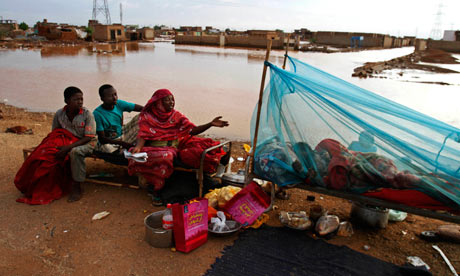
    MDG : Floods in Sudan : A Sudanese homeless family rest on the side of a highway in Khartoum

    Sudan’s floods have left many families homeless, particularly in the region around Khartoum, the capital. Photograph: Abd Raouf/AP

    Forty-eight people have been killed and more than 500,000 affected by the worst floods in Sudan in quarter of a century.

    The region around the capital, Khartoum, was particularly badly hit, with at least 15,000 homes destroyed and thousands of others damaged. Across Sudan, at least 25,000 homes are no longer habitable. A UN official described the situation as a disaster.

    The flooding, caused by continuous rains, has damaged public buildings, including schools, clinics, offices, shops, markets and water and sanitation facilities. Roads have been inundated, disrupting transport.

    One of the major health worries is the collapse of more than 53,000 latrines; the World Health Organisation (WHO) has warned of an increase in malaria cases in the past two weeks.

    WHO and Unicef, the UN agency for children, are supporting Sudanese authorities and national NGOs to run 50 emergency health clinics. The centres will be open for two months in eight states – Khartoum, White Nile, El Gezira, River Nile, Northern, Blue Nile, North Darfur and South Darfur.

    In South Sudan, recent fighting has forced 148,000 people in Pibor country – almost the entire population – to flee to the bush. Médecins Sans Frontières (MSF), the medical NGO, says about 90,000 people are missing. The 28,000 people who have been accounted for are in and around Gumuruk village, where MSF is running a clinic.

    The organisation has provided up to 100 consultations a day to people with diseases contracted after spending weeks or months hiding in the bush during the rainy season.

    MSF has expressed concern about the absence of men coming for treatment, apparently because they are frightened of seeking help where there is a military presence.

    In May, clashes between the South Sudan Army and the David Yau Yau militia intensified in Pibor county, prompting a mass exodus. In July, further violence between the Lou Nuer ethnic group and the Murle, the majority group in the area, triggered a wave of panic. Last month’s attacks left 328 people dead, according to a Murle leader.

    A woman who received treatment from MSF said her husband was too frightened to visit the clinic. “My husband does not dare enter the village as he is afraid he will be killed. If we run to the town the soldiers might kill us, and if we run to the bush the enemy tribe might kill us,” she said.

    MSF is also worried about the impact of the fighting on food supplies. “People come to the village and sit all day waiting for food,” said Carolina Lopez, its emergency co-ordinator in Pibor county. “Most lost their cattle in the recent fighting, and this year’s planting season was plagued with violence, so they are extremely vulnerable. Too many of them turn and walk back through the rain to their temporary shelters in the evening, their bags empty.”

    The UN military mission in South Sudan said this week it had increased its patrols in Pibor county to allow civilians to return to their towns and access food distribution points. Jonglei state has been plagued by ethnic violence between the Lou Nuer and the Murle, who have a history of animosity over grazing land, water sources and cattle raids that have often involved the abduction of women and children.

  • Letters: Blind workers in too hard basket Saturday, August 24, 2013

    Letters: Blind workers in too hard basket Saturday, August 24, 2013 60% of legally blind people were unemployed and looking for work. I disagree with a few points in the article “Blind workers fight for jobs at Vision Australia”. There are lots of parts of welfare to work which are not great but there is a particular part which helps people with disabilities be able to compete on the labour market or become self employed more easily. This is the Job Access Fund [JAF], which is a grant system that gives funding to people with disability to buy infrastructure they need, i.e assistive technology such as talking technology on computers, magnification for the vision impaired or altered desks for a person in a wheelchair. Stating welfare to work should be scrapped is simplistic since the JAF is part of this. In regards to unemployment, there was a Vision Australia survey that found 60% of legally blind people were unemployed and looking for work. But when it comes to disability, merely ordering that a company or government department has to employ someone with a disability is not enough, there needs to be a degree of a mindshift. There is legislation in India, for example, which makes it compulsory for the government to employ a certain percentage of people with disabilities (PWD) in the government workforce. A number of PWD do not feel empowered or engaged as a result of this legislation because they are sometimes told to stay at home yet still get paid. Having legislation making it compulsory to employ a percentage of PWD’s is not enough. A mind shift needs to take place as well. This needs to start with the government taking the lead. Why are the workers who have been sacked by Vision Australia unlikely to find more employment? It’s because they are in the too hard basket like many of the blind. Duncan Meerding Hobart, Tas SUSTAINABLE AUSTRALIA RESPONDS In the article “Rise of the populationists greenwashes racism”, Malcolm King claims that: “Talking about population control serves to shift blame from the rich in the West onto those who are least to blame”. First, Sustainable Population Australia does not advocate “control” as it implies coercion. Voluntary measures should be sufficient to stabilise and then reduce population numbers and thereby help bring the world back within its biological carrying capacity. Of course the West and highly polluting life-styles are to blame for much of the world’s environmental woes, especially in terms of greenhouse gases. Yet people need to be fed and it is agriculture that not only destroys other species’ habitats through land-clearing, but is a significant source of greenhouse gas emissions. SPA does not advocate contraception as the only means of reducing fertility. You can’t “blame” women who have too many children if they do not have the means to control their fertility or the education to pursue a different life-style than merely raising children. Women need empowerment, education and access to a full range of reproductive services. Those who deny women these things and condone the status quo are the ones practising coercion. For King to go on at length about forced sterilisations in the 1970s that no-one supported, certainly not us, is anachronistic at best. Post-1994 and the International Conference on Population and Development, the focus has rightly been on women’s reproductive rights and health. SPA does, in fact, have environmental credentials. We are recognised as an environmental organisation by the Department of Environment and by the Tax Office. We were set up 25 years ago by people concerned about overpopulation’s effect on the environment. Social and economic factors were secondary. Many of us have a background in science so any claims we make are based on science and not ideology. SPA does not blame immigrants for our environmental problems. If blame is to be sheeted anywhere, it is successive federal governments who have encouraged population growth through incentives for bigger families such as the baby bonus and exceptionally high immigration levels. The latest State of the Environment: Australia report recognises population growth as one of the major drivers of environmental change. One would hope that a publication that has “Green” in its title would accept this. Jenny Goldie President Sustainable Population Australia Michelago, NSW – See more at: http://www.greenleft.org.au/node/54832#sthash.d6YmkGyb.dpuf

  • New global population trends are worrisome

    New global population trends are worrisome

    What are we to do? By Tan Sri Lin See-Yan

    Email
    Facebook
    6

    Demography matters. But it’s not destiny as the French philosopher, Auguste Comte, would have us believe. Other things also matter. Certainly its impact endures far longer and has far wide-ranging effects. Nevertheless, even demographic trends do change. What’s happening right now is extraordinary. The UN’s “State of World Population 2011” points to ominous trends. The world’s population reached 7 billion on October 31, 2011, of which only 1.2 billion (17%) live in the rich world; 5.8 billion (83%) are found in developing economies including 851 million in the least developed.

    More than 4 billion (57% of the world) reside in Asia and the Pacific. What’s remarkable today is that about 900 million people are over the age of 60 worldwide; by 2050, they will rise to 2.4 billion as population ages and live longer, and birth-rates slide further. The 20th century was marked by the greatest fall in death rates. Low birth rates look likely to be the defining demographic event of the 21st century. Total fertility rate (TFR) now averages below 2.1 in more than 70 nations (representing 50% of world population). This level of TFR measures number of births the average woman would need to bear over her life time to prevent population from falling in the long run. All European nations have low TFRs today and so do many Asian economies, including Japan, China, South Korea and Taiwan. Russia, Japan and Italy now have the lowest TFRs – typically not more than one child during her life time. Without strong immigration, their populations will fall. The US, by contrast, still has a growing population because its TFR is at about the 2.1 replacement level and continues to attract significant immigration.

    Not long ago, many were concerned, and some still do, about the rapid rise in population. This poses an ominous policy dilemma – while the falling population brings with it the benefits of inverse correlation between fertility and income per capita which should please neo-Malthusians (those who still believe population will rise faster than the means of sustenance, bringing with it war, famine & epidemic), the current trend of low TFR and rising life expectancy will result in eventually, falling economic growth and rising costs, including health and related spending on social safety nets, as the workers pool supporting retirees fall. Today 4 workers support one retiree in the European Union; by 2060, the number of such workers will drop to just 2.

    Dispelling the myths

    —Overpopulation: Is 7 billion too many? No one knows for sure; not economists, not demographers. UN forecasts world population will reach 9.3 billion in 2050 and more than 10 billion by the end of this century. So? Population density can’t be used as the yardstick: Monaco has more than 16,000 persons per square kilometre, whereas Bangladesh has only 1,000. So? Some scholars even tried to determine the “optimum population.” Part of the problem lies in uncertainties forecasting the impact of future technologies on food production. Using resource scarcity isn’t helpful either. Real prices of corn, rice and wheat fell during the 20th century when world population exploded from 1.6 billion to more than 6 billion. Since prices are supposed to reflect scarcity, the world should be less “overpopulated” today than 100 years ago? Don’t match common sense, does it?

    —High population growth keeps poor nations poor: Experience of Asian tigers South Korea and Taiwan don’t bear this out. In 1960, they were poor with fast growing populations. Over the next 2 decades, South Korea’s population rose 50%, and Taiwan’s, 65%. Between 1960 and 1980, these nations boomed; income per capita rose an average 6.2% a year in South Korea, and 7% in Taiwan. That’s not unique. Between 1900 and 2000, world population exploded but per capital income grew faster by fivefold.

    —As population declines, so does growth: Again, empirical evidence showed otherwise. Between 1940s and 1960s, Ireland’s population collapsed, falling from 8.3 million to less than 3 million. Yet Ireland’s per capita income tripled. More recently, most of the former Soviet-bloc nations experienced depopulation since the end of the cold war. Yet, today, economic growth has been rather robust in this region; e.g. Bulgaria and Estonia suffered sharp population contractions of close to 20% – but their income per capita rose 50% and 60% respectively.

    —Small is beautiful: A contrarian view that Japan should accept a smaller population and hence, less competition for space and resources. “Support a smaller Japan with a higher quality of life” (Prof. A. Matsutani). This challenge to the orthodoxy urging Japan to re-examine its social and political priorities could yet gain ground. The call to “populate or perish” remains compelling for most developed nations, including Japan.

    —China’s one-child policy boost growth: This restrictive policy and China’s adoption of Deng’s pro-market reforms began in the late 1970s. Since then, China’s per capital income rose more than 8-fold. Both outcomes are not necessarily linked. Before the one-child policy, China’s TFR was 2.7; today, it’s 1.6, or 40% lower. Between 1960s and 1970s, Chinese TFR fell from 5.9 to 2.9, a sharper 50% drop. Yet, China’s per capita income only rose modestly. Its falling trend in fertility reflected also the experience of many East and South-east Asian societies. Myanmar also experienced very low fertility, but without state intervention. Nevertheless, reform is on the cards even though many exceptions are already being granted to minority groups; rural families whose first child is female; and couples who are both from one-child families.

    Tale of two “bellies”

    The demographic divide between nations (“bellies”) with high and low population growth has enormous economic and political significance. Today, Europe is following the traditional normal demographic path: as it became richer after the ‘50s, its TFR fell sharply to 1.4 now, below the replacement 2.1 rate. US followed a similar pattern until ‘80s. Then the TFR reversed its fall and even rose to about the replacement rate. With immigration, US population actually rose. UN expects US population to rise from 315 million today to 350 million to 400 million over the next 25 years, and to 400 million to 550 million by 2050. Europe’s population will likely peak at 740 million in 2025 and fall thereafter. So what? With a fertility rate 50% higher than Germany, Russia or Japan, and well above China, South Korea and Italy, and virtually higher than all of Eastern Europe, the US is the outlier among its traditional competitors, all of whose populations are destined to eventually fall after 2035.

    Today, Russia’s low TFR (1.3) suggests its population will drop 30% by 2050 to less than one-third of US’s population. Equally serious is the emerging gap between US and East Asia. By 2050, a third or more of East Asia’s population will be more than 65 years old (30% in China). A slowdown in population growth can offer short-term economic and environmental benefits, but will soon cut deep into the nation’s savings and income.

    Between 2000-2050, US workforce will grow 42%, while the same will decline 10% in China and 25% in Europe, and 44% in Japan. Unlike Europe and East Asia, US’s imperative is not in meeting the needs of the aging but in promoting jobs and opportunities for its expanding workforce. What the US does with this “demographic dividend” derived from its new “sweet-spot” of a robust young workforce, will depend on the entrepreneurial spirit of and innovative initiatives taken by the private sector – an issue that’s worrisome even now as more than 15 million are already unemployed. But the eventual loss of human capital as generation–Y ages means that this dividend has to be repaid.

    Similarly, Europe and East Asia’s aging demography also needs to set their agenda – to find ways to ease pension and health burdens and grow productivity at the same time. Both regions need to bring new sparkiness into their midst through entrepreneurial vigour. They have to become more open to immigration.

    The billionaires

    Asia is home to more than four billion people. Its population will peak at 5.2 billion in 2052 and then start a slow decline. It claims the world’s two billionaires: China with 1.35 billion (and TFR of 1.6) in 2011; and India, 1.24 billion (and TFR, 2.5). China’s population will stabilise in 2025 (its workforce had started to shrink for the first time in 2012) and India, in 2060. In 2028, India will overtake China (with 1.39 billion) as the world’s most populous nation with 1.46 billion.

    China’s population will stop growing by 2032 and then decline to 1.3 billion by 2050, while India will continue to grow to 1.7 billion by 2060 before it begins to fall. Global population shrinkage is real: Russia’s population will fall by 22% in first half of 21st century; Ukraine by a staggering 43%.

    This is creeping all over the rich world: Japan has started to shrink (from 127 million to 100 million by 2050); Germany and Italy will follow soon. By 2050, populations will be lower than today in 50 nations.

    Demographic decline is worrisome because it is perceived to be accompanied by economic decline. When population contracts, growth will slacken. Companies worry because domestic markets shrink. People worry about their economic welfare. Yet all these need not happen. Productivity growth will keep per capita growth up through the smart use of technology and the free spirit of entrepreneurship. With political will, the new demographics can herald a golden age.

    Aging time bomb

    The world is greying and Japan is greying at an unprecedented rate. Fifty years ago, only 5% of its population was over 65, well below US, UK, France or Germany. Today, it’s risen to 20%, the highest in the world and is forecast to reach 30% by 2025. After WWII, it had a more defined population pyramid than US. Now, its demographic profile looks more like a Japanese lantern.

    Soon, it will turn into a narrow based urn, with serious consequences. Soon enough, there will be fewer productive workers, and more and more dependent elders. Also, the demographic shape of the workforce will eventually assume an inverted pyramid, with fewer young workers at the base where once there were many. The old consume more resources than the young, mostly in health related resources.

    The baby-boomers have now started to retire and become custodians of years of accumulated technical and managerial skills. Their absence will be sorely missed by Mama-san at Ginza bars. Japan at least had a chance to grow rich before it grew old. Most developing economies, including China, are growing old before they even get rich. Bear in mind China’s per capita income is only US$6,000 in 2012, against US$50,000 in US, US$36,800 in Hong Kong and US$22,600 in South Korea. China’s low TFR means that by 2020, 20% of its population will more than 65 years old (14% in 2012); on current trends, it will reach 30% by mid-century.

    It is estimated that by 2038, there will be as many people more than 65 as they are below age 20. Post 2038, older consumers will outnumber younger ones. Today, 1.4% of Chinese is more than 80 years old; by 2050, 7.2% will be. The implications on state finances are stark. The nation’s social security system, which covers only a fraction of the population, already has debts far exceeding its ability to repay. It also needs reform to put social spending, especially on healthcare, on a more sustainable footing.

    What then, are we to do?

    Yes, demography does matter. The new demographic trends are worrisome. Birth rates are low for good reasons, particularly the high time cost involved in raising children (especially for career women) and the desire to invest more in each child than in another. Birth rates can be raised by incentives and generous subsidies, but they are found in cross-country studies to have only modest impact. I am of the view that once nations (like Japan and Russia) have TFRs far below the replacement level of 2.1, even the most generous financial support will not significantly raise TFR in the next few decades. The viable solution to an ageing and falling population is to open the immigration gates. US studies have shown that significant inflows of immigrants: (i) have proven to be active venture capitalists; (ii) their ventures do create jobs and investment; (iii) they often act as critical catalysts in high-tech manufacturing and in information technology; and (iv) they can also make-up a large portion of new graduates in engineering and computer science, who are crucial in supporting growth of the finance and IT sectors. They help expand the pool of intellectual capital. Sure, immigration can create political, economic and social problems. That’s why Japan & Russia face a worrisome demographic and economic future. It’s not surprising people ignore the Greek philosopher Plato’s keen insight: “We easily forgive a child who is afraid of the dark; the real tragedy of life is when men are afraid of the light.”

    • Former banker, Dr Lin is a Harvard educated economist and a British Chartered Scientist who speaks, writes and consults on economic & financial issues. Feedback is most welcome; email:starbizweek@thestar.com.my