Category: Uncategorized

  • Tony Windsor concerned over slow progress of CSG scrutiny

    Tony Windsor concerned over slow progress of CSG scrutiny

    By Nonee Walsh, ABCUpdated August 24, 2013, 11:09 am

    Former independent MP Tony Windsor, who pushed for federal powers to scrutinise the impact of gas and coal projects on water supply says he is dismayed at its slow implementation.

    The powers to require assessment of cumulative water impacts of coal seam gas and coal projects under the Environment Protection and Biodiversity Act, known as the water trigger, was passed in June.

    So far it has been applied to only 4 out of 50 applications before the Federal Government.

    Mr Windsor, the former Member for , supported the Gillard Labor government, provided Federal environment law was extended to scrutinise water protection in coal mines and gas well projects.

    “I am a little bit concerned we don’t seem to be proceeding very quickly,” he said.

    “I would hope there is very good reason for that in terms of getting the process right, rather than some of the officials hoping that there will be a change of government or some change of policy after the election.”

    When the water trigger amendment was passed, Mr Windsor also moved an amendment to ensure the power could not be devolved back to the states.

    do not think restrictions of coal seam gas miners should be eased.

    Voters in rural and regional seats were more supportive of restrictions on CSG than urban dwellers.

    Concern about appropriate investigation of proposals

    Carmel Flint from Lock the Gate Alliance, which campaigns against inappropriate mining projects, says the Government needs to ensure that some of New South Wales and Queensland’s most controversial mine and gas applications are captured by the water trigger.

    The water trigger has been applied to the Kevin’s Corner open cut and underground coal mine in the Galilee basin in western Queensland, 160 kilometres west of Emerald, but not to three other projects in the same basin.

    “Because there has not been full and adequate assessments conducted, we don’t know what the full impacts will be and unless the Federal Government requires those assessments, these mines will be approved without full knowledge of the water impacts,” she said.

    Ms Flint says community concern about the Wallarah 2 mine in the New South Wales central coast water catchment and plans for CSHG wells in the western Sydney suburbs of Camden and Campbelltown must be addressed.

    “It is incredibly important that the Federal Government lets the community know know before the election whether it will require further water studies in these incredibly sensitive locations,” she said.

    The environment group is concerned because there is a 60-day statutory deadline for the trigger to be applied which falls just before election day.

    In a statement to the ABC, the Environment Department dismissed the concern.

    “According to the provisions of the Amendment Act, decisions on the application of the water trigger to transitional projects can continue to be made past the 60-business-day time frame,” the department said.

    However, Mr Windsor is not entirely convinced by the department’s assurances.

    “Tony Abbott and Kevin Rudd have been talking about Green tape as they call it, and the capacity to tighten up some of the environmental regulations, that to me is code that the water trigger is under scrutiny,” he said.

    “They would be far better off to have a very close look at a lot of the polls that are out there, particularly in relation to coal seam gas where the population has massive concerns about the relationship between some of these extractive activities and groundwater resources.”

    Sponsored Links

    Banks Fight For Your Loan

    TomorrowFinance.com.au/HomeLoans

    Use Our Simple Home Loan Form. Banks Call You With Their Best Rate

  • Is climate change humanity’s greatest-ever risk management failure?

    Is climate change humanity’s greatest-ever risk management failure?

    Humans are very good at managing risks, except when it comes to the greatest risk we’ve faced – climate change

    Roulette wheel

    Our gamble may lead to an unstable future climate. Photograph: Don Mcphee

    Humans are generally very risk-averse. We buy insurance to protect our investments in homes and cars. For those of us who don’t have universal health care, most purchase health insurance. We don’t like taking the chance – however remote – that we could be left unprepared in the event that something bad happens to our homes, cars, or health.

    Climate change seems to be a major exception to this rule. Managing the risks posed by climate change is not a high priority for the public as a whole, despite the fact that a climate catastrophe this century is a very real possibility, and that such an event would have adverse impacts on all of us.

    For example, in my job as an environmental risk assessor, if a contaminated site poses a cancer risk to humans of more than 1-in-10,000 to 1-in-1 million, that added risk is deemed unacceptably high and must be reduced. This despite the fact that an American man has a nearly 1-in-2 chance of developing and 1-in-4 chance of dying from cancer (1-in-3 and 1-in-5 for an American woman, respectively).

    To that 42 percent chance of an average American developing cancer in his or her lifetime, we’re unwilling to add another 0.001 percent. The reason is simple – we really, really don’t want cancer, and thus consider even a small added risk unacceptable.

    Yet we don’t share that aversion to the risks posed by human-caused climate change. These risks include more than half of global species potentially being at risk of extinction, extreme weather like heat waves becoming more commonplace, global food supplies put at risk by this more frequent extreme weather, glaciers and their associated water resources for millions of people disappearing, rising sea levels inundating coastlines, and so forth.

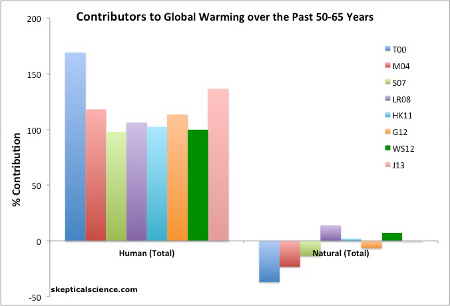
    This isn’t some slim one-in-a-million risk; we’re looking at seriously damaging climate consequences in the most likely, business-as-usual scenario. The forthcoming fifth IPCC report is likely to state with 95 percent confidence that humans are the main drivers of climate change over the past 60 years, and the scientific basis behind this confidence is quite sound. It’s the result of virtually every study that has investigated the causes of global warming.

    The percentage contribution to global warming over the past 50-65 years is shown in two categories, human causes (left) and natural causes (right), from various peer-reviewed studies (colors). The percentage contribution to global warming over the past 50-65 years is shown in two categories, human causes (left) and natural causes (right), from various peer-reviewed studies (colors).

    Yet in a recent interview with NPR, climate scientist Judith Curry, who has a reputation for exaggerating climate science uncertainties, claimed that based on those uncertainties,

    “I can’t say myself that [doing nothing] isn’t the best solution.”

    This argument, made frequently by climate contrarians, displays a lack of understanding about risk management. I’m uncertain if I’ll ever be in a car accident, or if my house will catch fire, or if I’ll become seriously ill or injured within the next few years. That uncertainty won’t stop me from buying auto, home, and health insurance. It’s just a matter of prudent risk management, making sure we’re prepared if something bad happens to something we value. That principle should certainly apply to the global climate.

    Uncertainty simply isn’t our friend when it comes to risk. If uncertainty is large, it means that a bad event might not happen, but it also means that we can’t rule out the possibility of a catastrophic event happening. Inaction is only justifiable if we’re certain that the bad outcome won’t happen.

    Curry is essentially arguing that she’s not convinced we should take action to avoid what she believes is a very possible climate catastrophe. That’s a failure of risk management. I wonder if she would also advise her children not to buy home or auto or health insurance. Maybe they’ll be a wasted expense, or maybe they’ll prevent financial ruin in the event of a catastrophe.

    Climate change presents an enormous global risk, not in an improbable one-in-a-million case, but rather in the most likely scenario. From a risk management perspective, our choice could not be clearer. We should be taking serious steps to reduce our impact on the climate via fossil fuel consumption and associated greenhouse gas emissions. But we’re not. This is in large part due to a lack of public comprehension of the magnitude of the risk we face; a perception problem that social scientists are trying to determine how to overcome.

    At the moment, climate change looks like humanity’s greatest-ever risk management failure. Hopefully we’ll remedy that failure before we commit ourselves to catastrophic climate consequences that we’re unprepared to face.

  • Australian cities urged to plan for growth of overseas arrivals

    Australian cities urged to plan for growth of overseas arrivals

    1

    by Ray Clancy on August 22, 2013

    in Australia Immigration

    Australian cities urged to plan for growth of overseas arrivals

    Australian cities urged to plan for growth of overseas arrivals

    Overseas migration accounts for half of the population growth rate in Australia with population expansion in major cities outstripping the national average. It means that cities need good planning in terms of managing this growth and helping to ensure that services can cope with the number of newcomers from abroad, according to the Planning Institute of Australia (PIA).

    In a new report it highlights the importance of good planning in managing growth and determining settlement patterns across the country. The population and settlement data is outlined in the latest report State of Australian Cities 2013, the fourth in a series of documents designed to present a comprehensive picture of how Australian cities are evolving.

    PIA chief executive officer, Kirsty Kelly said that the publications contain invaluable information for planning and policy decisions. ‘These reports are a pulse check on the trends and growth patterns in our major cities and they attract overwhelming interest from both the planning fraternity and the general public,’ she explained. ‘The migration data in this report is invaluable and can inform the best possible planning decisions for our cities,’ she added.

    Quote from AustraliaForum.com : “Just wondering after my wife’s visa is granted will she have to send her passport to Washington? As she is currently in the process of changing her name on documents. Just wondering if the passport can wait so we have it if needed to be sent.”


    The latest edition includes data from the second tranche of the Australian Bureau of Statistics 2011 Census of Population and Housing which has an emphasis on migration, industry structure and human capital. The report shows that in the 2011/2012 year the larger capitals grew almost 50% faster than the rest of the country. However, Sydney’s growth rate was below the national average which was due to overseas migrants taking the place of a significant numbers of residents who left the city.

    Kelly said the Federal government is to be congratulated on the way it has monitored the progress of Australian Cities since the benchmark report was first released in March 2010. ‘Good planning decisions need the latest data and the State of Australian Cities reports are essential tools in the development of planning policy,’ she added. She also pointed out that support for these initiatives is essential from all sides. ‘The focus on transport planning and the value of integrated land use are key factors in achieving healthy communities and decent productivity in our cities,’ she said.

    PIA has worked with the National Heart Foundation, the Department of Health and Ageing and the Australian Local Government Association to create the Healthy Places and Spaces programme.


    There are no comments posted yet. Be the first one!

    Post a new comment

  • Scientists find Arctic Ocean more vulnerable to acidification than Antarctic (audio)

    Scientists find Arctic Ocean more vulnerable to acidification than Antarctic (audio)

    Posted: 22 Aug 2013 01:29 AM PDT

    A new and unique year-long study of the pH level of the worlds polar oceans shows a marked difference between Arctic and Antarctic conditions.

    The study showed that the Arctic ocean, for a variety of reasons, was far more vulnerable to climate change and acidification from the added C02 in the atmosphere as a result of burning of fossil fuels.

    Helmuth Thomas is a professor at Dalhousie University’s Department of Oceanography in Halifax on Canada’s east coast. He is also hold the Canada Research Chair for Marine bio-geochemistry.


    Listen

    The study  (published in Science Reports) was carried out by Dr Thomas and oceanography doctoral graduate Elizabeth Shadwick.

    Dr Thomas noted that C02 and other greenhouse gases generated by events like volcanoes and forest fires are natural events having occurred over millenia, and nature has adapted quite well to them, but that human activity has added a great amount of C02 to the atmosphere and in a relatively short period.

    Scientists have long noted that as we pump more C02 into the air, more is absorbed by the oceans, which turns them slightly acidic as the C02 in combination with the water becomes a mild form of carbonic acid.

    As the water becomes more acidic, it becomes more difficult for marine life such as shell-fish to form their shells, and also weakens the shells  as the acidic condition reduces the concentration of calcium carbonate, a key building block of seashells and other marine skeletons.

    This new study shows the Arctic is more acidic than the Antarctic and that it will become even more so and at a much faster rate than the Antarctic Ocean.

    Their study noted differing conditions between the polar regions, with those conditions creating a greater propensity for the Arctic to become acidic more quickly.

    The time scale to prevent massive biogeochemical changes to occur in polar regions is extremely short; only a very few decades in the Arctic. – Helmuth Thomas, Professor of Oceanography, Dalhousie University

    One such difference was the higher freshwater content of the Arctic and the much greater variation in temperatures there. Between winter and summer conditions, water temperature could vary by up to 10 degrees, whereas in the Antarctic water temperature throughout the season remained almost constant throughout the year.

    Carbon dioxide absorbing phytoplankton also increase in the warmer summer and die off in the colder months in the Arctic even as the warmer summer water absorbs more carbon,

    Because of the mixing of different oceans around the Antarctic, there were also more nutrients in the water than in the Arctic which may help to mitigate acidification there.

    However, because of the fragile nature and “narrow windows” that enable life to exist in the polar oceans, even minute changes may have enormous affects.

    What was also unique was the full-cycle year-long duration of the study. The research vessel Amundsen, remained frozen in the ice during the winter as the studies continued.

    Up until this project, the Arctic and Southern Oceans remained under-studied at the annual scale compared to other oceans, with the majority of observations restricted to the less difficult and slightly less costly ice-free summer and autumn seasons.

    Dr Thomas noted that the changes in the Arctic will occur rapidly, and “the time scale to prevent massive biogeochemical changes to occur in polar regions is extremely short; only a very few decades”

    Because acidification will affect marine life such as tiny pteropods which are an important food source for fish, along with shell fish, both of which are important for marine animals higher up the food chain, including humans.

    The expected changes in the polar oceans, especially the Arctic are likely to result in changes resulting in severe consequences for the polar ecosystem, and the region’s inhabitants.

    Science reports: Vulnerability of Polar Oceans to Anthropogenic Acidification: Comparison of Arctic and Antarctic Seasonal Cycles

    Dr Helmuth Thomas-Dalhousie University page

    Marc Montgomery, Radio Canada International, 21 August 2013. Article and audio.

  • The Peak Oil Crisis: A Review of Richard Heinberg’s ‘Snake Oil’

    The Peak Oil Crisis: A Review of Richard Heinberg’s ‘Snake Oil’

    August 21, 2013 5:53 PM1 Comment

    Richard Heinberg has been following and writing about peak oil for a long time. In the last decade, he has published 10 books on peak oil and related resource depletion topics as well as given some 500 lectures warning about the hard times ahead. The subtitle of his recent book, “How Fracking’s False Promise of Plenty Imperils Our Future” captures “Snake Oil’s” theme in a lucid phrase. This is an angry book, for it is intended as a rejoinder to the avalanche of half truths and optimistic estimates concerning the future of our energy resources which have filled our media in the last few years.

    As the evidence accumulates that man is destroying the atmosphere by ever-increasing carbon emissions and bankrupting his economic systems by continued reliance on increasingly expensive oil, realistic appraisals of our true energy situation are being lost.

    In recent years numerous institutions which should know better, major universities and widely respected publications have joined the chorus talking about “energy independence for America” and a century of oil and gas just waiting to be tapped.

    “Snake Oil” starts with a review of the fundamentals that most “peakists” have come to understand and accept. Peak oil is about the rate of supply, not estimated size of underground resources. There is a lot of oil and gas still in the ground, but only a small percentage will ever be extracted at prices people can afford to pay. Production from existing oil fields is declining by 4-5 percent annually and demand is increasing by about a million b/d each year. To keep the lid on costs, the world will have to come up with 5 million b/d of new oil production each year for the foreseeable future.

    It takes energy to produce energy so that when you spend more than you get back, it is time to quit extracting. As the Middle East gets hotter, both physically and politically, oil exporters are consuming an increasing share of their own production to keep their people cool and off the streets. These and other underlying realities are largely ignored by those enamored with recent, admittedly impressive, gains in US oil production and optimistic talk of billions and sometimes trillions of barrels of oil waiting to be produced.

    Heinberg acknowledges that the fracking boom has produced some spectacular numbers with US oil production increasing by 766,000 barrels a day (b/d) in 2012 and is likely to do about the same this year if current trends continue. The problem, of course, comes from projecting this spectacular growth into the more distant future. There are simply too many factors especially rapid decline rates and lower initial production rates as the best drilling locations are used up.

    The heart of “Snake Oil” is directed at countering the optimistic projections for production of oil and gas by hydraulic fracturing (fracking). Fracked oil and gas production is simply another, albeit expensive, resource that will climb to a peak and then deplete away just like all the others.

    Using the work done by two independent geologists, Arthur Berman of Texas and David Hughes of Canada, who have extensively analyzed the production of fracked oil wells across the US, Heinberg and his associates conclude that “shale gas and oil wells have proven to deplete quickly, the best fields have already been tapped, and no major new field discoveries are expected; thus with average per-well productivity declining and ever-more wells (and fields) required simply to maintain production, an “exploration treadmill” limits the long-term potential of shale resources”.

    With per-well production decline rates of between 81 and 90 percent in the first 24 months, wells must be constantly replaced by new ones just to keep production flat. The higher production gets, the more new replacement wells have to be drilled. Before the end of the decade, this bubble will collapse on its own accord and fracked oil and gas production will begin dropping. As usual there are disputes as to just when this downturn will begin, but the best available analysis suggest that four or five years from now will be the time period when fracked oil peaks in the US and a few years later for gas.

    The analysis shows that decades of abundant fracked oil and gas production is simply not in the cards that we see today.

    An interesting chapter in the book deals with just who has benefitted from the shale boom. Although thousands of jobs have been created and some landowners have profited handsomely from lending their property for drilling, local governments have yet to fully comprehend the damage that boom towns have done to their communities and that heavy trucks have done to their roads. Service companies that sell equipment performing the actual fracking have done well, the drillers, include large ones such as ExxonMobil, who assume the ultimate risk have been losing money on natural gas and only some are making money on oil due to the high prices.

    Heinberg concludes that the real winners, however, are the investment banks that have earned huge fees for raising the money that has fueled the boom.

    The book is clearly a contribution to the literature of peak oil for it updates recent developments and does an effective job in separating reality from the hype of the financial media.

    Heinberg leave us with two somewhat contradictory thoughts:

    • Hydrocarbons are so abundant that, if we burn a substantial portion of them, we risk a climate catastrophe beyond imagining.

    • There aren’t enough economically accessible, high-quality hydrocarbons to maintain world economic growth for much longer.


  • The Battle Over Global Warming Is All in Your Head

    The Battle Over Global Warming Is All in Your Head

    Despite the fact that more people now acknowledge that climate change represents a significant threat to human well-being, this has yet to translate into any meaningful action. Psychologists may have an answer as to why this is

    165161414165161414
    ANDREY SMIRNOV/AFP/Getty ImagesClimate campaigns, like this one from Greenpeace in Moscow, have failed to galvanize public support for strong climate action

    Today the scientific community is in almost total agreement that the earth’s climate is changing as a result of human activity, and that this represents a huge threat to the planet and to us. According to a Pew survey conducted in March, however, public opinion lags behind the scientific conclusion, with only 69% of those surveyed accepting the view that the earth is warming — and only 1 in 4 Americans see global warming as a major threat. Still, 69% is a solid majority, which begs the question, Why aren’t we doing anything about it?

    This political inertia in the face of unprecedented threat is the most fundamental challenge to tackling climate change. Climate scientists and campaigners have long debated how to better communicate the message to nonexperts so that climate science can be translated into action. According to Christopher Rapley, professor of climate science at University College London, the usual tactic of climate experts to provide the public with information isn’t enough because “it does not address key underlying causes.” We are all bombarded with the evidence of climate change on an almost a daily basis, from new studies and data to direct experiences of freakish weather events like last year’s epic drought in the U.S. The information is almost unavoidable.

    If it’s not a data deficit that’s preventing people from doing more on global warming, what is it? Blame our brains. Renee Lertzman, an applied researcher who focuses on the psychological dimensions of sustainability, explains that the kind of systemic threat that climate change poses to humans is “unique both psychologically and socially.” We face a minefield of mental barriers and issues that prevent us from confronting the threat.


    (MORE: As Temperatures Rise, Empires Fall: Heat and Human Behavior)

    For some, the answer lies in cognitive science. Daniel Gilbert, a professor of psychology at Harvard, has written about why our inability to deal with climate change is due in part to the way our mind is wired. Gilbert describes four key reasons ranging from the fact that global warming doesn’t take a human form — making it difficult for us to think of it as an enemy — to our brains’ failure to accurately perceive gradual change as opposed to rapid shifts. Climate change has occurred slowly enough for our minds to normalize it, which is precisely what makes it a deadly threat, as Gilbert writes, “because it fails to trip the brain’s alarm, leaving us soundly asleep in a burning bed.”

    Robert Gifford, a professor of psychology and environmental studies at the University of Victoria in Canada, also picks up on the point about our brains’ difficulty in grasping climate change as a threat. Gifford refers to this and other psychological barriers to mitigating climate change as “dragons of inaction.” Since authoring a paper on the subject in 2011 in which he outlined seven main barriers, or dragons, he has found many more. “We’re up to around 30,” he notes. “Now it’s time to think about how we can slay these dragons.” Gifford lists factors such as limited cognition or ignorance of the problem, ideologies or worldviews that may prevent action, social comparisons with other people and perceived inequity (the “Why should we change if X corporation or Y country won’t?”) and the perceived risks of changing our behavior.

    Gifford is reluctant to pick out one barrier as being more powerful or limiting than another. “If I had to name one, I would nominate the lack of perceived behavioral control; ‘I’m only one person, what can I do?’ is certainly a big one.” For many, the first challenge will be in recognizing which dragons they have to deal with before they can overcome them. “If you don’t know what your problem is, you don’t know what the solution is,” says Gifford.

    Yet this approach can only work if people are prepared to acknowledge that they have a problem. But for those of us who understand that climate change is a problem yet make little effort to cut the number of overseas trips we make or the amount of meat we consume, neither apathy nor denial really explains the dissonance between our actions and beliefs. Lertzman has come to the conclusion that this is not because of apathy — a lack of feeling — but because of the simple fact that we care an overwhelming amount about both the planet and our way of life, and we find that conflict too painful to bear. Our apparent apathy is just a defense mechanism in the face of this psychic pain.

    (MORE: The Evil Brain: What Lurks Inside a Killer’s Mind)

    “We’re reluctant to come to terms with the fact that what we love and enjoy and what gives us a sense of who we are is also now bound up with the most unimaginable devastation,” says Lertzman. “When we don’t process the pain of that, that’s when we get stuck and can’t move forward.” Lertzman refers to this inability to mourn as “environmental melancholia,” and points to South Africa’s postapartheid Truth and Reconciliation Commission as an example of how to effectively deal with this collective pain. “I’m not saying there should be one for climate or carbon, but there’s a lot to be said for providing a means for people to talk together about climate change, to make it socially acceptable to talk about it.”

    Rosemary Randall, a trained psychotherapist, has organized something close to this. She runs the U.K.-based Carbon Conversations, a program that brings people together to talk in a group setting about ways of halving their personal carbon footprint. Writing in Aeon, an online magazine, Randall suggests that climate change is such a disturbing subject, that “like death, it can raise fears and anxieties that people feel have no place in polite conversation.” Randall acknowledges that while psychology and psychoanalysis aren’t the sole solutions to tackling climate change, “they do offer an important way of thinking about the problem.”

    Lertzman says the mainstream climate-change community has been slow to register the value of psychology and social analysis in addressing global warming. “I think there’s a spark of some interest, but also a wariness of what this means, what it might look like,” she notes. Gifford says otherwise, however, explaining that he has never collaborated with other disciplines as much as he does now. “I may be a little biased because I’m invested in working in it, but in my view, climate change, and not mental health, is the biggest psychological problem we face today because it affects 100% of the global population.”

    Despite the pain, shame, difficulty and minefield of other psychological barriers that we face in fully addressing climate change, both Lertzman and Gifford are still upbeat about our ability to face up to the challenge. “It’s patronizing to say that climate change is too big or abstract an issue for people to deal with,” says Lertzman. “There can’t be something about the human mind that stops us grappling with these issues given that so many people already are — maybe that’s what we should be focusing on instead.”

    MORE: The Psychology of Environmentalism: How the Mind Can Save the Planet

    Read more: http://science.time.com/2013/08/19/in-denial-about-the-climate-the-psychological-battle-over-global-warming/#ixzz2chPF6a1z