Category: Uncategorized

  • Chain reaction shattered huge Antarctica ice shelf

    Nature | News

    Chain reaction shattered huge Antarctica ice shelf

    Draining of meltwater lakes from surface explains sudden demise of Larsen B.

    09 August 2013

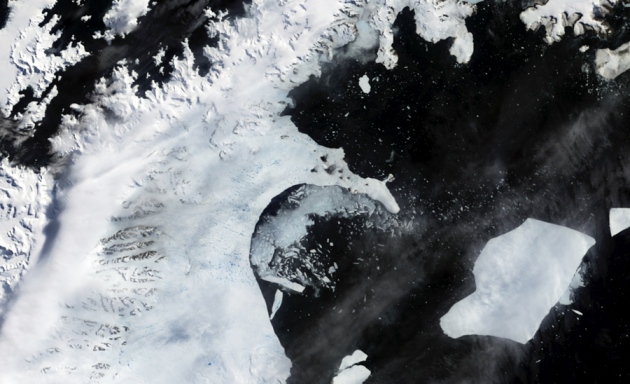
    The Larsen B Ice Shelf’s collapse in 2002 was surprisingly rapid because cracks produced by draining lakes caused other lakes to drain in a chain reaction, geophysicists now believe.

    NASA Earth Observatory

    It took decades for global warming to slowly melt the surface of the Larsen B Ice Shelf on the Antarctic Peninsula, forming nearly 3,000 lakes. But at the end of the Antarctic summer of 2002, all the lakes drained away in the space of a week. And then the 2,700-square-kilometre ice shelf, which was some 220 metres thick and might have existed for some 12,000 years, rapidly disintegrated into small icebergs, leaving glaciologists scratching their heads.

    It was “like the smashing of glasses at the throw of a stone”, University of Chicago geophysicist Douglas MacAyeal said last week at an International Glaciological Society meeting in Beijing.

    Researchers have been wondering ever since what could have caused the sudden draining of the lakes, and whether this caused the demise of the ice shelf. Now, a study led by MacAyeal might answer both questions.

    Using a mathematical model originally developed by Russian scientists to understand how to drive loaded trucks across frozen rivers, MacAyeal and his team found that the draining of one lake on an ice shelf changes the stress field in nearby areas, causing a fracture circle to form around the lake.

    As MacAyeal explained at the meeting, this is caused by ice elasticity. Ice bends in response to a heavy load, and bounces back when that load is taken off. “Draining a lake is equivalent to taking the load off the ice,” he said.

    Fast fractures

    The researchers showed that if there are many lakes on an ice shelf, the disappearance of one lake could result in fractures under others — an effect that can spread rapidly throughout the ice shelf. “This chain reaction could explain why the lakes drained all together,” MacAyeal said.

    Most of the lakes were about 1,000 metres wide, according to a poster presentation at the same meeting by study co-author Alison Banwell. Once drained, each would leave behind a ring fracture about 4,000 metres wide. When lakes are tightly packed together, as they were on the Larsen B ice shelf, the chain of fracturing would result in thin icebergs calving off, Banwell said.

    “This is a cool idea that could neatly explain the peculiar phenomenon of the Larsen B breakup,” says Ted Scambos, a glaciologist at the National Snow and Ice Data Center in Boulder, Colorado.

    “It adds into a more complete picture of ice-shelf disintegration,” says Christina Hulbe, a geophysicist at the University of Otago in Dunedin, New Zealand. But, she says, it remains to be seen how it works together with other mechanisms — such as sustained propagation of natural fractures caused by prolonged surface melting, or ice-shelf thinning owing to warming oceans — to produce the catastrophic event seen with Larsen B.

    Journal name:
    Nature
    DOI:
    doi:10.1038/nature.2013.13540

    Author information

    Author details


  • 29 Days MAKE IT COUNT get-up

    29 days to go! GetUp members have really stepped up for the first week of election campaigning.

    NEVILLE,

    GetUp members have really stepped up for the first hectic week of election campaigning. Well done on:

    • dozens of media hits, and more than 2 million Australians hearing about our enrolment campaign in the papers and on radio,
    • a win on anti-discrimination laws,
    • more time to save the Reef from dredging, and
    • great news on education reform – just weeks after GetUp members crowd-funded targeted radio ads.

    We know it’s Friday afternoon – so without further ado, here’s a quick update on the bright spots, and some reasons to keep fighting, from the past week:

    Three days left to enrol!

    enrol for goldWith just three days until the rolls close, there are still almost half a million young people around Australia who aren’t enrolled to vote. So where do we find them?

    Our enrolment campaign has already been featured in Courier-Mail, The Herald Sun, Fairfax Media as well as dozens of regional newspapers and radio stations. From today we’ll also be running radio ads in the Northern Territories, NSW and Victoria specifically targeting Indigenous youth – the most underrepresented demographic on the rolls.

    8pm Monday is the deadline to enrol or update enrolment. Think of anyone whose housewarming, 18th or 21st birthday party you attended in the last three years, and share these links with them: aec.gov.au/enrol and enrolforgold.org.au.

    Use this link to recruit your friends on Facebook: http://www.getup.org.au/recruit-your-friends

    Brief on the Reef

    reefToday, Environment Minister Mark Butler postponed his decision to dredge 3 million cubic metres of seabed in the Great Barrier Reef World Heritage Area. A few weeks ago, approval looked like a forgone conclusion. Now, it’s game on and anything could happen.

    GetUp members have put in an incredible campaigning effort on this decision. Environment Minister Mark Butler’s inbox, voicemail and letterbox has been quite literally overflowing with messages from GetUp members. Now we know he is listening, and what we’re doing is working — and we need to keep building the pressure.

    On Sunday 25 August, we’ll be teaming up with AMCS, Greenpeace, AYCC, 350.org, Friends of the Earth and Lock the Gate to hold a giant rally in Brisbane. RSVP or pass this link on to friends & family in Brisbane: www.getup.org.au/rallyforthereef

    A win on anti-discrimination

    anti-discrimination win
    This could be the best news you didn’t hear this week.

    Earlier this year, more than 35,000 GetUp members took action in support of stronger anti-discrimination protections — and last week, we had win on one of our five policy outcomes. You mightn’t have heard about the amendment to the Sex Discrimination Act, but it’s a landmark step that will ensure Federal protections from discrimination on the grounds of sexual orientation, gender identity and intersex status. Read more about the news here.

    Better education for every child

    educationGreat news. Last week, the Victorian Premier Denis Napthine joined his NSW, ACT, SA and Tasmanian counterparts in signing on to the reforms — and in a very welcome retreat, the Coalition has announced they’ll commit to more funding for schools.

    GetUp members have pushed for a fairer funding system for Australian schools by signing petitions, running creative social media campaigns, funding targeted radio ads in QLD and VIC and turning out to education rallies around the country. Now, not only have a majority of states and territories around the country have signed on, but the reforms for fairer funding for schools have been locked in to last into the future, regardless of what happens on September 7.

    Find out more about the reforms & join the campaign here: http://www.getup.org.au/everychild

    Tassie Devils and the Tarkine

    tarkineLast month, ten thousand GetUp members emailed the new Environment Minister Mark Butler calling on him to protect the Tasmanian Devil and put a stop to a controversial mine in the Tarkine region of Tasmania. Despite our best efforts, the mine was approved again – but not without new conditions to protect the Tassie devil. Read more about the conditions here, and what next on this campaign.

    Keen to get more involved this election?

    image In the lead-up to the election, we’ve started GetUp Live! – live-streamed, interactive discussions on what’s happening this Election season and what we can do to make a difference to the state of play. We’ll be live on your screen each Monday at 6.30PM. Tune in, catch up or register for a reminder when we’re about to kick off at getup.org.au/live

    Apply to become a local Election leader in your community: getup.org.au/volunteer

    The best, worst and downright wacky bits of election season so far

    imageWant to keep up to date with the latest, without checking your emails? Whether it’s the absurdly partisan front page of the Telegraph, the little legend who photobombed Kevin Rudd, or the painfully awkward candidate interviews — we’ll be sharing updates on the best bits of the campaigns day and night.

    If you prefer your news with a side of laughs, click here to follow GetUp on Twitter or click here to follow GetUp on Facebook.

    If this is what can happen in just one week, we have a lot to look forward to over the next 29 days!

    Thanks for everything,
    The GetUp team

    PS – “It made me think about how important my vote is.” If you missed it, here’s the inspirational election launch ad that GetUp members Barry, John, Sarah, Barbara, Joe, Amanda, Aaron and Jane star in, talking about the issues that will determine their vote this election: www.getup.org.au/your-vision


    GetUp is an independent, not-for-profit community campaigning group. We use new technology to empower Australians to have their say on important national issues. We receive no political party or government funding, and every campaign we run is entirely supported by voluntary donations. If you’d like to contribute to help fund GetUp’s work, please donate now! If you have trouble with any links in this email, please go directly to www.getup.org.au. To unsubscribe from GetUp, please click here. Authorised by Sam Mclean, Level 2, 104 Commonwealth Street, Surry Hills NSW 2010.

    Reply
    Forward
  • How Much Should You Worry About an Arctic Methane Bomb?

    How Much Should You Worry About an Arctic Methane Bomb?

    Recent warnings that this greenhouse gas could cost us $60 trillion have received widespread publicity. But many scientists are skeptical.

    —By

    | Thu Aug. 8, 2013 3:00 AM PDT
    Image of methane hydrate recovered from the ocean floor off the coast of Oregon.Methane hydrate, taken from the ocean floor off the coast of Oregon Wikimedia Commons

    It was a stunning figure: $60 trillion.

    Such could be the cost, according to a recent commentary in the journal Nature, of “the release of methane from thawing permafrost beneath the East Siberian Sea, off northern Russia…a figure comparable to the size of the world economy in 2012.” More specifically, the paper described a scenario in which rapid Arctic warming and sea ice retreat lead to a pulse of undersea methane being released into the atmosphere. How much methane? The paper modeled a release of 50 gigatons of this hard-hitting greenhouse gas (a gigaton is equal to a billion metric tons) between 2015 and 2025. This, in turn, would trigger still more warming and gargantuan damage and adaptation costs.

    The $60 trillion figure went everywhere, and no wonder. It’s jaw dropping. To provide some perspective, 50 gigatons is 10 times as much methane as currently exists in the atmosphere. Atmospheric methane levels have more than doubled since the industrial revolution, but this would amount to a much sharper increase in a dramatically shorter time frame.

    According to the Nature commentary, that methane “is likely to be emitted as the seabed warms, either steadily over 50 years or suddenly.” Such are the scientific assumptions behind the paper’s economic analysis. But are those assumptions realistic—and could that much methane really be released suddenly from the Arctic?

    A number of prominent scientists and methane experts interviewed for this article voiced strong skepticism about the Nature paper. “The scenario they used is so unlikely as to be completely pointless talking about,” says Gavin Schmidt, a noted climate researcher at the NASA Goddard Institute for Space Studies in New York.

    Schmidt is hardly the only skeptic. “I don’t have any problem with 50 gigatons, but they’ve got the time scale all wrong,” adds David Archer, a geoscientist and expert on methane at the University of Chicago. “I would envision something like that coming out, you know, over the centuries.”

    Still, the Nature paper is the most prominent airing yet of concerns that a climate catastrophe could be brought on by the release of Arctic methane that is currently frozen in subsea deposits—concerns that seem to be mounting in lockstep with the dramatic warming of the Arctic. That’s why it’s important to put these fears into context and try to determine just how much weight they ought to be accorded.
    Methane on Ice

    Let’s start with some basics on methane—CH4—a greenhouse gas that reaches the atmosphere from sources as diverse as wetlands, gas drilling, and cow burps. Compared with carbon dioxide, methane is kind of like the boxer who punches himself out in the early rounds, whereas carbon dioxide goes the distance and wins by TKO. Pound for pound, methane causes some 25 times as much global warming as carbon dioxide does. But it only remains in the atmosphere for about nine years, on average, before chemical processes break it down. Carbon dioxide, in contrast, has a far longer atmospheric residence time.

    What this means is that methane is most worrisome if a lot of it gets into the atmosphere over a relatively short time period—precisely the scenario contemplated by the Nature paper. So could that happen?

    The answer depends on a complicated and uncertainty-laden issue—the stability of frozen deposits of subsea methane in the Arctic region. Frankly, it’s hard to imagine something harder to study: We’re talking about deposits residing not only beneath one of the world’s most remote and inaccessible oceans, but also beneath the sea floor itself.

    Much of the world’s methane is concentrated in the form of so-called gas “hydrates,” icelike solids that form from methane and water at cold temperatures and high pressures, e.g., deep beneath the ocean floor. According to the US Geological Survey, the total global carbon content of such methane hydrates is estimated to equal some 1,800 gigatons (to be sure, there is considerable uncertainty about this estimate).

    Cross-section showing the location of methane hydrates, which are most vulnerable to dissolution in regions 2 and 3. Credit: US Geological Survey.

    One thousand eight hundred gigatons would create a climate catastrophe if it were all to be suddenly released, but the vast majority of subsea methane is under deep water, and quite stable. Only a relatively small fraction of global methane hydrates are at issue in the Nature paper, and this methane is in a very peculiar situation: It is frozen in the subsea permafrost of relatively shallow continental shelves in the Arctic region. This frozen sediment was once coastline, but was submerged as oceans rose following the last Ice Age. And now, it is being bathed in warmer waters due to the warming of the Arctic.

    So how much should we worry that these particular methane hydrates might melt, releasing gas that would then travel through both sediment and seawater to reach the atmosphere? That’s where the scientific debate begins—over both how much methane falls into this category, and how vulnerable it is to the warming that is now gripping the Arctic region.
    Peering Beneath the East Siberian Sea

    The methane disaster concerns gained major prominence with a 2010 paper in Science by University of Alaska-Fairbanks researcher Natalia Shakhova and her colleagues, who examined methane emissions in a very remote area of the Arctic, the East Siberian Sea north of Russia. The continental shelf underlying this ocean is more than 2 million square kilometers in size, and its subsea permafrost lies only about 50 meters below the sea surface. Traveling to the remote region in Russian ice-breakers, Shakhova’s team sampled water content and air content at the sea surface repeatedly, over a series of years. They found high concentrations of methane in the water—”50% of surface waters are supersaturated with methane,” the paper reported—and some of the gas was also venting from the water into the atmosphere.

    The East Siberian Sea. Wikimedia Commons

    Although the Science paper did not contain the figure, it seems clear that Shakhova is the source for the idea that a 50-gigaton release of methane could occur in a short time frame. Or as she put it in a 2008 abstract, “[W]e consider release of up to 50 Gt of predicted amount of hydrate storage as highly possible for abrupt release at any time,” adding that this could lead to “catastrophic greenhouse warming.” The Nature paper cited another 2010 paper by Shakhova and her colleagues in the journal Doklady Earth Sciences, which uses the 50 gigaton figure in discussing possible methane emission scenarios.

    Shakhova did not respond to several requests for comment for this article; her automatic email response said she out doing fieldwork. But Peter Wadhams, the Cambridge physicist who is a coauthor of the Nature paper, said that his work relied on that of Shakhova and her team because “they’ve done the most work there, working there every year, doing field observations…we would rather base it on the estimates of the people actually working there, rather than the people who aren’t working there.” Here is a video of Shakhova discussing her research:

    The trouble is that at this point, many other scientists don’t accept that work—or rather, don’t agree about its implications. None seem to dispute the actual measurements taken by Shakhova and her team, but as soon as the Science paper came out, a group of researchers questioned the idea that there was any cause for alarm. “A newly discovered [methane] source is not necessarily a changing source, much less a source that is changing in response to Arctic warming,” they wrote. The implication is that perhaps methane has always been in the water at such levels, without methane hydrates having been disturbed—rather, the methane may be from another source. According to one 2011 study, for instance, the observed methane probably came not from hydrates, but simply from “the permafrost’s still adjusting to its new aquatic conditions, even after 8,000 years.” The hydrates, in contrast, are thought to be much deeper below the sea surface, due to basic physical constraints on their formation and stability. According to the US Geological Survey, “in permafrost areas, methane hydrate is not stable until about 225 m depth.”

    Indeed, according to Ed Dlugokencky, who monitors global atmospheric methane levels at the National Oceanic and Atmospheric Administration (NOAA), “so far, there has not been a significant increase in methane emissions in the Arctic.” In other words, if methane is really starting to vent into the air in large quantities, Dlugokencky says he isn’t seeing it.

  • Super Trawler could be back in 32 days

    Dazduzit – Pet Mindingwww.dazduzit.com.au – Pet Minding in your home Home Care when you are away

    512
    Collapse all
    Expand all
    Print all
    In new window

    Super Trawler could be back in 32 days

    Inbox
    x
    Rebecca Hubbard via CommunityRun stopthetrawler@et.org.au via controlshiftlabs.com
    2:12 PM (40 minutes ago)

    to me

    Dear friends,

    The two year Super Trawler ban could be lifted by a new Federal Government just 32 days from now, and we need your help to ensure that doesn’t happen!

    When public outrage forced the Australian Parliament to temporarily ban the Super Trawler last year, the Liberal Party and some Independents opposed the ban. They wanted it to trawl our oceans, risking our fish stocks and unique marine life.

    If the Liberal Party wins the upcoming federal election, we could have a Super Trawler back within three days. Even the Labor Party hasn’t yet banned Super Trawlers permanently!

    Let’s finish this once and for all. The Super Trawler FV Margiris is one of many Super Trawlers that could be heading our way in coming years. Last year we made a huge difference by each taking action. With an election just weeks away, now is the time to put the pressure on and make sure the next government bans Super Trawlers from our waters forever.

    Email your Local MP here and ask them to ban Super Trawlers, and secure our fisheries and marine life, for good. All you need is your postcode.

    The need to outlaw Super Trawlers couldn’t be more urgent. Any day now the current two year ban could be struck down by the Federal Court as a result of a legal challenge launched by Seafish Tasmania. The judge’s decision is pending.

    Super Trawlers fly in the face of the kind of fishing we want in Australia – sustainable fishing that supports small operators and avoids overfishing local areas. Please join us in asking your local MP to represent their constituents (that’s us!) and ban Super Trawlers for good.

    Thanks for using your electoral muscle for our oceans,

    Rebecca


    Ps. We’ve updated www.stopthetrawler.org.au with some information about which State Governments supported the temporary ban

  • Marshall Islands seeks support for climate change initiative


    Marshall Islands seeks support for climate change initiative

    Jemima Garrett for Pacific Beat

    Updated Mon Jul 29, 2013 10:43pm AEST

    The Marshallese Government has called on Australia to support its new global climate change initiative.

    The Marshall Islands is hosting this year’s meeting of the 16-nation Pacific Islands Forum in September.

    It wants leaders to agree to approve the Majuro Declaration for Climate Leadership, an initiative for urgent action on climate change.

    Tony de Brum, the Minister in Assistance to the Marshall Islands President, is in Canberra to highlight the unprecedented droughts and floods that have hit his country and to seek support from the Australian Government ahead of the Pacific summit.


    He says Australia is crucial to the success of the Majuro Declaration, especially with its new role on the United Nations Security Council.

    “We think that anything that the Pacific Islands do in terms of climate change must have the blessing, the support and the voice of Australia and New Zealand to the outside world,” he said.

    “You have circles of diplomatic friends far wider and much more powerful than each of us, or even of the small island states of the Pacific put together.

    “Those important connections must be used to draw attention to the fact that climate change is now, it needs the attention of the world now, and the sacrifice of the large developed countries must be part of that solution.”

    Senator de Brum warns rising sea levels will create a humanitarian crisis in the region, with many people eventually seeking asylum in Australia.

    “If you look further down the line there are two million people – potential refugees – from the Pacific should climate change continue the way it is now, and that will be an overwhelming problem.”

    Topics: climate-change, foreign-affairs, world-politics, marshall-islands, pacific, australia


  • Ocean acidification center another example of state leading the nation

    Oeean acidification center another example of state leading the nation

    Published 8 August 2013 Press releases , Projects , Science Leave a Comment

    UW and the Community  Washington’s governor and state legislators in the last session created a hub at the University of Washington to coordinate research and monitoring of ocean acidification and its effects on local sea life such as oysters, clams and fish.  Based on what’s learned, the center will marshal efforts to improve the ability to forecast when and where corrosive waters might occur and suggest adaptive strategies to mitigate the effects.


    “I don’t know of any other place in the nation where the state legislature has had the foresight to allocate funding to address these questions,” said Terrie Klinger, UW associate professor of marine and environmental affairs, and co-director of the new center with Jan Newton, principal oceanographer at the UW Applied Physics Laboratory.

    The UW, which received $1.8 million in state funding for the center’s first two years, will work with investigators from other universities such as Western Washington University and with agencies, tribes, the shellfish industry and other organizations to address the needs specified by the legislature.

    When the ocean absorbs excess carbon dioxide from the atmosphere it becomes slightly more acidic and can deprive animals such as oysters, clams and crabs of the building materials for their shells. When such animals encounter carbon dioxide-rich waters, particularly in their earliest stages as larvae and juveniles, it can cause poor development or death.

    Washington’s shellfish industry is the nation’s top provider of farmed oysters, clams and mussels and generates $270 million each year while supporting 3,200 direct and indirect jobs. Marine resources in Washington produce additional jobs and income through recreation, tourism and fisheries. Providing information to help sustain these sources of revenue and to maintain healthy ecosystems is an overarching goal of the new center, Klinger said, and the knowledge generated will be made available to scientists, resource managers, decision-makers, industry representatives and the public.

    Clearly, the long-term solution to ocean acidification involves national and international efforts to put less carbon dioxide into the atmosphere so that less is absorbed by the oceans, but a panel appointed by then-governor Chris Gregoire made dozens of recommendations last November concerning things the state might pursue on its own. Gregoire then directed state agencies to take initial steps to address the problem. News reports called it the first state-level action of its kind in the nation.

    This year, Gov. Jay Inslee and state legislators reaffirmed the state’s commitment to addressing the issue.

    “The center being established at the UW will coordinate scientific research, monitoring and data-sharing. We will work within the region and nationally to avoid redundancies and make the money that’s being invested go as far as possible,” Newton said.

    A key first step is to ensure that observations are made in the most efficient and effective way possible, and that these observations can be used to build and improve models, the co-directors said. Newton and Klinger just returned from an international workshop focused on the design of such monitoring networks.

    The seafood industry is already monitoring acidification conditions at six sites established with initial funding from the federal government. The work at these sites will continue with support from the center.

    Other first steps already underway include forming an advisory board and a science advisory team to help guide the center’s activities while continuing to build connections between scientists, managers and policy makers.

    A part of the UW’s College of the Environment, the new center will be modeled after the college’s Climate Impacts Group. Led by UW’s Amy Snover, that center compiles climate data for the region and provides businesses, agencies and others with information so they can adapt their operations in the face of changing climate forecasts.

    “The Climate Impacts Group has provided an indispensable service to the people of Washington state,” said Lisa Graumlich, dean of the College of the Environment. “We are thrilled to help shepherd a similar service through the Washington Ocean Acidification Center that will ultimately help us better manage our natural resources and safeguard marine ecosystems. It is critically needed.”

    ###
    For more information:
    Klinger, tklinger(at)uw.edu
    Newton, 206-543-9152, newton(at)apl.washington.edu

    Sandra Hines, University of Washington, 8 August 2013. Article.

    Rate this:

    Rate This

    Share this post!

    0 Responses to “Ocean acidification center another example of state leading the nation”

    1. Leave a Comment

    Leave a Reply

    Subscribe to the RSS feed

    Powered by FeedBurner

    Follow AnneMarin on Twitter

    Blog Stats

    • 658,570 hits

    OA-ICC Partners

    OUP book