Category: Uncategorized

  • Trial run for biggest battery in Europe that could help power Britain

    Trial run for biggest battery in Europe that could help power Britain

    Cutting-edge technology going on trial in Leighton Buzzard could save UK £3bn a year and spread around the world

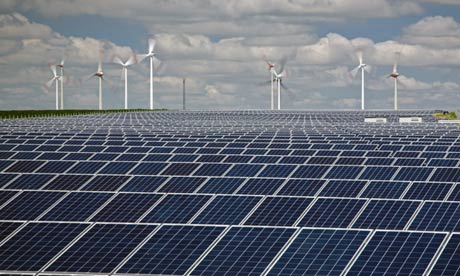
    Onshore Wind Farm and Solar Panels

    New energy storage technology could offset dips in supply from wind and solar power. Photograph: Thomas Trutschel/Photothek via Getty Images

    A trial of the largest battery in Europe, which proponents hope will transform the UK electricity grid and boost renewable energy is due to start in Leighton Buzzard, Bedfordshire.

    The trial of cutting-edge energy storage technology will test new methods of capturing electricity for release over long periods, evening out the bumps and troughs of supply and demand that plague the electricity grid. Finding ways of storing power from wind and solar generation is key to maintaining a constant source of energy.

    But storage technology has been difficult to translate from small devices such as batteries and laptops to the enormous scale needed to balance demand and supply on the national grid.

    At the electricity substation serving Leighton Buzzard, three companies are hoping to deploy one of the biggest batteries ever constructed, using lithium manganese technology. The £18.7m project will form the centrepiece of a trial of energy storage that could have far-reaching implications for the renewables sector. The three companies – S&C Electric Europe, Samsung SDI and Younicos – have gained £13.2m backing from the UK taxpayer for their 6 megawatt capacity battery installation, which will absorb and release energy to meet the demands of the grid. The first results are not expected until 2016.

    Andrew Jones, managing director of S&C Electric Europe, said that Leighton Buzzard had been chosen as it had the necessary infrastructure to hold the trial, including good grid connections and capacity for a large scale battery installation. He said: “The major grid challenges from the UK’s decarbonisation can be met through energy storage’s inherent ability to reinforce the network. But currently there are limited large-scale energy storage projects here, leaving a confidence gap. This practical demonstration promises to show the strengths and limitations of storage and unlock its potential as a key technology for the transition to low carbon energy.”

    If successful, the battery technology and networking knowhow that goes along with it will be spread around the world. The UK alone could save £3bn a year in the 2020s through large scale energy storage, according to research from Imperial College London.

  • Earthquakes trigger undersea methane reservoirs: study

    Earthquakes trigger undersea methane reservoirs: study

    (AFP) – 11 hours ago

    PARIS — Earthquakes can rip open sub-sea pockets of methane, a highly potent greenhouse gas, according to a study by German and Swiss scientists published on Sunday.

    Quake-caused methane should be added to the list of heat-trapping carbon emissions that affect the world’s climate system, although the scale of this contribution remains unclear, they said.

    The evidence comes from cores of sediment drilled from the bed of the northern Arabian Sea during a research trip by marine scientists in 2007.

    One of the cores has now been found to contain methane hydrates — a solid ice-like crystalline structure of methane and water — only 1.6 metres (5.2 feet) below the sea floor.

    Also uncovered were tell-tale signatures from water between sediment grains, and concentrations of a mineral called barite.

    Together, these suggested that methane had surged up through the sea bed in recent decades.

    “We started going through the literature and found that a major earthquake had occurred close by, in 1945,” said David Fischer from the MARUM Institute at the University of Bremen.

    “Based on several indicators, we postulated that the earthquake led to a fracturing of the sediments, releasing the gas that had been trapped below the hydrates into the ocean.”

    Their search names the culprit as an 8.1-magnitude quake, the biggest ever detected in the northern Arabian Sea.

    It ruptured a shallow gas reservoir at a location called Nascent Ridge, according to their paper, appearing in the journal Nature Geoscience.

    Over a likely period of decades, around 7.4 million cubic metres (261 million cubic feet) of methane — equivalent roughly to 10 large natural-gas tankers — belched to the surface, the authors calculate.

    This estimate is conservative, they stress, adding that there could well be other sites in the area that were breached by the quake.

    Greenhouse gases have both natural and man-made sources.

    Identified natural sources include volcanic eruptions, which disgorge heat-trapping carbon dioxide (CO2) as well as cooling sulphur dioxide particles, and methane from land and thawing permafrost.

    The biggest human source is CO2, from the burning of coal, gas and oil, and methane caused by deforestation and agriculture.

    Methane has become a rising concern in the global warming equation because it is 25 times more effective than CO2 in trapping solar heat, although it is also shorter-lived.

    According to estimates published last week in Nature, the leakage of 50 billion tonnes of methane from the thawing shoreline of the East Siberian Sea — part of the Arctic Ocean, which is one of the Earth’s hot spots for warming — would inflict costs almost as big as the world’s entire economic output.

    Copyright © 2013 AFP. All rights reserved. More »
    Related articles

    Earthquakes trigger undersea methane reservoirs —study
    GMA News – 1 hour ago
    More coverage (8) »

  • Tony Abbott’s 15 lies this week

    osted by in Economics, Politics on 27 July, 2013 11:35 am / 63 comments

    Tony Abbott’s dishonest speech this week confirms fact-checking in federal politics remains a faraway fantasy, writes IA’s fact-checking guru Alan Austin.

    abbott colour 1

    Tony Abbott is a self-confessed liar and here he is at it again. (Caricature by John Graham / johngraham.alphalink.com.au)

    At a time when good faith would seem pretty important, the man who would be Australia’s leader spouts blatant lies with apparent impunity.

    This despite so-called fact-checkers at Channel Seven, The Conversation and coming soon to the ABC.

    Mr Abbott’s address to the Australia-Israel Chamber of Commerce in Melbourne last Monday contained about twenty readily identifiable falsehoods — some are well-worn favourites from earlier speeches … plus fresh ones as well.

    Here’s a top fifteen.

     1. “The Howard/Costello Government … presided over what now seems like a golden age of prosperity – that’s been lost.”

    On most indicators, Australia is much wealthier now than 2007 — despite the worst economic downturn since the Great Depression. Indicators include income per person, pensions, superannuation, productivity and personal savings — all much higher now.

    Plus interest rates, inflation and tax levels — all lower.

    This is affirmed by international credit ratings, the value of the Aussie dollar and quality of life indices — all much better now.

    2. “By contrast, the Rudd/Gillard Government has not just failed to continue this bipartisan legacy of [economic and workplace] reform; it’s reversed it.”

    Nonsense. Heritage Foundation’s economic freedom index reflects progress in freeing capitalists from government obstruction. Its latest survey ranks Australia first among Organisation for Economic Cooperation and Development (OECD) nations and third in the world. Australia’s current score is higher than the Coalition ever achieved.

     3. “Each year’s deficit adds to Commonwealth debt, now rocketing past $300 billion with state debt on top.”

    Untrue. Borrowings to build an economy are not the same as debilitating debt, as economist Stephen Koukoulas compellingly explains. Borrowings as a percentage of gross domestic product (GDP) are currently just 20.7%. Ten OECD countries are now above 90%, including the UK, the USA and France. Japan is above 210%.

    Debt is not skyrocketing. It’s declining. Only ten wealthy nations reduced debt to GDP last year. Australia’s 2.2% reduction was only bettered by Iceland and Norway.

    AustraliaDebt

    The deficit is also falling. This year’s is less than half last year’s. At just 1.3% of GDP this is puny in comparative terms. Britain, Denmark, France, Israel and the Netherlands are above 4%. The USA, New Zealand and Japan are above 8.0%.

    Further, the underlying budget deficit, according to the non-partisan Parliamentary Budget Office is partly due to blunders during the Howard years, including reducing petrol and tobacco excise receipts.

     4. “GDP growth per head has been just one third of the Howard era.”

    This is a subtle porky, but a porky nonetheless. The essential dishonesty is denying the impact of the Global Financial Crisis (GFC) which devastated economies and reversed GDP growth worldwide.

    The average annual increase in Australia’s gross domestic product was 3.65% during the 11 Howard years. Then down to 2.44% under Labor. So it is not down to one third, more like two thirds.

    But here’s the deceit: Australia’s average growth through the Howard years was matched or bettered by several other economies. The USA averaged 3.04%. Canada 3.3%. Some European countries were higher. Luxembourg averaged 4.78%.

    Then came the GFC. In Labor’s five years, growth has been 2.44%. But in the USA 0.54%, in Canada 0.94% and Luxembourg 0.52%. And the Euro Zone negative 2.3%!

    AustraliaGDP

    5. “Australia’s fundamental strengths owe far more to the reforms of previous governments than to the spending spree of the current one.”

    Evidence affirms the opposite. Most recently, a UNICEF paper by Bruno Martorano shows that while Europe’s austerity measures worsened their economies, Australia’s prompt spending “limited the possible negative effects caused by the macroeconomic shock and favoured the process of economic recovery.”

    6. “Australia’s debt position is better than that of some other countries – not because we’ve done better, but because we started better.”

    Not true. If it were, then other nations with no debt and strong budgets surpluses should have done well through the GFC. And nations deeply in debt and deficit would have done poorly. There is no such correlation.

    Several countries which emerged from the GFC in good shape went in with huge debts at the outset. These include Israel, Switzerland and Singapore.

    In contrast, Spain, Finland, Iceland and Chile all had modest debt and budget surpluses in 2008 yet suffered severe reversals.

    7. “Sure, our economic position is stronger than that of the United Kingdom and much better than that of Greece and Italy and Spain, and France; but so was Ireland’s until quite recently.”

    Coalition spokespersons often suggest snidely that “Sure, Australia is doing better than Greece, Italy, Spain and Ireland”. Australia is in fact doing better than every economy. Economists debate whether Canada or Switzerland is second. But no-one challenges Australia’s position as world leader — and forging further ahead with each quarter’s results.


    8. “It’s good that Mr Rudd … committed the Government to a new effort to boost productivity … but he’s never actually taken the steps needed to convert aspiration into achievement.”

    False. The data shows productivity increased dramatically for four quarters in 2009, despite the GFC. It stalled in 2010 as the global downturn hit businesses badly. Since 2010, productivity has increased for a record nine consecutive quarters to an all-time high.

    9, 10, 11. “Tax reform starts with abolishing the carbon tax and the mining tax, which have done so much to spook investors, threaten jobs and hurt every family’s cost of living.”

    Three fibs in one sentence. Investment in Australia has not been impacted by the carbon tax. Total numbers of people employed have risen every quarter since the tax was introduced. And inflation is currently 2.4%. This is below the rate for most of the Labor period prior to the carbon tax, and below the rate for most of the last five Howard years.

    12. “Based on previous experience, we are confident that these changes will produce a million new jobs within five years … unlike the anaemic job creation record of the past six years.”

    More than one million jobs have been created since 2007, a record unmatched in comparable nations. The UK, with a population and an economy three times Australia’s, managed 656,000 extra jobs in that period. The unemployment rate in Australia is 5.7%. In the UK it is 7.8%. In the Euro Area 12.2%.

    The unemployment rates of 34 OECD economies as at December 2012. (Author: OECD; Image courtesy The Conversation)

    13. “At the Press Club recently, Mr Rudd declared that the mining boom was over and that Australia needed to be ready for life afterwards.”

    False. Mr Rudd specifically affirmed that “the China resources boom is over”. There is a difference. Australia has other customers.

    Rio Tinto reports that first half of 2013, iron ore production set a new first half record, driven by sustained productivity improvements and 2013 sales set a new record for a first half at two per cent higher than in 2012.

     14. “What had obviously escaped him [Rudd] was Labor’s role in bringing the mining boom to a premature end with the mining tax … and a jungle of red and green tape that means a typical mine that took under 12 months to approve in 2007 can now take over three years.”

    This old favourite was debunked by Professor John Quiggin in early July.

    15. “Also at the Press Club recently, Mr Rudd claimed credit for saving Australia from the global financial crisis — almost single-handedly apparently. Apparently he thinks that installing batts that caught fire in people’s roofs and building school halls for twice the normal price was good economic policy.”

    Multiple fibs here also. It is not Mr Rudd asserting that the stimulus packages saved Australia’s economy almost alone in the developed world from recession. Those claiming this include Joseph Stiglitz, Scott Haslem, Juan Jose Daboub, Dun and Bradstreet, John Quiggin, Rodney Tiffin, David Gruen, Glenn Stevens, Tim Harcourt and several business and union groups. Plus countless economics journalists.


    As the CSIRO found, the rate of house fires and industrial injuries and deaths during 2009-10 fell to one quarter of the rate during the Howard years. Audits of the building programs found cost overruns to have been minimal.

    There are other untruths in the speech. But there’s a start.

    So how many are deliberate lies and how many reflect genuine misinformation? In other words, does the man suffer a major personality disorder or profound ignorance?

    And where are Australia’s fact-checkers and what are they doing?

  • Who Cares About Global Warming?

    Who Cares About Global Warming?

    Mean surface temperature change for 1999–2008 ...Mean surface temperature change for 1999–2008 relative to the average temperatures from 1940 to 1980 (Photo credit: Wikipedia)

    Animals. Long-term changes in global and local temperatures kill animals. Plants, too. We geologists have a good understanding of changes in global temperatures through time and some things are pretty clear.

    First, major climatic changes have happened over and over again for the last billion years. Whenever it occurs, there follows lots and lots of death.

    Second, it’s not about the absolute temperature or the absolute amount of CO2 in the atmosphere. It’s all about the rate of change. Temperatures have been much higher many times in the past. Atmospheric CO2 levels have been much higher than today many times in the past.

    Third, we are in a major glacial period, and have been for the last 10 million years. CO2 levels are quite low relative to much of the past. Major glaciations like the present have occurred about ten other times in Earth’s history (Judith Parrish and Gerilyn Soreghan).

    The figure below shows our present understanding of the relative changes in global average temperature for the past 550 million years (Paleotemperatures through Time; Berner 2006 and others). Be careful in reading this graph as the time scale is vastly different for each of the five general time segments, going from hundreds of millions of years per segment, to millions of years, to thousands of years, as the more recent periods have greater detail in the data.

    The Earth goes through minor changes often within these overall cold or hot periods. So we shouldn’t be worried since this is all natural, right?

    Wrong.

    The rate of temperature change is pretty fast this time and we’re seeing serious effects even within a single human lifetime. The number of species that go extinct is a direct function of the rate at which the temperature changes.

    So we should be very, very concerned since the rate of change going on now is dramatic even for the big kill times in the distant past. (Remember the last ten thousand years on the graph is really stretched out, so it looks flatter).

    And it doesn’t matter if this present temperature change is human induced or not. We need to deal with it. Of course, it’s never black or white, and the warming effects appear to be a human-exacerbated natural trend.

    So it doesn’t matter what the concentrations are, it matters how fast they change, and which species and groups can’t keep up with it. They’re the ones that die.

    Source: http://en.wikipedia.org/wiki/File:All_palaeotemps.png; Berger and Loutre, 2002; Berner 2006; Royer et al. 2004, and others.

    Food does not actually come from a supermarket. It comes from the ecosystem, and we need a certain amount of co-existing plants and animals on this planet to live. When too many die too quickly, our own survival is at stake.

    In a purely selfish way, that’s why everyone needs to care about this. The Earth doesn’t care about us. We have to.

    Humans are now a global force of nature, and we need to appreciate the implications of that. Don’t let our big brains fool you, if we don’t fully understand this problem and our place in it, we will make even more planet-wide mistakes.

    Although atmospheric CO2 levels are strongly implicated in climate change, other human activities are also very important, particularly deforestation, extensive agriculture, desertification, and removal of natural waters for irrigation. These activities affect a significant amount of land surface globally and change the albedo, carbon and evaporative cycles across the planet. We can do these activities better, like in the Columbia Basin where low biodiversity in an arid region can be aided by reasonable irrigation and a diverse crop rotation.

    The first resolution always made by those wanting to address this issue is to reduce fossil fuel use, and curb CO2 emissions. Which is fine. Regardless of your feelings on the relationship of CO2 to temperature, there are many other excellent reasons to dramatically decrease fossil fuel use that have nothing to do with warming or cooling, such as direct human health effects, environmental effects of mining and drilling, and ocean acidification.

    This last one is most troubling. Ocean acidification depends only on absolute atmospheric CO2 levels and has nothing to do with global warming.

    Atmospheric CO2 dissolves in ocean water to form carbonic acid (CO2 + H2O = H2CO3). The concentration reaches an equilibrium proportional to the amount of CO2 in the atmosphere (NOAA). The more CO2 in air, the more carbonic acid in seawater.

    Even a slight acidification prevents plankton and other creatures at the base of the food chain from precipitating their shells, and the entire food chain starts to collapse.  We’ve been observing this effect in the Pacific Ocean for the last decade with major adverse effects on fishing stocks. Huge dead zones are forming, some with cyanobacteria concentrations enough to burn fishermen hauling their nets (Scientific American).

    So what should we do about this? Many of us agree that if CO2 levels exceed 700 ppm even for a short time the Earth would be rapidly thrown out of our present glacial period for at least the next 50,000 years (Berger and Loutre, 2002; GSA Memoir 199). Beginning this century, the major changes in biozones around the world, plus the continued increase in human population, will force irreversible changes to the global ecosystem.

    As a geologist, it is difficult to image how life, and life-styles as we know them, could survive. Many species will thrive, but many will perish in the rapid environmental changes in temperature, water and flora. For human societies, who can barely handle a few years of drought, the effects on this scale will be dire.

    Ironically, the only thing that will help us is the very thing that got us into this mess in the first place – energy.  Lots and lots of energy. Whether it’s for cooling, for massive irrigation, for desalinization of seawater to make up for the loss of freshwater, building dikes, moving whole cities to higher ground, trying to remove CO2 from the air, or creating food for billions from algae and cockroaches, pushing back the effects of global temperature increases will require several times the entire energy output of human history.

    Which brings us back to what we’ve been discussing for the last year. What is a good energy mix that gives us sufficient, reliable power for 10 billion people to survive in a warming world, without trashing the planet?

    Stay tuned for the evolving answer to that question.

  • Climate change divestment campaigns go on the offensive

    Environment
    Guardian Environment Blogs

    Southern crossroads badge

    Previous
    Blog home

    Climate change divestment campaigns go on the offensive

    Australia must stop investing in carbon-intensive industries, global climate campaigners announce as they take on the fossil fuel industry

    Share 13
    inShare0
    Email

    Fossil fuel in Australia : Coal Stockpiles At The Newcastle Coal Terminal
    Steam surrounds bucket-wheel reclaimers as they operate at the Newcastle coal terminal in Newcastle, north of Sydney, Australia. Photograph: Ian Waldie/Getty Images

    Bill McKibben, leader of the global climate action group 350.org, had barely left Australia when the Climate Commission released its report The Critical Decade 2013.

    The timely report underlines much that we already know. The climate is changing and the evidence continues to strengthen. The risks we were warned about are now happening. The effects of climate change endangers our “health, property, infrastructure, agriculture and natural ecosystems”. More needs to be done to stabilise the climate. And most importantly, “most of the available fossil fuels cannot be burnt if we are to stabilise the climate this century”.

    McKibben was in Australia at the start of June as part of the Do The Maths tour. The tour came off the back of his Rolling Stone article that reiterated the fact the globe’s carbon budget was almost used up. While in Australia, McKibben appeared on the ABC’s Lateline and Q & A programmes, spoke to the National Press Club, wrote an op-ed for The Guardian, and was featured in The Monthly.

    The message he was spreading: Australia and the world must stop investing in carbon intensive industries:

    Absolutely, and for two reasons. One is it makes no sense to pay for your retirement by investing in companies that guarantee you won’t have a planet worth retiring on. And two, as we’re increasingly finding out, this is a bad bet economically, this industry … Australia’s not alone in causing this problem, but it’s punching above its weight because of its coal mining industry, so hopefully we can figure out how to keep it from expanding in those ways.

    His argument is that sooner or later, investments in fossil fuels will become unburnable, as the 2012 Carbon Tracker Initiative report, Unburnable, explains.

    As I wrote just before McKibben arrived in Australia, the new global climate campaign strategy, led by 350.org, is a divestment campaign based on the historic success of the anti-Apartheid campaign targeted at South Africa. It urges major Australian institutions with large investment portfolios, such as universities, superannuation funds and hedge funds, to sell their stocks in fossil fuel companies. Underscoring this strategy is the ambition to strip away the moral legitimacy of the fossil fuel industry.

    Needless to say, the Australian Coal Association, which represents 24 black-coal miners, is unhappy with this. In April, the ACA released a report into the coal industry, which claimed that “nearly one-fifth of our economy is reliant on mining” and that size of the coal mining industry is around $43 billion. An opinion piece written by coal-funded researchers Sinclair Davidson and Ashton de Silva condemned Bill McKibben and other climate activists:

    Foreigners coming to Australia to campaign against our national economy can do a lot of damage if their claims go unchallenged. So too will “uncivil” disobedience campaigns designed to sabotage local economies and cause property destruction.

    Unfortunately for the Australian Coal Association, the respectable centre for debate in Australia, and elsewhere, is firmly shifting towards the recognition that we are facing a climate emergency. The “emerging consensus” is that fossil fuels, especially coal, oil and gas, are on the wrong side of a historic debate about our economy. A recent Commonwealth Bank “my wealth” article highlights this as well.

    I had the opportunity to speak with McKibben about the Do The Maths tour, and his divestment campaign. I asked him why 350.org had decided to target the fossil fuel industry –  McKibben himself describes the five biggest oil companies making a collective $1tn in profits since 2000 — rather than an easier target.

    “Frankly,” he told me, “that’s where the carbon is. These guys own the carbon reserves. Our target is the carbon, not specific companies.” It just so happens that the majority of carbon reserves are controlled by a handful of companies.

    In the USA, climate activists have been the target of conservative, fossil-fuel funded counter-attacks. The Koch Brothers for example, whose enormous wealth derives from their oil investments, have led the charge. The UK’s Independent paper reported in January that:

    Together, the two brothers have given millions of dollars to non-profit organisations that criticise environmental legislation and support lower taxes for industry.

    The Kochs have also contributed vast sums to promote scepticism towards climate change, more even than the oil industry according to some estimates. Greenpeace, for instance, has calculated that ExxonMobil spent $8.9m on climate-skeptic groups between 2005 and 2008; over the same period the Koch brothers backed such groups to the tune of nearly $25m.

    In Australia, the coal association and the likes of mining magnate Clive Palmer have opposed measures to price carbon. A report in The Australian showed that the ACA  claimed the carbon price would “cost 4000 jobs”, while News Ltd paper The Daily Telegraph wrote that Palmer “urged a rally of climate change sceptics to dig deeper into their pockets and spend more fighting the carbon tax.”

    McKibben had a message for the fossil fuel lobby: “We will go right at them,” he told me. “We will fight them and name them.”

    Divestment is the key to struggle. “Divestment works well,” McKibben said. “It goes on the offence.”

    The Climate Commission report states: “From today until 2050 we can emit no more than 600 billion tonnes of carbon dioxide to have a good chance of staying within the 2°C limit.” To stay below the 2°C limit, most fossil fuels reserves cannot be burned.
    Alex White Posted by
    Alexander White
    Wednesday 24 July 2013 08.00 EST guardian.co.uk

    Jump to comments (0)

    Print this

    Article history
    America’s first climate refugees
    Environment

    Fossil fuels ·
    Climate change ·
    Coal ·
    Energy ·
    Carbon emissions ·
    Activism

    Series

    Guardian Environment Blogs

    More from Southern crossroads on
    Environment

    Fossil fuels ·
    Climate change ·
    Coal ·
    Energy ·
    Carbon emissions ·
    Activism

    Series

    Guardian Environment Blogs

    More blogposts

    Related

    26 Jul 2013

    Coal made up one-third of UK energy generation in 2012, figures show

    24 Jul 2013

    European investment bank to stop financing coal-fired power plants

    20 Jul 2013

    Carbon capture vital

    16 Jul 2013

    42% of UK population unaware of carbon capture and storage – poll

    Previous
    Blog home

  • Global warming and the future of storms

    Global warming and the future of storms

    New research by Kerry Emanuel suggests that hurricanes will become more frequent and more intense

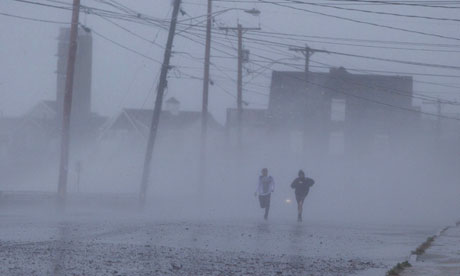
    Hurricane Sandy batters east coast

    Hurricane Sandy battered towns along the United States east coast. Photograph: Scott Eisen/REUTERS

    We know that changes we are making to the Earth’s climate will (and currently are) affecting weather. Some of the impacts are clear to see and easy to quantify. For instance, in some regions, droughts are becoming more severe and longer lasting, while in other locations, the opposite is occurring – more precipitation is falling in heavier downbursts. Two competing issues have to be considered. First, increased temperatures are increasing evaporation rates i.e., drying is occurring. Second, increased temperatures lead to more water vapor in the atmosphere, which results in heavier rain/snow events. In regions that are currently dry, the first issue dominates, whereas in wet regions, the second is more important.

    Despite these competing effects, scientists can detect changes in the drying/wetting patterns around the globe, and these are linked to human emissions.

    For other weather patterns, the evidence is not as clear. For instance for tornadoes, our observations just aren’t good enough to make categorical conclusions. Reliable records in the U.S. started in the early 1950s, but since then, there have been improvements in our sensing instruments, which makes it difficult to assess long-term trends.

    A similar situation exists for hurricanes and cyclones. We are more able to observe and quantify these storms now, so we have to ask whether increases in these storms is caused by global warming, by improved measurements, or by both. Similarly, we have had very destructive storms in the U.S. recently, but is the damage due to more powerful storms or increased infrastructure in storm areas?

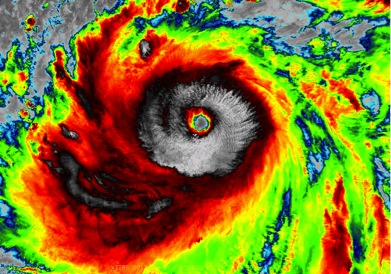
    Image of infrared emission from Typhoon Sanba, 2012. Image of infrared emission from Typhoon Sanba, 2012.One useful tool that can help answer these questions are climate models. Climate models are like virtual reality computer programs. You can input today’s conditions (wind speed, temperatures, pressures, etc.) and predict what will happen in the future. Today’s weather forecasts use similar prediction tools. In some respects, “climate” computer programs and “weather” computer programs are different, but there are some clear similarities. “Weather” prediction programs try to give short-term prognostications of local weather a few days into the future. “Climate” predictions attempt to describe long-term trends in large-scale climate patterns years and decades into the future.
    So, how can computer programs help us answer the hurricane/cyclone question? With the help of the program, a scientist can play “what if” scenarios and see how future storms will change. What if greenhouse gases increase? What if ocean temperatures increase? What if wind speeds change? How will these things affect the number and strength of hurricanes?

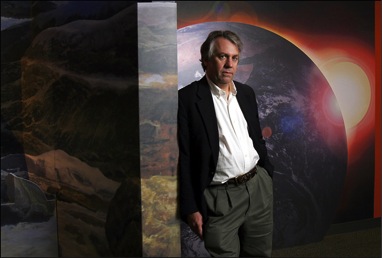
    Very recently, a publication appeared by perhaps the world’s best-known hurricane scientist, Dr. Kerry Emanuel of MIT. Dr. Emanuel combined global computer simulations with more regional simulations to look into the future at the evolution of storms. What he found was surprising. Because the storms will become stronger and more numerous, within the next century, the power dissipated by future storms will increase by about 50 percent. What was particularly interesting was that his findings show increases in both strong and weaker cyclones.

    Dr. Kerry Emanuel, MIT Dr. Kerry Emanuel, MITI asked Dr. Emanuel to summarize the present understanding of hurricanes, and he responded with the following insights:

    • The incidence of high-intensity tropical cyclones (Safir-Simpson categories 3-5) should increase, and the amount of rainfall in these storms should increase, upping the potential for freshwater flooding. These changes will not necessarily occur where tropical cyclones develop and thrive today. “Indeed,” wrote Emanuel, “it is likely that there will be decreasing activity in some places, and increasing activity in others; models do not agree on such regional changes.”

    • Though experts disagree on this point, Emanuel’s work suggests that weak events (tropical storms and Cat 1-2 storms) will become more frequent.

    • “Very little work has been done on the problem of storm size,” wrote Emanuel, “what little research has been done suggests that storm diameters may increase with global temperature. This can have a profound influence on storm surges, which are the biggest killers in tropical cyclone disasters. ”

    Is Dr. Emanuel right? We will have to wait and see. What we do know is he has been right many times in the past, and I am not willing to bet against him. All of this may be academic but it has real human impact. Just ask the people affect by recent storms Katrina, Sandy, Irene, Isaac, Ike, Rita, Wilma, Charley, Ivan, Andrew…you get the point.