Category: Uncategorized

  • Solar boat Türanor becomes a research vessel to study climate change

    Solar boat Türanor becomes a research vessel to study climate change

    Sun-powered craft that went around the world will now gather data on how global warming is affecting the Gulf Stream

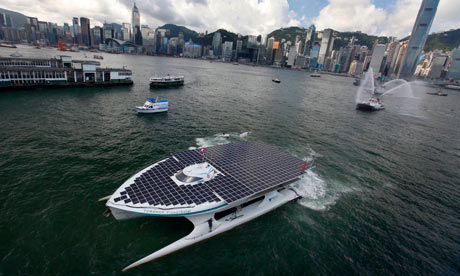
    Solar powered vessel, 'MS Turanor Planetsolar' enters Victoria Harbour, Hong Kong, China

    MS Türanor SolarPlanet will measure emissions in the open ocean. Photograph: Alex Hofford/EPA

    The solar-powered boat docked in Battery Park City in New York could easily have been packed off to a museum as a relic.

    The MS Türanor SolarPlanet saw its glory days last year, when the catamaran went around the world powered only by the sun and energy stored in the huge battery packs in each pontoon.

    Now the 102-ft craft has embarked on a new life as a research vessel for a team of scientists from the University of Geneva studying the Gulf Stream under climate change.

    The Swiss research team departs from New York on Friday for Boston, St John’s Newfoundland, Reyjavik, Iceland and Bergen, Norway to study the ocean current’s response to the warming of the atmosphere.

    “We know very little about what is taking place over the ocean,” said Prof Martin Benitson who heads the institute for environmental research at the University of Geneva.

    One big plus offered by the Türanor: the boat produces no emissions. Bentison said that zero emissions status means scientists for the first time will be able to collect data free of polluting substances, such as diesel fuel.

    “Once we start measuring emissions in the open ocean, we can be almost 100% certain that these are ocean emissions, and not biased by a ship’s chimney,” he said.

    The team will be collecting data from air and water to study the Gulf Stream’s response to climate change. The powerful ocean current carries water from the tropics up to the polar reaches of the Atlantic, taking the edge off winter temperatures in northern and western Europe.

    Benitson and his crew will be harvesting data on aerosols, tiny, airborne particles, over the ocean, as well as phytoplankton, the microscopic, plant-like animals that are at the bottom of the ocean food chain.

    They will also take a look at ocean eddies, the whirlpools that break off from the main current carrying large amounts of energy.

    Scientists believe slowing of the Gulf Stream under climate change could bring colder conditions to Europe.

    Projected changes in the Gulf Stream could also produce more intense hurricanes along the east coast of the United States.

    “Sandy might not have been a one off, but something that might repeat itself two or three times in a decade.” Benitson said.

    The research voyage offers a new lease of life for a ship that has outlasted its original purpose, said Gérard d’Aboville, the French captain.

    But there were also challenges, he said. In addition to the usual instrument panel, d’Aboville receives daily weather updates from the French weather service, enabling him to change course if he sees a patch of cloud ahead.

    Another monitor displays battery strength. Once fully charged, the boat can run on battery power for 72 hours. It was at 20% when it arrived in New York harbour on Monday afternoon. Within less than a day it was back up to full strength.

    “With a usual boat you take care of the sea, the winds, he currents. Now you have to take care of the sun,” he said.

    It was also strangely quiet, he said. “It’s a bit strange the first time you pilot the boat because you put it in forward motion, and there is absolutely no noise,” he said.

    And not much in the way of pick-up. Maximum cruising speed of the Turador is about 8 knots.

    But at least the catamaran remained at sea, he said. “Instead of being in a museum somewhere in some harbour, the boat is now engaged in this second life,” d’Aboville said. “We can have a second life and we can have a mission.”

  • Planktonic foraminiferal area density as a proxy for carbonate ion concentration: a calibration study using the Cariaco Basin Ocean Time Series

    Planktonic foraminiferal area density as a proxy for carbonate ion concentration: a calibration study using the Cariaco Basin Ocean Time Series

    Published 19 June 2013 Science Leave a Comment
    Tags: , , , , ,

    Biweekly sediment trap samples and concurrent hydrographic measurements collected between March 2005 and October 2008 from the Cariaco Basin, Venezuela are used to assess the relationship between [CO32-] and the area densities (ρA) of two species of planktonic foraminifera (Globigerinoides ruber (pink) and Globigerinoides sacculifer). Calcification temperatures were calculated for each sample using species-appropriate oxygen isotope (δ18O) temperature equations that were then compared to monthly temperature profiles taken at the study site in order to determine calcification depth. Ambient [CO32-] was determined for these calcification depths using alkalinity, pH, temperature, salinity, and nutrient concentration measurements taken during monthly hydrographic cruises. ρA, which is representative of calcification efficiency, is determined by dividing individual foraminiferal shell weights (± 0.43 µg) by their associated silhouette areas and taking the sample average. The results of this study show a strong correlation between ρA and ambient [CO32-] for both G. ruber and G. sacculifer (R2 = 0.89 and 0.86 respectively), confirming that [CO32-] has a pronounced effect on the calcification of these species. Though the ρA for both species reveal a highly significant (p < 0.001) relationship with ambient [CO32-], linear regression reveals that the extent to which [CO32-] influences foraminiferal calcification is species-specific. Hierarchical regression analyses indicate that other environmental parameters (temperature and [PO43-]) do not confound the use of G. ruber and G. sacculifer ρA as a predictor for [CO32-]. This study suggests that G. ruber and G. sacculifer ρA can be used as reliable proxies for past surface ocean [CO32-].


    Marshall B. J., Thunell R. C., Henehan M. J., Astor Y. & Wejnert K. E., in press. Planktonic foraminiferal area density as a proxy for carbonate ion concentration: a calibration study using the Cariaco Basin Ocean Time Series. Paleoceanography. Article (subscription required).

  • Wellington battered as storm heads north

    Wellington battered as storm heads north

    7:59pm June 20, 2013
    Share
    0
    Email

    Winds gusting up to 140km/h were battering downtown Wellington, lifting roofs from homes and cutting power to about 30,000 customers.

    The southerly winds were part of a storm which has already brought snow and heavy rain to much of the South Island on Thursday, and was expected to cause problems through the North Island moving into Friday.

    More than 200 people have called Wellington City Council’s call centre, reporting houses losing roofs, breaking windows and other structural damage due to the winds.

    The winds have also brought down trees and caused slips, and Middleton Rd between Johnsonville and Churton Park was closed after a tree blew onto a car.

    Acting civil defence controller Neville Brown says it’s essential people stay indoors if possible.

    “There is a lot of material being turned into missiles – it is a potentially lethal situation out there.”

    Mr Brown said the winds were so severe it was too treacherous in many cases to carry out repairs and clearance work, and he warned there were likely to be numerous obstructions for commuters on Friday.

    Wellington Electricity said trees and debris falling onto lines caused about 30,000 power outages through the region, particularly in the Hutt Valley and Porirua regions as well as the Miramar area.

    A spokesman said crews were doing what they can to repair the lines but the volume of outages and the danger caused by the winds might slow repair times.

    Wellingtonians were urged to stay clear of fallen power lines and anything touching them as they could be live and dangerous.

    MetService duty forecaster Heath Gullery said winds were averaging 85-90km/h in urban areas, gusting up to 140km/h.

    One resident told NZ Newswire she was having trouble driving her car home and it was the worst wind she could remember.

    Ferries, trains and flights in Wellington were all cancelled.

    Strong winds were also forecast in Nelson, Marlborough, the West Coast, Fiordland, Wairarapa, Whanganui, Taranaki, Auckland, the Coromandel and Northland, and were set to continue into Friday.

    The winds came as part of a storm which dumped snow through Otago and Canterbury on Thursday, and more

  • Immigration drives population growth to record levels

    Immigration drives population growth to record levels

    June 20, 2013 | Filed under: Breaking News,Environment,Government | Posted by:

    ABS population people

    The Australian Bureau of Statistics reports that Australia’s population grew by 1.8 per cent during 2012, returning to the excessive growth seen three years ago.

    This is the level advocated by then Prime Minister Kevin Rudd’s hugely unpopular ‘Big Australia’ policy, which was renounced by Julia Gillard on her ascension to the top job. Her government has in the intervening years quietly and gradually restored immigration levels to their Kevin Rudd-levels.

    The director of ABS Demography, Bjorn Jarvis, confirmed the increase in Australia’s population growth rate is being driven by net overseas migration.

    “Net overseas migration added 235,900 people to the population in 2012, which is a 17 per cent increase over 2011,” he said.

    “Net overseas migration accounted for 60 per cent of Australia’s total growth, with the remaining 40 per cent due to natural increase. Notably, 2012 also saw a 4 per cent rise in natural increase, which is the largest increase in almost four years.”

    Western Australia continued to lead the nation with an annual increase of 3.5 per cent, the highest of any state or territory, to reach 2.47 million by the end of December 2012. It also had the highest population growth by percentage over the ten years from 2002-2012, increasing by 27.6 per cent or 534,100 people.

    The lowest growth rate was in Tasmania where the population increased by just 0.1 per cent to reach 512,400.

    Victoria had the highest increase in natural increase for the year ending 31 December 2012, increasing by 18.6% (or 6,500 people).

    The number of births increased by 2.2 per cent over the past year while the number of deaths increased by 0.2 per cent.

    (92)
  • Human Population Growth Could Cause Extinction of Many Birds and Mammals In Next 40 Years

    Human Population Growth Could Cause Extinction of Many Birds and Mammals In Next 40 Years

    By Sam Goodwin | Jun 20, 2013 04:11 AM EDT

    • icon
    • icon
    Human Population Growth Could Cause The Extinction of Many Birds and Mammals In Next 40 Years

    Human Population Growth Could Cause The Extinction of Many Birds and Mammals In Next 40 Years (Photo : Flickr)

    The rapid growth of human population could lead to the extinction of many birds and mammals within the next 40 years, state researchers from the Ohio State University.

    Earlier this month, the United Nations released a report predicting that the human population will increase by 1 million over the next 12 years and will reach 9.6 billion by 2050 and could reach 11 billion by 2100. This growing population could lead to the extinction of many birds and mammals within the next 40 years, state researchers from The Ohio State University in a press release after conducting a thorough research.

    Share This Story

    • 0
      inShare

    Though growth in population is predicted mostly in developing countries, the United States has been ranked sixth in the world in terms of new species expected to be threatened by 2050.  The study says that the world can see a rise of 3.3 per cent  in the number of threatened species, which can go up to  10.8 by 2050 including extinction.

    Previous studies have been conducted on how the growing human population poses a serious threat to many birds and mammal species; this is the first study that links this growth to the extinction of such species.

    For the study, researchers used a model that had earlier been used based on 2000 data to predict the effect of population growth on species and their future existence. The predictions were published in 2004. In  2010, the predictions were confirmed to be accurate and the effectiveness of the model was guaranteed. The same model was used containing data on 114 countries, to extend their predictions to the middle of this century.

    “Our projection is based on human population density alone. It doesn’t take into account climate change, industrialization or wars,” said Jeffrey McKee, professor of anthropology at Ohio State and lead author of the study. “So the actual numbers that we predict for 2050 will be very different because everything we do will exacerbate the problem.”

    Researchers also stated that the top country predicted with new species threats by the middle of the century is the Democratic Republic of the Congo, where more than 20 species might face extinction in that time frame.

    Apart from these predictions, the model also predicted that countries expected to witness a decline in human population growth will also experience an average reduction in threatened species, as much as 2.5 percent.

    The findings are published in the journal Human Ecology.

  • COLUMN – The price of ignoring climate change: Senator Sheldon Whitehouse

    COLUMN – The price of ignoring climate change: Senator Sheldon Whitehouse

    Source: Reuters – Wed, 19 Jun 2013 04:08 PM

    Author: Reuters
    cli-wea cli-ada cli-cli hum-aid
    TweetRecommendGoogle +LinkedInBookmarkEmailPrint

    Jump down to related content

    (US Senator Sheldon Whitehouse is a Reuters columnist but his opinions are his own.)

    By Senator Sheldon Whitehouse

    June 19 (Reuters) – The effects of climate change, driven by carbon pollution, hit Americans harder each year. Extreme weather events like hurricanes, wildfires and droughts are growing ever more frequent and severe.

    Beyond our borders, these changes are hitting developing nations.

    Since our nation’s founding, America has stood as an example for the world. Now, we owe it to ourselves and to other nations, who look to Washington, to lead the way on climate change by putting a price on carbon pollution and taking other steps to minimize the harm being done to developing nations – and our own.

    In many of the world’s poorest regions, the sun scorches drought-stricken farmland and parches freshwater sources. Fierce storms bring ravaging floods. Warming, rapidly acidifying oceans and shifting seasons drive off economically valuable species and foster pests and disease.

    This year, the worst flood in a decade killed at least 38 people in Mozambique and left 150,000 homeless. Warmer weather allows malaria-bearing mosquitoes to move into previously unaffected altitudes, infecting cities like Nairobi, which had purposely been built above the “malaria line.” Ten of the 15 largest cities in the developing world, including Shanghai, Mumbai and Cairo, are at risk of flooding from rising sea levels or coastal storm surges. Rising seas are swallowing low-lying land in countries such as Bangladesh and India.

    Climate change endangers much of the world economy as well. Economists calculate that a 3.5?F rise in global temperature would reduce global gross domestic product by 1 percent. But loss will be 4 percent in Africa, and 5 percent in India. The United Nations estimates that environmental disasters could drive as many as 3 billion people into extreme poverty by the year 2050.

    These regions face a crisis not of their making. Developed countries have churned out two-thirds of all the carbon dioxide pollution since the Industrial Revolution – one-quarter of that from the United States alone.

    We have much to gain here at home from efforts to mitigate the effects of climate change: safer coastal communities, healthier farming and fishing industries, and cleaner air to breathe. But the American experiment has always been about more than that.

    Indeed, as one of the largest emitters of carbon pollution, the United States has a responsibility to help emerging nations adapt to the stark reality of a changing climate, lest, as Daniel Webster warned, our own example “become an argument against the experiment.”

    We are now taking important steps to help poorer nations cope with climate change. Indeed, federal agencies, from the U.S. Agency for International Development and the Environmental Protection Agency, to the Agriculture and Defense Departments, support adaptation strategies in the developing world. We provide financing to support construction and hardening of physical infrastructure. We make available technology to improve weather forecasting and irrigation techniques. While these physical adaptation programs are crucial, the crisis of climate change also requires political and diplomatic adaptation.

    This is the mission of the State Department’s Environment, Science and Technology and Health (ESTH) officers. These officers engage on both a bilateral and a regional basis to promote good environmental governance, enable sustainable trade practices, advance resource and wildlife conservation, and improve access to healthcare. Many work closely with our allies around the globe, helping make communities more resilient to the devastating effects of climate change.

    This is still a small effort. As of 2011, 260 of the State Department’s more than 13,000 Foreign Service officers handled environment, science, technology and health issues in our embassies. Only 76 were full-time ESTH officers. Theirs is vital work. It is worth replicating on a larger scale.

    The United States must also set an example by putting a price on carbon pollution. I’m working with Representative Henry Waxman (D-Calif.) and others to finalize legislation that would do so. Right now, the big polluters pump billions of tons of carbon into our atmosphere, forcing the rest of us to pay the price through higher healthcare costs, higher rebuilding costs after carbon-driven extreme weather events, and more.

    Our proposal would put those costs back on the polluters. It would generate billions of dollars in new revenue, which could produce substantial benefits for the U.S. economy. But, just as important, it would improve the global environment by encouraging reduced emissions. It would also send a message that we are ready to lead once more on one of the great issues of our time.

    The effects of more than a century of Western pollution bear heavily on less-developed countries. The eyes of the world are on us. Without concerted action, we run the risk of allowing climate change to destabilize entire nations – and their confidence in America’s leadership.

    (U.S. Senator Sheldon Whitehouse (D-R.I.) is a member of the Environment and Public Works Committee and co-chairman of the Bicameral Task Force on Climate Change of the US Senate. He also serves on the Budget and Judiciary Committees. (Senator Sheldon Whitehouse)

    Topical news

    We welcome comments that advance the story through relevant opinion, anecdotes, links and data. If you see a comment that you believe is irrelevant or inappropriate, you can flag it to our editors by using the report abuse links. Views expressed in the comments do not represent those of the Thomson Reuters Foundation. For more