Category: Uncategorized

  • Take a ‘Snapshot’ of How Climate Change Affects Your Community

    Take a ‘Snapshot’ of How Climate Change Affects Your Community

    Kim Knowlton

    Posted June 19, 2013 in Curbing Pollution, Health and the Environment, Moving Beyond Oil, Solving Global Warming

    Tags:
    , , , , , , , , ,

    Today, NRDC is launching a new webtool that lets you take a ‘Snapshot’ of what climate change means in your area. You can read whether current conditions and trends in your area indicate a higher vulnerability to extreme weather events, such as heat waves, floods, and drought as well as health risks that climate change is fueling, right now.

    Here’s how it works: you enter your ZIP Code to get a quick ‘Snapshot” of how your county stacks up in several of the categories from our climate vulnerability maps: Extreme heat, air pollution, flooding, drought, infectious illness like dengue fever, wildfires, sea level rise, and extreme weather. It’s a quick way to get a sense of how these threats can affect the environment and your health, right where you live.

    You can also easily share your Snapshot on Facebook or Twitter with the webtool.

    NRDC has been bringing together scientific information about the local effects of global climate change on communities nationwide since 2007. We’ve created web tools that let you zoom in and ask, ‘What does climate change mean in my backyard?’ Our online maps connect the dots between climate change and the ways it harms our health.  We’ve mapped extreme weather events that are being fueled by climate change, and we also highlight preparedness steps that protect our kids’ health and our own, saving lives and dollars along the way.

    Climate change is one of the most serious public health threats facing our nation, but many people don’t yet realize how it could affect their local community and health. While climate change threatens all of us, children, the elderly, and communities living in poverty are among the most vulnerable. Storms like Hurricane Sandy and searing summers like 2012 – the hottest summer in America’s history – take a huge toll on health, and are themselves a ‘snapshot’ of what our future will look like more and more, with climate change. We need to be ready.

    Why the urgency now?

    • Extreme heat can be lethal. The annual death toll from extreme heat is already on the rise, according to a report released by the CDC at the beginning of June, with the number of heat-related deaths predicted to jump from the current annual rate of around 700 to between 3,000 and 5,000 by 2050.
    • Increasing flood risks with climate change will hammer homeowners. A new report released by FEMA suggests that, by 2100, the number of flood-prone properties in the U.S. could double. An estimated 70% of that additional flood risk will be from climate change (the other 30% due to projected population growth in at-risk areas).
    • Drought and wildfire risks are worsened by extreme heat. Much of Texas is in a state of drought emergency declared by Governor Rick Perry, and the costs of the 2012 drought have been estimated at $60-100 billion.
    • It’s been estimated that American taxpayers in 2012 paid $139 billion in damages related to many types of events fueled by climate change: severe weather, flooding, wildfire and drought.
    • The health-related costs of climate change add billions more – not to mention the costs in lives lost, illnesses, lost work and school days, and diminished quality of life on hot, smoggy days.

    Hopefully, our new webtool will bring these statistics home for people.  We want people to be able to think about and talk about their own local climate-health vulnerabilities — because taking action to protect the places and the people we love from climate change is an urgent matter.

    What kinds of actions could make a difference?

    Limiting heat-trapping carbon pollution, which is the root cause of climate change, would make an enormous difference. The US Environmental Protection Agency State has proposed limits on carbon pollution from power plants, which would cut about 40% of US emissions. This is a critical step forward. You can ‘Take Action’ here to write the President a letter saying so.

    At the same time as we work to prevent and reduce carbon pollution before it gets into the air by moving toward cleaner, less polluting fuels, we need to become better-prepared for climate change, too. State preparedness plans and policies have not kept pace with these health challenges. Only about one-third of US states have climate preparedness plans in place that include public health measures to cope with climate challenges.

    We have to do better than this.

    We need to prepare and plan for the future, not the past. And the future isn’t an abstraction: it’s where your kids and grandkids will live, and you, too, in a slightly older version. Your local climate-vulnerability Snapshot could be a different picture in the future, if we put the brakes on heat-trapping carbon pollution today and veer away from the worst effects of climate change.

  • Siberian Caves Warn of Permafrost Meltdown

    Siberian Caves Warn of Permafrost Meltdown

    June 19, 2013 — Climate records captured in Siberian caves suggest 1.5 degrees of warming is enough to trigger thawing of permafrost, according to a paper to be given at the Geological Society of London on 27 June.


    Share This:

    Permafrost regions cover 24% of the northern hemisphere land surface, and hold an estimated 17,000 Gt of organic carbon. Thawing releases CO2 and CH4, creating positive feedback during greenhouse warming.

    The researchers, led by Gideon Henderson at the University of Oxford’s Department of Earth Sciences, studied speleothem records from the caves to identify periods where temperatures were above freezing. Speleothems, such as stalactites and stalagmites, form when water seeps through cracks in cave walls, dissolving minerals which precipitate in the air filled cave.

    ‘Cave temperatures usually approximate the local mean annual air temperature’ says Anton Vaks, the paper’s lead author. ‘When they drop below 0 degrees, the rock above and around the cave freezes, and speleothem growth stops.’

    By dating the speleothems and comparing their ages to existing climate records, it is possible to identify the degree of warming which caused the permafrost to melt. New results from Ledyanaya Lenskaya Cave, Eastern Siberia, show major deposition of speleothems at around one million years and 400,000 years ago.

    ‘Both episodes occurred when global temperatures increased 1.5°C ± 0.5 above the pre-industrial level’ says Vaks, ‘showing that this degree of warming is a tipping point for continuous permafrost to start thawing.’

    Global temperatures are currently around 0.7 degrees above pre-industrial level, with current models suggesting that a warming of 1.5°C ± 0.5 will be achieved within 10-30 years.

    The paper will be read at the Geological Society’s forthcoming William Smith Meeting, held on 25-27 June, which celebrates the 100th anniversary of the beginning of modern dating methods.

    In 1913, Frederick Soddy’s research on the fundamentals of radioactivity led to the discovery of ‘isotopes’. Later that same year, Arthur Holmes published his now famous book ‘The Age of the Earth’, in which he applied this new science of radioactivity to the quantification of geologic time. Combined, these two landmark events did much to establish the field of ‘isotope geochronology’ — the science that underpins our knowledge of the absolute age of most Earth and extraterrestrial materials.

    Share this story on Facebook, Twitter, and Google:
  • Millions on Bangladesh coastline to be trapped

    Millions on Bangladesh coastline to be trapped

    Star Online Report

    An iceberg floats in Jacobshavn fjord in Greenland in 2006. Photo Reuters

    An iceberg floats in Jacobshavn fjord in Greenland in 2006. Photo Reuters

    The World Bank has warned that Bangladesh, under a 2°C warming, emerges as an impact hotspot with sea-level rise causing threats to food production, livelihoods, urban areas and infrastructure.
    Shifting rain patterns in South Asia leaving some parts under water and others without enough water for power generation, irrigation, or drinking are the likely impacts of a possible global temperature rise of 2 degrees Celsius  in the next few decades that threatens to trap millions of people in poverty, a World Bank report on climate change says.
    Under 4°C warming, the west coast and southern India, as well as Bhutan and northern Bangladesh, are projected to shift to new, high-temperature climatic regimes, the report said.
    The report, prepared for the World Bank by the Potsdam Institute for Climate Impact Research and Climate Analytics, reveals how rising global temperatures are increasingly threatening the health and livelihoods of the most vulnerable populations, crucially magnifying problems each region is struggling with today.
    Unusual heat is projected for 60–80 percent of the Northern Hemisphere summer months in most parts of the region, the WB report said
    Bangladesh emerges as an impact hotspot with increasing and compounding challenges occurring in the same timeframe from extreme river floods, more intense tropical cyclones, rising sea levels, extraordinarily high temperatures, and declining crop yields.
    Increased river flooding combined with tropical cyclone surges poses a high risk of inundation in areas with the largest shares of poor populations.
    A 27 cm sea-level rise, projected for the 2040s, in combination with storm surges from an average 10-year return period cyclone, such as Cyclone Sidr, could inundate an area more than 80-percent larger than the area inundated at present by a similar event, it adds.

    TURN DOWN THE HEAT

    Climate Extremes, Regional Impacts, and the Case for Resilience builds on a World Bank report released late last year, which concluded the world would warm by 4 degrees Celsius (4°C or 7.2 degrees Fahrenheit) above pre-industrial levels by the end of this century if we did not take concerted action now.
    This new report looks at the likely impacts of present day, 2°C and 4°C warming on agricultural production, water resources, coastal ecosystems and cities across Sub-Saharan Africa, South Asia and South East Asia.
    Deaths in India and Bangladesh currently account for 86 percent of global mortalities from cyclones even though only 15 percent of all tropical cyclones affect this region.
    “This new report outlines an alarming scenario for the days and years ahead – what we could face in our lifetime,” said World Bank Group President Jim Yong Kim.
    “The scientists tell us that if the world warms by 2°C — warming which may be reached in 20 to 30  years –  that will cause widespread food shortages, unprecedented heat-waves, and more intense cyclones.
    In the near-term, climate change, which is already unfolding, could batter the slums even more and greatly harm the lives and the hopes of individuals and families who have had little hand in raising the Earth’s temperature.”
    “These changes forecast for the tropics illustrate the level of hardships that will be inflicted on all regions eventually, it we fail to keep warming under control,” Kim said.
    “Urgent action is needed to not only reduce greenhouse gas emissions, but also to help countries prepare for a world of dramatic climate and weather extremes,” he added.

    Published: June 19, 2013 at 6:36 pm | Last Modified: June 19, 2013 at 6:59 pm
  • Breaking news: children off Manus! GET-UP

    Breaking news: children off Manus!

    Inbox
    x
    GetUp!
    6:32 PM (7 minutes ago)

    to me
    Breaking news: we’ve just learned that it appears that children and families were today relocated from Manus Island Detention Centre. Read on for a message from Leila. Your details have not been shared with anyone.

    Dear NEVILLE,

    Today, on World Refugee Day, I received the best message – the news I’ve been waiting to hear every day now for almost a year: “My family is finally getting off Manus Island!” my young friend told me.

    Overjoyed, she asked me to pass this on to you: “Thank you to all the Australians who haven’t abandoned us on the forgotten Island.”

    She is the young asylum seeker who earlier this year revealed the appalling conditions in the Manus Island detention centre during an exclusive recorded interview with us. Thanks to GetUp members, her message reached millions all over the country.

    In that interview she shared her grief for the very young children who felt like they were being punished for something, but couldn’t figure out what. She recounted the heartbreaking story of a young boy, only 8 years old, who would lie down next to the fence and stare off into the distance, wishing he was a dove so he could fly away. She feared for his mental health. I feared for hers.

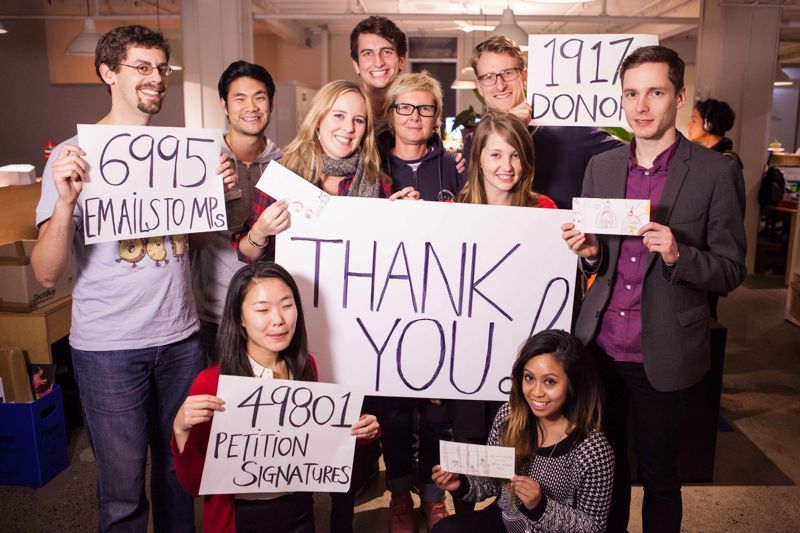
    But today, I’ve heard news that my friend was one of the sixty-five asylum seekers who were removed from the notoriously inhumane facilities on Manus Island detention centre. It’s because of you – and refugee advocates everywhere – that Manus is no longer ‘the forgotten Island’. Our movement rallied together – sending postcards, emailed MPs, and ran TV ads – sharing the stories of the children on Manus in order to ensure that these families would not remain out of sight, out of mind. We did it.

    You might remember the moment in the campaign, back in March, when the children saw their drawings on this website and learned their stories were being told on TV. She contacted me on that day and through tears of happiness said the children were literally dancing with joy. They were dancing because they felt that if we could hear their stories, they wouldn’t be forgotten. We’d have to help them. They were right.

    Today, on World Refugee Day, we should all take a moment to feel proud about what our movement’s actions have done to bring about the release of the most vulnerable people out of the shameful and inhumane facilities that make up the Manus Island detention centre. It’s a hard fought and long overdue victory.

    This is a big step, but it’s not yet over for the kids and families we’ve fought so hard to free. There are still some families – including children – who will need to wait until June 30 before they are released from Manus. Most of those whom have been released were transferred to Christmas Island, where the facilities are so overcrowded that we’ve heard families are crammed into the dining room. Processing has been stalled so numbers continue to rise.

    But for now, we should congratulate those who made it happen. Today would not have happened without the sustained and tireless campaigning from amazing people and groups in the refugee space including, but not limited to, ChilOut, Amnesty International, Sarah Hanson-Young and the Greens, retiring Liberal MP Judi Moylan and the countless other refugee advocacy groups. A big thank you!

    Today is a moment on the Manus campaign we can all be proud of, but the fight for a more humane system for processing asylum seekers and refugees who flee to Australia – including no child in detention – is one that we’ll continue to fight and continue to update you on.

    Thank you,
    Leila, for the GetUp team

    PS – Did you see coverage of the GetUp Manus campaign on the home pages of the Sun-Herald and The Sunday Age this past weekend? If not, make sure to check it out!

    PPS – In the coming months GetUp will endeavour to keep tabs on what is happening with the children who have left Manus Island, including visiting them in their new facilities and advocating for them to receive the support they need after what they’ve endured. If you would like to chip in to help us continue the campaign click here to donate: www.getup.org.au/great-news-from-manus. Watch this space – we’ll be in touch soon.


    GetUp is an independent, not-for-profit community campaigning group. We use new technology to empower Australians to have their say on important national issues. We receive no political party or government funding, and every campaign we run is entirely supported by voluntary donations. If you’d like to contribute to help fund GetUp’s work, please donate now! If you have trouble with any links in this email, please go directly to www.getup.org.au. To unsubscribe from GetUp, please click here. Authorised by Sam Mclean, Level 2, 104 Commonwealth Street, Surry Hills NSW 2010.

  • Gulf Of Mexico Dead Zone 2013 — Record-Setting Deadzone Is Likely This Year Posted on June 19, 2013 by Nathan

    Gulf Of Mexico Dead Zone 2013 — Record-Setting Deadzone Is Likely This Year

    Posted on June 19, 2013 by
    Print Friendly
    11 Share 5 Tweet 0 Share 16 16 Share

    The 2013 Gulf of Mexico dead zone may very likely be the largest one ever, according to new predictions based on several different NOAA-supported forecast models. The hypoxic dead zone is forecast to cover somewhere between 7,286 and 8,561 square miles of the Gulf of Mexico. The largest dead zone on record was the 2002 one, which covered 8,481 square miles.

    "Less oxygen dissolved in the water is often referred to as a 'dead zone' (in red above) because most marine life either dies, or, if they are mobile such as fish, leave the area. Habitats that would normally be teeming with life become, essentially, biological deserts." Image Credit: NOAA

    “Less oxygen dissolved in the water is often referred to as a ‘dead zone’ (in red above) because most marine life either dies, or, if they are mobile such as fish, leave the area. Habitats that would normally be teeming with life become, essentially, biological deserts.”
    Image Credit: NOAA

    Dead zones — whether hypoxic (very low oxygen) or anoxic (no oxygen) — are caused primarily by high-levels of nutrient pollution. This nutrient pollution — mostly the fertilizers used in industrial agriculture — causes large algal blooms which use up all of the oxygen in a given environment. As a result, the environment becomes devoid of life — a “dead zone”. These deadzones have been increasing in frequency and scale since at least the 1970s. More than 1.7 million tons of potassium and nitrogen make their way into the Gulf of Mexico every year as a result of agricultural runoff — via the Mississippi river.

    If the 2013 Gulf of Mexico dead zone becomes as large as is being predicted it will cover an area the size of New Jersey. The 2013 predictions were made by modelers at the University of Michigan, Louisiana State University, and the Louisiana Universities Marine Consortium.

    Read more at http://planetsave.com/2013/06/19/gulf-of-mexico-dead-zone-2013-record-setting-deadzone-is-likely-this-year/#7A8rQ0FcToqYYehM.99

  • A reprieve but the Great Barrier Reef remains on death row

    The Great Barrier Reef may have been spared the indignity of being listed as a World Heritage Area “in danger” this week, but the Reef’s woes are just beginning. There are 962 properties on the world heritage list. Most of these are protected for their cultural values, while many, like the Great Barrier…

    Tb9cx9p5-1371696229
    World Heritage won’t mean anything if nothing’s done about climate change. Flickr/350.org

    The Great Barrier Reef may have been spared the indignity of being listed as a World Heritage Area “in danger” this week, but the Reef’s woes are just beginning.

    There are 962 properties on the world heritage list. Most of these are protected for their cultural values, while many, like the Great Barrier Reef, are protected for their natural values. Thirty-eight sites have been placed on the world heritage “in danger” list in recognition of the damage they have sustained or risks they face.

    The World Heritage Committee agreed to postpone their review of the Great Barrier Reef to 2014, as the Queensland and Federal governments prepare reports into coastal development. But it isn’t just coal and ports that are the problem.

    It is only a matter of time before the Australian government and the international community will have to face up to reality. Climate change is fundamentally challenging the way we go about protecting the environment.

    To protect the reef, look beyond the coast

    Managing the Reef now can buy time while a global response is hammered out to deal with climate change and ocean acidification. But the Federal and Queensland governments don’t seem to recognise time is running out.

    In fact, neither does the World Heritage regime itself. It remains based on a somewhat dated view about how natural environmental assets should be protected.

    The 1972 World Heritage Convention, which defined how and what can be listed as World Heritage, is built on the premise that sites are best protected by conservation at the site. Historically this made sense. The Convention is one of the earliest environmental treaties, and concluded at a time when the main threats to world heritage were highly localised. It is a bit like a museum, seeking to preserve certain outstanding illustrations of cultural and natural property for future generations.

    What it doesn’t do is account for natural change, or the much more serious threat of human-induced change. World heritage properties cannot be frozen in time. In the current geological epoch, which we can think of as the Anthropocene, the greatest single threat to many world heritage properties is climate change.

    Back in 2004 a report from University of Sydney found the Howard government’s failure to ratify the Kyoto Protocol and to support international initiatives to curb greenhouse gas emissions was one reason among several why the Great Barrier Reef might be included on the “in danger” list. We mustn’t let the current debate about development hide the reality of climate change.

    World Heritage can’t address this. That is for other regimes, chiefly the UN Framework Convention on Climate Change, to resolve. What World Heritage can do is draw attention to global threats that major environmental assets face. Its “in danger” listing process is a key mechanism to achieve this.

    For well over a decade there has been discussion over whether the Great Barrier Reef should be placed on the “in danger” list. The main reason for this is the dawning realisation the Reef will be severely damaged by rising sea temperatures from climate change.

    2012: development the new threat

    The recent discussions about the reef have focused on the range of developments proposed for the Queensland coast, such as new or expanded ports to facilitate coal exports.

    This is based on a 2012 report from UNESCO and the IUCN. It warned Australia the reef would be placed on the “in danger” list unless this development was curtailed or properly assessed.

    The report set out 14 detailed recommendations for getting the protection and management back on track. These included:

    • no new port development outside existing port areas
    • an independent review of developments at Gladstone and Curtis
    • an independent review by internationally recognised and widely respected scientific experts of the overall planning, protection and management of the Reef

    With official endorsement by the World Heritage Committee in 2012, it was clear the committee was keeping watch on the Reef, and that a brake had to be placed on coast developments.

    On a positive note, the report observed that the actual management of the Reef was world-class, and considered the “gold standard” for conserving large marine areas.

    2013: still on the brink

    In February 2013 the Great Barrier Reef Marine Park Authority responded to the 2012 report and its recommendations. Several aspects of the Government’s response have been subject to significant criticism, particularly in respect to Gladstone Harbour.

    Media reports earlier this week indicated that discussions at the 37th Session of the World Heritage Committee turned on whether Australia was satisfying a host of “priority issues” for protecting the reef. These have been identified by the UNESCO World Heritage Centre and the IUCN, but not yet made public.

    At the 2013 World Heritage session officials were satisfied that Australia was meeting some but not all of their recommendations. They gave Australia further opportunity before 2014 to show that it is meeting the Convention obligations. There’s an ultimatum of sorts on development – any new coastal development with an impact on the Reef’s heritage values will be considered a violation.

    The June 2013 decision of the World Heritage Committee has, like the 2012 decision, again preserved the status quo for the Reef. While recognising the threats to the Reef, those have not yet risen to a level that would allow the Committee to list the property on the “in danger” list.

    Without a move on climate change the reef will remain “in danger”, and not just on the World Heritage list.