Category: Uncategorized

  • Biodiversity offsets rely on ongoing biodiversity

    In a recent interview, the Opposition environment spokesperson Greg Hunt promised to reverse biodiversity decline in five years if the Coalition wins the forthcoming election. Is this goal achievable? Not the way we’re going. Our investment in enhancing biodiversity is not keeping pace with the factors…

    6gndvy4f-1369713951
    “Averted loss” biodiversity offsets rely on ongoing biodiversity declines to work. Kenneth Pinto

    In a recent interview, the Opposition environment spokesperson Greg Hunt promised to reverse biodiversity decline in five years if the Coalition wins the forthcoming election.

    Is this goal achievable? Not the way we’re going. Our investment in enhancing biodiversity is not keeping pace with the factors driving biodiversity declines.

    We continue to lose biodiversity by clearing vegetation for mining, urban development and farm management. Queensland’s rate of clearing alone has recently averaged about 100,000 hectares each year, and looks set to increase. Even our national parks have come under attack.

    Is it possible to continue to clear land, but also stop biodiversity decline? In theory, perhaps. This is the apparent promise of biodiversity offsetting, an increasingly popular policy approach. But are our current offset policies really designed to halt declines? We argue the answer is no.

    No net loss compared to what?

    In Australia, the federal government and all state governments have biodiversity offset policies either in place, or in development. Offsetting is done by trading a biodiversity loss in one location with an equivalent gain in another. Biodiversity offset policies usually aim to achieve “no net loss” of biodiversity.

    To what extent can biodiversity offsets contribute to halting biodiversity decline? As usual, the devil is in the detail.

    Leaving aside the vexed issue of how we actually measure biodiversity, let’s consider what is actually meant by “no net loss” of biodiversity.

    The crucial question here is, “no net loss compared to what?” Most people probably imagine that the answer is no net loss of biodiversity compared to what was there before the impact. But this is not usually the case.

    Instead, the real intention of most biodiversity offset policies is to achieve no net loss compared to what would have happened in the absence of the impact and the offset. This is often referred to as the counterfactual.

    Calculating the compensation

    We can see why this definition of “no net loss” emerges if we consider the two ways that offsetting can be done.

    First, gains can be achieved through improving existing habitat, or creating habitat from scratch. For example, we could create new wetland habitat for a threatened frog to compensate for a development that destroys its current wetland habitat.

    Although there are many limitations to such restoration offsets, they can neutralise damage to some elements of biodiversity.

    Threatened native grasslands to the west of Melbourne, a place where offsets require ongoing biodiversity declines to work Ryan Chisholm
    Click to enlarge

    Second, we can protect existing habitat as an offset. This is known as an “averted loss” offset, and is the more commonly-used approach.

    The assumption here is that protecting against clearing or degradation results in a gain for biodiversity compared to what would have happened without the protection. Calculating this gain requires choosing some sort of “business as usual” rate of decline, based on data on vegetation clearing or degradation of habitat quality.

    The gain then occurs because the offset results in better outcomes than would have occurred under the counterfactual “business as usual” scenario. This gain, together with the loss from an impact, provides the “no net loss” outcome.

    One of the challenges with this approach is in estimating the counterfactual. It is often (unfortunately) a reasonable assumption that biodiversity will continue to decline. The problem arises when estimating what that rate of decline might be. Since we do very little biodiversity monitoring in Australia, there can be considerable uncertainty around the “business as usual” baseline to which we might compare our offset outcome.

    But there are is another important consequence of averted loss offsetting that might not be immediately obvious.

    Averted loss offsets only work if biodiversity keeps declining

    The crucial point about averted loss offsetting is that it can entrench the baseline rate of decline. That is because the gains from the offset and the losses from the impact are only required to add up to the decline that would otherwise have occurred.

    So without additional conservation actions, this approach to offsetting simply ensures current declines continue, at the same rate. This outcome is not a policy failure — it is the way the policy is designed to work.

    Allowing this type of averted loss offsetting is therefore an admission that ongoing decline is the norm for our biodiversity. Worryingly, policies structured this way could also provide a perverse incentive to ensure declines continue. This is because without declines, offsets based on “protection” are not possible.

    For example, part of the disquiet around increasing protection of vegetation, such as through the Wild Rivers declarations on Cape York, is linked to the potential loss of opportunity to sell offset “credits”. The less of our vegetation we protect, the easier it is to find offsets.

    So biodiversity offsets policies that rely heavily on “averted loss” offsetting cannot in themselves reverse declines; they are not designed to. Whether it is fair to expect developers to be responsible not only for negating their impact, but also contributing to improving the lot of biodiversity, is debateable. But we should be aware that offsets are not a panacea. At best, our averted loss offsets will achieve a continuing decline of biodiversity.

    At worst, they may provide an incentive for the decline to continue.

  • Dresden hit as 100,000 people across Germany fight floods

    Dresden hit as 100,000 people across Germany fight floods

    River Elbe more than 6 metres above normal level as military and national disaster team work frantically to hold back floodwaters

    • Associated Press in Dresden
    • guardian.co.uk, Friday 7 June 2013 05.32 AEST
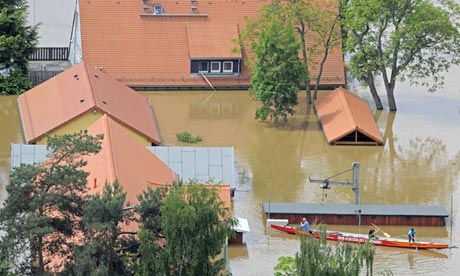
    People paddle in a boat between houses flooded by the river Elbe in Dresden

    People paddle in a boat between houses flooded by the river Elbe in Dresden. Photograph: Jens Meyer/AP

    The river Elbe flooded on Thursday in the eastern German city of Dresden, sparing the historic centre but engulfing wide areas of the Saxony capital.

    Residents and emergency crews had worked through the night to fight the floods in Dresden. The German military and national disaster team sent more support in a frantic effort to sandbag levees and riverbanks as floodwaters that have claimed 16 lives since last week surged north.

    “Everybody’s afraid but the people are simply fantastic and sticking together,” said Dresden resident Silvia Fuhrmann, who had brought food and drinks to those building sandbag barriers.

    The Elbe hit 8.76m around midday – well above its regular level of 2m. Still, that was not high enough to damage the city’s famous opera, cathedral and other buildings in its historic centre, which was devastated in a flood in 2002.

    Germany has 60,000 local emergency personnel and aid workers, as well as 25,000 federal disaster responders and 16,000 soldiers now fighting the floods.

    Farther downstream, the town of Lauenburg – just southwest of Hamburg – evacuated 150 houses along the Elbe, n-tv news reported, as the floodwaters roared toward the North Sea.

    In the south, the Bavarian city of Deggendorf was hit by a third levee break on Thursday, with floods gushing into neighbourhoods. Scores of homes remained underwater and authorities warned that a dam was still in danger of bursting.

  • Europe struggles with worst floods in decade

    Europe struggles with worst floods in decade

    AFPJune 6, 2013, 9:18 pm

    BITTERFELD, Germany (AFP) – Germany pushed on with frantic efforts to secure saturated river dykes with sandbags Thursday, bracing for a surge of the worst floods in over a decade that have claimed 12 lives and forced mass evacuations across central Europe.

    Vast stretches along the Elbe river basin have turned into a sea of brown water in the Czech Republic and downstream in eastern Germany, with only red-tiled roofs sticking out of the muddy water in many abandoned villages and towns.

    The picture of devastation was similar along the mighty Danube, which has jumped its banks in Germany’s southern Bavaria state and Austria and sparked large-scale disaster preparations in Hungary, where the water was expected to peak in coming days.

    In northeast Germany, thousands of volunteers, many organised through social media, firefighters, aid workers and troops have filled millions of sandbags to hold back the torrent which has risen from two to above eight metres (six to above 26 feet).

    Thousands worked through the night or kept a nervous watch on flood barriers while recalling dark memories of the 2002 floods that killed scores across central Europe and caused a clean-up bill running to billions of euros (dollars).

    Fears were centred on Bitterfeld in Saxony-Anhalt state where two lakes, one higher than the other, loom dangerously close to a city that during the communist East Germany era became notorious as a heavily polluted industrial centre.

    Local officials have warned that a breach in the lake defences could spark a “mini-tsunami” that could engulf the city, and officials have twice attempted to blow holes in the lake dyke away from the city, with limited success.

    Chancellor Angela Merkel has promised 100 million euros ($130 million) in immediate flood relief across Germany, and Finance Minister Wolfgang Schaeuble promised on Thursday that more money would follow.

    Dresden, with more than two million people, said the peak of 8.75 metres was reached on Thursday, with flood waters lapping through the mud-caked living rooms and trashed gardens of thousands of outlying homes.

    However, the old inner city — dubbed the “Jewel Box” for its baroque and rococo churches, opera and buildings — was secured by flood barriers installed after the even higher 2002 flood.

    People also breathed a cautious sigh of relief as water levels eased in Halle, where Elbe tributary the Saale had reached its highest level in 400 years the day before and authorities have urged 30,000 people to flee.

    Upstream in the Czech Republic — where five days of flooding killed at least eight people and forced some 20,000 evacuations — rescue workers in rubber dinghies were supplying isolated families who lack drinking water, power or gas.

    In the industrial centre of Usti nad Labem near the German border, where 11,000 people were told to evacuate, looters targeted empty homes and businesses, and a waiter at a pub-restaurant told how he came face to face with three robbers at night.

    “I entered the corridor and got a blow. They broke my nose, my side is sore and there’s something wrong with my ribs,” Ladislav Kratochvil told the DNES daily.

    The capital Prague held up well thanks to 17 kilometres of temporary aluminium barriers, and city trains were running again, but people in Usti bemoaned their poorer flood defences.

    “It’s a shame. If they were a metre higher, it would have been enough,” a police officer told the DNES. “It went fast, the water rose really quickly.”

    In Austria, where two people have died in the floods, the Danube town of Korneuburg just north of Vienna reported an all-time record river level of 8.06 metres.

    In nearby Nussdorf a river cruise ship with some 120 tourists onboard was stranded in the middle of the river Thursday, an AFP photographer witnessed.

    Down the Danube in Hungary, preparations moved into high gear to prepare Budapest for the wall of water coming along one of Europe’s longest waterways which empties into the Black Sea in a delta in Romania and Ukraine.

    Prime Minister Viktor Orban has warned large-scale evacuations were likely because of “a real threat to human life” but has pledged that “with good cooperation, we can protect everyone”.

    An “anti-catastrophe team” with 10,000 volunteers and close to 12,000 police and troops was on stand-by, while some 300 people had been evacuated so far.

  • What’s new on ice sheet melt?

    What’s new on ice sheet melt?

    • 05 Jun 2013, 18:30
    • Freya Roberts
     Sourced under creative commons

    A major review of the latest research on ice sheets is published today in Nature, updating what scientists know about the world’s two biggest bodies of ice – Greenland and Antarctica.

    Since the last major climate science report, published by the Intergovernmental Panel on Climate Change (IPCC) in 2007, there have been some big advances in modelling and monitoring ice sheets. That monitoring process is important, because when ice on land melts it drains into the ocean, causing sea levels to rise.

    Over the last six years, satellite techniques used to observe changes in ice sheets have improved, allowing scientists to refine estimates of how much ice sheets are contributing to sea level rise. But what do the new and improved modelling techniques tell us about the ice sheets?

    Greenland in decline

    In Greenland, loss of ice is adding about 0.7 mm to sea levels each year. Surface melting reached record levels in the past few years, but Greenland is also losing chunks of solid ice too. Glaciers and ice flows are transporting more ice from the heart of the ice sheet out to sea where it floats, displacing water and forcing sea levels up.

    It’s likely the Greenland ice sheet will drive more sea level rise in the future too, the article says. Although climate models predict more snow will fall over Greenland, those gains are likely to be outpaced by losses from melting and shedding.

    The article highlights processes which might amplify ice loss from the ice sheet. For example, both the loss of nearby Arctic sea ice and melting on the surface of the ice sheet reduce the amount of sunlight reflected. Instead, that heat is absorbed, raising surface temperatures.

    Antarctica’s mixed picture

    At the other end of the planet, the picture is a little less clear. But overall, data indicate the Antarctic ice sheet is losing mass. The review suggests Antarctica is adding a more modest 0.2 mm per year to sea levels.

    But different parts of the ice sheet are changing in different ways. The Antarctic Peninsula and West Antarctica is losing solid ice, as huge bodies of ice acting as buttresses to ice flows break up under rising temperatures. But the picture in East Antarctica is somewhat different – here the ice sheet is growing thanks to an increase in snowfall.

    As co-author of the paper, Dr Ben Smith from the Polar Science Centre in Washington tells us, there’s still uncertainty about changes in Antarctica, despite the technological advances. One reason is that satellites can only collect data over a small area of the ice, so errors come from scaling up their estimates to cover the entire ice sheet.

    Measuring the height of the ice is further complicated by the fact the land beneath the ice is itself changing height, the article notes.

    For now at least, the losses outweigh the gains. But scientists aren’t  sure what will happen in the future.

    A bigger contribution to sea levels

    Despite remaining uncertainties, scientists still have a better idea now of how much ice sheets are raising sea levels compared to a few years ago.

    At the time of the last IPCC report (AR4) there was only about 10 years worth of reliable sea level data, from 1993 and 2003. It suggested Greenland and Antarctica were together raising sea levels by about 0.42 mm per year – that’s about 15 per cent of total sea level rise. According to the review, over the next ten years that contribution doubled to about 0.82mm per year:

    Smith tells us that increase is down to two things:

    “First, we now know better what’s going on in the two ice sheets […] Second, and more importantly, the ice sheets are changing faster than they were in the years leading up to AR4.”

    Lead author of the article, Edward Hanna, a Professor at the University of Sheffield adds:

    “The main increase [in sea level contribution] has been from the Greenland Ice Sheet due to significant warming, leading to increased melting and discharge of ice over the last 5-10 years whereas Antarctic ice sheet losses seem to be much more modest”

    It’s worth bearing in mind these are still quite short time periods, which means natural climate cycles could be affecting what’s driving sea levels. Together with the uncertainties over the data, scientists are still treating these estimates with caution.

    But overall, the figures demonstrate what scientists have learned from the last few years of scientific advances – that Antarctica and Greenland are losing mass and driving up sea levels, increasingly fast as time goes on.

    Hanna et al. (2013) Ice sheet mass balance and climate change. Nature. DOI:10.1038/nature12238
  • Canberra’s Bonner is Australia’s top dwelling approvals and population growth hotspot: HIA

    Canberra’s Bonner is Australia’s top dwelling approvals and population growth hotspot: HIA

    By Larry Schlesinger
    Thursday, 06 June 2013

    The Canberra suburb of Bonner was Australia’s top building and population hotspot in 2011/12, according to the latest HIA Population and Residential Building Hotspots report.

    The report gives an indication of which locations are likely to experience a strong rise in residential construction activity over the coming years.

    There is a $171 million worth of residential building work approved in Bonner, which has a population growth rate of 100%, reflecting the relatively new history of this area.

    Bonner is in the district of Gungahlin, about 16 kilometres north of Canberra, named after Senator Neville Bonner, Australia’s first Indigenous parliamentarian.

    The second-placed hotspot was Forrestdale-Harrisdale-Piara Waters (about 30 kilometres south east of Perth) with $143 million worth of residential building work approved and a population growth rate of 23.5%.

    Yanchep (56 kilometres north of Perth) ranked third where in 2011/12 the value of residential building work approved was over $102 million and the population growth rate was 18.8 %.

    The top five list was rounded out by Baldivis (46 kilometres south of Perth), followed by Tarneit (25 km west of Melbourne).

    The HIA defines a ‘hotspot as a local area where population growth exceeds the national rate (which was 1.6% in the year to June 2012) and where the value of residential building work approved is in excess of $100 million.

    Click to enlarge

    Source: Housing Industry Association

    For the second consecutive year, Victoria dominated the hotspots rankings with the state accounting for 10 of the national top 20.

    Western Australia also had a strong year with the state represented four times in the national top 20 ranking.

    The ACT punched well above its weight, providing two hotspots to the national top 20.

    New South Wales also had two hotspots in the national top 20, following no entries in last year’s list, while Queensland and the Northern Territory each made one contribution.

    “Residential building activity is in decline in Victoria and the ACT, but is heading south from record levels. It is no surprise these two regions still feature prominently in the top 20 list. WA, meanwhile, is seeing a recovery in new home building this year and four spots in the top 20 list provide an indication of the potential in the west,” said HIA chief economist, Dr Harley Dale.

    “In total there are 68 hotspots identified and many more areas where population growth is relatively fast or where the value of approvals for new homes or larger alterations and additions is quite healthy,” Dale said.

    “There is clearly considerable potential for residential construction work in Australia – for a start, six of Australia’s eight states and territories feature in the national top 20 hotspots list.”


    Did you like this article?

    Sign up to the Property Observer Newsletter to receive a daily news wrap-up straight to your inbox AND a free eBook!

    Please enter a valid email address. For example fred@domain.com .

  • Australia has huge deposits of shale gas – but it won’t come cheap

    Australia has huge deposits of shale gas – but it won’t come cheap

    Australians could be sitting on more than 1,000tn cubic feet of untapped gas, study finds, but lack infrastructure to exploit it

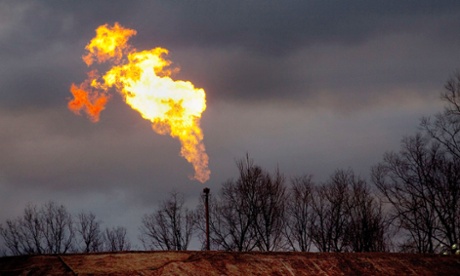
    Shale gas extraction in the US
    Shale gas extraction in the US. Photograph: LES STONE/REUTERS

    Australia could be sitting on more than 1,000tn cubic feet of untapped shale gas, but effective environmental regulations and a fall in costs are needed before this resource can be fully exploited, according to a new report.

    The Australian Council of Learned Academies study found that while Australia had huge deposits of gas, it would “not be cheap gas in most circumstances” and would have a slightly higher rate of carbon emissions than standard gas, albeit significantly less than coal-fired power.

    The report states that shale gas infrastructure costs in Australia will be double that of the US, where the industry is relatively mature, and will require a high price to make it profitable.

    Around $500m will be spent by businesses over the next two years on shale gas exploration, the report predicts, with resources company Santos already working on an initial well in Queensland.

    Shale gas extraction is similar to coal seam gas in that both processes gather methane for energy use. However, shale gas involves drilling at far greater depths than coal seam gas.

    The report is sanguine on the environmental impact of coal seam gas, with some caveats.

    “A large number of impacts are possible, but the likelihood of many of them occurring is low and where they do occur, other than in the case of some biodiversity impacts, there are generally remedial steps that can be taken,” it states.

    “Nonetheless it is important that the shale gas industry takes full account of possible adverse impacts on the landscape, soils, flora and fauna, groundwater and surface water, the atmosphere and on human health in order to address people’s concerns.”

    Prof Peter Cook, co-author of the report, told Guardian Australia that rigorous background work would need to be done on shale gas for it to avoid the controversy that has dogged the coal seam gas industry.

    “You need a regulatory regime that is transparent,” he said. “One problem with coal seam gas is that people didn’t do the work needed before they started. You need to know what the impact is going to be, rather than rely on a high degree of speculation. That has caused angst around coal seam gas.

    “Groundwater clearly needs to be safeguarded and used in careful way to ensure it doesn’t get contaminated. Fragmentation of landscapes through roads and drilling is another thing you need to be careful of.”

    He added: “We won’t see a shale gas boom here as we have in North America. It will be more modest growth, but what might really push it along is the oil associated with the gas.

    “Oil is what is driving the industry in North America. Gas is almost a byproduct. Things will move very quickly if they find oil amongst the shale gas here, because Australia doesn’t have much oil. But we just don’t know what’s down there yet.”