Category: Uncategorized

  • With chilling disregard for our climate, the Australian Government is set on expanding our fossil fuel industry at all cost.

    here to enable desktop notifications for Gmail.   Learn more  Hide

    1 of 50
    Why this ad?
    Learn about coal seam gasyoursayagl.com.au – Ask us a question about our natural coal seam gas projects

    Will you be a divestment leader?

    Inbox
    x

    Charlie Wood – 350.org Australia <charlie@350.org>

    1:59 PM (17 minutes ago)

    to me

    Dear friend,

    With chilling disregard for our climate, the Australian Government is set on expanding our fossil fuel industry at all cost.

    We know that we need to keep 80% of fossil fuels in the ground, yet in recent months we’ve seen approval of the monstrous Carmichael mine, license for dredging and dumping in our Great Barrier Reef and reckless approval of coal seam gas projects.

    But that’s the bad news. Here’s the good news– while the Coal and Gas industry is holding our Government in the palm of their hand, divestment campaigns are forcing their financiers onto the back foot.

    In under a year, the divestment movement has seen hundreds of Australians move over hundreds of millions of dollars out of financial institutions that invest in fossil fuels; we’ve dominated Big 4 Bank AGMs with our questions; received constant mainstream news coverage and earned the wrath of Australia’s Coal and Gas giants.

    Our strategy is working but we’re running out of time to keep Australian Coal and Gas in the ground. It’s time for a radical escalation of our people powered divestment campaign.

    That’s why we’re launching a nationwide Divestment Leadership training.  Hundreds of people just like you will join together to grow and lead our movement in 2014.

    Click here to register for a training near you!

    The training will help you speak confidently on the risks of fossil fuel investment to our planet and to our own finances. It will connect you to other people in your city and together give you the tools to work with 350.org.au to build a powerful divestment movement.

    Regardless of your age, gender, or experience, if you are passionate about stopping the expansion of the fossil fuel industry we’d love YOU to join us.

    With our Government unwilling to take any meaningful action to address climate change, divestment is one of the best tools we have to transition our economy and keep fossil fuels in the ground.

    Hope you can join us to become a Divestment Leader in 2014!

    Warmest wishes,

    Chrissy and Charlie on behalf of the 350 Australia team

  • Australia’s biggest coalmine gets green light GREEN LEFT

    Australia’s biggest coalmine gets green light

    Saturday, August 9, 2014
    The logic of the market allows companies to invest where they think they can make a profit, no matter the risk to people or the environment.

    The largest coalmine ever built in Australia, and one of the biggest in the world, received final approval from the federal environment minister Greg Hunt on July 28.

    The Carmichael coalmine in central Queensland, owned by Indian company Adani, is forecast to produce 60 million tonnes of coal a year over the next 60 years. This dwarfs Australia’s current largest mine, which produces 20 million tonnes a year.

    Approval for the mine was given even after global banks like Deutsche Bank and HSBC refused to fund the expansion of the coal ports associated with the project. They cited concerns by UNESCO that the Great Barrier Reef was at risk from mining development.

    An independent Commonwealth committee, the Independent Expert Scientific Committee on coal seam gas and large mining developments, also raised serious concerns about the impact the mine would have on water resources.

    But the Queensland and federal governments ignored these concerns.

    This is just one of nine mega-coalmines that have been proposed in Queensland’s Galilee Basin. Environmentalists say if the mines go ahead, it will be game over for the climate.

    Two years ago, Greenpeace produced a major report about the impact these mines would have on climate change, saying: “If the Galilee Basin were a country, the carbon dioxide produced from using this coal would make it the seventh dirtiest fossil fuel burner on the planet.”

    It is not just the climate that will suffer if this project goes ahead. Environmentalists have warned it could also have a devastating impact on the Great Barrier Reef Marine Park.

    The mine will comprise six open-cut pits and five underground mines, and stretch over 200 square kilometres. The coal will be transported along a railway line hundreds of kilometres long to link up to the Abbot Point and Hay Point coal ports near Rockhampton.

    From there, the coal will be shipped through the Great Barrier Reef for export to India.

    Felicity Wishart, from the Australian Marine Conservation Society, said the mine would need huge port development, including millions of tonnes of dredging and dumping, in the reef’s World Heritage Area.

    “Approval of the Carmichael coalmine is another step along the way to seeing Indian company Adani develop port expansion at Abbot Point. If this mine goes ahead, at full capacity there would be another 450 ships crossing the reef every year.

    “There is growing scientific evidence of the impacts of dredging and dumping, shipping and coal dust on the reef’s health – increased coral disease, reduced water quality and ship strikes on whales. This means impacts on the industries that rely on a healthy reef like tourism and fishing.

    “With mining you can only dig it up once, but the reef and the industries it supports should be forever.”

    Last year, UNESCO warned the Australian government that development along the reef was putting it in serious danger. It threatened to place the Great Barrier Reef on its “World Heritage in danger” list.

    One delegate said: “We are concerned that not only [is] Canberra handing over environmental approval powers to the Queensland state government on a matter of such high national and international relevance, but also other measures that have been taken that can deteriorate the health of the reef even more.”

    All available evidence says these coalmines and coal ports will be disastrous for the climate and the reef. It has led some people to scratch their heads about how such an environmentally destructive project could be given the green light.

    Greenpeace campaigns director Ben Pearson described Hunt as “a decent bloke who cares about the environment”, who, on the basis of the evidence in front of him, could have easily rejected this proposal but “for whatever reason, [he] couldn’t do it.”

    If you believe Hunt’s role is to make a decision only after rationally weighing up the evidence in front of him, you would be right to be confused about why he decided to approve the mine.

    The truth is, he ignored all advice and approved the mine because he is a minister in a government that believes corporations should be free to invest their money where they want, and governments should get out of the way.

    The logic of the market allows companies to invest where they think they can make a profit, no matter the risk to people or the environment.

    Queensland premier Campbell Newman has repeatedly said the state is “open for business”, and their business is coal. So it is no surprise the state and federal governments are enthusiastic about a coalmine of this size.

    But even though final approval has been given, there is still a long way to go before the mine is built. Last year, huge rallies were held around the country calling on the federal government to do more to protect the reef from industrialisation.

    This public pressure could hurt Adani’s attempts to secure financing for the project. Greenpeace has said it will run a campaign targeting Australian banks and calling on them not to loan money for the mine. Banks are becoming more wary of loaning money to risky projects, particularly those that do not have the support of the public, because of the harm it does to their brand.

    Like similar environmentally destructive projects that have been defeated in the past, such as the coal seam gas project at Bentley, or the gas hub at James Price Point in the Kimberley, people power can defeat this mine too.

    Like Green Left Weekly on Facebook and follow us on Twitter.

  • default avatar
    Welcome to the site! Login or Signup below.
    Login|Signup

    Award-winning scientist warns threats to oceans threaten all life

    Share:
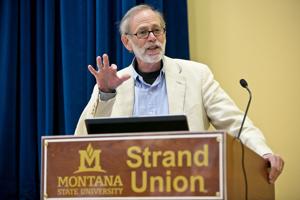
    Oceanographer Sylvia Earle Receives the Ronald B. Tobias Award at MSU Adrian Sanchez-Gonzalez/Chronicle

    Oceanographer and conservationist Sylvia Earle receives the Ronald B. Tobias Award for achievement in science and natural history filmmaking from Montana State University professor Ronald Tobias on Thursday, Aug. 7, at MSU. Earle was acknowledged for her work in oceanography and will be releasing a documentary, “Mission Blue,” on Aug. 15.

    Posted: Friday, August 8, 2014 5:00 am

    GAIL SCHONTZLER, Chronicle Staff Writer | 4 Comments

    Sylvia Earle, a pioneering ocean scientist for 50 years, says when she was a girl nobody thought it was possible to harm the Earth’s air or oceans, which appeared “too big to fail.”

    But today, 78-year-old Earle said, “The ocean is dying.”

    Carbon dioxide generated by 7 billion human beings is being absorbed by the oceans, making them acidic, killing off corral reefs and altering ocean ecosystems. That adds to the harm from fossil-fuel burning, pollution and industrial-scale overfishing.

    “We’re essentially waging war on the ocean,” Earle said. It matters, she said, because, “No ocean, no life. No ocean, no us.”

    The good news, she told an audience at Montana State University, is that today we have the tools to know something is seriously wrong.

    More people, especially young people, care about making change. And thanks to powerful media, like photography and filmmaking, the message can be communicated to a wide audience.

    Earle, a National Geographic “explorer-in-residence,” has been named a Living Legend by the Library of Congress and the first “Hero of the Planet” by Time Magazine.

    On Thursday, she was honored with MSU’s award for achievement in science and natural history filmmaking education, during the 68th annual University Film & Video Association conference.

    The award is named for Ronald Tobias, who founded MSU’s master’s program in science and natural history filmmaking in 2001 with a Discovery Channel grant.

    Tobias called Earle a combination of Jacques Cousteau, Ralph Nader, Carl Sagan and Cesar Chavez.

    Earle said she has heard people living in the Midwest say they’re so far from the ocean, it doesn’t affect them. They’re wrong.

    “People far inland don’t realize that with every breath they take … with every drop they drink, they’re connected with the ocean,” she said.

    It wasn’t until 1986 that scientists discovered one of the most important connections — a microscopic ocean organism, prochlorococcus, that produces 20 percent of the oxygen in the atmosphere, Earle said.

    “One in every five breaths you take, you can thank prochlorococcus.”

    This month Earle is coming out with a National Geographic book, “Blue Hope,” and a film on Netflix, “Mission Blue,” to explain the oceans’ peril and use “amazing photos” to share what she’s learned about the colorful creatures living in the deep.

    Hope is in young people, Earle said, like Hong Kong’s 1,000 teenagers who pledged not to eat shark-fin soup. Millions of sharks have been killed for shark-fin soup, and blue-fin tuna have been severely overfished, she said.

    Earle, who grew up in New Jersey, started scuba diving and exploring the oceans in the 1950s, and has spent weeks at a time living undersea for scientific research.

    She was appointed chief scientist for NOAA, the National Oceanographic and Atmospheric Administration, under the first President George Bush, but resigned because her views on fisheries conflicted with the administration’s.

    It was hard as a scientist to speak to the popular press, she said, crossing a line many academics are loath to cross. But she decided she had an obligation to speak out publicly, tell the truth and inspire people to change, so the Earth doesn’t become like Mars, which once had an ocean.

    “We still have time,” Earle said. “Now is the time.”

    Some 400 film school professors and professionals from across the nation are attending this week’s conference, said Dennis Aig, director of MSU’s School of Film and Photography.

    “This is an organization teaching the filmmakers of the future,” Aig said.

    Gail Schontzler can be reached at gails@dailychronicle.com or 582-2633.

  • Arctic Emergency: Scientists Speak Posted by Greg Laden on August 7, 2014

    Arctic Emergency: Scientists Speak

    Posted by Greg Laden on August 7, 2014
    Sea_Ice_Arctic_Global_Warming

    Lots to talk about here:

    Published on Aug 1, 2014
    Arctic Emergency: Scientists Speak On Melting Ice and Global Impacts (1080p HD)

    This film brings you the voices of climate scientists – in their own words.

    Rising temperatures in the Arctic are contributing the melting sea ice, thawing permafrost, and destabilization of a system that has been called “Earth’s Air Conditioner”.

    Global warming is here and is impacting weather patterns, natural systems, and human life around the world – and the Arctic is central to these impacts.
    —————————————-­———
    Scientists featured in the film include:

    – Jennifer Francis, PhD. Atmospheric Sciences
    Institute of Marine and Coastal Sciences, Rutgers University.

    – Ron Prinn, PhD. Chemistry
    TEPCO Professor of Atmospheric Science, Massachusetts Institute of Technology.

    – Natalia Shakhova, PhD. Marine Geology
    International Arctic Research Center, University of Alaska-Fairbanks.

    – Kevin Schaefer, PhD.
    Research Scientist, National Snow and Ice Data Center.

    – Stephen J. Vavrus, PhD. Atmospheric Sciences
    Center for Climatic Research, University of Wisconsin-Madison

    – Nikita Zimov, Northeast Science Station, Russian Academy of Sciences.

    – Jorien Vonk, PhD. Applied Environmental Sciences
    Faculty of Geosciences, Utrecht University

    – Jeff Masters, PhD. Meteorology
    Director, Weather Underground

  • Scientists Fear Massive Sea Level Rise from “Unstoppable” Melt of West Antarctica Ice Sheet

    14 May 2014
    Home  »  Uncategorized   »   Scientists Fear Massive Sea Level Rise from “Unstoppable” Melt of West Antarctica Ice Sheet

    Scientists Fear Massive Sea Level Rise from “Unstoppable” Melt of West Antarctica Ice Sheet

    Posted in Uncategorized By Neville On May 14, 2014

    Tue, 2014-05-13 11:14Chris Rose

    Chris Rose's picture

    Scientists Fear Massive Sea Level Rise from “Unstoppable” Melt of West Antarctica Ice Sheet

    Comment on this StoryEmail this story
    thwaites glacier, west antarctic ice melt, nasa, climate change

    Two new academic studies released Monday reveal that the crucial West Antarctic ice sheet is now melting, a seemingly unstoppable disaster that could eventually trigger sea levels to rise by more than 14 feet (4.3 metres).

    The studies could finally make politicians rethink how climate change is affecting humankind and how society is going to deal with the increasingly expensive cost of mitigating climate change caused by burning fossil fuels overheating our atmosphere.

    One of the studies indicates the glaciers in the Amundsen Sea sector of West Antarctica “have passed the point of no return,” according to glaciologist and lead author Eric Rignot, of UC Irvine and NASA’s Jet Propulsion Laboratory in California. The new study has been accepted for publication in the journal Geophysical Research Letters.

    NASA says the glaciers already contribute significantly to sea level rise, releasing almost as much ice into the ocean annually as the entire Greenland ice sheet. “They contain enough ice to raise global sea level by four feet (1.2 metres) and are melting faster than most scientists had expected,” according to a press release.

    Greenland and Antarctic ice sheets. Image Credit: NASA

    “The collapse of this sector of West Antarctica appears to be unstoppable,” Rignot was quoted as saying. “The fact that the retreat is happening simultaneously over a large sector suggests it was triggered by a common cause, such as an increase in the amount of ocean heat beneath the floating sections of the glaciers. At this point, the end of this sector appears to be inevitable.”

    Image from NASA’s “The Unstable West Antarctic Ice Sheet: A Primer.”

    The other study, conducted by University of Washington researchers, also shows the collapse of the West Antarctic ice sheet appears to have already begun. “The fast-moving Thwaites Glacier will likely disappear in a matter of centuries, researchers say, raising sea level by nearly two feet,” according to a media release.

    “That glacier also acts as a linchpin on the rest of the ice sheet, which contains enough ice to cause another 10 to 13 feet (three to four metres) of global sea level rise. The study is to be published in Science.”

    Lead author Ian Joughin, a glaciologist at the UW’s Applied Physics Laboratory, said scientists looking at ice thinning previously didn’t know how fast the glacier would melt. “In our model simulations it looks like all the feedbacks tend to point toward it actually accelerating over time; there’s no real stabilizing mechanism we can see,” Joughin said.

    “All of our simulations show it will retreat at less than a millimeter of sea level rise per year for a couple of hundred years, and then, boom, it just starts to really go,” Joughin said.

    The studies suggest the ice sheet won’t totally melt for between 200 and 1,000 years, as they aren’t currently sure of the pace of melting, but they say the accompanying sea level rise is inevitable.

    West Antarctica bed topography. Areas colored brown are below sea level. Sea level itself is colored yellow, and green areas are above sea level. Image credit: NASA/GSFC/SVS

    And while scientists have been warning about the possibility of the West Antarctic ice sheet melting for years, the studies released Monday suggest that human-induced climate change is indeed redefining our world.

    The two studies come just a week after an alarming U.S. National Climate Assessment report noted climate change is already occurring in every region of America and a month after the Intergovernmental Panel on Climate Change said global emissions of greenhouse gases have risen to unprecedented levels.

    Together the recent reports could force politicians, engineers, money markets, health planners, military leaders and insurance companies to more aggressively embrace climate change as humankind’s most pressing issue.

    Ironically, as sea levels rise, offshore oil exploration platforms and drilling rigs — one of the most high-profile symbols of society’s addiction to fossil fuels — will also have to deal with problems associated with higher seas. But almost certainly the most negatively affected will be the more than a billion people estimated to live along low-lying coastlines, some of which will most likely be abandoned over time.

    Image Credit: Thwaites Glacier, NASA

  • Antarctica is at point of no return now

    Columns

    Ant

    arctica is at a point of no return now

    by ANDERS LEVERMANN    |    August 06, 2014 , 8 : 17 pm GST

    Recent satellite observations have confirmed the accuracy of two independent computer simulations that show that the West Antarctic ice sheet has now entered a state of unstoppable collapse.

    The planet has entered a new era of irreversible consequences from climate change. The only question now is whether we will do enough to prevent similar developments elsewhere.

    What the latest findings demonstrate is that crucial parts of the world’s climate system, though massive in size, are so fragile that they can be irremediably disrupted by human activity.

    It is inevitable that the warmer the world gets, the greater the risk that other parts of the Antarctic will reach a similar tipping point; in fact, we now know that the Wilkes Basin in East Antarctica, as big or even bigger than the ice sheet in the West, could be similarly vulnerable.

    There are not many human activities whose impact can reasonably be predicted decades, centuries, or even millennia in advance. The fallout from nuclear waste is one; humans’ contribution to global warming through greenhouse-gas emissions from burning fossil fuels, and its impact on rising sea levels, is another.

    Indeed, the latest Intergovernmental Panel on Climate Change (IPCC) report stated, in uncharacteristically strong terms, that the sea level is “virtually certain” to continue to rise in the coming centuries or millennia. Moreover, the greater our emissions, the higher the seas will rise.

    But the recent revelations about Antarctica are different. Rather than reacting to global warming with gradual and predictable patterns of change, the West Antarctic ice sheet has suddenly “tipped” into a new state.

    A relatively small amount of melting beneath the Amundsen Sea’s ice shelf has pushed its grounding line to the top of a sub-glacial hill, from which it is now “rolling down.”

    Simply put, one thermal kick was enough to initiate an internal dynamic that will now continue under its own momentum, regardless of any action that humans might take to prevent it.
    It is not completely clear whether humans have caused this tipping — though nothing like it has ever occurred during the 11,500-year Holocene period before humans started interfering with the planet’s energy balance. But that is not the point.

    What is important is that we recognize the existence of gigantic parts of the earth’s climate system — such as West Antarctica’s three-quadrillion-ton ice sheet — that can be tipped when a fractional temperature rise occurs in key locations.

    This risk is no longer merely theoretical. For the first time, findings based on observations and computer simulations all point to the same conclusion: the huge Amundsen Sea sector of West Antarctica has begun an irreversible ice discharge, and nothing can now halt the subsequent drainage of the entire basin. It has passed the point of no return.

    That is why we must now focus on similar topographic conditions elsewhere. If an “ice plug” near the coast of Wilkes Basin melts or breaks off into icebergs, the basin’s huge quantities of water will drain into the ocean.

    Although no one knows precisely what might destabilize the Wilkes Basin, we can be fairly certain that further global warming, caused by greenhouse-gas emissions, will increase the risk.

    The fact that sea levels will continue to rise is now clear. But we can still determine how high and how fast levels rise by controlling the degree of global warming that we cause. Climate change is caused by mankind, so the good news is that mankind can stop it by cutting greenhouse-gas emissions.

    Although West Antarctica’s fate is sealed, we may still be able to prevent the collapse of East Antarctica’s marine ice sheet. That means deciding — sooner rather than later — which path to follow. The current path risks further destabilization in Antarctica; choosing the alternative path of a new energy system for the planet is our last best hope. – Project Syndicate