Category: Uncategorized

  • Global warming stopped? Not in the real world

    Global warming stopped? Not in the real world

    Monday, August 4, 2014

    Remember all those articles that claimed global warming has stopped? Here’s proof that those were anti-scientific fantasies.
    On July 21, the National Oceanic and Atmospheric Administration (NOAA) announced that last month’s average global temperature was 16.2°C, which is 0.7°C higher than the 20th-century average.

    Heat records were broken on every continent apart from Antarctica. The rises were especially notable in New Zealand, northern South America, Greenland, central Africa and southern Asia.

    June this year was the warmest June, and May the warmest May, since records began in 1880.

    And on July 17, the American Meteorological Society released its annual State of the Climate report. The vast global climate indicators — greenhouse gases, sea levels, global temperatures — continued to reflect trends to a much hotter earth.

    The report said greenhouse gases continued to climb. Atmospheric carbon dioxide concentrations increased by 2.8 parts per million last year, reaching a global average of 395.3 ppm for the year.

    At the Mauna Loa Observatory in Hawaii, the daily concentration of carbon dioxide exceeded 400 ppm on May 9 for the first time since measurements began at the site in 1958.

    This milestone follows observational sites in the Arctic that observed this carbon dioxide threshold of 400 ppm in 2012.

    Warm temperature trends continued near the Earth’s surface: Four major independent datasets show last year was among the warmest years on record.

    In the southern hemisphere, Australia observed its warmest year on record, while Argentina had its second warmest and New Zealand its third warmest.

    Sea surface temperatures rose. Four independent datasets indicate that the globally averaged sea surface temperature for last year was among the 10 warmest on record. Global mean sea level also continued to rise last year.

    The Arctic continued to warm and sea ice extent remained low. The Arctic observed its seventh warmest year since records began in the early 20th century.

    Arctic sea ice extent was the sixth lowest since satellite observations began in 1979. All seven of the lowest sea ice extents on record have occurred in the past seven years.

    Near the end of the year, the South Pole had its highest annual temperature since records began in 1957.

    The number of tropical cyclones last year was slightly above average, with a total of 94 storms compared to the 1981-2010 average of 89.

    In the Western North Pacific Basin, Super Typhoon Haiyan — the year’s deadliest cyclone — had the highest wind speed ever assigned to a tropical cyclone.

    Lesson number one for climate science deniers: Just because you hope something is true doesn’t mean that it is.

    Abridged from Climate and Capitalism.

    A 10 point climate plan

    With evidence of higher-than-ever concentrations of greenhouse gasses in the atmosphere, rising sea and air temperatures and worsening ice melts, it is important to keep in mind that many solutions have been developed — only to be ignored by governments in the pocket of big corporations.

    In Australia, Beyond Zero Emissions developed a detailed plan in 2010 to shift to 100% renewable energy by 2020. That same year, Socialist Alliance, an Australian political group, adopted this 10-point plan.

    * * *

    1. Set immediate emission cut targets to reduce net emissions to zero as soon as possible, including a target to achieve 100% renewable energy by 2020. Introduce emissions reduction targets of at least 5% a year.

    2. Begin new international treaty negotiations aimed to get all countries to agree on a global target of at least 90% emissions cuts on 1990 levels by 2030. Make cutting rich industrial nations’ emissions a priority, and increase aid to poorer countries to help them to use clean energy for their development.

    3. Start the transition to a zero-waste economy. Legislate to end industrial energy waste. Improve or ban wasteful consumer products, such as those with built-in obsolescence. Engage with workers and unions to redesign their products and jobs sustainably.

    4. Require advanced energy efficiency measures be fitted to existing houses and subsidise owner-occupiers for the costs. Allow renters to use the same system. Install photovoltaic solar panels and solar hot water heaters on home roofs, subsidised or owned by the electricity authority. Give all commercial buildings a deadline to meet six-star energy standards within two years, and 10-star standards within 10 years. Improve mandatory energy efficiency standards for all new buildings.

    5. Bring power industries under public ownership and democratic control. Begin phasing out coalmining and coal-fired power immediately. Provide guaranteed jobs and retraining on full pay for affected communities.

    New sustainable industries should be built in these areas, with voluntary paid redundancies and free retraining offered to all workers. Run the maximum possible base-load power from existing natural gas and/or hydro power stations instead of coal until renewable energy is available.

    6. Bring the car industry under public control. Re-tool this industry to manufacture wind turbines, public transport vehicles and infrastructure, solar hot water and solar photovoltaic cells. Subsidise the conversion of private cars to electric power.

    7. Build solar thermal with storage plants and wind farms in suitable areas now. Boost research into all renewable energy sources. Create localised power grids and upgrade the national grid to make it compatible with 100% renewable energy.

    8. Ban the logging of old-growth forests and begin an urgent program of reforestation, carbon farming and biodiversity protection.

    9. Phase out industrial farming based on fertilisers, pesticides and fuel sourced from petroleum. Restrict farming areas to ensure that threatened ecosystems return to healthy states. Encourage new farming practices including organic and urban farming. This process must allow for security of food supplies, and guarantee full employment and retraining for rural communities.

    10. Make all public transport free and upgrade services to enable all urban residents to use it for regular commuting. Nationalise and upgrade interstate train and ferry services. Rail freight must be prioritised. All rail, light rail and interstate freight to be electrified or to run on biofuels from waste. Encourage bicycle use through more cycleways and better facilities for cyclists. Implement free or low-cost bicycle rental networks.

    From GLW issue 1019

  • Climate change may trigger earthquakes and volcanoes

    11 Apr 2010
    Home  »  Climate chaos, Extreme weather and global warming   »   Climate change may trigger earthquakes and volcanoes

    Climate change may trigger earthquakes and volcanoes

    Posted in Climate chaos, Extreme weather and global warming By admin On April 11, 2010

    01 October 09

    Climate change may trigger earthquakes and volcanoesPosted by: Richard Graves

    Climate change may trigger earthquakes and volcanoes

    Far from being the benign figure of mythology, Mother Earth is short-tempered and volatile. So sensitive in fact, that even slight changes in weather and climate can rip the planet’s crust apart, unleashing the furious might of volcanic eruptions, earthquakes and landslides.

    That’s the conclusion of the researchers who got together last week in London at the conference on Climate Forcing of Geological and Geomorphological Hazards. It suggests climate change could tip the planet’s delicate balance and unleash a host of geological disasters. What’s more, even our attempts to stall global warming could trigger a catastrophic event (see “Bury the carbon”).

    Evidence of a link between climate and the rumblings of the crust has been around for years, but only now is it becoming clear just how sensitive rock can be to the air, ice and water above. “You don’t need huge changes to trigger responses from the crust,” says Bill McGuire of University College London (UCL), who organised the meeting.

    You don’t need huge changes to trigger a response from the crust. They can be tiny.

    Among the various influences on the Earth’s crust, from changes in weather to fluctuations in ice cover, the oceans are emerging as a particularly fine controller. Simon Day of the University of Oxford, McGuire and Serge Guillas, also at UCL, have shown how subtle changes in sea level may affect the seismicity of the East Pacific Rise, one of the fastest-spreading plate boundaries.


    Source: New Scientist

  • Climate Change Causes Volcanoes and Tsunamis By Akshaya B S

    Tsunamis

    Climate Change Causes Volcanoes and Tsunamis

    Posted in Uncategorized By Neville On June 14, 2014

    Climate Change Causes Volcanoes and Tsunamis

    Iceland Volcano Could Power Up UK

    The UK government is planning power up Britain homes with the help of geo thermal energy.

    Bill McGuire, a professor of geophysical and climate hazards at the University College London, has discovered that climate change can lead to earthquakes, volcanoes and tsunamis.

    McGuire’s work, part of which can be read in “Waking the Giant: How a Changing Climate Triggers Earthquakes, Tsunamis and Volcanoes”, suggests that climate change is not only about floods and droughts. It can also lead to increased volcanic activity and increasing numbers of earthquakes.

    McGuire believes the Earth is very sensitive to change and even though the Earth’s crust seems to be safe, the rapid changes can result in its destabilisation.

    In 2010, Eyjafjallajokull – the ice-covered Icelandic volcano that spewed several million cubic meters of ash – brought European air traffic to a grinding halt. Last year, the tsunami that hit the eastern coast of Japan was the result of a cataclysmic earthquake.

    According to information in McGuire’s book, it is believed that the Earth underwent astonishing climatic transformations some 20,000 years ago. During this period, it transformed from a frigid wasteland of ice to the world we are more familiar with.

    The point is that during this dynamic episode, as the ice melted and sea levels subsequently rose, the pressure of the water acting on solid earth increased. The planet’s crust then bent and cracked, leading to resurgence in volcanic activity, a proliferation of seismic shocks and burgeoning giant landslides, according to an article McGuire wrote in The Guardian.

    McGuire concludes by saying that human activity seems to be increasing risks of a geologic backlash at the most inopportune time.

    He stresses that unless there is a dramatic and completely unexpected turnaround in the matter of handling resources and the planet, the long-term impact could be very “grim”.

    Recommend Share Share on google_plusone_share

  • Daily update: Hunt: The ‘extreme left is against electricity’ Inbox x

    1 of 1
    Why this ad?
    My Aged Care & Nursingwww.myagedcare.gov.au/AgedCare – Have More Choices And Control Over Your Aged Care Services Options.

    Daily update: Hunt: The ‘extreme left is against electricity’

    Inbox
    x

    Renew Economy editor@reneweconomy.com.au via mail4.atl111.rsgsv.net

    12:45 PM (6 minutes ago)

    to me
    Hunt: The ‘extreme left is against electricity’; SunPower sees storage in commercial market in 2015; How “YieldCos” are changing paradigm of renewables investment; Aust CleanTech index beats main market again; Australian businesses don’t recycle, don’t care; Utilities want to promote EVs to ‘remain viable’; Finding a fair price for solar & the grid; and Tesla & Panasonic finally sign lithium-ion gigafactory agreement.
    Is this email not displaying correctly?
    View it in your browser.
    RenewEconomy Daily News
    The Parkinson Report
    In an audience with right wing commentator Andrew Bolt, Australia’s environment minister Greg Hunt says the left is “against electricity” and anyone opposed to coal mines is trying keep hundreds of millions of people in poverty. Not only does this just parrot extreme blogs and the coal lobby, it doesn’t make financial sense.
    SunPower has flagged the introduction of battery storage into the commercial market in 2015 in Australia, as it looks to rapidly expand its home energy service offerings.
    Alongside Green Bonds, the recent success of renewable energy YieldCos is attracting attention as a way to aggressively access global capital markets.
    Australian CleanTech Index closes first month of new financial year with 5 per cent gain, beating out S&P ASX200 and S&P ASX Small Ordinaries Index.
    New study finds that 80% of Australian companies have no green policy in place and don’t care enough to recycle waste when possible.
    Facing flat or declining electricity sales, electric vehicles are a path to growth for power companies.
    A Californian utility is exploring a future of distributed energy. The key is to accurately reflect costs and benefits of these services to the grid.
    Panasonic and Tesla have agreed on how the two will jointly carry out construction of gigafactory in  the U.S, including the roles each will play.
  • Scientists lambast The Australian for misleading article on deep ocean cooling

    Scientists lambast The Australian for misleading article on deep ocean cooling

    By on 30 July 2014
    Print Friendly

    The Carbon Brief

    the ausAn article in Friday’s The Australian suggested brand new research by two eminent oceanographers casts doubt on scientific understanding of global warming. But the authors of the research have taken the newspaper to task for its coverage of their work.

    The research by Carl Wunsch from Harvard University and Patrick Heimbach from MIT found temperatures seem to be falling in parts of the very deep ocean, known as ‘the abyss’.

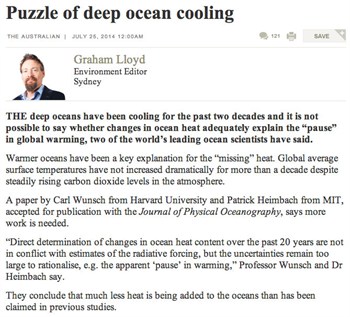
    In a piece headline headlined “Puzzle of deep ocean cooling”, journalist Graham Lloyd of the Australian interpreted the new research for readers:

    “The deep oceans have been cooling for the past two decades and [so] it is not possible to say whether changes in ocean heat adequately explain the “pause” in global warming”.

    But the authors think Lloyd’s article is misleading. In an letter to the editor in today’s edition of the Australian, they say:

    “The article by Graham Lloyd will likely leave a mis-impression with many of your readers concerning the substance of our paper.”

    Wunsch tells us Lloyd’s article “cherrypicks” statements from their paper and “misses some key points”.

    Graham LloydThe Australian 25th July 2014

    Overall, the oceans are warming

    The new research, just published in the Journal of Physical Oceanography, explains how measurements in recent decades suggest some parts of the very deep ocean – the ‘abyss’ – are cooling slightly. The paper says:

    “[Our findings show] warming in the abyss at high southern latitudes, in the western basin of the Atlantic and with cooling elsewhere.”

    At depths of thousands of meters, taking the temperature of the deep ocean is very challenging. Quite a lot of the discussion in the paper is about the limits of current measurements.

    Though the research suggests some parts of the very deep ocean are cooling, not all of it is. Scientists can detect a weak cooling signal overall, but other parts are showing strong warming.

    This wasn’t explained by The Australian, say the authors. Wunsch tell us:

    “If the opening sentence in the Australian had said ‘Parts of the deep ocean have been cooling for the past two decades’ there would have been no quarrel with that statement.”

    Wunsch and Heimbach’s research is very clear on an important point – that overall, the planet’s oceans are warming. The letter to the editor says:

    “We never assert that global warming and warming of the oceans are not occurring – we do find an ocean warming, particularly in the upper regions.”

    The point the new paper makes is the oceans aren’t a solid lump. Knowing how different parts of the oceans behave is important. Though new technology is making it easier, the deepest and most remote parts of the ocean are still poorly understood. Wunsch tells us:

    “[The oceans are] a very noisy system, with parts warming and parts cooling, it looks like a net warming is taking place, but exactly by how much is at the very edge of the science.”

    Not a reason to doubt scientists explanations of the “pause”

    Lloyd argues that parts of the deep ocean cooling contradicts other scientists’ explanations of the so-called “pause” in surface warming.

    The “pause” describes the fact that temperatures at earth’s surface have risen more slowly in the last 15 years than in previous decades, despite greenhouse gas emissions continuing to rise.

    Scientists say periods of slower and faster warming aren’t unusual and the most likely explanation is that heat is making its way to the deep ocean rather than staying at the surface.

    The Australian gives the impression Wunsch and Heimbach disagree with this explanation. It says their study suggests “much less heat is being added to the oceans than has been claimed in previous studies”.

    But that’s not the case, say the authors. Wunsch tells us the overall warming of the ocean they report is consistent with other scientific literature – a point they also make in the paper.

    An article by Christopher Booker in Saturday’s Telegraph also argues the new research contradicts other scientists.

    US climate professor Kevin Trenberth first described the slower-than-expected surface warming as the “missing heat” problem, and has been prominent in research pointing to faster warming in the deep ocean as a likely explanation.

    Describing Trenberth as “one of the UN’s top climate alarmists”,  Booker claims Wunsch’s new paper suggests “the warmists have no real evidence to support their claim other than computer modelling”. He says:

    “Now magisterial cold water has been poured on this theory by none other than Prof Carl Wunsch, probably the world’s most respected oceanographer.”

    But Wunsch’s letter to the editor makes clear his findings are of little consequence for global warming or the so-called “pause”. The letter says:

    “Contrary to the implications of Lloyd’s article, parts of the deep ocean are warming, parts are cooling, and although the global abyssal average is negative, the value is tiny in a global warming context.”

    A quote from Dr Andy Hogg of Australia’s National University at the end of the Australian article explains parts of the very deep ocean can take a very long time (centuries to millennia) to respond to what’s happening at the surface.

    Hogg adds:

    “So if cooling has occurred over large parts of the abyssal ocean, it is unrelated to global warming of the atmosphere over the last century.”

    Hogg adds that while there is still some uncertainty about temperatures in the deep ocean, shallower regions are well understood and Wunsch’s findings are “consistent” with warming oceans.

    Wunsch told us he thought Hogg’s comments were “on the mark,” and that it was a shame that they are “hidden at the end” of the article.

    Source: Carbon Brief. Reproduced with permission.

  • Arctic sea-ice loss adds 25% to carbon dioxide warming over last 30 years

    23 February 2014

    Arctic sea-ice loss adds 25% to carbon dioxide warming over last 30 years

    First posted at robertscribler

    What’s the difference between a majestic layer of white sea ice and an ominous dark blue open ocean?

    For the Arctic, it means about a 30 to 50 per cent loss in reflectivity (or albedo). And when seasonal sea-ice states are between 30 and 80 per cent below 1979 measures (depending on the method used to gauge remaining sea ice and relative time of year), that means very, very concerning additional heating impacts to an already dangerous human-caused warming.

    Arctic Ocean September 1, 2012
    A dark and mostly ice-free Arctic Ocean beneath a
    tempestuous swirl of clouds on September 1, 2012,
    a time when sea ice coverage had declined to an
    area roughly equal to the land mass of Greenland.
    Image source: Lance-Modis/NASA AQUA.

    How concerning, however, remained somewhat unclear until recently.

    In the past, idealized climate simulations and physical model runs had produced about a two per cent overall loss in Arctic albedo based on observed sea ice losses. This decline, though minor sounding, was enough, on its own, to add a little more than a 10 per cent amplifying feedback to the already powerful human atmospheric carbon dioxide (CO2) forcing during recent years. Such an addition was already cause for serious concern and with sea ice totals continuing to fall rapidly, speculation abounded that just this single mechanism could severely tip the scales toward a more rapid warming.

    But, as has been the case with a number of Arctic model simulations related to sea ice, these computer projections failed to measure up to direct observation. In this case, direct satellite observation. The situation is once more worse than expected.

    A new study produced by University of San Diego Scientists now shows that loss of albedo for the Arctic Ocean due to rapidly declining sea ice was four per cent during the period of 1979 to 2011. This amazing loss of reflectivity, on its own, created a powerful enough heat trap to produce an amplifying feedback to human warming equal to 25 per cent of the heat captured by CO2 emitted during that time — when spread out over the entire globe.

    This is a feedback double what we were led to expect from climate model simulations. Perhaps more importantly, the local feedback in the Arctic — a region containing gigatons and gigatons of additional carbon waiting to be released during a period of rapid warming — is not 25 per cent greater, but four times greater than the total human CO2 forcing since the start of the industrial revolution.

    It is important to step back for a moment and consider the implication of this new information. If you took all the emissions from cars in the world, all the buses, all the aircraft, all the land use CO2 emissions, all the agriculture, and all the amazing extra atmospheric heat capture that an emission equal to 160 times that of all the volcanoes on Earth would entail and added it all together, just one insult to our natural world in the form of Arctic sea-ice loss has now equaled a 25 per cent addition to that amazing total.

    Or just add enough extra heat equal to forty times the CO2 emitted by Earth’s volcanoes (for a total of X200). And the burden of all that extra heat is directly over a region of the world that contains a number of very large ice sheets which, if rapidly warmed, result in catastrophic land change and sea-level rise, and a number of outrageously enormous carbon deposits that, if rapidly warmed and released make the current albedo loss feedback look like child’s play.

    In short, the game just got a lot uglier. Such an increase is a very big deal and will have strong implications going forward that affect the overall pace of human caused warming, the pace of Earth and Earth Systems changes, and the degree to which we might contain ultimate temperature rises under a scenario of full mitigation. From the study contents:

    We find that the Arctic planetary albedo has decreased from 0.52 to 0.48 between 1979 and 2011, corresponding to an additional 6.4 ± 0.9 W/m2 of solar energy input into the Arctic Ocean region since 1979. Averaged over the globe, this albedo decrease corresponds to a forcing that is 25 per cent as large as that due to the change in CO2 during this period, considerably larger than expectations from models and other less direct recent estimates.

    It is worth noting that the period measured by the study did not include the unprecedented sea-ice area, extent and volume losses seen during 2012. So it is likely that albedo loss and related Arctic additions to human warming are somewhat worse than even this study suggests. It is also worth noting that the total additional radiative forcing from all human CO2 emissions since the industrial age began is estimated to be about 1.5 W/m2. 

    No way out through increasing cloud cover

    The study also found that:

    Changes in cloudiness appear to play a negligible role in observed Arctic darkening, thus reducing the possibility of Arctic cloud albedo feedbacks mitigating future Arctic warming.

    Though seemingly innocuous, this statement is a death knell for one proposed method of geoengineering — namely cloud generation via spray ships deployed throughout the Arctic basin. The proposal had suggested that numerous ships could be spread about the Arctic during summer. These ships would be equipped with large machines that would dip into the ocean and spray sea water into the atmosphere to form clouds. The notion was that this would somehow increase albedo. Proponents of the plan neglected to provide scientific evidence that such a scheme would actually work or wouldn’t make matters worse by increasing atmospheric water vapor content — a substance with known heat-trapping properties.

    Others had hoped a cloudier Arctic would take care of itself by producing a negative feedback naturally. Numerous studies have found that an Arctic with less sea ice is a much stormier, cloudier Arctic. And a number of specialists and enthusiasts hinted that the extra clouds would provide some cooling.

    Not so according to the San Diego study. And this makes sense as clouds, while reflective of direct radiation contain large quantities of heat-trapping water vapor and tend to also trap long-wave radiation — which is more prevalent in the Arctic due to low angle of light or extended periods of darkness.

    Extraordinarily rapid arctic amplification

    Despite the various hollow conjectures and reassurances, what we have seen over the past seven years or so is an extraordinarily rapid amplification of heat within the Arctic. Arctic sea ice continues its death spiral, hitting new record lows at various times at least once a year.

    Heat keeps funneling into the Arctic, resulting in heatwaves that bring 90 degree temperatures to Arctic Ocean shores during summer and unprecedented Alaskan melts during January. We have seen freakish fires in regions previously covered by tundra, in the Yakutia region of Russia, Alaska and Canada and in Arctic Norway during winter time. And we see periods during winter when sea ice goes through extended stretches of melt, as we did just last week in the region of Svalbard.

    One need only look at the temperature anomaly map for the last 30 days to know that something is dreadfully, dreadfully wrong with the Arctic:

    30 day anomaly
    Global temperature anomaly vs the, already warmer than
    normal, 1981 to 2010 baseline.
    Image source: NOAA/Earth Systems Research Laboratory.

    And one need only begin to add the number of amplifying feedbacks in the Arctic together to start to understand how much trouble we’ve set for ourselves:

    1. Arctic albedo decrease due to sea ice loss.
    2. Arctic CO2 release due to thawing tundra.
    3. Arctic methane release due to thawing land tundra.
    4. Arctic methane release due to thawing subsea tundra and venting seabed methane.
    5. Arctic albedo loss due to black carbon deposition.
    6. Arctic albedo loss due to land vegetation changes.
    7. Warming Arctic seas due to runoff from warming lands.
    8. Arctic albedo decrease due to land snow and ice sheet melt.
    9. South to north heat transfer to the Arctic due to a weakening, retreating Jet Stream and increasing prevalence of high amplitude atmospheric waves.

    We all know, intuitively what an amplifying feedback sounds like. Just hold a microphone closer to a speaker and listen to the rising wail of sound. And it is becoming ever more obvious with each passing day, with each new report that the Arctic is simply screaming to us.

    How deaf are we? How deaf are those of us who continue to fail to listen?

    RELATED POSTS