Category: Uncategorized

  • CLIMATE CODE RED DAVID SPRATT

    11 July 2014

    Is a 2014 El Niño still on the way?

    by Rob Painting, via Skeptical Science  

    Main points

    • Development of El Niño in 2014 continues to edge closer with sea surface temperature in the key indicator equatorial regionapproaching El Niño thresholds.
    • The discharge of ocean heat to the atmosphere associated with the build-up of the El Niño phenomenon has predictably seen a rise in global surface temperatures, resulting in May 2014 being the warmest May ever recorded.
    • Despite the strong initial build-up of a large warm water volume anomaly (WWV) in the equatorial subsurface ocean earlier in the year, the atmosphere has so far not provided sufficient reinforcement to maintain this large pool of warmer-than-average water and a substantial portion has been eroded.
    • The last half-century of observations, however, still favour the development of an extreme El Niño event, but the substantial reduction of the warm water volume anomaly (thankfully) diminishes the odds of a powerful event rivaling that of 1997-1998 from taking hold.

    15 June 2014

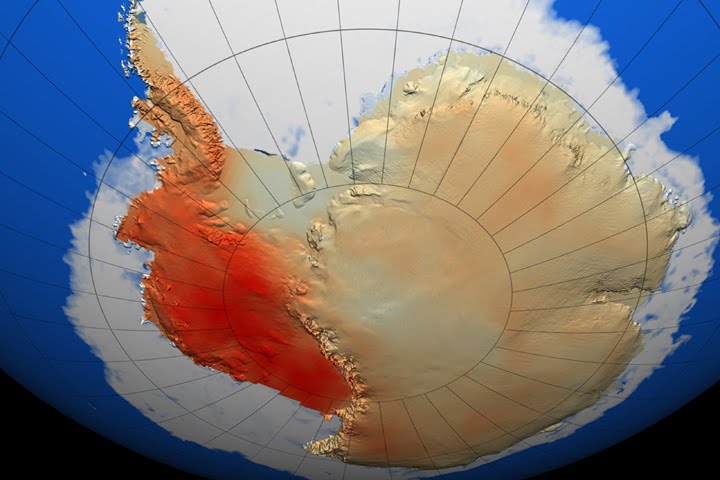
    Big trouble in the Antarctic has been brewing for a long time

    by David Spratt

    “A game changer” is how climate scientist Dr Malte Meinshausen describes newly published research that West Antarctic glaciers have passed a tipping point much earlier than expected and their disintegration is now “unstoppable” at just the current level of global warming. The research findings have shocked the scientific community. “This Is What a Holy Shit Moment for Global Warming Looks Like,” ran a headline in Mother Jones magazine.
    08 June 2014

    Carbon budgets, climate sensitivity and the myth of “burnable carbon”
    by David Spratt

    Breakthrough National  Climate Restoration
    Forum 21-22 June,  Melbourne

    In my previous post explaining why there is no carbon budget left for burning fossil fuels for a 2-degree Celsius (°C) target, I explained that these carbon budget calculations are expressed in probabilities of not exceeding the target. This reflects a number of uncertainties in understanding, including climate sensitivity, ocean heat uptake inertia, the influences of non-carbon dioxide forcing agents, and because results vary somewhat among model ensembles.

    Of these, climate sensitivity is the biggest issue, because of the possibilities that climate change might proceed more rapidly than currently estimated because of reinforcing feedbacks, thresholds or tipping points in the climate system, or less rapidly because of dampening feedbacks.

    22 May 2014

    The real budgetary emergency and the myth of “burnable carbon”

    by David Spratt

    How fast and how profoundly we act to stop climate change caused by human actions, and work to return to a safe climate, is perhaps the greatest challenge our species has ever faced, but are we facing up to what really needs to be done?

    LISTEN
    Listen to David’s carbon budget interview on Radio EcoShock
    RELATED POST
    Carbon budgets, climate sensitivity and the myth of “burnable carbon”
    WATCH PRESENTATION
    No carbon left to burn (audio + slides, 17 minutes)

    We have to come to terms with two key facts:  practically speaking, there is no longer a “carbon budget” for burning fossil fuels while still achieving a two-degree Celsius (2°C) future; and the 2°C cap is now known to be dangerously too high.

    No Carbon Budget Left – David Spratt from Breakthrough on Vimeo.

    For the last two decades, climate policy-making has focused on 2°C of global warming impacts as being manageable, and a target achievable by binding international treaties and incremental, non-disruptive, adjustments to economic incentives and regulations (1).

    14 April 2014

    Climate change communication: Key psychological research findings (and why you haven’t heard about them yet) (2)
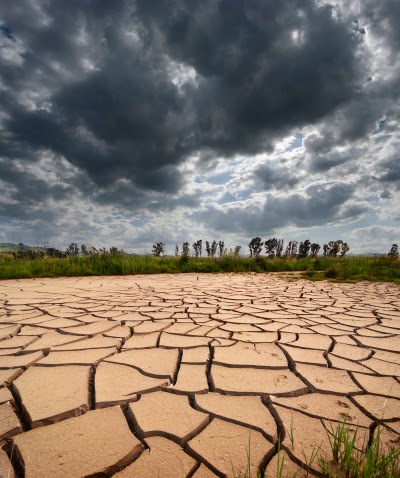
    Research has identified a number of psychological barriers that can prevent people from believing in or acting on messages about climate change. Luckily, it has also suggested strategies for overcoming these barriers. Second of a two-part report by Paul Connor.

    Second of 2 parts | Part 1

    5. Some messages can get through to conservatives! Sort of…

    One of the most common analyses one hears about the social psychology of climate change is that the issue has become increasingly politicised over the last decade. More and more, it is said, people are making up their minds on the issue according to their political allegiance, and not by an objective assessment of the facts. And certainly, there has been an observable trend for opinions on the issue to increasingly diverge across political and ideological lines.

    Climate change communication: Key psychological research findings (and why you haven’t heard about them yet) (1)

    Research has identified a number of psychological barriers that can prevent people from believing in or acting on messages about climate change. Luckily, it has also suggested strategies for overcoming these barriers. First of a two-part report by Paul Connor.

    Part 1 of 2 parts | Part 2

    1. Climate change activists are pretty decent social psychologists. Social psychologists are terrible activists.

    Most climate change activists I know are at least to some degree also social psychologists. They constantly consider questions like ‘how can we change the way people think’, ‘how can we make people care more’, and ‘what is the sound bite that is going to be most effective for this campaign?’. Generally, they hold reasonable theories about human psychology and societies. And for the most part, they’re willing to revise these theories as experience dictates.

    04 April 2014

    Climate economic impact models meaningless, so key question is “what is survivable?” not “what is affordable?”

    Forget the cost of mitigating climate change, say two researchers. It’s impossible to work out how much it will be – and whatever it is, we should do it anyway.

    By Alex Kirby, Climate News Network

    Two researchers who tried to work out the economics of  reducing global climate change to a tolerable level have come up with a perhaps surprising answer: essentially, we do not and cannot know what it would cost.

    15 March 2014

    14 things we learned — and the Abbott government didn’t

    by Giles Parkinson, via RenewEconomy

    It has been a busy few weeks. All sorts of things have become apparent: Climate change is real, and it man-made, Australia’s policies are a joke, renewable energy investment is leaving Australia, wind and solar do not add costs to the grid, they don’t need new back-up, and they have been reducing prices. And the world is changing while Australia stands still. So, what’s the problem? Clarke and Dawe have the answer.
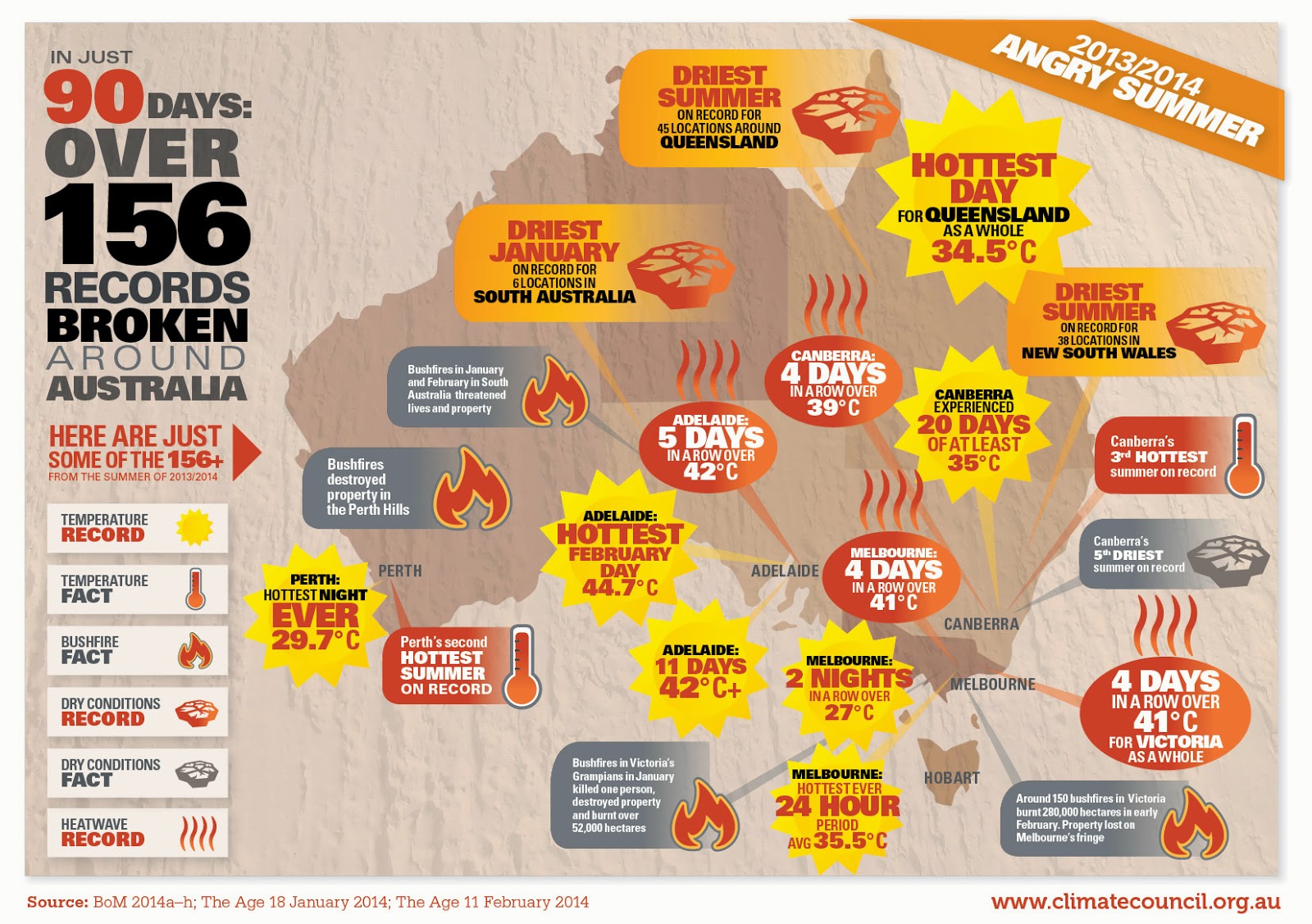
    Source: Climate Council

    The planet is warming, and so is Australia
    The latest survey compiled by the CSIRO and the Bureau of Meteorology – two institutions that the Abbott government has yet to remove or successfully muzzle – shows that Australia is almost a degree warmer, on average, than it was a century ago. And that is roughly in line with global rates of atmospheric warming. And, it is set to continue warming at a rate that depends on how fast greenhouse emissions can be reduced.
    The report says seven of Australia’s 10 warmest years have happened since 1998; over the past 15 years, very warm months have occurred at five times the long-term average, while very cool months have declined by a third; and by 2070, temperatures will be anywhere between 1C and 5C warmer than the 1980-1999 average, depending on future emissions cuts. Note the link between rising temperatures and emissions.

    05 March 2014

    Too hot to handle: life in a four-degree world
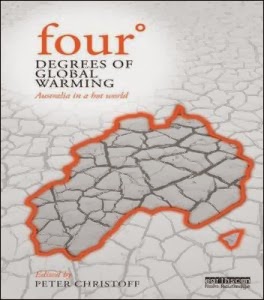
    by Gabrille Kuiper, first published in Overland

    Four Degrees of Global Warming:
    Australia in a hot world
    Peter Christoff (ed),
    Earthscan/Routledge, 2013

    The book Four Degrees or More? Australia in a hot world, edited by political scientist Peter Christoff, is a timely overview of what we know currently about both global and local predicted impacts of climate change.

    As Christoff notes, ‘this four-degree world is one of almost unimaginable social, economic and ecological consequences and catastrophes’ but, given current international and Australian energy and climate policies, it is “an impending reality”. The book contains contributions by Australia’s leading scientists and economists, including Ross Garnaut, David Karoly and Will Steffen, setting out a four-degree future across the ecological, social and economic impacts, and the adaptation that will be required.

    26 February 2014

    Connecting the dots to win on climate
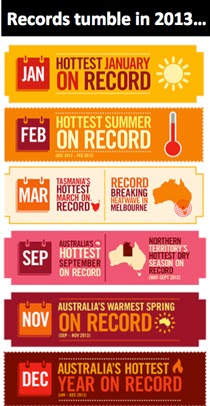
    by David Spratt

    On 20 March I spoke, together with Adam Bandt MP, at a forum in Melbourne on Global warming, Tony Abbott and the need for climate action.

    The second half of my presentation was on how to turn the tide, looking at the “middle third” in recent polling and Tony Abbott’s and his government’s vulnerability on climate, and what they are desperate to not talk about:

    • More and more intense extreme weather events (exemplified by their silence on the spring 2013 fires, and record January 2014 heat);
    • A public conversation that “connects the dots” between extreme events and climate change, and which gives immediacy to the perception of climate impacts;
    • Constructing a climate narrative about human climate impacts, rather than electricity prices and taxes;
    • Public focus on the responsibility of political leaders to “protect the people” from climate change; and
    • Close attention being paid to the efficacy of their “direct action” climate plan.

    23 February 2014

    Arctic sea-ice loss adds 25% to carbon dioxide warming over last 30 years

    First posted at robertscribler

    What’s the difference between a majestic layer of white sea ice and an ominous dark blue open ocean?

    For the Arctic, it means about a 30 to 50 per cent loss in reflectivity (or albedo). And when seasonal sea-ice states are between 30 and 80 per cent below 1979 measures (depending on the method used to gauge remaining sea ice and relative time of year), that means very, very concerning additional heating impacts to an already dangerous human-caused warming.

    Arctic Ocean September 1, 2012
    A dark and mostly ice-free Arctic Ocean beneath a
    tempestuous swirl of clouds on September 1, 2012,
    a time when sea ice coverage had declined to an
    area roughly equal to the land mass of Greenland.
    Image source: Lance-Modis/NASA AQUA.

    How concerning, however, remained somewhat unclear until recently.

    In the past, idealized climate simulations and physical model runs had produced about a two per cent overall loss in Arctic albedo based on observed sea ice losses. This decline, though minor sounding, was enough, on its own, to add a little more than a 10 per cent amplifying feedback to the already powerful human atmospheric carbon dioxide (CO2) forcing during recent years. Such an addition was already cause for serious concern and with sea ice totals continuing to fall rapidly, speculation abounded that just this single mechanism could severely tip the scales toward a more rapid warming.

    12 February 2014

    Oceans warmed at a rate of 12 Hiroshima bombs per second in 2013 as temperatures spiked

    by Lindsay Abrams, via Salon.com 

    Think global climate change hasn’t been very noticeable from where you’re standing? Down in the oceans (which is to say, over the majority of Earth’s surface), temperatures spiked last year, as warming proceeding at an incredibly rapid pace.
    Skeptical Science calls attention to the oceans’ temperature rise for the final quarter of 2013, which literally was almost off-the-charts:

    (via the National Oceanic Data Center)

    07 February 2014

    The why and how of radical emissions reductions (2): Corinne Le Quere

    Second in a series | Part 1

    On 10-11 December 2013, a Radical Emissions Reduction Conference was held at the Royal Society, London under the auspices of the Tyndall Centre for Climate Change Research at the University of East Anglia. In this blog, we look at a presentation by Professor Corinne Le Quere, of the Tyndall Centre for Climate Change Research, University of East Anglia on “The scientific case for radical emissions reductions”.

    Le Quere framed “radical emission reductions” as reductions consistent with a two-in-three chance of keeping global warming to less than 2 degrees Celsius (°C), saying that there is no surety that 2°C is a safe threshold, but according to the geological record, there have been periods of up to 2°C warming during the past 800,000 years that did not trigger any “nasty or unexpected” feedbacks, though sea-levels were 5–10 metres higher than today.

    06 February 2014

    No warming “pause” says World Meteorological Organization head

    The head of the World Meteorological Organization says there is no standstill in global warming, which is on course to continue for generations to come.
    By Alex Kirby, Climate News Network

    The planet is continuing to warm, with implications for generations ahead, and temperatures are set to rise far into the future, the World Meteorological Organization (WMO) reports.
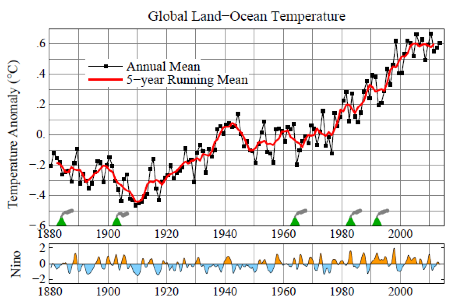
    Global surface temperatures relative to 1951-1980. The Niño index is based on sea surface temperature in the Niño 3.4 area (5N-5S, 120-170W) in the eastern tropical Pacific for 1951-1980 base period. Green triangles mark times of volcanic eruptions that produced an extensive stratospheric aerosol layer.

    It says 2013 was among the ten warmest years since modern records began in 1850, equalling 2007 as the sixth warmest year, with a global land and ocean surface temperature 0.50°C above the 1961–1990 average and 0.03°C higher than the most recent 2001–2010 average.

    02 February 2014

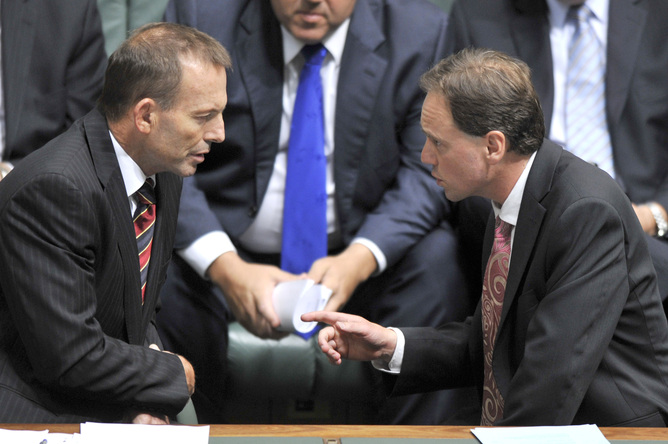
    As Tony Abbott launches all-out war on climate action, what’s the plan?
    [ Updated 2 February 2014]
    NOTE: This blog was originally drafted as notes for a small group discussion in Melbourne. It is in part a situational analysis, covering the need to engage with conservative voters, the fragmentation of our efforts, and the growing gap between what is scientifically necessary and what is considered politically possible, resulting in a cognitive dissonance which is structurally embedded in the climate discourse. At first, I was reluctant to publish these notes because they are pretty blunt, but a number of people thought they were worth an airing, especially because the Abbott government is waging an all-out “shock and awe” war to destroy climate and environment public policy, for which much of our side appears ill-prepared.

    by David Spratt

    “Honesty about this challenge is essential, otherwise we will never develop realistic solutions. We face nothing less than a global emergency, which must be addressed with a global emergency response, akin to national mobilisations pre-WWII or the Marshall Plan… This is not extremist nonsense, but a call echoed by an increasing numbers of world leaders as the science becomes better understood… In the face of catastrophic risk, emission reduction targets should be based on the latest, considered, science, not on a political view of the art-of-the-possible.”
    — Ian Dunlop, formerly senior oil, gas and coal industry executive and CEO of the Australian Institute of Company Directors,  “Global warming is a global emergency”, Crikey, 25 February 2009

    Australia’s climate action movement is diverse: from large, professional national organisations to local volunteer community groups; from issue-specific campaigns focussing on coal, coal seam gas (CSG) and renewables to sector-specific groups; from organisations focused on policy-makers to activists directly confronting the fossil fuel industry. The election of the Abbott government has created a moment of crisis and a chance to review.

    Code Red’s most popular climate posts
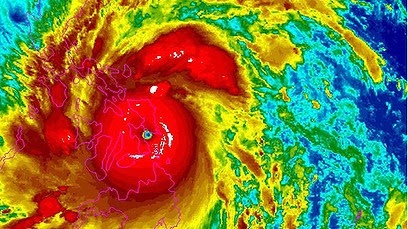
    Here’s the pick of the crop: our most popular posts over the last three years, starting with the most read.

    The state of the Australian climate movement as Labor falters and the conservatives gain ascendancy in mid-2012, some harsh realities and ways forward.

    Arctic sea-ice melt record more than broken, it’s being smashed
    The extraordinary events of the 2012 northern summer and their consequences.

    Brightsiding is a bad strategy (5 parts)
    Why all “good news” and no “bad news” is a bad climate action and communications strategy?

    What would 3 degrees mean?
    The astounding global impacts of 2, 3 and 4 degrees of warming.

    29 January 2014

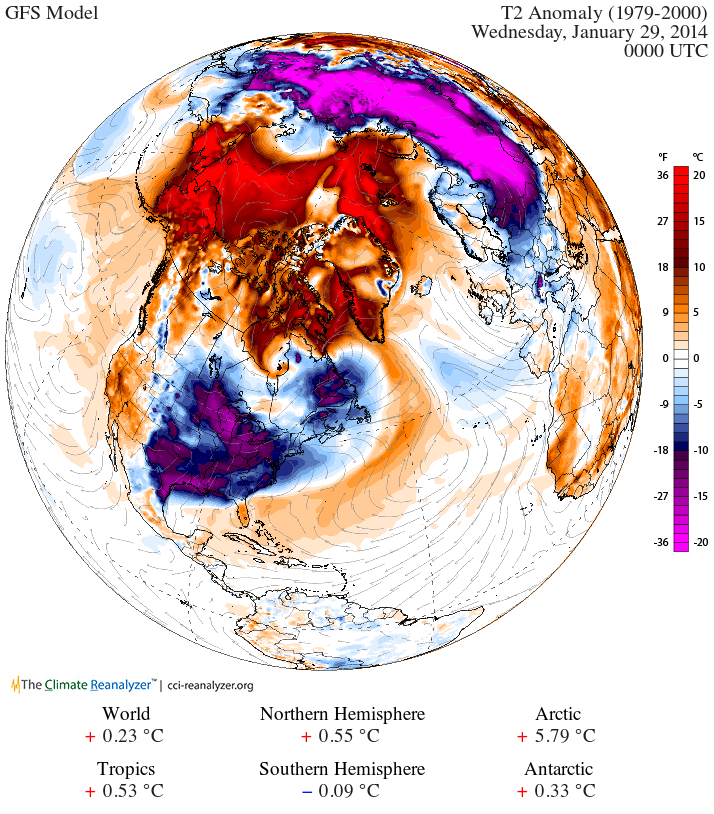
    With Arctic freezer door open, frigid air drains into USA and Eurasia, with Arctic unusually mild

    by David Spratt

    It’s a cliche that a picture tells a story better than a thousand words, and it’s really true in the case of this extraordinary map of weather modelling of northern hemisphere temperature anomalies (variations from the expected values based on climate records) for 29 January 2014:
    21 January 2014

    The why and how of radical emissions reductions: (1) Kevin Anderson
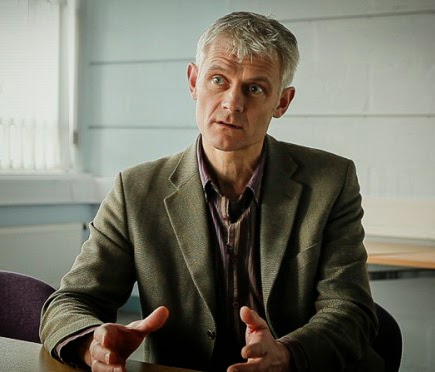
    Prof. Kevin Anderson

    First in a series

    On 10-11 December 2013, a Radical Emissions Reduction Conference was held at the Royal Society, London under the auspices of the Tyndall Centre for Climate Change Research at the University of East Anglia. The conference’s purpose was described as:

    Today, in 2013, we face an unavoidably radical future. We either continue with rising emissions and reap the radical repercussions of severe climate change, or we acknowledge that we have a choice and pursue radical emission reductions: No longer is there a non-radical option. Moreover, low-carbon supply technologies cannot deliver the necessary rate of emission reductions – they need to be complemented with rapid, deep and early reductions in energy consumption – the rationale for this conference.

    17 January 2014

    A climate of denial grips Abbott government’s holiday madness
    by James Wight

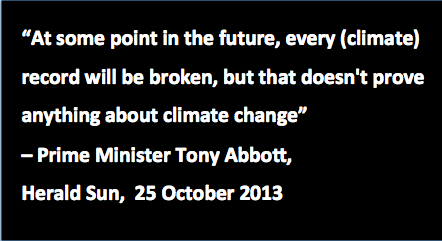
    While many of us were distracted in December by seasonal festivities and summer sports, the Abbott government quietly announced a number of actions which will exacerbate the climate problem, in the long-standing tradition of avoiding scrutiny by hiding unpopular announcements in holiday periods.

    The government approved Adani’s T0 coal export terminal, and the dredging for two more coal export terminals, at Abbot Point. This will be the world’s biggest coal port and open up mining in the Galilee Basin, whose nine proposed mega-mines would export coal with annual emissions of 700 million tonnes of carbon dioxide, almost twice Australia’s domestic emissions and greater than the emissions of all but six countries. Four other fossil fuel projects were approved: an Arrow coal seam gas processing facility on Curtis Island, a transmission pipeline to supply it, Clive Palmer’s China First mine, and the Surat Gas Expansion.

  • Can Nuclear Make a Substantial Near-Term Contribution?

    Sign up | Login with →

    Posted by: Schalk Cloete

    Can Nuclear Make a Substantial Near-Term Contribution?

    Like it?

    23
    Posted July 31, 2014
    51
    52
    3
    106

    This article is the result of some very interesting discussions below a recent TEC article on the potential of coal, nuclear and wind/solar to supply the rapidly growing energy needs of the developing world. In that article, I estimated that nuclear is roughly an order of magnitude less scalable than coal, but more than double as scalable as wind/solar. These estimations were challenged by both nuclear and wind advocates and, as such critical discussions often do, have prompted much closer investigations into this issue. In particular, data pertaining to the near-term prospects of nuclear energy in China, the nation accounting for fully 43% of nuclear plants currently under construction, has been analysed in more detail.

    The results of this analysis confirmed my estimations above fairly well, but only under two very important assumptions: 1) that all the nuclear plants currently under construction in China are successfully completed roughly 6 years after construction commenced and 2) that it will be a very long time before we experience another black swan event like Fukushima.

    Recent nuclear developments in China

    China has invested heavily in nuclear energy over the past few years, leading to a rapid increase in construction activities. Data from the World Nuclear Association has allowed for the creation of the following plot of started and completed nuclear reactor capacity in China. Note that the plot shows the cumulative started and completed nuclear capacity from the start of 2007.

    Image

    The graph shows a rapid increase in new nuclear construction projects from 2008 onwards when alternative energy investment really started to take off. In addition, a clear 18-month pause in new construction projects is visible starting from 2011, indicating the substantial impact of the Fukushima disaster on Chinese nuclear growth. However, the graph shows that new nuclear construction starts resumed an upwards trend from middle 2012, albeit significantly less aggressively than before Fukushima.

    As can be expected, nuclear plant completions show a long time-lag relative to nuclear plant starts. Nuclear plant construction generally takes 4-6 years in China, but the trends in the graph suggest that the reality might lie towards the upper end of this range. In the event that a 6 year construction time is generally representative, it would seem that we are currently on the cusp of a rapid nuclear growth phase in China. Thus, if the next 2-3 years reveal that the blue curve above is essentially a 6-year time-shift of the red curve, it will bode well for the future of nuclear energy. If not, however, nuclear prospects would appear substantially dimmer, at least in the medium term. It will therefore be very interesting to extend this graph with real-world data over the next couple of years.

    Nuclear vs. wind

    Wind power has also been growing rapidly in China since 2008.  The relative simplicity and modular nature of wind causes much shorter construction times than nuclear, and has therefore led to a much more immediate impact. However, the true scalability of a technology must be tested over substantially longer time periods than the 6 year nuclear construction period, implying that this time-lag is not highly relevant when considering the longer-term energy future of China.

    Under the assumption that wind construction times are essentially negligible, we can therefore compare the rate at which new investments are committed to wind and nuclear energy. To make this comparison, one also has to take into account the difference in capacity factors between wind and nuclear energy. This is a rather sensitive area, but I will use data from the BP Statistical Review and the World Nuclear Association to make a reasonable estimate. At the end of 2013, China had 15 GW of operational nuclear and 91 GW of operational wind. In terms of generation, nuclear delivered 110.6 TWh and wind 131.9 TWh. This implies that one unit of nuclear capacity delivers about 5 times as much electricity as one unit of wind capacity. This might be an over-estimate, however, since China is working hard to solve significant wind curtailment problems at present. I will therefore use a ratio of 4 in this analysis.

    Using these assumptions, the Chinese wind capacity buildout is compared against the Chinese nuclear construction starts in the graph below (note that wind capacity is divided by 4 in order to reflect actual electricity generation relative to nuclear). Similar to the graph above, numbers are presented from a base of 0 at the start of 2007.

    Image

    It is shown that new nuclear projects were started at a tempo more than double the rate at which wind projects were competed before Fukushima and roughly at an equal rate when nuclear starts eventually recovered thereafter. This is a clear indication of the impact of a black swan event on the prospects of nuclear power, even in China. Thus, it can be theorized that nuclear scales roughly triple as fast as wind under normal circumstances, but at an equal rate when a recent black swan event burdens the industry with additional regulations. Hopefully, we will go some decades without another black swan event so that nuclear growth rates can return to pre-Fukushima levels and maintain (or even exceed) these rates for an extended period of time.

    It should also be mentioned that the Chinese tariff system favours wind over nuclear by paying a fixed feed-in tariff of $83-100/MWh to wind and $70/MWh to nuclear. Another important factor to consider is the reduced value of wind relative to nuclear due to the variability of wind power (see my previous articles on this subject here and here). Wind power also requires expensive high voltage transmission networks to transport power from good wind locations to population centres, something which is creating substantial challenges.  Thus, if the playing field were to be leveled, the difference between nuclear and wind scaling rates should increase substantially.

    Another important factor to consider is the CO2 avoidance potential of nuclear vs. wind. Here, there are two important distinctions to be made. Firstly, nuclear plants have a very long lifetime relative to wind, implying that more CO2 will be avoided over the lifetime of the plant. Secondly, nuclear displaces baseload generation (essentially 100% coal) while wind displaces load-following generation (includes some gas). Even though I cannot find any good data, it should be safe to say that a large amount of load-following is still done with coal in China. However, natural gas consumption is rising rapidly and the gas share of load-following generation should increase substantially over the lifetime of current wind plants.

    When accounting for these two main factors, the CO2 avoidance potential over the lifetime of the nuclear and wind investments depicted in the figure above can be estimated. For the plant lifetime, 50 years is assumed for nuclear and 20 years for wind. In terms of CO2 intensity of displaced generation, nuclear is assumed to displace 0.9 tonCO2/MWh (coal) and wind 0.6 tonCO2/MWh (coal + gas).

    Image

    It is clear from the graph above that, under these assumptions, investments in new nuclear plants will translate into much greater CO2 abatement than investments in new wind farms. This is due to the longer lifetimes and baseload coal displacement capability of nuclear.

    Nuclear vs. coal

    If all nuclear plants currently under construction are successfully completed, China may well lead a much needed revival in nuclear energy. However, it is important to keep things in perspective by comparing to the rate at which fossil fuels like coal have scaled to fuel the economic miracle that took place in China over the past decade or two.

    In order to compare the scaling rates of nuclear and coal, projected nuclear power (under the assumption that all plants under construction are successfully completed) has been converted to primary energy using a capacity factor of 90% and a typical thermal plant efficiency of 40%.  The graph below compares the potential scaling rates by comparing the projected increase in primary energy from nuclear over the next 6 years to the increase in primary energy from coal one decade ago (coal data from the BP Statistical Review). The graph is plotted from a base of 0 in 2013 for nuclear and 2003 for coal.

    Image

    The graph shows that nuclear is projected to scale a little over an order of magnitude slower than coal did one decade ago before the impact of Fukushima and still slower thereafter. This result is especially significant given the fact that the Chinese economy more than doubles in size every decade. This implies that the Chinese economy is about double as capable of adding energy capacity today as it was in 2003.

    Conclusion

    This analysis has shown that the scaling rate estimations provided in the previous article are fairly accurate under two important assumptions: 1) that all nuclear reactors currently under construction are completed 6 years after construction started and 2) that it will be a long time before we experience another nuclear black swan event like Fukushima. Only time will tell whether these assumptions are accurate though…

  • 700.000 homes at sea rise risk

    14 Jun 2014
    Home  »  Uncategorized   »   700.000 homes at sea rise risk

    700.000 homes at sea rise risk

    Posted in Uncategorized By Neville On June 14, 2014

    homes at sea rise risk

    700.000 homes at sea rise risk

    Posted in Climate chaos, Extreme weather and global warming By admin On May 30, 2009

    “Other scientists say the sea could rise metres in the next century. The director of the Fenner School of Environment and Society at

    the Australian national University, Professor Will Steffen, told the inquiry there was huge uncertainty among scientists about the rate

    of sea level rise and ‘the science … has progressed significantly since the publication of the IPCC (report) last year’. The observed

    rate of sea-level rise is tracking at or near the upper limits of the envelope of IPCC projections. With no further changes in the rate of

    sea level rise, this would suggest that sea levels in 2100 would be 0.75m to one metre above the 2000 levels. However, there was

    further uncertainty over the loss of polar ice sheets, particularly Greenland, which was melting rapidly. The concern is that a

    threshold may soon be passed beyond which we’ll be committed to losing most or all of the Greenland ice sheet. This would lead to

    6.0m of sea level rise (with enormous implications for Australia), although the time frame required to lose this amount of ice is

    highly uncertain, ranging from a century to a millennium or more.”

    “Insurance Australia Group actuary Tony Coleman said preliminary estimates of the value of property, homes, businesses and public

    infrastructure vulnerable to sea inundation ranged from $50 billion to $150 billion. The figure depends upon the extent of sea-level

    rise assumed and the effectiveness or otherwise of potential mitigation measures.”

  • Trust Me (I hate you) LEFT FLANK

    Trust Me (I hate you)

    by · August 2, 2014

    HoC

    BY TROY HENDERSON

    We are cross posting this thoughtful post by Troy Henderson, from his blog Radical Blues, on the relationship between anti-politics and neoliberalism. 

    ***

    Alongside tackling climate change and fighting psycho-capitalism one of the challenges of modern life is keeping up with all the high-qual TV series coming out of the US.

    I’d fallen badly behind on this front until a recent surge of intimacy with my laptop saw me chew off seasons 1 and 2 of House of Cards and the first season of Boardwalk Empire.

    I found them both very zeitgeisty. Very post-West Wing. Post-Hope and Change. Post-GFC. Post post-9/11. (Yes, I realise Boardwalk Empire is set in the 1920s but you know the past is about the present and all that).

    In House of Cards Kevin Spacey and Robin Wright play Frank and Claire Underwood, a charming, scheming, double-crossing political powercouple intent on stylishly slashing their way to the top.

    Boardwalk Empire stars the ever-ill looking Steve Buscemi as Nucky Thompson, a corrupt Irish-American treasurer of Atlantic City during Prohibition. Nucky just wants to be loved while taking 10% of whatever you make – and you’d better pay up or you’re dead.

    From what I’ve seen both series convey the same message: politics is a brutal bloodsport where the bad guys finish first and have much fun along the way. They show that beneath the seductive veil of political rhetoric about the public good and community values lies a naked lust for personal power supported by patronage networks that determine who rises and who falls.

    The Underwoods and Nucky Thompson deploy a mix of charm, deception, favours, bullying and violence in order to achieve their ends, as circumstances require.

    The realist and the cynic will say: twas ever thus. True enough, as a general statement. But it’s not always true with the same intensity or with the same visibility.

    For me the themes and characters explored in House of Cards and Boardwalk Empire resonate with a growing sense that politics is a massive sham n scam in which the ruthless and the powerful play the rest of us for mugs.

    I think we can see this pretty clearly in #AusPol.

    On the one hand, we have the increasingly empty spectacle of official politics in which our dear leaders mouth their platitudes and perform their rituals with ever-dwindling levels of conviction (Exhibit A: 2010 federal election debates #killmenow).

    On the other hand, we have ICAC and the federal budget revealing the truth about how politics is done and whom it’s for.

    This increasingly visible tension between superficial farce and underlying reality creates a challenge for politicians like Abbott and Hockey. It’s easier to rule through consent than through coercion but when a critical mass of people stop drinking a particular brand of political Kool Aid it makes the business of screwing them over more difficult.

    The best analysis I’ve read of the current political conjuncture is by Tadeusz Tietze. You need to spend some time reading the back catalogue of posts at Left Flank by Tietze, Elizabeth Humphrys and others to get the full ‘anti-politics’ thesis but I’ve found a few pieces particularly useful for situating the Abbott government within a broader – and deeper – context.

    Tietze argues that Abbott suffers from a lack of political authority – within his party and in relation to public – that is a symptom of a “general crisis of official politics” linked to an erosion of the “social bases of the established two-party political system”.

    In an August 2012 piece in Overland Tietze wrote:
    It seems almost certain that he [Abbott] wants to play a similar game to that of recently elected state Liberal premiers, launching a series of attacks around a theme of deficit reduction. But he will do so in a situation where, no matter how big his parliamentary cushion, he will have little popular base to rely on and no coherent program to win consent for. The result is likely to mean more political chaos, not less. 

    In December 2013 Left Flank post on a similar theme he wrote:
    None of this means that Abbott can’t still do nasty things, especially to vulnerable groups like asylum seekers, and especially to try to address his lack of authority. His supporters may even demand a big bang reform package to stem the malaise, one that he will feel unable to refuse. But all this will be from a position of weakness not seen in a newly elected federal government since the Great Depression.

    Pretty prescient stuff. This relationship between ‘nasty things’ and ‘weakness’ is clear in Operation Sovereign Borders, the May budget and even in Abbott’s tawdry efforts to make political capital out of the MH17 tragedy.

    In a post-budget piece this year Tietze characterised the Abbott government’s “especially destructive attacks on a series of highly disadvantaged social groups” as an attempt to address the “malaise, the aimlessness, and the loss of authority” of its first eight months in office by picking “some ugly fights to prove they are still a force to be reckoned with”.

    He argued that the budget should not be seen as a “consistent neoliberal austerity program” or an example of “über-Thatcherism designed to reshape society” but rather as a “pragmatic attempt to keep the economy sputtering along while renovating government balance sheets…enough for ‘future-proofing’ operations ahead; i.e. for throwing money at another financial crisis”.

    While I agree with the general thrust of this analysis I disagree on a couple of particulars. I think if Abbott managed to implement the budget in full (unlikely) it would qualify as “über-Thatcherism” and that consistency (ie actually slashing the deficit if you say it’s such an urgent issue) is far less important than the “restructuring” the “budget emergency” rhetoric is used to justify.

    What matters here is how widely the need for restructuring (further retrenchment of the welfare state, deregulation, privatisation etc) and the justification for it (the debt and deficit disaster) are accepted as legitimate by both the public and the political class. Evidence cited by Tietze, Richard Cooke, and others, suggests that public support on both counts is on the wane, a factor that clearly exacerbates the political class’s crisis of authority that Tietze identifies.

    But while politicians are on the nose and few people believe that more privatisation, deregulation, ‘tax reform’ and ‘flexible labour markets’ will make them better off this does not mean that neoliberalism is dead.

    Despite the many obituaries written since the GFC neoliberalism has proved resilient. Political economist Damien Cahill argues that “progressive commentators failed to appreciate the durability of neoliberalism in the face of crisis because of their idealist, or ideas-centred, understanding of neoliberalism”. This approach, according to Cahill, led the likes of Joseph Stiglitz and Kevin Rudd, among others, to assume that because the GFC showed that neoliberal ideas were ‘wrong’ the neoliberal project would be abandoned.

    Cahill contrasts an ideas-centred understanding with the concept of “embedded neoliberalism” that emphasises the “ways in which neoliberal policies have become deeply embedded within a growing bureaucratic apparatus of rules that commit states to further neoliberalisation”. These policies are “embedded within a set of class relations which favours the owners of capital”. “Such features”, Cahill argues, “lend considerable inertia and resilience to neoliberal policy”.

    This doesn’t mean dismissing the importance of neoliberal ideology altogether. But rather, as Cahill puts it, that “neoliberal doctrines” should be seen as “a malleable set of discursive weapons that can be selectively appropriated to justify all kinds of neoliberal policies, and which have worked in combination with class forces and institutional biases to ensure that neoliberal policies have been the ‘go to’ form of economic crisis management since the onset of the global economic downturn”.

    While I agree with Tietze’s characterisation of the budget as an attempt by Abbott to “stem the malaise” and “address his lack of authority”, I also see it as a good example of the “considerable inertia and resilience” of neoliberal policy identified by Cahill.

    The big lies about the ‘debt and deficit disaster’ and ‘unsustainable spending’ are examples of the selective use of “discursive weapons” deployed to justify policies that are “embedded within a growing bureaucratic apparatus of rules” that serve specific class interests.

    Three examples serve to illustrate this point.

    Firstly, ‘small government’ rhetoric is a familiar part of neoliberal patois and we’ve heard plenty from Abbott and Hockey about the need to ‘end of the age of entitlement’ and rein in ‘unsustainable’ spending that will ‘mortgage our children’s future’, and so on.

    But the claim that government spending is ‘out of control’ or ‘unsustainable’ is rubbish. As this Australia Institute report shows, after a sharp increase under Whitlam and (early) Hawke, “government spending has tended to hover around 25 per cent of GDP”. However, with about 60% of the $400 billion federal budget going on social security and welfare (34.7%), health (16.2%) and education (7.5%) you can see what the Right’s target is here.

    Part of the budget’s solution to the non-problem of runaway spending is to place a medium-term cap on government spending of 23.9% of GDP and to cut $80 billion in health and education payments to the states over the next decade.

    The cap is a classic example of Cahill’s “bureaucratic apparatus of rules” that aims at removing important political decisions (ie how much government should spend) from the sphere of democratic deliberation.

    The $80 billion cuts are meant to force the states to ‘work it out’ through some combination of spending cuts and tax hikes (ie raise the GST) that would introduce an element of ‘policy competition’ between state governments that opens up the space for business to play off one jurisdiction against another.

    Because their target is spending on health, education and welfare both the cap and cuts clearly serve particular class interests by attempting to reduce the genuinely redistributive and (somewhat) universal elements of the welfare state.

    Second, the budget asks the public to ‘share the burden’ of ‘fixing the budget’ and getting spending ‘under control’ by accepting a host of changes that will make most people worse off while entrenching the principle of ‘loser pays’. These include the changes to family payments, pension indexation and unemployment benefits, the Medicare co-payment, cuts to Aboriginal services and the further deregulation of higher education.

    By ‘loser pays’ I mean that the budget asks those on lower incomes to pay more (in absolute terms) than those on higher incomes to fix the budget emergency that doesn’t exist (see NATSEM graphic below and this paper by Whiteford and Nethery) while further extending the principle of ‘user pays’ to GP visits and all higher education. In the longer term, ‘loser pays’ implies that society owes nothing to ‘losers’ who are unemployed, don’t have private health insurance and can’t afford to pay for their higher education fees upfront. These proposed changes are technocratic, incremental and make use of the existing institutional framework (ie retaining HECs but charging up to 6% interest) to deepen inequality and heighten class distinctions.

    NATSEM

    Third, the budget aims to lighten the burden on corporations (cutting company tax, abolishing mining and carbon taxes) and to open up new sites of capital accumulation on the principle of ‘heads I win, tails you lose’. On the one hand, Abbott wants to sell off public assets that will provide easy economic rents to private owners (ie the Royal Mint, Defence Housing Australia, the ASIC register and Australian Hearing) and encourage state governments to do the same through the $5 billion Asset Recycling Fund. On the other hand, the state will act as an intermediary between corporations and service users where there might be more risk involved for private operators (ie the $3.7 billion allocated to roads funding and allowing private education providers access to public funding). Again, we have examples of the use of technocratic means within the existing institutional framework to achieve ends favourable to corporations and the wealthy.

    The detail is all pretty boring but the consequences of this stuff are hella crap for most people.

    We’re at an interesting moment in Australian where the balance of forces between the “crisis of authority” and “anti-political mood” identified by Tietze and the resilience of “embedded neoliberalism” highlighted by Cahill is far from clear.

    In his famous 1944 book The Great Transformation about the transition from feudalism to capitalism Karl Polanyi wrote: “to allow the market mechanism to be the sole director of the fate human beings and their natural environment…would result in the demolition of society” and “human society would have been annihilated but for protective counter-moves which blunted the action of this self-destructive mechanism”.

    From this vantage point, it’s difficult to discern clear evidence of the “protective counter-moves” that might begin the process of disembedding neoliberalism (although the strong public opposition to the budget could be a sign that such moves are desired). The stark absence of any attractive and coherent alternative being offered by the Left compounds the situation.

    But perhaps the current anti-political mood will morph into something generative? If not, at least we have HBO and Netflix to help remove our blinkers and dull our pain.

    – See more at: http://left-flank.org/2014/08/02/trust-hate/#sthash.Z1JnrZuN.dpuf

  • Yellowstone Volcano Eruption Effects: Entire World Would be at Risk if Supervolcano Erupts

    Yellowstone Volcano Eruption Effects: Entire World Would be at Risk if Supervolcano Erupts

    By , Epoch Times | August 1, 2014

    Last Updated: August 1, 2014 4:46 pm
    A plume of ash rises from a volcano erupting under the Eyjafjallajokull volcano, Hvolsvollur, Iceland, Wednesday, May 5, 2010. (AP Photo/Brynjar Gauti)

    A plume of ash rises from a volcano erupting under the Eyjafjallajokull volcano, Hvolsvollur, Iceland, Wednesday, May 5, 2010. (AP Photo/Brynjar Gauti)

    The Yellowstone volcano is an increasing source of interest, being perceived as one of the volcanoes most likely to erupt in the United States and the subject of a number of articles, videos, and blog posts.

    People have been sharing advice on how to survive if the volcano does end up erupting anytime soon. Now it’s worth looking at the potential effects of an eruption.

    Many U.S. residents would be at risk of dying or suffering from the results of an eruption. When volcanoes erupt, they shoot out lava, which becomes ash during the eruption as it’s shattered into tiny particles. Volcanic ash is made up of tiny, dust-like fragments of jagged rock, minerals, and volcanic glass.

    Volcanic ash is a big mess, being hard, abrasive, and not dissolving in water, according to the National Geographic encyclopedia. It can also conduct electricity when wet.

    The main concern with an eruption at Yellowstone revolves around the span of the ash. How far away could it get?

    Most of the United States could get covered with the ash, as it was in the previous large eruptions at Yellowstone. More than a dozen states could be covered entirely or partially with ash and debris.

    Places nearby the eruption would also have to deal with the pyroclastic flow, which is basically an avalanche of the ash, gases, and rock mixed together. The flow can raze buildings, uproot trees, and cause massive damage and loss of life. In addition, calderas would form across areas in Montana, Idaho, Wyoming, and other states. These are broad volcanic depressions created as the ground collapses.

    “The ash is thick (more than about 30 centimeters of ash) near the eruption source and a small fraction of a millimeter once you move 2,000 miles away. It’s fair to say that a trace of ash would be found over most of the United States, though it would only be thick enough to collapse roofs in the states closest to Yellowstone,” Jacob Lowenstern, scientist-in-charge at the Yellowstone Volcano Observatory, told Live Science.

    The ash would also hang in the air for several days, blocking sunlight and making it difficult to breathe. The ash would decimate crops and make it near-impossible to grow food for a period of time. ”A lot of people would perish,” said Stephen Self, director of the Volcano Dynamics Group at the Open University in the U.K, noting that if an eruption happened he would predict American refugees lining up at the Mexican border.

    This map from the U.S. Geological Service shows the range of the volcanic ash and debris that was deposited after the three large Yellowstone volcano eruptions over the last 2.1 million years. as well as the Mount St. Helens eruption. (USGS)

    This map from the U.S. Geological Service shows the range of the volcanic ash and debris that was deposited after the three large Yellowstone volcano eruptions over the last 2.1 million years. as well as the Mount St. Helens eruption. (USGS)

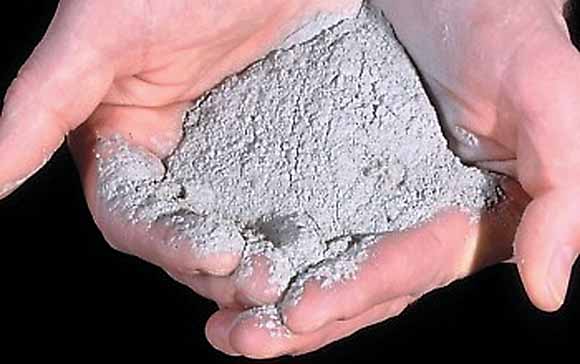
    Close-up photograph of person's hands holding half a cup of rock flour

    Volcanic ash. (USGS)

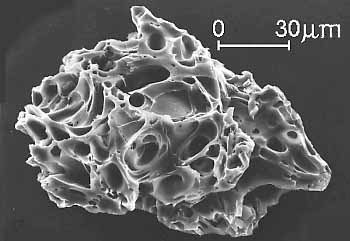
    image from scanning electron microscope showing ash particle having the texture of lacy Swiss cheese

    Ash particle magnified about 200 times. (USGS)

    iceland

    A plume of ash from the volcano under the Eyjafjallajokull glacier covers the farm of Pall Eggert Olafsson, in Thorvaldseyri, Iceland, Monday, April 19, 2010. Meteorologists in Iceland said eruptions from the volcano were weakening and the ash was no longer rising to a height where it would endanger large commercial aircraft. (AP Photo/Brynjar Gauti)

    More importantly for those outside the U.S., the effects of a Yellowstone eruption would be worldwide, according to the U.S. Geological Service, including the “injection of huge volumes of volcanic gases into the atmosphere could drastically affect global climate.”

    Volcanic expert Harldur Sigurdsson highlighted the worldwide effects of volcanic eruptions to CBS earlier this year. He and the CBS team were in Iceland watching the Eyjafjallajokull volcano shoot out the big clouds of ash and huge rocks, some the size of cars.

    “It was this ash that made Eyjafjallajokull the most disruptive eruption in years. The ash billowed up nearly 33,000 feet and drifted a thousand miles over Europe. One hundred thousand flights were cancelled. Ten million people were stranded for a week,” CBS reported. Still, volcanologist Haraldur Sigurdsson told us that kind of trouble is nothing compared to eruptions, elsewhere, in the recent past.”

    Sigurdsson said: “And the best example of that occurred in 1815, when there was an eruption in Tambora volcano, in Indonesia. And a big, explosive eruption sent out an ash cloud up to about 30 miles. And it dispersed very widely. And also, a lot of sulfur came out of this volcano. And that led to global cooling. And produced what is known as the year without a summer in New England, in North America.”

    The year without a summer was in 1816, caused by a volcano eruption halfway around the world.

    The eruption in Iceland was a four on the scale of eight. Yellowstone is one of the places an eight could happen, according to Sigurdsson.

    “The floor of the volcano is breathing like an animal. It’s rising, and moving up and down. Because of magma inside the volcano,” he said.

    Yellowstone erupted about 640,00 years ago, as well as 1.3 million and 2.1 million years ago. These are the large eruptions.

    “The Yellowstone-size eruption will occur. Of course, we have no idea when. It’s being monitored very, very closely. So there is no chance of it occurring without any warning. But it’s a devastating event,” said Sigurdsson.

    “Devastating to aviation, communications and agriculture, volcanoes can change the course of history. Never before have so many people lived within striking distance–200 million worldwide. Science is good at warning of eruptions that are weeks away but, beyond that, it’s impossible to predict which one is next or how big it will be.”

    Category: US US News
  • Yellowstone Volcano Eruption Effects: Entire World Would be at Risk if Supervolcano Erupts

    Yellowstone Volcano Eruption Effects: Entire World Would be at Risk if Supervolcano Erupts

    By , Epoch Times | August 1, 2014

    Last Updated: August 1, 2014 4:46 pm
    A plume of ash rises from a volcano erupting under the Eyjafjallajokull volcano, Hvolsvollur, Iceland, Wednesday, May 5, 2010. (AP Photo/Brynjar Gauti)

    A plume of ash rises from a volcano erupting under the Eyjafjallajokull volcano, Hvolsvollur, Iceland, Wednesday, May 5, 2010. (AP Photo/Brynjar Gauti)