Writing in this week’s Pearls and Irritations, Peter Sainsbury points out that the most recent Intergovernmental Panel on Climate Change (IPCC) projections regarding climate change assume continual economic growth as fundamental to their projection. Their modelling offsets this with unprecedented technical change, such as green hydrogen and green steel and new, negative emissions technologies. Europe’s Fit for 55 zero-emissions plan, also predicates economic growth, decoupled from environmental harm. Sébastien Wälti of the Swiss National Bank and other degrowth researchers point out that the vast sums of money spent on emissions reduction technologies over the last two decades have had very little impact on emissions. Reducing consumption and population rather than inventing new technologies.
One of the items he put to air was an interview he had earlier recorded with Dick Smith. “… we know that we cannot continue to grow on a finite planet, but capitalism depends on growth, so it might all go bust. We might not be here to see the future, I’m sure some cockroach will be here and ready to start evolving again, but I am optimistic. I am a capitalist and I hope that some wonderful genius will come along and save us from ourselves.”
Dick Smith campaigned against endless growth
Yes Dick reflects the dilemma we face as a civilisation. Interestingly, he knows more than most of us about the challenges of ending growth. He ran Australian Geographic as a xero-growth company for eight years. Listen to the last three minutes of the interview to hear him discuss that.
A public discussion on the Post-Growth Future for Business held
at University of Queensland generated far-reaching discussion last Friday, 7th
June.
Dr Cle-Anne Gabriel at UQ Business School
Hosted by Dr Cle-Ann Gabriel, who is researching business
models for sustainability, the event outlined the reasons for considering an
end to growth, the challenges that poses for business and some approaches that
can help business flourish in a post-growth environment.
Key among the ideas was that individual businesses can grow
in a zero growth economy, the challenge is where the degrowth comes from to
balance that out.
Dr Gabriel provided an overview of the philosophical
underpinnings of zero-growth, the difference between degrowth (it is a process
that can be applied to specific areas, such as developed countries, to move
toward a post-Growth economy) and post-Growth, and a list of the challenges
facing economists.
Dr Michelle Maloney
Dr Michelle Maloney, codirector of the New Economy Network,
walked through the recent history of growth and the increasing influence of
finance as a result of neo-liberalism and some of the tools being used to
replace economic growth in specific communities.
Associate-Professor Bernard McKenna
Associate Professor Bernard McKenna focused on the nature
and application of wisdom. He pointed out that the application of theory and
dogma to economic management and in governance generally can lead to harsh and
unintentional harm, if is applied without the ameliorating impact of wisdom.
The complimentary and thorough talks generated vigorous and
wide ranging discussion in the workshops raising a number of interesting
questions and observations.
One very challenging observation was that the exponential
curves of the “Great Acceleration” all follow similar trajectories to that of
population. If deforestation, plastic pollution, ocean acidification, falling
water tables, disappearing ice etc are all functions of overpopulation, then this
leads to the challenging idea that reducing population would solve all the
other problems on its own. That in turn leads to the uncomfortably cynical
observation that the inaction of the world’s richest nations on climate change
and their increasing hostility to immigration could well engineer such an outcome
by simply letting three quarters of the world disappear in an ecological
catastrophe.
Professor McKenna’s work on Wisdom would obviously not accommodate
such a conclusion.
Entrepreneur and adventurer Dick Smith is no stranger to controversy.
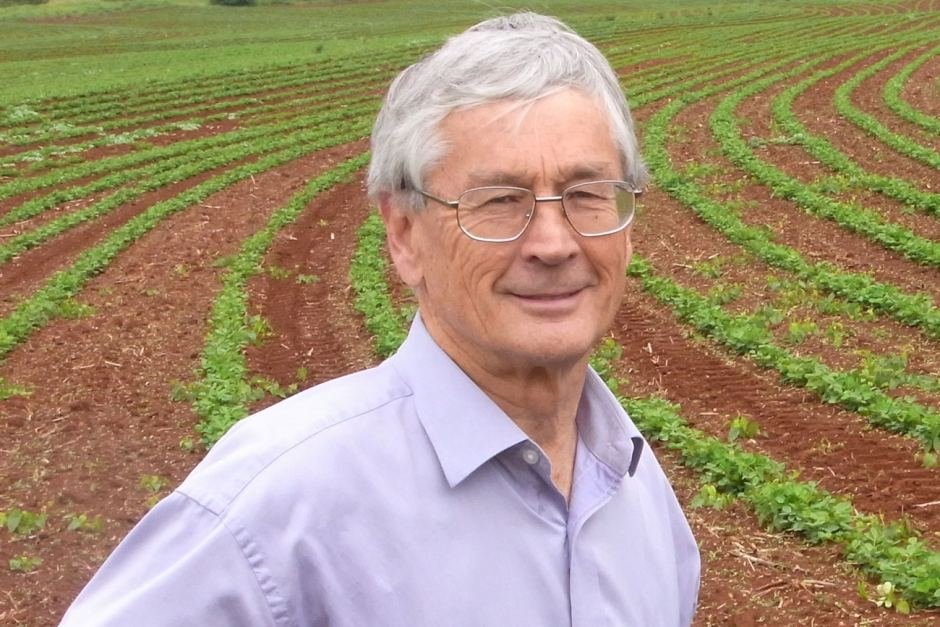
Dick Smith appeared on the ABC discussing Australian food production
Over the years he has threatened to run against Tony Abbott, as well as starting a range of ventures that can only be described as profit for a purpose. Dick Smith foods for example was set up with the sole purpose of keeping Australian food processors in Australian hands.
In this interview with Geoff Ebbs, Dick Smith discusses the end of growth and the challenges inherent for capitalism in that concept.
Dick and Geoff discuss growth and capitalism in this section of a 15 minute interview.
The interview was first aired on The Generator, a weekly radio show on Byron Bay’s Bay FM that ran from 2005 until 2009.