Author: admin

  • Fall in power demand ‘unprecedented’ says Drax

    Fall in power demand ‘unprecedented’ says Drax


    • Industry demand for power station’s electricity slumps 8%
    • Factory closures and fall in demand for new cars a factor


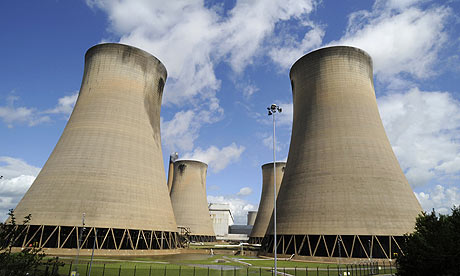
    Power station chimneys near Drax in northern England

    The Drax power station is the largest coal-fired power station in Europe and supplies around 7% of Britain’s electricity. Photograph: Nigel Roddis/Reuters


    Electricity demand from British industry has fallen by an unprecedented 8% this year as factories have shut down in droves, power station operator Drax said today.


    Household demand has also declined – by 2% – but that was due to mild weather rather than economic reasons, the company’s chief executive, Dorothy Thompson, said, as she unveiled half-year results.


    Overall demand for the power station’s electricity fell by 6% in the first six months of 2009, compared with the same period a year earlier. The station, in Yorkshire, is the largest coal-fired power station in Europe and supplies around 7% of Britain’s electricity.


    Thompson said it was usual for energy demand to fluctuate in line with changes in overall economic output, but this time the drop was abnormally large. “For our sector it’s a very unusual movement … in fact, unprecedented in my experience,” she said.


    A slump in world trade volumes in the second half of last year and a collapse in demand for things like new cars meant Britain’s industry has borne the brunt of the recession. Many car plants closed for several months around the turn of the year as they tried to run down stocks of unsold cars. That also caused many parts suppliers to shut down temporarily, which could explain such a sharp drop in electricity demand.


    Drax – the country’s biggest carbon dioxide emitter, which burns around 100m tonnes of coal a year – said its carbon abatement projects were on track. These include an upgrading of existing turbines to increase their efficiency, the conversion of some to also burn biomass such as wood pellets, and the building of new, biomass-only plants.


    It said that on completion, the biomass co-firing facility would be the largest of its type in the world. Along with Drax’s existing co-firing capability, it would provide a total of 500MW of renewable electricity, or the equivalent output of over 600 wind turbines, by mid-2010. That will be equivalent to 12.5% of its total output.


    The biomass co-firing facility will reduce Drax’s emissions of CO2 by over 2.5m tonnes each year. With the upgrade in efficiency of the standard turbines, the station will have cut its carbon emissions by 3.5m tonnes, or 17.5%, by 2011 compared with 2006 levels.


    Drax posted a sharp fall in first half earnings due to lower power prices, but said profit should rise sharply in 2010 thanks to more favourable hedging contracts for its electricity. Pretax profit fell to £33.8m in the first six months of the year from £149.5m in the same period last year after revenues declined 12% to £706.9m.

  • Government distances self from migrant-terrorist link

    Government distances self from migrant-terrorism link


    By Simon Lauder for AM


    Kelvin Thomson has been criticised by Australia's Race Discrimination Commissioner for linking the threat of terrorism with immigration.

    Kelvin Thomson has been criticised by Australia’s Race Discrimination Commissioner for linking the threat of terrorism with immigration. (AAP: Sergio Dionisio)


    Australia’s Race Discrimination Commissioner has criticised a Federal Government backbencher for linking the threat of terrorism with immigration.


    Labor MP Kelvin Thomson says Australia should severely cut its intake of migrants so the threat of terrorists coming in can be reduced.


    In a speech to year 12 students at a foreign affairs forum in Melbourne, the Member for Wills called for more rigorous background checks on prospective migrants.


    “The arrests this week in Melbourne will put renewed focus on our counter [terrorism] security measures. And it’s right that they should do so,” he said.


    Mr Thomson says reducing Australia’s immigration intake by about half would improve security because it would give authorities more time to assess applications.


    The suggestion comes just as the Race Discrimination Commissioner, Graeme Innes, is trying to prevent a public backlash against the Somali community.


    “There have certainly been comments on talkback radio criticising the whole communities, when only a very small minority of people may be responsible for the allegations and the charges that have been made,” he said.


    Mr Innes says it is wrong to link this week’s terrorism charges with a debate about immigration.


    “I think it’s unfortunate that those suggestions have been made in this particular week,” he said.


    “In several of the instances of people that have been charged, they came here as young children, and reducing migration intakes or vetting, better vetting of migrants just wouldn’t have addressed these issues.”


    Mr Innes says making the link increased the risk of a backlash.


    “It risks the sort of backlash where people in the broader Australian community start to tag communities as a whole as responsible for extremism and radical positions, whereas that is far from the reality,” he said.


    The Opposition’s immigration spokeswoman, Sharman Stone, says Mr Thomson is right to highlight problems with security checks.


    “Kelvin’s got his finger on the button when he says that there is a real problem right now about how we are assessing applications,” she said.


    “It’s not, I think, due to the numbers of people coming in, it’s due to the reduction of resources.”


    The Government’s Parliamentary Secretary for Multicultural Affairs, Laurie Ferguson, says it is not more time that is needed for security checks as Mr Thomson contends, it is more resources.


    Mr Ferguson says ASIO is under-resourced and that’s causing unnecessary delays.


    “I often, almost weekly, write to ASIO about trying to finalise security checking of people in my electorate and their families. And there’s been a significant additional time that people are separated because of this requirement,” he said.


    “And I do say that on occasion it seems to me that some cases are blatantly not a security worry, and yet they’ve still got to be waiting all this time.”


    Despite Mr Ferguson’s admission that ASIO is not fully equipped for the task, the Federal Government is defending its security migration process.


    Immigration Minister Chris Evans has released a written statement which says Australia’s migration screening is world class, and Mr Thompson’s views are not those of the Federal Government.


    Tags: community-and-society, immigration, race-relations, government-and-politics, federal-government, unrest-conflict-and-war, terrorism, australia

  • Scottish climate policy is hypocritical, conrtadictory and counter-productive

    Scottish climate policy is hypocritical, contradictory and counter-productive


    The Scottish government boasts of stringent targets to cuts emissions while squeezing North Sea oil reserves and approving new opencast coal mines. No wonder people are taking into their own hands to highlight this hypocrisy


    It’s the same everywhere. Governments are simultaneously seeking to minimise the demand for fossil fuels and maximise the supply.


    In its Low Carbon Transition paper, for example, the UK government makes elaborate plans for cutting the consumption of oil, gas and coal. It then reveals that “[We will] maximise the economic production of oil and gas from the North Sea“.


    The 2007 energy white paper says it intends to “maximise economic recovery of the oil and gas from the UK Continental Shelf (UKCS) and from remaining coal reserves“.


    The contradiction is shocking and ridiculous. But nowhere is it starker than in Scotland.


    The Scottish government boasts of setting the world’s most stringent target for greenhouse gas reductions: 42% by 2020.


    This beats the Westminster target (34%) and leaves all other administrations standing. If you knew nothing more about Scotland, you would conclude that it had become the rich world’s greenest nation.


    But at the same time the Scottish government has been trying to squeeze every last drop out of both the North Sea oil reserves and its substantial coal seams. Take a look at the opencast mining stats here.


    As you can see, Scotland accounts for the great majority of all opencast coal produced in the UK (which is another way of saying all coal, as deep-mining is more or less dead here) and for the majority of the permitted reserves waiting to be dug. More importantly, as it reflects current Scottish government policy, it also accounts for almost all the new coal workings that were granted planning permission in the UK in 2008. Out of 6.29m tonnes of new production, Scotland will account for 5.75m tonnes, or 91%. The new workings will dig up 1,200 hectares of land. Seven new pits were given planning permission last year and none were refused.


    So if you were to describe Scottish government policy as hypocritical, contradictory and counter-productive, you wouldn’t be stating the half of it.


    But while the government undermines its own targets, some people in Scotland are putting its climate change policy into effect. The Scottish camp for climate action has declared war on opencast coalmining. Yesterday people associated with it did what the government should have done years ago, and cut the conveyor belt used to carry coal from the Glentaggart pit in Lanarkshire to the local rail terminal.


    Now they propose to take on other pits, as well as Scotland’s biggest coal-burning power stations.


    They have chosen the right targets. Coal is the dirty word that threatens to destroy attempts at Copenhagen in December to prevent climate breakdown. If governments won’t take it on, we must.


    monbiot.com

  • Migrants ; ‘may pose terrorist threat’

    Migrants ‘may pose terrorist threat’


    By Emily Bourke for PM


    Posted 4 hours 27 minutes ago
    Updated 1 hour 45 minutes ago


    Kelvin Thomson says there is a genuine risk of fundamentalists entering Australia

    Kelvin Thomson says there is a genuine risk of fundamentalists entering Australia. (AAP: Sergio Dionisio)


    Federal Labor MP Kelvin Thomson has criticised Australia’s existing immigration laws, calling for the slashing of migrant numbers and more rigorous background checks on prospective residents.


    Speaking to a group of Year 12 students in Melbourne on Friday, the Member for Wills said spiralling numbers of migrants were compromising Australia’s security.


    “Given time, it would be possible to get to the bottom of the background of applicants from Somalia and elsewhere and work out whether they have any association with fundamentalist groups and make a rational assessment of whether they pose a risk,” he said.


    “Reducing our rates of immigration intake to the rates prevailing back in the 1990s would provide authorities with much more time in which to assess applications, and thereby improve Australia’s security.”


    He pointed to this week’s arrests of terror suspects and the conduct of the men at court.


    “My own view about this is that there needs to be more vetting of both prospective migrants and temporary residents, including students, to minimise the risk that people who do not respect Australia’s laws and legal system will enter this country,” Mr Thomson said.


    “And someone who refuses to stand up when asked by a judge and says ‘I stand only before God’ does not respect Australia’s laws or legal system.”


    Aid budget boost


    But Mr Thomson also said improving Australia’s foreign aid commitment would help reduce terrorism, drug trafficking and unauthorised boat arrivals.


    He has called for Australia’s aid budget to be boosted in keeping with a UN target that rich countries devote 0.7 per cent of national income to overseas aid.


    “The overseas threats that Australians are legitimately worried about – terrorism, drugs, boat people – are fuelled by grinding poverty,” he said.


    “If we can help lift people in Africa, Asia, and the Middle East out of grinding poverty, we are not only doing the right thing by our fellow human beings, we are also tackling the root cause of many of our serious problems here in Australia.”


    After his 30-minute speech, one student asked whether there had been any cases of a terrorist attack involving refugees, but the Labor backbencher was not backing away.


    “I’ve strongly supported humanitarian treatment of people who arrived by boat,” he said.


    “But if you look down the track and say what are the real threats to Australia, I think that is a far more serious issue than the prospect of us being attacked by another country,” he said.


    Puzzled, concerned


    The Federation of Ethnic Communities Councils of Australia is puzzled and concerned by the remarks from Mr Thomson.


    The federation’s director, Peter Van Vliet, says the timing of his speech, in the current circumstances, seems to be provocative.


    “My understanding, talking to the Government, is a migrant gets the same security and health check regardless of whether Australia accepts five or 500,000 migrants a year,” he said.


    “The level of security check is exactly the same.”


    Mr Van Vliet has also dismissed the link between migrant numbers and potential security threats.


    “Often the majority of suspects in terrorism cases, they’re often born in Australia and often they’re from Anglo-Saxon backgrounds, as we’ve seen with some of the high-profile cases over the last few years,” he said.


    “So it’s … the nexus is not quite as strong as I think has been pushed.”


    He says migrant numbers have flat-lined over the past year and he is warning against a dramatic cut in the intake.


    “If you had a huge reduction of numbers of the type Kelvin Thomson talks about, you would have really serious economic implications for Australia,” he said.


    “He raises concerns about the international student numbers; international students represent our third largest export industry.


    “I think at a time when Australia’s just struggling to get through the global financial crisis, the worst thing we could be doing is cutting back international student numbers.


    “Sure, there are some dodgy private vocational educational providers the Government has to deal with, and needs to deal with more firmly, but I think it’s economic lunacy to suggest cutting back our international student numbers.”


    Tags: community-and-society, immigration, government-and-politics, terrorism, refugees, australia, vic

  • Sea power,Part 2

    August 5, 2009

    Sea Power, Part 2


    No, not fleets of warships — this power comes from warm and cold running water. Part 2 of our 3-part series.

    by Mason Inman

    Washington, D.C. United States [RenewableEnergyWorld.com]

    In theory, ocean thermal energy conversion (OTEC) could meet all of today’s electricity needs. But does the world need OTEC? Solar and wind energy have long track records and are already fast-growing industries. However, as OTEC supporters are quick to point out, those sources have a major limitation: so far, there’s no easy or cheap way to store the energy. Solar energy only works during the day and when it’s not too cloudy. Wind is intermittent and the turbines spin efficiently only when the weather cooperates.


    “Great hope has been placed in military-controlled small islands, because the Department of Defense of the United States is richer than most countries, and they have discretion to do things that others can’t.”


    — Gerard Nihous, Ocean Engineer, Hawaii Natural Energy Institute


    Ocean thermal energy’s big selling point is that it’s always on, and it’s always available. “Once you get the system going, it runs twenty-four/seven,” says Harry Jackson, president of Ocean Engineering and Energy Systems (OCEES), a company based in Honolulu, Hawaii, that designs OTEC plants. It’s consistent because the oceans act like a giant battery, storing up sunlight. “As an alternative energy source, it’s one of the few to provide baseload power,” says Reb Bellinger, vice president of Makai Ocean Engineering, also based in Honolulu, a firm that designs deep water pipes for OTEC.


    The oceans’ thermal energy can be effectively harnessed wherever the temperature difference between the warm surface water and the cold deep water is at least 20°C — which covers about one-third of oceans’ area. OTEC’s major downside, however, is that most of the resource is marooned far from land and far from people. But scores of specially outfitted ships could float in the open ocean, grazing on the energy and using it to synthesize fuels and chemicals that get shipped to shore — a futuristic dream that could be the key to unlocking the technology’s potential.


    Trial Niche


    It won’t be easy. Even a simple test of OTEC, if it’s realistic, requires a huge system. “Unlike other renewables, it cannot be tested in small sizes,” says Girard Nihous of the Hawaii Natural Energy Institute. For one thing, even a proof-of-concept power plant still needs a wide pipe that reaches about a kilometer deep into the ocean. The up-front capital costs are also high, partly because of the sheer scale but also because of the difficulty of working with the sea. These systems have to contend with corrosive salt water and a slime of microorganisms that can grow inside the plumbing and clog it up. Violent weather can wreak havoc with the long cold-water pipes, especially if a storm hits when they’re in the midst of being installed. “The part that brings the risk is the ocean engineering,” Nihous says.


    These obstacles have deep-sixed all efforts to date to build a practical OTEC system, though engineers have been trying for over a hundred years. Since the five-year run of an experimental plant in Hawaii ended in 1998, there hasn’t been a functioning OTEC plant anywhere in the world. However, several new plants are in various states of planning and the first could be switched on as soon as 2012.


    That could be the plant the U.S. Navy has commissioned for its remote base on the island of Diego Garcia, in the middle of the Indian Ocean. The 8-megawatt plant — about 40 times bigger than any built so far — would float on a platform like those used for offshore oil drilling, about five kilometers from the coast. As a byproduct of the process of creating electricity, it would also desalinate nearly 5 million liters of drinkable water each day. “This is the first commercial project,” says Jackson of OCEES, the firm designing the plant. “A lot of people are watching to see how that goes. I think we’re going to learn a lot in this first project, and the technology will advance extremely fast.”


    The base in Diego Garcia is now powered almost entirely by diesel fuel brought in by tanker. “There’s definitely an energy security issue,” says Christopher Tindal of the Navy’s Energy Policy Office. “Also, because of the price of energy these days, it’s prudent to go with alternative energy.” The new OTEC plant will save the Navy $290 million over 30 years, according to OCEES’s estimates — and that’s the main reason the Navy is going for it. “We won’t pay more for green power than for brown power,” Tindal says. “Any of the renewable projects we’re doing have to be cost-effective.” Getting the first commercial plant installed will be a major milestone, according to all the players in this field. “This is the golden egg,” as Tindal puts it. “Whether the Navy does it, or whether Lockheed Martin does it first, it doesn’t matter. I think it’s a wonderful concept.”


    Other plants are in the works as well. The U.S. Navy is exploring the feasibility of an OTEC plant for its base on Guam, a South Pacific island. In November, the state of Hawaii concluded a deal with the Taiwan Industrial Technology Research Institute and Lockheed Martin that could pave the way for a 10-megawatt OTEC plant there. And the National Energy Laboratory of Hawaii Authority (NELHA) is also looking for companies interested in building an OTEC plant. “We’re issuing a request for proposals to build a 1-megawatt OTEC scale-up plant,” says Ronald Baird, NELHA’s chief executive officer. “The last one [at this site] was about 200 kilowatts, so this is five times bigger.”


    Baird argues that OTEC is ideal for remote tropical islands like Hawaii, which gets over 90 percent of its energy from imported fossil fuels. “And our major sources of imported petroleum are very stable countries — Vietnam, Iraq, Iran, Yemen,” he adds sarcastically. “Hawaii’s electricity price is 44 cents per kilowat-thour — the highest in the U.S., and probably one of the highest electricity costs in the world.” But with a 1-megawatt OTEC plant, he said, the cost would be about half that, 22 cents per kilowatthour.


    Serving this niche market of remote islands, where energy and drinking water are at a premium, could help OTEC get over a hump and move toward more widespread application, many of the technology’s supporters hope. “Great hope has been placed in military-controlled small islands, because the Department of Defense of the United States is richer than most countries, and they have discretion to do things that others can’t,” Nihous says. “So it makes sense to approach OTEC development this way.”


    In part 3 of this series, we’ll explore other benfits of OTEC.


    Mason Inman is a freelance science journalist currently based in Karachi, Pakistan.


    This article originally appeared in World Watch Magazine May/June 2009 and is reprinted by permission.

  • Climate change melting US glaciers at faster rate, study finds

    Climate change melting US glaciers at faster rate, study finds


    US geological survey commissioned by Obama administration indicates a sharp rise in the melt rate of key American glaciers over the last 10-15 years


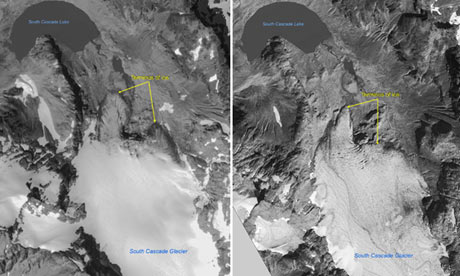
    Meltinggt glacier : South Cascade glacier, Washington state, US

    A composite image showing South Cascade glacier in Washington state (year 2000, left, 2006, right). A new study today found a sharp rise in the melt rate of three key American glaciers over the last 10-15 years. Photograph: USGS


    Climate change is melting America’s glaciers at the fastest rate in recorded history, exposing the country to higher risks of drought and rising sea levels, a US government study of glaciers said today.


    The long-running study of three “benchmark” glaciers in Alaska and Washington state by the US geological survey (USGS) indicated a sharp rise in the melt rate over the last 10 or 15 years.


    Scientists see the three – Wolverine and Gulkana in Alaska and South Cascade in Washington – as representative of thousands of other glaciers in North America.


    “The observations show that the melt rate has definitely increased over the past 10 or 15 years,” said Ed Josberger, a USGS scientist. “This certainly is a very strong indicator that climate change is occurring and its effects on glaciers are virtually worldwide.”


    The survey also found that all three glaciers had begun melting at the same higher rate – although they are in different climate regimes and some 1,500 miles apart.


    For South Cascade, the average surface loss rate grew to 1.75 to 2m a year from about 1m a year.


    USGS researchers have been measuring the three glaciers for more than 50 years, drawing on photographs and a network of stakes driven into the glaciers to gauge the accumulation of snow during winter, and the resulting melt each spring. It is the oldest such record of glacier activity.


    In a sign of the Obama administration‘s focus on climate change, this year’s survey was promoted by the interior secretary, Ken Salazar, who called it an important contribution to dealing with climate change. “This information is helpful in tackling the effects of climate change and it is exactly the kind of science we need to invest in to measure and mitigate the dangers impacts of climate change,” he said.


    Shrinking glaciers have led to a reduction in spring run-off which is intensifying the effects of drought in California and other states, especially later in the summer when other water sources dry up.


    Glacier loss has also contributed to rising sea levels, which has put low-lying coastal areas – such as New Orleans – at greater risk of storm surges.