Author: admin

  • Thin film vs. monocrystalline panels in grid connect systems

    Thin film vs. monocrystalline panels in grid connect systems


    Quite often we’re asked about the advantages of monocrystalline panels over their amorphous thin film counterparts; particularly in home solar power grid connect systems. 


    In all our grid connect packages, we only use monocrystalline panels (except in very specific circumstances) for the following reasons:


    Less roof space required


    Monocrystalline solar panels need far less surface/roof area – and roof space is very valuable real estate when it comes to solar energy related electricity production. You may have just enough roof space to deck it out in thin film panels now; but what about later if you wish to upgrade? We’ve seen instances where home owners have had to rip up all their thin film panels and sell those at a loss in order to boost the size of their solar power system.


    In the future, solar energy may also have a huge role in personal transport.  For example, Honda is working on a hydrogen car which will be powered by the sun . In this case a 4-5KW solar power system will create the energy to power a small pump station on the side of the house, creating hydrogen from water during the day which will then be available as fuel for the car. 


    With the world rapidly moving towards renewable energy sources and with developments such as Honda’s, we envision a time in the not-too-distant future where the type of solar array used; specifically the ability to scale up, will also factor into house price values.


    Don’t underestimate the value of your north facing roof area – monocrystalline solar panels are the best choice, even just on that point alone. 


    Ease of installation


    Some amorphous thin film panels actually need more mounting rails and take longer to install; adding to the overall cost of the system


    Embodied energy


    While thin film offers a lower level of embedded energy per panel, the fact that more panels are needed somewhat negates this aspect, especially given the extra mounting rails sometimes needed. Embodied energy refers to the amount of energy required to manufacture and supply a product.


    Other environmental concerns


    Some thin film solar products uses cadmium telluride (CdTe). Cadmium is a heavy metal that accumulates in plant and animal tissues. Cadmium is a ‘probable carcinogen’ in humans and animals. While cadmium telluride doesn’t pose a threat while the panel is in service, disposal of this toxic waste when the product reaches the end of its life comes at large cost and suitable facilities are not present in Australia currently


    General performance


    We’ve noticed that some companies use reports and impressive graphs on efficiency to show amorphous thin film as being superior. In most cases we’ve seen, the data is taken from the late 1990’s – it’s over 8 years old! Like any technology, solar power has rapidly evolved, and that includes the performance of monocrystalline panels.


    In most conditions in Australia, we strongly recommend monocrystalline panels; the only exceptions being far North Queensland and the Northern Territory where amorphous thin film may have some performance advantages during the hottest times of the year and given the amount of solar radiation in those areas (a separate issue to heat.).


    Durability


    Thin film is still relatively new technology whereas monocrystalline panels have been around for decades. Some monocrystalline panel installations in the 1970’s are still cranking out power today. Monocrystalline has even withstood the rigours of space travel! Amorphous thin film is yet to prove itself in harsh conditions over a long period of time.


    Flate plate vs. tempered glass


    In many grid connect packages where thin film is utilized, the panels are covered with plate glass – this is incredibly inferior to tempered glass, both from a safety and durability aspect. The type of glass used in a panel is so important – it just doesn’t pay to cut costs by cutting corners on material quality. We’ve published a full article just on this topic – plate vs tempered glass.


    Exaggerated claims of shading tolerance


    The simple fact of the matter is, no panel is shade tolerant to any great degree and it just doesn’t make sense to install an expensive solar power system in an area that experiences a great deal of shade as the system’s performance will be extremely low.


    Comparing apples to apples in grid connect


    In a addition to the above points, if you’re looking to buy a solar power grid connect system, ensure you compare similar systems in terms of price – what you are getting for your money. The difference between a 1kw system and a 1.3kw system may not sound like much, but there’s a huge difference in power output; approximately 33%.


    Adding to your system in the future


    As mentioned, our 175W and 180W monocrystalline panels are some of the best in the solar industry – proven, long lasting, produced in high quantities and will still available for years to come. If in the future you wish to increase your system or need to replace a panel for whatever reason, there will be no shortage in obtaining these products. Many manufacturers actually produce very similar panels in terms of dimensions, so that you are not tied to one particular manufacturer, but actually have a choice(see table below). 

    In the case of thin film there is no such assurance as these panels are produced in much lower quantities by a smaller number of manufacturers. You might find that you are stuck with old technology that cannot be easily upgraded

    Mono-crystalline solar module comparisons (showing similarities of panels)


    Technical Specifications 175W
    Suntech
    175W 
    Sharp
    175W
    Solarfun
    175W 
    BP Solar
    Max power Output 175 W 175 W 175 W 175 W
    Open circuit voltage-Voc 44.7 V 44.4 V 44.8 V 44.5 V
    Max operating voltage-Vmp 35.8 V 35.4 V 36.0 V 35.4 V
    Max operating current-Imp 4.9 A 4.95 A 4.86 A 4.9 A
    Operating temperature -40 0C to +850C -40 0C to +850C -40 0C to +850C 40 0C to +850C
    Max system voltage 1000 VDC 1000 VDC 1000 VDC 1000 VDC
    Cells 72 Cells
    125×125 mm
    72 Cells
    125×125 mm
    72Cells
    125×125 mm
    72  Cells
    125 x 125mm
    Dimensions 1580 x 808 x 35 mm 1575 x 826 x 46 mm 1580 x 808 45 mm 1593 x 790 x 50mm
    Weight 15.5 kg 17 kg 15 kg 15.4 kg
    Warranty on output 25 Years 25 Years 25 Years 25 Years


    So why do we sell thin film panels?


    Energy Matters does stock thin film solar panels, all good quality brands. As mentioned, we recommend amorphous thin film for North Queensland and for the Northern Territory. Flexible thin film panels are also extremely well suited to curved structures where flat panel mounting isn’t viable. Thin film is also desirable for some off grid and mobile applications as they are lightweight. Finally, we also sell them because our customers demand them, however we do point out the advantages of monocrystalline when people enquire.


    There’s a great deal of competition among suppliers of grid connect systems now given the generous government solar power rebates on offer and the decreasing price of solar technology. It’s very important that consumers shop around and check the way systems are promoted against the actual facts behind any particular type of component before making a purchase decision. Don’t be afraid to ask questions – after all, it’s a substantial investment and a decision you’ll be living with for a very long time! 


    Confused about grid connect solar power? Contact one of our friendly experts for free, no-obligation advice tailored to your specific needs on 1300 727 151 or via email

     

  • Farmers have had it: Nationals

    Premier John
    Brumby’s decision to raise the four per cent cap on water trade and the
    downturn in the dairy industry has affected the number of people trying
    to sell water, Shadow Minister for Country Water Resources and Deputy
    Leader of The Nationals Peter Walsh said today.

    Mr Walsh has questioned Goulburn-Murray Water’s (G-MW’s) logic in
    stating last week that the real measure of producers wanting to exit
    irrigation was the number of farmers selling delivery shares as well as
    water shares.

    “The number of people applying to sell their water shares in
    northern Victoria has more than doubled since the Brumby Government
    announced it would lift the cap to allow the Commonwealth Government to
    purchase water,” Mr Walsh said.

    “The fact that producers are retaining their delivery share is not an indication that all is well in the sector.

    “G-MW is misreading the dynamics of the industry in an effort to put a positive spin on the numbers.

    “Producers are keeping their delivery shares because if they choose
    to sell them they will have to pay thousands of dollars in termination
    fees to exit the system.

    “It doesn’t make sense for people to fork out that kind of money
    when there’s a strong possibility the fees could be reduced or waived
    if the delivery infrastructure is rationalised as part of the Northern
    Victorian Irrigation Renewal Project (NVIRP).

    “It’s just good business sense for food producers to retain their
    delivery share until such time as NVIRP decides whether it wants to
    rationalise their channel. Then they might not be required to pay the
    termination fees.”

    Mr Walsh said the Brumby Government had to acknowledge the
    ramifications of its decision to remove restrictions on water trade.

    “The increase in applications to permanently sell water is an
    indication that more food producers are trying to exit the industry,”
    Mr Walsh said.

    “People are selling water because they are short of cash and they’re
    keeping their delivery shares because they can’t afford to pay
    termination fees.

    “The massive increase in those wanting to sell water only goes to show the Brumby Government made the wrong decision.

    “It has undermined confidence in irrigated food production to such
    an extent that many people now feel the only way forward is out,” Mr
    Walsh said.

  • NSW town pushed to ban bottled water

    NSW town pushed to ban bottled water


    By environment reporter Shane McLeod for AM


    Bottled water for SE Qld level 5 water restrictions.

    Vote tonight: Bundanoon is pondering a ban on bottled water (ABC News: Giulio Saggin)


    A town in the New South Wales southern highlands hopes to become the first community in Australia to ban the sale of bottled water.


    Bundanoon is probably best known for its annual Scottish cultural festival. But now the town of 2,500 people hopes to make a name for itself for another canny decision.


    Bundanoon businessman Huw Kingston suggested the ban after a company applied to pump water out of a local aquifer to supply the bottled market.


    “I put a little article – ‘Does Bundanoon have the bottle to go bottled water free?’ – in our local newsletter. I guess we have gone on from there,” he said.


    The suggestion won the support of local businesses.


    They are proposing to replace plastic bottles of water on their shop shelves with reusables and then offer directions to filtered water fountains that will be installed on the main street.


    Tonight that idea will be put to local residents at a community meeting.


    Mr Kingston believes there will be widespread support.


    “I think there is an overwhelming opposition to the marketing scam that is stilled bottled water,” he said.


    Around the world other cities have taxed bottled water – in some places, local officials have been banned from using taxpayers funds to buy it.


    Environmentalist Jon Dee from activist group Do Something believes Bundanoon could be the first town to ban it entirely.


    “Huge amounts of resources are used to extract, bottle and transport that bottled water, and much of the package ends up as litter or landfill,” he said.


    “So environmentally it makes no sense and that is what we are trying to do in Bundanoon, is show that a community can live without single use bottled water.”


    Mr Dee, who was behind the campaign that saw plastic bags banned in the Tasmanian town of Coles Bay, says other towns around the country would not find it hard to follow Bundanoon’s lead.


    “If Bundanoon can ban bottled water, well many other towns and communities around Australia will also consider their usage of bottled water,” he said.


    “And at the very least, if they don’t ban it then at least they will reduce their usage of it and in doing so reduce the half a billion dollars a year that Australians are spending on bottled water and not just save money but save the environment too.”


    Mr Kingston says visitors to Bundanoon will not be set upon if they are seen sipping water from a plastic bottle.


    “We are fairly civilised people down here. Nobody is going to get lynched for carrying a bottle of prepackaged water down the main street of Bundanoon,” he said.


    But he hopes the ban will make them think twice about how they quench their thirst.


    Tags: environment, conservation, recycling-and-waste-management, water, australia, nsw, bundanoon-2578

  • Drought alert as El Nino works up double whammy

    Drought alert as El Nino works up double whammy


    Asa Wahlquist, Rural writer | July 07, 2009


    Article from:  The Australian


    EASTERN Australia is increasingly likely to be hit by the drought-inducing double whammy of an El Nino and a positive Indian Ocean Dipole.


    The Bureau of Meteorology is putting the odds of an El Nino at more than 50 per cent.


    Bureau meteorologist Andrew Watkins said there were several signs of a looming El Nino in the Pacific Ocean. “We have trade winds that are weaker than normal,” he said.


    “We have warmer than normal sea-surface temperatures; they are about one degree warmer than normal in the equatorial Pacific. The water below the surface of the ocean is up to three degrees, or even a bit more, above normal. The SOI (southern oscillation index) has been negative, as well.”


    However, there is not the cloudiness along the equatorial Pacific usually associated with El Nino events. Nor are the ocean and atmospheric systems reinforcing each other, which happens in an El Nino.


    “The climate models are pretty much in agreement there will be a continued warming,” Dr Watkins said. “Most of them are saying there will be an El Nino later in the year.” El Nino events are linked with reduced rainfall in eastern, northern and parts of southern Australia in the second half of the year, and higher daytime temperatures. The last El Nino events occurred in 2002 and 2006, when, according to the bureau, “rainfall deficiencies were widespread and severe”.


    There is also growing interest in the influence the Indian Ocean has on Australia’s rainfall.


    The Indian Ocean Dipole, like El Nino, is a coupled ocean-and-atmosphere phenomenon. When it is in its positive phase, the Indian Ocean is cooler near Australia. Dr Watkins said scientists believed that a positive IOD reduced rainfall over southeastern Australia.


    CSIRO scientist James Risbey said that although most of the models pointed to a looming El Nino, there was less consistency about the IOD.


    “The models may be leaning towards a positive IOD, but some of them have flip-flopped, which lowers our confidence,” he said.


    “And when we look at the observations, it is not classically set up for a positive IOD. We don’t see cold water where we expect it.”


    Some scientists thought the Indian Ocean was “in part a slave to the Pacific Ocean”, Dr Risbey said. “They believe the IOD is just a reflection of what the Pacific Ocean does to the Indian Ocean.”


    There have been 11 positive-IOD events since 1958. Seven of them coincided with El Ninos in 1963, 1972, 1977, 1982, 1994, 1997 and 2006. Dr Risbey said ocean temperature was critical to forecasting because it changed slowly: “Once you get an anomaly in the ocean, it tends to persist for some months.”


    In El Nino years, as was happening this year, Dr Risbey said a big pool of warm water came to the surface in the Pacific Ocean. That not only led to changes in rainfall patterns, it also pushed up global temperatures. “There is a chance we could set a record for global mean temperatures this year with the El Nino,” he said.


    Story Tools


  • Coral condemned to extinction by CO2 levels, warns Attenborough

    Coral condemned to extinction by CO2 levels, warns Attenborough


    Coral is the canary in the cage as damage can be seen most quickly, veteran naturalist tells Royal Socie 


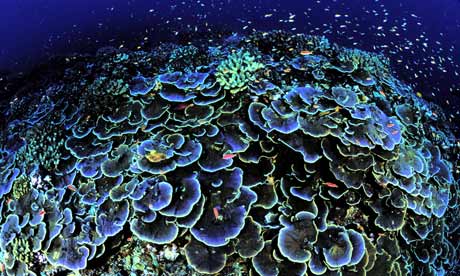
    A coral seen off Jarvis Island in the Pacific Ocean

    A coral seen off Jarvis Island in the Pacific Ocean. Photograph: Jim Maragos/AP


    David Attenborough joined scientists yesterday to warn that carbon dioxide in the atmosphere is already above the level which condemns coral reefs to extinction in the future, with catastrophic effects for the oceans and the people who depend upon them.


    Coral reefs support a quarter of all marine life including more than 4,000 species of fish. They also provide spawning, nursery, refuge and feeding areas for creatures such as lobsters, crabs, starfish and sea turtles. This makes them crucial in supporting a healthy marine ecosystem upon which more than 1bn people depend for food. Reefs also play a crucial role as natural breakwaters, protecting coastlines from storms.


    Attenborough said the world had a “moral responsibility” to save corals.


    He was speaking yesterday at the Royal Society in London, following a meeting of marine biologists. At the current rate of increase of atmospheric CO2, they said, coral would become extinct within a few decades.


    “A coral reef is the canary in the cage as far as the oceans are concerned,” said Attenborough. “They are the places where the damage is most easily and quickly seen. It is more difficult for us to see what is happening in, for example, the deep ocean or the central expanses of ocean.”


    “Anybody’s who’s had the privilege of diving on a coral reef will have seen the natural world at its most glorious, diverse and beautiful,” said Attenborough. “[There is a] moral responsibility one has to the natural world. Also you have responsibility to future generations, to your future grandchildren and great grandchildren.”


    Increasing carbon dioxide in the atmosphere has a double effect on coral. Global warming means warmer seas, which causes the corals to to bleach, where the creatures lose the symbiotic algae they need to survive. Carbon dioxide also makes seas more acidic, which means the corals find it difficult to prevent their exoskeletons from dissolving.


    “We’ve already passed a safe threshold for coral reef ecosystems in terms of climate change. We believe that a safe level for CO2 is below 350 parts per million,” said Alex Rogers of the Zoological Society of London and International Programme on the State of the Ocean, who helped organise yesterday’s meeting.


    Carbon dioxide in the atmosphere has risen from 280 ppm before the industrial revolution to around 387ppm today. Environmentalists say that any new global deal on climate must restrict the growth of CO2 levels to 450ppm, though more pessimistic scientists say that the world is heading for 550ppm or even 650ppm.


    “When we get up to and above 450ppm, that really means we’re into the realms of catastrophic destruction of coral reefs and we’ll be moving into a planetary-wide global extinction,” said Rogers.


    “The only way to get to 350ppm or below is not only to have major cuts in CO2 emissions but also to draw CO2 out of the atmosphere through measures such as geo-engineering.”


    Attenborough said the plight of the corals was another example of why the control of carbon was so important to the world’s inhabitants. “Each ecological disaster or problem traces its cause back to carbon. To quibble about this is really fiddling while Rome burns. If we do not control the emission of carbon, this world is heading for a major catastrophe and this is one of the first to be staring us straight in the face.”

  • Types of solar collectors for electric generation

    Types of solar collectors for electric generation


    Parabolic troughs, dishes and towers described in this section are used almost exclusively in solar power generating stations or for research purposes. The conversion efficiency of a solar collector is expressed as eta0 or η0.


    [edit] Parabolic trough


    Parabolic trough

    This type of collector is generally used in solar power plants. A trough-shaped parabolic reflector is used to concentrate sunlight on an insulated tube (Dewar tube) or heat pipe, placed at the focal point, containing coolant which transfers heat from the collectors to the boilers in the power station.


    [edit] Parabolic dish


    Solar Parabolic dish

    It is the most powerful type of collector which concentrates sunlight at a single, focal point, via one or more parabolic dishes — arranged in a similar fashion to a reflecting telescope focuses starlight, or a dish antenna focuses radio waves. This geometry may be used in solar furnaces and solar power plants.


    There are two key phenomena to understand in order to comprehend the design of a parabolic dish. One is that the shape of a parabola is defined such that incoming rays which are parallel to the dish’s axis will be reflected toward the focus, no matter where on the dish they arrive. The second key is that the light rays from the sun arriving at the earth’s surface are almost completely parallel. So if dish can be aligned with its axis pointing at the sun, almost all of the incoming radiation will be reflected towards the focal point of the dish — most losses are due to imperfections in the parabolic shape and imperfect reflection.


    Losses due to atmosphere between the dish and its focal point are minimal, as the dish is generally designed specifically to be small enough that this factor is insignificant on a clear, sunny day. Compare this though with some other designs, and you will see that this could be an important factor, and if the local weather is hazy, or foggy, it may reduce the efficiency of a parabolic dish significantly.


    In some power plant designs, a stirling engine coupled to a dynamo, is placed at the focus of the dish, which absorbs the heat of the incident solar radiation, and converts it into electricity. See Knowing Parabolic Concentrators and Concentrating Solar power overview


    [edit] Power tower


    Power Tower

    A power tower is a large tower surrounded by small rotating (tracking) mirrors called heliostats. These mirrors align themselves and focus sunlight on the receiver at the top of tower, collected heat is transferred to a power station below.


    [edit] Solar pyramids


    Another design is a pyramid shaped structure, which works by drawing in air, heating it with solar energy and moving it through turbines to generate electricity. Solar pyramids have been built in places like Australia. Currently India is building such pyramids.[4]


    [edit] Advantages


    • Very high temperatures reached. High temperatures are suitable for electricity generation using conventional methods like steam turbine or some direct high temperature chemical reaction.[citation needed]
    • Good efficiency. By concentrating sunlight current systems can get better efficiency than simple solar cells.
    • A larger area can be covered by using relatively inexpensive mirrors rather than using expensive solar cells.
    • Concentrated light can be redirected to a suitable location via optical fiber cable. For example illuminating buildings, like here (Hybrid Solar Lighting).


    [edit] Disadvantages


    • Concentrating systems require sun tracking to maintain Sunlight focus at the collector.
    • Inability to provide power in diffused light conditions. Solar Cells are able to provide some output even if the sky becomes a little bit cloudy, but power output from concentrating systems drop drastically in cloudy conditions as diffused light cannot be concentrated passively.