|
Web Clip
Best Cruises Latest Specials – Seabourn Cruise Line – Dalmation Coast & Greek Isles
|
Abbott’s plans for food price hikes

|
||||||||||||||||||
|
Web Clip
Best Cruises Latest Specials – Seabourn Cruise Line – Dalmation Coast & Greek Isles
|
Abbott’s plans for food price hikes
|
||||||||||||||||||
Environment
As shepherds watched, it got hotter and hotter
Date
December 24, 2014
Peter Hannam
Peter Hannam
Environment Editor, The Sydney Morning Herald
View more articles from Peter Hannam
Follow Peter on Twitter Follow Peter on Google+ Email Peter
Human health – and that of other animals and even plants – is likely to become an ever more pressing public issue as temperatures rise with global warming, cities grow and populations age.
inShare
submit to reddit
Email article
Print
Reprints & permissions
While shepherds watched: NSW gets hotter and hotter.
While shepherds watched: NSW gets hotter and hotter. Photo: Anthony Johnson
Australia’s woodlands at risk as mercury rises
If Australia’s test cricketers suffer heat stress during the Boxing Day Test in Melbourne or January’s match at the Sydney Cricket Ground, it won’t be for want of trying.
Earlier this year, in preparation for the series against Pakistan in the United Arab Emirates, players were dispatched for intensive training in Brisbane and Darwin to examine their response to heat extremes.
Summer extremes: Surfers at Bondi Beach.
Summer extremes: Surfers at Bondi Beach. Photo: Getty Images
Aside from the standard ice baths and cool drinks – Esky-chilled beverages at 4 degrees turn out to be ideal – players swallowed capsule-sized thermometers to help team dietician Michelle Cort monitor which of them struggled most to shed heat.
Advertisement
“It allowed us to keep an extra watchful eye on specific players and make sure they were doing everything they needed to do to keep the core temperature down,” Ms Cort said.
Across the summer, sports medicine will be getting a work out. In an increasingly crowded season, cricketers are vying for attention with the upcoming Asian Football Cup in addition to the regular fare of the Tour Down Under cycling, the A-League, and tennis at the Australian Open – all potentially taking place during a heatwave.
The issue of heat, though, isn’t just confined to playing fields and accompanying concrete stadiums packed with fans of the spectator variety.
The heat is on: How scientists predict Sydney’s climate will warm over the next 50 years. Graphic: Remi Bianchi, Photo: Quentin Jones
Human health – and that of other animals and even plants – is likely to become an ever more pressing public issue as temperatures rise with global warming, cities grow and populations age.
Until recently, public health authorities would issue a warning whenever the temperature was likely to exceed a certain level.
However, heatwaves are also related to the conditions people are accustomed to. To reflect that, the Bureau of Meteorology last year pioneered a heatwave service that predicts the severity of coming heatwaves based on both how far temperatures are likely to deviate from historical averages but also taking into account the previous month’s weather.
How scientists predict Sydney’s climate will warm over the next 50 years. Graphic: Remi Bianchi
In a further tweak, the bureau has added charts to assess the impact of each heatwave after it’s hit. That’s needed because people often don’t realise the damage to health can come from exposure to prolonged warmth rather than a particular temperature spike.
“If the body doesn’t have time to recover overnight, or for some period during 24 hours, that’s when significant problems start to emerge,” said Alasdair Hainsworth, assistant director of hazard prediction services at the bureau.
“We know that Australia is warming … and we believe we should provide some level of warning associated with that,” Mr Hainsworth said, adding the charts may one day be common features of weather reports.
Indeed, of the emerging signals of climate change in Australia, rising temperatures and increasing heatwaves are the probably the clearest.
For New South Wales, average maximum temperatures have already risen by half a degree over the last two decades or so. They are likely to increase by another 0.7 degrees by 2030 and as much as 2.6 degrees by 2070, according to research released by the state government and the University of NSW earlier this month.
“We know heatwaves have a big impact,” said Matthew Riley, director of climate and atmospheric science for the Office of Environment and Heritage. “They are the costliest natural disaster in terms of the loss of human life in Australia.”
While Victoria’s 2009 Black Saturday bushfires killed 174 people, at least 370 people died during the heatwave that preceded the fires – drawing much less public or media focus.
NSW Health has identified people aged over 75, infants and those taking perscription medicine that restricts perspiration as among those most at risk from heat stress.
Human physiology means that excess warmth starts to undermine health for most of us when body temperatures exceed 37.8 degrees. Similar damage is inflicted on plants when certain thresholds are crossed (see related article).
When overlaid on Australia’s famously variable climate, the existing temperature rise is also associated with heatwaves becoming more intense, more common, lasting longer, and starting earlier in spring.
Research published in August in the Journal of Climate predicts Sydney will experience as many as 42 heatwave days each summer by the end of the century, assuming greenhouse gas emissions remain at the high end of trajectories. That tally would exceed even Perth’s 40 such days and Melbourne’s 12.
“Definitely we’ll see more heatwaves and the number of heatwave days will increase,” said Sarah Perkins, a heatwave expert at UNSW’s ARC Centre of Excellence for Climate System Science and one of the report’s authors. “It’s not a good story.”
By contrast, Sydney had just three heatwave days on average 60 years ago and about six to seven now, Dr Perkins said. A heatwave is defined as having at least three days in a row with temperatures in the top 10 per cent for those days.
The government-backed study, meanwhile, generated scenarios down to 10km resolution for the first time, giving local governments greater clarity on what to expect as the climate shifts.
For now, Sydney as a whole averages fewer than 10 days of 35 degrees or warmer weather each summer. In the city’s west, residents sweat through 10 to 20 such days.
By 2030, the city can expect four more 35-plus degree days and 11 more each year by 2070, the report said.
But in the city’s west and the Hawkesbury region, the increase will be 5-10 such days by 2030 and a doubling of 10-20 more hot days by 2070.
The longer-term estimate is based on a business-as-usual emissions scenario which, if governments get serious about addressing global warming, may be too pessimistic.
On the other hand, there are reasons why the scenarios, grim as they are for heat, may be optimistic not least because they did not account for population growth.
Sydney’s population is projected to swell by 1.6 million by 2030, with most newcomers likely settle in the growth corridors in the city’s south-west and north-west .
By geography, these two areas already have furnace-like potential as demonstrated by last month’s heatwave.
Penrith set a November record maximum of 44.9 degrees – albeit in data only going back about two decades – while Richmond hit 45.3 degrees in Bureau of Meteorology records from 1939.
During a February 2011 heatwave, a Landsat satellite passed over Sydney taking infrared pictures identifying the city’s hottest spots.
Brent Jacobs, research director of the Institute of Sustainable Futures at the University of Technology, Sydney, is among those examining the heat mapping to help planners limit current and future effects of the warmth.
Dr Jacobs says developers of new housing estates usually leave little in the way of green spaces and water features that – while costly to maintain – would help counter the inevitable heat-island effects.
He is also scathing of the layout of residential roads that often loop around, ending up cul-de-sacs.
“You’re talking about an area that’s already hot,” Dr Jacobs said. “All you’re doing is creating canyons that trap in the hot air. There’s no air movement through that suburb so there’s no way for that heat to get out.”
Cricket Australia dietitian Michelle Cort, meanwhile, says people who are overweight or particularly muscular are among those who should pay special heed to warnings about heatwaves.
“The more body fat people have, the less able they are to dissipate the heat,” Ms Cort said, adding that the $100 single-use thermometer capsules will be little use for the wider public without expert monitoring.
As for the players, two provided surprising responses. NSW fast bowler Mitchell Starc proved able to dissipate heat better than his work-rate and muscle mass would imply, while Victorian all-rounder Glenn Maxwell struggled more than expected.
In the finish, the team wilted to a series thrashing to Pakistan, but managers couldn’t blame the heat.
 ,,
,,
Components of Population Change
| One birth every 8 seconds | |
| One death every 12 seconds | |
| One international migrant (net) every 33 seconds | |
| Net gain of one person every 16 seconds |
The U.S. population clock is based on a series of short-term projections for the resident population of the United States. This includes people whose usual residence is in the 50 states and the District of Columbia. These projections do not include members of the Armed Forces overseas, their dependents, or other U.S. citizens residing outside the United States.
The projections are based on a monthly series of population estimates starting with the April 1, 2010 resident population from the 2010 Census.
At the end of each year, a new series of population estimates, from the census date forward, is used to revise the postcensal estimates, including the population clock projections series. Once a series of monthly projections is completed, the daily population clock numbers are derived by interpolation. Within each calendar month, the daily numerical population change is assumed to be constant, subject to negligible differences caused by rounding.
Population estimates produced by the U.S. Census Bureau for the United States, states, counties, and cities or towns can be found on the Population Estimates web page. Future projections for the United States and states can be found on the Population Projections web page.
Source: U.S. Census Bureau, International Data Base
The Country Ranking tool provides a quick and easy method to view the most populous countries and areas of the world for any year between 1950 and 2050. The data for this tool are drawn from the International Data Base (IDB), which offers additional demographic information for each country.
“Top 10 Most Populous Countries,” projected to July 1, 2015.
To learn more about world population projections go to http://www.census.gov/population/popwnotes.html
United States data used in the IDB are based on official estimates and projections. All population estimates and projections are for the resident population. Population estimates for 2000-2012 are consistent with the 2010 Census. Population data in the IDB for 2013-2050 are based on the 2012 National Projections, Middle Series. Revised official population estimates are released each year (www.census.gov/popest), and projections are updated periodically (www.census.gov/population/projections). The official, current U.S. population estimates and projections may not match those shown in the IDB due to differences in the timing of their releases.
Coordinated Universal Time (UTC) is the equivalent of Eastern




 Send to Kindle
(Indian Ocean Observatory) – At his offices in the second floor of Kibaki Flats in Bamburi Beach on Kenya’s coastal region of Mombasa, Dr David Obura has a commanding view of the Indian Ocean.
Sounds of waves lapping on the beach, Indian crows on the nearby trees are a constant companion. The sea breeze gushes into his office providing relief from the searing heat of the Kenyan coastal region. His offices are not different from a library. Shelves stacked with marine science books and journals stacked adorn this office.
The events of 1998 are still etched in Obura’s mind as if they happened yesterday.
“Fishermen alerted us that ‘mawe ya bahari’ (stones of the sea) – as they refer to corals – had changed colour,” Obura says. “Corals had changed colour and lost their lustre. In other words they were all bleached.”
At the time Obura was working as a marine researcher at the Kiunga National Marine Park, which is in Kenya’s northern most coastal tip bordering Somalia.
Slightly more than 2000 kilometres away at Amitie, a breezy and slow-moving locale of Praslin island, which is the Seychelles’ second largest island after Mahe, the effects of coral bleaching were also experienced here.
Amitie is where the not-for-profit organisation Nature Seychelles coordinates a unique and elaborate coral reef restoration initiative. Nature Seychelles marine scientists Claude Reveret and Dr. Sarah Frias-Torres spearhead this labour intensive coral replanting exercise.
“This is our response to climate change effects,” Reveret says.
Every working day Reveret and Frias-Torres accompanied by a team of scuba divers descend into the ocean floors around Praslin and the nearby Cousin Island Special Reserve for this unique undersea gardening project.
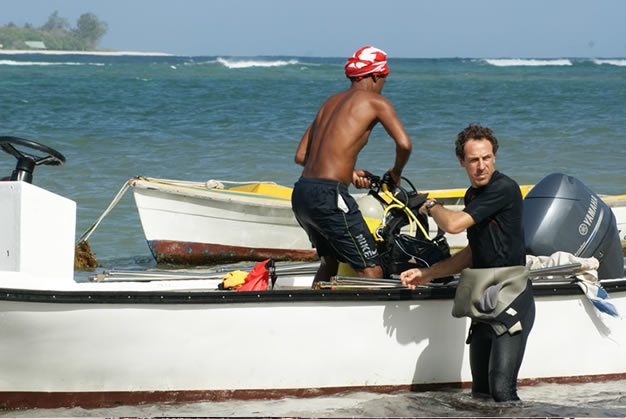 |
| Claude Reveret and a colleague preparing for the labour intensive coral replanting in Amitie beach, Seychelles. (Indian Ocean Observatory) Photo License: All Rights Reserved |
Seychelles is an archipelago of 115 islands in the middle of Indian Ocean known worldwide as a tourist destination of choice thanks largely to its scenic beaches. As a Small Island Developing State (SIDS) faced with diverse natural vulnerabilities, Seychelles conservationists are adapting fast to climate related dangers.
How was this unique undersea ‘farming’ idea conceived?
After years of listening to scientists most of whom are his colleagues warning of the dangers of coral reef destruction, Nirmal Shah, who is the Chief Executive of the Nature Seychelles, decided to confront the problem.
“For years we would be hearing about coral bleaching because that was the big thing in marine science in this region. Scientists came and presented their latest research on re-establishing coral reefs. I got tired of hearing it,” Shah says.
“I said okay folks. We know the problems as you people have been researching about it all the time. What are the solutions?” Shah remembers in one of the symposiums organized by the regional scientific body the Western Indian Ocean Marine Science Association (WIOMSA).
“There was pin drop silence in the plenary. The entire scientific community was quiet.”
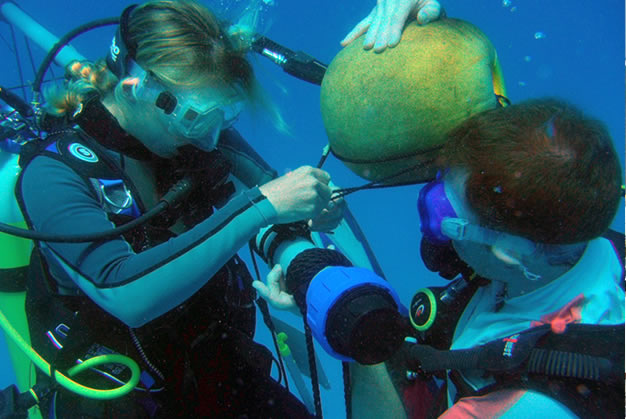 |
| The thrills of coral replanting (Nature Seychelles) Photo License: All Rights Reserved |
By advocating for a solution, Shah, who also doubles as president of WIOMSA, had dug himself into a hole of responsibility. He had to take the lead. He sought for both technical and financial support to provide a coral reef restoration solution and give meaning to his colleagues studies and findings.
“The interesting thing about coral reefs is that they grow in a desert. Tropical ocean waters are deserts. Coral reefs grow there and create an oasis of life, which benefits everyone,” Shah says.
And so four years ago Nature Seychelles received funding support from USAID totalling $500,000 to kick start the project. This was a double achievement for Shah as he managed to not only secure funding from USAID but got the US aid agency back into Seychelles after a 27-year absence. He later secured another $200,000 grant from the UNDP-administered Global Environment Facility (GEF) for the initiative, which he dubbed the “reef rescue project.”
“We started this project three years ago,” Shah says.
“We have grown corals from the scratch and in the last few months we have been involved in transplanting them from the garden nurseries to the actual restoration sites. The nursery has been a success, because we grew more corals than we expected.”
Frias-Torres explains in detail how the coral gardening which will lead to restoration process works. Initially an entire ecosystem survey was conducted all around Cousin Island to decide the exact locations of the nurseries and the translocation sites too. The other aspect that the survey identified was the type of corals to be nurtured.
According to Spanish-born Frias-Torres, who is a marine ecologist, this project came as a result of “coral bleaching which occurs when corals expel the algae living in their tissues causing the coral to turn white and lose its colourful nature and eventually fail to support fisheries and dies.”
Frias-Torres acknowledges that high water temperatures and brighter sunlight are the main climate related causes of coral bleaching. The others are human induced such as anchoring, trampling, destructive fishing practices and even pollution.
In 1998 the expansive ocean space that is Western Indian Ocean suffered immeasurable damage on its vast coral ecosystems due to El Nino which Frias-Torres explains as a Spanish term meaning “Christ’s child” that was originally used by Ecuadorian and Peruvian fishermen to describe warm ocean currents that led to less fish stocks.
“To an island nation like Seychelles the importance of coral reefs cannot be underestimated as coral reefs act as natural barriers which reduces the force of waves and end up protecting beaches, shorelines and coastal communities from erosion, sea-level rise, and destruction of properties,” Frias-Torres says.
According to the US National Oceanic and Atmospheric Administration (NOAA) the global benefit accruing from corals stands at $29.5 billion annually. Globally, around 500 million people rely on corals for food, livelihoods and even coastal defense.
“Coral reefs are one of the most sensitive ecosystems to climate change and the corals in this region have been quite disturbed,” says Tim McClanahan, a senior conservation zoologist with the Wildlife Conservation Society (WCS) based in Mombasa, Kenya.
“About 50% of them died in 1998 with the El Nino. Some have recovered but others did not.”
McClanahan, whose expertise is on coral reef preservation, has been studying western Indian Ocean corals for over a decade and explains how these undersea coral colonies are tied to the all-important human food chain.
“If reefs and fisheries were better managed they could contribute more to food security,” McClanahan says.
“Weak management is undermining their potential.”
Eight different types of corals species were chiseled from select ‘donor colonies’ within the Seychelles archipelago and used to establish the nurseries. The identification of the donor sites where the coral fragments – referred to as nubbins – were picked are those that had withstood the bleaching. The two Indian Ocean monsoon seasons also played a part in the selection of sites.
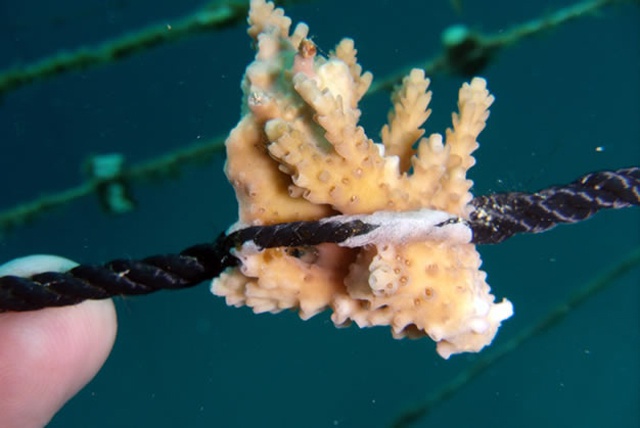
“In the coral reef gardening we have used those from the colonies that survived the El Nino taken from and tie them to nylon ropes of 20 metres each setting up our mobile nurseries. We have two types of nurseries the rope and net nurseries which make up our coral garden,” Reveret says.
“The coral gardening takes six months and some can take a year, depending on the species.”
A total of eight rope nurseries with 40,000 nubbins have been established through the labours of scuba divers and their agility to adapt to ever changing ocean currents. The nurseries are monitored and cleaned everyday with hard brushes to quicken growth rates, of course with a little help from the surgeon fish that eat the algae which stunts coral growth.
“As a rule of thumb you don’t use only one species of corals and at the same time you get those nubbins that are resilient. What we are doing is to replicate nature.” Fries-Torres says.
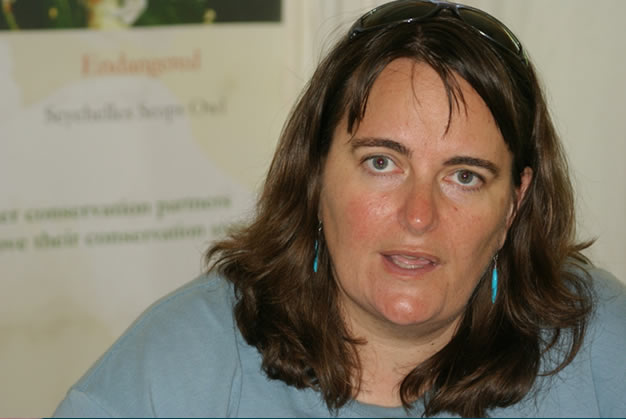 |
| Marine scientist, Dr Sarah-Frias Torres (Indian Ocean Observatory) Photo License: All Rights Reserved |
Frias-Torres further explains that many branching coral species have evolved to survive and adapt to hurricanes and typhoons and from little broken pieces they can grow new colonies.
“We are not inventing anything new, we are just using what we know about nature to restore coral reefs. It is this same basic principle that is being applied during replanting by attaching the ropes into the sea floor so that the corals can sense the sea bed and attach themselves and grow.”
Shah remembers the challenge he posed to scientists four years ago and smiles cautiously at the strides that has been made so far. Shah explains that the ‘reef rescuing’ project is much more than replicating nature but biased towards solving challenges posed by nature should other disasters occur.
“So far the results are encouraging. In the next five years we expect to see the whole ecosystem structures’ taking shape and that is when we will have full answers and directly involve the community owing to the lessons learnt,” Shah says.
“It’s a long term problem solving process with a lot of hours undersea and there are no short cuts. However it is very fulfilling to see corals growing again.”
Source: Indian Ocean Observatory
– See more at: http://www.seychellesnewsagency.com/articles/2079/Deep+sea+gardening+holds+answers+for+climate+adaptation#sthash.F2maFG2k.dpuf
|
Web Clip
|
New Year’s Resolution #1

Dear friends, The New Year is upon us – a fresh start, a blank slate, so much hope and promise…. Right now, many of us are writing or re-writing our New Year’s resolutions – maybe they include: get fit, quit coffee, learn a language, spend more time with family and friends. But this year, in addition to all these laudable things, we’re asking you to make something special the top of your New Year’s Resolutions. As we speak, there’s an addiction going on that’s far worse than any of our attachments to chocolate and coffee – it’s Australia’s toxic relationship with fossil fuels. Our beautiful country, is rapidly being pulled down by its unhealthy attachment to coal and gas — and this year we want you to make the resolution to help us break this attachment. This Valentines Day is Global Divestment Day and we’re staging an intervention. Together we’ll divest our own money and call on institutions — banks, universities, churches, councils, superannuation funds and individuals — to do the same by breaking up with fossil fuels.
(click on the image above to LIKE and SHARE on facebook) On February 13-14, we’ll hold events around Australia to up the ante on the divestment movement which is taking churches, universities, banks, super funds and local councils by storm. And we won’t be alone – as we kick the dirty fossil fuel habit, thousands of people across six continents will be doing so too! There are three ways you can take a stand and Break Up With Fossil Fuels as part of Global Divestment Day: 1. Build the Buzz Join a Global Divestment Day event near you 2. Divest yourself 3. Play it forward Start your own divestment campaign Join the chorus of voices calling for Australia and the world to end its toxic relationship with fossil fuels. This year – help us tell the fossil fuel industry that this relationship is officially over! Here’s to a happy, healthy and fossil free 2015, Charlie and the 350.org Australia team
350.org is building a global climate movement.You can connect with us on Facebook, follow us on Twitter, and become a sustaining donor to keep this movement strong and growing. |
|||||||||||