Author: Neville

  • What Santos could do to Australia’s water supply

    1 of 17
    AdDon’t buy CBA, BHP, WOWwww.moneymorning.com.au – Forget blue-chip stocks. Here’s where the big gains are in 2014

    What Santos could do to Australia’s water supply

    Inbox
    x

    Sam R – GetUp!

    5:55 PM (9 minutes ago)

    to me
    NEVILLE,

    It’s what we’ve feared all along.

    Santos’ coal seam gas project threatens the lifeblood of Australia – the Great Artesian Basin.

    News broke in The Australian today. A new report confirmed drilling from Santos’ Narribri CSG project could “stop bores flowing throughout the basin, which is the sole water source for towns and farms across 22 per cent of Australia.”1 Essentially, much of the Australia’s groundwater could stop flowing.

    It’s the worst case scenario, but the consequences would be unthinkable.

    The basin covers almost a quarter of the country, and is the only supply of fresh water for much of inland Australia. No access to water from the Great Artesian Basin means no farming. It means no cattle-grazing. It means no irrigation, no drinking water for rural communities. Without overstating it, losing water from the basin would be catastrophic.

    The stakes simply are too high to take any chances. Can you contact NSW Premier Mike Baird to immediately stop Santos’ CSG project until any threat the the Great Artesian Basin has been ruled out?

    The pressure companies like Santos can put on decision-makers is huge, and standing up to a project of this scale takes a whole lot of courage. That’s why we need to fight it together with people power. We need tens of thousands of us to stand up and be more powerful than the cashed-up mining industry could ever be.

    Ask Premier Mike Baird to protect our water, and stand up for rural Australians.

    Santos has already shown us it can’t be trusted to protect our groundwater. Earlier this year, it ran a full page newspaper ad reassuring the community it posed no danger to their water. Months later, a Santos owned CSG project was found to have contaminated an aquifer.2

    Right now, Santos has 56 test wells operating in the Narribri area. From these wells alone, they have reported 16 spills or leaks, including the one which poisoned an aquifer with heavy metals including uranium.

    It’s simple. No risk to our Great Artesian Basin is worth it. Not ever.

    Sam R, for the GetUp team

    [1] Great Artesian Coal Seam Gas Risk. The Australian. 7 November 2014
    [2] Santos coal seam gas project contaminates aquifer. The Sydney Morning Herald. 8 March 2014

  • An avalanche of support – Not Likely

    Click here to enable desktop notifications for Gmail.   Learn more  Hide
    More

    4 of 11
    AdDon’t buy CBA, BHP, WOWwww.moneymorning.com.au – Forget blue-chip stocks. Here’s where the big gains are in 2014

    “An avalanche of support?” Not likely

    Inbox
    x

    Bill Shorten via sendgrid.info 

    1:21 PM (3 hours ago)

    to me
    .

    Neville —
    “There’s been an avalanche of support for the Government’s higher education reforms”
    – Christopher Pyne, last week

    Is he dreaming?

    84,000 people who have signed our petition say no to $100,000 degrees:

    Petition.jpg


    The hundreds of thousands who have used our uni fee calculator say no to $100,000 degrees:

    Calculator.jpg


    The thousands of Labor members who funded our TV ad say no to $100,000 degrees:

    Ad-Donation.jpg


    The 6 million people who have seen our Facebook graphics learnt we’re saying no to $100,000 degrees:

    Facebook.jpg

    The 2 million people who have seen our TV ad (that you funded) learnt we’re saying no to $100,000 degrees:

    TV-Ad.jpg


    So does anyone still think there’s “an avalanche of support” for Tony Abbott’s $100,000 degrees?

    Christopher-Pyne.jpg

    Photo credit: Alex Ellinghausen / Fairfax Syndication 

    Thanks for standing with me on this,
    Bill

    PS — With the legislation still up for debate, it’s not too late to keep spreading the word. Please share NoDebtSentence.org to keep proving the Liberals wrong.

  • Drought Tech: How Solar Desalination Could Help Parched Farms

    Drought Tech: How Solar Desalination Could Help Parched Farms

    | May 9, 2014 | 4 Comments

    By Alice Daniel

    Farmers on the western side of the San Joaquin Valley can count on two things: sunshine and water that’s polluted and salty where minerals have built up in the soil. Now a Northern California entrepreneur is using one to clean up the other in the Panoche Water and Drainage District near the little town of Firebaugh, about 50 miles northwest of Fresno.

    This solar desalination plant uses curved mirrors to capture the sun's energy and separate the salt from the water. (Alice Daniel/KQED)

    It’s called a “drainage district” because farms around here have to get rid of excess salty irrigation water, explains ranch manager Wayne Western (yes, that’s his name). An elaborate system of underground drains and pumps collects the runoff. The district then recycles that water on 6,000 acres of more salt-tolerant crops.

    “These are pistachios right here, they’re 13 years old,” he says, walking through an orchard that’s getting some of the reclaimed water.

    “The district is doing this for its growers because if they didn’t, at some point you’d have to retain your own runoff water,” says Western. “If you’ve got nowhere to go with it, after awhile, you’re not going to be growing anything in that ground.”

    ‘Not in our wildest dreams did we ever think we could have revenue generated from this wastewater.’

    The residual water is laden with salts and other contaminants such as selenium, which is toxic in high concentrations. The district reuses this water not only on pistachios, he says, but also on another salt-tolerant crop, Jose tall wheatgrass.“Our whole goal here was to get rid of the wastewater,” says Dennis Falaschi, who runs the district. “Not in our wildest dreams did we ever think we could have revenue generated from this wastewater.”

    The revenue comes from selling the wheatgrass, which is used for cattle feed, and the pistachios. As it turns out, cattle need a certain amount of selenium. But there’s still the problem of the brackish runoff from these salt-tolerant crops. By 2016, environmental regulations will put a stop to dumping it into the San Joaquin River. Falaschi says finding another solution is paramount, if tricky.

    “Over the course of the last 15 years, we must have tried out 20-to-25 different treatment processes and you know, you end up spending a lot of time and a lot of hours on something that just doesn’t work,” he says.But now there’s one idea that’s starting to look a little brighter. Falaschi points to a row of curved mirrors that stretch out near a field of wheatgrass.

    “The equipment that we’re looking at here — with the exception of the solar panels — is pretty much shelf-item stuff,” he says. “I mean, you know, you’re looking at a boiler, and then you have a plumbing system that actually runs through.”

    ‘If we can treat this water, we’ve managed our drainage problem, but we’ve also created supplemental water.’

    It’s an experimental solar desalination plant, funded by the district with a million-dollar state grant. The project looks a bit like a spaceship on this vast expanse of land.“If we can treat this water, we’ve managed our drainage problem, but we’ve also created supplemental water,” says Falaschi. “That’s why we’re excited.”

    “It’s actually a lot like back when you were a kid and you would play with a magnifying glass on the sidewalk to burn things,” explains Aaron Mandell, the founder of WaterFX, which designed the solar plant. “We don’t actually burn things but it’s the same concept; you concentrate solar energy and you can generate very high temperatures.”

    An absorption pump that Mandell and his team designed reduces by half the energy it takes to evaporate water. The project also uses a reflective mirror-like film to focus the sun on long tubes containing mineral oil. The heat from the oil is piped into evaporators to generate steam.

    “So the heat that we generate from the sun basically separates water and salt,” he says. The process produces potable water which the company can then sell, along with some of the minerals distilled out, like selenium and even boron. The project is timely with California three years into a drought, but Mandell says, that wasn’t his motivation.

    ‘Even if the drought were to end right now, we would still need desalination as a more reliable source of water going forward.’

    “Even if the drought were to end right now, we would still need desalination as a more reliable source of water going forward,” he says. “Because the real problem is that the water supply in California and many of the Western states is actually no longer reliable.”WaterFX will soon build a much larger plant, this one funded by investors. It’s slated to treat about 2 million gallons a day. Mandell says it will cost about $450 to produce an acre-foot of water. That’s more than farmers here pay for surface water but about half the total operating costs of a conventional desalination plant that uses reverse osmosis.

    Dennis Falaschi says his water district will provide the 75-acre site and probably be the main customer. Farmers this year received no water from the federal Central Valley Project, so the onus, he says, is on Water FX.

    “You showed us the baby steps you can perform. Now go out and do the big steps,” says Falaschi. “And if you perform? That’s why the world goes around. I get water, you get money.”

  • No quick fix for overpopulation — let’s focus on climate

    Australia
    7 November 2014, 6.26am AEDT

    No quick fix for overpopulation — let’s focus on climate

    The rise in population since 1900 has been so rapid that up to 14% of all humans that have ever lived are still alive today, according to recent research. Other research shows that slowing population growth…

    By 2100 there could be 11 billion people on Earth, but there’s no quick way to slow growth. James Cridland/Flickr, CC BY

    The rise in population since 1900 has been so rapid that up to 14% of all humans that have ever lived are still alive today, according to recent research.

    Other research shows that slowing population growth could provide between 16% and 29% of emissions reductions necessary by 2050 to avoid the effects of dangerous climate change, concluding “reduced population growth could make a significant contribution to global emissions reductions”.

    In a previous article, we argued that a decision to have children or not could be a vital part of climate policy, perhaps through a market-based mechanism similar to emissions trading.

    But a new paper casts doubt on our ability to make any meaningful dent in population growth.

    Corey Bradshaw and Barry Brook at the University of Adelaide argue in Proceedings of the National Academy of Sciences that the even a global one-child policy, or the catastrophic death of billions of people, would not slow population growth enough to reduce carbon emissions and resource use.

    So, is it time to put market-based population control to bed?

    More kids, more carbon

    The UN forecasts that by 2100 there may be 10.9 billion people on Earth. If families, on average, have half a child more than the UN projects, population could reach 16 billion by 2100.

    If you have two children, your carbon legacy could be forty times higher than any savings you make.

    Market-based mechanisms — emissions trading schemes — are ubiquitous around the world at the national, state or region and local levels to address the climate change problem, to mitigate the effects of climate change.

    So it’s no surprise that some experts have drawn on them to solve the population problem.

    Emissions trading the policy of choice

    When it comes to mitigating the effects of climate change, the question is whether to rely on quantity-based or price-based instruments.

    A quantity-based instrument is an ETS, the most common example of which is a cap-and-trade scheme — what the former Australian Carbon Pricing Mechanism would have become this year, for instance. A price-based instrument is a carbon tax.

    An ETS is the instrument of choice around the world — for developed and developing states — to address the climate change problem. It is a market-based instrument under which limits are placed on the quantity of carbon that can be emitted.

    There are two broad, alternative types of emissions trading schemes, “cap and trade” and “baseline and credit”. The latter model is not widely used.

    Under the cap and trade model, the scheme sets a maximum quantity of emissions for a compliance period (a year, for example), across the whole sector to which the scheme applies.

    Permits are issued by the scheme administrator totalling that cap. An emitter must obtain and surrender to the scheme administrator at the end of the compliance period a permit for each unit of its emissions during the compliance period. The initial issue of permits may be allocated free of charge or auctioned.

    Cap and trade schemes exist, in one form or another, and in various stages in the European Union, India, China, Kazakhstan, South Korea (next year), New Zealand, California, Quebec (which links with the California ETS) nine US northeastern and mid-Atlantic states (the Regional Greenhouse Gas Initiative), and Tokyo.

    An emissions trading scheme is the global climate change policy of choice.

    Procreation permits?

    There’s not much these days that money can’t buy. We live in a time when almost everything can be bought and sold.

    As Michael Sandel, a professor of politics at Harvard University, notes: “the logic of buying and selling no longer applies to material goods alone. It increasingly governs the whole of life”.

    You could argue that we live in a society where everything is up for sale.

    Recently, New York Times reporter Andrew Revkin asked if it is far fetched for individuals to be compensated for having fewer or no children.

    At a Wilson Center discussion in 2009, Revkin wondered whether the next step, in a world enamoured with carbon markets, would be carbon credits for avoided children:

    Should you get credit — if we’re going to become carbon-centric — for having a one-child family when you could have had two or three? And obviously it’s just a thought experiment, but…

    A thought experiment

    Market-based population control is a thought experiment with its origins with the economist Kenneth Boulding in 1964.

    Boulding proposed a system of marketable procreation licenses as a way of dealing with overpopulation:

    I think … that a system of marketable licenses to have children is the only one which will combine the minimum of social control necessary to the solution to this problem with a maximum of individual liberty and ethical choice. Each girl on approaching maturity would be presented with a certificate which will entitle its owner to have a certain number of children.

    Boulding suggested that a market would then be set up in these units “in which the rich … would purchase them from the poor, the mums, the maiden aunts, and so on”. Others assessed Boulding’s proposal and proposed amendments.

    The Boulding proposal was revived by two Belgian academics in 2006. They pointed out that, since the rich would likely buy procreation licenses from the poor, their scheme would have the further advantage of reducing inequality by giving the poor a new source of income.

    And in 2007, Perth-based medical academic Barry Walters proposed a “baby levy” in the form of a carbon tax in line with the “polluter pays” principle. Every family choosing to have more than a defined number of children should be charged a carbon tax that would fund the planting of enough trees to offset the carbon cost generated by a new human being.

    Sandel argued, however, in light of such proposals, that notwithstanding an argument that a market in children (or in the right to have them) might be efficient, “trafficking in the right to procreate promotes a mercenary attitude toward children that corrupts parenthood”.

    Is population control the solution?

    But all of this may be irrelevant in light of the important research conducted by Bradshaw and Brook. Their research shows that:

    No matter what levers you pull, we have such a huge demographic momentum, there’s no way we can rein in the human population fast enough to address sustainability issues in the next century.

    Population growth trends for the rest of the 21st Century are “virtually locked-in” unless there are “extreme and rapid reductions in female fertility”.

    Even a global one-child policy and the catastrophic death of several billion people, they argued, would not materially affect CO2 emissions and resource use; the result would still be 5 to 10 billion people by 2100.

    The authors of the research ultimately conclude that “there are no easy ways to change the broad trends of human population size this century”.

    So, while market-based population control might encourage people to have fewer children, when it comes to addressing the twin problems of climate change and overpopulation it may be better to simply concentrate our trading schemes on climate change.

  • 210.000 Victorians out of work

    Click here to enable desktop notifications for Gmail.   Learn more  Hide
    More

    1 of 12
    AdANZBalance Transfer Offer – 0% p.a for the first 16 months on balance transfers. T&Cs, fees & charges apply.

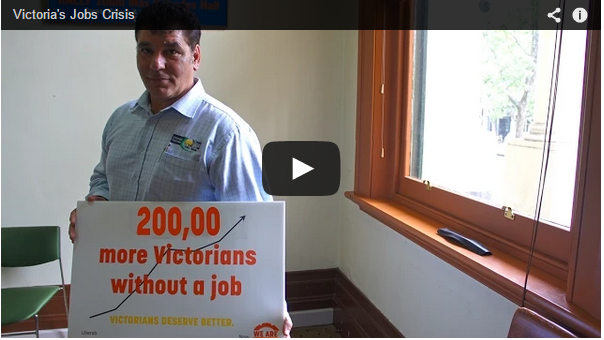
    210,000 Victorians out of work

    Inbox
    x

    Luke Hilakari via sendgrid.info 

    6:08 PM (7 minutes ago)

    to me
    Dear NevilleToday, the ABS released new statistics showing that 210,000 Victorians are unemployed. We haven’t seen that many people unable to find a job since 1996.

    This is Billy Hassan. He has a good job at Bluescope steel – but because of the Napthine Government’s decisions, hundreds of steelmakers are losing their jobs.

    billy_vid.png

    Can you share Billy’s story?

    210,000 Victorians are now without a job. Let’s make Premier Napthine number 210,001.

    See more stories to share

    In unity,

    Luke Hilakari

    http://www.weareunion.org.au/

    Victorian Unions · 54 Victoria St, Carlton, VIC 3053, Australia
    This email was sent to nevilleg729@gmail.com To unsubscribe, click here. http://www.weareunion.org.au/
  • Renew Economy Daily Update

    7 of 100
    AdSolar Panels Newcastlewww.electroysolar.com.au/newcastle – Electroy Solar are in your area! Free assesment and solar quote

    Daily update: Big Coal takes control of the US Congress

    Trash
    x

    Renew Economy editor@reneweconomy.com.au via mail141.us4.mcsv.net Unsubscribe

    3:33 PM (1 hour ago)

    to me
    Big coal takes control of US Congress; Moree Solar construction begins; More evidence energy storage is a big deal; Community renewables in spotlight in UK with new govt initiative; Farmer send solar message to G20; Blackouts dent big coal’s sales pitch in South Africa; World’s largest merchant solar project goes online; 4 Trends shaping the US solar-storage market; The tiny house movement is here; and Scotland’s renewable sector generated over 100% of residential needs in Oct.
    Is this email not displaying correctly?
    View it in your browser.
    RenewEconomy Daily News
    The Parkinson Report
    On Tuesday night in the US, Republicans – and particularly those who reject climate science and despite renewable energy, won big in the US Congressional elections.
    Ground broken at northern NSW site of the 70MW Moree Solar PV tracking plant, as construction of one of Australia’s biggest solar projects begins.
    Stem to provide 85MW energy storage for LA households, Hanwha QCELLS-Samsung SDI deal helps German households self-consume, US CSP project revisits storage.
    New govt initiative requires renewables developers to offer project stake to local community groups. Another allows locals to buy shares in new wind, solar, hydro projects for just £5.
    Queensland farmer uses ploughs giant solar message for G20 into landscape, as Ricky Muir pledges continued support for 41,000GWh renewable target.
    The collapse of a coal storage silo at a major power station in South Africa last Saturday has crippled the credibility of the government-owned utility Eskom. And the case for coal.
    Recent Al Qaeda threat to disrupt Australian fuel supplies is fuel for thoughtful action on an issue of national importance. EVs may be the answer.
    Project Salvador is largest solar PV plant to rely only on spot market for electricity, underlining solar’s ability to compete without subsidies in certain markets.
    Energy storage is expensive but offers a host of opportunities, both in revenue generation and cost reduction. Paired with solar, storage is even more attractive.
    Australian houses are also among the largest in the OECD, but is bigger really better?
    The Scottish renewable energy sector is one of the world’s best performing.