Author: Neville

  • Geology.com News – 12 Topics

    1 of 3
    Why this ad?
    CEC Callaghan Electricalwww.cecontractors.com.au – Our Focus is Safety & Excellence Domestic, Comercial & Industrial

    Geology.com News – 12 Topics

    Inbox
    x

    Geology News fb@geology.com via google.com

    7:01 PM (30 minutes ago)

    to me

    Geology.com News – 12 Topics

    Link to Geology News

    The Status of Landslide Mapping in the USA?

    Posted: 13 Apr 2014 05:29 AM PDT

    An article on CNBC website explores some of the challenges of producing landslide hazard maps for the United States.

    Slow-Moving Landslide in Wyoming

    Posted: 13 Apr 2014 05:28 AM PDT

    A slow-moving landslide in Jackson, Wyoming has prompted the evacuation of numerous homes and shut down a Walgreens store.

    Related: Landslide incidence map

    Watching the Total Lunar Eclipse

    Posted: 13 Apr 2014 05:23 AM PDT

    National Geographic has an article that explains how to watch the total lunar eclipse that will occur overnight on April 14-15.

    Possible Exomoon Found

    Posted: 13 Apr 2014 05:11 AM PDT

    NASA-funded researchers have spotted the first signs of an “exomoon,” and though they say it’s impossible to confirm its presence, the finding is a tantalizing first step toward locating others. The discovery was made by watching a chance encounter of objects in our galaxy, which can be witnessed only once.

    LED Bulb Prices and Efficiency

    Posted: 13 Apr 2014 05:05 AM PDT

    The Energy Information Administration shows that the efficiency of LED light bulbs is increasing as prices are rapidly falling.

    Bottled Water: A Geological Product?

    Posted: 13 Apr 2014 04:57 AM PDT

    Although much of the bottled water sold in stores is nothing more than expensive tap water, some of it is actually a geological product such as: mineral water, ground water, artesian water, spring water, sparkling water…

    South Korea Energy Report

    Posted: 13 Apr 2014 04:55 AM PDT

    “South Korea relies on imports to meet about 97% of its energy demand as a result of insufficient domestic resources, and the country is one of the world’s leading energy importers.” Quoted from the Energy Information Administration report.

    California Snow Pack is Low and Why That’s a Problem

    Posted: 13 Apr 2014 04:54 AM PDT

    California already has drought problems, but mountain snowpacks in the state are really low this spring and that will prevent reservoirs from filling. Since melting snowpack is a major contributor to California’s water there will likely be more water shortages this summer unless more rail falls.

    First Geothermal Plant in New Mexico

    Posted: 13 Apr 2014 04:51 AM PDT

    KOB4 has a short report on Lightning Dock Geothermal, the first geothermal plant to open in the state of New Mexico.

    A Scientist’s Life

    Posted: 13 Apr 2014 04:43 AM PDT

    Scripps Institution of Oceanography features Lihini Aluwihare: “In my field I’m called an organic geochemist. In a very basic sense, I’m using molecules to tell a story about the processes on Earth that involve organisms. If you think about the number of different molecules that are on Earth most of them are organic, meaning they were made by organisms. My interest lies in trying to understand those molecules and what their structure tells us about the processes that have acted on them.”

    Future of the Haynesville Shale?

    Posted: 13 Apr 2014 04:35 AM PDT

    Natural gas drilling activity in the Haynesville Shale was booming in 2010 but has fallen significantly since then. The fall occurred as natural gas prices fell from $12 down to $2. Companies started drilling there with a high income assumption. After the price fall, drillers could make more money drilling liquid and oil-rich plays because the revenue there was greater. They Haynesville still holds lots of gas and drilling will increase when prices increase.

    Made to Outlast the Geologist

    Posted: 13 Apr 2014 04:25 AM PDT

    Many people say that Gfeller leather field equipment is “made to outlast the geologist”. They make field belts, hammer carriers, field cases, field brief cases, lanyards, Brunton cases, acid bottle cases and more.

  • Climate change communication: Key psychological research findings (and why you haven’t heard about them yet) (2)

    14 April 2014

    Climate change communication: Key psychological research findings (and why you haven’t heard about them yet) (2)

    Research has identified a number of psychological barriers that can prevent people from believing in or acting on messages about climate change. Luckily, it has also suggested strategies for overcoming these barriers. Second of a two-part report by Paul Connor.

    Second of 2 parts | Part 1

    5. Some messages can get through to conservatives! Sort of…

    One of the most common analyses one hears about the social psychology of climate change is that the issue has become increasingly politicised over the last decade. More and more, it is said, people are making up their minds on the issue according to their political allegiance, and not by an objective assessment of the facts. And certainly, there has been an observable trend for opinions on the issue to increasingly diverge across political and ideological lines.
     But even with this increasing polarisation, the party line split in climate change attitudes is not absolute. In both Australia and the US, research shows that around one in four conservative voters still accepts the basic tenets of climate change science that climate change is happening and that it is due to human activities. And there is some pretty good research out there that suggests tailoring your climate change messages in the right way can increase their appeal to conservative audiences.

    In their 2010 paper entitled ‘System Justification, the Denial of Global Warming, and the Possibility of ”System-Sanctioned Change”’, Irina Feygina of New York University and colleagues explored the connection between attitudes towards environmental issues and a constellation of beliefs known as ‘system justification’. System justification is the tendency in some individuals to defend society’s status quo and see the way things are as right and just. It is strongly related to conservative political attitudes, and is thought to stem from a psychological need for order, structure, and security.

    Feygina and colleagues began by using large samples of undergrad students (340 in the first study and 563 in the second) to compile correlational data regarding system justification and environmental attitudes. Oddly, given their paper’s title, they did not look specifically at climate change denial, but focused more broadly on denial of environmental issues in general, which they measured by asking participants how much they agreed with statements such as “The so-called “ecological crisis” facing humankind has been greatly exaggerated”.

    In both experiments, they found system justification and environmental denial to be strongly related. In fact, in the second study, they found that the extent to which people reported holding system justifying beliefs largely (but not totally) explained the connection between people’s political orientation and their denial of environmental problems.

    Feygina and colleagues’ third study was experimental. First, they presented 41 undergrads with a generic message about research into the environment. E.g., “Today, researchers are especially interested in the relationship between people and the environment”. They then presented some of the participants with what they called a ‘system-sanctioned’ message designed to make pro-environmental behaviour more appealing to system justifiers. It read: “Being pro-environmental allows us to protect and preserve the American way of life. It is patriotic to conserve the country’s natural resources”. The participants’ then answered questions regarding their intentions to act pro-environmentally, and also about their system-justifying beliefs. Finally, the participants were given the option of signing a number of pro-environmental petitions.

    The results showed that overall, there was no significant difference between the ‘system sanctioned’ message and the normal message in promoting pro-environmental intentions and behaviours.  However, the results showed that among people high in system justification, the system sanctioned message was significantly more effective. The authors concluded that “…reframing environmentalism as supporting (rather than undermining) the American way or life eliminates the negative effect of system justification on pro-environmental behavior”.

    The effect of the normal and ‘system-sanctioned’ (or system-preservation’) environmental messages over the pro-environmental intentions of low and high system justifiers in Feygina and colleagues’ results. While the system justifying message (the bold black line) was more effective for high system justifiers, the normal message (the dotted line) was more effective among low system-justifiers.

    Another study that explored ways of reframing environmental messages for a conservative audience was the 2012 study by Paul Bain from the University of Queensland and colleagues entitled “Promoting pro-environment action in climate change deniers”. Bain and colleagues were interested in whether climate change sceptics could perhaps be sold on climate change action by its possible co-benefits in addition to mitigating climate change.

    To start, they recruited 155 people “from the general public” who either did not believe climate change was happening or believed it was not human caused. These people were then asked to imagine a future society where substantial action had been taken to combat climate change. After this, they were asked to rate how different that future society would be from today in terms of a number of different characteristics. These included the interpersonal warmth of the society, its societal competence, and its societal development (which involves, for example, scientific or technological advancement). They were then asked about their intentions towards performing ‘environmental citizenship’ actions. These included actions like donating to environmental groups, signing pro-environmental petitions, and voting for political candidates because of their environmental credentials. Results showed that overall, the sceptics were more likely to report higher environmental citizenship intentions when they thought that that acting on climate change would create a more interpersonally warm society, and also when they thought that it would enhance societal development.

    Following on from this finding, Bain and colleagues tested whether messages aimed at promoting such co-benefits of climate change action might prove effective among climate skeptics. To do so, they recruited another 347 people from the public, including 128 skeptics, who read one of three ‘personal testimonials’ relating different reasons for supporting action on climate change. One of the testimonials suggested climate change action would create a more interpersonally warm society (e.g. “I think it’d make us more considerate in other ways – like looking out for each other, and caring for people in the community”), one suggested that climate change action would promote societal development (e.g. “Taking action to reduce energy pollution would lead to new scientific breakthroughs and new industries”), and one suggested that climate change action would prevent environmental destruction (e.g. ““We’d be less affected by food and water shortages”). As expected, the results showed that the testimonials promoting the co-benefits of climate change action produced higher levels of environmental citizenship among the sceptics than the testimonial that focused on environmental destruction. What’s more, these co-benefits testimonials were also more effective in producing environmental citizenship intentions among the climate change believers (though this effect did not reach a statistically significant level).
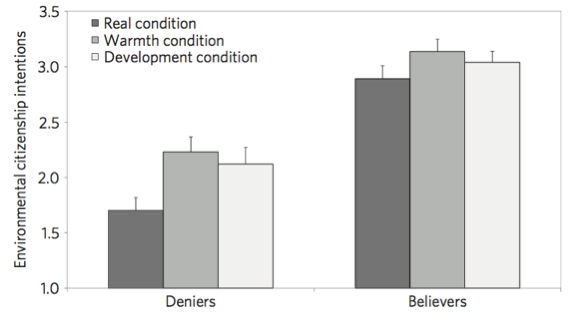
    The effectiveness of different climate change ‘personal testimonials’ in Bain and colleagues’ study. Among climate sceptics (on the left) the message focused on societal warmth and societal development were significantly more effective than the message focused on environmental damage. Among believers (o the right) the same pattern of results was observed, but did not reach significance.

    One slight caveat to these results should, however, be mentioned. In Bain and colleagues’ study, the co-benefits testimonials included an introductory statement that indicating an agnostic position towards climate science (“People like Al Gore say that reducing carbon emissions will stop the planet heating up, and most scientists seem to think that. But then there’s other scientists who think that’s not true”). Yet in the environmental destruction testimonial, the introductory statement expressed a more dogmatic position regarding climate science (“People like Al Gore say that reducing carbon emissions will stop the planet heating up, and most scientists seem to think that. I think that because there is general consensus among scientists we have to accept that climate change is real”). This, then, created another confounding variable. It may be that it was not the discussions of the co-benefits that caused their testimonials to be more effective among sceptics. Instead, this may have related to their agnosticism regarding climate science being perceived as less alienating among the sceptics.

    Despite this quibble, however, both these studies indicate that climate activists need not necessarily give up on conservative-minded individuals. Instead, they indicate that there is room for tailored messaging towards conservative audiences, which keeps in mind the arguments that will appeal to more conservative mindsets, and remembers that even climate skeptics can sometimes see non-environmental benefits in climate change action.

    5. Emphasise the scientific consensus!

    Another message that seems to be important for winning support for climate change policies is that of the consensus among climate scienists. 97% of climate scientists agree with the consensus position that the planet is warming and we are causing it, yet studies have shown that people generally misunderstand this to a surprising degree.

    A 2011 study by Ding Ding of the University of California San Diego and colleagues entitled ‘Support for climate policy and societal action are linked to perceptions about scientific agreement’ examined this phenomenon. The study asked 751 US participants to report their perceptions of the scientific consensus regarding climate change, their own beliefs regarding climate change, and their support for climate change policies.

    The results showed that there was both a huge misunderstanding of the scientific consensus, with 66% of the respondents classified as ‘consensus not understood’. These were people who agreed with one of the following statements: ‘there is a lot of disagreement among scientists about whether or not global warming is happening’ (45%), ‘most scientists think that global warming is not happening’ (5%) or they ‘do not know enough to say’ (16%). The results also showed that there was a strong correlation between people’s perceptions of the scientific consensus around climate change and their support for climate change policies. In fact, people’s perceptions of the scientific consensus were shown to explain nearly 60% of the variance in their support for climate policies (explaining variance basically means how well one thing can be predicted from another, in this case how well we can predict people’s support or climate policies if we just know about their perception of the scientific consensus).

    The authors also performed a mediation analysis. This basically involves checking if your data matches a particular theory about one variable having an effect over another variable via a third mediating variable (For example, the correlation between owning drums and being disliked by neighbours is very likely mediated by a third variable – the overall amount of drums played). They proposed that people’s perceptions of the consensus were affecting the degree to which they held certain key beliefs about climate change (including whether climate change is happening and whether it is human caused), which was in turn affecting their support for climate change policies. Their data supported this theory (though keep in mind this data is correlational!).

    Extending upon Ding and colleague’s findings, Stephan Lewandowsky of the University of Bristol and colleagues sought to experimentally investigate the effects of scientific consensus information in their 2012 paper entitled ‘The pivotal role of perceived scientific consensus in acceptance of science’. Surveying people recruited from the street (in Perth I believe, though I’m not sure), they first asked people how many out of 100 climate scientists they believed endorsed the belief that climate change is happening and caused by humans. They then provided information about the 97% scientific consensus to half of these people via a short text and graphs (the other half received a ‘neutral’ message about climate change – I do not know what that was though!), and following this asked people about a number of key beliefs about climate change. Finally, they asked participants about how much they endorsed free market capitalism, a view previously shown to be related to lower belief in climate change.
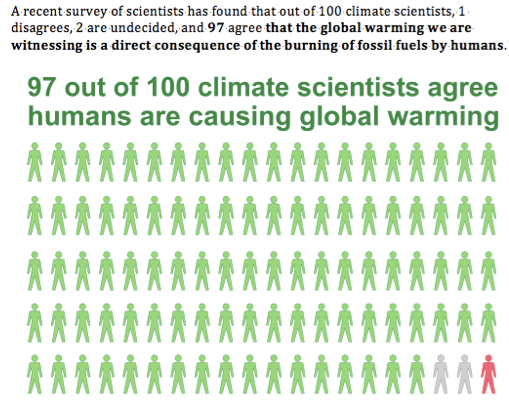
    An example of ‘consensus information’ being used in climate communication research, Please note that this was provided by another researcher, not Stephen Lewandowsky, but that it has been used and has achieved equivalent effects to the results discussed from Lewandowsky and colleagues.

    Like Ding and colleagues’ study, results showed that people vastly underestimated the consensus among climate scientists, with the average guess having 67% of climate scientists accepting the consensus position. Yet providing people with consensus information had a large effect. The group that received the consensus information showed significantly higher belief in climate change than the group not provided the consensus information, and the difference between the two groups was of a size rarely seen in research of this kind. In addition, among the group who did not receive the consensus information, endorsement of free market capitalism was related with lower belief in climate change. Yet crucially, among the people who received the consensus information, there was no significant relationship between endorsement of free market capitalism and belief in climate change. The authors concluded that “the role of ideology was drastically attenuated when participants were provided with information about the scientific consensus”.
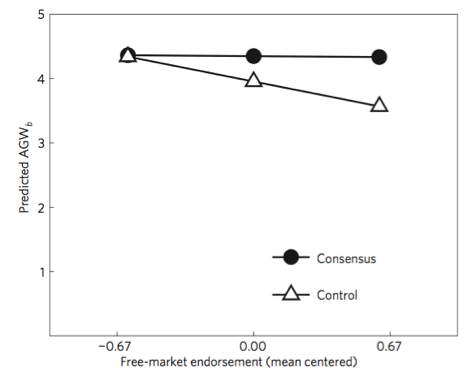
    Results from Lewandowsky and colleagues’ 2012 study. While in the control condition higher free market beliefs were associated with lower belief in climate change (AGW), when consensus information was provided this association was absent.

    While Lewandowsky only examined the effects of consensus information on climate beliefs and not on behavioural intentions or policy support, he and others (including John Cook of the University of Queensland and hopefully myself!) are continuing to perform research on the effects of consensus information. And given the previously established links between climate beliefs, behaviour and policy support, it is likely that this work will again show strong effects of consensus information. So although it is early days, these results certainly seem important. My advice, then, is to provide consensus information whenever possible, and  watch this space! 
    7. Make people feel good about themselves.

    The last study I want to discuss is the 2010 paper by Paul Sparks and colleagues from the University of Sussex entitled ‘Pro-environmental actions, climate change,
and defensiveness: Do self-affirmations make a difference to people’s motives and beliefs about making a difference?’. It’s a nice paper. Not only is it solid scientifically, but I also think it says something pretty poignant about individuals need to be approached by change makers.

    Sparks and colleagues were interested in investigating the effect of ‘self-affirmation’ on climate change denial and motivations towards pro-environmental behaviours. The theory behind self-affirmation is basically about how we protect out concept of our self. It suggests that when we feel more sure of ourselves and confident of our own self-image, we are generally more open to receiving new information, and react less defensively to information that is threatening or upsetting in some way.

    In Sparks and colleagues’ first experiment, 125 undergrad students were asked to complete either a self-affirmation exercise or a non self-affirming questionnaire about themselves. The self-affirming exercise, designed to strengthen the participants’ perceptions of themselves as being kind, asked the participants to list instances when they had behaved kindly or compassionately towards others. The non self-affirming questionnaire simply asked neutral questions about the participants, such their favourite flavour of ice cream. Following this, all participants were presented with a number of real life climate change communications chosen by the researchers for their ‘threatening’ nature. One was taken from the Guardian newspaper, one from a book by George Monbiot, and one was this gloomy missive from James Lovelock: “Why are we so slow . . . to see the great peril that faces us and civilization? What stops us from realizing that the fever of global heating is real and deadly and might already have moved outside our and the Earth’s control?”. After reading these messages, the participants were asked about their beliefs regarding climate change.

    Results showed that the participants who had completed the self-affirmation exercise reported lower levels of denial regarding climate change than non-affirmed participants. Interestingly, this ‘denial’ was mainly due to what the researchers called ‘denial of self involvement’, measured by participants’ agreement with statements such as “My own personal impact upon climate change is insignificant”. While the affirmed participants also reported lower levels of ‘denial of outcome severity’, which was measured by their agreement with statements such as “The threat of climate change has been exaggerated”, this difference was not quite statistically significant.

    Sparks and colleagues then used another 90 undergrads to investigat whether self-affirmation would also affect people’s reactions to messages encouraging pro-environmental behaviours such as recycling. This time, their self-affirmed group simply chose a particular value from a list (e.g. kindness, forgiveness, altruism) that they felt was most important to them, while the non-affirmed group did nothing. Following this, information was presented to all the participants about the risks of not recycling, and attitudes and intentions towards recycling were measured.

    The results again showed that the affirmation exercise made a difference. Among people who had previously been relatively low in recycling behaviours, the self-affirmation produced significantly higher intentions to recycle in the future. The researchers concluded that “…both studies point to the success of manipulations of self-affirmation and point to further avenues where self-affirmation theory may be potentially applied to the psychology of environmental issues”.

    It appears, then, that when people feel more secure and confident about who they are and the values they hold, they are more open to potentially threatening climate change and environmental messages, and also potentially more open to changing their behaviour. Again, when I read this finding I was reminded of an activist I had once seen intuitively applying it in her work. Speaking on television about the need to move away from fossil fuels such as coal, she prefaced everything she said by praising the hard working and self-sacrificing coal communities that had so reliably toiled to provide energy for our society for the past century. Given the threatening nature of her message for those communities, such an affirmation of their worth and moral integrity was no doubt a wise strategy.

    I have to say, I do find it kind of amazing that asking someone to list a few occasions they have been kind or choose a value that is important to them could have an effect over their reactions to climate change messages or their intentions to recycle. Yet it did. And this, I suppose, is yet another reminder of a common theme that runs through much of the research discussed here – climate change can simply be confronting to a lot of different people in a lot of different ways. Whether through threatening just world beliefs, through threatening system justification beliefs, through making people feel disempowered, or through threatening people’s sense of self, there are just a lot of ways that people can and will find messages about climate change psychologically aversive. And this is obviously a major challenge for both the activists and social psychologists working in the area. But as I hope I have shown, there are some ways of using evidence-based knowledge regarding these challenges in order to more ably navigate them.

    References

    Bain, P. G., Hornsey, M. J., Bongiorno, R., & Jeffries, C. (2012a). Promoting pro-environmental action in climate change deniers. Nature Climate Change, 2, 600-603.
    Ding, D., Maibach, E. W., Zhao, X., Roser-Renouf, R., & Leiserowitx, A. (2011). Support for climate policy and societal action are linked to perceptions about scientific agreement. Nature Climate Change, 1, 462-466.
    Feygina, I., Jost, J. T., & Goldsmith, R. E. (2010). System justification, the denial of global warming, and the possibility of “system- sanctioned change.” Personality and Social Psychology Bulletin, 36(3), 326–338.
    Lewandowsky, S., Gignac, G. E., & Vaughan, S. (2013). The pivotal role of perceived scientific consensus in acceptance of science. Nature Climate Change, 3, 399=404.
    Sparks, P., Jessop, D. C., Chapman, J., & Holmes, K. (2010). Pro-environmental actions, climate change, and defensiveness: Do self-affirmations make a difference to people’s motives and beliefs about making a difference? British     Journal of Social Psychology, 49, 553-568.

    Paul Connor is a climate change campaigner and social psychological researcher at

  • If Abbott Succeeds in Slashing the Renewable Energy Target, What Will it Cost Aussie Homeowners and Business Owners Considering Solar?

    abbott infront of solar panels

    If Abbott Succeeds in Slashing the Renewable Energy Target, What Will it Cost Aussie Homeowners and Business Owners Considering Solar?

    Prime Minister Tony Abbott is making solar advocates (like me!) both nervous and angry.

    His recent “signals” leave little doubt that, after years of progress, the Abbott government may be the first administration to slash Australia’s Renewable Energy Target (RET).

    Abbott believes Australia should be an “affordable energy superpower”.

    But traditional fossil fuel generators like Origin Energy and AGL are finding it harder and harder to stay “affordable” these days.

    You may have noticed that in your recent electricity bill if you’re not a solar power owner.

    So Abbott, unwilling to blame big energy, is looking around for someone to blame. And he’s found an easy, if mistaken, scapegoat in renewable energy…

    “…We’ve got to accept though that in the changed circumstances of today the renewable energy target is causing pretty significant price pressure in the system and we ought to be an affordable energy superpower “

    The truth, as most Australian (and German and Chinese) citizens know, is that the days of affordable fossil fuel energy is over and slashing the RET isn’t going to bring them back.

    But energy politics aside, this raises a question for any homeowner or small business owner considering a solar power installation…

    If Abbott Follows Through with his Anti-Renewables Crusade and Slashes the Renewable Energy Target How Much Could It Cost Me?

    Around $3,000 maybe much more.

    Here’s how…

    To hit the renewable energy target, big energy producers like Origin and AGL have a couple of choices:

    1. produce a certain amount of renewable energy

    or

    2. buy “certificates” from those who do.

    When an average home owner installs a solar system, the government gives that home owner certificates he or she can sell to these big energy producers.

    Of course, normally, the solar power installer will “buy” these certificates from the home owner (in the form of a discount off the price of the system) and then sell them to the big energy producers themselves.

    But the bottom line is, that if the renewable energy target goes away, the market for the certificates goes away.

    And for the average homeowner that could mean an increase in the price of a 5kW solar system of approx $3000.00.

    What should the home owner or small business owner considering solar power do?

    Get 3 Quotes for solar whilst the financial incentives are still available >>


    For more information on solar power costs, incentives and plans, you might like…

    This detailed description of how the RET and the STC incentive works

    A Solar Power Cost Calculator that includes all the factors I can think of affecting a solar purchase.

    Picture Credit http://www.flickr.com/photos/mystifyme07/ (background modified)

  • ADVANCES IN ENERGY EFFICIENCY AND RESOURCES CREATE A UNIQUE OPPORTUNITY FOR SMART LONG-TERM INVESTMENTS THAT MAXIMIZE THE BENEFITS OF AN INTEGRATED ENERGY MIX

    ENERGY

    ADVANCES IN ENERGY EFFICIENCY
    AND RESOURCES CREATE A UNIQUE
    OPPORTUNITY FOR SMART LONG-TERM
    INVESTMENTS THAT MAXIMIZE
    THE BENEFITS OF AN INTEGRATED
    ENERGY MIX

    Changes in the global energy landscape — including shifting demand-side dynamics, increased production from shale oil and gas in North America, and advances in technology — are providing significant opportunities for investment while also driving sustainable economic growth, enhanced competitiveness and responsible development of energy resources.

    THE SHALE OIL AND GAS REVOLUTION WILL CONTRIBUTE TO NORTH AMERICAN ENERGY INDEPENDENCE — AND OFFERS NEW OPPORTUNITIES FOR COORDINATION AND GROWTH

    GLOBAL INVESTMENT RESEARCH

    With the production of shale gas increasing dramatically, and oil production rapidly rising, the macro effects of the shale revolution are being felt around the world. The most dramatic impact is the gradual loosening of oil price constraints that have persistently threatened economic expansion in developed economies. According to Goldman Sachs research, the ability of shale to drive a resurgence of energy production in North America is creating powerful economic benefits. The revolution will contribute structurally to a more stable oil market, in which global demand can rise without placing the same upward pressure on energy prices. Other likely outcomes include an end to the drag energy prices can place on household incomes, improvement in the U.S. trade balance by 1.2 percent of GDP by 2017, and strengthening of the U.S. dollar by 5 –10 percent, according to Goldman Sachs research.

    BRIDGING THE DIVIDE

    INVESTMENT IS NOW CRUCIAL TO TURNING ENERGY PROMISE INTO REALITY

    Jeff Currie speaks about the shale revolution and the path to balancing supply and demand.

    According to Jeff Currie, global head of Commodities Research in the Global Investment Research Division at Goldman Sachs, a crucial task is “coupling the rapid advances in energy supply with investments that enable society to benefit, whether in manufacturing, transportation or the generation of power.”

    As that process unfolds, Goldman Sachs is focused on helping bring important stakeholders together to overcome impediments. “We don’t just have a role as an advisor and source of capital for energy companies,” Currie says. “We can also help facilitate the dialogue that is needed right now between policy on one side and finance on the other.”

    SMART GRID NETWORKS ARE DRIVING
    EFFICIENCY ALONG THE ELECTRICAL GRID

    WITH NEW SMART GRID TECHNOLOGY, utilities worldwide are better able to maximize the efficiency of the electrical grid while enabling customers to reduce their costs. One of the clear leaders in this space is Silver Spring Networks, whose smart grid networking platforms connect millions of devices along the grid that generate, control and monitor power. These networks provide a wealth of data that enables utilities to enhance efficiency, increase reliability and automate manual services, including meter reading. They also enable households to monitor their own energy use and make adjustments during times of expensive peak demand. In 2013, as lead bookrunner, we helped Silver Spring Networks raise $93 million through an IPO.

    RELIABLE, RESILIENT, CLEAN AND COMPACT:
    ON-SITE DISTRIBUTED POWER IS GAINING
    ATTENTION – AND TRACTION

    Bloom Energy, one of many innovative businesses for which Goldman Sachs has provided advice and financing, is part of a growing movement toward distributed on-site energy production. Its main concept: fuel cells that turn natural gas or biogas into electricity — cleanly, reliably and at a competitive cost for commercial enterprises including data centers, government facilities and utilities. In the wake of Hurricane Sandy, Bloom’s fuel cells were up and running when other sources of power were unavailable.

    Stuart Bernstein describes the commercial opportunity of clean energy and renewables.

    Clean energy
    and renewable
    companies are
    not only driving
    change in the
    production of
    energy but also in
    its consumption

    With a growing global population and increasing per capita consumption of energy, finding new ways to produce energy is of paramount importance. “We have made good progress toward our target of financing and investing $40 billion in clean energy over the next decade,” says Stuart Bernstein, global head of both the Clean Technology and Renewables Group and the Venture Capital Coverage Group at Goldman Sachs. “Our work is wide ranging in industries from renewable power production to electric vehicles to grid optimization to demand response.” Highlighting our work in solar, Bernstein says, “While there continues to be innovation upstream producing photovoltaic panels more efficiently, our work with downstream solar clients allowed companies installing photovoltaic panels on homes, businesses and military installations to provide lower energy costs to their end users.”

    RETHINKING THE GRID

    THE GOLDMAN SACHS CLEAN ENERGY ECOSYSTEM SUMMIT EXPLORED NEW APPROACHES FOR DISTRIBUTION AND SUPPLY

    In 2013, Goldman Sachs hosted the Second Annual Clean Energy Ecosystem Summit in Menlo Park, California. This conference brought together leaders of the world’s most innovative energy start-ups; key decision makers of the largest energy, technology and industrial companies globally; influential investors; and leaders across research, government and finance to share insights, foster a dynamic dialogue and — ultimately — be a catalyst for growth and innovation in clean energy.

    Goldman Sachs team members who supported the NRG Yield IPO: John Yanchek, Chuck Park, Jeff Pollard, Georgios Triantafyllou, Olympia McNerney, Matt Gibson, Shaan Goswami, Investment Banking Division

    As the industry evolves, energy companies are positioning for success with support from innovative financing solutions

    WHEN NRG ENERGY, INC., America’s largest competitive generation business, completed the IPO of NRG Yield, it created a first-of-its-kind business in the U.S. that is focused on keeping pace with the country’s growing need for environmentally responsible power. NRG Yield consists predominantly of renewable and gas-fired generation capacity that has been contracted over the long term by its utility customers. NRG Yield also proved to be a compelling investment opportunity for a variety of investors. The key: securities that offered generally stable, long-term cash flow with the prospect for growth. Yield Company structures enable energy businesses such as NRG to expand the investor base for its portfolio of assets, creating a cost-of-capital advantage to economically fund the acquisition and development of assets that are well-positioned for the future. Co-led by Goldman Sachs, the $495 million offering attracted a wide range of yield-conscious investors. A portion of the proceeds from the IPO allows the company to continue investing in the future of the industry, such as the 250-megawatt California Valley Solar Ranch, a utility-scale power plant with 10 vast solar arrays that follow the path of the sun, and capture up to 25 percent more energy than traditional systems.

    IN THE SPECTRUM
    OF ENERGY SOURCES,
    WIND IS MAKING
    AN IMPORTANT
    CONTRIBUTION

    As both developed and emerging market economies seek to create more diversified energy streams, wind power, both stand-alone and grid-connected, is becoming a more substantial energy source. In India, ReNew Power, whose mission is to enable the country to meet ambitious renewable energy targets, has already become a leader in the fast-growing renewable energy industry, with close to 400 megawatts of operating wind capacity. To date, Goldman Sachs and affiliated funds have invested $320 million to help ReNew Power expand, and Goldman Sachs has entered into a deal with ReNew to purchase wind power for our office in Bangalore.

  • UN: greenhouse gas emissions nearly doubled in first decade of 21st century

    environment

     Courtesy of Daid Spratt,

    environment

    UN: greenhouse gas emissions nearly doubled in first decade of 21st century

    Leaked draft shows emissions grew nearly twice as fast from 2000-10 as in previous 30 years – despite economic slowdown
    Greenhouse gas emissions : Smoke rises from chimneys of a coal power plant near Shanghai
    Smoke rises from chimneys of a thermal power plant near Shanghai March 26, 2014. Photograph: Carlos Barria/Reuters

    , US environment correspondent

    Friday 11 April 2014 18.51 EST

    Greenhouse gas emissions grew nearly twice as fast over the past decade as in the previous 30 years, bringing the world closer to warming that will bring dramatic and dangerous changes to the climate, according to a leaked draft of a United Nations’ report.

    The report from the Intergovernmental Panel on Climate Change (IPCC) said the growth rate in emissions over the from 2000-10 was higher than expected – even after taking into account the economic slowdown.

    “Global GHG [greenhouse gas] emissions have risen more rapidly between 2000 and 2010,” said the draft obtained by the Guardian. “Current GHG emissions trends are at the high end of projected levels for the last decade.”

    The draft went on to warn that delaying emissions cuts beyond 2030 would make it harder to avoid the severe consequences of climate change.

    Leading scientists and government officials are in Berlin this week to approve the exact wording of the report before it is formally released on 13 July.

    The IPCC report is the third part of a trilogy intended to serve as the definitive account of climate change.

    The first report, released last September, found climate change was caused by human activity.

    The second, released in Japan last month, warned climate change posed a grave threat to humanity, was already putting food security in jeopardy and could lead to wars and mass migration. It also set out the impacts global warming was having on wildlife.

    This third part was supposed to be focused on solutions. Instead, the report made increasingly clear the large and growing gap in the scale of the threat and the readiness of those solutions.

    The draft said emissions grew 2.2% a year on average between 2000 and 2010, compared to 1.3% a year over the entire period from 1970-2010. In 2010-11, global emissions from the burning of fossil fuels grew 3%, the draft went on.

    The rapid growth in emissions has defied efforts by governments to deal with climate change, and even though the historic recession saw some slowdown it was eventually reduced to a blip in the continuous upward path.

    “The global economic crisis 2007-08 has temporarily reduced emissions but not changed the trend,” the draft said.

    The culprit for the upward line on the graph was coal, the draft said. The decade saw a big jump in the number of new coal-burning power plants that came online.

    Coal plants are the most polluting of all power stations, and there are more than 1,000 new plants under construction worldwide.

    Most of those are earmarked for China and India – although the report pointed out that many of those power plants are supplying factories making goods whose ultimate destination is America or Europe.

    Other developing countries have also stepped up their use of coal. Germany, Britain and France have also been burning coal, because of low worldwide prices.

    But their consumption pales beside China, which on its own accounts for about 15% of total global emissions from coal. The expansion of coal-fired power plants – China gets two-thirds of its electricity from coal – have polluted the air and the water.

    A recent World Bank study estimated 750,000 people died in China every year as a result of air pollution, in large part because of the burning of coal.

    Leaked draft shows emissions grew nearly twice as fast from 2000-10 as in previous 30 years – despite economic slowdown
    Greenhouse gas emissions : Smoke rises from chimneys of a coal power plant near Shanghai
    Smoke rises from chimneys of a thermal power plant near Shanghai March 26, 2014. Photograph: Carlos Barria/Reuters

    , US environment correspondent

    Friday 11 April 2014 18.51 EST

    Greenhouse gas emissions grew nearly twice as fast over the past decade as in the previous 30 years, bringing the world closer to warming that will bring dramatic and dangerous changes to the climate, according to a leaked draft of a United Nations’ report.

    The report from the Intergovernmental Panel on Climate Change (IPCC) said the growth rate in emissions over the from 2000-10 was higher than expected – even after taking into account the economic slowdown.

    “Global GHG [greenhouse gas] emissions have risen more rapidly between 2000 and 2010,” said the draft obtained by the Guardian. “Current GHG emissions trends are at the high end of projected levels for the last decade.”

    The draft went on to warn that delaying emissions cuts beyond 2030 would make it harder to avoid the severe consequences of climate change.

    Leading scientists and government officials are in Berlin this week to approve the exact wording of the report before it is formally released on 13 July.

    The IPCC report is the third part of a trilogy intended to serve as the definitive account of climate change.

    The first report, released last September, found climate change was caused by human activity.

    The second, released in Japan last month, warned climate change posed a grave threat to humanity, was already putting food security in jeopardy and could lead to wars and mass migration. It also set out the impacts global warming was having on wildlife.

    This third part was supposed to be focused on solutions. Instead, the report made increasingly clear the large and growing gap in the scale of the threat and the readiness of those solutions.

    The draft said emissions grew 2.2% a year on average between 2000 and 2010, compared to 1.3% a year over the entire period from 1970-2010. In 2010-11, global emissions from the burning of fossil fuels grew 3%, the draft went on.

    The rapid growth in emissions has defied efforts by governments to deal with climate change, and even though the historic recession saw some slowdown it was eventually reduced to a blip in the continuous upward path.

    “The global economic crisis 2007-08 has temporarily reduced emissions but not changed the trend,” the draft said.

    The culprit for the upward line on the graph was coal, the draft said. The decade saw a big jump in the number of new coal-burning power plants that came online.

    Coal plants are the most polluting of all power stations, and there are more than 1,000 new plants under construction worldwide.

    Most of those are earmarked for China and India – although the report pointed out that many of those power plants are supplying factories making goods whose ultimate destination is America or Europe.

    Other developing countries have also stepped up their use of coal. Germany, Britain and France have also been burning coal, because of low worldwide prices.

    But their consumption pales beside China, which on its own accounts for about 15% of total global emissions from coal. The expansion of coal-fired power plants – China gets two-thirds of its electricity from coal – have polluted the air and the water.

    A recent World Bank study estimated 750,000 people died in China every year as a result of air pollution, in large part because of the burning of coal.

  • Psychological care in Australia

    1 of 40
    Why this ad?
    Master of Public Healthtua.edu.au/Master_of_Public_Health – Study Online at Torrens University. Request Information Right Now!

    Psychological care in Australia

    Inbox
    x

    Dr Ben Mullings mail@change.org

    8:10 AM (9 minutes ago)

    to me

    The National Mental Health Commission is calling on all Australians to provide feedback about the services currently available in our system. You can offer your feedback at https://consultations.health.gov.au/national-mental-health-commission/2014_mh_review

    Medicare supported psychological care is one key component of our system. Please get yourself a cup of tea or coffee over this weekend and share your thoughts about how we can improve mental health care. Submissions close on Monday. Tell our Government that ten visits of therapy are not enough!

    To find out more you can visit our website at http://www.betteraccess.net/index.php/information/tell-the-commission

    Many thanks,
    Dr Ben Mullings (Psychologist)
    Alliance for Better Access


    This message was sent by Dr Ben Mullings using the Change.org system. You received this email because you signed a petition started by Dr Ben Mullings on Change.org: “Australia needs Better Access to psychological treatment.” Change.org does not endorse the contents of this message.

    View the petition