Author: Neville

  • Scientists’ latest study: Climate impacts felt ‘across all continents’

    Saturday, March 29, 2014

    seattlepi.com
    seattlepi.com

    Scientists’ latest study: Climate impacts felt ‘across all continents’

    Posted on March 28, 2014 | By

    coal

    A coal-fired power plants:  Coal burning is a major cause of climate change.  Use of coal in the United States is down, but China has overtaken the U.S. in greenhouse gas emissions.

    Climate change is being felt from the lowlands of Bangladesh to villages in the Arctic, with impacts ranging from droughts to the spread of disease to the melting of glaciers, according to a United Nations-sponsored report due for release on Monday.

    It is the latest work of the Intergovernmental Panel on Climate Change, with a final version being hammered out in Yokohama, Japan, by 66 scientist-authors and officials from 115 countries.

    “In recent decades changes in climate have caused impacts on natural and human systems on all continents and across the oceans,” said a final draft of the report, obtained by The Guardian newspaper.

    The report says “tipping points,” in which damaging impacts cannot be reversed, are fast being reached in both cold and warm corners of the Earth.

    “Both warm water coral reefs and Arctic ecosystems are already experiencing the regime shifts,” concluded the IPCC report.

    The IPCC shared the 2007 Nobel Peace Prize.  The report due out Monday is the second of three on impacts of climate on the planet.  The first, published last fall, cited “unequivocal” evidence that humans are the “dominant cause” of global warming.

    A polar bear and her cubs at Kaktovik in Alaska, on edge of the Beaufort Sea.  The bears live and hunt on sea ice, and have been classified as "threatened" due to rapid shrinking of the Arctic ice pack.cubs

    A polar bear and her cubs at Kaktovik in Alaska, on edge of the Beaufort Sea. The bears live and hunt on sea ice, and have been classified as “threatened” due to rapid shrinking of the Arctic ice pack.cubs

    The latest report strings together very similar impacts in very different climates.

    It finds that the gravest immediate threat is to millions of people who live in low-lying coastal areas, as well as small islands — and island nations — who are vulnerable to both rising sea levels and storm surges.

    The New York Times, on Friday, published a long report on coastal flooding in Bangladesh, the densely populated, typhoon-swept Indian Ocean state.  Scientists in Bangladesh predict the country could lose 17 percent of its land by 2050, displacing 18 million people.

    Yet, in the far-off Alaskan Arctic, native villages are feeling impacts of climate change.  The ice pack, which protected them from fierce fall storms, is forming later in the year.  The result is that villages bear the full brunt of storms off the Bering Sea.

    The Seattle Times, in an exhaustive science-grounded report last year, detailed impacts of ocean acidification from New Guinea to the shellfish beds in coastal waters of Washington.

    “Once again, the science grows clearer, the case grows more compelling, and the costs in inaction grow beyond anything that anyone with conscience or common sense should be willing to contemplate,” said a draft of the IPCC report.

    The vast Alberta oil stands project, along with oil development in North Dakota, is outstripping the capacity of North America's pipelines.  Hence, oil is increasingly being moved by rail.  A disaster in Quebec raises questions for the Northwest. (Getty Images)

    The vast Alberta oil sands project:  It is a major emitter of greenhouse gases.  China is looking to transport oil by pipeline to the U.S. Gulf Coast, and to the coast of British Columbia for export.  (Getty Images)

    The report indicates, for instance, that drought and flooding could reduce crops across the world by 2 percent per decade.

    Despite the “unequivocal” evidence, and calls to “common sense,” polls show that the political critics of climate change have made an impact on public opinion in the United States.

    The right-wing “echo chamber” of talk show hosts, Fox News pundits, and allies of Big Oil and Big Coal continue to spread doubt.  At times they have even used the same strategists who designed the tobacco industry’s campaign of doubt about cigarettes causing cancer a generation ago.

    Another “tipping point,” said the IPCC draft, is that climate shocks will soon no longer be seen as local crises.

    “The really scary impacts are when things start gelling together globally: If you have a crisis two or three places around the world, suddenly it’s not a local crisis,” Dr. Saleemul Haq of the International Institute for Environmental Development told The Guardian.

    The Pacific Northwest is facing a fundamental decision, namely whether to promote and enable Big Coal and Big Oil as both seek new markets in Asian countries where emissions are rising.

    As coal is supplanted by cheaper natural gas, and faces tighter regulations, coal companies are seeking rescue by developing new export markets in China for coal from mines in Wyoming and Montana.

    A coal train:  Montana and North Dakota want to send lots of them our way.

    Coal trains could be rumbling through Northwest cities if proposed export ports are developed at Cherry Point north of Bellingham, and at Longview.

    Huge proposed coal export terminals, proposed for Longview and Cherry Point (north of Bellingham), are undergoing environmental review.  Canadian producers want to increase exports out of Roberts Bank, a 1960s-vintage export terminal just north of the U.S.-Canada border.

    Two big pipeline proposals are working through Canada’s regulatory system.  The first, called Northern Gateway, would ship Alberta oil across northern British Columbia to an oil port at Kitimat, at the head of a long, narrow channel.

    The second is a proposed “twinning” — or more — of the existing Trans-Mountain Pipeline that extends from Alberta down to Burnaby, B.C., just east of Vancouver.  The expansion would be for export, meaning an estimated 34 tankers a month would travel the waters of Haro Strait between the U.S. San Juan Islands and Canada’s Gulf Islands.

    Tesoro is planning a oil terminal in Vancouver, Wash., that would receive oil by rail.

    The last IPCC report indicated the world would be safer if much of its remaining fossil fuel reserves remained in the ground, and clean energy sources developed.

    IPCC has gotten bolder in its predictions, as studies show climate impacts accelerating.  It did get in hot water over a 2007 prediction that Himalayan glaciers, a vital water source for China and the Indian subcontinent, could be gone by 2035.  Not so fast, but the glaciers are still retreating.

  • Hear Ye, Hear Ye. A Message From Court. Five Best And Worst Moments In Parliament This Week.

    Hear Ye, Hear Ye. A Message From Court. Five Best And Worst Moments In Parliament This Week.

    Sometimes the Government makes the arguments for you. For anyone who questions if the Government is out of touch, I have three words: knights, dames and bigots. Here’s Manager of Opposition Business Tony Burke’s five best and worst moments from this week in Parliament. posted on March 28, 2014 at 5:18pm EDT

    Tony Burke MP

    BuzzFeed User

    This post was created by a user and has not been vetted or endorsed by BuzzFeed’s editorial staff. BuzzFeed Community is a place where anyone can post awesome lists and creations.” Learn more or post your buzz!

    Best:

    1. On Wednesday Bill gave a great speech about his values and Labor’s priorities at the National Press Club.

    You can watch Bill’s full speech here.

    2. I mentioned last week the Government was cutting payments to 1,200 children of war veterans, including orphans. Labor introduced disallowance votes in the House and Senate to stop the Government from cutting these payments.

    2. I mentioned last week the Government was cutting payments to 1,200 children of war veterans, including orphans. Labor introduced disallowance votes in the House and Senate to stop the Government from cutting these payments.

    We won the vote in the Senate, which means those payments are protected, for now. Shamefully the Coalition voted against our motions, and for cutting payments to orphans. Full story here.

    3. Sir Tony Abbott, Prime Minister of her Majesty’s Loyal Executive Council for the Colony of Australia decreed the return of knights & dames to Australia’s honour system. Senator Sam Dastyari of South Wales New gave a speech that will outlast the empire.

    4. After stepping aside as Assistant Treasurer, Senator Arthur Sinodinos’ plans to repeal important superannuation protections put in place by Labor have been shelved by Finance Minister Mathias Cormann.

    4. After stepping aside as Assistant Treasurer, Senator Arthur Sinodinos’ plans to repeal important superannuation protections put in place by Labor have been shelved by Finance Minister Mathias Cormann.

    When even Alan Jones is left supporting Labor’s position, the Liberals and Nationals have very few friends left.

    5. Bill Shorten and Tanya Plibersek reaffirmed Labor’s support for the Gonski school reforms by introducing a bill which would force the Government to keep its election promise that no school would be worse off under a Liberal Government.

    5. Bill Shorten and Tanya Plibersek reaffirmed Labor’s support for the Gonski school reforms by introducing a bill which would force the Government to keep its election promise that no school would be worse off under a Liberal Government.

    The Liberals and Nationals voted to stop the bill being debated. Labor will keep standing up for our teachers and students, even if Tony Abbott won’t.

    Worst:

    1. I wish this wasn’t true. In answer to a question from Senator Nova Peris, Attorney General George Brandis said: “People do have a right to be bigots you know”.

    Someone showed me the quote during Question Time only moments after he’d said it. My reaction was to ask if we’d checked the tape because it seemed too extreme to be true. Watch it the video here, it’s extraordinary. If the Federal Government won’t protect our citizens from hate speech, who will?

    If the Federal Government won’t protect our citizens from hate speech, who will?

    If the Federal Government won't protect our citizens from hate speech, who will?

    2. I was forced to introduce a motion of no confidence in the Speaker yesterday. Not since 1949 has the House moved a motion in this particular form.

    2. I was forced to introduce a motion of no confidence in the Speaker yesterday. Not since 1949 has the House moved a motion in this particular form.

    It’s not a decision I took lightly, but when parliament looks like a protection racket to protect Tony Abbott from answering any questions, something has to be done.

    3. Shadow Treasurer Chris Bowen showed that Joe Hockey has been cooking the books, adding $68 billion to the deficit in his first few months as Treasurer. We know what he’s up to. He’s trying to blow the deficit to justify his budget cuts.

    3. Shadow Treasurer Chris Bowen showed that Joe Hockey has been cooking the books, adding $68 billion to the deficit in his first few months as Treasurer. We know what he’s up to. He’s trying to blow the deficit to justify his budget cuts.

    Labor’s onto his trick, and the Australian people will be too.

    4. If ever there was an example of something falling short of the hype, this is it. Tony Abbott proclaimed Wednesday was to be “red tape repeal day” complete with a bonfire of regulation.

    Hear Ye, Hear Ye. A Message From Court. Five Best And Worst Moments In Parliament This Week.

    My favourite was the one about a mule or bullock being used for defence purposes. I’d love to know how repealing these laws makes a scrap of difference to any Australian business, but I am told there is precedent for cows with guns – check it out here.

    5. Have a look at what Christopher Pyne had to say within minutes of Tony Abbott claiming how grown up his government was.

    On a final note, Speaker Bronwyn Bishop established some new precedents in the Parliament this week.

    On a final note, Speaker Bronwyn Bishop established some new precedents in the Parliament this week.

    Mark Dreyfus is the first person in the history of Federation to be thrown out for saying “Madam Speaker” and Julie Collins became the first person since Federation to be thrown out for “infectious laughter”. In defence of Julie, Tony Abbott was talking about knights and dames, it was pretty funny. Photo by @mearesy.

    What’s your favourite moment?

  • Climate Change Is Going To Make Us All Very Hungry, And We’re Not Doing Anything To Stop It

    Ad placeholder

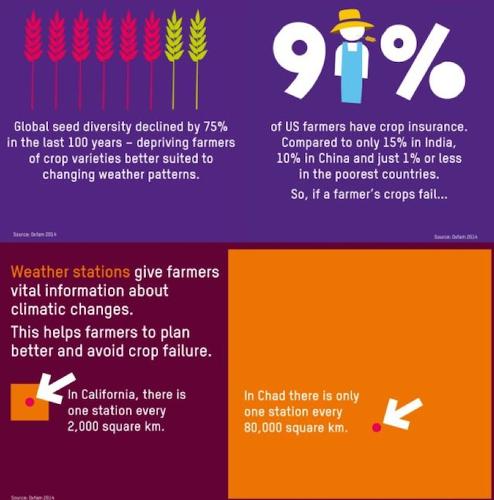
    Oxfam just released a report explaining how climate change is going to affect food–and how we’re not ready for it.

    Oxfam has highlighted 10 areas in which governments are falling far behind, including adaptation finance, gender equity, and social safety nets.

    The organization predicts that people who spend most of their paychecks on food will be the worst affected, and access to school nutrition and guaranteed employment for the most vulnerable communities will become especially critical.

    Ad placeholder

    Oxfam just released a report explaining how climate change is going to affect food–and how we’re not ready for it.

    Climate Change Is Going To Make Us All Very Hungry, And We’re Not Doing Anything To Stop It

    Impending food crises may arrive sooner than we think. Here are 10 ways the world–especially the developing world–is woefully unprepared

    • 0 Notes
    • /
    • 0 Pin
    • /
    • 10 Plus
    • /
    • 104 Tweet
    • /
    • 6 Like
    • /
    • 6 Share

    Next week, the Intergovernmental Panel on Climate Change, the scientific body that meets to release periodic assessments on the state of the world’s mutating climate, will release its fifth, and likely most concerning, report. Leaked copies have shown that governments, and especially poor countries, might have less time to adapt than previously thought.

    One of the main the effects of this shortened horizon for climate disaster is that climate-charged severe hunger will be felt within the next 30 years. Oxfam estimates that, because of climate change, 25 million children under five will experience malnutrition or severe hunger in 2050. In response, the organization has highlighted 10 areas in which governments are falling far behind, including adaptation finance, gender equity, and social safety nets. All of which are going to make the hunger problem even worse.

    In 2009, wealthy countries pledged to help poor countries reduce emissions and prepare for climate change by contributing $100 billion to a mitigation fund over several years. To date, however, those donations are far behind schedule. “Countries have only provided 2% in terms of the need,” explains Oxfam climate policy manager Heather Coleman. Without this money, countries set to experience the worst climate impacts are particularly ill-equipped.

    A lack of policies that empower women will also weaken countries’ abilities to feed populations in the face of shifting climactic conditions. Women make up 43% of the worldwide agricultural workforce in the developing world, but they’re also often shut out from the systems that alert them to extreme weather warnings, which occur in almost exclusively male spheres.

    In addition, Oxfam highlighted gaps in countries’ social safety nets as harbingers of crisis. The organization predicts that people who spend most of their paychecks on food will be the worst affected, and access to school nutrition and guaranteed employment for the most vulnerable communities will become especially critical.

    Some 20,000 fishing households in the Philippines are already living that reality. After Typhoon Haiyan destroyed coastal communities, local fisherman have seen entire mangroves and coral reefs that host important fish stocks wiped out.

    But while many of the harshest impacts will be felt in the developing world, wealthy countries won’t be exempt from the food crisis either. Food prices, according to Oxfam, will likely be some of the first shocks to the global system. The world experienced food price increases in 2008, 2010, and 2012, but the organization predicts that those will only become more severe in the next three decades–and more frequent.

    “With the hundred-year drought we’ve seen in California, and California being the largest source of fruit and vegetables in the United States, that will clearly affect food prices in the U.S.,” Coleman says. “And those spikes lead to instability. We’ve seen studies linking some of the uprisings around the Arab Spring, for example, linked to rising food prices.

    [Image: Cracked earth via Shutterstock]

  • West Antarctic Glaciers Speeding Toward the Sea, Study Finds

    1.1k

    West Antarctic Glaciers Speeding Toward the Sea, Study Finds

    3_28_14_andrew_nycsandy

    This aerial photo of Wednesday, Oct. 31, 2012, shows the New York skyline and harbor after Superstorm Sandy struck the city.
    Image: Mark Lennihan/Associated Press
    By Andrew Freedman10 hours ago
    Bad news from the Southern Hemisphere: the West Antarctic ice sheet is shedding ice at an accelerating rate, with six large glaciers in this region discharging nearly the same amount of ice as the entire Greenland ice sheet, according to a new study.

    The study is the first to combine observations from satellites, radar data, and other remote sensing methods to construct a long-term record of ice movement trends for six of the fastest-flowing glaciers in Antarctica.

    Published this week in the journal Geophysical Research Letters, the study examines glaciers in the Amundsen Sea Embayment of West Antarctica. The glaciers in this region include the Pine Island Glacier, which made headlines in recent years by discharging massive icebergs into the ocean.

    This region also encompasses the Thwaites, Haynes, Smith, Pope and Kohler glaciers, each of which are behemoths in their own right.

    A research team from the University of California at Irvine and NASA found that the total amount of ice coming off these glaciers has increased by 77 percent since 1973, with much of that increase coming since 2000. Together, these glaciers drain one-third of the West Antarctic Ice Sheet, or about 158 million square miles of ice, the study said.

    We need to know how quickly and extensively parts of Antarctica as well as the Greenland ice sheet are melting in order to accurately project how high global sea levels are likely to rise during the next several decades. It’s melting land-based ice, not the melting North Pole sea ice, that contributes to rising seas.

    Pine Island Glacier

    A massive crack running about 18 miles Pine Island Glacier’s floating tongue in 2011.

    Image: NASA

    According to a 2013 report from the U.N. Intergovernmental Panel on Climate Change (IPCC), average global sea level rise will likely be in the range of 10.2 to 32 inches by the end of the century, depending on the amounts of greenhouse gas emissions between now and then.

    If emissions continue on a business as usual path, which has been the trend in recent years, the IPCC said global average sea level rise could be closer to 40 inches — which would doom some low-lying coastal cities and nations, from Bangkok to Miami and Bangladesh.

    Illustrating the high stakes involved in the fate of West Antarctica, the study found that these six glaciers contributed about 10% of all the global average sea level rise that occurred between 2005 and 2010. If all six glaciers were to melt completely (which is not expected to happen during this century), global average sea level would rise by a catastrophic 3.9 feet, the study said.

    The new study also found, for the first time, that West Antarctic glaciers are not only flowing faster at the point where their base meets the ocean, which is known as the grounding line. Instead, areas as far inland as nearly 160 miles are also speeding up their march to the sea.

    Until this study, it was not known that sections of glaciers deep into the interior are also speeding up their movement. This is a troubling sign because of what it implies for sea level rise in the future, according to the study’s lead author, Jeremie Mouginot of the University of California at Irvine.

    “Increased ice discharge will have an impact on how [much] the sea level is going to rise,” Mouginot told Mashable.

    Mouginot says most of the action is taking place at the grounding line, then having ripple effects inland.

    In the same way that plaque slowly rots a tooth until it falls out, mild ocean temperatures are thought to be causing ice to thin and retreat where these glaciers meet the sea. This is likely setting in motion a chain of events that results in a far more unstable glacier.

    Sea level rise

    Projections of global mean sea level rise over the 21st century, depending on greenhouse gas emissions.

    Image: U.N. Intergovernmental Panel on Climate Change

    The grounding line positions of these glaciers have been retreating at a rate of 0.6 miles per year, the study found, which is among the fastest rates of glacier retreat in the world.

    According to Mouginot, all six of the glaciers in this study come into contact with the same body of water, which indicates that higher sea surface temperatures are likely playing a role in speeding up melting. Other studies have found evidence for this in other parts of the globe, including Greenland, and in other parts of Antarctica.

    “I think there is more warm ocean going beneath the ice shelf,” Mouginot says.

    It’s not absolutely clear exactly what is causing ocean temperatures to increase in that area — but global warming from the increased amount of greenhouse gases in the atmosphere, is almost certainly playing a role.

    “What I can say is, if you look at Greenland, it is changing, and West Antarctica is changing a lot,” Mouginot says. “And they are really far apart from each other. I don’t think it’s a regional change occurring. I think it’s more global.”

    The IPCC is scheduled to release another major climate report on Sunday evening eastern time, which is expected to detail some of the likely impacts of global sea level rise during the next several decades, among other findings.

    Have something to add to this story? Share it in the comments.

  • “Be Worried: Climate Scientists Under Attack”

    Be Worried: Climate Scientists Under Attack

    Share:

    facebook icon twitter icon google plus icon

    060403_TimeCoverClimate scientists are under attack like never before for telling the truth about about the growing dangers posed by unrestricted carbon pollution.

    Anyone who wishes can help climate scientists in their quest to provide humanity the information we need to save ourselves by supporting the Climate Science Legal Defense Fund (CSLDF). To find out how, go here.

    Eight years ago this week, Time magazine launched the bluntest cover story on climate change ever published by a major news outlet. Like the best science journalism, it was based on interviews with many of the world’s leading climate scientists. The article’s online sub-hed was especially blunt:

    Polar Ice Caps Are Melting Faster Than Ever… More And More Land Is Being Devastated By Drought… Rising Waters Are Drowning Low-Lying Communities… The climate is crashing, and global warming is to blame. Why the crisis hit so soon–and what we can do about it.

    For a time it seemed as if the public and policymakers were actually listening, as awareness of the climate crisis grew and leading politicians from both parties called for action. Then came the the vicious backlash — the most successful disinformation campaign in history, funded by fossil fuel companies and making use of tactics developed by the tobacco industry. Scientists were vilified and cyber-bullied.

    Scientists are far more worried than they were in 2006 — since emissions have soared, and the overwhelming majority of recent studies show the reality of climate change is far worse than what we suspected a decade ago — see this review of over 60 studies. See also the uncharacteristically blunt 2014 report from the American Association for the Advancement of Science, as well as the 2013 report from the U.N. Intergovernmental Panel on Climate Change. The IPCC’s next report, due out this weekend, appears no less alarming.

    And because the stakes are higher, the intimidation and cyber-bullying of climate scientists continues unabated. Doing something about it is easy, though.

    Climate Progress readers have been among the biggest supports of the important work of the Climate Science Legal Defense Fund (CSLDF). Prof. Scott Mandia explains what supporters have helped accomplish so far:

    But this has all been done by Mandia and Joshua Wolfe “from their kitchens.” They both have “full-time jobs and families with small children and neither receives compensation for their time.”

    So now they would like readers’ support to “go professional” to “hire a full-time Executive Director who will manage the day-to-day operations of providing legal help to our experts as well as increasing fundraising efforts. Having the full-time professional helps to assure that CSLDF will be there for our scientists years down the road. After all, climate change is not going anywhere and the sad fact is that neither will the legal attacks on our scientists.”

    Scientists are the thin blue line helping protect us from a world ruled by superstition and “might makes right.” If anyone wants to know how they can help climate scientists, they can go here.

  • UPDATE: Roseanne

    Why this ad?
    Drug and Alcohol Coursewww.seeklearning.com.au/Counselling – Alcohol And Drug Counselling Course Nationally Recognised & Accredited

    UPDATE: Roseanne

    Inbox
    x

    Ian Mckinlay via Change.org mail@change.org

    12:29 PM (24 minutes ago)

    to me
    Change.org
    NEVILLE — 

    I’m just back from Canberra, and I wanted to update you. It was a huge day of meetings – and yesterday’s headline in The Australian tells of some progress we made: “Peris backs jail audit over disability prisoners”

    We’ve now got support from all sides of politics. The Indigenous Affairs Minister Nigel Scullion, the PM’s advisor Warren Mundine, Senator Nova Peris, Senator Siewert and Boyce and others we met have all shown support for the release of Roseanne. And we’re closer than ever to a national audit and policy to end this shameful practice.

    I’m hopeful the Federal Government can show some leadership on this. It’s one thing to say they agree – now it’s time for them to respond with real action to end the use of indefinite prison sentences as ‘care’ for intellectually disabled people found ‘unfit to plead’.

    The response by Senator Scullion was very encouraging; he had a deep knowledge of issues and the effects of foetal alcohol harm. He should be thanked for his concern and encouraged as Minister of Aboriginal Affairs to push for the reforms needed to end this unjust imprisonment. Please help me thank the Indigenous Affairs Minister Nigel Scullion for meeting us – and urge him to immediately begin an inquiry and develop a policy. 

    Here’s where you can send him a quick email saying just that: Nigel.Scullion@ia.pm.gov.au

    Roseanne’s release is progressing, with the NT and WA beginning to work on a care plan and her transfer to Alice Springs. She phones me nearly everyday asking when she will be released. I look forward to having a date before too long.

    After decades of inaction, we’re finally bringing this issue out into the light. Thank you for signing my petition – and I’ll be in touch with more updates soon. 

    Thank you.

    Ian

    P.S. Some of you may have heard of Marlon Noble’s case. He spent 10 years in prison without conviction after being found “unfit to plead” just like Roseanne. If you want to watch his incredible story, recorded by the