Thank you for taking signing on to the Australian for Climate Action open letter.
You’ve joined tens of thousands of Australians in demanding more ambitious action to reduce our emissions and transition away from dirty fossil fuels toward renewable energy.
This campaign is growing by the day, with dozens of high-profile musicians, actors, former politicians, churches, journalists, celebrity chefs, athletes, scientists, comedians, academics and other trusted Australians adding their names to this critical call to action. By signing on thousands of every day Australians from around the nation, we can demonstrate the enormous and broad support for decisive action on climate change, a powerful rebuttal to the inaction of our leaders.
But we need your help to take it to the next level. Can you share the website with your friends?
David Donovan addresses the Gold Coast March in March in Surfers Paradise today (22/03/14, image via @P4217)
In a speech to the Gold Coast March in March today, managing editor David Donovan minces no words in explaining why it is important Australians reject Abbott and his “corporatist” neoliberal agenda.
IN 1996, after his election loss to John Howard, Paul Keating famously said:
“When you change the Government, you change the country.”
He was right.
During John Howard’s seemingly endless rule, the country changed profoundly.
John Howard coveted the popularity of Pauline Hanson and so, after he had put her in gaol and stolen all of her supporters, he adopted her ugly, divisive, racist, small-minded policies as his own.
It worked well for him.
The country was changed forever.
Indigenous Australians, asylum seekers, multiculturalism, scientists, academics, artists — anyone opposing Howard and his big financial supporters were in his sights.
And who were his big financial supporters? The graspers, the grifters, the plutocrats, the big corporations — all the people who fund the Liberal Party for millions every year.
Let’s call them ‘the corporatists’.
Howard said he wanted to make Australians “relaxed and comfortable”, and so to do that he spent the profits of the mining boom buying the votes of upper-middle bogans and cutting the taxes of his financial supporters.
Building Australia didn’t get a look in. He may have put up a few flagpoles — but not much else.
By 2005, the people who were paying the Liberal Party’s bills wanted more.
It was time for Howard to pay back more of his debt to them. And how did they want it repaid? They wanted to pay their workers less, of course.
WorkChoices, let’s be very clear, was about nothing else other than paying working men and women less and taking away their entitlements and conditions. This was something the corporatists had always wanted — both ideologically and financially.
Howard tried to give it to them. But he failed.
To save his miserable carcass, in the 2007 campaign against Rudd, Howard even tried to use the same phrase as Keating:
“When you change the Government, you change the country.”
But unluckily for him, the people said:
“Exactly!”
Howard tried to give the corporatists cheap people. But, thankfully, he couldn’t manage it.
After a brilliant campaign by the trade unions of Australia, the Australian people voted Howard out.
And there was much rejoicing.
And the country did change with Rudd — for a while.
We were getting our country back. We were regaining the respect of the world. We were working to solve the problems besetting humanity. We were building assets for our families and communities, which we could all use and about which we could be proud.
The corporatists gritted their teeth.
Then Rudd went further — too far for them.
He wrote an essay in The Monthlydecrying neo-liberalism. Warning bells rang for the corporatists.
The alarms moved up an octave when Rudd tried to bring in an ETS. The Liberal Party leader of the day, Malcolm Turnbull, also supported action on climate change, but the corporatists pulled one of their dirty tricks with Godwin Grech and got rid of him with ease, bringing in a thick-headed compliant stooge in the shape of Tony Abbott.
Mining heiress Gina Rinehart addresses an anti-mining tax rally in Perth (Photo: Sharon Smith via smh.com.au)
Then Rudd tried to bring in a mining tax, so we could all get a fair share of Australia’s mineral wealth. The alarms moved to DEFCON 4.
The extremists, the plutocrats, the corporatists who really run Australia ‒ the miners, the bankers, the foreign media moguls ‒ they all got together and hounded Rudd out of office.
In came Julia Gillard — so they used the obvious dissension in the Labor Party to undermine her as well.
She wasn’t meant to win in 2010, but she did — just. And she and the Independents did a good job in shepherding Australia through the last three years.
But you wouldn’t have heard that from the biased, yellow, Tory press.
A U.S. national, with far too much interest in Australian domestic affairs, set to work vilifying and destroying Australia’s first female Prime Minister. And the level of misogyny, bigotry and hatred stunned everyone with a shred of decency in their soul.
It may not be a popular thing to say, but Australia was well-run by Julia Gillard.
Can we say the same today?
With Murdoch running the PR for the Liberals and the Abbott camp, there was never any doubt he would become PM. The vitriol and bias from the owner of 70% of Australia’s press was beyond anything we have ever seen — anywhere in the world.
And so Abbott was installed above us as Australian Prime Minister.
Now allow me to let you in on a secret. I think the people who put Abbott in power know he won’t stay there very long. He is too bigoted, too awkward, too unpopular, too strange, too aggressive, too extreme, too out of touch with the mainstream of Australian society…
In short, he is too much of a dickhead to be Australian prime minister for long.
So the people who really run this nation need to get their neoliberal agenda through as quickly as possible.
And we have seen that in the first six months of Abbott’s Government.
Keating and Howard said, when you change the Government you change the country — well, everything is changing very quickly under Abbott.
The auto industry has gone, penalty rates are going, the Barrier Reef is about to wear a layer of sludge, and Gina Rinehart looks like she will get her wish and soon be able to pay no tax at all. Oh, and Rupert Murdoch will soon be able to own every newspaper, television station and radio station in Australia.
The corporations ‒ the ones who really run things ‒ have got their dream by having Tony Abbott in power. They think they have won.
We must make them think again.
It is us ‒ the people who have marched in March all over Australia, 100,000 of us and more ‒ who will stop their evil plans for Australia.
They think they’ve got us on the run. But who do they think they’re kidding?
Their time is coming swiftly to an end.
It is time for us to say: Down with the oligarchs. Down with the plutocrats. Down with the people who will make your children work for $2 a day.
Down with Gina Rinehart. Down with the IPA.
Down with the mindless media that will fill your head with propaganda and rubbish. Down with Murdoch.
Sea-level rise on the agenda at coastal conference
By Emily Barton
March 28, 2014, 6 a.m.
A PRESENTATION to a national conference of coastal councils has reiterated the need for local government to communicate with residents about sea-level rise, deputy mayor Neil Burnside says.
Councillors this week attended a two-and-a-half day conference at Ballina for coastal councils to discuss the future of the Australian coast and its communities.
The conference was timely as the Eurobodalla Shire Council sea-level rise policy has been under hot debate for the past month.
It comes after a motion, proposed by councillor Milton Leslight, to notify residents affected by sea-level rise was knocked back by the council last week.
Eurobodalla Shire Council general manager Dr Catherine Dale attended the conference along with ERA councillors Burnside, Leslight and Liz Innes.
Speaking on the last day of the conference on Wednesday, Cr Burnside said interesting reports and benchmarks comparing various areas were spoken about throughout the two days.
He said environmental lawyer Andrew Beatty spoke on the legal implications of planning for climate change impacts and reiterated comments made previously regarding the need for councils to be at the front foot when it came to planning for the risks.
“He (Andrew Beatty) said that not only should ratepayers have been told of the potential risk by now, but they should receive updates on the risk as more information becomes available,” Cr Burnside said.
“This flies in the face of the decision of the majority of Eurobodalla councillors at the meeting last week, saying that not only shouldn’t ratepayers be told of the decision taken years ago, but that there was no need to frighten the horses by bothering them with such matters.”
Cr Burnside said he was proposing to call upon all data to compare the Eurobodalla’s performance against other councils.
“Council needs to communicate with affected residents and inform them that they are affected, of the current sea level, the process of reviewing the policy and seek their input into the policy,” he said.
“Not only is it patronising it’s legally imprudent and council needs to tell them and involve them in the process to allow for a clear explanation and to stop the confusion.”
Also addressed at the conference were population trends in coastal areas, planning for uncertainty, and a national perspective of coastal issues.
With homeowners exploring more energy-efficient options for their heating and cooling systems, the purchase and installation of geothermal heat pumps are on the rise in the Sunflower State, according to the Kansas Geological Survey, or KGS.
Large-scale “direct use” geothermal systems – which involve using the heat in the water directly (without a heat pump or power plant) for such things as heating of building complexes, industrial processes, greenhouses, aquaculture (fish farming) and resorts – are more common west of the Rockies. However, the KGS informational report indicates that geothermal heat pumps, or GHP’s, for residential and commercial use are increasing in Kansas.
While that news may be encouraging, what exactly is geothermal heat and how does a geothermal heat pump work?
According to the Geothermal Resources Council, “GHP’s use the earth or groundwater as a heat source in winter and a heat sink in summer. Using resource temperatures of 4°C (40°F) to 38°C (100°F), the heat pump, a device which moves heat from one place to another, transfers heat from the soil to the house in winter and from the house to the soil in summer.”
Tim Dugan began Ground Source, Inc., of Holton, in the early 1990’s. He said while the awareness in the geothermal heat pumps has grown since he began installing the systems in homes and small businesses, the science of geothermal heat isn’t new. In fact, he said Oklahoma State University began studying geothermal heat after WWII. He said today, the basic level of knowledge about GHP’s mainly centers around the energy cost savings.
“From 23 years ago to now, yes, there’s more interest,” Dugan said. “From the people we talk to at the home show, they know someone who’s had lower bills (with the GHP). They know it’s good.”
Dugan said he estimates he’s installed 700 to 800 GHP’s in northeast Kansas since the early 1990’s. He said the GHP units he sells and installs initially cost an estimated $20,000. With a 30-percent federal tax credit (Kansas doesn’t offer a tax credit at this time for GHP’s), the cost drops to $14,000 and could decrease even more with additional energy-efficient credits and rebates. Some FHA-backed mortgage loans also have higher loan limits for homebuyers who will install energy-efficient systems and windows.
Using all available credits and rebates, Dugan said if you’ve been a propane customer, you could potentially recoup the cost of your GHP in two to three years. If you’ve been natural gas consumer, it could be four to six years before the GHP “pays for itself.”
Aside from the savings on your heating and cooling bills, Dugan said the GHP’s are quieter than standard HVAC systems and provide a more constant, comfortable temperature level in your home, even during the extremes of summer and winter.
According to information posted on Ground Source, Inc.’s website, “There is no combustion or need to vent exhaust gasses which means our equipment can be installed virtually anywhere.
If you have ductwork already installed in your home, you are starting the race ahead of the pack. If not, we can effortlessly install ductwork so you can enjoy the comfort of geothermal to its full extent.”
Another advantage of the GHP’s is they can be installed inside the home, free from the problems that weather and vandalism can present for traditional outside units.
I have prepared an urgent report and urge you to read. It is not long, and full of of pictures rather than scientific technicalities.
I am reporting on an urgent consequence of heating in the Arctic. Increased warming has created the immediate prospect of a massive release of methane.
The urgency is that this promises to be so large it will dwarf in one outburst all the carbon we have ever produced.
I asked friends whether I should send this out. It is such a monstrous story I felt I had to find support before posting it.
Neal: In the marketing world they say you have to get your storey across to your audience at least eight times before they will accept you. So I say publish and publish and keep repeating what people need to know.
Catherine: If for no other reason, this report is a good reminder of what really matters and of where we would be better served to put our attention.
So here it is. How do you react? What can you do personally?
John
Divestment success! And the big 6 things that happened this week
Inbox
x
Charlie Wood – 350.org Australia charlie@350.org Unsubscribe
5:07 PM (54 minutes ago)
to me
Dear friend,
While Tony Abbott got all medieval on Australia by reintroducing knights and dames this week, the fight for fossil fuel divestment has broken into the public spotlight like never before.
From the Minerals Council launching a campaign against the divestment movement on Monday, to UniSuper announcing it will divest its Socially Responsible investment portfolio of fossil fuels today, this week has been a game changer, and the battle is swinging our way!
This is a long email. That’s mainly a reflection that there are thousands of people in this movement, doing amazing work. That means there is a lot to report on, and today, a lot to celebrate.
So here we go with the 5 big moves of the week:
1. UniSuper makes an exciting divestment announcement!
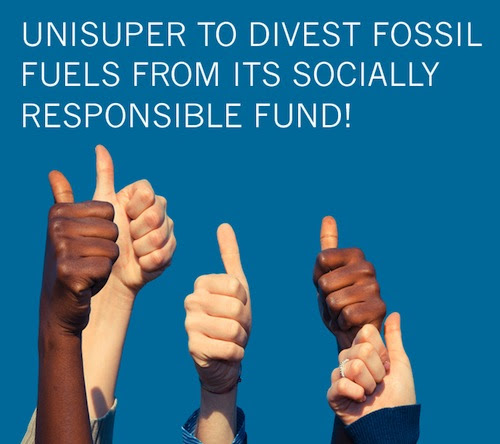
UniSuper is one of Australia’s largest super funds, with over 450,000 members and $30 billion under management. Since last month, over 1800 UniSuper members have asked the fund to go fossil free. Thanks to this support, we are now in negotiations with UniSuper over a comprehensive strategy for dealing with their fossil fuel investments. But excitingly, step one has been agreed to and today UniSuper notified their members that they will be divesting fossil fuels from their Socially Responsible fund. This is particularly excellent news given the campaign that the Minerals Council is now waging to keep our super funds wedded to coal*. Join us in celebrating this win by LIKING and SHARING our meme here.
2. Universities collude to avoid scrutiny and then get embarrassed.
Last night, ABC’s Lateline revealed that Australia’s Group of Eight** universities are colluding to avoid scrutiny over their plans to deal with the financial risks posed by their fossil fuel investments. The information was accidentally supplied by Monash University in response to a survey issued by the Asset Owners Disclosure Project (AODP) to 300 Universities internationally.***
This is the ultimate irony. One the one hand, universities are leaders of sustainability and climate change research, innovation and education, with staff, students and alumni working to build a low-carbon future. Yet on the other hand, our universities are investing in industries that will ensure this future is unattainable. If you are connected to a university, click here to ask them how they are managing the financial risks of climate change.
3. Melbourne University announced it won’t divest. Fossil Free MU won’t stop there.
University of Melbourne students and staff are outraged today by a public statement from the University indicating that it will not divest from fossil fuels. The University claims that divestment will reduce their returns, despite a recent report by The Australia Institute in partnership with 350.org and Market Forces indicating that divestment doesn’t reduce returns and a statement from UniSuper today that their returns would remain “about the same” after divesting fossil fuels from their socially responsible fund. Click here to ask the University of Melbourne to change their mind and go fossil free today.
4. Fossil Free ANU present to the University’s council.
Responding to the Group of Eight collusion revelation, Fossil Free ANU, Australia’s longest running divestment campaign, turned up at the university chancellery this morning to deliver a strong message to ANU’s council and Vice Chancellor Ian Young, who heads up the Group of Eight. They were given the opportunity to present to council on the need to disclose and divest the ANU’s fossil fuel investments. Click here to support the campaign’s call for ANU to go fossil free.
5. The Minerals Council attacked 350.org & launched an anti-divestment campaign.
On Tuesday we wrote to you about the attack in Monday’s Australian on 350.org and the divestment movement from the Minerals Council CEO, Brendan Pearson. His attack revealed more about the coal industry than about those interested in challenging it’s license to keep polluting. It was also noted that the Minerals Council has begun an anti-divestment campaign, lobbying investors not to divest. You can read our response to Mr Pearson’s oped in our blog response here.
6. Stranded assets expert gets public and media attention.
Finally, we’ve seen great media coverage and turnouts for talks and panel sessions with Oxford University academic Ben Caldecott on the risk of stranded assets in Australia — something everyone with a super fund, bank account or investments should know about! Checkout some of the coverage here.
This week has been incredible, and as Friday brings the week to an end, we’re left feeling hugely grateful to all of the people that are building this wonderful movement. Our massive gratitude goes to all the people who have stepped up to become a regular giver or a one off giver this week! Thanks to you, we’ll be able to sustain and power-up the work that 350.org does.
Have a wonderful weekend,
Charlie, Vicky, Aaron, Blair, Josh and the whole 350.org Australia team
**The Group of Eight includes: UNSW, ANU, Monash, University of Melbourne, University of Sydney, University of Adelaide, University of Queensland, University of Western Australia


 Add
Add