Author: Neville

  • Destroyer of Worlds MONBIOT

    Destroyer of Worlds

    March 24, 2014

    New research suggests there was no state of grace: for two million years humankind has been the natural world’s nemesis.

    By George Monbiot, published in the Guardian 25th March 2014

    You want to know who we are? Really? You think you do, but you will regret it. This article, if you have any love for the world, will inject you with a venom – a soul-scraping sadness – without an obvious antidote.

    The Anthropocene, now a popular term among scientists, is the epoch in which we live: one dominated by human impacts on the living world. Most date it from the beginning of the industrial revolution. But it might have begun much earlier, with a killing spree that commenced two million years ago. What rose onto its hindlegs on the African savannahs was, from the outset, death: the destroyer of worlds.

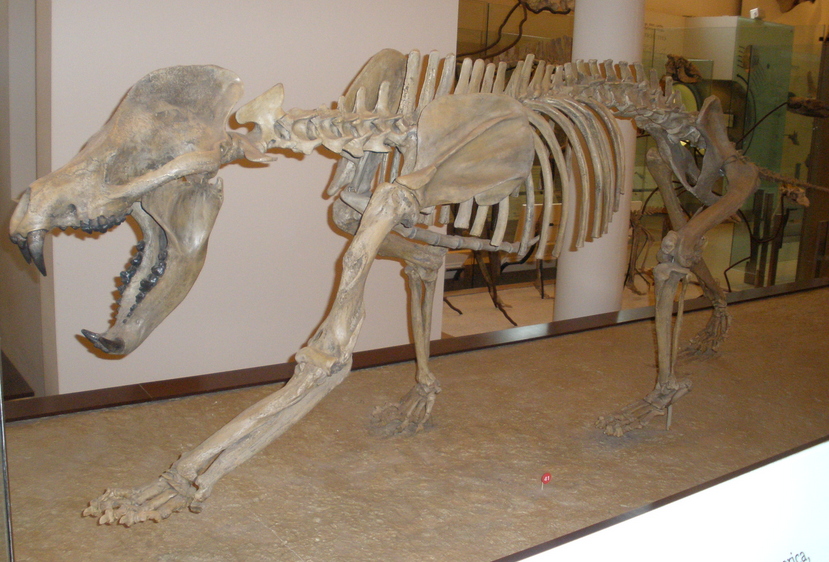
    Before Homo erectus, perhaps our first recognisably-human ancestor, emerged in Africa, the continent abounded with monsters. There were several species of elephants. There were sabretooths and false sabretooths, giant hyaenas and creatures like those released in The Hunger Games: amphicyonids, or bear dogs, vast predators with an enormous bite.

    Amphicyonid ("bear dog") skeleton

    Amphicyonid (“bear dog”) skeleton

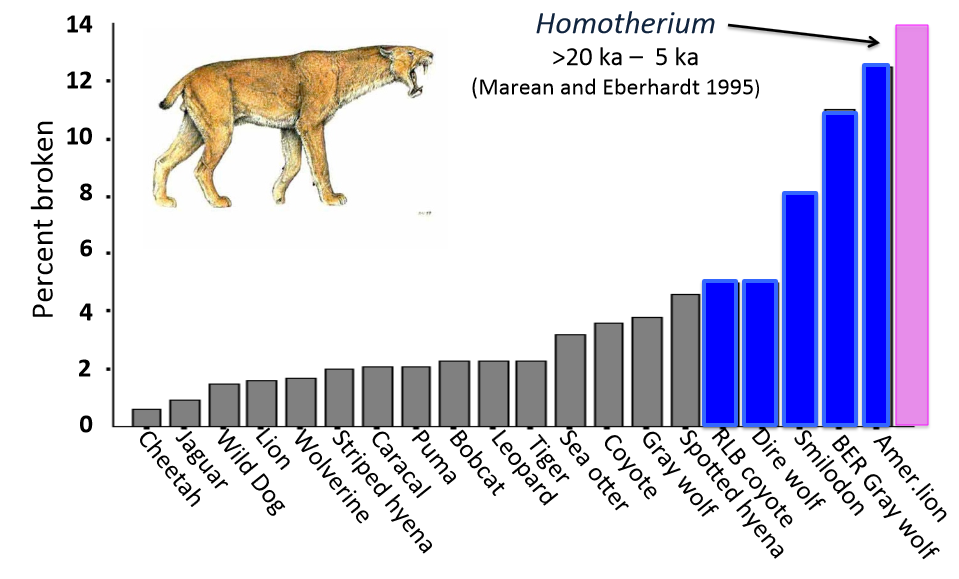
    Professor Blaire van Valkenburgh has developed a means by which we could roughly determine how many of these animals there were(1). When there are few predators and plenty of prey, the predators eat only the best parts of the carcas. When competition is intense, they eat everything, including the bones. The more bones a carnivore eats, the more likely its teeth are to be worn or broken. The breakages in carnivores’ teeth were massively greater in the pre-human era(2).

    Blaire van Valkenburgh's tooth breakage graph

    Blaire van Valkenburgh’s tooth breakage graph

    Not only were there more species of predators, including species much larger than any found on earth today, but they appear to have been much more abundant – and desperate. We evolved in a terrible, wonderful world – that was no match for us.

    Homo erectus possessed several traits that appear to have made it invincible: intelligence, cooperation; an ability to switch to almost any food when times were tough; and a throwing arm that allowed it to do something no other species has ever managed – to fight from a distance. (The increasing distance from which we fight is both a benchmark and a determinant of human history). It could have driven giant predators off their prey and harried monstrous herbivores to exhaustion and death.

    As the paleontologists Lars Werdelin and Margaret Lewis show, the disappearance of much of the African megafauna appears to have coincided with the switch towards meat eating by human ancestors(3). The great extent and strange pattern of extinction (concentrated among huge, specialist animals at the top of the food chain) is not easy to explain by other means.

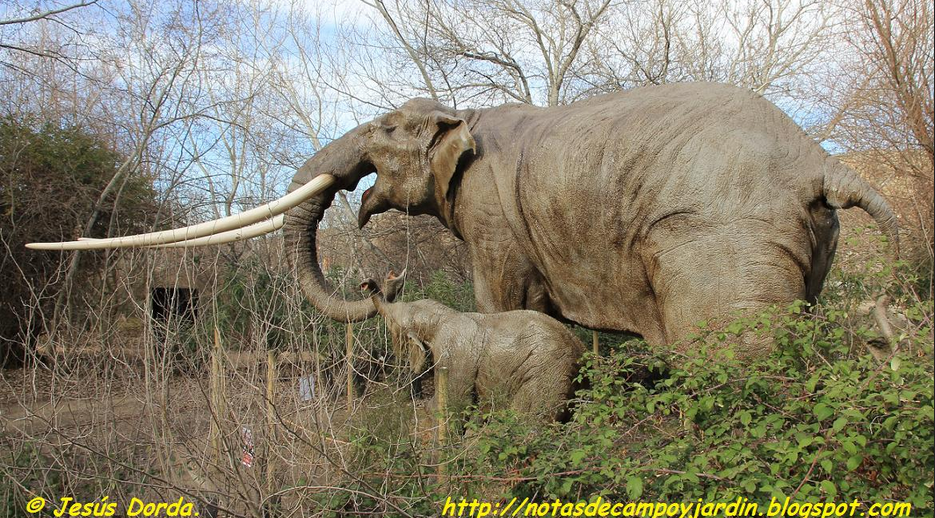
    At the Oxford megafauna conference last week, I listened as many of the world’s leading scientists in this field mapped out a new understanding of the human impact on the planet(4). Almost everywhere we went, humankind erased a world of wonders, changing the way the biosphere functions. For example, modern humans arrived in Europe and Australia at about the same time – between 40 and 50,000 years ago – with similar consequences. In Europe, where animals had learnt to fear previous versions of the bipedal ape, the extinctions happened slowly. Within some 10 or 15,000 years, the continent had lost its straight-tusked elephants, forest rhinos, hippos, hyaenas and monstrous scimitar cats.

    Straight tusked elephants once dominated the British ecosystem

    Straight tusked elephants once dominated the British ecosystem

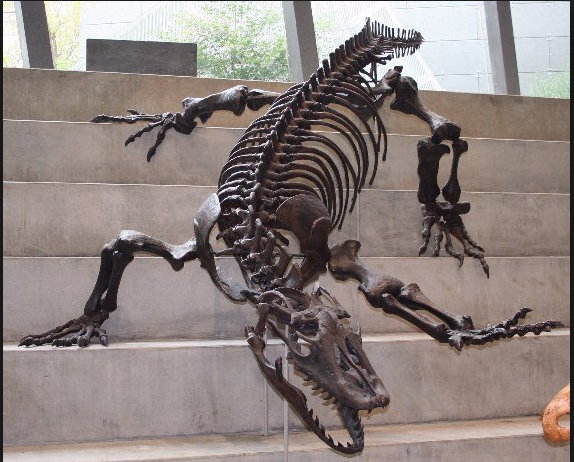
    In Australia, where no hominim had set foot before modern humans arrived, the collapse was  almost instant. The rhinoceros-sized wombat(5), the ten-foot kangaroo, the marsupial lion, the monitor lizard larger than a Nile crocodile(6), the giant marsupial tapir, the horned tortoise as big as a car(7) – all went, in ecological terms, overnight.

    Giant monitor lizard skeleton

    Giant monitor lizard skeleton

    A few months ago, a well-publicised paper claimed that the great beasts of the Americas – mammoths and mastodons, giant ground sloths, lions and sabretooths, eight-foot beavers(8), a bird with a 26-foot wingspan(9) – could not have been exterminated by humans, because the fossil evidence for their extinction marginally pre-dates the evidence for human arrival(10).

    I have never seen a paper demolished as elegantly and decisively as this was at last week’s conference. The archaeologist Todd Surovell demonstrated that the mismatch is just what you would expect if humans were responsible(11). Mass destruction is easy to detect in the fossil record: in one layer bones are everywhere, in the next they are nowhere. But people living at low densities with basic technologies leave almost no traces. With the human growth rates and kill rates you’d expect in the first pulse of settlement (about 14,000 years ago), the great beasts would have lasted only 1,000 years. His work suggests that the most reliable indicator of human arrival in the fossil record is a wave of large mammal extinctions.

    These species were not just ornaments of the natural world. The new work presented at the conference suggests that they shaped the rest of the ecosystem. In Britain during the last interglacial period, elephants, rhinos and other great beasts maintained a mosaic of habitats: a mixture of closed canopy forest, open forest, glade and sward(12). In Australia, the sudden flush of vegetation that followed the loss of large herbivores caused stacks of leaf litter to build up, which became the rainforests’ pyre: fires (natural or manmade) soon transformed these lush places into dry forest and scrub(13).

    In the Amazon and other regions, large herbivores moved nutrients from rich soils to poor ones, radically altering plant growth(14,15). One controversial paper suggests that the eradication of the monsters of the Americas caused such a sharp loss of atmospheric methane (generated in their guts) that it could have triggered the short ice age which began 12,800 years ago, called the Younger Dryas(16).

    And still we have not stopped. Poaching has reduced the population of African forest elephants by 60% since 2000(17). The range of the Asian elephant – which once lived from Turkey to the coast of China – has contracted by 97%; the ranges of the Asian rhinos by over 99%(18). Elephants distribute the seeds of hundreds of rainforest tree species; without them these trees are functionally extinct(19,20).

    Is this all we are? A diminutive monster that can leave no door closed, no hiding place intact, that is now doing to the great beasts of the sea what we did so long ago to the great beasts of the land? Or can we stop? Can we use our ingenuity, which for two million years has turned so inventively to destruction, to defy our evolutionary history?

    www.monbiot.com

    References:

    1. eg Wendy J. Binder and Blaire Van Valkenburgh, 2010. A comparison of tooth wear and breakage in Rancho La Brea sabertooth cats and dire wolves across time. Journal of Vertebrate Paleontology. http://www.tandfonline.com/doi/abs/10.1080/02724630903413016#.UzBUcM40uQk
    2. http://www.eci.ox.ac.uk/news/events/2014/megafauna/valkenburgh.pdf

    3. Lars Werdelin, 2013. King of Beasts. Scientific American. http://www.scientificamerican.com/magazine/sa/2013/11-01/

    4. http://oxfordmegafauna.weebly.com/

    5. Diprotodon.

    6. Megalania.

    7. http://www.wired.com/wiredscience/2010/08/last-giant-land-turtle/

    8. Castoroides ohioensis

    9. The Argentine roc (Argentavis magnificens).

    10. Matthew T. Boulanger and R. Lee Lyman, 2014. Northeastern North American Pleistocene megafauna chronologically overlapped minimally with Paleoindians. Quaternary Science Reviews 85, pp35-46. http://dx.doi.org/10.1016/j.quascirev.2013.11.024

    11. http://www.eci.ox.ac.uk/news/events/2014/megafauna/surovell.pdf

    12. Christopher J. Sandom et al, 2014. High herbivore density associated with vegetation diversity in interglacial ecosystems. Proceedings of the National Academy of Sciences, vol. 111, no. 11, pp4162–4167. www.pnas.org/cgi/doi/10.1073/pnas.1311014111

    13. Susan Rule et al, 23rd March 2012. The Aftermath of Megafaunal Extinction: Ecosystem Transformation in Pleistocene Australia. Science Vol. 335, pp 1483-1486. doi: 10.1126/science.1214261. https://www.sciencemag.org/content/335/6075/1483.full

    14. Christopher E. Doughty, AdamWolf and Yadvinder Malhi, 11 August 2013. The legacy of the Pleistocene megafauna extinctions on nutrient availability in Amazonia. Nature Geoscience vol. 6, pp761–764. doi: 10.1038/ngeo1895. http://www.nature.com/ngeo/journal/v6/n9/full/ngeo1895.html

    15. Adam Wolf, Christopher E. Doughty, Yadvinder Malhi, Lateral Diffusion of Nutrients by Mammalian Herbivores in Terrestrial Ecosystems. PLOS One, doi: 10.1371/journal.pone.0071352. http://www.plosone.org/article/info%3Adoi%2F10.1371%2Fjournal.pone.0071352

    16. Felisa A. Smith, 2010. Methane emissions from extinct megafauna. Nature Geoscience 3, 374 – 375. doi:10.1038/ngeo877. http://www.nature.com/ngeo/journal/v3/n6/full/ngeo877.html

    17. http://www.salon.com/2014/01/05/african_forest_elephants_are_being_massacred_into_extinction_partner/

    18. http://www.eci.ox.ac.uk/news/events/2014/megafauna/campos.pdf

    19. http://www.eci.ox.ac.uk/news/events/2014/megafauna/campos.pdf

    20. http://www.eci.ox.ac.uk/news/events/2014/megafauna/galetti.pdf

    Bookmark and Share
  • We’re taking it to court (again) REEF FIGHT

    1 of 37
    Why this ad?
    Solar Systems From $2,399energyaustralia.com.au/Solar – If You Find A Better Price, We’ll Match It. We Are The Solar Experts

    We’re taking it to court (again)

    Inbox
    x

    Sam – GetUp!

    10:27 AM (6 hours ago)

    to me

    NEVILLE,

    We hope you like legal fights, because we’ve just committed funding for a second court case to protect our Reef! This time, Environment Minister Greg Hunt is in the firing line for approving the dredging of 3 million cubic metres of World Heritage Area seabed.

    It’s been the largest and most diverse grassroots crowd funding effort our movement has ever seen. First, thousands of GetUp members helped North Queensland Conservation Council launch a case against the dumping approval. Now, we’re helping fund this critical dredging case as well.

    Our total contribution stands at $300,000 – made up of donations from more than 17,500 GetUp members all across the country.

    This is a significant day for the campaign to save our Reef, and one we should all be proud of. Congratulations and thank you to everyone who helped make this happen.

    If you haven’t already, you can still get in on the action and contribute to the citizen-led Reef Fighting Fund that’s already helped launch two potentially game-changing court cases for the Reef: https://www.getup.org.au/reef

    The case filed today argues that Minister Hunt failed his obligation to protect the World Heritage Area. If successful, the case would prevent the massive dredging project in Great Barrier Reef waters.

    But that’s not all. It could set a precedent that would make it harder for any development that threatens our World Heritage Area to get approval. The stakes are huge, and you can be sure the whole world will be watching closely.

    Can you help the fight?

    https://www.getup.org.au/reef

    We’re working with EDO Queensland, the same formidable lawyers leading the fight on the dumping case. This time, they’re representing the Mackay Conservation Group, who have been protecting our environment on the front lines for almost 30 years. There’s no-one better equipped to lead the charge, and we’re proud to throw our support behind them.

    “This is a big step for our organisation, but one that we know is necessary for protecting the Great Barrier Reef. Our local community is passionate about the future of the Reef and it’s crucial for us to have the support of GetUp members from around Australia.” – Dr Michael Williams, Mackay Conservation Group President and local paediatrician.

    The fight to protect our Reef isn’t going to be easy. Today we took another huge step, but there’s still a lot of work to be done.

    Whether it’s helping to launch further legal challenges, running high-impact television or newspaper ads or another strategic campaign, let’s be ready for whatever comes next.

    Can you be a part of the citizen-led Fighting Fund to save the Reef?

    https://www.getup.org.au/reef

    We’ll keep you posted on updates from both cases as they arise. But in the mean time, congratulations to everyone involved, and thank you for being part of this incredible movement. Days like today are what it’s all about.

    Sam, Erin, Kelsey and Aly, for the GetUp team.


  • We’re not getting the whole story

    Click here to enable desktop notifications for Gmail.   Learn more  Hide
    More

    1 of 1
    Why this ad?
    EnergyAustralia Solarenergyaustralia.com.au/Solar – Systems From $2,399. Find A Cheaper Price Anywhere, And We’ll Match It

    We’re not getting the whole story

    Inbox
    x

    Stop The Trawler Crew stopthetrawler@et.org.au via sendgrid.info

    2:11 PM (2 hours ago)

    to me
    Images are not displayed. Display images below – Always display images from stopthetrawler@et.org.au
    Dear Neville,

    We’ve certainly got their attention. We have Prime Minister Tony Abbott, Labor Senator Joe Ludwig, and Greens Senator Peter Whish-Wilson all talking about protecting Australia’s fisheries and marine life from super trawlers. But no one has done it yet, so let’s turn up the volume…

    3 weeks ago – Prime Minister Tony Abbott answered a question about the super trawler in Parliament “it was banned; it will stay banned”…
    2 days later – Liberal Senator Eric Abetz avoided answering a question from Greens Senator Peter Whish-Wilson as to whether the Government intended to legislate a permanent ban…
    In 2 days – Parliament will debate a Bill that Labor Senator Joseph Ludwig introduced under the banner of restoring tough laws on super trawlers, but this Bill merely delays decision-making on a permanent ban further…

    We have them listening. Now we need to turn up the volume. Can you help?

    1. Click here – to send a message to your local Representatives in the Australian Government, and tell them to permanently ban super trawlers in Australian waters

    2. Share this photo on facebook and encourage friends and family to email their MPs too (right click, save, then upload to a status update)Turn_up_the_volume.jpg

    Seafish is so committed to bringing super trawlers into Australian waters that after losing their court case against the temporary two year ban, they are challenging the decision in the Federal Court. Nothing short of a permanent ban on ALL super trawlers will ensure that the future of our fisheries, our unique marine life and our fishing will be safe from the decimation that these industrial factory trawlers bring.

    We hope you can help us turn up the volume with more emails to Federal Politicians, because it’s working!

    Thanks for all you do,
    Bec, Erika and the Stop the Trawler crew

    Ps. Tony Abbott said the super trawler ban will remain, but he hasn’t made the necessary law to do it. Please help us turn up the volume on Tony and the Australian Government. Use our easy ‘Email Your MP’ tool here, and tell them to ban super trawlers forever.

    http://www.stopthetrawler.net/

    -=-=-Environment Tasmania · 100 Elizabeth St, 1st Floor, Hobart, TAS 7000, Australia
    This email was sent to nevilleg729@gmail.com. To stop receiving emails, click here.
  • METEOTSUNAMIS ?

    Meteotsunamis have much lower wave heights than geophysical tsunamis, which are triggered by earthquakes, landslides or submarine volcanism.  Recent tsunami research was spurred by the 2004 Indonesian earthquake and tsunami, which killed 230,000 people, and the 2011 Japanese earthquake and tsunami, which killed 19,000 people and devastated areas like Otsuchi, shown here.

    Credit:

    U.S. Navy photo by Mass Communication Specialist 3rd Class Alexander Tidd

    The storm-generated wave of June 13, 2013, was amplified by the long, narrow harbor at Barnegat Bay, N.J. (seen here in 2007), where several anglers and scuba divers were injured when the waves swept over the breakwater near the inlet.

    Credit:

    USGS/USDA/USACE

    Early in the morning on June 21, 1978, the water withdrew 100 meters from the harbor at Vela Luka Bay on Korćula Island, Croatia, in the Adriatic Sea, stranding fish. Over the next hour, the sea surged back in a series of 6-meter waves that caused massive damage and huge economic losses for the island.

    Credit:

    Municipality of Vela Luka

    It was clear and sunny in Chicago on the morning of Saturday, June 26, 1954. Before dawn, a fast-moving storm out of the northwest had passed over Lake Michigan, pummeling Michigan City, Ind., on the southeastern shore of the lake with rain and 2-meter-high waves, but sparing Chicago on the southwestern shore.

    With the metropolis in the midst of a heat wave, people looking to cool off had headed down to the lake to swim, fish or just stroll along the waterfront. Mae Gabriel, 48, and her husband Edward, 49, the parents of 11 children, were in the waterfront park at Montrose Harbor. Nearby, 16-year-old Ralph Stempinski was fishing with his father, Ted, on the 55-meter-long breakwater that curves out into the lake. Shortly after 9 a.m., Ralph briefly left his father on the pier. When he returned, his father, along with about 15 other anglers, was gone.

    With no warning, the lakewater had risen 3 meters, surged over the pier and rushed 50 meters inland through the park. In the chaos that followed, many people were pulled alive from the water, but Ted Stempinski and Mae and Edward Gabriel were not among them. In all, at least seven people were killed.

    The incoming waves had arrived from the east and struck a 40-kilometer swath of shore from Jackson Park south of the city to Wilmette in the north. The afternoon edition of the Chicago Daily News reported that a freak “tidal wave” had struck the waterfront, but there are no such tides in the Great Lakes.

    One of the first scientific analyses of the 1954 Lake Michigan wave, published in 1965, attributed it to a seiche, a seesawing oscillation in the lake’s surface induced by strong winds or a sudden increase in air pressure, which reflected off the southeastern shore and sloshed west toward Chicago.

    Other large wave events associated with storms had occurred in the Great Lakes (see sidebar), but the 1954 event was the deadliest in 25 years. When another fast-moving squall line passed over Lake Michigan the following month, a warning was issued, the beaches were cleared and, when a smaller wave hit that time, no one was killed or injured.

    However, not all storms produce tsunami-like waves. Only recently have researchers come to more fully understand how storms trigger such sudden and massive waves, called meteotsunamis. Now they are attempting to develop models to forecast the events and prevent future tragedies like the one that happened that day in Chicago.

    Seismic Tsunami Versus Meteotsunami

    “Major wave events happen two to four times per year in the Great Lakes,” says Chin Wu, a civil and environmental engineer at the University of Wisconsin at Madison. “People thought they were seiches or storm surges, which occur when the water is pushed, but they’re not,” Wu says. “This is different.”

    Meteotsunami waves have many of the same characteristics as tsunamis, but are triggered by storms rather than earthquakes or landslides.

    “The storm is far away, but it is pumping energy into the water system, which can propagate very far to the shore,” Wu says.

    Tsunamis are more than just big waves, and they differ from waves typically seen at the beach in several important ways.

    First, they have extremely long wavelengths, often in excess of 100 kilometers, which means the waves can pass unnoticed in open water and travel great distances while losing very little energy, sometimes causing catastrophic impacts half a world away. Second, because they have such long wavelengths, they behave like shallow-water waves, the speeds of which are dependent on water depth. In deep water, a tsunami travels at speeds up to hundreds of kilometers per hour. When it enters shallow coastal waters, it slows and the waves rapidly gain amplitude, often reaching dozens of meters in height. The highest recorded wave height was a 576-meter-high local tsunami generated by a landslide in Lituya Bay, Alaska, in 1958.

    Major seismic, or geophysical, tsunamis are rare, but meteorological tsunamis are rarer still, with the largest occurring mainly in a few locations worldwide, including parts of the Mediterranean. Despite the risk they pose, and their worldwide occurrence, the phenomenon is not well known. Awareness of meteotsunamis has risen recently in the scientific community, says Paul Whitmore, director of the National Tsunami Warning Center in Palmer, Alaska, along with a general increase in tsunami research spurred by several recent tsunami-related disasters.

    There are several differences between seismic tsunamis and meteotsunamis, with one of the main ones being how much energy is involved.

    Seismic tsunamis triggered by earthquakes or landslides receive one extremely large energy input from the initial disturbance, whereas a meteotsunami requires continued energy input from the atmosphere for it to propagate. Thus, the maximum amplitude or wave height that meteotsunami waves can attain is much lower, with the largest observed waves reaching no more than 6 meters, Whitmore says. The lower energy level of meteotsunamis is also why they are always a local phenomenon. Unlike a seismic tsunami, which can have a global reach, meteotsunamis are usually geographically coincident with the storm that triggered them.

    Nevertheless, certain meteotsunamis can still be deadly and destructive, though it takes a specific combination of events to cause the destructive ones, Whitmore says. These are the events that researchers are most interested in understanding and forecasting.

    How a Storm Triggers a Wave

    Historical catalogs of tsunamis include many instances of “tsunami-like” waves of “unknown origin” for which no seismic or geophysical cause can be found, including many in the Mediterranean Sea, Adriatic Sea, English Channel, and off Japan and the West Coast of North America. Although it has long been understood that such events were storm-related, researchers only recently elucidated the specific mechanism of meteo­tsunami generation.

    The key trigger is a sudden change in atmospheric pressure over the water’s surface, which initiates the wave — but that alone cannot sustain it. To produce the resonance needed to sustain and amplify a meteotsunami, the storm front must be moving at the same speed as the water wave. Wave speed is dependent on water depth, so changes in water depth play a critical role in the propagation of the wave both at sea and when it enters shallow water, which is called shoaling.

    “The strongest meteotsunamis appear in funnel-shaped bays and harbors with a wide shelf in front of them,” says Ivica Vilibić, a physical oceanographer and meteotsunami researcher at the Institute of Oceanography and Fisheries in Split, Croatia. A flat shelf is necessary for so-called Proudman resonance to occur, which transfers energy from the atmosphere to the ocean.

    Because local bathymetry plays an important role, the conditions that cause a meteotsunami in the Mediterranean are not necessarily the same conditions that cause one in the U.S.

    “Croatia has both a wide [continental] shelf and lots of deep bays. The U.S. East Coast, with a wide shelf, was hit by several destructive meteo­tsunamis in the last few decades,” Vilibić says. However “the U.S. West Coast, having a narrow shelf, is not exposed to destructive meteotsunamis, only to moderate ones.”

    Major meteotsunamis, like major seismic tsunamis, may be rare, Whitmore says, but we need to worry about both.

    “The U.S. East Coast is actually at a higher risk of being hit by a meteotsunami than by a seismic tsunami,” Whitmore says. “While they’re not very common, they do occur, and without any warning. We have a tsunami warning system set up for the East Coast to warn of traditionally generated tsunamis, but we’re not set up for this.”

    The current warning system, which relies on the early detection of seismic signals from earthquakes, landslides and submarine volcanic activity that may generate a tsunami, is incapable of detecting potential meteorological sources of tsunamis.
 In 2010, Whitmore headed efforts at NOAA to launch a project with the goals of understanding the environmental, meteorological and bathymetric forces that cause meteo­tsunamis, as well as developing ways to forecast them and establishing a warning system for the U.S. East Coast.

    Funding for the two-year NOAA project was cut due to budget constraints. But the research team, led by Vilibić, had already made strides toward defining the conditions under which meteotsunamis occur and understanding what meteorological data need to be monitored to detect them.

    “What they were able to do was go back through historic meteorological data and figure out that [sudden atmospheric] pressure jumps are responsible,” Whitmore says.

    That information proved useful when a mysterious water wave struck the U.S. East Coast last summer.

    East Coast Meteotsunami of June 2013

    At about 3:30 p.m. on June 13, 2013, Brian Cohen was spearfishing from his boat in Barnegat Bay, N.J., when he saw anomalously high 2-meter waves suddenly crossing the inlet. The waves knocked several anglers off the jetty, and strong rip currents, which coincided with the outgoing tide that afternoon, pulled several scuba divers out over a breakwater. Cohen quickly headed his boat back to shore so he would not be sucked over the breakwater as well. The outrush of water continued for one to two minutes, eventually exposing the breakwater, which is usually submerged under about a meter of water.

    About the same time, rapid fluctuations in the water level at the mouth of Falmouth Harbor in Massachusetts, 350 kilometers farther north, were detected as the water rose and fell about 0.3 meters in less than 10 minutes, causing rapid currents in the harbor.

    About five hours earlier, a derecho — a high-speed windstorm associated with a band of fast-moving thunderstorms — had traveled from the Midwest to New Jersey and offshore into the mid-Atlantic.

    Tsunami researchers and oceanographers immediately suspected the wave event was a meteotsunami triggered by the storm. But once the storm moved offshore, the scientists had data from just two NOAA buoys off the coast of New Jersey — a DART (Deep-ocean Assessment and Reporting of Tsunamis) buoy that detects deep-water pressure changes, and a weather buoy — with which to work.

    In July 2013, Richard Signell, a physical oceanographer at the U.S. Geological Survey (USGS) in Woods Hole, Mass., presented a preliminary analysis of the event (posted at www.youtube.com/watch?v=IL4LGb2w75E), analyzing air pressure and water level fluctuations that occurred up and down the East Coast that day, along with radar records of the storm’s passage.

    Clocking the derecho as it passed the DART and weather buoys, Signell noted that given the speed of the storm and the water depths on the continental shelf at those locations, the waves induced by the storm would fall within the tsunami frequency band. A model reconstruction of the storm as it moved out to sea revealed a large wave reflecting off the shelf break and heading back toward Barnegat Bay — where Brian Cohen was spearfishing that day.

    “It looks plausible that this [wave event] could have been caused by the front,” Signell said.

    However, scientists also considered that the waves could have been triggered by another source known to occur off the East Coast: a submarine landslide. Researchers at NOAA’s Pacific Marine Environmental Laboratory quickly input the water level fluctuations observed up and down the East Coast into models, which suggested the most likely location for a landslide source was Hudson Canyon off the coast of New York. In the summer of 2013, the NOAA research vessel Okeanos Explorer was on a cruise in the mid-Atlantic and was redirected to Hudson Canyon to look for any evidence of a disturbance.

    “We are fortunate to have a number of mapping surveys from Hudson Canyon and, therefore, we could compare the morphology of the canyon from before and after the June event,” says Jason Chaytor, a research geologist at USGS in Woods Hole, Mass., who studies submarine landslides. “Analysis of the pre- and post-event bathymetry and shallow-subsurface mapping data showed no evidence of new landslides along the canyon,” Chaytor says. The NOAA ship also mapped the head of Atlantis Canyon, another potential landslide location, “but again, no significant change was detected,” he says.

    In the months since, a team of researchers from NOAA’s tsunami warning centers in Alaska and Hawaii and the National Data Buoy Center in Mississippi has conducted further analyses of the June 2013 event. They reported the results at the annual meeting of the American Geophysical Union in San Francisco, Calif., in December.

    “The presence of this storm, the lack of a seismic source, and the fact that tsunami arrival times at tide stations and deep ocean-bottom pressure sensors cannot be attributed to a ‘point-source’ suggest this tsunami was caused by atmospheric forces, that is, a meteotsunami,” the team wrote in the abstract.

    The researchers used the 2013 event as a test case to see if prediction might be possible.

    “This event caught everyone’s attention because it was so pronounced up and down the coast, and it caused some injuries,” says co-author William Knight, a physical scientist and oceanographer at NOAA’s National Tsunami Warning Center in Palmer, Alaska.

    The group gathered air pressure data from barometers at land-based stations in the path of the storm, along with sea-level gauges along the coast and DART buoys offshore, and plugged the data into a tsunami-forecast model that the team has been developing.

    “The only thing we changed was replacing the earthquake source with an atmospheric pressure source, which was a pretty straightforward modification,” Knight says. “We were trying to determine if the warning center could provide any kind of advance warning to people on the East Coast.”

    The model showed promising results, but several things need to happen before that determination can be made, he says, including testing the model’s predictive strength on several more historical events. So far, “we only have one stake in the ground here,” Knight says. “We need to look at earlier cases [of meteotsunamis] to make sure that we can identify a candidate [weather] system.”

    Researchers also need to develop a constellation of weather stations that provide the necessary air pressure data, he says. In this case, air pressure data were gleaned from barometers mounted on seismic stations that are part of the transportable USArray, many of which are not permanent stations.

    “We really need pressure data from the land-based stations, which will allow us to make a forecast,” Knight says. “By the time the storm is offshore, being seen by ocean-based pressure sensors, it’s already too late.”

    And lastly, the team will need to address what kind of warnings should be released to the public. “This is not the same kind of seismic source that we are used to, so the kind of warning we would put out to pull people back from the shore is still an open question,” Knight says.

    Can Meteotsunamis Be Forecast?

    Whitmore says the early results are promising and indicate that under certain conditions, and with adequate funding, East Coast meteo­tsunamis should be able to be forecast. An unusual aspect of Great Lakes and East Coast meteotsunamis actually gives tsunami researchers time to produce a forecast: As with the June 2013 event, the waves are often generated by storms moving from west to east, over land and offshore. In many Mediterranean events, the storms blow onshore.

    “Part of the reason that we can [potentially forecast an event],” Knight says, “is that the actual source was the reflected wave off the Atlantic shelf break, which is eastward of the coast, which could give us at least a couple hours of lead time.”

    Whitmore says good forecasts will require air pressure data recorded at much finer resolution, with correspondingly higher-resolution models, to detect the sudden atmospheric pressure jumps that trigger meteotsunamis. Current weather buoys off the coast only transmit one air pressure reading every hour, he says, but scientists need to track these air pressure fluctuations about once every minute.

    At the 2012 European Geosciences Union meeting in Vienna, Austria, Vilibić and colleagues presented their preliminary results from the TMEWS project (Towards a MEteotsunami Warning System along the U.S. coastline), which showed that some models could retrospectively reproduce the conditions under which meteo­tsunamis had occurred. Thus validated, it could be the basis of an early warning system, but there is still a long way to go.

    “It is quite hard, or almost impossible, with present models and systems, to forecast meteotsunamis because the source in the atmosphere is a very mesoscale process,” Vilibić says.

    Currently, the world’s only meteo­tsunami warning system is operating in the Balearic Sea in the western Mediterranean; however, it is based on identifying larger-scale weather systems.

    The method being used “in the Balearic Islands, Spain, is to assess synoptic conditions, which can be easily forecasted, and to assign a warning level if the conditions are close to those observed during meteotsunamis. However, the latter provides just qualitative and not quantitative forecasts, and does not tell you anything about the intensity of the potential event,” Vilibić says.

    In addition to efforts to develop warning systems for the U.S. coast, there have also been attempts in the Adriatic Sea, Vilibić says, but a great deal of work remains to be done.

    In Wisconsin, Wu and his team are also working on a predictive model for the Great Lakes, which experience 40 to 60 convective-type storms each year, the type of storm most likely to produce a meteotsunami.

    “The [1954] Chicago tsunami hit on a perfectly calm day, with no warning,” Wu says. “One of our major goals is to be able to warn people.”

    The National Weather Service currently issues broad warnings for the Great Lakes, although they are not specifically meteotsunami warnings. For example, in July 2013, a beach hazards alert was issued warning that an incoming cold front sweeping over Lake Michigan could generate “rogue waves” as high as 5 meters on the Chicago waterfront. The alert warned people to stay out of the water and away from the waterfront as waves could be “high enough to sweep an unsuspecting biker into the water.”

    Meteorologists and beachgoers are not the only ones interested in forecasting meteotsunamis, however. After the tsunami triggered by the 2011 Tohoku earthquake swamped the Fukushima Daiichi nuclear plant, causing reactor meltdowns and radioactive releases that contaminated the surrounding land, atmosphere and ocean, administrators from the Nuclear Regulatory Commission contacted Wu about his research. The Palisades nuclear power station is located on the shore of Lake Michigan near South Haven, Mich. — just south of  the site of a deadly meteotsunami that struck Grand Haven in 1929.
  • Wet La Nina years mask sea level rise

    Wet La Nina years mask sea level rise

    Monday, 24 March 2014 Alister Doyle
    Reuters

    Sea level marker

    “There is no slowing in the rate of sea level rise” after accounting for the natural variations, say researchers (iStockphoto: GAPS)

    Heavy rains from the Amazon to Australia have curbed sea level rise so far this century by shifting water from the oceans to land, according to a study that rejects theories that the slowdown is tied to a pause in global warming.

    Sea level rise has been one of the clearest signs of climate change — water expands as it warms and parts of Greenland and Antarctica are thawing, along with glaciers from the Himalayas to the Alps.

    During the 1990s, global sea levels rose at a mean rate of around 3.5 millimetres a year. But from 2003 to 2011 this slowed down to 2.4 millimetres a year.

    However, the rate would have been around 3.3 millimetres a year once natural shifts led by an unusually high number of La Niña weather events that cool the surface of the Pacific Ocean and cause more rain over land were excluded, report French scientists in the journal Nature Climate Change .

    They analysed time-series data of global mean sea level from five prominent research groups, including the CSIRO, for the periods 1994 -2002 and 2003-2011.

    “There is no slowing in the rate of sea level rise” after accounting for the natural variations, says lead author Anny Cazenave of the Laboratory for Studies in Geophysics and Spatial Oceanography in Toulouse, France.

    The scientists found the largest cause of interannual sea-level variability is the El Niño-Southern Oscillation, which impacts upon the global water cycle through changes in land water and atmospheric vapour content.

    Following the major El Niño event of 1997/1998, the past decade has favoured La Niña years.

    In La Niña years, more rain fell away from oceans, including over the Amazon, the Congo basin and Australia, says Cazenave. It is unclear if climate change itself affects the frequency of La Niñas.

    Rainfall over land only temporarily brakes sea level rise.

    “Eventually water that falls as rain on land comes back into the sea,” says Anders Levermann, a professor at the Potsdam Institute for Climate Impact Research, who was not involved in the study.

    “Some of it goes into ground water but most of it will drain into rivers, or evaporate.”

    Hiatus in warming

    The apparent slowing of sea level rise coincided with what the UN panel of climate experts calls a hiatus in global warming at the Earth’s surface, when temperatures have risen less sharply despite record emissions of greenhouse gases.

    But the study finding that there has been no slowing of sea level rise between the 1990s and the 2000s “clearly advocates for no recent slowdown in global warming,” write the authors.

    Many scientists suspect that the “missing heat” from a build-up greenhouse gases in the atmosphere is going into the deep oceans as part of natural variations in the climate.

    But, because water expands as it warms, that theory had been hard to reconcile with the apparent slowdown in sea level rise.

    Sea levels have risen almost 20 centimetres since 1900. The UN panel of climate experts expects an acceleration, with gains of between 26 and 82 centimetres over 100 years to the late 21st century.

    Last year, another study said that unusually heavy downpours over Australia in 2010 and 2011 had curbed sea level rise, before a rebound reaching a rate of about one centimetre a year globally, partly as water flowed back into the sea.

    “It has tailed off in the past 12 months or so” to above three millimetres a year, says John Fasullo of the U.S. National Center for Atmospheric Research who led the study.


  • ACT Assembly going to 25

    Author Archive

    ACT Assembly going to 25

    By

    Ben Raue

    March 24, 2014

    In the lead-up to the state elections in South Australia and Tasmania, I didn’t have time to cover another electoral story in the Australian Capital Territory. After many years of debate, and competing proposals, the ACT Legislative Assembly appears set to increase in size, from 17 to 25 seats.

    The ACT’s legislative body currently has 17 members elected from three multi-member electorates. The electorate of Molonglo, centred on Lake Burley Griffin, elects seven members, while the Belconnen-based Ginninderra and the Tuggeranong-based Brindabella each elect five members.

    The Labor Party and the Greens have supported some expansion in size of the ACT for a while, but it has faced opposition from the Liberal Party.

    An expert panel (read the report) recommended the creation of five electorates – which would initially elect five members each before eventually electing seven members each for a total Assembly size of 35.

    The Liberal Party’s ACT division decided to support the increase to 25 at their meeting on March 5. It’s unclear if either party is pushing for an eventual increase to 35 seats.

    The next ACT election is due in just over two and a half years, giving plenty of time for the Assembly to pass the change and for new boundaries to be drawn.

    We don’t know exactly how the boundaries will be drawn, but there aren’t that many options when you are drawing electoral boundaries in Canberra.

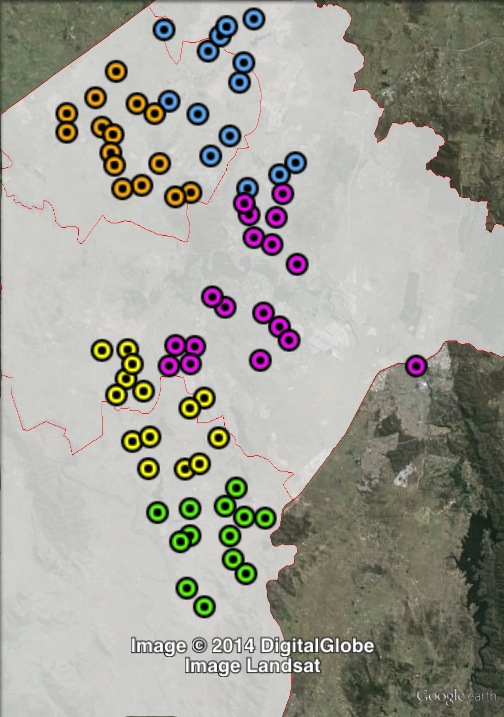
    One possible way to divide ACT's polling places into five electorates. Belconnen in orange, Central in purple, North in blue, Tuggeranong in green, West in yellow.

    One possible way to divide ACT’s polling places into five electorates. Belconnen in orange, Central in purple, North in blue, Tuggeranong in green, West in yellow.

    In 2010, I conducted some analysis at the likely impact of a 5×5 electoral system that didn’t make it to this blog. This included assigning all polling places to one of five electorates.

    The ACT is divided into seven districts. The central suburbs are split into North Canberra and South Canberra by the Lake. These areas are usually referred to as the ‘inner north’ and ‘inner south’.

    In the north you find Gungahlin, and Belconnen in the north-west.

    In the south you have Tuggeranong, and just north of Tuggeranong to the west of the city is Weston Creek and Woden Valley.

    When drawing these boundaries I found that both Tuggeranong and Belconnen were too large to be contained within a single electorate. Both areas formed the basis for an electorate. I then created an electorate called ‘West’ covering Weston Creek and the remainder of Tuggeranong. In the north I created an electorate covering all of Gungahlin and northern parts of Belconnen, as well as the northern fringe of the inner north.

    I then created a fifth electorate in the centre, surrounding the Lake and mostly covering the inner south and inner north.

    Population will continue to shift, and I didn’t take into account absentee and other special votes which may vary in numbers. It’s quite possible that the Central electorate will lose parts of Woden. Having said that, I think they provide a useful guide as to how a 5×5 system would change the balance in the ACT.

    I’ve taken the results by polling place of the 2012 results (no thanks to Elections ACT, who don’t provide the data in a format that allows you to download it all at once – you need to visit a separate page for each polling place) to produce my estimate of how many quotas each party would have polled in each of these five hypothetical electorates in 2012.

    Seat Labor Liberal Greens Others
    Belconnen 2.5227 1.8653 0.6105 1.0004
    Central 2.4636 2.1197 0.9045 0.5118
    North 2.4001 2.1628 0.7039 0.7324
    Tuggeranong 2.1273 2.8835 0.3939 0.5950
    West 2.4007 2.4501 0.5984 0.5494

    The ALP polled higher than the Liberal Party in 2012, but the Liberal vote is more concentrated in Tuggeranong so the highest result for a particular party is for the Liberal Party in Tuggeranong. Tuggeranong is the best area for the Liberal Party, and the worst for both the ALP and the Greens. Belconnen is best for the ALP and worst for the Liberal Party. The Greens vote peaks in the central electorate.

    On these numbers, I estimate that we would see 11-12 Liberals, 10-12 Labor and 2-4 Greens MLAs. The fifth seat in Belconnen could either go to the ALP or the Greens. The fifth seat in the West could go to Labor, Liberal or Greens. In this scenario, all parties would increase their numbers.

    In most circumstances, this result would ensure that both major parties won two seats in each electorate. The Greens vote is quite strong in Central – probably enough to offset the fact that they previously benefited from a lower quota in Molonglo that has been lost. In this scenario, 0.7 quota in the North is probably enough to elect a Green, but may not be enough to guarantee a win if the balance between the major parties shifts.

    The Greens polling 0.6 quotas in Belconnen and the West would provide enough of a base to give the party a chance, particularly in a good election. The Greens would have to perform exceptionally to win a seat in Tuggeranong.

    Overall, these new electorates would see no change in the balance of power: on 2012 votes, the Greens would have held the balance of power, with the likely result seeing Labor and the Greens sharing government as they have done. The biggest impact would have been a deeper bench: resulting in more talent available to serve as ministers, and a larger backbench.

    SA 2014 – boundary issues

    By

    Ben Raue

    March 18, 2014

    South Australia’s election produced a result that has sparked a lot of interest: despite the Liberal Party winning a majority of the two-party-preferred vote (and by even more than in 2010), the Liberal Party has won less seats than the ALP, and we appear to have narrowly avoided the Labor government holding an outright majority.

    It’s not an uncommon outcome, in South Australia and elsewhere in the country. The ALP has formed government in South Australia despite losing the statewide vote three times in the last 25 years: in 1989, 2002 and 2010, and in two of those cases the ALP won an overall majority.

    In federal politics, the 1990 and 1998 elections both saw the sitting government maintain power despite losing the vote (Labor in 1990, and the Coalition in 1998).

    Following Saturday night’s result, multiple Liberal figures have come out to complain about the outcome and to vaguely criticize our existing electoral system which allows such an ‘unfair’ result.

    Tony Abbott described South Australia’s election laws as ‘extraordinary’, ignoring the fact that Saturday’s outcome could just as easily happen under federal electoral law.

    Read the rest of this entry »

    WA Senate by-election – preferences announced

    By

    Ben Raue

    March 17, 2014

    Each group running in the WA Senate by-election submitted their group voting tickets on Saturday, which will direct preferences for above-the-line votes cast for each group. With the state elections in South Australia and Tasmania, I’ve only now had time to analyse the preferences lodged. You can download the Group Voting Tickets here (PDF).

    Each Group Voting Ticket covers all 77 candidates running in the election, but for the purposes of my analysis I have looked at only 33 candidates – the third Liberal candidate, the second Labor candidate and the first candidate for every other group running. I have also excluded the two ungrouped independents.

    All of my analysis focused on where each party preferenced a group of ten parties that all polled over 1% at the 2013 election in Western Australia. There’s no guarantee that these ten parties are the only parties to stand a chance of winning election, but their chance is greatest.

    After speculation about the ALP not preferencing the Greens, the outcome is a tad anticlimactic and is unlikely to hurt the Greens. The ALP preferences, in order, the Secular Party, the Animal Justice Party, the Sex Party, the independent Save the ABC group, the Voluntary Euthanasia Party, HEMP, and then the Greens. It is very unlikely that any of those parties will remain in the count long enough to challenge the Greens and benefit from Labor preferences.

    There is a wide variety in how parties have preferenced.

    On the left, the Greens received preferences directly from Wikileaks, the Socialist Alliance and the Pirate Party. The Save Our ABC group and the Sex Party preferenced the ALP before the Greens, while the Voluntary Euthanasia Party, Sustainable Population Party and Animal Justice Party all split their preferences evenly between Labor and the Greens. Surprisingly, Help End Marijuana Prohibition (HEMP) placed the Greens very low, behind the Shooters, the ALP and the Palmer United Party, amongst many others. The Secular Party preferenced the Sex Party and then the Greens, amongst parties with a significant chance.

    The Republican Party and the Mutual Party, both with names that suggest a progressive agenda, both preferenced the ALP and Greens poorly and placed the Liberal Democratic Party high.

    A block of parties preferenced tightly, including the LDP, the Republican Party, the Mutual Party, the Outdoor Recreation Party and Smokers Rights, all placed the LDP highly and otherwise mostly placed microparties in the top half of their preference order.

    The Australian Motoring Enthusiasts Party, Australian Fishing and Lifestyle Party, Freedom and Prosperity Party (formerly the Carbon Sceptics), Australian Voice, Building Australia Party, PUP, HEMP and the Australian Sports Party all placed the Shooters most highly amongst the top ten parties.

    We’ll have to wait for others to do a deeper level of analysis to know what tiny parties have accrued enough preferences to stand a chance of winning, in the way that the Australian Sports Party did. However one measure of this can be seen by averaging the rank that each party achieved on each other party’s preference list.

    As a score from 1 to 33, the parties with the best average preferences are the Australian Democrats (10.6), the Mutual Party (10.9), and the Australian Sports Party (11.7). The parties with the worst average preference ranking are the Smokers Rights Party (23.3), the Socialist Alliance (23) and Rise Up Australia (22.1).

    Over the fold, I’ve summarised the key preferences for all 33 groups. You can also download all of the Group Voting Tickets in spreadsheet form here.

    Update: Edited to reflect that the Voluntary Euthanasia Party split their preferences evenly between the Greens and Labor, not going to Labor entirely as previously written.