Author: Neville

  • Sea-level stoush on the rise

    Friday March 21, 2014
    Larger / SmallerNight Mode

    Sea-level stoush on the rise

    By KERRIE O’CONNOR

    March 20, 2014, 4:30 p.m.

    • Sea-level stoush on the rise

    Eurobodalla Ratepayers Association councillors this week lost a bid to immediately write to all ratepayers affected by the Eurobodalla’s interim sea-level rise policy, and an exchange of fire with opponents has spilled over into a post-meeting email stoush.

    At Tuesday’s ordinary Eurobodalla Shire Council meeting, ERA councillor Milton Leslight moved that council convene a community sea-level workshop, preferably before mid-May, involving “experts” invited by the council.

    He also moved that council update all affected ratepayers on the interim policy, as well as on reports being prepared on sea-level rise benchmarks, coastal hazards and management plans.

    That letter would have also informed ratepayers about the planned workshop.

    However, Greens councillor Gabi Harding

    successfully moved to amend his motion, supporting the workshop, but preventing the mass mail-out until the benchmarks, due mid-year, were completed.

    She argued a mail-out without the benchmarks would be premature and costly, winning the support of councillors Danielle Brice, Rob Pollock and mayor Lindsay Brown.

    With Shoalhaven City Council, the shire has commissioned a joint study on coastal benchmarks, due in June or July.

    The decision to wait until they were delivered “does not work for our community,” Cr Leslight told the meeting.

    “We have been trying to bring this to their attention and knowledge for some time.

    “It is important that we get them involved, the sooner the better.

    “This area has suffered economic and social impacts and it is a blight on our community for this to go forward in its current format.”

    He said he was disappointed and frustrated and said the amendment “reflects the politics that goes on this place”.

    Cr Pollock rejected that view.

    “I have looked long and hard and think the basic essence of this motion is well and truly worth supporting,” he said.

    “But to write to people now –  what are you going to tell them?”

    Cr Pollock said he hoped the current policy would change, but a letter now, which did not outline a clear way forward, would look “stupid”.

    “I don’t believe anyone is disadvantaged by not receiving correspondence from us at this point,” he said.

    Cr Pollock also said “an awful lot” of ratepayers would not be aware of the current situation and a letter now “would create more anxiety”.

    That, said Councillor Liz Innes, was the point.

    “That point exactly is why we should be going out and communicating with these property owners,” she said.

    “At the same time, we were also going to be advising them that we were going to put forward a forum for them to participate in. That is a sad, missed opportunity to connect with our community.”

    Cr Innes feared the benchmark study would be delayed.

    “If it drags on, like what has happened in the rural lands committee, we may be looking at another two or three months, so let’s just leave our community hanging out there a little longer, shall we?” she said.

    “I am disappointed that we, as councillors, again stepped back from being open and honest.”

    The amended motion was carried.

    Featured News

    Sea-level stoush on the rise

    Sea-level stoush on the rise

    Eurobodalla Ratepayers Association councillors this week lost a bid to immediately write to all ratepayers affected by the …

    Penguin happy as can be

    Penguin happy as can be

    A penguin who diced with death is dancing to a much happier tune after being saved by Australian …

  • Arctic Sea Ice Extent Decline Continued In February

    Site » News stories

    News

    Arctic Sea Ice Extent Decline Continued In February

    06.03.2014

    06.03.2014 13:36 Age: 15 days

    Arctic sea ice extent in February 2014 was the fourth lowest on record for the month and almost exactly in line with the long term trend decline while sea ice extent in the Antarctic remains significantly above average, according to data from the US National Snow and Ice Data Center (NSIDC).

    Click to enlarge. Arctic sea ice extent for February 2014 was 14.44 million square kilometers (5.58 million square miles). The orange line shows the 1981 to 2010 median extent for that month. The black cross indicates the geographic North Pole. Courtesy: NSIDC.

    Click to enlarge. The graph above shows Arctic sea ice extent as of March 3, 2014, along with daily ice extent data for five previous years. 2013-2014 is shown in blue, 2012-2013 in green, 2011-2012 in orange, 2010-2011 in brown, and 2009-2010 in purple. The 1981 to 2010 average is in dark gray. Courtesy: NSIDC.

    Click to enlarge. Monthly February ice extent for 1979 to 2014 shows a decline of -3.0% per decade relative to the 1981 to 2010 average. Courtesy: NSIDC.

    Click to enlarge. Barents Sea ice extent during February from the NSIDC Multisensor Analyzed Sea Ice Extent (MASIE) for the years 2010 through 2014. MASIE is produced daily by the U.S. National Snow and Ice Data Center based on human analysis of a variety of available satellite imagery. Courtesy: NSIDC.

    Click to enlarge. Bering Sea ice extent during February from the NSIDC Multisensor Analyzed Sea Ice Extent (MASIE) for the years 2010 through 2014. MASIE is produced daily by the U.S. National Ice Center based on human analysis of a variety of available satellite imagery. Courtesy: NSIDC.

    Click to enlarge. Antarctic sea ice extent (blue) compared with the previous Antarctic Summer (green). Courtesy: NSIDC.

    Click to enlarge. Long term growth in the extent of Antarctic sea ice in February which shows a long term growth rate of 4.1 per cent. Courtesy: NSIDC.


    Arctic sea ice extent continued to decline at a rate of around 3 per cent per decade in February 2014, while Antarctic sea ice extent continued to grow at a rate of around 4 per cent per decade, according to the latest NSIDC data.

    Below is the monthly report published by the US National Snow and Ice Data Center (NSIDC). The top five images (right) were issued with the report. The bottom two images are also from NSIDC but they were not included with the report which does not mention Antarctic sea ice extent in February 2014.


    In The Arctic, Winter’s Might Doesn’t Have Much Bite

    While the eastern half of the United States has dealt with a cold and snowy winter, temperatures in the Arctic have been distinctly higher than average. The warm conditions have led to a slower than average expansion of the winter ice cover. Less ice also contributes to higher air temperatures by allowing transfer of heat from the relatively warmer ocean. The annual maximum in sea ice extent is expected to occur sometime this month.


    Overview Of Conditions

    Arctic sea ice extent in February 2014 averaged 14.44 million square kilometers (5.58 million square miles). This is the fourth lowest February ice extent in the satellite data record, and is 910,000 square kilometers (350,000 square miles) below the 1981 to 2010 average. The lowest February in the satellite record occurred in 2005.

    Overall, sea ice grew slowly through the month of February. There were periods of declining ice, likely related to changes in ice motion. Bering Sea ice cover has been below average throughout winter, in contrast to the last several winters. Ice extent also remains below average in the Barents Sea and the Sea of Okhotsk, helping to keep the Arctic ice extent two standard deviations below the 1981 to 2010 average.


    Conditions In Context

    Ice extent increased at an average daily rate of 14,900 square kilometers (5,750 square miles) per day through the month of February. This is about 25% slower than the 1981 to 2010 February average rate of 20,300 square kilometers (7,840 square miles) per day. As the maximum extent approaches, the daily rate of ice extent growth is expected to slow.

    While the eastern half of the U.S. has suffered through a cold and sometimes snowy winter, conditions in the Arctic have been warmer than average. The Arctic in winter is still a very cold place and temperatures at the 925 mb level in the central Arctic averaged -25 to -15 degrees Celsius (-13 to 5 degrees Fahrenheit); however, this was 4 to 8 degrees Celsius (7 to 14 degrees Fahrenheit) above average for the month. The Arctic Oscillation settled into a near-neutral mode for February after swinging from a strong positive mode in December to a negative mode in January.


    February 2014 Compared To Previous Years

    The sea ice extent trend through February 2014 is -3.0% per decade relative to the 1981 to 2010 average, a rate of -46,100 square kilometers (-17,800 square miles) per year. Unlike the summer, where ice loss has accelerated over the past decade, winter month trends have been fairly consistent.


    The Two Bs Of The Arctic: Barents and Bering

    The Barents Sea has experienced consistently low extents, particularly in winter, and this year has been no different. While the Barents and Kara seas normally have close to 2 million square kilometers (772,000 square miles) of ice in February, recent years have seen 500,000 square kilometers (193,000 square miles) of ice extent or lower. This year, the Kara Sea is near average, but the Barents Sea remains low (Figure 4a). Unlike other regions in the Arctic, longer records of Barents Sea ice extent exist from records of fishing, whaling, and other activities. A recent paper (Miles et al., 2013) examined these records, along with paleoproxy data, to examine extent over the past four hundred years. They found a 60- to 90-year cycle in Barents and Greenland seas ice extent related to the Atlantic Multidecadal Oscillation (AMO); the AMO is a basin-wide cycle of sea surface temperature variability similar to the El Niño and La Niña cycles in the Pacific, but varying over much longer periods. This research shows that in addition to the warming trend in the Arctic, some sea ice regions are likely also responding to natural climate variability.

    In contrast to the Barents, the Bering Sea ice has had higher than average extent in recent years. However this year is different; Bering Sea ice extent has been below average through much of the winter. During mid-February, extent increased to a higher level, as seen in Multisensor Analyzed Sea Ice Extent (MASIE) data (Figure 4b), before a slight decline at the end of the month. This is in contrast with recent years in the Bering that have seen very high extents, even record levels .

    The Bering Sea consists exclusively of seasonal ice with a large marginal ice zone where new, thin ice dominates. Sea ice in this region is quite sensitive to changes in temperatures and, particularly, winds. Cold winds from the north advect ice southward and aid new ice growth. Warm winds from the south impede ice growth and push the ice northward, reducing extent in the region. Recent winters have been characterized by predominantly north winds. This year represents a change with more zonal, east to west, winds in January and February. As with the Barents Sea, the Bering may be responding to climate variability, including the Pacific Decadal Oscillation, though the links are complex (Bond et al., 2003).

    Winter and spring ice in the Bering Sea is of high importance to people living in the region, such as walrus hunters who go out on the ice or in boats during spring and early summer. Because ice conditions are so important, analyses and forecasts, such as those provided by the SEARCH Sea Ice for Walrus Outlook (SIWO), are particularly valuable. The SIWO program begins reporting on sea ice in late March or early April and continues through late June. The site provides sea ice imagery and analysis, reports from hunters in the field, and forecasts of future conditions. These reports are important for hunters to plan hunts and safely traverse the ice-infested waters.


    Source

  • I was shaking and giggling like a kid AVAAZ

    1 of 44
    Why this ad?
    Solar Systems From $2,399energyaustralia.com.au/Solar – If You Find A Better Price, We’ll Match It. We Are The Solar Experts

    I was shaking and giggling like a kid

    Inbox
    x

    Christoph Schott – Avaaz.org

    3:34 PM (21 minutes ago)

    to me
    Dear friends,

    Renata created a petition that helped save a rape victim facing prison in Dubai for ‘extramarital sex.’ “When I found out she was free, I just ran around the house yelling, ‘she’s out! she’s out!” I was shaking and giggling like a little kid.” Now we can all bring huge change to our communities with a few minutes and the Avaaz community petition site. Click below to get started:

    I just got off the phone with Renata and I have to share this with you!

    She told me, “When I found out she was free, I just ran around the house yelling, ‘she’s out! she’s out!’ I was shaking and giggling like a little kid. I yelled for my husband, grabbed him and started dancing around. I had no idea how much change just one person can bring!”

    Renata was talking about Hannah*, an Austrian woman who was facing prison in Dubai for extramarital sex, after reporting her brutal rape to the police!! When Renata read about her in the newspaper, she was “horrified and angry. Then I thought of Avaaz. I thought I can ignite a fire, get others to join.”

    Her petition to Austria’s foreign minister got over 150,000 signatures in one day and was quickly at the center of a media firestorm in Austria and around the world. Suddenly, after six weeks of inaction, the Minister scrambled a crisis team with high level negotiators who flew to Dubai, and three days after the petition was launched Hannah’s horrible ordeal was over and she was free!

    Any of us can use Avaaz’s petition site to do the same thing, and now Avaaz is going to provide $10,000 for each of the top 10 petitions to help them win. Click below to get started, and let’s get more shaking and giggling happening in the world 🙂

    http://www.avaaz.org/en/petition/start_a_petition/?cl=3915723073&v=37613&source=recruit

    The difference between reading about the worst news stories and actually being able to do something to change them can feel like a huge chasm — but it’s not. The internet is bringing people together in powerful ways faster than ever before, and by simply starting a petition, countless members of our community are literally saving lives.

    Renata’s petition is just one story — petitions started by people just like her have protected a vital park space in Italy, helped bring us inches away from ending a corrupt secret voting practice in Brazil and helped get the national government to move to protect habitat for orangutans in Indonesia. The potential of this tool to change the world is why Avaaz is now offering up to $10,000 in support of the best petitions started by our members to make the biggest impact possible. Imagine not only getting thousands of people behind a cause, but also having $10,000 to fund the best way to win – anything from dozens of radio ads to funding a rally to building a giant billboard or float.

    It only takes a couple of minutes to get started, and there are tonnes of tips and advice to help you along the way. Click below to start a petition now:

    http://www.avaaz.org/en/petition/start_a_petition/?cl=3915723073&v=37613&source=recruit

    We’re winning every day, but the world is full of opportunities for impact. With almost 35 million of us, we can spread our power like wildfire and bring justice across the globe. Let’s get started changing the future for all of us.

    With hope for all we will achieve together,

    Christoph, Jeremy, Patri, Ari, Alice, Ricken and the whole Avaaz team

    *Hannah is a pseudonym used to respect this woman’s request for anonymity

    SOURCES:

    Austria brings home rape case woman from Dubai (Reuters)
    http://uk.reuters.com/article/2014/01/31/us-austria-dubai-idUKBREA0U0PR20140131

    Sebastian Kurz under pressure to secure release of Austrian woman in Dubai (Austrian Times)
    http://austriantimes.at/news/General_News/2014-01-30/50406/Sebastian_Kurz_under_pressure_to_secure_release_of_Austrian_woman_in_Dubai_

    Nude protest against Brazil secret vote (IOL)
    http://www.iol.co.za/news/world/nude-protest-against-brazil-secret-vote-1.1579620#.UyoOSeddVpw

    Brazil’s lower house approves end to secret voting in congress; reform now goes to senate (Fox News)
    http://www.foxnews.com/world/2013/09/04/brazil-lower-house-approves-end-to-secret-voting-in-congress-reform-now-goes-to/

    176.000 signatures save Abruzzo’s Regional Park, in italian only, (Gaia News)
    http://gaianews.it/ambiente/il-popolo-del-web-salva-il-parco-regionale-in-abruzzo-49587.html#.UyrFFK1dW80

    Global calls to save Aceh Forest, (The Jakarta Post)
    http://www.thejakartapost.com/news/2013/05/19/global-calls-save-aceh-forest.html


    Support the Avaaz Community!
    We’re entirely funded by donations and receive no money from governments or corporations. Our dedicated team ensures even the smallest contributions go a long way.
  • Devil Ark Easter 2014

    1 of 46
    Why this ad?
    Solar Systems From $2,399energyaustralia.com.au/Solar – If You Find A Better Price, We’ll Match It. We Are The Solar Experts

    Devil Ark Easter 2014

    Inbox
    x

    Devil Ark info@devilark.com.au via mail21.atl71.mcdlv.net

    12:41 PM (49 minutes ago)

    to me
    You are receiving this as you have previously given us permission to keep you updated and informed about the Australian Reptile Park. Email not displaying correctly?
    View it in your browser.

    Devil Ark
    Giving hope to the iconic Tasmanian devil

    Devil Ark leads the way in
    Australian animal conservation

    Hi Inga & Neville

    Devil Ark is now recognised as the leading breeding facility for Tasmanian devils and home to almost 200 of these iconic marsupials.

    There are now twelve free range enclosures at Devil Ark and the fourth breeding season has just started. It’s funny – when we first placed the founder devils into Devil Ark in January 2011, we were unsure whether they’d settle enough to breed at all that year. We lived on tender hooks for three months; just monitoring the devils from afar to see if they showed any signs of breeding. These signs include the female devil developing a roll of fat around her neck (which the keepers think looks like a Mohawk!) to protect her when the male drags her into the den and it’s also where the joeys hang onto when they first venture out of the den. The female can look really red in the ears and eyes – it almost looks like she’s in a trance and she’s constantly dragging nesting material into her den.

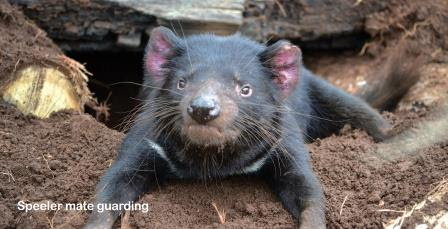
    Girls go through three breeding cycles from February to June (called oestrous) so joeys born in a breeding season can be older by four months. Once the devils have mated (yes, he does drag her into the den!), the male will guard her den for around seven days. This is called mate guarding. However, it’s a long time without eating, so if he sneaks off to find some food, another male may enter the den and mate with her. The Tasmanian devil is one of the few animals that can have multiple sires in the same litter of joeys.

    Around 25 joeys are born just 19-21 days later, but only the first four that attach to mum’s teat will live, so it’s survival of the fittest right from the start. The amazing thing is that they remain loyal to one teat for the duration so it’s easy for keepers to tell if mum had one, two, three or four joeys by how many teats are active.

    Anyway, back to my original story! We waited that first year and saw some promising signs, however it wasn’t until June that we could actually trap a female and check her pouch for young. So on a bitter winter’s day in the alpine conditions that are Devil Ark, we nervously opened the trap with anticipation. To our delight, the female devil had a “pouch full” – four joeys the size of jelly beans (and pink too) were spotted before the keepers quickly let mum go back to her den. So it was high-fives all ‘round and the sense of relief that our little conservation project was working! After all the hard work of building Devil Ark from nothing, in the middle of the bush, in torrential rain – we had joeys! It was a fantastic feeling for sure; one of the greatest days of my life. That season, we didn’t think we’d have any joeys, but the final count came in at 26!

    In Tasmania, the latest statistics on Devil Facial Tumour Disease are grim. More than 85% of the State is affected and in some parts, less than 10% of the wild population remains.

    That’s why Devil Ark is so important. Insurance breeding facilities like Devil Ark mean that we can repopulate Tasmania once Devil Facial Tumour Disease has finally run its course. Because the disease is only transmitted via biting, once the last devil has gone, the disease has gone. At this time, our devils will return to their home state and our ambitious job of saving the species from extinction will be done. My favourite animal is the Thylacine (Tasmanian tiger) and this magnificent creature became extinct in 1936. Please don’t let the devil go the same way. Our motto at Devil Ark is extinction is not an option!

    I wish you and your family a safe and Happy Easter. Autumn at Devil Ark is just beautiful, with the heat of summer behind us and the cool winds of winter approaching. Please help us continue our quest, every donation counts – and please – help us spread the word about Devil Ark by liking us on Facebook (facebook.com/tassiedevilark).
    Yours sincerely,

    Tim Faulkner

    General Manager- Devil Ark

    Mak
  • No cuts to the ABC

    1 of 1
    Why this ad?
    Solar Systems From $2,399energyaustralia.com.au/Solar – If You Find A Better Price, We’ll Match It. We Are The Solar Experts

    No cuts to the ABC

    Inbox
    x

    Jason Clare labor@australianlaborparty.emailnb.com via email.nationbuilder.com

    3:55 PM (13 minutes ago)

    to me

    Hi Neville,
    Last night I caught up with B1 and B2. The bad news is that they are on Tony Abbott’s chopping block.

    The budget is now only 8 weeks away. That means we have got 8 weeks to put the pressure on Tony Abbott to keep the promise he made the night before the election when he said there would be “no cuts to the ABC or SBS.”

    More than 25,000 people have already signed our petition, but we need to spread the word even further.

    We need your help to share our graphic on Facebook to get your friends and family to sign the petition.

    1959636_223880487819808_1042849816_n.jpg

    Click here to share our graphic on Facebook and spread the word.

    Thank you so much for all your help. We have got 8 weeks to go before the Budget. Now is the time to increase the pressure. It’s only with your support that we can protect the ABC from Tony Abbott’s razor gang.

    Jason Clare
    Shadow Minister for Communications

    P.S I spoke in the Parliament this week about cuts to the ABC and its impacts on regional Australia – you can watch it by clicking here.
    Donate

  • The CarbonClix Daily

    The CarbonClix Daily

    • Wednesday, Mar. 19, 2014
    • Next update in about 14 hours
    • Archives

    Researchers: Northeast Greenland Ice Loss Accelerating

    Shared by
    Pandeplata

    newswise.com – Newswise — COLUMBUS, Ohio—An international team of scientists has discovered that the last remaining stable portion of the Greenland ice sheet is stable no more. The finding, which will likely boos…

    Scientists Sound Alarm on Climate – NYTimes.com

    Shared by
    Marilyn Bush

    nytimes.com – Early in his career, a scientist named Mario J. Molina was pulled into seemingly obscure research about strange chemicals being spewed into the atmosphere. Within a year, he had helped discover a g…

    Climate Change Reduces Crop Yields, Says Study – TIME

    Shared by
    Greenpeace

    time.com – It’s St. Patrick’s Day, which means the 100 million or so people of Irish descent around the world get the opportunity to celebrate their heritage with song, food and increasingly controversial par…

    Climate Change: News – Amazon inhales more carbon than it emits, NASA finds

    Shared by
    Dindo Asuncion

    climate.nasa.gov – A new NASA-led study seven years in the making has confirmed that natural forests in the Amazon remove more carbon dioxide from the atmosphere than they emit, therefore reducing global warming. Thi…

    Abrupt Climate Change: No Bioperturbation

    Shared by
    Perry Bulwer

    truth-out.org – Today, we are burning fossil carbon one million times faster than it was naturally put in the ground, and carbon dioxide is increasing 14,000 times faster than anytime in the last 610,000 years (1,…

    From the Editor

    Editor’s note

    The objective of this Daily update is to provide a resource for individuals interested in understanding our impact on the planet. We at CarbonClix think everybody should care about the environment and do something about it on a daily basis. The more informed we are the easier it becomes to act. Hopefully you will find this a useful source of information.