Author: Neville

  • Climate risks as conclusive as smoking and lung cancer link – scientists

    The Daily Climate

    Climate risks as conclusive as smoking and lung cancer link – scientists


    UK flood

    Floodwaters hit Tadley, England, in 2007. Heavy flooding has hit the United Kingdom every year since. One of the world’s premier science organizations is trying, once again, to make clear to the public that rising greenhouse emissions are linked to changes we’re seeing in the world today. Photo courtesy Denni Schnapp/flickr

    March 18, 2014

    Doorstep logo

    In an unusual policy intervention, U.S. scientists say evidence that the world is warming is as conclusive as the link between smoking and lung cancer.

    A “Climate at Your Doorstep” story.

    Daily Climate staff and wire report

    Editor’s Note: “Climate at Your Doorstep” is an effort by The Daily Climate to highlight stories about climate change impacts happening now. Find more stories like this here.

    One of the world’s largest and most knowledgeable scientific bodies wants to make one point very clear: Just as smoking causes cancer, so too are humanity’s greenhouse gas emissions causing the planet to change, with potentially unknown and unalterable impacts.

    What we are trying to do is to move the debate from whether human-induced climate change is reality.

     – Alan Leshner,
    AAAS

    The American Association for the Advancement of Science, or AAAS, made a rare foray into the climate debate Tuesday, releasing a report reiterating what many scientific bodies have already said:

    The evidence is overwhelming. Temperatures are going up. Springs are arriving earlier. Ice sheets are melting. Seas are rising. Rainfall and drought patterns are changing. Heat waves are getting worse, as is extreme precipitation. The oceans are acidifying.

    WhatWeKnow-115“The science linking human activities to climate change is analogous to the science linking smoking to lung and cardiovascular diseases. Physicians, cardiovascular scientists, public health experts and others all agree smoking causes cancer,” the AAAS wrote in its report, “What We Know.

    “And this consensus among the health community has convinced most Americans that the health risks from smoking are real. A similar consensus now exists among climate scientists, a consensus that maintains climate change is happening, and human activity is the cause.”

    Move the debate

    Speaking to reporters at a teleconference, AAAS chief executive officer Alan Leshner said: “What we are trying to do is to move the debate from whether human-induced climate change is reality. We want to move the debate to: Exactly what should you do about it?”

    “We are trying to provide a voice for the scientific community on this issue so that we can help this country, help the world, move this issue forward,” he added.

    The report also warns of a “small but real” chance that a warming climate will cause sudden and possibly unalterable changes to the planet.

    This echoes the words used in the AAAS’ 2007 report by the Intergovernmental Panel on Climate Change (IPCC), which said climate change might bring “abrupt and irreversible” impacts.

    The significance of Tuesday’s report lies not in its findings, which cover familiar ground, but in who is saying it: the world’s largest general scientific body, and one of its most respected.

    Headline message

    The report’s headline messages are unambiguous. It says climate change is occurring here and now: “Based on well-established evidence, about 97 percent of climate scientists have concluded that human-caused climate change is happening.”

    This agreement, the report continued, is documented not just by a single study, but by a converging stream of evidence over the past two decades from surveys of scientists, content analyses of peer-reviewed studies, and public statements issued by virtually every membership organization of experts in this field.

    “We are at risk of pushing our climate system toward abrupt, unpredictable, and potentially irreversible changes with highly damaging impacts,” the association concluded. “Disturbingly, scientists do not know how much warming is required to trigger such changes to the climate system.”

    “As emissions continue and warming increases, the risk increases”.

    Unprecedented speed

    The AAAS says there is scarcely any precedent for the speed at which this is happening: “The rate of climate change now may be as fast as any extended warming period over the past 65 million years, and it is projected to accelerate in the coming decades.”

    Historically rare extreme weather like once-in-a-century floods, droughts and heat waves could become almost annual occurrences, it says. Antarctic and Greenland ice sheets could see large-scale collapse, the Gulf Stream could alter its course, the Amazon rain forest and coral reefs could die off, and mass extinctions could threaten ecosystems.

    The authors acknowledge that what the AAAS is doing is unusual: “As scientists, it is not our role to tell people what they should do or must believe about the rising threat of climate change,” the authors said.

    “But we consider it to be our responsibility as professionals to ensure, to the best of our ability, that people understand what we know: human-caused climate change is happening.”

    Climate News Network, a journalism news service delivering news and commentary about climate change for free to media outlets worldwide, contributed to this report.

    The Daily Climate is an independent, foundation-funded news service covering energy, the environment and climate change. Find us on Twitter @TheDailyClimate or email editor Douglas Fischer at dfischer [at] DailyClimate.org

    Find more Daily Climate stories in the TDC Newsroom

    Creative Commons License

     This work by The Daily Climate is licensed under a Creative Commons Attribution-No Derivative Works 3.0 United States License.

  • Climatologists offer explanation for widening of Earth’s tropical belt

    Featured Research

    from universities, journals, and other organizations

    Climatologists offer explanation for widening of Earth’s tropical belt

    Date:
    March 18, 2014
    Source:
    University of California – Riverside
    Summary:
    Climatologists posit that the recent widening of the tropical belt is primarily caused by multi-decadal sea surface temperature variability in the Pacific Ocean. This variability includes the Pacific Decadal Oscillation (a long-lived El Niño-like pattern of Pacific climate variability) and anthropogenic pollutants, which act to modify the Pacific Decadal Oscillation. Until now there was no clear explanation for what is driving the widening.

    A cool-water anomaly known as La Niña occupied the tropical Pacific Ocean throughout 2007 and early 2008. In April 2008, scientists at NASA’s …

    Credit: NASA image by Jesse Allen, AMSR-E data processed and provided by Chelle Gentemann and Frank Wentz, Remote Sensing Systems

    Recent studies have shown that Earth’s tropical belt — demarcated, roughly, by the Tropics of Cancer and Capricorn — has progressively expanded since at least the late 1970s. Several explanations for this widening have been proposed, such as radiative forcing due to greenhouse gas increase and stratospheric ozone depletion.

    Now, a team of climatologists, led by researchers at the University of California, Riverside, posits that the recent widening of the tropical belt is primarily caused by multi-decadal sea surface temperature variability in the Pacific Ocean. This variability includes the Pacific Decadal Oscillation (PDO), a long-lived El Niño-like pattern of Pacific climate variability that works like a switch every 30 years or so between two different circulation patterns in the North Pacific Ocean. It also includes, the researchers say, anthropogenic pollutants, which act to modify the PDO.

    Study results appear March 16 in Nature Geoscience.

    “Prior analyses have found that climate models underestimate the observed rate of tropical widening, leading to questions on possible model deficiencies, possible errors in the observations, and lack of confidence in future projections,” said Robert J. Allen, an assistant professor of climatology in UC Riverside’s Department of Earth Sciences, who led the study. “Furthermore, there has been no clear explanation for what is driving the widening.”

    Now Allen’s team has found that the recent tropical widening is largely driven by the PDO.

    “Although this widening is considered a ‘natural’ mode of climate variability, implying tropical widening is primarily driven by internal dynamics of the climate system, we also show that anthropogenic pollutants have driven trends in the PDO,” Allen said. “Thus, tropical widening is related to both the PDO and anthropogenic pollutants.”

    Widening concerns

    Tropical widening is associated with several significant changes in our climate, including shifts in large-scale atmospheric circulation, like storm tracks, and major climate zones. For example, in Southern California, tropical widening may be associated with less precipitation.

    Of particular concern are the semi-arid regions poleward of the subtropical dry belts, including the Mediterranean, the southwestern United States and northern Mexico, southern Australia, southern Africa, and parts of South America. A poleward expansion of the tropics is likely to bring even drier conditions to these heavily populated regions, but may bring increased moisture to other areas.

    Widening of the tropics would also probably be associated with poleward movement of major extratropical climate zones due to changes in the position of jet streams, storm tracks, mean position of high and low pressure systems, and associated precipitation regimes. An increase in the width of the tropics could increase the area affected by tropical storms (hurricanes), or could change climatological tropical cyclone development regions and tracks.

    Belt contraction

    Allen’s research team also showed that prior to the recent (since ~1980 onwards) tropical widening, the tropical belt actually contracted for several decades, consistent with the reversal of the PDO during this earlier time period.

    “The reversal of the PDO, in turn, may be related to the global increase in anthropogenic pollutant emissions prior to the ~ early 1980s,” Allen said.

    Analysis

    Allen’s team analyzed IPCC AR5 (5th Assessment Report) climate models, several observational and reanalysis data sets, and conducted their own climate model experiments to quantify tropical widening, and to isolate the main cause.

    “When we analyzed IPCC climate model experiments driven with the time-evolution of observed sea surface temperatures, we found much larger rates of tropical widening, in better agreement to the observed rate–particularly in the Northern Hemisphere,” Allen said. “This immediately pointed to the importance of sea surface temperatures, and also suggested that models are capable of reproducing the observed rate of tropical widening, that is, they were not ‘deficient’ in some way.”

    Encouraged by their findings, the researchers then asked the question, “What aspect of the SSTs is driving the expansion?” They found the answer in the leading pattern of sea surface temperature variability in the North Pacific: the PDO.

    They supported their argument by re-analyzing the models with PDO-variability statistically removed.

    “In this case, we found tropical widening — particularly in the Northern Hemisphere — is completely eliminated,” Allen said. “This is true for both types of models–those driven with observed sea surface temperatures, and the coupled climate models that simulate evolution of both the atmosphere and ocean and are thus not expected to yield the real-world evolution of the PDO.

    “If we stratify the rate of tropical widening in the coupled models by their respective PDO evolution,” Allen added, “we find a statistically significant relationship: coupled models that simulate a larger PDO trend have larger tropical widening, and vice versa. Thus, even coupled models can simulate the observed rate of tropical widening, but only if they simulate the real-world evolution of the PDO.”

    Future work

    Next, the researchers will be looking at how anthropogenic pollutants, by modifying the PDO and large scale weather systems, have affected precipitation in the Southwest United States, including Southern California.

    “Future emissions pathways show decreased pollutant emissions through the 21st century, implying pollutants may continue to drive a positive PDO and tropical widening,” Allen said.


    Story Source:

    The above story is based on materials provided by University of California – Riverside. The original article was written by Iqbal Pittalwala. Note: Materials may be edited for content and length.


    Journal Reference:

    1. Robert J. Allen, Joel R. Norris, Mahesh Kovilakam. Influence of anthropogenic aerosols and the Pacific Decadal Oscillation on tropical belt width. Nature Geoscience, 2014; DOI: 10.1038/ngeo2091

    Cite This Page:

    University of California – Riverside. “Climatologists offer explanation for widening of Earth’s tropical belt.” ScienceDaily. ScienceDaily, 18 March 2014. <www.sciencedaily.com/releases/2014/03/140318113829.htm>.

  • CSG: A remarkable effort GET-UP

    ere to enable desktop notifications for Gmail.   Learn more  Hide

    1 of 38
    Why this ad?
    Want to Win up to $50000?www.renewalreminder.com.au/NRMA – Share Your Car Insurance Renewal Dates with NRMA & Enter to Win!

    CSG: A remarkable effort

    Inbox
    x

    GetUp!

    6:44 PM (44 minutes ago)

    to me
    NEVILLE,

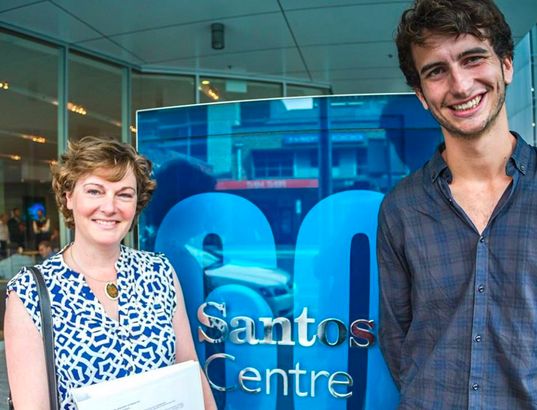
    It was what we feared all along. A coal seam gas project has poisoned an aquifer in north-west New South Wales, contaminating a catchment of groundwater.

    Since hearing the news, the response from GetUp members has been resounding. In just a few days, more than 32,000 GetUp members signed the petition targeting gas giant Santos’ CEO. More amazing still, GetUp members who own shares in Santos came forward to demand the company withdraw its developments in the region.

    On Friday, GetUp and The Wilderness Society delivered 161 resolutions from shareholders to Santos’ head office in Adelaide. Now, Santos must vote on whether to abandon their entire coal seam gas development in north-western NSW at their Annual General Meeting (AGM) in May.

    Click here to see the media coverage of the campaign and be part of the action leading to the AGM.


    https://www.getup.org.au/santos

    No matter what happens at the AGM, Santos’ CEO and board now need to justify their projects and explain their environmental breaches to their shareholders. It’s a great first step in holding Santos to account for the health and environmental risks we’ve known coal seam gas mining holds all along.

    By rallying so many of the company’s own shareholders, we’ve helped send a clear message — if Santos continues to ignore the science, they are at serious risk of losing the support of its investors.

    Right now, Santos have 56 test wells operating in the area. From these wells alone, they have reported 16 spills or leaks, including the one which poisoned an aquifer. Despite its awful environmental record, Santos is planning to build 850 wells throughout the region.

    Santos will decide on the future of the project at their AGM in May. The bigger we can grow our petition, the more shareholders we can alert to the harmful practices their company is conducting.

    Click here to sign the petition that we’ll deliver to CEO David Knox in the lead up to Santos’ AGM.

    https://www.getup.org.au/santos

    This is a great first step in the campaign against Santos’ rapid expansion into north-western New South Wales. We’ll be in touch again soon with the next phase of the campaign as the Santos AGM approaches.

    A big thank you and congratulations to our partner on this campaign, The Wilderness Society, without who’s hard work and great campaigning this never would have happened.

    Thanks to you too, for all that you do.

  • Palmer backs renewables as solar campaign heats up

    Palmer backs renewables as solar campaign heats up

    By on 19 March 2014
    Print Friendly

    The campaign to thrust the solar industry into the electoral limelight appears to have claimed its first major success after the Palmer United Party declared its support for the renewable energy target to remain as is.

    The re-run of the Senate count in West Australia is seen as crucial for the balance of power in the Senate, particularly over issues such as the renewable energy target, the carbon price, and the future of organizations such as the Clean Energy Finance Corp and the Climate Change Authority.

    For this reason, the Australian Solar Council launched a campaign to make solar – and the RET in general – a campaign issue, putting pressure on all parties to declare support for the RET as is – a 41,000GWh target by 2020, and leaving the small scale component untouched.

    palmer

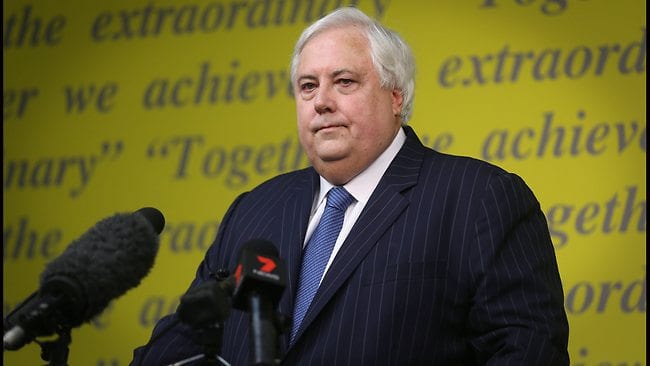
    Clive Palmer – will the aspiring coal baron emerge as saviour of renewable target?

    On Tuesday, Palmer United Party (PUP) Senate candidate Dio Wang came out in support of the RET. In a press statement, Wang said that the RET, “should remain as it is.”

    “It worries me when the government says everything is on the table in reviewing the RET,” said Wang. The PUP candidate said that the RET, “was the right scheme for maintaining and improving Australia’s environment.”

    His comments were later endorsed by Clive Palmer, who had previously made little comment about renewables.

    Dio Wang’s position poses a significant threat to the Abbott government’s ability to scarp or dilute the RET, which mandates 41,000 GWh of renewable energy capacity to be developed by 2020, as any legislation to reduce the RET would have to be passed by both houses of Parliament.

    Even when the new Senate forms in July, the Federal Government will not have an absolute majority and with two PUP senator taking their seats, along with Motoring Enthusiast party’s Ricky Muir – with whom PUP share a voting alliance – passing RET changes looks an increasingly difficult task.

    This does, however, assume that all PUP candidates follow through on support for the RET. Clive Palmer himself has plans to scrap the carbon tax and has issued campaign material saying that PUP was the only party West Australian’s could rely on to scrap the mining and carbon taxes.

    Further complicating the matter for Abbott are signs are that Labor will retain its second WA Senate seat this time around, with the Liberals retaining its three with the final being fought out between the Greens’ Scott Ludlam and PUP.

    With both the WA PUP candidate and the Greens in support of the current RET, it appears likely that the WA result will deliver three senators in favour of changes to the RET and three against.

    ABC election analyst Antony Green told The West Australian newspaper that the preference flows indicate that the 3 Liberal, 2 Labor, Green or PUP is the likely result of the WA Senate rerun.

    “The last spot will come down to Ludlam, Palmer United or one of the micro-parties,” said Green. Of the micro-parties Green said the Sustainable Population Party and the HEMP party are best situated to benefit from preference flows.

    Abbott, Opposition Leader Bill Shorten and Greens Deputy leader Adam Brandt have all visited WA in the last week to campaign ahead of the state’s April 5 Senate poll.

    The solar industry has done the same, with the Australian Solar Council set to publish a solar scorecard on the Senate candidates in The West Australian newspaper this weekend, backed by a TV advertising campaign.

    ASC chief John Grimes noted that the Greens actually supported an increased renewables target.  “We want all political parties to commit publicly to saving solar and the Renewable Energy Target,” he said.

    “Politicians know Australians love solar because it cuts household power bills. They know that supporting the Renewable Energy Target at the Senate election will deliver them votes.  Not supporting the Renewable Energy Target will cost them votes.”
    The Solar Citizens group has welcomed Dio Wang’s move, saying that with almost 150,000 homes in WA featuring a PV array, solar is hugely popular in the state.

    “That’s over 360,000 voters who are wondering how the candidates in WA will ensure that solar is secure in the State – and can continue to grow,” said Solar Citizens’ National Director Lindsay Soutar.

    The solar lobby group pointed to the backflip on a FIT reduction, proposed by Liberal Premier Colin Barnett’s government last month. Barnett and Energy Minister Nahan backed down from plans to slash the FIT for existing FIT customers within days of having announced the move.

    Friends of the Earth welcome PUP’s committmet to the RET. “Clive Palmer is an astute politician who understands Australians dont want to go backwards on renewable energy,” spokesman Leigh Ewbank said.

    “If the RET Review recommends cutting the Target they ‘re risking 4000 jobs and $10 billion worth of investment.”

    The ballot draw appears to have handed an advantage to the Greens’ Ludlam. The Wikileaks party has drawn the ballot’s first column and would presumably benefit from donkey votes. Wikileak’s deputy chairman Omar Todd has already indicated support for Senator Ludlam – who is an outspoken advocate for digital freedom.

    “We have a lot of respect for Scott Ludlam, and we would love to contribute to him,” said Todd.

    Labor candidate and current Senator Louise Pratt also appears to have benefited from preference deals in the WA race. The Sex Party has preferenced the ALP ahead of the Greens and directed its preferences directly to Pratt. Some other micro parties have followed suit and directed preferences directly to Senator Pratt.


  • CEFC $20mln loan to keep wave energy at home

    CEFC $20mln loan to keep wave energy at home

    By on 19 March 2014
    Print Friendly

    The Clean Energy Finance Corporation has provided a $20 million loan facility to Australia’s Carnegie Wave Energy that will likely see the company’s first commercial-scale wave energy array built in its home country.

    The loan facility is significant for two reasons: it is probably the first ever pure debt facility provided to the nascent wave energy sector; secondly, it could provide the catalyst to arrest the history of Australian developed technologies shifting to overseas markets.

    carnegie

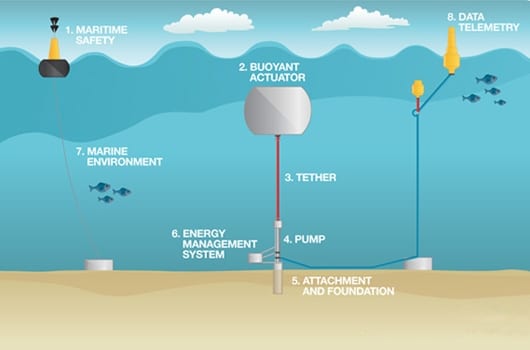
    Carnegie is current building the Perth wave energy project off the Garden Island naval base, which is the world’s first multi-machine wave energy project (it has three of its CETO-5 machines, pictured above), and the first demonstration of its ability to provide emissions-free desalinated water.

    However, the next project will feature CETO-6 machines, which will be twice the size of CETO-5 – at around 500kW each – and will be the first at what the company expects will be commercial scale size machines.

    Carnegie has been looking at four sites for that project – two in Australia (including Rottnest Island) and two overseas. CEO Michael Ottaviano said the CEFC funding boosted the chances of it occurring in Australia. In fact, he said, the loan facility is dependent on it.

    Carnegie has yet to release the scale and costs of the CETO project, although it is likely to start as a 3-machine installation before being expanded – likely to 20MW or beyond. Scale is the key to cost reductions.

    “The CEFC funding dramatically increases chances to deliver project in Australia,” Ottaviano told RenewEconomy. “Funding is a key uncertainty. Being able to secure for what is for Carnegie a significant amount of capital is a big part of the project de-risking process.”

    CEFC CEO Oliver Yates told RenewEconomy that obtaining debt funding was a critically important transition that every company had to go through as it moved towards commercialisation.

    “We are making this loan to ensure that the project is fully funded and can proceed,” Yates said. “It is a very important step that these companies go through – we will hold the company’s hand as they move through development, and they gain an understanding of how to manage debt. After this project, (Carnegie) will move on to much larger projects, and they will need a lot more debt for those.”

    Ottaviano said preliminary design for CETO-6 is happening now, and talks are being held with state governments over site tenure. However, because sites are a critical part of the equation, Carnegie will continue to progress offshore sites, at least for the time being. He hopes the CETO-6 project will be in construction in 2016.

    Carnegie last year raised $4 million in a convertible debt issue, which is considered to be a debt equity hybrid. All its other funding has come from equity and government grants.

    Ottaviano says he believes that the CEFC facility is the first pure debt facility ever for a wave energy project.

    “It is important and ground breaking,” he said. “It allows us to engage in a whole new pool of capital, and we can start having serious conversations with those debt providers.

    “As we scale up, and as we demonstrate this technology successfully, (loan providers) will provide most of the capital for most of these projects.”

    Ottaviano says Australia should be a world leader in wave energy, given its technology breakthroughs, its excellent wave energy resource, and the technology capabilities built up in the offshore oil and gas industries.

    “We believe there is significant potential for Australia to be a leader in this field which can create new industry and export opportunities,” he said in a written statement.

    Yates agreed, saying Australia has the wave energy resources and the skills to become a major player in the global wave energy sector. “This is an industry of the future with great potential for Australia,” he said.

    The World Energy Council has estimated that approximately 2 terawatts (2 million megawatts), about double current world electricity production, could be produced from the oceans via wave power. It is estimated that 1 million gigawatt hours of wave energy hits Australian shores annually (Australia’s current renewable energy target is 41,000GWh, and its total consumption less than 250,000GWh).

    In 2011, the UK Carbon Trust estimated that the Global Marine Energy sector could be worth US$760 billion by 2050 and could support 68,000 jobs in the British Marine energy sector alone.

    The loan facility is CEFC’s first wave energy investment and is the first of a new hybrid corporate loan/project finance financing structure that was developed for this transaction by Carnegie and the CEFC. T

    CEFC says the new financing model is designed to fund the development of a specific project but upon drawdown places security over the assets of the company including any cash refunds the company will receive under the R&D tax incentive. While technically a corporate loan, upon drawdown, which is at Carnegie’s election, this facility has a high level of structural controls akin to those found in project finance transactions.

    The $20 million 5 year term facility is provided at commercial rates and fees with no concessionality. The establishment fee and commitment fees for 2014 can be paid by Carnegie through the issue of 15 million ordinary shares in Carnegie. The shares are to be issued in 3 tranches of 5 million. The first tranche of 5 million shares was issued by Carnegie on execution of the facility agreement. Further details of the facility terms will be provided once Carnegie draws down debt under the facility.


  • Carbon crash – solar dawn

    Carbon crash – solar dawn

    By on 19 March 2014
    Print Friendly

    I think it’s time to call it. Renewables and associated storage, transport and digital technologies are so rapidly disrupting whole industries’ business models they are pushing the fossil fuel industry towards inevitable collapse.

    Some of you will struggle with that statement. Most people accept the idea that fossil fuels are all powerful – that the industry controls governments and it will take many decades to force them out of our economy. Fortunately, the fossil fuel industry suffers the same delusion.

    In fact, probably the main benefit of the US shale gas and oil “revolution” is that it’s keeping the fossil fuel industry and its cheer squad distracted while renewables, electric cars and associated technologies build the momentum needed to make their takeover unstoppable – even by the most powerful industry in the world.

    How could they miss something so profound? One thing I’ve learnt from decades inside boardrooms is that, by and large, oil, coal and gas companies live in an analytical bubble, deluded about their immortality and firm in their beliefs that “renewables are decades away from competing” and “we are so cheap and dominant the economy depends on us” and “change will come, but not on my watch”. Dream on boys.

    Their delusion, however, is good news for the world. If the industry really understood what was happening, it would pull out all stops to prevent it. While they’d ultimately fail, it would cost us decades of lost time – decades we can’t afford if we are to stabilise society and reduce the risk of collapse.

    I intend to spend this year writing about these trends. They can’t be covered in a single column because they are so broad and interconnected. In fact this is perhaps the best example I’ve seen of system-wide transformational change driven by parallel, apparently disconnected forces. Here I will provide an overview, with further reading, so you can more easily see the signals emerging around us. I’ll then dive into more detail over the coming months.

    I think it’s important to always start with a reminder of the underlying context. As I argued in my book The Great Disruption, dramatic economic change is not a choice we get to make it, but an inevitable result of physical science. This is because business as usual, with results like ever increasing resource constraint or a global temperature increase of 4 degrees or more, would trigger economic and social collapse. So the only realistic outcomes are such a collapse or an economic transformation that prevents it, with timing the only big unknown. I argued transformation was far more likely and, to my delight, that’s what we see emerging around us today – even faster than I expected.

    In parallel, we are also seeing the physical impacts of climate change and resource constraint accelerating. This is triggering physical, economic and geopolitical responses – from melting arctic ice and spiking food prices to the Arab Spring and the war in Syria. (See here for further on that.) The goods news in this growing hard evidence is that the risk of collapse is being acknowledged by more mainstream analysts. Examples include this commentary by investment legend Jeremy Grantham and a recent NASA funded study explained here by Nafeez Ahmed. So the underlying driver – if we don’t change in a good way, we’ll change in a very bad way – is gathering acceptance.

    So while it now frames thinking in this area, the mistake many make is to then extrapolate that risk into a likely global policy response as the main driver of change. The thinking goes that we need a “Pearl Harbour moment” – a physical event that forces a global policy agreement to change. As I also argued in The Great Disruption, that’s not how systems change or how our global market society works. Things are far more chaotic and messy – though ironically probably more predictable.

    In that systems context, economics is the best lens through which we can both see the triggers for transformation and are able to measure its progress. And let’s remember we care more deeply about economics and markets – at both the personal and macro level – than about polar bears or ecosystems. Crazy and irrational but still true.

    So when we see the price of solar plunge at extraordinary speed and watch it’s deployment swing like a wrecking ball through the utility sector, we should acknowledge it’s going to have more impact on the human system response to climate change than the terrifying acceleration of the melting of the Arctic.

    And when I say wrecking ball I probably understate it. As this excellent overview from Stephen Lacey at Greentech Media explains, the utility sector now faces a “death spiral”, and it’s likely many of them won’t make it. This is not a theoretical future crisis – growth in renewables is the prime reason the top 20 European utilities have lost $600 billion (no, not a typo!) in value over the past 5 years. That’s what the financial carbon bubble bursting in a sector looks like – ugly and messy – and there’s many more to come.

    The utility death spiral is a great example of system complexity that is simple to understand. Solar energy costs have plummeted – so far that in most places you can get electricity cheaper from your own solar panels than you can from a utility. The impact on the grid of people doing so at scale is to lower the overall cost of electricity generation by reducing both peak demand (and so peak pricing) and lowering volume. Utilities are then stuck with expensive physical assets, less sales and lower margins, so they need to increase either the cost per unit of power or impose grid connection charges to customers. But doing either gives customers more motivation to leave the utility – thus the death spiral.

    And the disruption is worse for old players because this is not just technology switching. The whole sector is moving to a distributed rather than centralised system, thereby inviting in countless new, nimble competitors into the space. This is fundamental structural change that is going global, as Giles Parkinson from RenewEconomy explains.

    If you think this utility problem isn’t enough to seriously threaten the overall fossil fuel industry, then think again – this is just one of a number of fronts where they’re being hammered. Long term expert on oil and energy trends, Richard Heinberg, explains the oil story well in this podcast, while this excellent overview from Chris Nelder, shows how oil, gas and coal are all under serious pressure. Like Heinberg, Nelder also argues the “soaring cost of producing oil has far outpaced the rise in oil prices”. Nelder also notes that in the US alone, 60 GW of coal power plants are expected to be taken off line by 2016 – double the volume forecast by the EIA less than 2 years ago. Things are moving very quickly now.

    This is all just a brief insight into what’s happening and just touches on the complexity and interconnectedness of various disruptive trends.

    I haven’t mentioned the revolution underway with electric cars, where Tesla is valued at more than half of GM – despite the latter producing 300 times as many cars! Do you think the market knows where that is going? Or the incredible impact of China having to clean up their air or risk economic and social unrest – knowing when China acts the market impacts are world scale.

    Or the role of digital technology and dot com billionaires in driving disruptive change via the move to a distributed energy system – one characterised by rapid innovation and entrepreneurship and the arrival of the “Internet of Things”. It’s in these connections between innovations that the most interesting disruptions are developing. So electric cars become grid storage devices for home renewables, with each car a mini-power station in peak times. I’ll never look at a city car park the same way again.

    Already businesses in the US can get battery systems from Coda Energy to even- out grid power use and avoid peak pricing. With software monitoring the grid to know the highest value time to respond, it can be installed at zero cost then paid for by sharing the savings with the battery company! And the solar industry is at last in boom times, with the HSBC’s Global Solar index up 65% last year and already up 23% in 2014.

    It won’t be long before all these new players take on the old ones in a battle of “business vs business”, a moment I’ve argued was coming. Knowing how fast new technology players can sweep away slow movers, that will be an interesting battle to watch!

    And all this brings increasing recognition by investors that the carbon bubble and stranded assets are serious financial risks, which in turn reinforces the growing power of NGO campaigns against coal and CSG along with their fossil fuel divestment campaign. Then of course there is the role of climate policy which, given the threat to civilisation, seems like it might gain traction at some point!

    So, as I see it, the game is up for fossil fuels. Their decline is well underway and it won’t be a gentle one. Of course they won’t just be gone in few years but once the market and policy makers understand what’s happening, it will become self- reinforcing and accelerate rapidly. Markets come into their own in situations like this. They rarely initiate change, but once they’re racing down the hill, it’s time to jump on board or get out of the way. It’s an ugly and brutal process for those involved, but it gets the job done quickly.

    When that occurs, we may find that those forecasts by myself and others like Tony Seba from Stanford University, that the oil, coal and gas companies will be all but obsolete by 2030, might turn out to be conservative after all. Interesting times indeed.