Author: Neville

  • The new faces of anti-coal activism 350 org

    1 of 1
    Why this ad?
    Gorilla Trackingwww.kazingatours.com – Uganda and Rwanda Safaris and Tours

    The new faces of anti-coal activism

    Inbox
    x
    Personal
    x

    Blair Palese, 350.org Australia australia@350.org Unsubscribe

    11:34 AM (2 hours ago)

    to me

    Dear friend,

    As the dawn rises, we’re writing to you from a tarp-covered office in the middle of a paddock just near Maules Creek, in north-western NSW.

    Over the past two days, the 350.org Australia team has joined the camp here to help step up the fight to stop Whitehaven’s massive new coal mine expansion at Maules Creek. We never set out to be in this position, but with formal avenues to halt this mine exhausted, peaceful direct action is where the fight is now at.

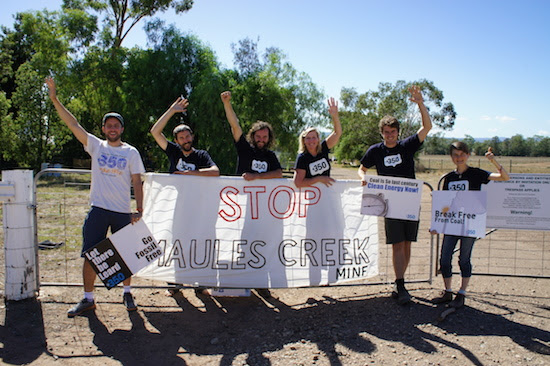
    In just two days, it has been truly inspiring to see what a small group of committed individuals can achieve. Retirees, young people, religious leaders — people from all walks of life — are here at the camp, day in and day out, putting themselves on the line to safeguard our future.

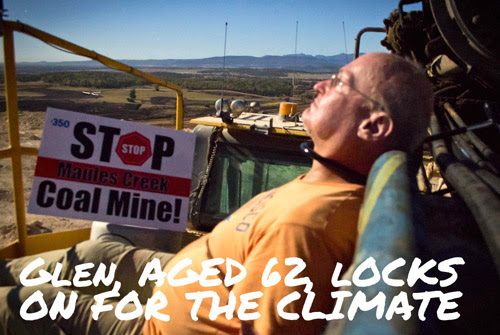
    Take yesterday for example, where a young man locked himself on to a drill rig and blocked work for twelve hours, while a small group of people blocked an access road for six hours and two people attached themselves to a crane, stopping construction of a new mine railspur. Or take the early hours of this morning where a 62 year-old retired geophysicist from Canberra locked on to a blast drill rig. Or last week where a group of ministers, priests, monks and lay people were arrested for peacefully blocking access to the mine.

    Click here to LIKE and SHARE our meme above and blog to share Glen’s story to spread the word about these brave acts of everyday Australians moving us beyond coal.

    Although each of these brave acts alone won’t stop the mine, together they send a powerful message that we won’t give over our future to big coal. Together, they cost Whitehaven dollars and time and show coal for what it is: a dying industry that is rapidly losing its social license.

    This campaign isn’t rocket science. It’s about simple acts of bravery by everyday individuals – people like you, me, like Glen the geophysicist and Thea the Christian leader. And it’s about delays – each of which makes this and other coal projects a little harder to justify, each of which sends a signal to investors and the fossil fuel industry that new expansion projects like these face growing public opposition.

    But to build this story and to delay this project fast enough, we need you. Consider what we achieved in two days with a small group against what we could achieve with hundreds of you here. Whether it’s a day or a week, a fundraiser or an info session, every contribution counts.

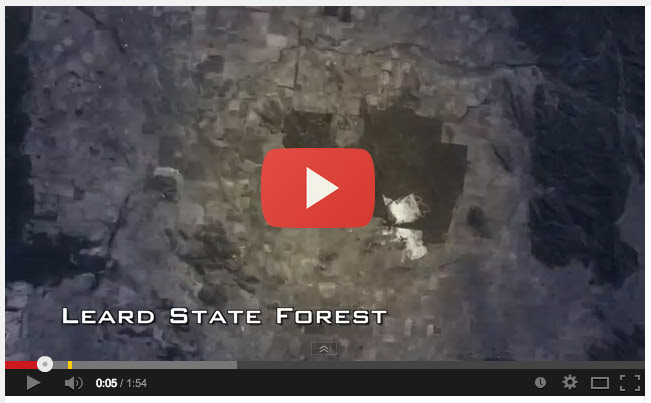
    If you’re ready to make the trek to the camp, a terrific opportunity is coming up on March 28 when more of us than ever before will converge on Maules for Act-Up 3. Watch this video to learn more…

    And if you’re apprehensive about coming to camp, you needn’t be! The team here is second to none, with highly experienced campaigners, legal support and media professionals. There is even a fully kitted-out kitchen, showers, internet, flushing toilets, and alternative accommodation options if you can’t camp.

    You don’t have to get arrested to make a contribution! There are many support roles and non-arrestable protests that you can be part of. Click here to register your interest in coming to the camp. And if you can’t make it to the camp, there are plenty of other ways you can get involved – click here to find out how you can help from home.

    History is in the making at Maules Creek. The turning point for Australian coal is within our reach. Join us to be part of this. Join us to help move Australia beyond coal.

    Respectfully yours,

    Blair, Josh, Phil, Charlie, Aaron and the rest of the 350.org Australia team


    350.org is building a global climate movement. Connect with us on Facebook and Twitter, and sign up for email alerts. You can help power our work by making a donation. To change your email address or update your contact

  • Antony Green’s Election Blog WA SENATE

    « Update on Tasmanian Election Results | Main

    March 17, 2014

    A Summary of Preferences and Candidates for the WA Senate Re-election

    If you re-run last September’s Western Australian Senate election with the same votes but using the new Senate preference tickets, then the result of the WA Senate re-election on April 5 would be 3 Liberal, 2 Labor and 1 Palmer United.

    This is the same as the result of the first count last September, the subsequent re-count and disaster of missing ballot papers changing the result to 3 Liberal and one each for Labor, the Greens and Sport Party.

    Full details of the preference tickets as well as a Senate Calculator using them will be published on the ABC elections site later this week.

    For the re-election, several micro-parties have directed preferences in a way that now helps Labor to reach its second quota and makes it harder for the Green’s Scott Ludlam to win without a significant rise in his vote.

    The Sports Party does not receive as many helpful preferences as last September. There is a subtle shift in the structure of the micro-party alliance, with a more obvious split between left-leaning and right-leaning micro-parties.

    It is likely there will be a lift in Labor’s first preference vote on April 5. Labor polled 26.59% last September and needs only 28.57% to be certain of two Senate seats. Labor has a much better ballot draw in column F rather than column Z, and seven months have passed since the defeat of the Rudd government. Even if Labor falls short of 28.57%, there are helpful micro-party preferences flows aimed at getting second placed candidate Louise Pratt elected.

    Once again the Liberals and Nationals are doing a direct preference swap. Last September the Nationals polled 5.07% and the Liberals 39.20%, 44.27% in total, easily above the 42.86 that would ensure three seats for the Coalition.

    The Nationals have a much better ballot draw in column B compared to column U last September, while the Liberals have only moved from column AA to R. It may be the Nationals poll slightly stronger and the Liberals weaker.

    Unless the Liberals and Nationals fall dramatically short of three quotas, there are enough micro-party preferences floating around to ensure they win three seats between them. The biggest danger for the Liberals is probably losing a seat to the Nationals rather than to any other party.

    If the first five seats point strongly to 2 Labor and 3 Coalition, preference flows favour the Palmer United Party to win the final seat ahead of the Greens, unless there is a rise in Green support.

    Enough of the micro-parties have inserted Palmer United in the middle of their ticket to ensure it will be difficult for a micro-party to harvest enough preferences to defeat Palmer, as long as Palmer United can repeat its vote of around 5% last September.

    If Palmer stays ahead of any right-wing micro-party, Palmer United can win election on micro-party, Liberal and National preferences.

    The Green’s Scott Ludlam will find himself a bit orphaned on preferences. The Greens polled 9.5% last September, but have lost a couple of micro-party preferences to Labor. Ludlam’s best chance of victory is for Labor to poll more than two quotas in its own right, in which case preferences that might have helped Labor win a second seat instead flow to the Greens.

    The problem for Ludlam is that a rise in Labor’s support could be at the expense of the Greens. Labor plus the Greens polled 36.08% last September, and this combined vote probably needs to reach 40% before Ludlam can be assured of victory. Ludlam will be helped by any donkey vote boost achieved by Wikileaks drawing column A.

    Where last September Labor and the Greens were competing for the same seat, if Labor gets to two quotas then the Greens are likely to be competing with Palmer United Party for the final seat.

    Of the micro parties, a couple such as Sustainable Population and HEMP do very well on preferences from left and right, but get shut out behind Palmer in any Liberal and National surplus. Wikileaks will stay in the count for a surprisingly long time with a significant first preference vote, but will miss out to Palmer United on preferences from the Liberals, Nationals and the Christian Parties.

    Unless there is a significant rise in the combined vote of Labor and the Greens, the preferences deals mean the two parties can win only two seats, and for the reasons I pointed out above, Labor is better placed to win a second seat, putting Ludlam in the race for the final seat against Palmer United.

    Of course, the larger ballot paper may play a part in the outcome. The number of columns has increased from 28 columns to 34, and the number of candidates from 62 to 77. The ballot paper will be the same length, but the font size has had to be reduced.

    Of the 77 candidates , only 36 contested last September’s WA Senate contest. Eight contested WA lower house seats last September, while another eight get a second go at Senate glory after being defeated in inter-state Senate races last September.

    The following parties are running exactly the same candidates on their tickets, the Australian Democrats, Liberal Democrats, Australian Voice, Family First, Australian Sports Party, Shooters and Fishers, Smokers’ Rights, Rise Up Australia and Animal Justice.

    Labor is running the same two lead candidates, Joe Bullock and Louise Pratt, with new third and fourth candidates. The Liberal Party has shortened its ticket from six to four candidates but is running the same candidates as the first four nominated last September.

    Four parties have changed their candidates but kept the same lead candidate. These are the Greens (Scott Ludlam), the Australian Motoring Enthusiasts Party (Richie Howlett) , the Secular Party (Simon Cuthbert), and the Outdoor Recreation Party (Stop the Greens) (David Fishlock).

    Palmer United has mixed and matched its ticket, still led by Zhenya Wang, former lower house candidate for Durack Des Headland at number two, with number two last September in Chamonix Terblanche now at number three.

    Wikileaks and the Nationals have changed both candidates on their tickets. The Nationals have replaced David Wirrpanda and David Eagles with two defeated Nationals candidates from last year’s state election, Shane Van Styne and Colin De Grussa.

    New parties contesting the re-election that did not run in WA last September are the Pirate Party, Voluntary Euthanasia Party, Building Australia Party, Republican Party of Australia, Mutual Party, Democratic Labour Party and the Socialist Alliance.

    Three parties that contested last year but not the re-election are the Socialist Equality Party, Australian Independents and One Nation.

    Four parties run under different names. No Climate Tax Climate Sceptics have changed their name to the Freedom and Prosperity Party. The Stable Population Party has become the #Sustainable Population Party, with the ‘#’ being part of the registered name. The Bank Reform Party is now the Mutual Party, while Stop the Greens have chosen to use their full name, Outdoor Recreation Party (Stop the Greens). Presumably this longer name will take up more space at the top of the ballot paper.

    As well as Headland, seven other candidates were defeated contesting WA lower house seats last September. This includes four Greens, Ian James (Durack last September), Jordan Stele-John (Fremantle), Sarah Nielsen-Harvey (Pearce) and Judith Cullity (Curtin). Ungrouped candidates Teresa Van Lieshout (Fremantle) and Kim Mubarek (Stirling) ran as Independents in the lower house last September, while new lead Katter’s Australian Party candidate Phillip Bouwman contested O’Connor last September.

    One unique record lies with ex-Liberal MP and ex-Family First and Independent candidate Anthony Fels. Last September he was the lead WA candidate for Katter’s Australian Party. Now he leads the Mutual Party ticket, a party that has changed its name from the Bank Reform Party and did not contest the WA Senate last year.

    The eight candidates who unsuccessfully ran for the same party but in different states last September are –

    Leon Ashby (Freedom and Prosperity) – South Australia in September
    Bill Koutalianos (Freedom and Prosperity) – New South Wales
    Philip Nitschke (Voluntary Euthanasia) – ACT
    William Bourke (#Sustainable Population) – New South Wales
    James Moylan (HEMP) – Queensland
    Suzzanne Wyatt (Fishing and Lifestyle) – Queensland
    Fiona Patten (Sex Party) – Victoria
    Joaquim De Lima (Outdoor Recreation) – New South Wales.

    A number of candidates list their addresses as being in other states, and a significant number give no addresses.

    Only four groups have nominated more than two candidates, Labor (4), Palmer United (3), Liberal (4) and Greens (6).

    Posted by on March 17, 2014 at 11:24 PM in Federal Politics and Governments, Senate Elections | Permalink

    Comments

    Is it any wonder that only four groups nominated more than twoi candiodates. At a $2000 per candidate deposit ith increased difficulty in getting deposit back tha majority of potential candidates are actively discouraged by nomination fee.

    COMMENTS: If a candidate cannot afford the deposit, then they won’t be able to afford to campaign, which makes it very difficult to be elected. That is unless you treat the deposit as being like buying a lottery ticket, which is what the current preference ticketing system is.

    Posted by: Andrew Jackson | March 17, 2014 at 11:55 PM

    I would have thought a rise in the combined ALP and Green vote of 4% after Labor moving from unpopular incumbent, some national poll decline for the Libs and Scott Ludlam having a much increased profile. The focus will be very strongly on not giving outright control to one party and this will not help the Lib vote. There is also likely to be a nervousness about microparties after last time. The fact that there is no Hof Reps election should also assist a Senate focussed party like the Greens.

    COMMENT: Nervousness about the micro parties may equally increase Liberal and National vote.

    Posted by: Peter Allan | March 18, 2014 at 12:15 AM

    The GVT for the Australian Christians seems rather odd, can you explain what they might be trying to achieve with the one ALP candidate tucked into the four LIB candidates?

    COMMENT: It is an irrelevant preference. Bullock will already have been elected so the preference would be skipped.

    Posted by: 2dogs | March 18, 2014 at 01:44 AM

    Any strategical significance in Greens running 6 candidates ? Purely for campaigning reasons (meet the senate candidate) or is there some other strategy at play.

    COMMENT: They stick out more on the ballot paper.

    Posted by: Scott | March 18, 2014 at 02:15 AM

    I find it absolutely appalling that candidates from other jurisdictions are permitted to nominate. So much for the notion that the Senate is the States’ house in the parliament!

    COMMENT: There has never at any time in Australian history been a law that prevents candidates from being nominated for contests in electorates where they do not live. Nominators must live in the electorate but residency for candidates has never been required. As far as the Senate is concerned, the Constitution protects free movement between the states which means candidates from other states are allowed to be nominated.

    Posted by: Joe | March 18, 2014 at 02:21 AM

    Hi Antony,

    I enjoyed the coverage during the Tasmanian election but due to the conclusive polling, unfortunately did not get to see as much analysis from you as I hoped.

    I am just wondering if there will be a WA Senate re-election calculator in the lead-up to the polls?

    COMMENT: The answer is in the 3rd paragraph of the post you have just commented on.

  • Scientists find cosmic ripples from birth of universe

    Scientists find cosmic ripples from birth of universe

    Published March 17, 2014

    FoxNews.com
    • bicep 2 cosmic.jpg

      This NASA graphic shows the universe as it evolved from the big bang to now. Goddard scientists believe that the universe expanded from subatomic scales to the astronomical in a fraction of a second after its birth. (NASA/WMAP)

    • bicep 2 cosmic 2.jpg

      Gravitational waves from inflation generate a faint but distinctive twisting pattern in the polarization of the cosmic microwave background, known as a “curl” or B-mode pattern. For the density fluctuations that generate most of the polarization of the CMB, this part of the primordial pattern is exactly zero. Shown here is the actual B-mode pattern observed with the BICEP2 telescope, which is consistent with the pattern predicted for primordial gravitational waves. The line segments show the polarization strength and orientation at different spots on the sky. The red and blue shading shows the degree of clockwise and anti-clockwise twisting of this B-mode pattern. (BICEP2 Collaboration)

    • bicep 2 cosmic 1.jpg

      The tiny temperature fluctuations of the cosmic microwave background (shown here as color) trace primordial density fluctuations in the early universe that seeded the later growth of galaxies. These fluctuations produce a pattern of polarization in the CMB that has no twisting to it. Gravitational waves from inflation are expected to produce much a fainter pattern that includes twisting (“B-mode”) polarization, consistent with the pattern observed by BICEP2, which is shown here as black lines. The line segments show the polarization strength and orientation at different spots on the sky. (BICEP2 Collaboration)

    • bicep 2 cosmic 3.jpg

      The sun sets behind BICEP2 (in the foreground) and the South Pole Telescope (in the background). (Steffen Richter (Harvard University))

    Astronomers have discovered what they believe is the first direct evidence of the astonishing expansion of the universe in the instant following the Big Bang — the scientific explanation for the birth of the universe some 13.8 billion years ago.

    Scientists believe that the universe exploded from a tiny speck and hurled itself out in all directions in the fraction of a second that followed, beginning just 10 to the minus 35 seconds (roughly one trillionth of a trillionth of a trillionth of a second) after the universe’s birth. Matter ultimately coalesced hundreds of millions of years later into planets, stars, and ultimately us.

    And like ripples from a ball kicked into a pond, that Big Bang-fueled expansion caused ripples in the ancient light from that event, light which remains imprinted in the skies in a leftover glow called the cosmic microwave background.

    Scientists still don’t know who kicked the ball.

    But if confirmed, the newfound ripples would be amazing proof of what has long been mere theory about what happened in those first millionths of a second.

    ‘[It’s] a direct image of gravitational waves across the entire sky, showing us the early universe.’

    – John Kovac, of the Harvard-Smithsonian Center for Astrophysics

    “The implications for this detection stagger the mind,” said Jamie Bock, professor of physics at Caltech, laboratory senior research scientist at the Jet Propulsion Laboratory (JPL) and project co-leader. “We are measuring a signal that comes from the dawn of time.”

    “It would be the most important discovery since the discovery, I think, that the expansion of the universe is accelerating,” Harvard astronomer Avi Loeb, who is not a member of the study team, told Space.com. He compared the finding to a 1998 observation that opened the window on mysterious dark energy and won three researchers the 2011 Nobel Prize in physics.

    The groundbreaking results came from observations by BICEP2, a telescope at the South Pole, of the cosmic microwave background — a faint glow left over from the Big Bang.

    Beginning a fraction of a fraction of a second after the universe’s birth, according to the current theory, space-time expanded incredibly rapidly, ballooning outward faster than the speed of light. The afterglow from that expansion is called the cosmic microwave background, and tiny fluctuations in it provide clues to conditions in the early universe.

    For example, small differences in temperature across the sky show where parts of the universe were denser, eventually condensing into galaxies and galactic clusters.

    Since the cosmic microwave background is a form of light, it exhibits all the properties of light, including polarization. On Earth, sunlight is scattered by the atmosphere and becomes polarized, which is why polarized sunglasses help reduce glare. In space, the cosmic microwave background was scattered by atoms and electrons and became polarized too.

    “Our team hunted for a special type of polarization called ‘B-modes,’ which represents a twisting or ‘curl’ pattern in the polarized orientations of the ancient light,” said Bock.

    The team presented their work at a press conference Monda at Harvard — the discovery of that characteristic pattern of polarization in the skies, which they called proof of the gravitational waves across the primordial sky.

    “This work offers new insights into some of our most basic questions: Why do we exist? How did the universe begin? These results are not only a smoking gun for inflation, they also tell us when inflation took place and how powerful the process was,” Harvard theorist Avi Loeb said.

  • Climate and Energy: Testimony to the United States Senate HANSEN

    3 of 42
    Why this ad?
    Pay Phone Repairswww.duons.com.au – Off site repair & refurbishment of Pay Phones. Medium/High Volume Only

    Climate and Energy: Testimony to the United States Senate

    Inbox
    x

    James Hansen via mail4.wdc03.rsgsv.net

    3:25 AM (5 hours ago)

    to me
    Email not displaying correctly? View it in your browser.
     Climate and Energy: Testimony to the United States Senate
    My testimony to the Senate Committee on Foreign Relations, including the four charts that I used, is also available on my web site.  Discussion at the hearing revealed that most politicians have hardened positions. Hopefully Kerry and Obama recognize that Keystone would signify the full-body dive into unconventional fossil fuels that assures game-over for climate, i.e., assures disastrous climate effects for young people and future generations.  Rejection of KXL would provide a brief respite that may allow implementation of a simple flat rising carbon fee-and-dividend approach, which has the potential to go near-global.

    ~Jim
    17 March 2014

    Like my Facebook page
    Like https://www.facebook.com/jimehansen on Facebook

  • Hansen Web Page and Reports.

    Home  »  Uncategorized   »   Hansen Web Page and Reports.

    Hansen Web Page and Reports.

    Posted in Uncategorized By Neville On March 13, 2014

    Home  »  Uncategorized   »   Hansen Web Page and Reports.

    Hansen Web Page and Reports.

    Posted in Uncategorized By Neville On March 1, 2014

    Dr. James E. Hansen

    Columbia University
    Earth Institute
    475 Riverside Drive
    New York, NY 10115 USA
    E-mail: jeh1@columbia.edu

    “Storms of My Grandchildren”, by James Hansen

    On the webpage “Updating the Climate Science: What Path is the Real World Following?”, Drs. Makiko Sato and James Hansen update figures in the book Storms of My Grandchildren (see LA Times review) and present updated graphs and discussion of key quantities that help provide understanding of how climate change is developing and how effective or ineffective global actions are in affecting climate forcings and future climate change. A few errata in Storms are also provided.

    Near Future Presentations

    Recent Communications

    Dr. Hansen periodically posts commentary on his recent papers and presentations and on other topics of interest to an e-mail list. To receive announcements of new postings, please click here.

    Go to older postings

    Recent Scholarly Publications

    Hansen, J., P. Kharecha, M. Sato, V. Masson-Delmotte, et al., Assessing “Dangerous Climate Change”: Required Reduction of Carbon Emissions to Protect Young People, Future Generations and Nature. PLOS ONE, 8, e81468.


    Hansen, J., M. Sato, G. Russell, and P. Kharecha, 2013: Climate sensitivity, sea level, and atmospheric carbon dioxide. Phil. Trans. R. Soc. A, 371, 20120294, doi:10.1098/rsta.2012.0294.

    Go to older publications

    Other Recent Publications

    Apr. 4, 2013: Keystone XL: The pipeline to disaster. Op-ed in the Los Angeles Times.

    Go to older publications

    Recent Presentations

    February 2014: Symposium on a New Type of Major Power Relationship: Presentation given at Counsellors Office of the State Council, Beijin, China on Feb. 24.
    + Download PDF (3.5 MB)

    December 2013: Minimizing Irreversible Impacts of Human-Made Climate Change: Presentation given at AGU Fall Meeting on Dec. 12.
    + Download PDF (4.3 MB)

    September 2012: A New Age of Risk: Presentation given at Columbia University on Sep. 22.
    + Download PDF (2.1 MB)
    + Download PPT (2.5 MB)

    Go to older presentations

    Recent TV Appearance

    in Recent News

    Recent Video

    December 2012: Discussion at Climate One about Superstorm Sandy and Carbon Pricing.

    Go to older video

  • Make the call ADAM BANDT

    3 of 39
    Why this ad?
    Compare Electricity Priceyoucompare.com.au/electricity – Save On Gas & Electricity. Beat Rising Prices. Compare & Save

    Make the call

    Inbox
    x

    Adam Bandt

    6:50 PM (47 minutes ago)

    to me

    Dear Neville —

    In just 18 days, voters in Western Australia could decide the future direction of our country.

    They can reject Tony Abbott and his destructive agenda or they can hand him total control of the Parliament. We want to do everything we can to help voters make the right choice.

    From now until the WA Senate by-election, we need to call as many voters as we can in Perth and other Western Australian communities. We are all set up and ready to go. We just need you.

    Sign up to phone call WA – we start this Thursday 20 March at 6pm

    Last weekend I was in Western Australia campaigning with Greens Senator Scott Ludlam. There was a big buzz amongst his campaign team who have hit the streets knocking on doors. They are putting in a massive effort but we need to back them up.

    By making calls we help voters understand what is at stake, including rejecting Tony Abbott’s attacks on clean energy, refugees, the ABC and the rest of his brutal agenda.

    Already hundreds of Greens supporters around the country are making calls. Now is the time for Melbourne and Victoria to step up.

    Join me in making calls to WA from Thursday

    Friends, we have a short amount of time. The last election in WA came down to just 14 votes. A single call from you could make all the difference.

    Please sign up to make a call – www.melbourneforscott.com/

    Adam