The rapid transformation of the electricity market – and the crucial role of household and commercial consumers – continue to confound the experts, including the energy market operator, which has announced yet another downgrade of its forecasts.
AEMO (Australian Energy Market Operator) last week quietly released its latest “Supply Demand” snapshot for February, with the biggest takeout being that demand continues to fall way below forecast, despite big revisions in the last few years.
In June, AEMO slashed its forecasts for the current fiscal year by 2.4 per cent. That came after a 10 per cent downgrade for 2012/13, which still overshot the result by 1.1 per cent.
In November, it noted that consumption in the first quarter of 2013/14 was 3.5 per cent lower than it had forecast in June – leading it to cut its overall forecast for the financial year by a further 1.3 per cent.
Now, it says, consumption in the October to January period was 1.5 per cent lower than even the November revision. It blamed this mostly on “variances in commercial and residential consumption” in November 2013, likely to have been caused by the increase in rooftop solar in the past year.
AEMO noted that 500MW of rooftop solar had been installed in the first 9 months of 2013 – although this was 30 per cent lower than a year earlier. But is seems – from this and other reports – that the combination of solar, energy efficient devices and bill awareness is causing a fundamental change in the consumption profile of residential and commercial users.
The South Australian network distributor recently reported, for instance, that household consumption had fallen 5.7 per cent in the latest year, despite an increase in population. EnergyAustralia reported an “unprecedented” fall in demand as it reported massive losses and the write downs in the valuations of several key generation assets.
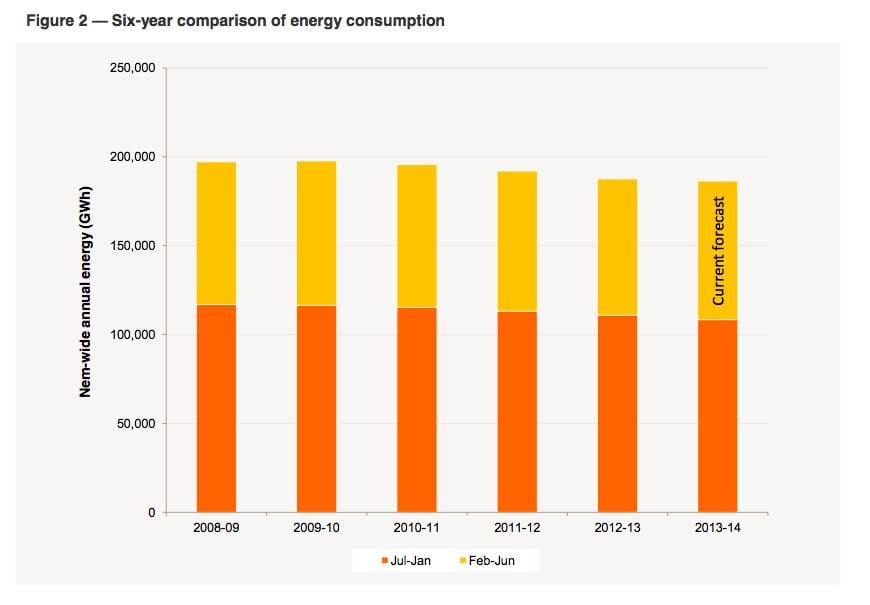
“There has been a downward trend in consumption from the grid over the last five years, and current forecasts indicate that this decline will continue for the remainder of 2013–14,” AEMO writes.
“On a year-to-date basis, 2013–14 consumption to January 2014 is 2.3% lower than the same period in 2012–13. The recent announcement that Alcoa Australia’s Point Henry aluminium smelter will close in August 2014 will further reduce industrial consumption in Victoria by approximately 360 MW.”
The AEMO data shows that 2,400MW of baseload power – nearly 10 per cent of Australia’s baseload capacity (coal and gas) has been withdrawn from service – either temporarily or permanently.
The AEMO report is likely to be used as further grist to the mill from the appeal by generators to bring the renewable energy target to a stop, or at least to reduce it dramatically. But the focus on costs to consumers highlights the point that these appeals are entirely framed as an appeal to generators to protect their own investment.
The RET was designed to hasten the transition to clean energy, but no-one anticipated it would be quite so successful. That’s because no-one anticipated the rapid uptake of rooftop solar and the impact it would have on demand.
Here is the latest AEMO graph chronicling the decline in demand since 2008 – when assumptions of high demand growth were used as the launch-pad for much of the $45 billion investment in networks across the National Electricity Market. (This graph does not include the WA grid or other isolated grids in WA, NT, and Queensland).
Even Queensland, which is anticipating a 1GW rebound in demand when the massive LNG plants start to come online later this year, will not need any new capacity as early as thought.
AEMO said previously the state might need new capacity by 2019/20, but that is likely to be pushed out beyond at least another year. No other state has any new demand requirements within the 10-year modelling horizon.
Clean energy and low-carbon investors are abandoning Australia as the new Federal government, and its conservative colleagues at state level, turn their interests and policies away from renewables and long-term abatement incentives.
Several key players in the clean energy finance industry have told the Senate hearings into the proposed Direct Action policy that investors are looking to Europe, the US and some South American countries to find low-carbon opportunities.
“My members are looking at the United Kingdom, Ireland, the United States, France and some South American countries as having more stable investment environments for low-carbon opportunities,” said Nathan Fabian, the head of the Investor Group on Climate Change.
“Direct action is not an investment grade policy,” he said, noting that investors viewed it more like a short-term grants scheme. Banks were likely to take a similar view.
He also proposed review of the RET “appears to be another very clear signal that Australia will not be a market for low-carbon investing for the next few years.”
Tim Buckley, a former Citigroup analyst, funds manager, and now with the US-based Institute for Energy Economics and Financial Analysis, said the Australian clean energy industry is regressing because of the lack of clarity on policy.
“We are worse than stalling; we are actually investing in assets that I think will become stranded as a result. Internationally, companies and economies are building industry capacity to transition for the long term. We should be building capacity as well and we are not doing so.”
He said Australia was currently missing out on hundreds of billions of dollars that being invested every year in renewables, in energy efficiency and in development of these new technologies, and the hundreds of thousands of jobs being created in China, in Germany and in America.
Numerous other parties have dismissed the proposed emissions reduction fund as “unfinancable” – mostly because it offers a maximum 5-year investment horizon. That reflects the view of most people, and possibly even the government, that Direct Action is not a long-term policy position, just part of a short-term political manoeuvre that has helped deliver power to the Conservatives.
Still, it is the situation that is facing investors – be they developers, financiers, bankers or infrastructure investors – in Australia in the coming year.
Tim Buckley, a former Citigroup analyst, funds manager, and now with the US-based Institute for Energy Economics and Financial Analysis, said the Australian clean energy industry is regressing because of the lack of clarity on policy.
“We are worse than stalling; we are actually investing in assets that I think will become stranded as a result. Internationally, companies and economies are building industry capacity to transition for the long term. We should be building capacity as well and we are not doing so.”
He said Australia was currently missing out on hundreds of billions of dollars that being invested every year in renewables, in energy efficiency and in development of these new technologies, and the hundreds of thousands of jobs being created in China, in Germany and in America.
Players in the renewables industry say the sector is facing its biggest crisis in a decade, when the last Coalition government brought a close to the then mandatory renewable energy target , causing new manufacturing facilities to close, international groups to withdraw, and local developers such as Pacific Hydro and Roaring Forties to move the bulk of the operations overseas.
The assessment by Fabian and Buckley is consistent with frustrations expressed privately by international investors, who have seen policies on hold, the price of renewable energy certificates fall by nearly half, the carbon price subject to repeal, and a proposed replacement that holds no interest for financiers.
One investor said recently there is a complete lack of liquidity in the market, because everyone is in “wait and watch” mode. Banks are not able to price the forward market, and the outlook looks poor.
Its ironic, one noted, because the market for conventional generation is dead, but there is currently little to interest investors in clean technology, particularly new emerging technologies. The ACT auction program, part of its plan to seek 90 per cent renewables by 2020, is the one exception. But while welcome and of interest, it is relatively small-scale in a global or national context.
Buckley said Australia appears to be working on the premise that the world is going to do nothing on climate change.
“That is a flawed premise, he said. “We are investing tens of billions of dollars building new assets to promote fossil fuels, be it in LNG, coal, the Galilee in particular, Abbot Point port infrastructure. The investment is huge and I think it is going to end up leaving us with stranded assets because we are missing the point that China, India, America and Germany are moving full steam towards a low-carbon economy.
“They are not going to need our fossil fuels in 20 or 30 years time, and we are building assets with 50-year lives. To build a coal port in the middle of the Great Barrier Reef with a 50-year life means we are effectively becoming a price taker for fossil fuels. Those assets will be stranded and we will see very, very significant write-downs on the back of them. “
Fabian said the scenario that Buckley cited could begin to “bite quite hard” within the next decade. “That compromises our investors, compromises the beneficiaries and workers and compromises the pensions that we guard. That is the essential policy risk that we are trying to address with a long-term framework.
Fabian said that the carbon price, the renewable energy target, and institutions such as ARENA and the CEFC play critical roles in assisting and building the capacity of the Australian financial community in low-carbon investing.
“This is a strategic question for Australia in terms of what competency we are going to have in our financial markets,” he said. “We need to move markets to places where they are not quite sure they should be yet because the policy signals are not clear enough. We know that cannot last.
“Without a central, long-term policy framework, there is significant uncertainty for investors in all assets – emissions-intensive, emissions- reducing technologies and low-carbon activities alike. The consequence of this is that the cost of private capital for achieving emissions reductions would increase and the cost of achieving those reductions would also increase.”
SCITUATE — Over and over again, the Atlantic has taken aim at 48 Oceanside Drive. Almost four decades ago, it slammed the seafront house clear off its foundation. Thirteen years later, ocean water poured through the roof during a nor’easter. So often has the sea catapulted grapefruit-sized rocks through the vacation home’s windows that a former owner installed bulletproof glass.
In all, the property has sustained significant flood damage from coastal storms at least nine times. And each time, the federal government helped owners rebuild with National Flood Insurance Program payouts — a sum estimated to total more than three-quarters of a million dollars over the years.
Government money helped raise the house on stilts in 2005. Now, the current owner of the $1.2 million vacation house is applying for what construction experts say could be $80,000 or more in taxpayer money to raise the house still higher, hoping to secure it from the thundering surf.
The tortured history of 48 Oceanside Drive and the government’s open wallet highlight the central question as Congress debates changes to the flood insurance program: At a time of rising tides and soaring deficits, does the program create incentives for owners to stubbornly keep homes in places the sea inexorably is claiming as its own?
“We always knew it was unsustainable there,’’ said Dr. David Cooney, 75, a Maryland oncologist who sold the house after the 1991 Perfect Storm severely damaged it.
The saga of the Scituate property is repeated across the United States. There are 534 properties in New England alone that the Federal Emergency Management Agency considers Severe Repetitive Loss properties — meaning in most cases that the flood insurance program has paid the owners for four significant flood claims, two within one decade. Nationally, according to FEMA, there are about 12,000 such properties.
Scituate has 112 of them. Over the years, such properties have accounted for 689 losses. The total in claims: $21.3 million.
TOWN OF SCITUATE
The house at 48 Oceanside Drive took a pounding in the Blizzard of 1978, which knocked it off its foundation.
All this occurs without any inquiry into whether the homeowners are wealthy, poor, or in between: FEMA’s flood insurance was designed to help all flood-prone properties regardless of economic status. Homeowners, like those at 48 Oceanside Drive, have every right to take advantage of legal government programs to protect their property.
The insurance program, which began in 1968 after private insurers largely abandoned flood insurance because of the recurrent risks, subsidizes some premiums to limit the cost of coverage for owners of older homes that predate current flood plain maps.
It was initially designed to pay for itself, but premiums have not kept pace with payouts since a series of punishing storms starting with Hurricane Katrina in 2005. Today, the program is about $24 billion in debt and taxpayers are left to pay the claims.
That shortfall is expected to grow in coming years as sea levels rise and storms are projected to become more intense because of climate change. Atlantic waters from north of Boston to Cape Hatteras, N.C., are rising three to four times faster than oceans globally, according to federal scientists. Billions of dollars worth of homes are on the front line.
In 2012, Congress voted to phase out premium subsidies for homeowners, boosting their insurance costs to better reflect the true risks of living in flood-prone homes.
But even as the law took hold, new federal flood plain maps caused insurance rates to soar for hundreds of thousands of homeowners, many of them in areas where flooding is rare or, historically, not an issue at all.
The shock to those unsuspecting property holders created a backlash, with many politicians, including those in New England who initially voted for the new law, supporting its delay or rollback.
The Senate is expected to pass a House-approved bill this week that would still raise premiums, but not as steeply as the 2012 law mandated.
While premiums for second homes and properties that have been severely and repeatedly hit would experience greater increases, their owners would still be eligible for sizable grants to elevate and fortify homes. And there remains no limit on the number of times a property can sustain damage and its owners collect.
“It’s like a boat with a hole in the side of it, the [National Flood Insurance Program] needs bailing out,’’ said Seth Kaplan, vice president for policy and climate advocacy at the Conservation Law Foundation, a Boston-based legal and environmental nonprofit. “It only stays afloat as long as the government is willing to put taxpayer money into it.”
In Massachusetts, state Senator Marc Pacheco, a Taunton Democrat, filed a bill in January offering an alternative approach: Create a fund to buy back flood-afflicted properties from willing owners. While there is no funding mechanism yet, Pacheco says he is committed to figuring one out.
“There is a lot to be said for not rebuilding in areas,” he said.
Holding back the sea
Harold Cooney, a successful Arlington, Mass., accountant, never learned to swim but always wanted an ocean view. In the mid-1950s, he bought a five-bedroom second home in Scituate for his wife and children, according to David Cooney, one of his sons, and land records.
David bought the home after his father died. A year later it was destroyed along with 188 others in town, a casualty of the Blizzard of ’78.
Cooney received a federal claim payment although he said he can’t recall the amount. He then built atwo-winged home — he hoped it would be his retirement house — overlooking the Atlantic. He fortified the house with secure shutters and design elements to let water flow freely under it. Still, in 1991 it was badly damaged by towering waves and Cooney came to the conclusion the house was going to be hit again and again. He sold.
TOWN OF SCITUATE
This picture shows a home at the location around 1988. David Cooney hoped it would be his retirement house.
Today, town officials say there are patches of oceanfront in Scituate that should probably never have been developed.
There are few natural barriers offshore to slow advancing storm waves, and when those waves come, they slam into sea walls and jettison water — along with boulders — up and onto land, says Richard W. Murray, a Scituate selectman and professor of earth and environment at Boston University.
“It’s why people have steel shutters on their windows,’’ said Murray. “There are foot-long boulders flying around down there in some key locations.”
Joseph Pizziferri, 48 Oceanside’s next owner, says he put $155,000 worth of repairs into the damaged house, including steel beams. “I tried everything,’’ he said, but still got flooded three times. Because flood claims are capped and may not cover all repair costs, Pizziferri said he often had to draw on his own funds to fix the damage.
Tired of constantly rebuilding, he sold the property in 1999 for $465,000 to Donald F. Craig Jr., a Quincy accountant, and his wife. Craig was initially billed close to $12,000 in flood insurance premiums, but said he was able to almost cut the amount in half because the structure was grandfathered — it had been built to code based on flood maps in effect at the time of construction.
Craig also remembers collecting insurance claims two or three times. He decided to elevate, expand, and protect the house: He used 2-by-8s in the ocean-facing walls for strength and even installed three-quarter-inch high-impact bulletproof glass.
While he paid for the expansion, the federal government chipped in for the elevation: just shy of $40,000, according to government documents obtained by the New England Center for Investigative Reporting.
FEMA refuses to disclose the identities of those who have received flood insurance premium subsidies, claim payouts, and grants to protect their homes.
The center was able to reconstruct much of the history of 48 Oceanside Drive by combing through town building permits, conservation commission minutes, and town archives and interviewing some of the previous owners and the current one. That reporting shows that total claim and grant payouts for the property over the past 35 years likely exceed $750,000.
The amount of flood insurance premium subsidies is unclear because owners said they did not remember or declined to disclose them. Insurance specialists say, however, it is likely that after the 2005 expansion, the home no longer was eligible for any subsidized rate.
Economic studies show that every $1 spent to elevate or protect buildings from flooding reduces future losses by $4 or more. But the height Craig lifted the house to — higher than what the federal government and town required — wasn’t enough: Since he sold it to Gary and Margaret Motyl of Florida in 2007 for $1.2 million, it’s been hit twice by storms, most recently in early 2013. That storm caused $160,000 in damage, according to a town building permit application.
Margaret Motyl said she is waiting to see whether the federal government will pay to elevate the vacation house again. She said she and her late husband have paid more than $50,000 of their own money to fix the sea wall behind the home, which also protects the town road and other properties.
Motyl’s late husband, Gary, was chief investment officer of the Templeton Global Equity Group and president of Templeton Investment Counsel.
Undoing a legacy
Not all properties that have repeated severe losses or are second homes are owned by the wealthy. It is these homeowners who have the least wiggle room to pay for the large premium increases arising from the 2012 law and new flood plain maps. Without relief — or help to elevate properties — they have few options, they and some politicians say. It is these homeowners that have sparked most of the call for delay in Washington.
Those who own second homes meanwhile, say they are merely availing themselves of a government-promoted program.
Doris Privitera’s summer home at 121 Turner Road on the oceanfront in Scituate, on which she pays a government-subsidized insurance rate, is being elevated with a FEMA grant that will pay 90 percent of the cost. She and her husband bought the house 45 years ago.
Flood insurance “is controversial,’’ she acknowledged, noting her neighbor had questioned why FEMA was giving her elevation funds until he, too, applied. “Should the taxpayers pay? It’s a difficult thing to say as an owner,” she said, but pointed out that the elevation would save on future payouts.
Some coastal experts say incentives need to change to encourage people to leave homes that will continually get hit; perhaps by giving tax breaks for moving, denying insurance after a certain number of losses, or pursuing voluntary buyouts. While FEMA has purchased 20,000 properties since 1993, the buyouts have not been popular among coastal dwellers.
Rachel Cleetus, senior climate economist for the Union of Concerned Scientists, a Cambridge-based research and advocacy group, said the flood insurance law the Senate is likely to vote on this week takes important steps to bring insurance premiums in line with the risk of severe repetitive loss properties.
She suggested that the addition of a means-tested voucher program — reduced premiums for people with lower incomes — could help soften the financial blow for families that can’t afford a rate increase.
“You see these properties becoming a bigger and bigger problem going forward, especially as sea levels rise,’’ Cleetus said. “We can’t change the past, but there is an opportunity to do better going forward.”
The New England Center for Investigative Reporting is a nonprofit investigative reporting newsroom based at Boston University and WGBH TV/radio and supported in part by New England news outlets. NECIR interns Michael Bottari and Amanda Ostuni helped research and prepare this report. Follow Beth Daley on Twitter at @BethBDaley
It’s happened. After years of insisting coal seam gas mining poses no threat to our water supply, a Santos CSG project has poisoned an aquifer in north-western New South Wales.1
This is the first time an aquifer has been proven to be contaminated by coal seam gas mining in Australia.
Now, it’s filled with uranium at 20 times the safe drinking water levels, and has elevated levels of arsenic, lead, aluminium, nickel, barium and boron. And the penalty handed down to Santos? A paltry $1500 fine. Unbelievably, two days after the fine was issued, the NSW State Government signed an agreement with Santos to fast-track their coal seam gas development in the Pilliga Forest.
It’s clear. Our governments won’t stand up against dangerous projects that threaten our land, our water and our communities. Looks like it’s up to the rest of us.
Click here to sign the petition to demand Santos CEO David Knox stop the CSG developments in our beautiful Pilliga Forest immediately.
Are you a Santos shareholder? If so, there’s an amazing opportunity for you to be directly involved in Santos’ AGM. Already, 50 shareholders have put their name to a resolution calling on Santos to halt its huge CSG project in north-western NSW. But the resolution can only be put to a vote if 50 more shareholders sign on in the next few days. Click here for more details.
The AGM is being held in May, and is the perfect opportunity to voice our opposition to these dangerous projects. When shareholders meet to discuss the direction of the company, let’s make sure they know exactly how Australians feel about the CSG developments ruining our water supply and the Pilliga Forest.
Santos executives and shareholders alike need to know that Australia simply won’t stand for anyone gambling with our precious natural resources for short term profits.
If we can build a huge petition, you can be sure we’ll be in the minds of Santos’ shareholders when they make decisions about the company’s future.
Sign the petition that will be delivered at Santos’ AGM, and ask that our water supplies are protected from coal seam gas
This isn’t the only time Santos’ CSG projects have damaged the Pilliga. Earlier this year, 10,000 litres of untreated toxic CSG waste was spilled into the forest. Worse still, Santos failed to report the incident to authorities.2 Alongside uranium, chemicals pumped deep into the ground for CSG mining include methanol, used for explosives; naphthalene, used in napalm; and hydrochloric acid, used to strip metals.
The stakes are simply too high to have these projects anywhere near our precious groundwater.
Add your name to the petition demanding Santos CEO David Knox withdraw all CSG projects from the Pilliga Forest.
This news proves what what we’ve known all along — the risks CSG pose to our water supply are just too great. Let’s demand better from our governments and our energy companies.
Thanks for everything,
the GetUp team.
PS. If you own more than $500 in Santos shares, there’s an incredible opportunity to help protect New South Wales’ water supply from dangerous coal seam gas projects. Click here to find out more and get involved: https://www.getup.org.au/santos-shareholders
[1] Santos coal seam gas project contaminates aquifer. Sydney Morning Herald. March 8, 2014
[2] Govt urged to act after Santos CSG fine. Nine News National. March 8, 2014
GetUp is an independent, not-for-profit community campaigning group. We use new technology to empower Australians to have their say on important national issues. We receive no political party or government funding, and every campaign we run is entirely supported by voluntary donations. If you’d like to contribute to help fund GetUp’s work, please donate now! If you have trouble with any links in this email, please go directly to
Too Much Propane Could Be a Factor in Exploding Oil Trains
Producers are supposed to strip out volatile gases before transporting oil. But experts say some may have been ‘cheating’ and leaving in large amounts.
By Marcus Stern and Sebastian Jones
Mar 5, 2014
A tanker train carrying North Dakota Bakken crude oil burns after derailing in western Alabama outside Aliceville, Ala. in November. Credit: Alabama Emergency Management Agency
As federal regulators continue investigating why tank cars on three trains carrying North Dakota crude oil have exploded in the past eight months, energy experts say part of the problem might be that some producers are deliberately leaving too much propane in their product, making the oil riskier to transport by rail.
Sweet light crude from the Bakken Shale formation straddling North Dakota and Montana has long been known to be especially rich in volatile natural gas liquids like propane. Much of the oil is being shipped in railcars designed in the 1960s and identified in 1991 by the National Transportation Safety Board as having a dangerous penchant to rupture during derailments or other accidents.
While there’s no way to completely eliminate natural gas liquids from crude, well operators are supposed to use separators at the wellhead to strip out methane, ethane, propane and butane before shipping the oil. A simple adjustment of the pressure setting on the separator allows operators to calibrate how much of these volatile gases are removed. The worry, according to a half-dozen industry experts who spoke with InsideClimate News, is that some producers are adjusting the pressure settings to leave in substantial amounts of natural gas liquids.
“There is a strong suspicion that a number of producers are cheating. They generally want to simply fill up the barrel and sell it—and there are some who are not overly worried about quality,” said Alan J. Troner, president of Houston-based Asia Pacific Energy Consulting, which provides research and analysis for oil and gas companies. “I suspect that some are cheating and this is a suspicion that at least some refiners share.”
Harry Giles, a now-retired, 30-year veteran of the Department of Energy whose duties included managing the crude oil quality program for the Strategic Petroleum Reserve, said there’s “a distinct possibility” that propane has been intentionally left in Bakken oil.
“I think there is such a large focus on what’s happening in the Bakken…that no one really cares to talk about these issues,” Giles said.
Producers might be tempted to leave in some of the natural gas liquids because there aren’t enough gas-processing facilities or pipelines in the Bakken to handle all the methane, ethane, propane and butane that is suspended in the crude when it comes out of the ground. Without sufficient infrastructure, operators are left with few options. They can flare or vent the volatile gases into the North Dakota sky, although they risk being penalized for violating emission limits. Or they can leave some of the gases, especially propane, suspended as liquid in the crude oil they send to refineries, where gas-processing facilities already exist.
Some drillers might also be purposefully selling their crude “fluffed up” with propane and small amounts of butane to boost the volume of oil in the railcar and maximize their profits, according to the experts, some of whom spoke on the condition they not be identified because of pending lawsuits triggered by recent accidents.
The Bakken, a vast crude reservoir lying about two miles beneath the Earth’s surface, has been tapped since 1953. It was only in recent years that new fracking technologies allowed the volume of crude taken from the ground to explode, jumping from a negligible amount in 2007 to 1 million barrels a day currently.
Energy companies have been scrambling to install the infrastructure they need to support the boom. But they face awkward economics. Constructing gas plants and pipelines is expensive and involves a lengthy permitting process. By the time the facilities are in place, production at many Bakken wells might be in decline. Shale gas production can drop off sharply in the first few years.
Lynn Helms, head of the North Dakota Department of Mineral Resources and the state’s chief oil-well regulator, said in a statement emailed by his spokesperson on Feb. 26 that “at this time we are investigating what, if any, issues there may be surrounding separation of Bakken streams.”
At the federal level, the movement of crude oil by rail is regulated by the Federal Railroad Administration and the Pipeline and Hazardous Materials Safety Administration (PHMSA), both housed within the Department of Transportation.
PHMSA officials did not respond to questions about whether the agency is investigating Bakken oil companies for deliberately leaving too much propane in their crude. The American Petroleum Institute, which has been assisting PHMSA in its effort to determine what new rules or testing methods are needed, declined to comment.
PHMSA began testing Bakken crude to see what was making it so volatile after an oil train from North Dakota derailed and exploded in Canada in July, killing 47 people and generating up to $2 billion in liabilities. In response to questions from InsideClimate News about what is making the Bakken crude explosive, PHMSA spokesman Gordon “Joe” Delcambre said in a Feb. 14 email that the agency is “still awaiting the final report of the test results on the crude oil samples submitted to the lab. Keep checking back periodically.” As of Wednesday, PHMSA had provided no update.
Comment space is provided for respectful discourse. Please consult our comment policies for more information. We welcome your participation in civil and constructive discussions.
The end of Summer Heat. Time to strengthen the blockade!
Inbox
x
Josh Creaser – 350.org Australia josh.creaser@350.org.au via list.350.org
Mar 8 (1 day ago)
to me
Dear friends,
March has arrived and our 350.org Summer Heat campaign comes to a close. What an amazing three months it was. You helped support over 100 events targeting the fossil fuel industry, thousands of you took part in actions across the country and showed that we are a strong and united movement.
But our work does not stop as the summer heat subsides – 2014 is a crucial year to stand up to the dangerous expansion plans of the coal and gas industry and their backers in Government.
As you probably know, the community blockade to stop the Maules Creek Coal Mine has become a flagship fight for 2014. Already we’ve seen 350.org Australia supporters from across the country turning out to info nights, undertaking non-violent direct action trainings and heading to the blockade to lend a hand.
The show of support has been inspiring – but it’s time to do more. If there is any chance of stopping this coal mine, then the blockade needs to stay strong and grow. To build this strength, we need your help.
Here’s how:
1. D.I.Y. – Maules Creek Info Nights and Fundraiser
A conversation with a friend or family member is one of the most powerful ways to inspire people to take action. With your help we can inspire thousands across the country to join the Maules Creek Campaign. That’s why we are inviting you to run a Do it Yourself – Maules Creek Info Night or Fundraiser.
These events can be run from the comfort of your own living room, over a barbeque, at the local community hall – anywhere really.
The fight to stop the Maules Creek Coal Mine will be long and it will be hard. But with your help we can build the strength of our movement and stand up for a safe climate!
Warm wishes,
Josh, Simon, Charlie, Aaron, Blair and Phil, for 350.org Australia
P.S. If you can’t get to Maules Creek, or don’t have time to organize a fundraiser, consider making a donation to support our efforts. Donate here.





 A tanker train carrying North Dakota Bakken crude oil burns after derailing in western Alabama outside Aliceville, Ala. in November. Credit: Alabama Emergency Management Agency