Author: Neville

  • Queensland axes 8c/kWh solar feed-in tariff

    Queensland axes 8c/kWh solar feed-in tariff

    Print Friendly

    Queensland’s Newman government has continued its “war on solar”, confirming it will axe the state’s 8c/kWh rooftop solar feed-in tariff at the end of June, leaving solar households with the challenge of negotiating a tariff with their electricity retailer.

    The move by the government – which will affect 40,000 households, and any new rooftop solar adopters – was expected, and was justified by claims it would “lift the cost burden” from electricity network businesses and put “downward pressure” on electricity prices for all Queenslanders.

    In a refrain taken straight from the Campbell Newman songbook, Queensland energy minister Mark McArdle said in a media release on Thursday that the carbon tax and renewable energy targets had driven electricity prices “much higher than they should be.” No mention of the soaring cost of the government-owned networks.

    “Left unchecked, the 8 cent feed-in tariff would cost Queensland households and businesses an extra $110 million on their power bills over the next six years,” McArdle said. Presumably, he was expecting the number of Queensland households to increase dramatically, because the current 40,000 households on the 8c/kWh tariff would need to export nearly all their generation to meet that figure.

    Critics say the changes – announced as part of a series of reforms to the state’s Solar Bonus Scheme – mean that the 40,000 solar households in Queensland will be left at the mercy of the state’s electricity retailers, who will assume responsibility for setting and offering solar energy tariffs.

    “This is incredibly unfair,” said Lindsay Soutar, from Solar Citizens. “It is obvious that it will be difficult for individual households to get a good deal from their power company. They simply don’t have the negotiating power. When retailers set the rules, solar owners lose.”

    As one solar industry expert pointed out, the Queensland government was unable to win its fight with retailers over pricing, so what chance would an individual household have? Victoria, WA, and South Australia all have mandated minimum tariffs. NSW is the only state that doesn’t, and even IPART found that customers were not getting a good deal – most well below the recommended rate. Many households are offered nothing.

    Rhys Clay from Local Energy Solar said that while he disagreed with the Newman government’s approach to limiting the solar feed-in tariff, the changes would at least help encourage customers to install energy storage, and save their surplus solar energy for use later in the night.

    “It is our hope that the QLD goverment reforms electricity pricing to accurately reflect the true cost of electricity (higher prices at peak times) as this will help facilitate a shift energy efficiency and storage which in turn will benefit the network,” Clay said.

    The Queensland government said customers of Energex would no longer have a government regulated rate, but will be able to negotiate a tariff with their retailer. Ergon Energy customers, meanwhile, will continue to be paid a tariff set by the Queensland Competition Authority until “there is enough retail competition in regional areas to make solar more self-sufficient.”

    “These reforms will mean electricity retailers will pay any newly negotiated solar tariff direct to users,” McArdle said. “These are common-sense decisions that will produce a positive outcome for existing customers on the 8 cent rate, as well as new solar owners.”

    This latest solar tariff cut follows the slashing of the 44c/kWh net tariff in 2012, when Campbell Newman’s decision to provide a month-long window to take advantage of the 44c rate inadvertently sparked a massive rush for rooftop solar in Queensland.

    Today, McArdle said the 44c/kWh solar feed-in tariff would be kept in place for the around 284,000 Queensland households who signed up to it before it was closed.

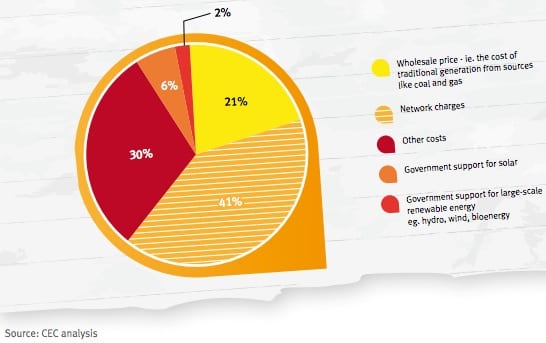
    The solar industry has argued that government support for rooftop solar adds a negligible amount to the average household electricity bill, with more than two-thirds of price rises caused by factors completely unrelated to any green schemes, such as soaring generation costs, network costs, and increased costs from retailers and billing centres.

    Price-breakdown-of-average-home-power-bill

    Price breakdown of average Australian household electricity bill

    Last year, a Queensland Competition Authority report recommended a 13.5 per cent increase in solar tariffs from July 1, 2014, and predicted that the impact of the carbon price, even if not repealed, would actually go down, as would any impact from renewable energy schemes.

    In an interview with the Courier Mail, McArdle said axing the 8c FiT in the state’s southeast would foster competition ahead of the removal of regulated prices in July 2015.

    “I don’t think (retailers) will abandon solar customers, because paying the feed-in tariff is part of their market strategy to attract customers to their contracts,” he said.

    “Customers can then start to play retailers off against each other to get a better deal, and we may well find that the feed-in tariff increases with competition.’’

  • Four Degrees or More? Australia in a hot world, CLIMATE CODE RED

    Why this ad?
    Compare Electricity Ratesyoucompare.com.au/electricity – Save Hundreds On Electricity Bills Cheaper Electricity. Compare & Save

    climate code red

    Inbox
    x

    Climate Code Red noreply@blogger.com via google.com

    8:26 PM (1 minute ago)

    to me

    climate code red


    Too hot to handle: life in a four-degree world

    Posted: 04 Mar 2014 06:24 PM PST

    by Gabrille Kuiper, first published in Overland

    Four Degrees of Global Warming:
    Australia in a hot world
    Peter Christoff (ed),
    Earthscan/Routledge, 2013

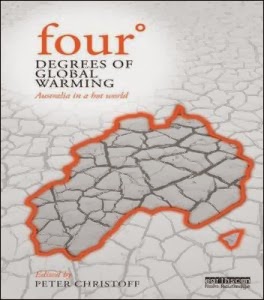
    The book Four Degrees or More? Australia in a hot world, edited by political scientist Peter Christoff, is a timely overview of what we know currently about both global and local predicted impacts of climate change.

    As Christoff notes, ‘this four-degree world is one of almost unimaginable social, economic and ecological consequences and catastrophes’ but, given current international and Australian energy and climate policies, it is “an impending reality”. The book contains contributions by Australia’s leading scientists and economists, including Ross Garnaut, David Karoly and Will Steffen, setting out a four-degree future across the ecological, social and economic impacts, and the adaptation that will be required.

    Previously, climate change dialogue has mainly focused on two degrees Celsius of global temperature rise, which had been identified as a key environmental “tipping point”. Scientific consensus is now that our business-as-usual trajectory will cause the global average temperature to rise by a global average of four degrees Celsius above pre-industrial levels by 2070-2100.

    Nonetheless, regional increases will range from four to sixteen degrees on land, with the Arctic continuing to heat up the most, as it has done to date.

    One of the key insights from Four degrees or More? is that almost nothing about the consequences of climate change will be uniform. To better represent changes across Australia, the book’s initial chapters match Australian cities with places with climates currently analogous with those that these cities will experience in a four-degree world. So Sydney becomes Rockhampton and Brisbane becomes more like Cairns. Broome, which currently has 54 days a year over 35 degrees is projected to have 284 days per year over 35 degrees by 2100. Darwin will be like be like nowhere on earth; the researchers could find no analogue anywhere on earth to a Darwin under a four-degrees scenario.

    The possible consequences of these changes for Australia’s population are not explored in the book. This would be a valuable exercise for geographers and urban planners. One might assume that some northern Australia’s inland settlements will be abandoned. Meanwhile, Tasmania is likely to be a haven from the heat. At the book’s launch, the number of climate scientists who own land in Tasmania was remarked on. Penfolds and Brown Brothers have already purchased land for new vineyards in Tasmania, the wine industry being one that is highly climate dependent and (at least in some companies) very alive to how the climate is already changing.

    The impact of climate change on the marine environment is not as visible but the consequences are worrying indeed. The basic science means that as carbon dioxide levels in the atmosphere increase, some of it dissolves in and acidifies seawater. The world’s oceans have already acidified by almost thirty percent since the Industrial Revolution. Further ocean acidification will disrupt the marine food chain, making it more difficult for organisms to form shells and skeletons, and leading to the decline or collapse of coral reef ecosystems.

    Over 2.6 billion people depend on the seas for their primary source of protein. As Four degrees highlights, overfishing is just one of a multitude of examples of where climate change will exacerbate, accelerate or multiply an existing unsustainable trend. The emission of greenhouse gases is only one way in which humans have fundamentally altered the planet’s biosphere and ecology.

    Other examples of the numerous negative feedback effects caused by climate change include the strengthening of the urban heat island effect (which already exists as a result of the sheer coverage of paved areas and building mass in most cities) and increased riverine salinity due to the extraction of ever-decreasing amounts of water for agriculture from rivers such as the Murray Darling.

    Four degrees discusses how Australian food yields will in decline in quantity and quality as the protein content of grain crops decline. By 2100, Australia – currently a net food exporter – is likely to face food shortages in a world where half of the global population also faces droughts and famine.

    A Four-degree world will also affect human health in other ways. As the January heatwave has underlined, temperature extremes and related events have profound health consequences. Such extremes will become more frequent and ‘normal’ as global warming accelerates.

    Heat is a silent killer. The 2003 European heatwave is estimated to have caused up to 70,000 excess deaths. The Black Saturday bushfires in Victoria in February 2009 killed 173 people, but an additional 374 people died as a consequence of the accompanying heatwave. Children, elderly people and those with underlying health conditions are particularly vulnerable in extreme heat, as are the services and systems that might otherwise support them.

    In addition, a wide variety of health risks will become more common and more extreme in a Four Degree world, ranging from increases in air pollution and aeroallergens (affecting asthma sufferers, in particular) to changes to natural constraints on infectious agents (such as malaria and Ross River fever) to psychological (mental health) effects.

    Crucially, it is the indirect effects of climate change on water and food security, alongside extreme climatic events, which are likely to have the biggest effect on global health – and indeed the movement of people around the globe. As McMichael, Steffen and Griggs highlight in their chapters, there will be complex interactions between climatic impacts. For instance, persistent drought will reduce food production, leading to food shortages, and perhaps emigration, conflict and violence.

    Globally, by the end of this century, up to one billion people will be displaced by climate change as populations try to move towards more survivable climates in the biggest wave of forced migration in human history. Sea level rise is already influencing emigration from Tuvalu, Kiribati, Papua New Guinea and the low-lying Carteret Islands, while water stress is propelling the relocation of people from Mauritania, Sudan, Ghana and Kenya. The Maldives has established a sovereign wealth fund to purchase a new homeland for the 350,000 islanders expected to become the first nation of people fully displaced by climate change.

    Closer to home, Indonesia has a population of 240 million and the fourth largest coastline in the world. Christoff and Eckersley note some 6.4 percent of Indonesia’s population live in the three metre zone prone to coastal flooding and suggest that climate change already locked in to the global system will result in the potential displacement of (at least) 15 million people north of Australia.

    Such detail is what is needed for adaptation planning by Australian governments, business and civil society. The book provides a welcome overview of the big picture; the next step is a more tangible picture of the specific changes to day-to-day business and lives in Australia. But that also requires more research. As Christoff highlights, there hasn’t, for example, been any economic modeling of the consequences for Australian tourism, trade and agriculture since 2008. It’s no wonder that some business finds it frustrating to operate with big picture warnings of massive disruption without the particulars for their industry.

    The indispensable crux of this book – the view of some of the world’s most eminent scientists and social scientists ­– accords with that of Professor Schellnhuber that ‘the difference between (two and four degrees) is human civilisation, if you like’.

    Given a choice, a four-degree world is not one any of us wants to imagine. We don’t want to know about it or talk about it – and some of us actively deny it. This book is essential in that it forces us to stare at the world we are collectively creating, and at its consequences. Its nightmarish projections emphasise that we must put all our efforts into avoiding a four-degree future. We have everything to lose.v

    Dr Gabrielle Kuiper has been working on climate change in various ways for two decades and is currently an independent energy and climate consultant.

  • The Benefits Claimants the Government loves

    The Benefits Claimants the Government Loves

    March 3, 2014

    Corrupt, irrational, destructive, counter-productive: this scarcely begins to describe our farming policy.
    By George Monbiot, published in the Guardian 4th March 2014

    Just as mad cow disease exposed us to horrors – feeding cattle on the carcasses of infected cattle – previously hidden in plain sight, so the recent floods have lifted the lid on the equally irrational treatment of the land. Just as BSE exposed dangerous levels of collusion between government and industry, so the floods have begun to expose similar cases of complicity and corruption. But we’ve heard so far just a fraction of the story.

    I hope in this article to lift the lid a little further. The issues I’ve begun to investigate here – the corrupt practices and the irrationality of current policies – should unite both left and right in a demand for change. They should be as offensive to those who seek to curb public spending as they are to those who seek to defend it.

    In July 2013, the British government imposed a £26,000 cap on the total benefits a household can receive. In the same month it was pursuing a different policy in urgent discussions in Brussels: fighting tooth and nail to prevent the imposition of a proposed cap precisely ten times that size (€300,000, or £260,000). The European Commission wanted this to be as much money as a single farmer could receive in subsidies(1). The British government was having none of it.

    It won, with the result that this measure is now discretionary: member states can decide whether or not to cap the benefits they give to farmers. Unsurprisingly, the British government has decided not to. The biggest 174 landowners in England take £120m between them. A €300,000 cap would have saved around £70m(2). If farmers were subject to the benefits cap that applies to everyone else (£26,000), the saving would amount to around £1bn(3). Why should the cap be imposed on the poor but not the rich?

    Last week the MP Simon Danczuk read out a letter in the House of Commons that one of his constituents had received from the Department for Work and Pensions(4). It told her she was about to “enter the second stage of your intensive job-focused activity”. It expressed the hope that “all the activity or training intervention completed so far has not only supported you to achieve your aspirations but has moved you closer to the job market.”

    Lying in a coma since December had not affected her ability to work, or her progress towards achieving her aspirations. She’s in a coma because she suffered a heart attack. The heart attack, her father maintains, was brought about by extreme stress, caused by the threat of having her benefits stopped despite a mental illness so severe that she had been unable to work for 27 years.

    Two days before this letter was read to the Commons, the farming minister, George Eustice, was speaking at the conference of the National Farmers’ Union(5). He began by paying “tribute to the great work” of its outgoing president: “thank you for what you’ve done.” Can you picture a minister in this government saying that about the head of any other trade union? The NFU’s primary work is lobbying. Yet the critical distance between government and lobbyists you would expect in a functioning democracy is non-existent.

    The same goes for distance of any other kind. The address of Eustice’s ministry, the department for environment, food and rural affairs, is 17 Smith Square, London SW1. The address of the National Farmers’ Union is 16 Smith Square, London SW1. Though farmers comprise just 0.3% of the population of England and only 1.4% of the rural population(6), ministers treat them and their lobbyists as an idol before which they must prostrate themselves. Rural policy and farming policy are, to the government, synonymous; 98.6% of rural people are marginalised by the decisions it makes.

    Eustice continued his speech by announcing that he is seeking to “slash guidance”, to “drive down the burden of farm inspections further”, and that he is “pushing hard at an EU level for sanctions and penalties to be more proportionate.”(7) These are the sanctions and penalties imposed for breaking the conditions attached to farm subsidies. They take the form of a reduction in the benefits a farmer receives. “More proportionate” is the government’s code for smaller.

    So just as the rules and penalties regulating the ordinary recipients of benefits have become so onerous that many find them almost imposssible to meet, the rules and penalties attached to the benefits the rich receive are being reduced.

    But how? The conditions attached to farm subsidies (which are called cross-compliance) are already so weak as to be almost non-existent. Let me give you an example. There are several rules which are meant to encourage farmers to protect their soils from compaction and erosion(8). Their purpose is to sustain fertility, to defend water supplies and the ecology of the rivers and to prevent flooding. Not one of these measures appears to be either functional or enforceable.

    All farmers receiving subsidies must complete a soil protection review. This is a booklet they fill in to show that they have thought about soil erosion and identified any problems on their land. Once every 100 years on average, an inspector from the Rural Payments Agency will visit the farm(9). If the inspectors identify a soil erosion problem, they have the power to … er, offer guidance about how to rectify it. And that, in practice, is it. There are hardly any cases of this guidance being followed up with even the threat of action, let alone the imposition of any penalties(10). And even the guidance, Eustice now promises, will be “slashed”.

    Bad enough? Oh no. Most inspectors have no expertise in soil erosion. So all they tend to do during their centennial visits is to ask the farmer whether he or she possesses a soil protection booklet. If the answer’s yes, that’s job done, even if their soil is rushing off the fields and into the rivers.

    To discover whether or not farmers are causing a related problem – soil compaction through the use of heavy machinery in the wrong conditions – inspectors need to dig holes in the fields with a spade, to look at what has happened to the soil layers. But – and here you have a choice of laughing or crying – they do not possess the power to conduct an “invasive investigation” (ie digging a hole)(11). So they are not permitted even to detect, let alone enforce, a breach of the compaction rules.

    Are we there yet? Nope. Even these unenforceable non-rules are deemed too onerous for farmers growing a crop that both strips and compacts the soil faster than almost any other. Because the rows are planted so far apart, and because the soil is left bare through autumn, winter and much of the spring, maize causes more severe erosion than any other cereal crop. Yet, as I pointed out a fortnight ago, maize growers are entirely and mysteriously exempted from the erosion rules(12).
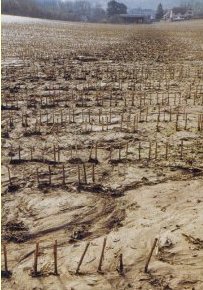
    Soil erosion in a maize field. Photo: Defra

    Soil erosion in a maize field. Photo: Defra

    Since then I have asked the department five more times for an explanation. While all my other questions have been answered, albeit half-heartedly, this one was not fudged or spun or mangled, but simply ignored. I’ve never encountered this before: a government department refusing even to acknowledge that a question has been asked. What should I conclude but that the answer is highly embarrassing? I guess that because it’s almost impossible to grow maize without wrecking the soil, and because the government’s plans for biogas production depend on growing maize to fuel anaerobic digesters, the only way to reconcile this conflict is to remove the crop from the regulations(13).

    In a devastating response to claims made in the Guardian’s letters page by the National Farmers’ Union(14), the soil scientist Robert Palmer calculated that so much compaction and erosion is caused by maize growing that a 10-hectare field causes the run-off of 375 million litres of water(15). Maize expanded 24% between 2012 and 2013, much of it in sensitive catchments. This is a formula for repeated flooding.

    As a result of these multiple failures by the government, even Farmers’ Weekly warns that “British soils are reaching crisis point”(16). Last week a farmer sent me photos of his neighbours’ fields, where “the soil is so eroded it is like a rockery. I have the adjoining field … my soil is now at least 20 cm deeper than his.” In the catchment of the River Tamar in Devon, one study suggests, soil is being lost at the rate of five tonnes per hectare per year(17).

    I could go on. I could describe the complete absence of enforceable regulations on the phosphates farmers spread on their fields, which cause eutrophication (blooms of algae which end up suffocating much of the freshwater ecosystem) when they run into the rivers. I could discuss the poorly-regulated use of metaldehyde, a pesticide that is impossible to remove from drinking water(18). I could expand on the way in which governments all over Europe have – while imposing a temporary ban for flowering crops – permitted the use of neonicotinoid insecticides for all other purposes, without any idea of what their impact might be on animals in the soil and the rivers into which they wash. The research so far suggests it is devastating, but they were licensed before any such investigation was conducted(19).

    There is just one set of rules which are effective and widely deployed: those which enforce the destruction of the natural world. Buried in the cross-compliance regulations is a measure called GAEC 12(20). This insists that, to receive their money, farmers must prevent “unwanted vegetation” from growing on their land. (The rest of us call it wildlife habitat). Even if their land is producing nothing, they must cut, graze or spray it with herbicides to get their money. Unlike soil erosion, compaction and pollution, breaches of this rule are easy to detect and enforce: if the inspectors see trees returning to the land, the subsidy can be cut off altogether.

    Many of the places in which habitats might otherwise be allowed to recover – principally the highly infertile land in the uplands – are kept bare by this rule. It’s another means by which floods are hard-wired. The government has just raised the incentive to clear such land, by announcing that hill farmers will now be paid the same amount per hectare as lowland farmers – equalising the rate upwards, not downwards(21).

    It also seems to be on the verge of raising the amount of public subsidy paid to the owners of grouse moors by 84%(22). These are among the richest people in Britain. The management of their land to maximise grouse numbers involves the mass destruction of predators and the burning of blanket bogs, causing floods downstream(23) and releasing large amounts of carbon(24). If this looks like the work of a self-serving club of old school chums, that’s because it is.

    First we give landowners our money: vast amounts of it, uncapped and almost unconditional. Then we pay for the costs they kindly dump on us: the floods, the extra water purification necessitated by the pollution they cause, the loss of so many precious and beautiful places, the decline of the wildlife that enchants and enraptures. Expensive, irrational, destructive, counter-productive: this scarcely begins to describe our farming policies.

    But it need not happen this way. Change the rules, change the incentives, support impoverished farmers to do the right thing, stop support for the rich farmers altogether, and everything else can follow. In my book Feral I’ve begun to sketch out what a functioning, lively, wonderful countryside could look like(25). High in the catchments, where most of the rain falls and the soil is so poor that farming is sustained only through public money, we should be paying the farmers to replant trees, which hold back the water and stabilise the soil.

    To these returning forests we could reintroduce animals that have been wiped out across much or all of this land: capercaillies, wildcats, pine martens, eagles, lynx, moose, bison, even, in the Scottish Highlands, wolves. Aside from the opportunities this rewilding presents for re-enchanting our lives, experience elsewhere in Europe suggests that eco-tourism has a far higher potential for employment, for supporting communities, for keeping the schools and shops and pubs and chapels open than sheep farming does(26).

    Lynx and cub. Photo: Norbert Rosing.

    Lynx and cub. Photo: Norbert Rosing.

    We should turn the rivers flowing into the lowlands into “blue belts” or “wild ways”. For fifty metres on either side, the land would be left unfarmed, allowing trees and bogs to return and creating continuous wildlife corridors. Bogs and forests trap the floodwaters, helping to protect the towns downstream. They catch the soil washing off the fields and filter out some of the chemicals which would otherwise find their way into the rivers. A few of us are now in the process of setting up a rewilding group in Britain, which would seek to catalyse some of these changes.

    Where soils are fragile and the risk of erosion is high, farmers should be encouraged to move towards regenerative or permacultural techniques: clever new methods which can produce high yields without damaging soil, water and wildlife(27). A fortnight ago, Rebecca Hosking, a farmer who uses regenerative techniques, published a photo of the confluence of the stream leaving her land with the stream leaving her neighbour’s land(28). His looked like cream of tomato soup; hers was clear.
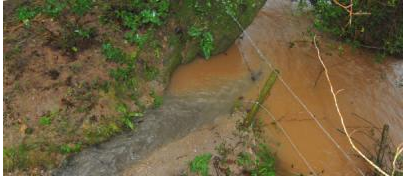
    Rebecca Hosking's stream meets her neighbour's.

    Rebecca Hosking’s stream meets her neighbour’s.

    The British government currently spends – on top of the £3.6bn in farm subsidies disbursed in this country – £450m on research and development for the food and farming industries(29). Much of this money could be characterised as corporate welfare. Yet a search of the British government’s website finds not one mention of permaculture. Not a penny of public money is being spent on investigating its potential here.

    It’s not hard to see how a land which is now being pillaged, eroded, polluted and wrecked could be allowed to remain productive – even to produce more food for people than Britain does today (though perhaps less for livestock and biofuel) – while also supporting a vibrant ecosystem. It is not hard to see how public money could be spent to deliver social goods rather than social harms. But for this to happen we must insert a political crowbar between numbers 16 and 17 Smith Square, to prise the government away from the industry it is supposed to regulate.

    www.monbiot.com

    References:

    1. http://www.bbc.co.uk/news/world-europe-11216061

    2. http://www.eadt.co.uk/business/farming/farming_comment_tenant_farmers_association_chief_executive_george_dunn_calls_for_a_cap_on_cap_payments_1_2360224

    3. http://www.thisiscornwall.co.uk/MP-s-cap-farm-subsidies-pound-26-000/story-19541145-detail/story.html#axzz2uuZpF8DM

    4. http://www.theguardian.com/society/2014/feb/28/minister-apologise-woman-coma-find-work

    5. https://www.gov.uk/government/speeches/backing-the-business-of-british-farming

    6. http://www.monbiot.com/2012/06/08/captive-animals/

    7. https://www.gov.uk/government/speeches/backing-the-business-of-british-farming

    8. see Defra and the Rural Payments Agency, 2014. The Guide to Cross Compliance
    in England 2014: complete edition.

    http://rpa.defra.gov.uk/rpa/index.nsf/0/6eb355ea8482ea61802573b1003d2469/$FILE/The%20Guide%20to%20Cross%20Compliance%20in%20England%202014%20complete%20edition.pdf

    9. In other words, 1% of farms are visited for a cross-compliance inspection every year.

    10. The Rivers Trust, 2011. Defra Strategic Evidence and Partnership Project. http://www.theriverstrust.org/projects/sepp/downloads/The%20Rivers%20Trust%20DSEPP%20Report%20complete%20low-res.pdf

    11. The Rivers Trust, as above.

    12. http://www.theguardian.com/commentisfree/2014/feb/17/farmers-uk-flood-maize-soil-protection

    13. http://www.farmersguardian.com/home/arable/taking-maize-for-energy-production-to-the-next-level/59704.article

    14. http://www.theguardian.com/environment/2014/feb/20/answer-flooding-in-the-soil

    15. http://www.theguardian.com/environment/2014/feb/25/maize-farmers-flood-blame

    16. http://www.fwi.co.uk/articles/10/02/2014/142962/uk-soil-crisis-hitting-crop-yields-warns-expert.htm

    17. Cited by The Rivers Trust, 2011. Defra Strategic Evidence and Partnership Project. http://www.theriverstrust.org/projects/sepp/downloads/The%20Rivers%20Trust%20DSEPP%20Report%20complete%20low-res.pdf

    18. Water UK, 13th August 2013. Briefing paper on metaldehyde.

    http://www.water.org.uk/home/policy/positions/metaldehyde-briefing/water-uk-policy-briefing-metaldehyde-13-aug-2013.pdf

    19. http://www.theguardian.com/environment/georgemonbiot/2013/aug/05/neonicotinoids-ddt-pesticides-nature

    20. Defra and the Rural Payments Agency, 2014. The Guide to Cross Compliance
    in England 2014: complete edition.

    http://rpa.defra.gov.uk/rpa/index.nsf/0/6eb355ea8482ea61802573b1003d2469/$FILE/The%20Guide%20to%20Cross%20Compliance%20in%20England%202014%20complete%20edition.pdf

    21. Defra, December 2013. Consultation on the implementation of CAP reform in England:
    Summary of responses and government response. https://www.gov.uk/government/uploads/system/uploads/attachment_data/file/267987/cap-reform-sum-resp-201312.pdf

    22. Defra, December 2013, as above.

    23. Joseph Holden et al, 2013. Fire decreases near-surface hydraulic conductivity and macropore flow in blanket peat. Hydrological Processes. DOI: 10.1002/hyp.9875. http://onlinelibrary.wiley.com/doi/10.1002/hyp.9875/abstract

    24. David Glaves et al, 30th May 2013. The effects of managed burning on upland peatland
    biodiversity, carbon and water. Natural England. http://publications.naturalengland.org.uk/publication/5978072

    25. http://www.monbiot.com/2013/05/24/feral-searching-for-enchantment-on-the-frontiers-of-rewilding/

    26. Stefanie Deinet et al, 2013. Wildlife comeback in Europe: The recovery of selected
    mammal and bird species, pp284-288. Rewilding Europe. http://www.rewildingeurope.com/assets/uploads/News/Wildlife-Comeback-in-Europe/Wildlife-Comeback-in-Europe-the-recovery-of-selected-mammal-and-bird-species.pdf

    27. http://permaculturenews.org/

    28. http://www.permaculture.co.uk/articles/responding-crisis-regenerative-agriculture-other-solutions

    29. https://www.gov.uk/government/uploads/system/uploads/attachment_data/file/227259/9643-BIS-UK_Agri_Tech_Strategy_Accessible.pdf

    Bookmark and Share
  • Leaked document shows T4 coal port assessment a sham, NSW planning system deeply flawed

    Leaked document shows T4 coal port assessment a sham, NSW planning system deeply flawed

    Approval documents complete with consent conditions for the proposed 4th coal terminal in Newcastle (T4) have been leaked from the NSW Planning Department well before the Planning Assessment Commission (PAC) has even been convened to assess the project.

    “This leaked approval report casts doubt over the entire PAC system. For the T4 project the commission appears to be nothing more than a rubber stamp,” said Hunter Community Environment Centre spokesperson Dr John Mackenzie.

    “Premier Barry O’Farrell pledged to deliver a planning system that was transparent, rigorous and above corruption.

    “We now have the opposite – an opaque, arbitrary system that excludes the community from meaningful input.”

    The Hunter Community Environment Centre has received a leaked Conditions of Approval report for the controversial proposed fourth coal terminal in Newcastle (T4).

    The report, prepared by the NSW Department of Planning and Infrastructure, has been written before the Planning Assessment Commission has even been convened to assess T4 or has begun the deliberations, public hearings and assessment of evidence that were expected later this year.

    “How can the community have faith in the planning system for coal projects in NSW?” Dr Mackenzie said.

    “After all of the corruption revelations exposed through ICAC, we now have evidence that the assessment process is just an approval process.”

    Newcastle residents and community groups have been preparing for the PAC for almost two years.

    More than 1,000 groups and individuals made submissions expressing opposition to the terminal and 150 participated in the T4 People’s Commission in October 2013 to rehearse their presentations to the PAC’s public hearings.

    The NSW planning system requires the Department of Planning to provide advice for Commissioners, however the department has prepared a 28-page approval document, ready for signing, with detailed conditions of consent.

    “How can the community have any faith that fair and objective decisions are being made by the PAC when they are being given pre-written approvals by the department?” Nature Conservation Council Campaigns Director Kate Smolski said.

    “The assessment process for T4 must be suspended until the NSW Government can guarantee a fair and evidence-based assessment process.

    “Given the stench of corruption around the NSW coal industry, an independent inquiry is necessary to investigate the integrity of the approvals process for projects that have such profound impact on communities and the environment.”

    Download the leaked report here.

  • Take 3 minutes to ban super trawlers forever

    Why this ad?
    Best Spider Pest Controlwww.macquariepestcontrol.com – 30% OFF Lake Macquarie & Newcastle 25 Years Experience Ph 49453950

    Take 3 minutes to ban super trawlers forever

    Inbox
    x

    Rebecca Hubbard via CommunityRun stopthetrawler@et.org.au via sendgrid.info

    9:18 AM (2 hours ago)

    to me

    Dear friends,

    It’s official. Super trawlers can be banned, and politicians do listen! We’ve convinced Tasmania’s major political parties to support a permanent ban on super trawlers to protect our fisheries and oceans from decimation. And now, as a nation, we need to convince the new Australian Government to do the same.

    Here’s what you can do to help (in just 3 minutes!)

    1. Click here to send a message to your local Representatives in the Australian Government, and tell them to permanently ban super trawlers in Australian waters.
    1. Click here to chip in and help us get this powerful ad on TV and radio to increase the pressure on key decision makers in the Federal Government.

    One of the key reasons we succeeded in getting a temporary two year ban was the support and actions of fishers and conservationists, together. If you’re a fisher – we need you to stick with us. If you’re a conservationist, we need you too! It’s time to rebuild momentum across the country to convince the new Australian Government to legislate a permanent ban on super trawlers before the temporary two year ban ends in November.

    Last week, the Federal Court finally handed down their decision on super trawler proponent Seafish’s legal appeal against the temporary two year ban. The two year ban was upheld, with Justice John Logan saying that former Environment Minister Tony Burke was within his rights to ban the factory freezer trawler, which would have had uncertain impacts on small pelagic fish. That means new Environment Minister Greg Hunt and Secretary for Fisheries Richard Colbeck could permanently ban super trawlers in order to protect our environment and fisheries, so send an email to your local Representatives to increase the pressure on them!

    Thanks for helping to make history for our oceans,

    Bec, Erika and the Stop the Trawler crew

    Ps. In 2012 we convinced the Australian Government to ban super trawlers for two years. In just three weeks, we convinced all Tasmanian political parties to support a permanent ban on super trawlers in Australian waters. Now it’s time to get the Australian Government – YOUR local MPs – on board again! Use our easy ‘Email Your MP’ tool here, and tell them to ban super trawlers forever.

  • Delay and attack Change org

    1 of 38
    Why this ad?
    Get 3 Solar Quotessolar-power-australia.com.au – Compare 3 Solar Installers. Save Time & Money Now!

    Delay and attack

    Inbox
    x

    Peter Mitchell via Change.org mail@change.org

    2:23 PM (2 hours ago)

    to me
    Change.org
    NEVILLE –


    I can hardly tolerate it anymore. Archbishop Philip Wilson is saying in the media he “regrets” and is “sorry” for the abuse my son suffered at St Ann’s – yet his lawyers never stop the delay and attack tactics. 

    I’m so thankful to have 86,000 of you in my corner who’ve signed my petition on change.org asking him to settle the case, and help us pay for counselling our children need. But so far he’s not listening.

    Right now we’re on another “adjournment” requested by Catholic Church lawyers. They’ve become routine for us now – we know they mean another torturous few years without us seeing justice.

    That’s why I need your help again now. Can you help get their attention by emailing in to the Archbishop’s office at cco-reception@adelaide.catholic.org.aumedia@catholic.org.au asking him to end the 12 years of legal delay tactics for St Ann’s abuse victims?

    It’s the hypocrisy that is just so wrong now. The Catholic Church is saying in public they’re doing everything they can to help victims. When that’s far from the truth.

    I really want to thank you for signing and sharing my petition. If you can help continue our fight, we’re also asking people to fill in our survey to help us show the Archbishop what the public thinks of this kind of treatment of sexual abuse victims. It’d be a lot of help if you can fill it in too. 

    Your support is keeping us going.

    Peter Mitchell