Author: Neville

  • Standard & Poor’s appeals landmark ruling in favour of NSW local councils

    Standard & Poor’s appeals landmark ruling in favour of NSW local councils

    By business reporter Sue Lannin

    Updated 7 hours 45 minutes ago

    One of the world’s biggest credit ratings agencies and a European investment bank will begin an appeal in the Federal Court in Sydney today to try and overturn a landmark ruling that they misled local councils.

    In late 2012, the court ruled that 13 New South Wales councils were deceived because Standard & Poor’s gave complex investments a AAA credit rating, the highest investment ranking.

    The councils lost most of their money when the product, a Constant Proportion Debt Obligation (CPDO), plunged in value during the global financial crisis.

    The judge, Justice Jayne Jagot, granted them nearly $30 million in compensation.

    S&P, ABN AMRO, the European bank which created the investments, and Local Government Financial Services, which sold the product to the councils, are appealing the judgment to the Full Court of the Federal Court.

    Claimants and their losses:

    • Bathurst Regional Council: $1 million
    • Cooma Monaro Shire Council: $1.86m
    • Corowa Shire Council: $933,225
    • Deniliquin Council: $466,613
    • Eurobodalla Shire Council: $466,612
    • Moree Plains Shire Council: $1.9m
    • Murray Shire Council: $933,225
    • Narrandera Shire Council: $1.86m
    • Narromine Shire Council: $466,612
    • Oberon Council: $933,225
    • Orange City Council: $1.4m
    • Parkes Shire Council: $2.8m
    • City of Ryde: $933,225


    S&P told the ABC in a statement that it is not responsible for investment decisions and investors need to do their own analysis.

    “It is bad policy to enforce a legal duty against a party like S&P, which has no relationship with investors who use rating opinions, yet impose no responsibility on those investors to conduct their own due diligence,” the statement read.

    “It turns S&P’s predictions about the future into guarantees.”

    Standard & Poor’s decision to give the investments a AAA or gold star investment ranking was criticised by Justine Jagot in November 2012.

    The judge found S&P made negligent misrepresentations and had misled the councils.

    It was the first court ruling of its kind worldwide against a credit ratings agency.

    Justice Jagot said a description of the CPDOs as “grotesquely complicated” was accurate.

    ABN AMRO and Local Government Financial Services (LGFS) were also found to have behaved in a misleading and deceptive way.

    LGFS also was found to have breached its fiduciary duty to the councils.

    Litigation funder John Walker, from Bentham IMF, financed the case for 12 of the councils.

    He says CPDOs were high risk but were marketed as being as safe.

    “It turned out to be very risky. It was simply a bet,” he said.

    Council says any overturn would have significant impact

    Bathurst Regional Council was awarded more than $1 million in compensation by the court.

    It originally got just $67,043 of its $1 million investment back.

    Bathurst Regional Council Mayor Gary Rush says council spending plans will be affected if the judgment is overturned.

    “Having to pay that money back would have a significant impact,” he said.

    “It would mean we have to curtail some of the maintenance opportunities or the development of infrastructure opportunities we are currently looking at.”

    CPDOs were created by ABN AMRO in 2006 and were described as the “poster child for the excesses of financial engineering” by researchers from the United States Federal Reserve.

    In court documents, an ABN AMRO banker described the product as being like a casino.

    “If you win you start again. If you lose, double your bet. Repeat. You have a great chance of winning (99.9 per cent) 1 pound, but a chance of losing the lot (0.10 per cent) if you lose 11 times in a row,” ABN AMRO’s David Poet wrote in an email.

    The investments tracked corporate debt but as companies defaulted on their loans during the global financial crisis, the value of the notes was all but wiped out.

    Justice Jagot found S&P rating analysts were “sandbagged” by ABN AMRO into awarding the top investment ranking to the product to make it more appealing to investors.

    Court documents show S&P debated whether the CPDO was worth a AAA rating.

    “You are the wuss for bending over in front of bankers and taking it… you rate something AAA, when it is really A-? You proud of that little mistake?” wrote Sebastian Venus to Derek Ding in May 2007.

    Standard & Poor’s is also being sued by 90 local councils, churches and charities for rating toxic mortgage bonds sold by the collapsed investment bank, Lehman Brothers, as AAA.


  • A new study will help predict sea level changes related to El Nino.

    Site » News stories

    News

    New Study Analyses El Nino Taimasa

    20.02.2014

    20.02.2014 17:55 Age: 10 days

    A new study will help predict sea level changes related to El Nino.

    Click to enlarge. This shows flat-top Porites coral on a shallow reef near American Samoa. Coral heads are fully submerged under normal conditions. During El Niño Taimasa, tops of large flat coral on the reef are exposed to air at low tide. Courtesy: National Park of American Samoa.

    During very strong El Niño events, sea level drops abruptly in the tropical western Pacific and tides remain below normal for up to a year in the South Pacific, especially around Samoa. The Samoans call the wet stench of coral die-offs arising from the low sea levels “taimasa” (pronounced [kai’ ma’sa]). Studying the climate effects of this particular variation of El Niño and how it may change in the future is a team of scientists at the International Pacific Research Center, University of Hawai’i at Mānoa and at the University of New South Wales, Australia.


    Two El Niño Taimasa events have occurred in recent history: 1982/83 and 1997/98. El Niño Taimasa differs from other strong El Niño events, such as those in 1986/87 and 2009/10, according to Matthew Widlansky, postdoctoral fellow at the International Pacific Research Center, who spearheaded the study.


    “We noticed from tide gauge measurements that toward the end of these very strong El Niño events, when sea levels around Guam quickly returned to normal, that tide gauges near Samoa actually continued to drop,” recalls Widlansky.


    During such strong El Niño, moreover, the summer rain band over Samoa, called the South Pacific Convergence Zone, collapses toward the equator. These shifts in rainfall cause droughts south of Samoa and sometimes trigger more tropical cyclones to the east near Tahiti.


    Using statistical procedures to tease apart the causes of the sea-level seesaw between the North and South Pacific, the scientists found that it is associated with the well-known southward shift of weak trade winds during the termination of El Niño, which in turn is associated with the development of the summer rain band.


    Looking into the future with the help of computer climate models, the scientists are now studying how El Niño Taimasa will change with further warming of the planet. Their analyses show, moreover, that sea-level drops could be predictable seasons ahead, which may help island communities prepare for the next El Niño Taimasa.


    Abstract

    During strong El Niño events, sea level drops around some tropical western Pacific islands by up to 20–30 cm. Such events (referred to as taimasa in Samoa) expose shallow reefs, thereby causing severe damage to associated coral ecosystems and contributing to the formation of microatolls. During the termination of strong El Niño events, a southward movement of weak trade winds and the development of an anomalous anticyclone in the Philippine Sea are shown to force an interhemispheric sea level seesaw in the tropical Pacific that enhances and prolongs extreme low sea levels in the southwestern Pacific. Spectral features, in addition to wind-forced linear shallow water ocean model experiments, identify a nonlinear interaction between El Niño and the annual cycle as the main cause of these sea level anomalies.


    Citation

    Widlansky, M.J., A. Timmermann, S. McGregor, M.F. Stuecker, and W. Cai, 2014: An interhemispheric tropical sea level seesaw due to El Niño Taimasa. J. Climate, 27 (3), 1070-1081, doi:10.1175/JCLI-D-13-00276.1.

    Read abstract and get the paper here.


    Source

    This story based on a news release from the University of Hawaii publicised via the EurekAlert! Service of the AAAS here.


    At Ocean Sciences 2014: PROJECTIONS OF EXTREME SEA LEVEL VARIABILITY DUE TO EL NIÑO TAIMASA, Oral presentation Session #:079 Rising Sea Level: Contributions and Future Projections; Date: 2/26/2014; Time: 12:00; Location: 313 B; here.

  • Standard & Poor’s appeals landmark ruling in favour of NSW local councils

    Standard & Poor’s appeals landmark ruling in favour of NSW local councils

    By business reporter Sue Lannin

    Updated 7 hours 48 minutes ago

    One of the world’s biggest credit ratings agencies and a European investment bank will begin an appeal in the Federal Court in Sydney today to try and overturn a landmark ruling that they misled local councils.

    In late 2012, the court ruled that 13 New South Wales councils were deceived because Standard & Poor’s gave complex investments a AAA credit rating, the highest investment ranking.

    The councils lost most of their money when the product, a Constant Proportion Debt Obligation (CPDO), plunged in value during the global financial crisis.

    The judge, Justice Jayne Jagot, granted them nearly $30 million in compensation.

    S&P, ABN AMRO, the European bank which created the investments, and Local Government Financial Services, which sold the product to the councils, are appealing the judgment to the Full Court of the Federal Court.

    Claimants and their losses:

    • Bathurst Regional Council: $1 million
    • Cooma Monaro Shire Council: $1.86m
    • Corowa Shire Council: $933,225
    • Deniliquin Council: $466,613
    • Eurobodalla Shire Council: $466,612
    • Moree Plains Shire Council: $1.9m
    • Murray Shire Council: $933,225
    • Narrandera Shire Council: $1.86m
    • Narromine Shire Council: $466,612
    • Oberon Council: $933,225
    • Orange City Council: $1.4m
    • Parkes Shire Council: $2.8m
    • City of Ryde: $933,225


    S&P told the ABC in a statement that it is not responsible for investment decisions and investors need to do their own analysis.

    “It is bad policy to enforce a legal duty against a party like S&P, which has no relationship with investors who use rating opinions, yet impose no responsibility on those investors to conduct their own due diligence,” the statement read.

    “It turns S&P’s predictions about the future into guarantees.”

    Standard & Poor’s decision to give the investments a AAA or gold star investment ranking was criticised by Justine Jagot in November 2012.

    The judge found S&P made negligent misrepresentations and had misled the councils.

    It was the first court ruling of its kind worldwide against a credit ratings agency.

    Justice Jagot said a description of the CPDOs as “grotesquely complicated” was accurate.

    ABN AMRO and Local Government Financial Services (LGFS) were also found to have behaved in a misleading and deceptive way.

    LGFS also was found to have breached its fiduciary duty to the councils.

    Litigation funder John Walker, from Bentham IMF, financed the case for 12 of the councils.

    He says CPDOs were high risk but were marketed as being as safe.

    “It turned out to be very risky. It was simply a bet,” he said.

    Council says any overturn would have significant impact

    Bathurst Regional Council was awarded more than $1 million in compensation by the court.

    It originally got just $67,043 of its $1 million investment back.

    Bathurst Regional Council Mayor Gary Rush says council spending plans will be affected if the judgment is overturned.

    “Having to pay that money back would have a significant impact,” he said.

    “It would mean we have to curtail some of the maintenance opportunities or the development of infrastructure opportunities we are currently looking at.”

    CPDOs were created by ABN AMRO in 2006 and were described as the “poster child for the excesses of financial engineering” by researchers from the United States Federal Reserve.

    In court documents, an ABN AMRO banker described the product as being like a casino.

    “If you win you start again. If you lose, double your bet. Repeat. You have a great chance of winning (99.9 per cent) 1 pound, but a chance of losing the lot (0.10 per cent) if you lose 11 times in a row,” ABN AMRO’s David Poet wrote in an email.

    The investments tracked corporate debt but as companies defaulted on their loans during the global financial crisis, the value of the notes was all but wiped out.

    Justice Jagot found S&P rating analysts were “sandbagged” by ABN AMRO into awarding the top investment ranking to the product to make it more appealing to investors.

    Court documents show S&P debated whether the CPDO was worth a AAA rating.

    “You are the wuss for bending over in front of bankers and taking it… you rate something AAA, when it is really A-? You proud of that little mistake?” wrote Sebastian Venus to Derek Ding in May 2007.

    Standard & Poor’s is also being sued by 90 local councils, churches and charities for rating toxic mortgage bonds sold by the collapsed investment bank, Lehman Brothers, as AAA.
     

  • Shale resources add 47% to global gas reserves: US EIA

    Developing

    Shale resources add 47% to global gas reserves: US EIA

    AFPBy John Biers | AFP – Mon, Jun 10, 2013

    Shale-based resources increase the world’s total potential oil reserves by 11 percent and natural gas by 47 percent, according to a US report released Monday.

    In an initial assessment of shale oil resources and an update of shale gas reserves, the US Energy Information Agency said shale deposits could add 345 billion barrels of oil to global reserves, increasing the total to 3,357 billion barrels.

    Shale gas adds 7,299 trillion cubic feet of natural gas, or 32 percent of the world total, the EIA report estimated.

    The report seeks to quantify the potential global significance of the shale boom, after the exploitation of North American shale deposits transformed the US oil and gas industry.

    It said an improvement in geologic data has allowed a better view of global resources. In addition to the United States, other countries with large shale resources include Russia, China, Argentina, Algeria and Libya.

    However, the EIA cautioned that the estimates are “highly uncertain and will remain so until they are extensively tested with production wells.”

    The report also does not assess the economic viability of developing the resources. The cost of some wells internationally could be higher than in the US, potentially marking the “difference between a resource that is a market game changer and one that is economically irrelevant at current market prices.”

    So far, only the US and Canada produce shale energy in commercial quantities.

    The report is an update of a 2011 EIA report on natural gas resources, boosting the global quantity of shale gas by 10.2 percent. The 2011 report did not estimate the global potential of shale oil.

    Not all of the drilling data has led to higher estimates on resources.

    EIA slashed the estimate for China to 1.1 trillion cubic feet of gas from 1.3 trillion cubic feet in 2011 after acquiring better data that revealed the size of key hydrocarbon fields and their total organic content.

    China is estimated to have the world’s greatest recoverable shale resources and the third-larges shale oil resources.

    The report also cites recent drilling in Argentina, Mexico and Poland as shedding more light on resources. It does not assess prospective shale formations in some regions, such as the Middle East and the Caspian region.

    The top six countries in terms of recoverable shale gas resources — China, Argentina, Algeria, the US, Canada and Mexico — account for more than 60 percent of the world’s recoverable shale gas resources.

    The top five countries in terms of recoverable shale oil — Russia, the US, China, Argentina and Libya — account for 63 percent of the world’s total.

    Because of both geology and “above-the-ground conditions,” the report said, “the extent to which global technically recoverable shale resources will prove to be economically recoverable is not yet clear.”

    Key above-ground advantages in the US and Canada that may not apply in other countries include private ownership of subsurface rights “that provide a strong incentive for development,” the report said.

    EIA also cited the availability of many independent operators and supporting contractors with expertise and drilling rigs and preexisting gathering and pipeline infrastructure.

    The report said the jump in US shale oil production played a role recently in keeping a lid on oil prices.

    Longer term, the report said the effect of shale oil on oil prices will depend on the Organization of Petroleum Exporting Countries’ “ability and willingness” to trim output. A retreat in prices could also boost oil consumption that “would tend to soften any long-term price-lowering effects of increased production.”

    The US boom has been enabled by the controversial drilling technique of hydraulic fracturing, which involves pumping fluids deep into rock to allow extraction.

    Some countries, such as France and Bulgaria, have blocked fracking, while others, such as the Netherlands, are studying the issue.

  • Shale gas won’t stop peak oil, but could create an economic crisis

    Shale gas won’t stop peak oil, but could create an economic crisis

    Overinflated industry claims could pull the rug out from optimistic growth forecasts within just five years
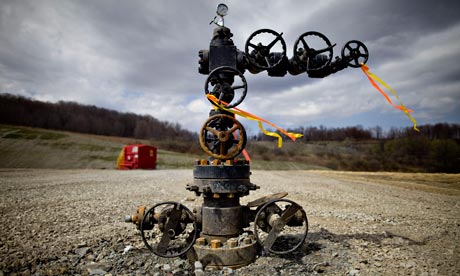
    Shale Gas : A natural gas wellhead near Montrose, Pennsylvania,

    A natural gas wellhead on an Alta Resources LLC drill site near Montrose, Pennsylvania. Photograph: Daniel Acker/Getty Images

    A new report out last week from the US Energy Information Administration (EIA) has doubled estimates of “technically recoverable” oil and gas resources available globally. The report says that shale-based resources potentially increase the world’s total oil supplies by 11 per cent.

    Acknowledging fault-lines in its new study, contracted to energy consulting firm Advanced Resources International Inc. (ARI), the EIA said:

    “These shale oil and shale gas resource estimates are highly uncertain and will remain so until they are extensively tested with production wells.”

    The report estimates shale resources outside the US by extrapolation based on “the geology and resource recovery rates of similar shale formations in the United States.” Hence, the EIA concedes that “the extent to which global technically recoverable shale resources will prove to be economically recoverable is not yet clear.”

    Two years ago, following the publication of the EIA April 2011 report a New York Times investigation obtained internal EIA communications showing how senior officials, including industry consultants and federal energy experts privately voiced scepticism about shale gas prospects.

    One internal EIA document said oil companies had exaggerated “the appearance of shale gas well profitability” by highlighting performance only from the best wells, and using overly optimistic models for productivity projections over decades. The NYT reported that the EIA often “relies on research from outside consultants with ties to the industry.”

    The latest EIA shale gas estimates, contracted to ARI, is no exception. ARI, according to the NYT’s 2011 article, has “major clients in the oil and gas industry” and the company’s president, Vello Kuuskraa, is “a stockholder and board member of Southwestern Energy, an energy company heavily involved in drilling for gas in the Fayetteville shale formation in Arkansas.”

    Independent studies published over the last few months cast even more serious doubt over the viability of the shale gas boom.

    A report released in March by the Berlin-based Energy Watch Group (EWG), a group of European scientists, undertook a comprehensive assessment of the availability and production rates for global oil and gas production, concluding that:

    “… world oil production has not increased anymore but has entered a plateau since about 2005.”

    Crude oil production was “already in slight decline since about 2008.” This is consistent with the EWG’s earlier finding that global conventional oil production had peaked in 2006 – as subsequently corroborated by the International Energy Agency (IEA) in 2010.

    The new report predicts that far from growing inexorably, “light tight oil production in the USA will peak between 2015 and 2017, followed by a steep decline”, while shale gas production will most likely peak in 2015. Shale gas prospects outside the US are incomparable to gains made so far there “since geological, geographical, and industrial conditions are much less favourable.”

    Consequently, global gas prices are likely to increase rather than follow the initial US trend. In the meantime, conventional oil production will continue declining, dropping as much as 40 per cent by 2030. The upshot is that the US “will not become a net oil exporter.”

    The EGW report follows two other reports published earlier this year also challenging the conventional wisdom.

    A Post-Carbon Institute study authored by geologist David Hughes, who worked for 32 years as a research manager at the Geological Survey of Canada, analysed US production data for 65,000 wells from 31 shale plays using a database widely used in industry and government. While acknowledging that shale has dramatically reversed “the long-standing decline of US oil and gas production”, this can only:

    “… provide a temporary reprieve from having to deal with the real problems: fossil fuels are finite, and production of new fossil fuel resources tends to be increasingly expensive and environmentally damaging.”

    Despite accounting for nearly 40 per cent of US natural gas production, shale gas production has “been on a plateau since December 2011 – 80 per cent of shale gas production comes from five plays”, some of which are already in decline.

    “The very high decline rates of shale gas wells require continuous inputs of capital – estimated at $42 billion per year to drill more than 7,000 wells – in order to maintain production. In comparison, the value of shale gas produced in 2012 was just $32.5 billion.”

    The report thus concludes:

    “Notwithstanding the fact that in theory some of these resources have very large in situ volumes, the likely rate at which they can be converted to supply and their cost of acquisition will not allow them to quell higher energy costs and potential supply shortfalls.”

    Report author Hughes said that the main problem was the exclusion of price and rate of supply: “Price is critically important but not considered in these estimates.” He added: “Only a small portion [of total estimated resources], likely less than 5-10 per cent will be recoverable at a low price…

    “Shale gas can continue to grow but only at higher prices and that growth will require an ever escalating drilling treadmill with associated collateral financial and environmental costs – and its long term sustainability is highly questionable.”

    Another report was put out by the Energy Policy Forum, and authored by former Wall Street analyst Deborah Rogers – now an adviser to the US Department of the Interior’s Extractive Industries Transparency Initiative. Rogers warns that the interplay of geological constraints and financial exuberance are creating an unsustainable bubble. Her report shows that shale oil and gas reserves have been:

    “… overestimated by a minimum of 100% and by as much as 400-500% by operators according to actual well production data filed in various states… Shale oil wells are following the same steep decline rates and poor recovery efficiency observed in shale gas wells.”

    Deliberate overproduction drove gas prices down so that Wall Street could maximise profits “from mergers & acquisitions and other transactional fees”, as well as from share prices. Meanwhile, the industry must still service high levels of debt due to excessive borrowing justified by overinflated projections:

    “… leases were bundled and flipped on unproved shale fields in much the same way as mortgage-backed securities had been bundled and sold on questionable underlying mortgage assets prior to the economic downturn of 2007.”

    Seeking to prevent outright collapse, the report argues, the US is ramping up gas exports so it can exploit the difference between low domestic and high international prices “to shore up ailing balance sheets invested in shale assets.”

    Rogers, who testified last month before the Senate Committee on Energy and Natural Resources, also expressed scepticism about the EIA’s latest assessment:

    “The EIA actually does retrospective assessments of their forecasting and their track record is dismal… They admit that they overestimated natural gas production 66 per cent of the time and crude 59.6 per cent of the time in their March 2013 assessment for 2012.”

    She added that “there is definitely a bubble.” Though it would not have an impact as devastating as the banking crisis, she said:

    “The oil majors do have losses, but the smaller independents are being shaken out. Chesapeake and others are struggling, like Devon, Continental, Kodiak and Range. Without exception, they all have had a significant deterioration in negative free cash since 2010. This is obviously not sustainable.”

    The impact of this would be greater centralisation, with smaller companies and their assets being absorbed by the oil majors through mergers and acquisitions. Rogers said:

    “What is most troubling to me is that there appears to be a complacency setting in about transitioning to a more sustainable energy economy. Shales should be used as a bridge. But we are hearing far too much euphoric talk about 100-200 years of natural gas. Therefore no need to worry, it can be business as usual. This is highly problematic in my opinion. We must globally transition away from hydrocarbons.

  • Global riot epidemic due to demise of cheap fossil fuels

    Global riot epidemic

    due to demise of

    cheap fossil fuels

    From South America to South Asia, a new age of unrest is in full swing as industrial civilisation transitions to post-carbon reality
    A pro-European protester swings a metal chain during riots in Kiev

    A protester in Ukraine swings a metal chain during clashes – a taste of things to come? Photograph: Gleb Garanich/Reuters

    If anyone had hoped that the Arab Spring and Occupy protests a few years back were one-off episodes that would soon give way to more stability, they have another thing coming. The hope was that ongoing economic recovery would return to pre-crash levels of growth, alleviating the grievances fueling the fires of civil unrest, stoked by years of recession.

    But this hasn’t happened. And it won’t.

    Instead the post-2008 crash era, including 2013 and early 2014, has seen a persistence and proliferation of civil unrest on a scale that has never been seen before in human history. This month alone has seen riots kick-off in Venezuela, Bosnia, Ukraine, Iceland, and Thailand.

    This is not a coincidence. The riots are of course rooted in common, regressive economic forces playing out across every continent of the planet – but those forces themselves are symptomatic of a deeper, protracted process of global system failure as we transition from the old industrial era of dirty fossil fuels, towards something else.

    Even before the Arab Spring erupted in Tunisia in December 2010, analysts at the New England Complex Systems Institute warned of the danger of civil unrest due to escalating food prices. If the Food & Agricultural Organisation (FAO) food price index rises above 210, they warned, it could trigger riots across large areas of the world.

    Hunger games

    The pattern is clear. Food price spikes in 2008 coincided with the eruption of social unrest in Tunisia, Egypt, Yemen, Somalia, Cameroon, Mozambique, Sudan, Haiti, and India, among others.

    In 2011, the price spikes preceded social unrest across the Middle East and North Africa – Egypt, Syria, Iraq, Oman, Saudi Arabia, Bahrain, Libya, Uganda, Mauritania, Algeria, and so on.

    Last year saw food prices reach their third highest year on record, corresponding to the latest outbreaks of street violence and protests in Argentina, Brazil, Bangladesh, China, Kyrgyzstan, Turkey and elsewhere.

    Since about a decade ago, the FAO food price index has more than doubled from 91.1 in 2000 to an average of 209.8 in 2013. As Prof Yaneer Bar-Yam, founding president of the Complex Systems Institute, told Vice magazine last week:

    “Our analysis says that 210 on the FAO index is the boiling point and we have been hovering there for the past 18 months… In some of the cases the link is more explicit, in others, given that we are at the boiling point, anything will trigger unrest.”

    But Bar-Yam’s analysis of the causes of the global food crisis don’t go deep enough – he focuses on the impact of farmland being used for biofuels, and excessive financial speculation on food commodities. But these factors barely scratch the surface.

    It’s a gas

    The recent cases illustrate not just an explicit link between civil unrest and an increasingly volatile global food system, but also the root of this problem in the increasing unsustainability of our chronic civilisational addiction to fossil fuels.

    In Ukraine, previous food price shocks have impacted negatively on the country’s grain exports, contributing to intensifying urban poverty in particular. Accelerating levels of domestic inflation are underestimated in official statistics – Ukrainians spend on average as much as 75% on household bills, and more than half their incomes on necessities such as food and non-alcoholic drinks, and as75% on household bills. Similarly, for most of last year, Venezuela suffered from ongoing food shortages driven by policy mismanagement along with 17 year record-high inflation due mostly to rising food prices.

    While dependence on increasingly expensive food imports plays a role here, at the heart of both countries is a deepening energy crisis. Ukraine is a net energy importer, having peaked in oil and gas production way back in 1976. Despite excitement about domestic shale potential, Ukraine’s oil production has declined by over 60% over the last twenty years driven by both geological challenges and dearth of investment.

    Currently, about 80% of Ukraine’s oil, and 80% of its gas, is imported from Russia. But over half of Ukraine’s energy consumption is sustained by gas. Russian natural gas prices have nearly quadrupled since 2004. The rocketing energy prices underpin the inflation that is driving excruciating poverty rates for average Ukranians, exacerbating social, ethnic, political and class divisions.

    The Ukrainian government’s recent decision to dramatically slash Russian gas imports will likely worsen this as alternative cheaper energy sources are in short supply. Hopes that domestic energy sources might save the day are slim – apart from the fact that shale cannot solve the prospect of expensive liquid fuels, nuclear will not help either. A leaked European Bank for Reconstruction and Development (EBRD) report reveals that proposals to loan 300 million Euros to renovate Ukraine’s ageing infrastructure of 15 state-owned nuclear reactors will gradually double already debilitating electricity prices by 2020.

    “Socialism” or Soc-oil-ism?

    In Venezuela, the story is familiar. Previously, the Oil and Gas Journal reported the country’s oil reserves were 99.4 billion barrels. As of 2011, this was revised upwards to a mammoth 211 billion barrels of proven oil reserves, and more recently by the US Geological Survey to a whopping 513 billion barrels. The massive boost came from the discovery of reserves of extra heavy oil in the Orinoco belt.

    The huge associated costs of production and refining this heavy oil compared to cheaper conventional oil, however, mean the new finds have contributed little to Venezuela’s escalating energy and economic challenges. Venezuela’s oil production peaked around 1999, and has declined by a quarter since then. Its gas production peaked around 2001, and has declined by about a third.

    Simultaneously, as domestic oil consumption has steadily increased – in fact almost doubling since 1990 – this has eaten further into declining production, resulting in net oil exports plummeting by nearly half since 1996. As oil represents 95% of export earnings and about half of budget revenues, this decline has massively reduced the scope to sustain government social programmes, including critical subsidies.

    Looming pandemic?

    These local conditions are being exacerbated by global structural realities. Record high global food prices impinge on these local conditions and push them over the edge. But the food price hikes, in turn, are symptomatic of a range of overlapping problems. Global agriculture‘s excessive dependence on fossil fuel inputs means food prices are invariably linked to oil price spikes. Naturally, biofuels and food commodity speculation pushes prices up even further – elite financiers alone benefit from this while working people from middle to lower classes bear the brunt.

    Of course, the elephant in the room is climate change. According to Japanese media, a leaked draft of the UN Intergovernmental Panel on Climate Change‘s (IPCC) second major report warned that while demand for food will rise by 14%, global crop production will drop by 2% per decade due to current levels of global warming, and wreak $1.45 trillion of economic damage by the end of the century. The scenario is based on a projected rise of 2.5 degrees Celsius.

    This is likely to be a very conservative estimate. Considering that the current trajectory of industrial agriculture is already seeing yield plateaus in major food basket regions, the interaction of environmental, energy, and economic crises suggests that business-as-usual won’t work.

    The epidemic of global riots is symptomatic of global system failure – a civilisational form that has outlasted its usefulness. We need a new paradigm.

    Unfortunately, simply taking to the streets isn’t the answer. What is needed is a meaningful vision for civilisational transition – backed up with people power and ethical consistence.

    It’s time that governments, corporations and the public alike woke up to the fact that we are fast entering a new post-carbon era, and that the quicker we adapt to it, the far better our chances of successfully redefining a new form of civilisation – a new form of prosperity – that is capable of living in harmony with the Earth system.

    But if we continue to make like ostriches, we’ll only have ourselves to blame when the epidemic becomes a pandemic at our doorsteps.