Author: Neville

  • Big thaw projected for Antarctic sea ice: Ross Sea will reverse current trend, be largely ice free in summer by 2100

    Featured Research

    from universities, journals, and other organizations

    Big thaw projected for Antarctic sea ice: Ross Sea will reverse current trend, be largely ice free in summer by 2100

    Date:
    February 27, 2014
    Source:
    Virginia Institute of Marine Science
    Summary:
    A new modeling study suggests that a recent observed increase in summer sea-ice cover in Antarctica’s Ross Sea is likely short-lived, with the area projected to lose more than half its summer sea ice by 2050 and more than three quarters by 2100. These changes will significantly impact marine life in what is one of the world’s most productive and unspoiled marine ecosystems.

    Emperor Penguins: Changes in the extent and duration of Ross Sea ice will significantly impact marine life in what is one of the world’s most productive and unspoiled marine ecosystems, where rich blooms of phytoplankton feed krill, fish, and higher predators such as penguins.
    Credit: Photo courtesy of Walker Smith

    Antarctica’s Ross Sea is one of the few polar regions where summer sea-ice coverage has increased during the last few decades, bucking a global trend of drastic declines in summer sea ice across the Arctic Ocean and in two adjacent embayments of the Southern Ocean around Antarctica.

    Now, a modeling study led by Professor Walker Smith of the Virginia Institute of Marine Science suggests that the Ross Sea’s recent observed increase in summer sea-ice cover is likely short-lived, with the area projected to lose more than half its summer sea ice by 2050 and more than three quarters by 2100.

    These changes, says Smith, will significantly impact marine life in what is one of the world’s most productive and unspoiled marine ecosystems, where rich blooms of phytoplankton feed krill, fish, and higher predators such as whales, penguins, and seals.

    Smith, who has been conducting ship-based fieldwork in the Ross Sea since the 1980s, collaborated on the study with colleagues at Old Dominion University. Their paper, “The effects of changing winds and temperatures on the oceanography of the Ross Sea in the 21st century,” appears in the Feb. 26 issue of Geophysical Research Letters. Smith’s co-authors are Mike Dinniman, Eileen Hofmann, and John Klinck.

    Smith says “The Ross Sea is critically important in regulating the production of Antarctica’s sea ice overall and is biologically very productive, which makes changes in its physical environment of global concern. Our study predicts that it will soon reverse its present trend and experience major drops in ice cover in summer, which, along with decreased mixing of the vertical column, will extend the season of phytoplankton growth. These changes will substantially alter the area’s pristine food web.”

    Researchers attribute the observed increase in summertime sea ice in the Ross Sea — where the number of days with ice cover has grown by more two months over the past three decades — to a complex interplay of factors, including changes in wind speed, precipitation, salinity, ocean currents, and air and water temperature.

    But global climate models agree that air temperatures in Antarctica will increase substantially in the coming decades, with corresponding changes in the speed and direction of winds and ocean currents. When Smith and his colleagues fed these global projections into a high-resolution computer model of air-sea-ice dynamics in the Ross Sea, they saw a drastic reduction in the extent and duration of summer sea ice.

    The modeled summer sea ice concentrations decreased by 56% by 2050 and 78% by 2100. The ice-free season also grew much longer, with the mean day of retreat in 2100 occurring 11 days earlier and the advance occurring 16 days later than now.

    Also changed was the duration and depth of the “shallow mixed layer,” the zone where most phytoplankton live. “Our model projects that the shallow mixed layer will persist for about a week longer in 2050, and almost three weeks longer in 2100 than now,” says Smith. “The depth of the shallow mixed layer will also decrease significantly, with its bottom 12% shallower in 2050, and 44% shallower in 2100 than now.”

    For Smith, these changes in ice, atmosphere, and ocean dynamics portend major changes in the Antarctic food web. On the bright side, the decrease in ice cover will bring more light to surface waters, while a more persistent and shallower mixed layer will concentrate phytoplankton and nutrients in this sunlit zone. These changes will combine to encourage phytoplankton growth, particularly for single-celled organisms called diatoms, with ripples of added energy potentially moving up the food web.

    But, Smith warns, the drop in ice cover will negatively affect several other important species that are ice-dependent, including crystal krill and Antarctic silverfish. A decrease in krill would be particularly troublesome, as these are the major food source for the Ross Sea’s top predators — minke whales, Adélie and Emperor penguins, and crabeater seals.

    Overall, says Smith, “our results suggest that phytoplankton production will increase and become more diatomaceous. Other components of the Ross Sea food web will likely be severely disrupted, creating significant but unpredictable impacts on the ocean’s most pristine ecosystem.”


    Story Source:

    The above story is based on materials provided by Virginia Institute of Marine Science. The original article was written by David Malmquist. Note: Materials may be edited for content and length.


    Journal Reference:

    Walker O. Smith, Michael S. Dinniman, Eileen E. Hofmann, John M. Klinck. The effects of changing winds and temperatures on the oceanography of the Ross Sea in the 21stcentury. Geophysical Research Letters, 2014; DOI:

  • Days to kill Keystone — the carbon mega-bomb AVAAZ

    e to enable desktop notifications for Gmail.   Learn more  Hide

    1 of 36
    Why this ad?
    TAFE Courses Onlinewww.opencolleges.edu.au – Study From Home At Your Own Pace Download A Course Guide Today.

    Days to kill Keystone — the carbon mega-bomb

    Inbox
    x

    Pascal V. – Avaaz.org

    2:57 PM (22 minutes ago)

    to me
    Dear friends,

    Right now, the US is deciding whether to approve a monster oil pipeline that would unleash devastating levels of carbon pollution from Canada’s dirty tar sands. The US State Department is holding a public comment process before the big decision, and insiders say they want a mandate to stand up to industry pressure. Let’s help by flooding the comment process with an overwhelming mandate to kill this carbon bomb — we only have days left:

    SIGN THE PETITION

    Right now, the US government is about to make the defining climate decision of Obama’s presidency — whether to approve a monstrous pipeline that will transport up to 830,000 barrels a day of the world’s dirtiest oil from Canada across the US.

    If approved, the Keystone XL pipeline will help pump billions of dollars into the pockets of a few companies… but also millions of tons of carbon into the atmosphere. It’s been called “a fuse to the biggest carbon bomb on the planet”. Bold public action has delayed it once, and a court ruling last week has dealt a serious blow to the project. Now, if we act fast and in massive numbers, we can help kill it for good.

    The US Secretary of State, responsible for the US’s relationship with the world, has opened a final round of comments from the public. He knows this decision is a vital litmus test for US global leadership to avert climate disaster. Let’s turn it into a truly global referendum by flooding the consultation with a million voices from every country calling on them to kill Keystone and take the leadership role they say they want in the fight to save the planet. We only have days until it closes – join here:

    http://www.avaaz.org/en/stop_the_keystone_xl_pipeline_loc/?bhPqncb&v=36676

    The heat from Big Oil is already intense — they’ve bought out the ads in DC subways that politicians pass through to get to work. If we hit a million signers, Avaaz will fight back on the DC battleground, taking out ads right next to theirs so Secretary Kerry and his staff see the people’s voices first and loudest.

    Big Oil ads are just the tip of the iceberg. We know that the US is under fire from industry lobbyists who will make serious money from the pipeline. But it will be at the cost of all of our futures. Tar sands oil is the dirtiest dirty fossil fuel ever cooked up – releasing 3-4 times the global warming pollution of normal petrol!

    Last year, Obama said he’d let Keystone go ahead only if it was found to be in the US’s national interest and if it could be proven that it wouldn’t worsen the climate crisis for future generations. And Secretary of State Kerry, who made climate change one of his signature issues, wants to lead on the world stage, so he’ll be more sensitive to global opinion. Pipeline supporters are answering with claims of more construction jobs and greater independence from petro-states. But Obama knows that the real jobs are in clean energy and that climate change is perhaps the greatest threat to US and global security there is.

    We’re already winning. Three years ago, this pipeline was a foregone conclusion. But then people-power swung into action — thousands were arrested at the largest act of civil disobedience in the US in decades, and Obama refused the initial proposal. Let’s do our part now by collecting the most international comments EVER for a US government decision and give Secretary Kerry and President Obama the public cover they need to reject the Keystone carbon bomb:

    http://www.avaaz.org/en/stop_the_keystone_xl_pipeline_loc/?bhPqncb&v=36676

    Wherever we are in the world — Alberta, Canada, where the pipeline would begin; the UK, still recovering from historic floods; Australia, just emerging from a summer ravaged by record fires, or any other country where extreme weather is taking its toll — we’re all downstream from climate change. If we stand together today, we can all be a part of a victory to stop this crazy pipeline and help build a strong climate movement.

    With hope,

    Pascal, David, Luis, Antonia, Emma, Patri, Wen, Ricken, and the Avaaz team

    SOURCES:

    Pressure is on Kerry as Keystone pipeline decision nears (Washington Post):
    http://www.washingtonpost.com/national/health-science/pressure-is-on-kerry-as-keystone-pipeline-deci…

    Pipeline Fight Lifts Environmental Movement (New York Times):
    http://www.nytimes.com/2014/01/25/us/keystone-xl-pipeline-fight-lifts-environmental-movement.html

    10 Reasons to Oppose the Keystone XL Pipeline (The Huffington Post):
    http://www.huffingtonpost.com/rose-ann-demoro/10-reasons-to-oppose-the-_1_b_4791713.html

    Oil sands pollution two to three times higher than thought (Yahoo News):
    http://news.yahoo.com/oil-sands-pollution-two-three-times-higher-thought-210153802.html

    How Much Will Tar Sands Oil Add to Global Warming? (Scientific American):
    http://www.scientificamerican.com/article/tar-sands-and-keystone-xl-pipeline-impact-on-global-warmin…

    Foreign Company Tries To Seize U.S. Land For Keystone Pipeline (Forbes):
    http://www.forbes.com/sites/jamesconca/2014/02/24/foreign-company-tries-to-seize-u-s-land-for-keysto…


    Avaaz.org is a 33-million-person global campaign network
    that works to ensure that the views and values of the world’s people shape global decision-making. (“Avaaz” means “voice” or “song” in many languages.) Avaaz members live in every nation of the world; our team is spread across 18 countries on 6 continents and operates in 17 languages. Learn about some of Avaaz’s

  • Antarctic Circumpolar Current Carries 20 Percent More Water Than Previous Estimates

    Data is key to validating accuracy of climate models

    Released: 2/26/2014 3:00 PM EST
    Source Newsroom: University of Rhode Island

    Contact Information

    Available for logged-in reporters only

    Citations

    Ocean Sciences Meeting

    Newswise — NARRAGANSETT, R.I. – February 26, 2014 – The Antarctic Circumpolar Current transports water around Antarctica and into the Atlantic, Pacific and Indian Oceans, transferring heat and energy around the globe. Quantifying how much water it carries is an important step in understanding climate change and validating the accuracy of climate and oceanographic models.

    By analyzing four years of continuous measurements of the current at Drake Passage, the narrowest point in the Southern Ocean, three University of Rhode Island oceanographers have concluded that the current carries 20 percent more water than previous estimates. They also found that the current remains strong all the way to the seafloor.

    “It’s important to understand the dynamics of the current so we can understand the impacts of our changing climate,” said Kathleen Donohue, associate professor at the URI Graduate School of Oceanography. “We want to know how the current will respond to changing conditions, so quantifying the transport gives important guidance to the climate models that are trying to predict the future.”

    Donohue, along with URI Professor Randolph Watts and Marine Research Specialist Karen Tracey, will present the results of this research this week at the biennial Ocean Sciences Meeting in Honolulu. The meeting is sponsored by the American Geophysical Union, The Oceanographic Society, and the Association for the Sciences of Limnology and Oceanography.

    The Southern Ocean is warming faster than other oceans, and the easterly winds that drive the current have increased significantly in the last 30 years. How the current will respond to these changes is not fully understood. Eddies, or ocean storms, are essential for transferring momentum from the circumpolar winds that drive the current to the sea floor.

    To study the dynamics of the current, Donohue, Watts and Teresa Chereskin of the Scripps Institution of Oceanography deployed 35 current and pressure recording inverted echo sounders, which measure oceanic fronts and currents, across Drake Passage in 2007. They retrieved them in 2011. Another more closely spaced array of instruments was also deployed to map circulation and eddy patterns. The instruments collected higher resolution data over a longer period of time than the only other similar study of the Antarctic Circumpolar Current, which was conducted in the 1970s.

    Drake Passage is an important site for oceanographic measurements because it is one of the few places around the globe where ocean currents travel through a somewhat narrow passage. Drake Passage is 800 kilometers wide and runs from the southern tip of South America to the northernmost point of Antarctica.

    “We’re never going to be able to measure the whole ocean,” said Watts. “So if we’re going to make accurate predictions of future climate, we’re going to have to accurately measure processes like water transport and heat flux at key locations like the Drake Passage to guide our understanding.”

    The next step for the scientists is to develop a method of monitoring the Antarctic Circumpolar Current using a smaller array of instruments so the measurements can continue well into the future. They also hope to travel to the South Pacific and South Atlantic to make additional measurements of how ocean storms transport heat toward the pole.

  • Announcing: “Stranded Down Under” Tour 350 org

    1 of 36
    Why this ad?
    PhD in Educationtua.edu.au/Education_PhD – Study Online at Torrens University. Request Information Right Now!

    Announcing: “Stranded Down Under” Tour

    Inbox
    x

    Charlie Wood – 350.org Australia charlie@350.org

    6:05 PM (1 hour ago)

    to me

    Dear friend,

    You’re invited to Stranded Down Under – are fossil fuels bankrupting us financially and ecologically? with Oxford University and Bloomberg New Energy Finance’s Ben Caldecott.

    What’s the connection between your bank account, superannuation and fossil fuels?

    As the world acts to cut emissions, Australia plans to invest over AUD 100 billion in new coal projects over the next 15 years. This includes nine mega-mines in Queensland’s Galilee Basin, export ports along the Great Barrier Reef and Whitehaven Coal’s Maules Creek mine in the Leard State Forest.

    Whether we like it or not, these projects and the companies behind them, are receiving loans from our big banks and investment from our super funds.

    But as major economies like China act to reduce their dependence on fossil fuels, these projects will face increasing risks – risks our savings will be forced to foot.

    Come and hear Ben Caldecott, founder of Oxford University’s Stranded Assets Programme and author of the groundbreaking report Stranded Down Under?, sheds light on the ramifications of Australia’s fossil fuel addiction and what we can do to kick Australia’s dirtiest habit.

    Click here to register for your nearest event:

    • Canberra: 18:00-19:30, March 25th, Coombs Lecture Theatre, Fellows Rd, ANU, Introduction by The Australia Institute’s Richard Denniss AND Crawford School Lunchtime Panel, 13:30-14:00, March 25th (details tbc)

    • Sydney: 18:30-20:00, March 27th, Seymour Centre, Cnr Cleveland St & City Rd, Introduction by former Liberal Party Leader, John Hewson and 350.org’s Blair Palese

    • Melbourne: 18:00-19:30, April 1st, Theatre 1, 207 Bouverie St, University of Melbourne, Introduction by Melbourne University’s Professor David Karoly

    • Brisbane: 18:00-19:30, April 3rd, C Block Auditorium CI411, Southbank TAFE, South Brisbane

    Look forward to seeing you there!

    Warm wishes,

    Charlie, Blair, May, Aaron, Simon, Josh and the whole 350.org Australia

  • Climate Code Red

    Neville Gillmore

    To Me
    Feb 26 at 9:38 PM

    This message contains blocked images.

    ———- Forwarded message ———-
    From: Climate Code Red <noreply@blogger.com>
    Date: Wed, Feb 26, 2014 at 8:31 PM
    Subject: climate code red
    To: nevilleg729@gmail.com

    climate code red


    Connecting the dots to win on climatePosted: 25 Feb 2014 08:13 PM PST

    by David Spratt

    On 20 March I spoke, together with Adam Bandt MP, at a forum in Melbourne on Global warming, Tony Abbott and the need for climate action.

    The second half of my presentation was on how to turn the tide, looking at the “middle third” in recent polling and Tony Abbott’s and his government’s vulnerability on climate, and what they are desperate to not talk about:

    • More and more intense extreme weather events (exemplified by their silence on the spring 2013 fires, and record January 2014 heat);
    • A public conversation that “connects the dots” between extreme events and climate change, and which gives immediacy to the perception of climate impacts;
    • Constructing a climate narrative about human climate impacts, rather than electricity prices and taxes;
    • Public focus on the responsibility of political leaders to “protect the people” from climate change; and
    • Close attention being paid to the efficacy of their “direct action” climate plan.

    The key task is to sell the product (climate impacts), and not its price (carbon tax), by constructing a narrative about climate impacts that brings the message back to the home, that connects the dots, that poses the choice between increasing harm and threat, or acting to restore climate safety, and the duty of political leaders to protect the people. To do this we need to more thoroughly learn the lessons from the health promotions sector: be honest about the problem and tell it like it is; show a better alternative, the benefits of changing behaviour; and finally demonstrate an efficacious path to move from fear to success. This means making the story about:

    • People in Australia and not distant places;
    • Now and not just the distant future;
    • How family and friends will live in a hotter and more extreme world;
    • How it will affect where we live and how we work; and
    • Health and well-being, about increasing food and water insecurity, and the lives that children and grandchildren will face.

    Some of these ideas were canvassed at greater length in “As Tony Abbott launches all-out war on climate action, what’s the plan?”

    This post is about the first part of my presentation, on connecting climate extremes that are being experienced today to an understanding of what climate change will mean for people in the future.

    A new climate regime

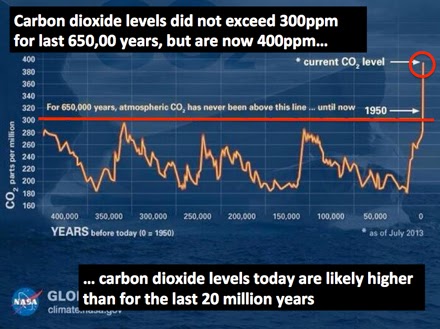
    One starting point is to make it clear that we are moving to a whole new climate that will be a new experience to people wherever in the world they live. Carbon dioxide levels – the principal determinant of changing temperatures – are higher than at any time since modern human evolved, and likely higher than for the last 15 to 20 million years, so we are creating a new climate regime that humans have never experienced.

    Climate change manifests not as a slow, imperceptible and smooth change, but as a series of extreme events that become increasingly frequent till they become the new norm. So these extreme events – record temperatures, longer and more intense heat waves, changing rainfall and drought patterns – are all a preview of what life will be like every day in a few decades time.

    In January, Melbourne set two new extreme heat records:

    • four consecutive days of maximums over 41°C;
    • three days of where the average, 24-hour temperature was over 35°C (basically in the range of 28C-44°C).

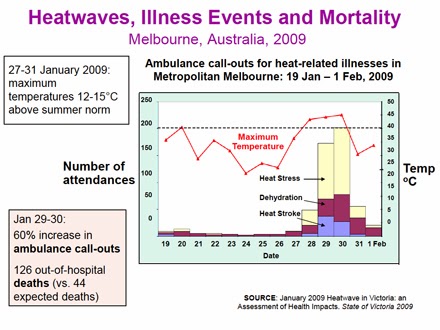
    During this extreme heatwave, preliminary estimates are that there were 140 additional heatwave deaths, many of whom we should call victims of climate change. In 2009, the heatwave leading up to Black Saturday claimed twice as many victims (374) as the fires themselves (173), with ambulance calls-outs spiking once temperatures hits 40°C, as this chart of ambulance call-outs at that time shows:

    Courtesy: Prof. Tony McMichael

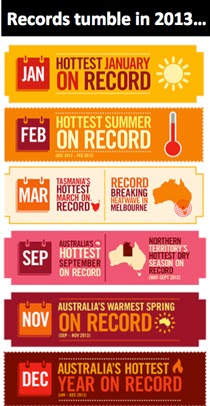
    In 2013 we experienced hottest day, week, month and year on record in Australia. During the 2012-13 summer high temperature records were set in every state and territory.

    And a new Climate Council report finds that over last 30 years, Melbourne heat-waves are occurring 17 days earlier, have become 1.5°C hotter, and the maximum temperature of the hottest day is 2°C higher, compared to 1950-1980.

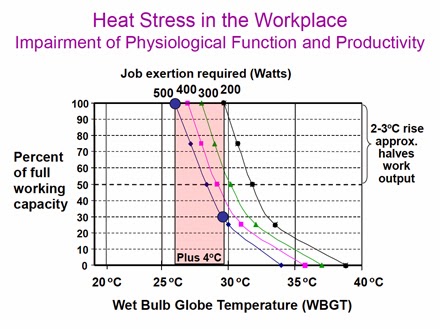
    Extreme heat affects workplace productivity. As the next chart shows, for medium-exertion work, when  the temperature increases from 30°C to 34°C (at 20% humidity), productivity halves.  By the time the temperature is around 40°C, productivity approaches zero.

    Courtesy: Prof. Tony McMichael

    The key message to communicate is that we are departing from the climate we have known, and moving to a new climate.

    Points of departure

    A graphic way of demonstrating this is using resources from a paper published in October last year, “The  projected timing of climate departure from recent variability”.

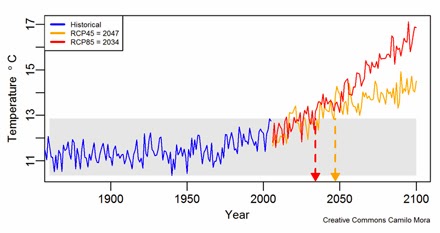
    The associated website includes data for many locations around the globe. Below is one projection for Melbourne. The research tracked average temperatures for each location from 1850 to 2005 (blue line) and established this historical temperature band (grey area).  Then climate models for two emissions scenarios (RCP8.5 which is the high “business-as-usual” emissions scenario the world is current tracking on, in red; and a lower scenario, in yellow) were run to ask the following question: for each scenario, what is the year in which temperatures from that point on will all be higher than the current band. For Melbourne the answer for one climate model (Institut Pierre Simon Laplace Earth System Model CM5A-M) is 2034 (high emissions) and 2047 (medium emissions):

    Melbourne: point of departure from current climate
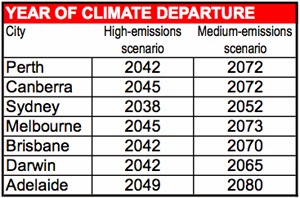
    Point of departure from 1850-2005 climate
    for major Australia cities for RCP8.5 and RCP4.5
    scenarios

    When all models are taken into account and averaged, the results for Melbourne are 2045 and 2073. To summarise, sometime from 2045 onward in Melbourne, even the coldest years will be hotter than any year up to 2005. So this is a way of showing the points of departure from the current climate regime, and the movement into a whole new higher, hotter regime. A table of climate departure years for major Australia cities is shown at right.

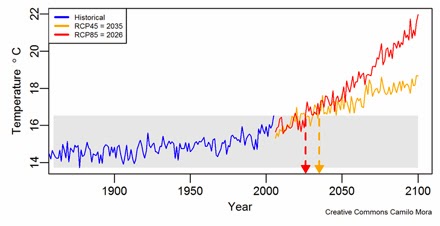
    And here is the Sydney result for the Institut Pierre Simon Laplace Earth System Model CM5A model:

    Sydney: point of departure from current climate

    Devastating impacts

    And it is not just about air temperatures.  Waters around Australia had hottest sea surface temperatures on record in February 2013. In the last four years, we have experienced unprecedented and out-of-season bush fires, a record two years of rain, repeated “1-in-a-100-year” floods, as well as record heat.

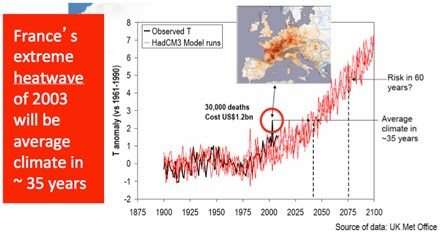
    And, of course, it’s not just Australia. One well-studied extreme event is the European/French heatwave of 2003, which killed 70,000 people, resulted in a 30 per cent drop in plant growth and caused $12 billion of crop losses, adding half a billion tonnes of carbon to the atmosphere. As the next image shows, in 35 years time, the 2003 extreme will be the average climate for that region:

    All of which suggests that even one degree of warming is not exactly safe. Yet carbon dioxide levels today are sufficient for one-and-a-half degrees of warming, and without rapid and deep emission cuts two degree will be unavoidable.

    We know quite a bit about a 2°C world from climate history research. Three million years ago in the mid-Pliocene, when greenhouse gas levels similar to today and sufficient for 2°C of warming, sea levels were 20 metres or more higher than today. Yet with a 5-metre rise, Miami would disappear and Central London, Bangkok, Bombay and Shanghai would lose most of their area. Rich food-growing deltas such as Nile, Mekong and Brahmaputra inundated.

    At 2°C warmer, every year in Australia would likely be hotter than the hottest year up to 2005; there would up to a doubling of days over 35°C, and roughly a doubling in extreme fire days. The barrier reef would be lost, Kakadu salinated, Murray Darling water flows down by about a quarter, and seas would be on the way to rising several metres in a nation where 85% of the population lives within 50 Kms of the coast. In Australia, more than $200 billion worth of coastal assets and 700,000 properties are at risk from a sea level rise of just 1.1 metre.

    What more can we do to connect the dots between today’s extreme experiences and tomorrow’s world?

    You are subscribed to email updates from Climate Code Red
    To stop receiving these emails, you may unsubscribe now.
    Email delivery powered by Google
  • Renewable Energy, Nuclear Power, and Galileo Access to Hansen’s Website and reports back to 2004

    (ACCESS TO WEBSITE)

    Renewable Energy, Nuclear Power, and Galileo (HANSEN) (ACCESS TO WEBSITE)

    Posted in Uncategorized By Neville On February 21, 2014

    Renewable Energy, Nuclear Power, and Galileo

    Inbox
    x

    James Hansen via mail170.wdc02.mcdlv.net

    5:04 AM (4 hours ago)

    to me
    Email not displaying correctly? View it in your browser.
    Renewable Energy, Nuclear Power, and Galileo

    A draft opinion piece, Renewable Energy, Nuclear Power, and Galileo, is available here or on my web site. Criticisms are welcome.

    ~Jim
    21 February 2014