Author: Neville

  • Ask Tim Flannery your climate questions

    1 of 48
    Why this ad?
    Landscape Garden Edgingwww.kwikkerb.net.au/Garden-Edging – Make Your Garden Look Amazing. Call Us For Free Onsite Quote!

    Ask Tim Flannery your climate questions

    Inbox
    x

    Amanda McKenzie – Climate Council via sendgrid.info

    2:49 PM (39 minutes ago)

    to me
    “An opinion is useless, what we need are more facts” – Tim Flannery

    Hi Inga

    We’re coming to the end of another intense summer in Australia with record-breaking temperatures, heatwaves, bushfires and drought. Many people are left wondering if what we’ve seen this summer is normal, or if we’re already experiencing the impacts of climate change.

    It’s an important time to discuss the state of the climate and get clear about the facts. So this Thursday Tim Flannery will be giving you a personal briefing on the latest climate science in a live online Q&A.

    Date: Thursday 27th February
    Time: 6.30pm AEDT
    Where: Online at www.climatecouncil.org.au
    RSVP: on Facebook and submit your question now

    At its heart the Climate Council exists to provide independent information on the state of our climate. This summer we’ve released a series of reports about climate change impacts in Australia – this is your opportunity to get an up to date briefing on our latest findings. Participating in the Q&A is free and open to everyone.

    RSVP to the event on Facebook to submit your questions.

    You can also submit your questions by replying to this email or tweeting @climatecouncil with the hashtag #asktim during the broadcast.

    This is what people said about our last live Q&A with the experts:

    • It’s great to hear a rational discussion of the science and its implications without all of the politics. – Anne
    • I got a lot out of Will Steffen’s simple responses to complex science questions – too often it’s assumed we should all be totally up to speed with what’s happening. – Adam

    We hope you will join us on Thursday evening for what is sure to be a lively and informative Q&A.

    See you there,

    Amanda McKenzie,
    Climate Council CEO

    P.S If you think your friends and networks would be interested in tuning in, head to the Facebook event and hit invite friends to tell them about it. 

     
  • Don’t let them underestimate you.

    Click here to enable desktop notifications for Gmail.   Learn more  Hide
    More

    1 of 1
    Why this ad?
    Consolidate Credit Cardsaustralian-debt-reduction.com.au – Multiple Debt Consolidation Options Pre-Qualify Online in 15 Seconds

    Don’t let them underestimate you.

    Inbox
    x

    Stephen Campbell steve@antarcticocean.org via cmail1.com

    1:41 PM (1 hour ago)

    to me
    Will you keep fighting to protect Antarctica’s Ocean?

    Antarctic Ocean Alliance

    SHARE THIS EMAIL

    Dear NEVILLE,

    Summer may be coming to an end in Antarctica’s great Southern Ocean, but a new dawn is breaking in the fight to protect these pristine waters.

    Last October we came incredibly close to the creation of two large-scale ocean sanctuaries in the Ross Sea and East Antarctica but were blocked by the Russian and Ukrainian delegations. While this result was extremely disappointing, we know that you are determined to keep fighting to protect these waters. Together, we will persevere. They have underestimated your strength, passion, and drive.

    This year we will build on the successes we had in 2013, bringing worldwide attention to the plight of some of our favourite animals that live in these pristine waters. One of these animals, the penguin, has an international day of celebration, on the 25th April. World Penguin Day is not only a fun opportunity to celebrate our web-footed friends in all their glory, but is also a critical opportunity to spread the word about protecting their home in the Southern Ocean. Stay tuned and get ready for shareable penguin fun coming your way soon…

    Our plans and activities are developing fast, but our most valuable asset and ally is YOU. We need you to stay with us in this year’s critical push to create the world’s largest ocean sanctuaries around Antarctica. So to start off 2014 you can help by:

    1. Sharing our petition with your friends on social media.
    2.  Ask your friends and family to join the campaign by signing up to receive our news or joining us on Facebook, Twitter, VK or Weibo.

    Beyond celebrating World Penguin Day we also have a calendar packed full of events, meetings and activities internationally. In Russia and Ukraine we will hold science seminars and build our presence online through Russian social media site, VK. In China we will continue to work with renowned explorer Wang Jing to spread the word about why Southern Ocean protection is important to the Chinese people. We will also be active in Norway, Japan, Korea, the UK and the EU, as well as in all our supporting countries: USA, Australia, New Zealand, and France.

    Our international work will culminate in October in Australia at the 33rd meeting of the Commission for the Conservation of Antarctic Marine Living Resources (CCAMLR XXXIII,) when we will – together with you – stand united to get the creation of two large-scale ocean sanctuaries in the Ross Sea and East Antarctica.

    Don’t let them underestimate you. Together we can win this.

    You’ll be hearing from us very soon!


    Steve Campbell, Campaign Director
  • Hydrogen Fuel Production Gets Big Boost From Cheap New Material


    Hydrogen Fuel Production Gets Big Boost From Cheap New Material

    While hydrogen fuel production — via the splitting of water into hydrogen and oxygen using sunlight — has long been prominent in the public imagination, the reality is that the technology is still quite a ways off from being economical. That gap between the economical and the reality is narrowing though, as new research from the University of Wisconsin-Madison shows.

    Researchers there have succeeded in achieving a new record (with regard to oxide-based photoelectrode systems) solar-to-hydrogen conversion efficiency of 1.7% — while using relatively inexpensive new materials.

    Sunny day

    “In order to make commercially viable devices for solar fuel production, the material and the processing costs should be reduced significantly while achieving a high solar-to-fuel conversion efficiency,” states researcher Kyoung-Shin Choi, a chemistry professor at the University of Wisconsin-Madison.

    So, to address this, the researchers created solar cells from bismuth vanadate and used electrodeposition (think gold-plated jewelry) to boost “the compound’s surface area to a remarkable 32 square meters for each gram.”

    “Without fancy equipment, high temperature or high pressure, we made a nanoporous semiconductor of very tiny particles that have a high surface area,” explains Choi. “More surface area means more contact area with water, and, therefore, more efficient water splitting.”


    The University of Wisconsin-Madison provides more:

    Bismuth vanadate needs a hand in speeding the reaction that produces fuel, and that’s where the paired catalysts come in. While there are many research groups working on the development of photoelectric semiconductors, and many working on the development of water-splitting catalysts, according to Choi, the semiconductor-catalyst junction gets relatively little attention.

    Choi and Kim exploited a pair of cheap and somewhat flawed catalysts — iron oxide and nickel oxide — by stacking them on the bismuth vanadate to take advantage of their relative strengths.

    “Since no one catalyst can make a good interface with both the semiconductor and the water that is our reactant, we choose to split that work into two parts,” Choi states. “The iron oxide makes a good junction with bismuth vanadate, and the nickel oxide makes a good catalytic interface with water. So we use them together.”

    The dual-layer catalyst approach allows for the simultaneous optimization of the semiconductor-catalyst junction and also the catalyst-water junction.

    “Combining this cheap catalyst duo with our nanoporous high surface area semiconductor electrode resulted in the construction of an inexpensive all oxide-based photoelectrode system with a record high efficiency,” Choi continues.

    “Other researchers studying different types of semiconductors or different types of catalysts can start to use this approach to identify which combinations of materials can be even more efficient,” says Choi. “Which some engineering, the efficiency we achieved could be further improved very fast.”

    The researchers are currently working to tweak their design further.

    The new research was just published in the journal Science.

    Image Credit: UW-Madison/Bryce Richter

    How much is your roof worth with solar panels?

    Profit from your roof space: find local deals on solar in your area, eliminate your power bill, and join the solar revolution.

    Print Friendly

    Tags: , , ,

    About the Author

    James Ayre’s background is predominantly in geopolitics and history, but he has an obsessive interest in pretty much everything. After an early life spent in the Imperial Free City of Dortmund, James followed the river Ruhr to Cofbuokheim, where he attended the University of Astnide. And where he also briefly considered entering the coal mining business. He currently writes for a living, on a broad variety of subjects, ranging from science, to politics, to military history, to renewable energy.

    • albundy57

      Hey numbnuts – What is the ONE thing this planet has that almost does not exist anywhere else in the Galaxy as far as we know… H2O. Burning for fuel for our cars is WAAAAYYYYYY more stupid than burning old-azz dinosaurs. Sometimes I think Liberals REALLY want us all to die and go the way of the Cavement. Save the H20! Burn the Oil!

      • duh master

        When you burn Hydrogen you get water.

        • Duh Master

          On a side note the universe is filled with ice and water. It’s not rare at all. Liquid water on a planet’s surface is rare, but water and ice are abundant.

      • RealTeaMan

        Interesting to see someone so arrogant and ignorant call others names and tell them they are stupid. Intelligence has limits, but ignorance is boundless….

        FYI, the energy of the electrons used to split water atoms is stored. When the hydrogen is burned (combined again with oxygen) the energy is released again. In addition to heat, the by product of the reaction is…. water. Yes, burning something is combining a fuel with oxygen. If you burn a hydrocarbon (such as oil) you get water (hydrogen and oxygen) and carbon dioxide (carbon and oxygen) which acts as a greenhouse gas, increasing the Earth’s surface temperature. If you burn hydrogen gas (H2) then you get 2 H2 + O2 –> 2 H20. Again, H20 is …water…and you have a balanced equation, so there are no other products. I don’t doubt the significance will be beyond you…

        On a related note, recenttly published studies have shown that only 4% of scientists are conservatives. Scientist have no explanation of why the percentage found in the study is so high.

    • Johnny Le

      conversion efficiency of 1.7%? What would be the ideal conversion rate for it to become economical?

    • David H

      How about a link to the article? Or the common courtesy of dating your article? Is this what we can expect from online journalism?

      • Jake

        Lol. There’s a link is in the middle of the article.

        • David H

          LOL. It doesn’t link to the purported article in Science. The last sentence states, “The new research was just published in the journal Science.” The only thing published in the most recent, 2/21/2014, issue of Science regarding Dr. Choi’s research was a schedule for an upcoming schedule for the Gordon Research Conferences taking place last this year, but no published research in any recent issue of Science by Dr. Choi.

          http://www.sciencemag.org/content/343/6173/902.summary?sid=147a4fce-2eba-4168-8e61-3df0e06735ad

      • http://zacharyshahan.com/ Zachary Shahan

        There’s a date in the URL — pretty obvious.

  • Scandal of Europe’s 11m empty homes

    Scandal of Europe’s 11m empty homes

    Housing campaigners denounce ‘shocking waste’ of homes lying empty while millions cry out for shelter
    Empty houses

    There are more than 700,000 vacant homes in the UK, something housing campaigners say is a shocking waste. Photograph: Martin Godwin

    More than 11m homes lie empty across Europe – enough to house all of the continent’s homeless twice over – according to figures collated by the Guardian from across the EU.

    In Spain more than 3.4m homes lie vacant, in excess of 2m homes are empty in each of France and Italy, 1.8m in Germany and more than 700,000 in the UK.

    There are also a large numbers of vacant homes in Ireland, Greece, Portugal and several other countries, according to information collated by the Guardian.

    Many of the homes are in vast holiday resorts built in the feverish housing boom in the run up to the 2007-08 financial crisis – and have never been occupied.

    On top of the 11m empty homes – many of which were bought as investments by people who never intended to live in them – hundreds of thousands of half-built homes have been bulldozed in an attempt to shore up the prices of existing properties.

    Housing campaigners said the “incredible number” of homes lying empty while millions of poor people were crying out for shelter was a “shocking waste”.

    “It’s incredible. It’s a massive number,” said David Ireland, chief executive of the Empty Homes charity, which campaigns for vacant homes to be made available for those who need housing. “It will be shocking to ordinary people.

    “Homes are built for people to live in, if they’re not being lived in then something has gone seriously wrong with the housing market.”

    Ireland said policymakers urgently needed to tackle the issue of wealthy buyers using houses as “investment vehicles” – not homes.

    He said Europe’s 11m empty homes might not be in the right places “but there is enough [vacant housing] to meet the problem of homelessness“. There are 4.1 million homeless across Europe, according to the European Union.
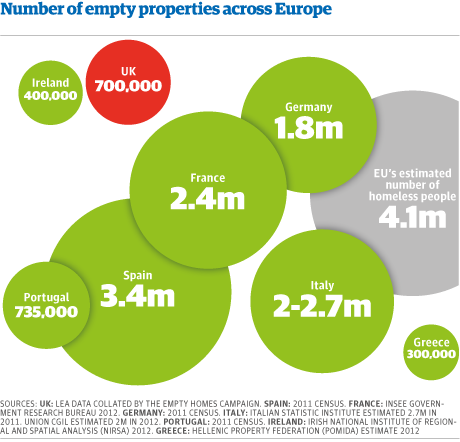
    Housing graphicFreek Spinnewijn, director of FEANTSA, an umbrella organisation of homelessness bodies across Europe, said it was a scandal that so many homes have been allowed to lie empty. “You would only need half of them to end homelessness,” he said.

    “Governments should do as much as possible to put empty homes on the market. The problem of homelessness is getting worse across the whole of the European Union. The best way to resolve it is to put empty homes on the market.”

    Last month MEPs passed a resolution demanding the European Commission “develop an EU homelessness strategy without any further delay”, which was passed 349 votes to 45.

    Gavin Smart, director of policy at the UK Chartered Institute of Housing, said many of the empty homes were likely to have fallen into disrepair or be in deprived regions lacking jobs, but others could be easily brought back to the market.

    He said a growing problem was rich investors “buying to leave” and hoping to profit from rising property prices. The prices of prime London property – defined as homes that cost more than £1,000 per sq ft – are now 27% above their 2007 peak, according to estate agent Savills.

    Last month a Guardian investigation revealed that a third of the mansions on the most expensive stretch of London’s “Billionaires Row” are empty, including some that have fallen into ruin after standing vacant for a quarter of a century.

    Link to video: Inside the derelict mansions of London’s ‘Billionaires Row’Smart said there was growing evidence of the practice in “rich parts of London, other areas of the country … probably all over Europe”.

    Most of Europe’s empty homes are in Spain, which saw the biggest construction boom in the mid-2000s fed largely by Britons and Germans buying homes in the sun. The latest Spanish census, published last year, indicated that more than 3.4m homes – 14% of all properties – were vacant. The number of empty homes has risen by more than 10% in the past decade.

    The Spanish government estimates that an additional 500,000 part-built homes have been abandoned by construction companies across the country. During the housing boom, which saw prices rise by 44% between 2004-08, Spanish builders knocked up new homes at a rate of more than 800,000 a year.

    In some resorts more than a third of homes are still empty five years after the peak of the financial crisis.

    The Spanish census suggests that more than 7,000 of the 20,000 homes in Torre-Pacheco, a holiday region between Murcia and the coast are empty.

    The area has undergone a massive holiday home construction boom with several new golf holiday resorts, including a 2,648-apartment complex called Polaris World, which opened as the crisis struck.

    Madrid Anti-eviction protesters in Madrid confront police as they try to stop the eviction of a disabled neighbour. Photograph: Juan Carlos Lucas/Demotix/CorbisOwners of apartments in the Polaris World resort, which has a golf course designed by Jack Nicklaus, are struggling to sell homes for half the €200,000 (£163,000) they paid before the crisis.

    More than 18% of homes in Galicia, on the north-west Spanish coast, and La Rioja, near Pamplona, are vacant.

    Many of the empty Spanish properties were repossessed by banks after owners defaulted on mortgages.

    María José Aldanas of Spanish housing and homelessness association Provivienda said: “Spain is suffering from high numbers of repossessions and evictions, so we have reached a point where we have too many people without a home and many homes without people.”

    Some city councils in Catalonia have threatened banks with fines of up to €100,000 if homes they repossess remain empty for more than two years. The city council of Terrassa, to the north of Barcelona, has reportedly written to banks holding more than 5,000 homes demanding they take “all possible actions to find tenants” or hand the homes over to the council to use for social housing.

    In France, the latest official figures from INSEE, the government research bureau, show that 2.4m homes were empty in 2012, up from 2m in 2009.

    Italy will release figures for the number of empty properties in the country’s census, published this summer. A survey by the Italian statistics institute estimated there were 2.7m in 2011, and a 2012 report by the Cgil union estimated 2m.
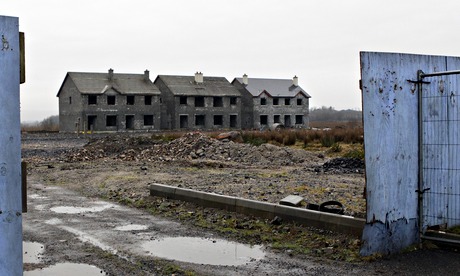
    unfinished houses Ireland The Waterways, an empty and unsold housing development, is pictured in the village of Keshcarrigan, County Leitrim, Ireland. Photograph: Cathal McNaughton/ReutersIn the UK more than 700,000 homes are empty, according to local authority data collated by the Empty Homes campaign. Campbell Robb, chief executive of Shelter, the UK’s biggest homelessness charity, said “homes shouldn’t stand empty” and the government needed to come up with “bigger, bolder ideas” to tackle the lack of available, affordable homes.

    In Portugal there are 735,000 vacant properties – a 35% increase since 2001 – according to the 2011 census. An estimated 300,000 lie empty in Greece and 400,000 in Ireland.

    The Irish government has begun demolishing 40 housing estates built during the boom but still empty. It is working out how to deal with a further 1,300 unfinished developments, and Deutsche Bank has warned that it will take 43 years to fill the oversupply of empty homes in Ireland at the current low population growth rate.

    Read more

    Empty homes spawn black housing market in Spain

    Ireland’s bailout may be over but its housing crisis is far from finished

    Society briefing
  • Victory Adrian De Luca via Change.org mail@change.or

    2 of 44
    Why this ad?
    Landscape Garden Edgingwww.kwikkerb.net.au/Garden-Edging – Make Your Garden Look Amazing. Call Us For Free Onsite Quote!

    Victory

    Inbox
    x

    Adrian De Luca via Change.org mail@change.org

    4:15 PM (1 hour ago)

    to me
    Change.org
    NEVILLE —We did it. Minh’s visa has been reinstated and he’ll be returning to Australia on Friday. It’s all thanks to you and 89,000 others who signed the petition. Thank you so much.

    When Minh’s visa was cancelled, mid-recovery from being bashed by neo-nazis and with a year left to finish his degree – I was devastated for him. I didn’t know if Minh would ever be able to return. They gave him a 3-year ban.

    But that’s all changed now. I started this petition on change.org out of desperation, and thousands of you helped. 89,000 of you. It’s incredible. And with coverage in The Age, ABC’s 7.30, Herald Sun, – Scott Morrison was forced to respond on national TV.

    That’s when it all turned around. Consular officials started helping Minh, we got pro-bono legal help from migration lawyer David Bongiorno – and late on Friday evening we got word that his visa has been re-instated. 

    You can read more and share the great news with this article on The Age here.

    This wouldn’t have happened without your help. This really is a win for people power. Now Minh can return to continue his recovery from that brutal bashing, and finish his studies.

    From Minh and I, we can’t thank you enough.

    All the best,

    Adrian

    P.S. I didn’t know what would happen when I started this petition, but the support blew us away. I’d really recommend starting a petition if there’s an issue you think needs changing. Here’s the link I found where to start

  • Grime and punishment call in coal dust row

    Monday February 24, 2014
    Larger / SmallerNight Mode

    Grime and punishment call in coal dust row

    By IAN KIRKWOOD

    Feb. 24, 2014, 7 a.m.

    • Grime and punishment call in coal dust row

    Source: The Newcastle Herald

    A MAYFIELD group says its dossier of coal train photographs is all the proof that the state government needs to penalise the Hunter coal industry for breaching pollution laws.

    The Correct Planning and Consultation for Mayfield Group is the latest community organisation to voice concerns over dust from coal trains.

    A long-running debate on the problem  took a new turn last week when the NSW Minerals Council announced new research, including wind tunnel tests, into the dust from coal trains.

    This followed the release of documents obtained under freedom-of-information laws that environmental groups  said were evidence of collusion between the coal industry and regulators.

    The Mayfield group’s spokesman, John Hayes, said yesterday that the public was ‘‘sick of hearing the official line that there is no problem with coal coming from coal wagons’’.

    Mr Hayes said a 17-page report with 33 colour photographs taken along the coal rail lines had been lodged last week with the Environment Protection Authority and  Transport for NSW.

    “These photos and this report call into question their statements and assurances that all is well; and residents need not be concerned.’’

    He said trucks were not allowed on the roads with uncovered loads, yet coal trains were being allowed to pollute the air,  ground, and eventually  waterways.

    ‘‘Our photographs show coal on the unwashed interior surfaces of empty wagons just waiting to blow out,’’ Mr Hayes said.

    ‘‘They show ill-fitting wagon doors that fail to seal, they show coal spilling over the sides of over-filled wagons. Coal building up all over the wagon couplings and coal on the tracks.’’

    The Newcastle Herald was waiting on Sunday night for a response from the EPA, which  said last week that it was proud of its efforts in the Hunter region.

    Chief executive Barry Buffier said the EPA had undertaken  programs ‘‘where we have good evidence supporting a significant impact on air quality’’.

     Mr Buffier said he absolutely rejected claims the EPA had been ‘‘lying to the community’’.