Author: Neville

  • Before the last home is torched AVAAZ

    Why this ad?
    EA Solar Panelsenergyaustralia.com.au/solarsaver – Quality Solar Systems from $2,399 We are the Solar Power Experts!

    Before the last home is torched

    Inbox
    x

    Allison Johnson – Avaaz.org

    Feb 10 (1 day ago)

    to me

    Dear friends,

    Heavily armed police just burned 1,000 homes to the ground to force indigenous families out of the Kenyan forest. The World Bank has given millions to the forest police, but is staying quiet. If enough of us supercharge the community’s desperate call for help, we can force the World Bank to demand the government halts these vicious land grabs. Sign now:

    SIGN THE PETITION

    Heavily armed police just burned 1,000 homes to the ground to force indigenous families out of the Kenyan forest where they’ve lived for centuries. This desperate community needs our help to save their homes — and the forest — before it’s destroyed forever.

    The World Bank has given millions of our tax dollars to the Kenyan forest police who are annihilating this ancient community. And — with new funding at stake this year — the Bank has massive leverage over the government. So far the Bank is staying mum, but if enough of us supercharge the community’s call for help, we can force it to demand this horror stops.

    World Bank President Jim Yong Kim says he wants to change the Bank. Let’s hold him to his word, demanding that he call on the Kenyan government to stop these vicious land grabs and commit to new human rights standards for all future grants. When a million of us sign, we’ll grab Kim’s attention by showing burning homes outside the Bank’s Washington HQ. Add your name, then send Kim a message, now:

    http://www.avaaz.org/en/stop_the_forced_evictions_loc/?bhPqncb&v=35579

    The Sengwer people have lived in the majestic Embobut forest for centuries and their rights to their ancestral lands are protected under the Kenyan constitution and international law. They’ve already won a court order to stop the evictions, but the government has ignored it, claiming they need to clear the forest to protect water sources for nearby towns. The Sengwer fear that next, the forest will be decimated for profit.

    The Bank has backed many impressive initiatives, but for too long has blamed the governments and companies it lends to when destructive projects force people off their land. But the tide is turning. After an outcry, the Bank pulled back from projects that were driving 30,000 Cambodians a year from their homes. And it admitted it ignored its own policies when it funded a Honduran palm oil company accused of brutal evictions and assassinations. The Bank is now investigating the Sengwer scandal, but far too slowly to save Kenya’s ancient forest peoples.

    The US Congress has just called on the Bank to stop evictions, or risk losing US money. It’s the perfect moment to stop this brutal land grab in Kenya and get the institution to take human rights seriously. Sign now — when a million of us are on board, we’ll deliver our message straight to President Kim:

    http://www.avaaz.org/en/stop_the_forced_evictions_loc/?bhPqncb&v=35579

    After the Tanzanian government announced plans to kick thousands of Maasai families off their lands to build a hunting reserve, almost two million Avaaz members stood with their community. We kept pushing for over a year until finally the Prime Minister allowed them to stay, helping end a 20 year land battle. The Maasai say they couldn’t have done it without us — now let’s do it again, for the Sengwer people.

    With hope,

    Allison, Alex, Joseph, Emilie, Alice, Sayeeda, Ricken and the rest of the Avaaz team

    More information:

    Kenya: KFS Guards Burn Down Homes in Embobut Forest (The Star)
    http://allafrica.com/stories/201401200456.html

    Kenyan families flee Embobut forest to avoid forced evictions by police (The Guardian)
    http://www.theguardian.com/global-development/2014/jan/07/kenya-embobut-forest-forced-evictions-police

    Kenya defies its own courts (Forest Peoples Programme)
    http://www.forestpeoples.org/topics/legal-human-rights/news/2014/01/kenya-defies-its-own-courts-torc…

    U.S. pushes for outside oversight of World Bank (Washington Post)
    http://www.washingtonpost.com/business/economy/us-pushes-for-outside-oversight-of-world-bank-opposes-push-toward-big-hydro/2014/01/24/fb41bb7c-8516-11e3-8099-9181471f7aaf_story.html

    Kenya / Embobut Forest: UN rights expert calls for the protection of indigenous people facing eviction (UN)
    http://www.ohchr.org/EN/NewsEvents/Pages/DisplayNews.aspx?NewsID=14163&LangID=E

    Indigenous Kenyans evicted in the name of ‘conservation’ (New Internationalist)
    http://newint.org/features/web-exclusive/2014/01/23/sengwer-forest-evictions/

  • Why global water shortages pose threat of terror and war

    Why global water shortages pose threat of terror and war

    From California to the Middle East, huge areas of the world are drying up and a billion people have no access to safe drinking water. US intelligence is warning of the dangers of shrinking resources and experts say the world is ‘standing on a precipice’
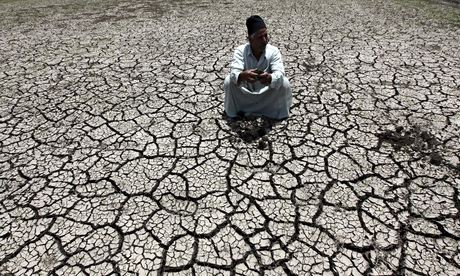
    An Egyptian farmer on cracked soil

    An Egyptian farmer shows the dryness of the land due to drought in a farm formerly irrigated by the river Nile. Photograph: Mohamed Abd El Ghany/Corbis

    On 17 January, scientists downloaded fresh data from a pair of Nasa satellites and distributed the findings among the small group of researchers who track the world’s water reserves. At the University of California, Irvine, hydrologist James Famiglietti looked over the data from the gravity-sensing Grace satellites with a rising sense of dread.

    The data, released last week, showed California on the verge of an epic drought, with its backup systems of groundwater reserves so run down that the losses could be picked up by satellites orbiting 400km above the Earth’s surface.

    “It was definitely an ‘oh my gosh moment’,” Famiglietti said. “The groundwater is our strategic reserve. It’s our backup, and so where do you go when the backup is gone?”

    That same day, the state governor, Jerry Brown, declared a drought emergency and appealed to Californians to cut their water use by 20%. “Every day this drought goes on we are going to have to tighten the screws on what people are doing,” he said.

    Seventeen rural communities are in danger of running out of water within 60 days and that number is expected to rise, after the main municipal water distribution system announced it did not have enough supplies and would have to turn off the taps to local agencies.

    There are other shock moments ahead – and not just for California – in a world where water is increasingly in short supply because of growing demands from agriculture, an expanding population, energy production and climate change.

    Already a billion people, or one in seven people on the planet, lack access to safe drinking water. Britain, of course, is currently at the other extreme. Great swaths of the country are drowning in misery, after a series of Atlantic storms off the south-western coast. But that too is part of the picture that has been coming into sharper focus over 12 years of the Grace satellite record. Countries at northern latitudes and in the tropics are getting wetter. But those countries at mid-latitude are running increasingly low on water.

    “What we see is very much a picture of the wet areas of the Earth getting wetter,” Famiglietti said. “Those would be the high latitudes like the Arctic and the lower latitudes like the tropics. The middle latitudes in between, those are already the arid and semi-arid parts of the world and they are getting drier.”

    On the satellite images the biggest losses were denoted by red hotspots, he said. And those red spots largely matched the locations of groundwater reserves.

    “Almost all of those red hotspots correspond to major aquifers of the world. What Grace shows us is that groundwater depletion is happening at a very rapid rate in almost all of the major aquifers in the arid and semi-arid parts of the world.”

    The Middle East, north Africa and south Asia are all projected to experience water shortages over the coming years because of decades of bad management and overuse.

    Watering crops, slaking thirst in expanding cities, cooling power plants, fracking oil and gas wells – all take water from the same diminishing supply. Add to that climate change – which is projected to intensify dry spells in the coming years – and the world is going to be forced to think a lot more about water than it ever did before.

    The losses of water reserves are staggering. In seven years, beginning in 2003, parts of Turkey, Syria, Iraq and Iran along the Tigris and Euphrates rivers lost 144 cubic kilometres of stored freshwater – or about the same amount of water in the Dead Sea, according to data compiled by the Grace mission and released last year.

    A small portion of the water loss was due to soil drying up because of a 2007 drought and to a poor snowpack. Another share was lost to evaporation from lakes and reservoirs. But the majority of the water lost, 90km3, or about 60%, was due to reductions in groundwater.

    Farmers, facing drought, resorted to pumping out groundwater – at times on a massive scale. The Iraqi government drilled about 1,000 wells to weather the 2007 drought, all drawing from the same stressed supply.

    In south Asia, the losses of groundwater over the last decade were even higher. About 600 million people live on the 2,000km swath that extends from eastern Pakistan, across the hot dry plains of northern India and into Bangladesh, and the land is the most intensely irrigated in the world. Up to 75% of farmers rely on pumped groundwater to water their crops, and water use is intensifying.

    Over the last decade, groundwater was pumped out 70% faster than in the 1990s. Satellite measurements showed a staggering loss of 54km3 of groundwater a year. Indian farmers were pumping their way into a water crisis.

    The US security establishment is already warning of potential conflicts – including terror attacks – over water. In a 2012 report, the US director of national intelligence warned that overuse of water – as in India and other countries – was a source of conflict that could potentially compromise US national security.

    The report focused on water basins critical to the US security regime – the Nile, Tigris-Euphrates, Mekong, Jordan, Indus, Brahmaputra and Amu Darya. It concluded: “During the next 10 years, many countries important to the United States will experience water problems – shortages, poor water quality, or floods – that will risk instability and state failure, increase regional tensions, and distract them from working with the United States.”

    Water, on its own, was unlikely to bring down governments. But the report warned that shortages could threaten food production and energy supply and put additional stress on governments struggling with poverty and social tensions.

    Some of those tensions are already apparent on the ground. The Pacific Institute, which studies issues of water and global security, found a fourfold increase in violent confrontations over water over the last decade. “I think the risk of conflicts over water is growing – not shrinking – because of increased competition, because of bad management and, ultimately, because of the impacts of climate change,” said Peter Gleick, president of the Pacific Institute.

    There are dozens of potential flashpoints, spanning the globe. In the Middle East, Iranian officials are making contingency plans for water rationing in the greater Tehran area, home to 22 million people.

    Egypt has demanded Ethiopia stop construction of a mega-dam on the Nile, vowing to protect its historical rights to the river at “any cost”. The Egyptian authorities have called for a study into whether the project would reduce the river’s flow.

    Jordan, which has the third lowest reserves in the region, is struggling with an influx of Syrian refugees. The country is undergoing power cuts because of water shortages. Last week, Prince Hassan, the uncle of King Abdullah, warned that a war over water and energy could be even bloodier than the Arab spring.

    The United Arab Emirates, faced with a growing population, has invested in desalination projects and is harvesting rainwater. At an international water conference in Abu Dhabi last year, Crown Prince General Sheikh Mohammed bin Zayed al-Nahyan said: “For us, water is [now] more important than oil.”

    The chances of countries going to war over water were slim – at least over the next decade, the national intelligence report said. But it warned ominously: “As water shortages become more acute beyond the next 10 years, water in shared basins will increasingly be used as leverage; the use of water as a weapon or to further terrorist objectives will become more likely beyond 10 years.”

    Gleick predicted such conflicts would take other trajectories. He expected water tensions would erupt on a more local scale.

    “I think the biggest worry today is sub-national conflicts – conflicts between farmers and cities, between ethnic groups, between pastoralists and farmers in Africa, between upstream users and downstream users on the same river,” said Gleick.

    “We have more tools at the international level to resolve disputes between nations. We have diplomats. We have treaties. We have international organisations that reduce the risk that India and Pakistan will go to war over water but we have far fewer tools at the sub-national level.”

    And new fault lines are emerging with energy production. America’s oil and gas rush is putting growing demands on a water supply already under pressure from drought and growing populations.

    More than half the nearly 40,000 wells drilled since 2011 were in drought-stricken areas, a report from the Ceres green investment network found last week. About 36% of those wells were in areas already experiencing groundwater depletion.

    How governments manage those water problems – and protect their groundwater reserves – will be critical. When California emerged from its last prolonged dry spell, in 2010, the Sacramento and San Joaquin river basins were badly depleted. The two river basins lost 10km3 of freshwater each year in 2012 and 2013, dropping the total volume of snow, surface water, soil moisture and groundwater to the lowest levels in nearly a decade.

    Without rain, those reservoirs are projected to drop even further during this drought. State officials are already preparing to drill additional wells to draw on groundwater. Famiglietti said that would be a mistake.

    “We are standing on a cliff looking over the edge and we have to decide what we are going to do,” he said.

    “Are we just going to plunge into this next epic drought and tremendous, never-before-seen rates of groundwater depletion, or are we going to buckle down and start thinking of managing critical reserve for the long term? We are standing on a precipice here.”

    REGIONS AT RISK

    1 CALIFORNIA

    The state’s water resources are at critically low levels and a drought emergency has been declared. The health department says 17 rural areas are dangerously parched.

    2 BRAZIL

    São Paulo, the country’s largest city, is on the verge of water rationing because of a severe drought and shortages are possible when the country hosts the football World Cup in the summer. January was the hottest month on record in the city and water in its main reservoir has fallen to 20.9% of its capacity, the lowest level in a decade.

    3 MIDDLE EAST

    Tehran, the capital of Iran, is facing a shortage so serious that officials are making contingency plans for rationing in an area where 22 million live as well as in other big cities. President Hassan Rouhani has identified water as a national security issue. Shortages are so severe in the United Arab Emirates that the country is using non-conventional resources, including desalination, treated wastewater, rainwater harvesting and cloud seeding. At a a water conference,Crown Prince General Sheikh Mohammed bin Zayed al-Nahyan said: “For us, water is [now] more important than oil.” With the third lowest water reserves in the region, Jordan is struggling to cope with an influx of Syrian refugees. The country is undergoing power cuts because of water shortages. Prince Hassan, uncle of King Abdullah, warned last week that a war over water and energy could be bloodier than the Arab spring.

    4 NORTH AFRICA

    Egypt has demanded that Ethiopia stop construction of a mega-dam on the Nile, vowing to protect its historical rights to the river at “any cost”. The Egyptian authorities have called for a study into whether the project would reduce the river’s flow.

    5 SOUTH ASIA About 600 million people live on the 2,000km swath that extends from eastern Pakistan, across the hot dry plains of northern India and into Bangladesh and the land is the world’s most intensely irrigated. Up to 75% of farmers rely on pumped groundwater.

    6 CHINA

    There is increasing competition for water. More than half the proposed coal-fired power stations are expected to be built in areas of high water stress, thus threatening water insecurity for farms, other industry and the public.

  • Met Office: Evidence ‘suggests climate change link to storms’

    Met Office: Evidence ‘suggests climate change link to storms’

    Somerset

    Climate change is likely to be a factor in the extreme weather that has hit much of the UK in recent months, the Met Office’s chief scientist has said.

    Dame Julia Slingo said the variable UK climate meant there was “no definitive answer” to what caused the storms.

    “But all the evidence suggests there is a link to climate change,” she added.

    “There is no evidence to counter the basic premise that a warmer world will lead to more intense daily and hourly rain events.”

    More than 130 severe flood warnings – indicating a threat to life – have been issued since December. In contrast, there were only nine in the whole of 2012.

    More than 5,000 properties have been flooded over this period, although the Environment Agency says investment in flood defences over the past decade has protected a further 1.3 million properties.

    ‘Exceptional’Speaking ahead of the launch of a Met Office report – produced by the Centre of Ecology and Hydrology – into recent climatic events, Dame Julia said the UK had seen the “most exceptional period of rainfall in 248 years”.

    Unsettled weather at this time of year was not unexpected – but the prolonged spell of rain, as well as the intensity and height of coastal waves, was “very unusual”.

    “We have records going back to 1766 and we have nothing like this,” she said. “We have seen some exceptional weather. We can’t say it is unprecedented but it is exceptional.”

    The report links the recent extreme weather in Europe and North America to “perturbations” in the North Atlantic and Pacific jet streams, partly emanating from changing weather patterns in South East Asia and “associated with higher than normal ocean temperatures in that region”.

    “The attribution of these changes to anthropogenic [caused by humans] global warming requires climate models of sufficient resolution to capture storms and their associated rainfall,” it says.

    ‘Makes sense’”Such models are now becoming available and should be deployed as soon as possible to provide a solid evidence base for future investments in flood and coastal defences.”

    David Cameron has said the UK must be prepared for more extreme weather.

    At Prime Minister’s Questions last month, Mr Cameron said he “suspected” that the recent storms to batter the UK and the extreme weather in North America were connected to global temperature changes – an argument challenged by some Conservative MPs and peers.

    He subsequently clarified the remarks, saying that although “you can’t point to one weather event and say that is climate change”, many scientists were talking of a link between the two.

    “The point I was really trying to make is, whatever you think – even if you think that (climate change) is mumbo-jumbo – because these things are happening more often, it makes sense to do all you can to… prevent these floods affecting so many people and that is exactly what we are doing.”

    Friends of the Earth climate campaigner Guy Shrubsole said this assessment was a “warning sign that cannot be ignored”.

    “By appointing an environment secretary who doesn’t take climate change seriously this government has turned its back on the science and cut flood defence spending when it should be cutting emissions.”

  • Pacific trade winds stall global surface warming … for now

    Featured Research

    from universities, journals, and other organizations

    Pacific trade winds stall global surface warming … for now

    Date:
    February 9, 2014
    Source:
    University of New South Wales
    Summary:
    Heat stored in the western Pacific Ocean caused by an unprecedented strengthening of the equatorial trade winds appears to be largely responsible for the hiatus in surface warming observed over the past 13 years. The strongest trade winds have driven more of the heat from global warming into the oceans; but when those winds slow, that heat will rapidly return to the atmosphere causing an abrupt rise in global average temperatures, scientists say.

    This is a schematic of the trends in temperature and ocean-atmosphere circulation in the Pacific over the past two decades. Color shading shows …

    Credit: Nature Climate Change

    The strongest trade winds have driven more of the heat from global warming into the oceans; but when those winds slow, that heat will rapidly return to the atmosphere causing an abrupt rise in global average temperatures.

    Heat stored in the western Pacific Ocean caused by an unprecedented strengthening of the equatorial trade winds appears to be largely responsible for the hiatus in surface warming observed over the past 13 years.

    New research published today in the journal Nature Climate Change indicates that the dramatic acceleration in winds has invigorated the circulation of the Pacific Ocean, causing more heat to be taken out of the atmosphere and transferred into the subsurface ocean, while bringing cooler waters to the surface.

    “Scientists have long suspected that extra ocean heat uptake has slowed the rise of global average temperatures, but the mechanism behind the hiatus remained unclear” said Professor Matthew England, lead author of the study and a Chief Investigator at the ARC Centre of Excellence for Climate System Science.

    “But the heat uptake is by no means permanent: when the trade wind strength returns to normal — as it inevitably will — our research suggests heat will quickly accumulate in the atmosphere. So global temperatures look set to rise rapidly out of the hiatus, returning to the levels projected within as little as a decade.”

    The strengthening of the Pacific trade winds began during the 1990s and continues today. Previously, no climate models have incorporated a trade wind strengthening of the magnitude observed, and these models failed to capture the hiatus in warming. Once the trade winds were added by the researchers, the global average temperatures very closely resembled the observations during the hiatus.

    “The winds lead to extra ocean heat uptake, which stalled warming of the atmosphere. Accounting for this wind intensification in model projections produces a hiatus in global warming that is in striking agreement with observations,” Prof England said.

    “Unfortunately, however, when the hiatus ends, global warming looks set to be rapid.”

    The impact of the trade winds on global average temperatures is caused by the winds forcing heat to accumulate below surface of the Western Pacific Ocean.

    “This pumping of heat into the ocean is not very deep, however, and once the winds abate, heat is returned rapidly to the atmosphere” England explains.

    “Climate scientists have long understood that global average temperatures don’t rise in a continual upward trajectory, instead warming in a series of abrupt steps in between periods with more-or-less steady temperatures. Our work helps explain how this occurs,” said Prof England.

    “We should be very clear: the current hiatus offers no comfort — we are just seeing another pause in warming before the next inevitable rise in global temperatures.”


    Story Source:

    The above story is based on materials provided by University of New South Wales. Note: Materials may be edited for content and length.


    Journal Reference:

    1. Matthew H England et al. Recent intensification of wind-driven circulation in the Pacific and the ongoing warming hiatus. Nature Climate Change, February 9, 2014

    Cite This Page:

    University of New South Wales. “Pacific trade winds stall global surface warming … for now.” ScienceDaily. ScienceDaily, 9 February 2014. <www.sciencedaily.com/releases/2014/02/140209152454.htm>.

  • REEF NEWS: We’re taking this to court GET-UP

    1 of 35
    Why this ad?
    Get 3 Free Solar Quotessolarquotes.com.au/_3_Best_Quotes – Compare 3 Local Solar Installers. Totally Free & No Obligation. Save!

    REEF NEWS: We’re taking this to court

    Inbox
    x

    GetUp!

    8:23 PM (40 minutes ago)

    to me
    “This is nothing short of miraculous. We are overwhelmed by the determination of GetUp supporters!” – Environmental Defenders’ Office (EDO) Queensland Solicitor Jo Bragg.

    NEVILLE,

    They must have assumed they’d had the final word.

    When Greg Hunt and the Marine Park Authority approved dumping of five million tonnes of seabed inside Reef waters, it was supposed to be campaign over. Vested interests had won, and our Reef would be sold out for short-term profits.

    Instead, something incredible happened. Thousands of GetUp members put their own money forward to launch a citizens’ Reef Fighting Fund. We’ve never seen anything quite like it.

    All up, more than 16,000 people have donated so EDO Queensland and North Queensland Conservation Council can take this fight to the courts. Together, we’re contributing $130,000 to the legal case right off the bat – $50,000 more than our original target! GetUp members have also ensured we have the resources to fund a strong ongoing campaign that won’t shy away from other hard-hitting legal, legislative and corporate tactics.

    Thank you to everyone who’s made this possible.

    We all know how prolonged and expensive legal fights can be. To their enormous credit, EDO Queensland and North Queensland Conservation Council had been prepared to pull together a case on a barebones budget. Now, it’s a very different story.

    “Now there is money for expert witnesses, court transcripts, barristers’ fees and transport costs. We can be bigger, better and more ambitious with the court case to protect the Reef. This is nothing short of miraculous. We are overwhelmed by the determination of GetUp supporters!” – Jo Bragg, EDO Queensland Solicitor.

    No matter what happens in court, we’ve sent a very uncomfortable ripple through the legions of power and vested interests used to getting their way. Thousands of everyday Australians are making it possible to go toe-to-toe with big mining, and together we will do everything in our power to protect our Reef.

    There’s so much further to go with this campaign, so we’ll be in touch soon. But for now, thank you.

    The GetUp team


  • Spectacle beats substance in political circus

    ENJOY THIS GEM FROM MUNGO MacCALLUM

    Spectacle beats substance in political circus

    Posted 3 hours 20 minutes ago

    The circus is in town and the antics of the Abbott and Howes sideshow is providing plenty of laughs and tears, writes Mungo MacCallum.

    Last week Australian politics ceased to be a contest of ideas or even of emotions. Principal players from both sides decided to turn it into sheer entertainment – a circus, in fact.

    So roll up, roll up, to the greatest show on earth. Well, in the Australian silly season anyway. Gape with astonishment as our performers undertake stunts too outrageous, too improbable, too just plain crazy for the rational mind to contemplate.

    And here, entering from the right, the boneless wonder, the master contortionist, please put your hands together, or perhaps keep them securely on your wallets – yes, it’s Tony Abbott.

    Marvel as he ties himself in seemingly inextricable knots explaining why a handout of $16 million to Cadbury is sound economics but a rescue package of $25 million to SPC Ardmona would be totally irresponsible.

    Now watch as plastic Tony takes up his first position: SPC Ardmona is a subsidiary of a profitable multinational. Well, yes, but can’t the same be said of Cadbury? Yes. And Tony’s twisting again – this time it’s the reverse wriggle, asserting that Tasmania is different because it has the highest unemployment of any state. True, but as Dr Stone points out, the rate in Shepparton, where SPC Ardmona is based, is even higher.

    So Tony’s at it again with the convex convolution: The handout to Cadbury was not about a bailout but about tourism, which makes it OK. So promoting tourism is more worthwhile than saving an industry and the jobs that go with it?

    Wait, Tony’s still on the move. Now it’s the warped wangle: Workers’ conditions at SPC Ardmona were absurdly generous, so it was all the unions’ and the management’s fault. However, as it turns out, the Cadbury agreement with the union United Voice was, if anything, even more lavish. Can Tony untangle himself from this position?

    But we have an interruption, from Tony’s own side of the tent. What was that, Sharman Stone? Hypocrite? Lies? The only real difference is that Cadbury is in a marginal electorate and SPC Ardmona is in a safe one? Not only that, but the Cadbury pledge was before an election and SPC Ardmona after a comfortable win. Would the crowd please stop chanting “pork barrel”. Well, I think we’ll have to leave our screwed up star for the moment, he seems unable to remove his head from his bottom.

    But don’t go away, ladies and gentlemen, there’s more, because entering from the left we have the high-flying whiz-kid from the AWU, the amazing trick cyclist, Paul Howes. And yes, Hot-head Howes is ready for his unprecedented balancing act; perched on the highwire of lofty ambition, he will attempt to juggle the unions, the employers and the ALP while at the same time pretending to be serious about his unsupportable position.

    And please stop laughing. There, he’s away, possibly with the pixies. He’s tossing up the unions, accusing them of corruption and unsustainable wage demands. Now Flexible Tony, suddenly sensing the distraction he needed, has extracted his head and is cheering wildly. And now Preposterous Paul has the employers in the air, challenging them to come to a non-aggressive consensus. And what’s more, he wants Tony, who is in the process of launching a Royal Commission to expunge the unions from the political landscape forever, to come to the party too.

    What was that, Tony? A very 1980s idea? Not quite medieval enough for you? Never mind, I can just detect a murmur from a barely visible figure on the left – at least I think he’s on the left. Bill something? Oh, you think Tony can’t change his spots. Well, it must be the only thing our India rubber man can’t change, but we’ll take your word for it.

    Back to Perilous Paul – oh dear, he’s teetering – someone must have told him that with union membership down to about 15 percent of the workforce, the unions couldn’t deliver consensus even if they wanted to, which they don’t. But look, despite the showers of excrement coming from all sides, Paul is completely undeterred. He’s pressing ahead, he’s heading the press, he is satisfied just to be the centre of attention.

    And he wants a new baby grand – no, I’ve misheard that, what he actually wants is a new grand compact. Perhaps one combining recovery, reconciliation and whatever the other 1983 thing was. Rhubarb, was it? But never mind, Posturing Paul is now putting on another new persona – yes, he thinks he is the new Messiah. More, he thinks he is the new Bob Hawke!

    Paul, you’re presumptuous. To steal a great put down: I knew Bob Hawke, I drank with Bob Hawke. And let me tell you, Paul, you’re no Bob Hawke. Oh, now I’ve done it – Paul has plummeted. But don’t worry ladies and gentleman – I’m assured that it’s only a bruised ego, and Paul has recovered from plenty of those in the past. By tomorrow he’ll be as good as new, back to his insufferable best.

    And how’s Twisted Tony? Well, he’s in the hands of a large man who appears to be a sort of trainer and is offering him some advice. I think I can make it out … the age of entanglement is over? No, entitlement – but Joe, say it ain’t so. No more handouts for the miners, the financial planners, the polluters, the private schools, the private health funds, the big banks, the rich mothers … oh, Joe just said it ain’t so. Well, we never really thought it was.

    But before we close down the tent and get back to business – and politics – as usual, let me remind you that the carnival is not over.

    In fact the big one, the twin ring circus with the all-star case of hundreds, is back in Canberra. Yes, this week parliament resumes. Our little sideshow was just the curtain raiser. Happy stunting, and send in the clowns.

    Mungo Wentworth MacCallum is a political journalist and commentator. View his full profile here.