Author: Neville

  • This is what Australia’s frontline fight against massive coal looks like

    1 of 4
    Why this ad?
    Vistaprint AU250 Free Business Cards – Get 250 Free Business Cards + Free Holder! Design in Minutes and Just Pay $7.79 for Delivery.

    This is what Australia’s frontline fight against massive coal looks like

    Inbox
    x
    Simon Copland – 350.org Australia simon@350.org
    4:45 PM (2 minutes ago)

    to me

    Dear friends,

    I have to tell you that as I write this email I am absolutely exhausted. I am that sort of tired where I am having trouble keeping my brain and fingers in line with each other as I try to type. I really would like to go to bed.

    But I am typing on. Because whilst I am overwhelmingly exhausted, my stronger feeling today is one of inspiration. And I have to share that inspiration with you. A couple of weeks ago we emailed you all about a mass convergence at Maules Creek – opposing the construction of the disastrous coal mine proposed in the region by the coal company Whitehaven. Well, I’ve just gotten back from the forest and I have to tell you about it.

    We’ve told you about this coal mine – the mine that will destroy the Leard State Forest which houses 34 threatened species. The mine that will spew the equivalent greenhouse gas emissions into the air as New Zealand’s entire energy system. The mine that will drain the water table, forcing farmers out of the region.

    Well, on Tuesday, over 150 people took to the Leard State Forest to blockade the construction of the mine. We had teams situated all around the mine site – four blocking the gates to forest, and three inside locking themselves onto equipment so Whitehaven couldn’t continue with their destruction of the forest. We held the company out for hours, seriously disrupting their work on the day.
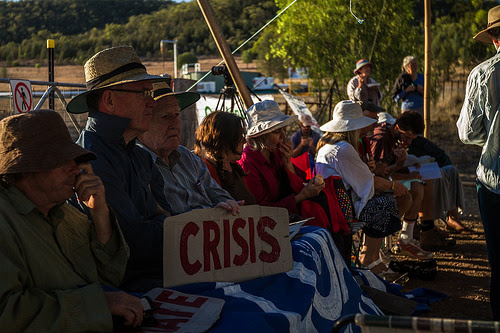
    The crew were as diverse as you could think. We had seasoned campaigners in this fight, and those who had never been to a protest before. We had people coming from the local community members to cities as far away as Brisbane, Sydney, Canberra, Melbourne and even Adelaide! Our ages ranged dramatically – from those in their early twenties, to Bill Ryan, a 91 year old legally blind World War Two veteran who sat in front of the main gate determined to stay there and stop Whitehaven from entering the site.

    Each and every person was an inspiration to me – whether they were putting themselves in a place to get arrested, or staying back and looking after the camp to make sure we all had food when we got back from the long day.

    Tuesday was exciting. It was inspiring. Back home now in Brisbane I am tired, but ready and excited for more. I am ready and excited to step it up again and stop this destructive mine. And that is why we need your help. We have a series of information sessions coming up where you can find out about the Maules Creek Coal Mine Campaign – whether you want to head out to the forest, or help in the city.

    The first sessions are happening in Brisbane and Sydney tonight, whilst there are more on their way in Canberra, Melbourne, and other cities to be confirmed! We’d love to see you there. Click here to see the details.

    If you can’t make it, then please get in contact, and we’ll let you know about other ways you can get involved. If you want to host your own information session as well, then we’ll provide you the support to do that.

    This campaign is a line in the sand. It is the time where we all have to step up and say ‘enough is enough’. It is the time where we let the coal industry know that they will not get away with their destructive behaviour any more.

    I have been thoroughly inspired watching people doing this so far, but we need many more.

    Please come along and find out how you can help.

    For the climate, our land, our water and our community,
    Simon Copland and the rest of the 350.org team.

    P.S. For further information about how you can get involved in this or other Summer Heat activities, please visit joinsummerheat.org
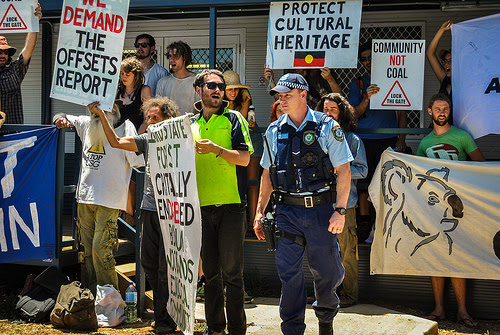
    We rallied outside Whitehaven’s office
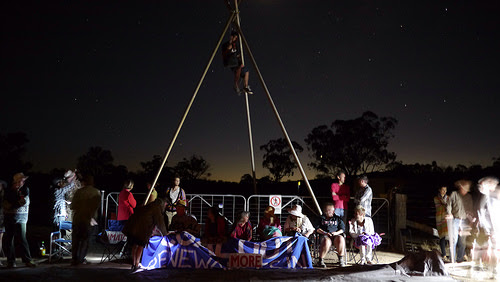
    We camped out into the night
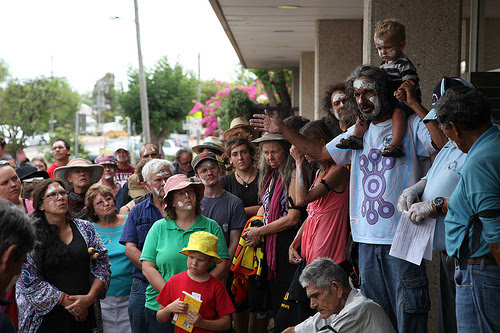
    We joined with Gomeroi Elders and Traditional Owners for a spiritual ceremony and a march in Gunnedah
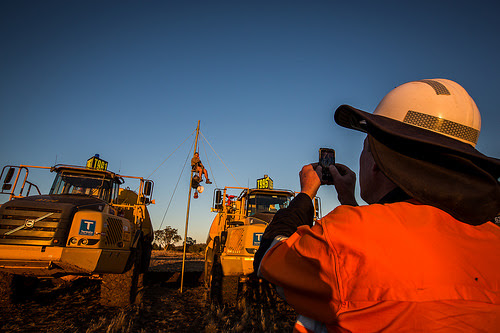
    And we stopped Whitehaven from working. Join us and together we can

  • Robotic floats to detect ocean heatwaves, other changes in the Indian Ocean

    The Sydn

    Search smh:

    Search in:

    Robotic floats to detect ocean heatwaves, other changes in the Indian Ocean

    Date
    January 29, 2014
    Ocean heatwave 2011.Ocean heatwave 2011. Photo: CSIRO

    Australian and Indian scientists have teamed up to identify the causes and impacts of so-called marine heatwaves such as the devastating pulse of warm water that swept down the West Australian coastline in 2011.

    During that event, water temperatures soared to 5 degrees above long-term seasonal averages for a two-week period – and were more than 3 degrees higher for an extended time – triggering large-scale fish kills and coral bleaching.

    To study the interplay of biology and physics in the Indian Ocean, including how circulation is changing as the planet warms, CSIRO has joined India’s National Institute of Oceanography and the Indian National Centre for Ocean Information Services to launch 15 sophisticated robot floats in mid-2014.

    Coral bleaching can devastate reef life, as seen here off Queensland.Coral bleaching can devastate reef life, as seen here off Queensland. Photo: Supplied

    Australia and other nations already operate more than 3600 of the Argo floats to collect data on temperature and salinity in the world’s oceans. The pilot scheme, which has the potential to double in size, involves floats equipped with extra sensors to gather a wider range of information on levels of oxygen, chlorophyll and dissolved organic matter.

    Advertisement

    “We’ll probably have more data from these floats in a decade’s time than we have in the whole past century from ships,” said Tom Trull, a professor at the University of Tasmania and a senior principal research scientist at CSIRO.

    Oxygen changes will be one focus, with levels in the deep ocean apparently decreasing over the last century as temperatures rise and circulation alters. Regions off north-west India and in the Bay of Bengal have large patches of ocean with little or no oxygen.

    More than 3600 Argo buoys have been deployed globally.More than 3600 Argo buoys have been deployed globally.

    By adding oxygen sensors, “we can figure out what those changes in circulation mean for the health of the deep sea”, Professor Trull said.

    Other sensors will detect levels of phytoplankton, microscopic plants that form the basis of the aquatic food chain, and the zooplankton that feed on them.

    “It will probably give us an idea of which year, in which place, we’re likely to get strong amounts of fish production,” Professor Trull said.

    How Argo floats work.How Argo floats work. Photo: CSIRO

    Big influence

    Changes in sea-surface temperatures in the Indian Ocean, the world’s third-largest, can have a big influence on the Australia’s weather. Warmer-than-normal waters off north-western Australia, as seen last winter, typically trigger increased flows of moisture over the continent and above-average rains over south-eastern states.

    Australian scientists are keen to understand more about the “Ningaloo Nino”, named after the Ningaloo Reef off Coral Bay in WA, when waters in the region are unusually warm. It serves as a counterpart to the El Nino-Southern Oscillation – the main climate driver over the Pacific Ocean.

    While Australia’s wheat production can be correlated to an El Nino phase, which typically results in reduced rainfall over eastern Australia, relatively little is known about how ocean ecosystems including fisheries are affected by changing weather patterns, Professor Trull said.

    “We don’t understand what the links might be,” he said. “These kinds of sensors may get us that kind of data.”

    Each specially equipped Argo buoy costs about $50,000 and can collect data down to 2000 metres below the surface as they drift on the ocean currents. Depending on the task, the buoys surface between four times a day to once every 10 days to transmit information to satellites.

    Each “profile” sent costs about $50, far cheaper than ship surveys. Sending a vessel might take 100 readings in a month but cost $50,000-80,000 per day, Professor Trull said.

    Advertisement
    Featured advertisers
    Advertisement

    Skip

    Readers’ most viewed

  • As sea level rises, Fijian village begins to relocate citizens


    As sea level rises, Fijian village begins to relocate citizens

    By on 30 January 2014
    Print Friendly

    Climate Progress

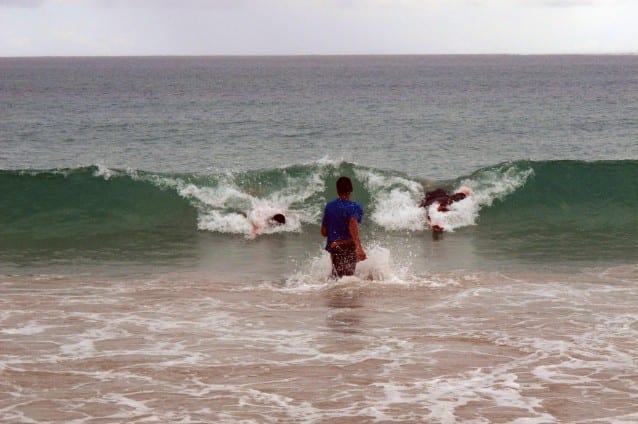
    Bodysurfers ride a wave at Natadola Beach in Natadola, Fiji, on Nov. 5, 2013.

    Bodysurfers ride a wave at Natadola Beach in Natadola, Fiji, on Nov. 5, 2013.

    Faced with rising sea levels that flood farmlands and seep into homes during high tide, residents of the Fijian village of Vunidogolo are packing their bags.

    The village is the first to have its citizens relocated under the country’s “climate change refugee” program, according to a report in the Fiji Times. The relocation has included the construction of 30 houses, fish ponds, and farms, which reportedly cost the small island’s government about $879,000.

    “All 30 houses have been fully constructed, painted and prepared well for the villagers,” Fiji Acting Commissioner Northern Alipate Bolalevu told the Times. “The Fisheries Department is in charge of the fish ponds and the Agriculture Ministry will help the villagers with farming practices.”

    The village’s relocation is not the first instance where people have sought “refugee”-like status from the affects of climate change. Last year, 37-year-old Ioane Teitota and his family attempted to legally seek refugee status in New Zealand, having left Kiribati — a low-lying Pacific Island nation near the equator — in 2007 due to sea level rise. Though his request was eventually rejected, one of Teiota’s core arguments for refugee status was that humans cause exorbitant carbon emissions, which are responsible for rising sea levels and changes of weather patterns. Therefore, he argued, climate change constitutes an indirect but worldwide persecution on he and his family.

    The New Zealand court called the argument “novel” and “optimistic,” but ultimately ruled that it was unconvincing. If it were adopted, the court said, then millions of people experiencing the effects of climate change could seek refuge in New Zealand or any other county.

    Meanwhile, Fiji’s National Climate Change Policy says that it expects global sea level changes to more than double by the end of the century, based on projections from the fourth U.N. Intergovernmental Panel on Climate Change assessment report. The IPPC’s Fifth Assessment Report released in September, however, was even worse, predicting that ocean levels would rise by as much as three feet by the end of the century due to climate change.

    The country’s 2012 policy document also notes that average monthly sea levels at the country’s Lautoka tide have been increasing at a rate of 4.6 millimeter per decade since 1993, though satellite observations indicate that the sea level is changing at the faster rate of 6 millimeters per year over the same period.

    While Fiji is a minor emitter of greenhouse gases on a global scale, the country has nonetheless expressed a desire to commit to reducing its own emissions. However, the country’s climate policy document notes that Fiji faces “major barriers to improved energy efficiency,” most notably lack of information, inadequate pricing signals, and a lack of standards for imported appliances and machinery.

    Rising sea levels in Fiji also stand to affect the country’s tourism industry. With the island receiving more than 500,000 visitors per year, the industry is the largest and fastest-growing, contributing about 17 percent to Fiji’s overall gross domestic product and employing approximately 40,000.


  • Laser Diode Combats Cross-gas Interference

    Jan 29 2014 03:41 PMGas Detection

    Laser Diode Combats Cross-gas Interference

    Knowing exactly where methane (CH4) emissions are occurring on site is essential in order for AD biogas plants to comply with environmental enforcement agencies and save valuable energy, yet cross-gas interference can often cause a problem in identifying accurate emission locations and the gases present.

    Flame Ionisation Detectors (FIDs) traditionally use hydrogen cylinders which can often require refills, and regularly costly servicing. They can also prove ineffective in adverse weather conditions and are unsafe to use in potentially explosive environments due to the flame. FIDs can also suffer from cross-gas interference, unlike the TDL-500 laser diode methane detector, from Geotech (UK).

    The  TDL-500 uses laser diode technology to accurately detect methane to 1ppm, with no interference from other gases. It also has optional  GPS functionality with an accuracy of 0.5 meters, compared to 10 metres with FID units, meaning it shows precisely where methane emissions are happening on site. It combines accurate sensitivity with speedy results, having a response time of 2 seconds.

    Geotech’s customers greatly benefit from this increased level of accuracy, Dwight El Mahassni, from Thermo Fisher Australia, stated “The instrument works extremely well. Its ability to distinguish from other volatile compounds in the atmosphere is very useful and the readings are very stable”.

    The TDL-500 is also ATEX certified, making it intrinsically safe and a more robust instrument out in the field.

    Combining laser technology with a practical build, the TDL-500 is the ultimate in safe, time saving, and cost-effective

  • Stonewall silence on transport disability amenities.

    2 of 46
    Why this ad?
    Vistaprint AU250 Free Business Cards – Get 250 Free Business Cards + Free Holder! Design in Minutes and Just Pay $7.79 for Delivery.

    Stonewall silence

    Inbox
    x
    Pauline David via Change.org mail@change.org
    12:28 PM (1 hour ago)

    to me
    Change.org
    NEVILLE –

    This has been an incredible fortnight. Sharing my story about how hard it is for people in wheelchairs to get around Sydney’s public transport wasn’t easy – but finally, we’re getting the issue into the media spotlight.

    Since starting my petition challenging the Transport Minister to spend just one day travelling like many of us have to — nearly 20,000 of you have added your name to the petition at www.change.org/disabilitychallenge. Thank you – and thank you for your comments and kind words of support.

    But still there’s been stonewall silence from the Minister. It just seems there’s excuse after excuse instead — and more and more delays for better public transport access for people with disability.

    I think if Minister Gladys Berejiklian takes on this challenge, she’ll begin to see that there is so much more she needs to do if she really is “passionate about improving access” – as she says she is.

    Can you help increase pressure on the Minister to take our challenge by forwarding on this email to friends and family and asking them to sign too?

    They can sign the petition just by going to www.change.org/disabilitychallenge — or you can share it on Facebook by clicking here.

    Thanks for all your help,

    Pauline

    P.S. If you missed it, you can see the Daily Telegraph story that started me on this journey by clicking here.

  • Recent media reports that “nanoparticles in sunscreen are harmless” on the basis of a recently published study don’t reflect the paper’s own conclusions nor the current state of the science.

    Why this ad?
    HKTDCHK Int’l Jewellery Show – Meet over 2100 suppliers on 5-9 Mar. Register for Free admission now!

    FoE Nano Newsletter

    Inbox
    x
    Friends of the Earth Nanotechnology Project nano@foe.org.au via mail176.atl21.rsgsv.net
    12:06 PM (1 hour ago)

    to me
    Is this email not displaying correctly?
    View it in your browser.

    Conclusions that nano-ingredients in sunscreen are safe are premature

    Recent media reports that “nanoparticles in sunscreen are harmless” on the basis of a recently published study don’t reflect the paper’s own conclusions nor the current state of the science.
    Read more

    ACCC refuses to tackle misleading conduct in the sunscreen industry

    The ACCC has refused to take action against two sunscreen ingredient manufacturers, Antaria and Ross Cosmetics, for misleading conduct, despite clear evidence that the two companies sold nanomaterials as ‘non nano’ and ‘nanoparticle free’.
    Read more

    US court warns of risk to toddlers of nano-silver exposure

    A US Court has found that toddlers are at risk from exposure to a nano-silver coating on clothing, carpets and blankets and has thrown out an approval given by the US Environmental Protection Agency permitting unrestricted use of the coating.
    Read more

    Independent review finds inaccuracy and bias in Government materials on nanotechnology

    An independent review of Government materials found that many of them shamelessly promoted the nanotechnology industry.
    Read more