Author: Neville

  • Managing “Jim Cantore” Risk: Why CPOs Should Have the Weather Channel On In Their Offices

    Managing “Jim Cantore” Risk: Why CPOs Should Have the Weather Channel On In Their Offices

    DSC00410

    Spend Matters welcomes another guest post from David C. Wyld of Southeastern Louisiana University.

    If your cable lineup is like the one at our house, CNBC is sandwiched between the Weather Channel and CNN. Perhaps that is very fitting, as today we have unprecedented coverage of natural disasters. We live in a remarkable age where we truly live in an interconnected world, where we can witness a tsunami hit Japan or a hurricane hit Miami live in HD. Yet, severe weather events have very real financial consequences, and as soon as a tornado hits a major metropolitan area or a tropical depression forms in the Gulf of Mexico, markets move.

    There is an entire segment of the financial industry that analyzes how weather impacts the energy, food and other markets, and even a weather futures market where companies can hedge the impact of mother nature on their financial performance. Thus, in an age where all forms of natural disasters can have a major impact on entire industries, it is entirely appropriate that many of us can click between breaking news coverage of severe weather and severe natural events and coverage of how investors are reacting to and companies are coping with these phenomena.

    With complex, global supply chains for companies having become the norm for industries ranging from automobiles and aircraft to technology products and retailing, natural disasters have to be on the radar of all CPOs and other procurement executives. Paul R. Kleindorfer and Germaine H. Saad wrote a classic article for Production and Operations Management on the subject, titled “Managing Disruption Risks in Supply Chains.” The two esteemed professors from the Wharton School of Business at the University of Pennsylvania stated that there are really two broad categories of supply chain risk:

    1. risks arising from the problems of coordinating supply and demand
    2. risks arising from disruptions to normal activities


    Up to a decade ago, while companies paid much attention to the former, the latter area of “disruptions” had been largely regarded as random occurrences that could not be planned for. In this category, while in the modern world there will always be risk arising out of political and economic instability (from strikes, political protests, terrorism, civil insurrections, and actual armed conflicts), by far the greatest source of “disruptions” is not man-made.

    The extent of the impact natural disasters can have on supply chains was brought home with the release of a major report on the global impact of natural disasters, both in human and economic terms. This month, Aon Benfield, a leading intermediary in the global reinsurance market and capital advisory service, released its Annual Global Climate and Catastrophe Report. According to the firm’s methodology, for a natural “event” to be classified as a natural disaster, the occurrence must at least result in an economic loss of $50 million U.S. dollars; an insured loss of $25 million; at least 10 fatalities; 50 or more injuries; and/or damage to at least 2,000 homes or structures.

    While 2013 was a below average year in terms of economic losses from natural disasters—the global estimated economic losses of “only” $192 billion being 4% below the yearly average of $200 billion over the past decade (see Table 1)—there was a significant uptick in the number of non man-made events that reached the severity to be termed natural disasters. In fact, last year there were 296 natural disasters, which was significantly higher than a “normal” year in which there would be 259 such occurrences. And unlike in past years, the vast majority of economic losses (84%) occurred outside the United States (see Table 2). However, please do note the vast gulf between the total economic losses and the insured losses, which speaks to how natural disasters, particularly those like Typhoon Haiyan in the Philippines, have a devastating and long-standing impact – sometimes decades and even generations – on places in the world both near and remote.

    Table 1: Top 10 Global Natural Disasters in Terms of Economic Loss – 2013

    Source: Aon Benfield (2014), Annual Global Climate and Catastrophe Report, p. 4.

    Source: Aon Benfield (2014), Annual Global Climate and Catastrophe Report, p. 4.

    Table 2: Top 5 Most Economically Significant U.S. Natural Disasters in 2013

    Source: Aon Benfield (2014), Annual Global Climate and Catastrophe Report, p. 25.

    Source: Aon Benfield (2014), Annual Global Climate and Catastrophe Report, p. 25.

    The majority of these events were weather driven, led by the two opposites of floods and drought conditions. While it may seem odd to talk about global warming at a time when much of the United States is in a deep freeze, the Aon Benfield researchers noted that severe weather events caused by higher water and atmospheric temperatures (tornadoes, hurricanes and cyclones, flooding, etc.) were only likely to increase in the future. They went into extensive detail analyzing the correlation of each category of weather-related natural disasters to rising temperatures and warned that 2013 was the fourth warmest year since land and ocean temperature records began to be recorded in 1880.

    And so what are CPOs to do with this knowledge that natural disasters borne from both above and below terra firma will undoubtedly impact the value chain for their company and more specifically, the supply chain that they are overseeing? Should they cower under their desks every time a severe weather alert is issued? Should they conclude that every time they see a cold reporter on the Weather Channel standing beside an Interstate Highway somewhere in the lower 48 states reporting on a serious accident that the trucks involved were heading for their distribution center? Should they surmise that every time they see a cable news story about a sink hole swallowing part of a warehouse in an industrial park or an earthquake collapsing part of a processing plant in California that the company was one of their suppliers?

    As one might take as a lesson from Freakonomics, even big, area-affecting events do not affect everyone. So, this analyst does think it wise for procurement executives – both themselves and those under them in the procurement hierarchy – to monitor the Weather Channel, CNN, and other sources for breaking news available on TV and on the Web and to keep in communication with their supplier and transport partners to see how weather and other natural phenomena may impact their operations and their ability to deliver critical goods and services to the organization. However, there is a caveat to be realistic in the amount of effort devoted to both monitoring activities and contingency planning. As the old adage goes, try as one might, you simply can’t plan for everything. And so, CPOs should try to strike a balance between being prepared and being obsessed.

    I would conclude with a rule borrowed from a radio show from Washington, DC that I listen to almost religiously. Tony Kornheiser, of PTI fame on ESPN, has what he calls the Jim Cantore rule. He is himself obsessed with weather and how it might impact his daily life and work, and thus, weather takes up a major portion of his local “sports” radio show on WTEM ESPN980 every weekday morning in Washington. Plainly stated, Kornheiser jokes that while severe weather is well worth paying attention to, you really should pay attention when the Weather Channel sends meteorologist Jim Cantore to report on a weather calamity on your block or in your city, because that means that they believe that the killer hurricane or blizzard has a bull’s eye on you!

    By then, yes, it’s really too late to plan, as it’s time to cope with immediate conditions and get ready for the aftermath of whatever is to come. However, if a CPO has monitored conditions and effectively planned for such an occurrence both internally and externally with partner firms in the supply network, he or she can have a critical 24, 48, or even 72 hour jump on what weather-related event is about to happen and lead his or her procurement operation in a coordinated, thoughtful manner. And sure, there are natural disasters of sky (tornadoes) and earth (earthquakes, sinkholes) that, while regional, are random in exactly who they will ultimately impact. For these, this management consultant would say be prudent and prepared.

  • Reef: let’s get talking GET-UP

    1 of 51
    Why this ad?
    Get 3 Solar Quotessolar-power-australia.com.au – Compare 3 Solar Installers. Save Time & Money Now!

    Reef: let’s get talking

    Inbox
    x
    GetUp!
    2:28 PM (2 hours ago)

    to me
    NEVILLE.

    You know our Reef’s in trouble. Thousands of other GetUp members, marine biologists and tourism operators know it too.

    But you know who may not have any idea? The millions of Australians who get their news from talkback radio.

    Let’s create a media storm those in power won’t be able to ignore, as we count down to a major decision about the future of the Reef. Click below to phone in a friendly call to your local talkback radio station – you’ll find all the info and details you need to get started.

    http://www.getup.org.au/voices-for-our-reef

    This Friday, the Great Barrier Reef Marine Park Authority must make their final decision on whether to approve the proposal to dump three million cubic metres of dredged seabed into Reef waters, creating a path for giant ships to traffic yet more coal out of Australia.

    The Reef Authority has been fielding tens of thousands of calls, emails and social media complaints from Australians concerned that instead of protecting the Reef, they’re about to let big mining inflict serious damage for short-term profits.

    But despite the controversy the project has created, far too many Australians still have little idea what’s going on, and probably won’t know until it’s too late.

    We’ve already shown the Reef Authority how we feel with an amazing campaigning effort. We’ve marched, we’ve called, we’ve run ads, we’ve emailed. We’ve done everything we can, now it’s time to bring the rest of Australia on board. Click here to get started.

    http://www.getup.org.au/voices-for-our-reef

    Talkback radio is a powerful political forum – providing live, saturated coverage of the issues of the moment. In metropolitan markets, hosts are highly-paid celebrities whose shows are syndicated to millions of people. In regional areas, they hold huge local influence, particularly with an audience of voters that are hard to reach in other ways. Talkback hosts have the power to get Ministers and Prime Ministers on the phone or into the studio for answers.

    So in the final moments we have to influence this decision, we want to ignite conversations on talkback stations nationwide. You don’t have to be an expert to phone in, and you’ll find everything you need on the page.

    Let’s show decision-makers they’ll have all of Australia to answer to if they make a bad call for our Reef.

    http://www.getup.org.au/voices-for-our-reef

    Thanks for speaking up,
    The GetUp team

    PS: We know the Marine Park Authority are under enormous pressure. Environment Minister, Greg Hunt wants this project approved. So does Gina Rinehart, and Indian mining company Adani – both of whom expect to profit handsomely from creating the largest coal port in the world just 50 kms north of the Whitsundays. But millions of us don’t want our Reef damaged. Click here to get Australia talking.


    GetUp is an independent, not-for-profit community campaigning group. We use new technology to empower Australians to have their say on important national issues. We receive no political party or government funding, and every campaign we run is entirely supported by voluntary donations. If you’d like to contribute to help fund GetUp’s work, please donate now! If you have trouble with any links in this email, please go directly to www.getup.org.au. GetUp has recently updated our Privacy Policy, to read the policy go

  • Meanwhile in Ukraine FRIENDS OF THE EARTH

    Why this ad?
    Landscape Garden Edgingwww.kwikkerb.net.au/Garden-Edging – Make Your Garden Look Amazing. Call Us For Free Onsite Quote!

    Meanwhile in Ukraine

    Inbox
    x
    Friends of the Earth International web@foei.org via bounce.bluestatedigital.com
    9:03 PM (27 minutes ago)

    to me
    ActNow Header

    Dear Neville

    Peaceful protestors in Ukraine have suffered violence, harassment and abuse at the hands of their own police force in recent months. Vadim Shebanov, a member of Friends of the Earth Ukraine/ Zelenyi Svit, was arrested following a peaceful protest in Dnipropetrovsk, Ukraine on January 26. Please help us put pressure on the Ukrainian authorities to release Vadim immediately.

    Roughly five thousand people demonstrated at the city’s park on Sunday January 26, before moving to Dnipropetrovsk Regional Administration. The demonstrators were calling for the repeal of recent anti-democratic legislative amendments.

    Three people, including Vadim Shebanov, were nominated to negotiate on behalf of the protestors. They discussed their demands with Vice-Chair of the Dnipropetrovsk Regional Administration, Mr. Krupsky. Among their demands was a request to improve the security situation, which had been getting out of hand. Unfortunately, police arrested peaceful activists including Vadim Shebanov instead. He was detained by police and sentenced to two months pre-trial detention in the same night.

    Vadim Shebanov is a well-known Dnipropetrovsk activist, member of Friends of the Earth Ukraine/ Zelenyi Svit, chair of a sports associations, public activist and former deputy of Dnipropetrovsk regional council.
    In solidarity,


    Jagoda Munic

  • We need to talk about our Australian cities, and how to sustain their growth

    We need to talk about our Australian cities, and how to sustain their growth

    Building communities is about so much more than building houses, and we must be prepared to lead a big conversation in the communities we represent
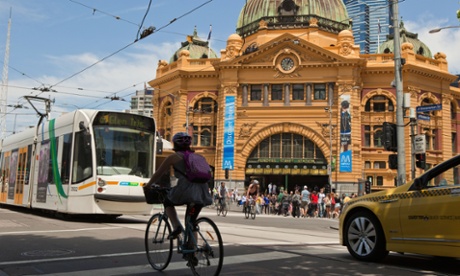
    Sunny Melbourne day.
    Sunny Melbourne day. Photograph: Alamy

    We need to talk about cities, especially Australia’s large state capitals like Melbourne.

    In the world’s most urbanised nation, around three quarters of recent population increase has been in our largest cities. Notwithstanding the mining boom, 80% of Australia’s economic activity takes place in major urban communities.

    Since I represent an outer-suburban electorate in the federal parliament, questions of the future shape of cities are not simply an abstract concern to me.  Every day I can’t help but think of how government actions – and failures to act – shape the choices people have in their daily lives, and the horizons of their futures.

    If our cities are growing, outer suburban communities are booming. The number of people living in the outer suburbs is projected to double over the next 25 years. One in five Australians will live in the outer suburbs – while less than one in every 10 jobs is presently located there.

    Under Labor, the shape of our cities was a national priority for our national government. Unfortunately, this isn’t so under the conservatives. One of the first acts of the Abbott government was to abolish the Major Cities Unit which provided vital advice on supporting the development of Australia’s 18 biggest cities.

    Tony Abbott wishes to be known as the “infrastructure prime minister”. But a more telling self-description is his view that the Commonwealth should “stick to its knitting” in terms of infrastructure funding and not support the passenger rail that is so vital to productive and sustainable communities. This speaks to more than simply a preference for cars over trains. It demonstrates a wider prejudice against the collective, indeed against the very sense that it should be the business of government to shape urban development.

    On the other hand, the Grattan Institute has undertaken some important work through its Cities unit. Last year’s Productive Cities report neatly sets out why, this year, Australia must get to work on cities policy:  “[b]etter functioning cities would unleash higher productivity, and provide everyone with more opportunities. In this case, what is good for the economy is also good for the fair go.”

    Useful work has been done in the past through the National Urban Policy and the Liveable Cities program, as well as through State and Local governments. And right across our cities, residents groups – people like the Aurora Community Association in my own electorate – are grappling with the big questions around the way we live, as well as issues more closely tied to individual communities.

    But since the election, we’ve seen a vacuum in terms of political leadership. Labor proposed a minister for cities, and an outer suburban growth taskforce. In their place we have, well, very little with the promise of still less to come: a shrunken approach to “regional development” denying, in effect, its application to urban communities.

    Before minister Albanese, Tom Uren and Brian Howe showed what can be achieved when we make our cities and suburbs national priorities. We cannot afford to hide behind the complexities of our federal system, or the limited direct policy levers at the disposal of the Commonwealth when the stakes are so high.

    There is a major role here for Australia’s government. Building communities is about so much more than building houses, and we must be prepared to lead a big conversation in the communities we represent and in the Parliament about the cities we aspire to live in. What is to be done about housing affordability? How do we support sustainability? How can we secure infrastructure investment based on need? How do we attract jobs to the suburbs? How do we build social inclusion and cohesion?

    We must also recognise that the relevant timelines are much longer than the political cycle. Consider the impact of under-investment in public transport decades ago on Victorian politics today, or the huge productivity and liveability impacts of our failure to remove so many level crossings in Melbourne – a job finished in New York in the 1920s.

    Places like Toronto, Seattle and Copenhagen demonstrate the benefits of a strategic and coordinated approach to the governance and planning of communities. Crucially, successful cities are engaged in a real dialogue with citizens in this reform project. Shaping how we live is a democratic process, not simply a problem for technocrats to “solve”. In the US, this has been called a “metropolitan revolution.”

    Melburnians are proud of living in the world’s most liveable city, and rightly so. But we didn’t get to this point by luck alone and today risk the prospect of fragmenting into two cities: a prosperous core and lesser opportunities further out.

    If we want to remain a vibrant, inclusive and dynamic place we can’t sit on our hands. Our cities and those who live in them deserve the full attention of all levels of government – working with one another, responsive to community.

  • As Tony Abbott launches all-out war on climate action, what’s the plan? CLIMATE CODE RED

    1 of 7
    Why this ad?
    Need Legal Representationwww.hcdlaw.com.au – Ensure you are prepared for Court. Experienced lawyer for best outcome

    climate code red

    Inbox
    x
    Climate Code Red noreply@blogger.com via google.com
    8:17 PM (54 minutes ago)

    to me

    climate code red


    As Tony Abbott launches all-out war on climate action, what’s the plan?

    Posted: 27 Jan 2014 07:55 PM PST

    NOTE: This blog was originally drafted as notes for a small group discussion in Melbourne. It is in part a situational analysis, covering the need to engage with conservative voters, the fragmentation of our efforts, and the growing gap between what is scientifically necessary and what is considered politically possible, resulting in a cognitive dissonance which is structurally embedded in the climate discourse. At first, I was reluctant to publish these notes because they are pretty blunt, but a number of people thought they were worth an airing, especially because the Abbott government is waging an all-out “shock and awe” war to destroy climate and environment public policy, for which much of our side appears ill-prepared.

    by David Spratt

    “Honesty about this challenge is essential, otherwise we will never develop realistic solutions. We face nothing less than a global emergency, which must be addressed with a global emergency response, akin to national mobilisations pre-WWII or the Marshall Plan… This is not extremist nonsense, but a call echoed by an increasing numbers of world leaders as the science becomes better understood… In the face of catastrophic risk, emission reduction targets should be based on the latest, considered, science, not on a political view of the art-of-the-possible.”
    — Ian Dunlop, formerly senior oil, gas and coal industry executive and CEO of the Australian Institute of Company Directors,  “Global warming is a global emergency”, Crikey, 25 February 2009

    Australia’s climate action movement is diverse: from large, professional national organisations to local volunteer community groups; from issue-specific campaigns focussing on coal, coal seam gas (CSG) and renewables to sector-specific groups; from organisations focused on policy-makers to activists directly confronting the fossil fuel industry. The election of the Abbott government has created a moment of crisis and a chance to review.

    1. We lack electoral power

    Denial-and-delay governments dominate Canberra and in the major states, with another likely to come in Tasmania. On the other hand, the Victorian conservative government is looking wobbly ten months out from a State election. The balance of power in the Senate will likely be in the hands of an Australian coal baron and right-wing independents for the next six years, depending to some extent on the WA Senate re-election result.

    In the federal election no Liberal–National Party sitting member or candidate held reasonable fear that they would lose their seat because of their climate or environment stance. We lack(ed) electoral political power.

    Most of the movement’s public allies (such as unions, aid organisations, welfare lobby, churches) have largely disappeared from public view over the last two years for various reasons (and the Abbott government attacks on their sectors won’t help), and the movement looks more isolated than it has for some time. There are very few paradigm-challenging, conservative Australian climate action advocates consistently in the public space. Those in business who apparently were supporting a carbon price backflipped as soon as Abbott was elected. However a reasonable number of people were motivated to come out for the 17 November rallies.

    Regional organising on CSG has build sufficient power to worry some State governments. However this movement does not have an explicit climate action focus.

    2. Strategic choice

    In the recent years, the climate movement put too much effort into lobbying and advocacy work, and not enough into community education, organisation and mobilisation, especially as Abbott advanced. The Labor government and much of the climate advocacy movement made a strategic mistake in 2010 by trying to sell the climate legislation as about “clean energy futures” and “saying yes” without engaging people about how climate change would affect people’s lives. It was all about selling good news and not mentioning bad news, selling an answer without elaborating the question. Public support went down. And our side kept on talking too much about carbon pricing and targets, and too little about how climate change threatens the Australian way of life.

    It should be now obvious that the Abbott government is on a complete bender to smash climate action and the renewable sector, and no amount of rationale argument or reasoned lobbying inside the walls of parliament house are going to make any difference. 

    3. The majority of Australians are not really with us

    In the last six years, support in Australia for the view that global warming is a serious and pressing problems that requires taking steps now even if it involves significant costs fell from over 60% to under 40%, according to Lowy Institute polling (below). We lost our majority.
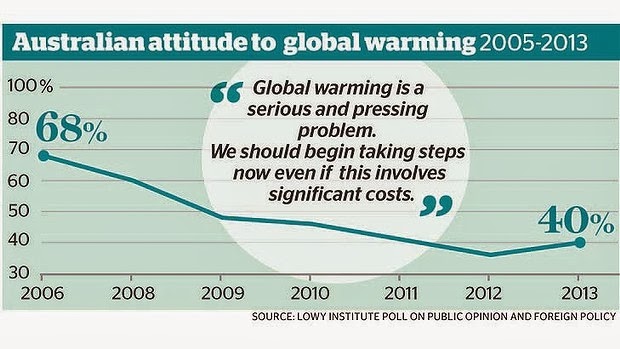
    Australian attitudes to climate change 2005–13. source: Lowy Institute

    So today we can say, very roughly, based on recent polling (which I have roughly sketched in the next chart) that:

    • One our side (left section of chart), around 40%  view climate change as real, human caused and a problem requiring serious action, and support a carbon price in some form.
    • At the other end (right section of chart), around 20% are deniers, don’t know, or want no action.
    • In the middle (centre of chart within red dashed box) are 40% who believe climate change is real (but have mixed views about human causation), and view  extreme events as becoming more frequent (with mixed views about causation). They believe climate change will become a serious threat to their way of life (more in the distant future than soon), want some action on climate change but don’t want it to cost them, so oppose carbon pricing.
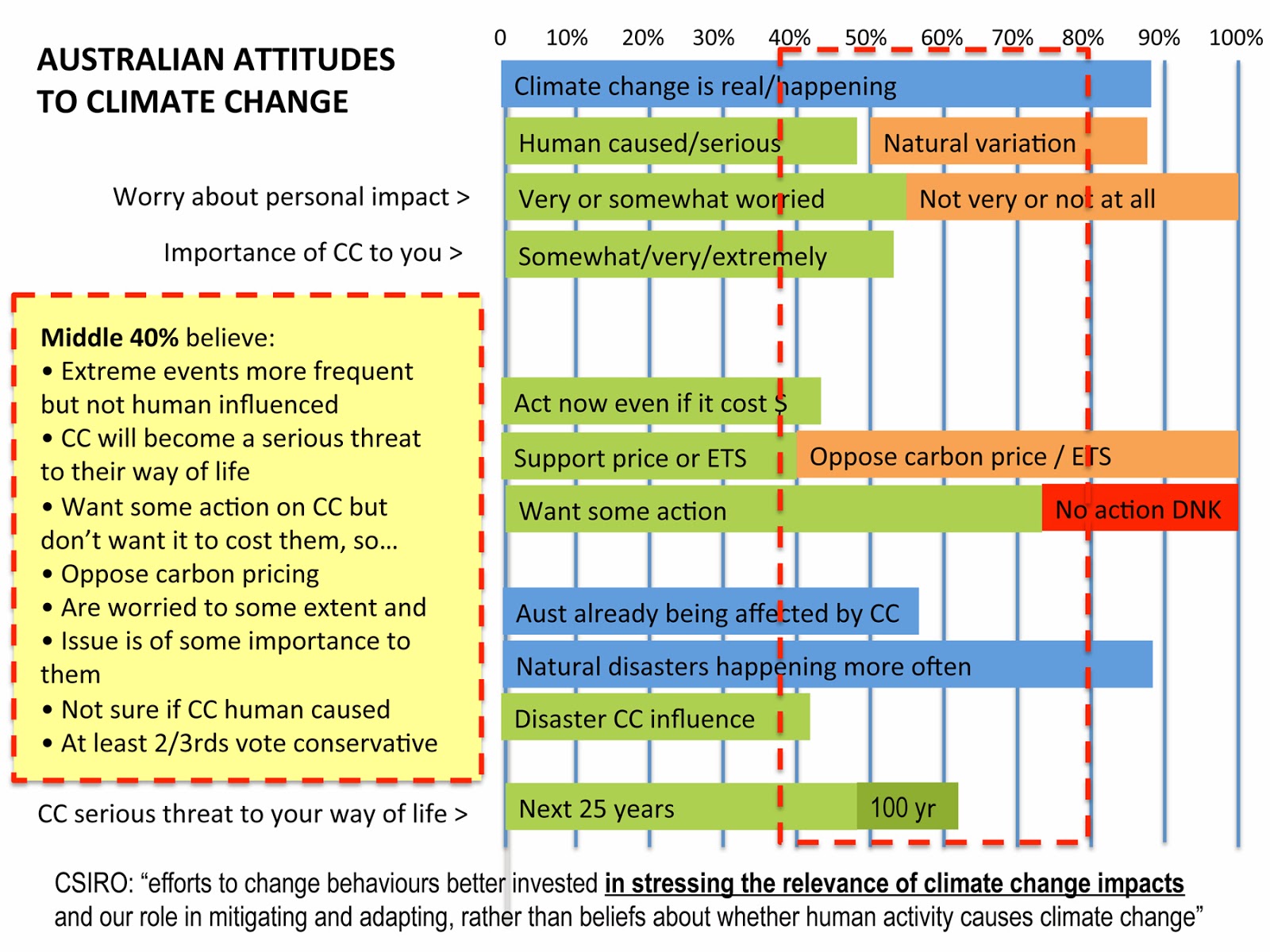
    A rough roadmap to public opinion in Australia on climate change (David Spratt)

    Looking in more detail at this middle group, the fact that they are unwilling to countenance climate policies they perceive as costing them even a small amount  — hence Abbott’s largely fallacious but effective  appeal to “cost of living pressures” and electricity prices —  will only change when the visceral impacts of climate change — on health, home, livelihoods, children — are well understood as personally affecting their lives in a significant way, and sooner rather than later.

    At least 70% of this middle group vote conservative. Winning this group is essential, especially that portion of it (15–20% of total population) who attribute human cause to climate change, and also to more extreme events. But the human attribution issue is not an insurmountable obstacle, as a CSIRO attitudes survey concluded that:

    efforts to change behaviours (are) better invested in stressing the relevance of climate change impacts and our role in mitigating and adapting, rather than beliefs about whether human activity causes climate change.

    4. Climate as culture war 

    The Abbott government constructs climate as a culture war. It will not be persuaded by reason and is not interested in compromise: fighting enemies and winning is more important than reality-based policy-making. At present, Nick Minchin and Maurice Newman influence the Abbott government more than the climate movement in totoRationale conversation will not move Abbott or those close to him and they have no interest in what we say. This is clear in the decisions made so far in the climate, energy and environment portfolios, which are not evidence-based.

    Culture wars are not primarily about policy detail, but about legitimacy and dominance. They are out to smash us up and anything that threatens the fossil fuel industries.

    The most imminent threat to their position is their own overreach. It is in this environment that we set our goals.

    5. What Abbott fears

    Tony Abbott’s climate message is largely tailored to the “middle 40%”, whilst also dog-whistling to the deniers. Abbott is a denier, but his publicly crafted position is that:

    • Climate change is happening with an (unspecified) “human contribution”, but also due to natural variation, a sort of each-way bet;
    • It’s a problem but not an urgent one; and
    • He has a plan that isn’t a carbon price, so won’t cost people directly (which is untrue because it is being paid for out of peoples’ taxes).

    All of which fits the “middle 40%” demographic, so from an opportunistic political point of view Abbott’s position is not mad, even though from a scientific standpoint it is completely bonkers.

    Tony Abbott gets into trouble (as we saw in his response to the NSW bushfires’ public debate) because he cannot afford to admit to the climate change–more extreme weather link, he cannot afford to admit that climate change is a serious threat to the Australian way of life, and he cannot credibly say he will protect the Australian people from climate change. And he does not want to explain how his plan will work, because it won’t. So what the Abbott government fears is:

    • More and more intense extreme weather events (note their complete silence on climate change connection to the summer’s record breaking heatwaves, and the record heat year of 2013);
    • A public conversation that “connects the dots” between extreme events and climate change, which gives immediacy to the perception of climate impacts;
    • Constructing a climate narrative about human climate impacts, rather than electricity prices and taxes;
    • Public focus on the responsibility of political leaders to “protect the people” from climate change; and
    • Close attention being paid to the efficacy of his climate plan.
    • Weakening of the government’s general credibility, which may detract from the authority of its position on carbon pricing.  The government is already suffering from over-reach, arrogance and incompetence which have dented its credibility on a number of fronts (foreign affairs, education, debt, jobs and industry), resulting it already being behind in some polls. This rules out any double dissolution and, if the trend continues, will weaken the case for scrapping the carbon tax in the new Senate after 1 July 2014.

    5. Sell the product, not its price

    So one key task is to make the story about how climate change will make peoples’ lives worse and the duty of politicians to protect them, not a story about taxes and electricity prices and cost-of-living pressures.

    That is, sell the product (climate impacts), not its price (carbon tax) by constructing a narrative about climate impacts that brings the message back to the home, that connects the dots, that poses the choice between increasing harm and threat, or acting to restore climate safety.

    We need to more thoroughly learn the lessons from the health promotions sector: be honest about the problem and tell it like it is; show a better alternative, the benefits of changing behaviour; and finally demonstrate an efficacious path to move from fear to success.
    This means making the story about:

    • People in Australia and not distant places;
    • Now and not just the distant future;
    • How family and friends will live in a hotter and more extreme world;
    • How it will affect where we live and work;
    • Health and well-being, about increasing food and water insecurity, and the lives that children and grandchildren will face.

    It probably means developing the capacity to tell “micro” stories about impacts in particular geographies, for example to show how climate change will impact a NSW north coast retirees’ beach town in terms of fishing (fewer fish), surfing and beach amenity (sea levels and storm surges), outdoor recreation clubs (more intense droughts), backyard vege gardens, health (more heat waves and heat stoke) property damage (more intense “tropical” storms events moving further south), and so on. Every place in Australia has its own future “micro-climate-change” story, and it’s up to us to be able to tell it convincingly.

    It also means thoroughly preparing for, and better managing, extreme climate teachable moments. Figures just out show that the mid-January 2014 heat wave caused around 140 more Victorian deaths, mainly amongst the elderly and due to heat stroke and heart attacks. The Victorian Government is wide open to the charge of “failing to protect Victorians from climate change” (as Greens deputy leader Adam Bandt did with Abbott and the spring 2013 NSW bush fires) but to my knowledge nobody has so far taken up the case, which would have had the Victorian government on the back foot and looking foolish and embarrassed.

    A meta-theme of “Protect Australians from climate change” is stable over time (as policy details and particular campaigns demands change), and directly opens governments to the charge of “failing to protect Australians/Victorians from climate change” which they can neither answer in the positive (because they obviously are not) nor answer in the negative (accepting their own negligence). A meta-theme of “Protect Australians from climate change” links directly to people’s own lived experience of extreme heat and discomfort, of bush fires, health impacts on family, of changing coastlines, of extreme drought and water restrictions, and so on.

    6. Scale of task

    Scientists describe warming of two degrees Celsius (2C) not as the boundary for dangerous climate change, but as representing a boundary between dangerous and extremely dangerous climate change, pointing to a safe boundary as being under 350 parts per million carbon dioxide equivalent (ppm CO2e), more than 120 ppm CO2e below the current level. Our stated purpose is to prevent dangerous climate change, but the current level of greenhouse gases is already extremely dangerous. Even for 2C, there is NO carbon budget left if one wants a low risk (less than 10%) of exceeding 2C:
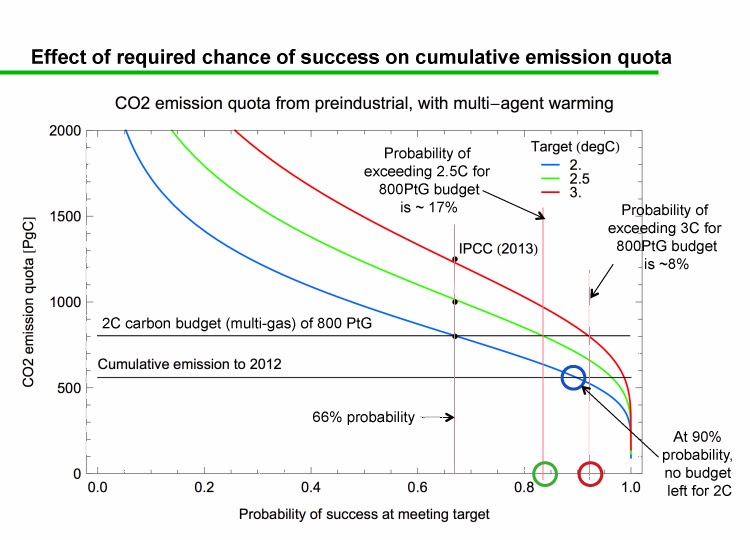
    Carbon budget (vertical axis) and probability of keeping below target (horizontal axis) for 2C (blue line), 2.5C (green line) and 3C (red line) of warming. Source: adapted from Raupach (2013, unpublished), based on Raupach, M.R., Harman, I.N. and Canadell, J.G. (2011) “Global climate goals for temperature, concentrations, emissions and cumulative emissions”. Report forthe Department of Climate Change and Energy Efficiency. CAWCR Technical Report no. 42. Centre for Australian Weather and Climate Research, Melbourne.

    As the graph shows, based on a chart from Mike Raupach at the ANU, at a 66% probability of not exceeding 2C, the carbon emissions budget remaining is around 250 petagrams (PtG or billion tonnes) of CO2. However this “carbon budget” also has a 17% chance of exceeding 2.5C and an 8% chance of exceeding 3C, which is clearly a risk we would be mad to accept. If one wants a 90% chance of not exceeding 2C, there is NO “carbon budget” left (blue circle). From this point of view, it is time to “Re-do the maths” that Bill McKibben popularised in his Rolling Stone article.

    Even for a 50/50 chance of not exceeding 2C, Anderson and Bows have demonstrated that for the high-polluting, developed economies this means annual emissions reductions of 10% per year. Do we ever have a conversation about how these imperatives might affect what we do?  Do we dare articulate (even amongst ourselves) the bleeding obvious, as Tony de Brum, Kelly Rigg and former Irish president Mary Robinson did in the Guardian at the conclusion of COP19, that “We are now at a tipping point that threatens to flip the world into a full blown climate emergency”?

    7. Political power

    With the current level of greenhouse gases sufficient to produce 2C of warming, a rapid transition to a zero-emissions economy and large-scale atmospheric carbon drawdown are now necessary. At a time when global coal consumption is still growing, this means a rapid winding down of the fossil fuel industries and the stranding of capital, radical reductions in energy demand, and radical changes to many industries including food production, tourism and travel, international education, construction and transport, all of whose current interests are defended and promoted by government. What level and character of political power would need to be mobilised to achieve this objective, and how might this be done?

    8. Success

    Four necessary conditions for successful, large-scale and transformative social movements such as the anti-apartheid movement, the US civil rights movement, the Vietnam moratorium, or many of the recent movements which overthrew despotic regimes, seem to be:

    • Goals worth fighting for;
    • Political unity at the ideas level;
    • An effective power strategy that shows plausibly how the goals can be delivered and by whom; and
    • Sustained organisational unity at the action level.

    Is it fair to say that the climate movement in Australia too often exhibits few of these conditions?

    At the moment, do we fail on the basics, even on such things as what we say? Too often, are a hundred different things are said at once, rather than everybody saying the one thing a million times?

    There are messages and campaigns about coal, and gas, and renewables, and big solar, and wind farms, and new coal mines, and new coal export terminals, and energy efficiency, and community solar, and targets, and divestment, and renewable energy targets, and clean energy, and carbon prices, and carbon trading, and climate authorities, and clean energy funding, and saying yes, and keeping fossil fuels in the ground, and protecting the barrier reef, and the Arctic and many more.

    If we want the electoral centre to listen to us, do we need to all say the one, same, effective thing over and over and over and over and over and over again until it becomes normalised?  This is one of the ABCs of politics that Tony Abbott and his staff understood in opposition very well, and our side little or not at all.

    The movement seems to have an incapacity to unite consistently around a successful strategy. Much of the movement consists of big and small NGOs dependent on philanthropists and donor/supporters operating within a climate advocacy marketplace in which NGOs compete against each other for a pool of funders, supporters and dollars. Building brands and product differentiation provides a structural basis that inhibits effective ongoing political unity. Some in the movement now acknowledge this as perhaps the prime strategic obstacle.

    Carefully-guarded individual NGO databases can inhibit effective community organising in specific locations, unless one is prepared to re-invent the wheel by building ones own list from scratch. The duplication is large scale, and a big waste of precious resources.

    Is it fair to say that more often than not we have a fractured movement?

    9. United mobilisation?

    The national climate rallies in November painted a revealing picture of the climate movement’s current state.

    Democracy: Essentially, one organisation (GetUp) called the rallies without consultation, and everyone else had to fall in behind so the rallies did not fail, but everyone knew that if there had been a proper consultative process and four months had been allowed to build events in February at the end of a long, hot, bushfire- and heatwave-plagued summer, something really much bigger could have been achieved and at the same time kicked off the year with energy and action. The history of mass rallies in Australia is that people are tired at the end of the year; after a summer break they are more likely to hop into what is happening, with February to June the best window. After all, the crucial Senate votes are not until July 2014, so rushing was less important that succeeding.

    Limited outcome: The numbers were nowhere big enough to give Tony Abbott a fright, their political impact negligible. The claim was 60,000 nationally, in reality probably 30-40,000 from what I counted in Melbourne and reports from other cities. From my own observations over many different issues, to made a serious political statement you generally need 50,000 in big cities like Sydney and Melbourne, and preferably 100,000 in each.  And you sit in one place and particularly a park away from pedestrian traffic and don’t march, the only people who see you are the people who have made a conscious decision to attend; for the rest of the town or city, the event is invisible.

    Clicktavism limits: The groups endorsing the rallies collectively have many more than a million digital supporters, so the attendance wasn’t great.  Experience tells us that for big events to be really successful and maximise opportunities, they need months and months of preparatory work, engaging local community-based groups, streets-stalls, small forums and big public meetings, lead-up media narratives, working across church and union and welfare and the aid and arts and conservation and similar sectors. For the November rallies, this was not feasible.

    Resource use: It is reported that the events cost $260,000 or $6 a head. That is a poor outcome for money spent.

    Opportunism: After the rallies, GetUp hit their lists selling Bill McKibben’s book (without, as far as I could see, a single mention of 350’s work) on the basis that by buying the book/donating to GetUp, you would be “powering(ing) the movement”. So GetUp IS the movement, right?

    Followup: One key purpose of any rally is to propel people into the next run of activities, to collect contact details, organise new local activism groups, promote events, and so on.  Because there was no such plan or intent, this task failed. The rallies were a moment in time, not a building block.

    10. Organising questions

    The need for large-scale serious organising for political power to throw this government out of office, and spending less time spent on policy detail, is fundamental in responding to the Abbott agenda. Many groups in the movement are now saying this, and it’s hardly a new idea. It’s been done for many, many generations, one way or another, and on many issues in Australia today. It’s a political skill that perhaps has perhaps diminished in the digital age and is now being reclaimed.

    Has the climate movement in general, and particularly some of the large NGOs, spent too much time talking at the community (one-way, centralised communications) and too little time talking with the community (in the manner, for example, of the recent electoral campaigns in seats such as Indi and Melbourne, or CSG campaigning)?

    How will community organising be done from now on? Will everybody do their own thing, and hope it adds up to something coherent?  The logic of the structural/branding issues discussed  above is that most activist and organisation take responsibility only for their own turf and for their own interests.

    Should we ponder the question: “If everybody takes responsibility for their part, who takes responsibility for the interests of the movement as a whole?” Do we have an answer?

    Can we learn from the trade union movement? In the last term of the Howard government, trade unionism faced a government with very hostile industrial relations laws and made a very clear decision not to give priority to working in Canberra’s halls of power lobbying and prying incremental changes from the government, but to devote all the resources they could muster to bringing down the government. The “Your Rights at Work” was a well-resourced, strategic, unified and persistent campaign encompassing a strong public affairs campaign, and an electoral campaign over 20 marginal seats, each with a full-time organiser and local cooperation between the ACTU affiliates to facilitate systematic community outreach.

    What can we learn from Your Rights at Work, the Melbourne and Indi election campaigns, the Port Augusta work, the Sunrise Project, Lock the Gate, and Environment Victoria’s community engagement strategy?

    In building political power, what is the balance between winning the public affairs battle (how the issue is framed and understood), public mobilisation, building sectoral strength, building issues-based campaigning, and building geographic (electorate) strength?

    I know it is easier to ask questions than provide answers. But at the moment perhaps even the questions are not being asked as often and as loudly as they need to be, especially as the Abbott government turns upside the climate policy paradigm in Australia.

  • Quentin Bryce: Highlights of the Governor-General’s five years in office

    Posted 2 hours 23 minutes ago

    During her five years as Governor-General, Quentin Bryce has met thousands of Australians, visited dozens of countries, and hosted scores of foreign dignitaries.

    As the Queen’s representative in Australia, Ms Bryce fulfilled important constitutional and ceremonial roles, and also attended numerous community events.

    Her term is due to end in March, when former Defence Force chief Peter Cosgrove takes up the position.

    Here are some of the memorable moments from Ms Bryce’s past five years.

    September 2008: Term begins

    Ms Bryce is sworn in as Australia’s 25th Governor-General and is the first woman to fill the position.


    During a ceremony at Parliament House in Canberra, she remarked:

    As I travel over our rich and testing country – into the vibrant and struggling sectors of our community, to our rural and remote places – forever deep in my heart I promise to be alive, open, responsive and faithful to the contemporary thinking and working of Australian society.

    Australians, you have entrusted a great deal to me. I will honour your trust wholeheartedly.

    Quentin Bryce, speaking at her swearing-in ceremony


    March 2009: Africa tour

    Ms Bryce embarked on a three-week, nine-nation tour of Africa in a bid to demonstrate Australia’s growing engagement with the continent.

    But it also emerged the trip was about helping Australia win a seat on the UN Security Council.

    That prompted criticism from the Opposition who complained the Governor-General’s role was becoming too political.


    The then-minister for foreign affairs, Stephen Smith, defended Ms Bryce’s journey.

    “During her visit to Africa, the Governor-General will underscore the point that Australia wants to enhance its engagement with Africa,” he said.

    “Reflecting our strong support for the United Nations, we are running for the Security Council. During her visit to Africa, the Governor-General will remind those she meets of that fact, as appropriate.

    “It is a nonsense to suggest that the Governor-General be ‘negotiating’ or ‘bargaining’ for a seat on the Security Council.”

    April 2011: Royal wedding

    Ms Bryce and her husband Michael joined then-prime minister Julia Gillard and her partner Tim Mathieson at the wedding of Prince William and Catherine Middleton in London.

    Following the announcement of their engagement, Ms Bryce commented the news had “warmed our nation’s heart”.

    Often admired for her sartorial choices, the Governor-General wore a hot pink, red and orange silk brocade two-piece suit and matching pink patent stilettos.


    A total of 2,000 guests were invited inside Westminster Abbey for the royal wedding, and Ms Bryce was among the select group of 600 that went on to the reception at Buckingham Palace.

    During her trip to London, Ms Bryce also laid a wreath at the Australian War Memorial to commemorate Anzac Day, before travelling to Oxford for a special meeting with university academics and Australian Rhodes scholars.

    September 2012: Refugee camp visit

    The Governor-General was reduced to tears while visiting a refugee camp in Jordan to meet with some of the thousands who have fled unrest in Syria.

    After Ms Bryce spoke to a small group of mothers, the woman known for her poise could not hold back her tears.


    People like me, we have no understanding of the risks, the dangers, the constant anxiety, how draining that must be, how debilitating. And I can see in their eyes the extreme weariness that’s come from such long nights and days and constant worry.

    Quentin Bryce, speaking at the Al Zaatari refugee camp


    October 2013: Offers to quit

    Following the appointment of Bill Shorten as new Labor leader, Ms Bryce offered to resign.

    Her daughter Chloe is married to Mr Shorten and the Governor-General wanted to avoid any perception of bias.

    However, new Prime Minister Tony Abbott asked her to stay on and complete her term.


    “Her Excellency … has served the people of Australia with distinction and has provided a gracious note to our constitutional arrangements through her widespread engagement with the community,” he said.

    “I believe it is only fit and proper that she be permitted to conclude her term and be accorded the appropriate farewell that her exemplary service merits.”

    November 2013: Boyer Lecture

    Ms Bryce delivered the year’s final Boyer Lecture in which she backed both gay marriage and Australia becoming a republic.

    She said she hoped Australia might become a nation where “people are free to love and marry whom they choose… and where perhaps, my friends, one day, one young girl or boy may even grow up to be our nation’s first head of state”.


    It was the first time a governor-general had publicly supported a republic while still serving as the Queen’s representative.

    While the republican movement applauded her comments, others said the Governor-General had crossed the line by voicing opinions on two sensitive political issues.

    Mr Abbott said she was entitled to express her own personal opinion.