Author: Neville

  • Will extreme weather like super typhoon Haiyan become the new norm?

    Will extreme weather like super typhoon Haiyan become the new norm?

    The strongest hurricanes are becoming stronger, fueled by warmer oceans caused by climate change
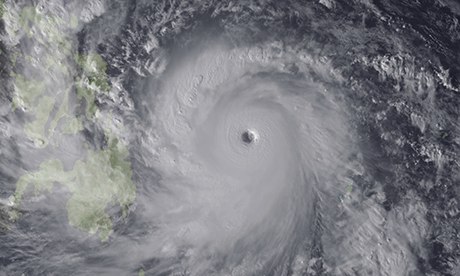
    Satellite image of typhoon Haiyan 7/11/13

    Typhoon Haiyan over the Leyte Gulf, east of the central Philippines. Photograph: Zuma/Rex Features

    Typhoon Haiyan may have been the strongest storm ever recorded; a fact that has triggered an array of stories discussing its possible links to climate change.

    Global Warming Fuels Hurricanes

    Climate scientists are confident in three ways that climate change will make the impacts of hurricanes worse. First, global warming causes sea level rise, which amplifies storm surges and flooding associated with hurricanes. As a paper published in the Proceedings of the National Academy of Sciences by Aslak Grinsted and colleagues concluded,

    “we have probably crossed the threshold where Katrina magnitude hurricane surges are more likely caused by global warming than not.”

    Second, as climate scientist Kevin Trenberth has noted, global warming has also increased the amount of moisture in the air, causing more rainfall and amplifying flooding during hurricanes.

    Third, warmer oceans are fuel for hurricanes. Research has shown that the strongest hurricanes have grown stronger in most ocean basins around the world over the past several decades, and climate models consistently project that this trend will continue. Chris Mooney recently documented the past decade’s worth of monster hurricanes around the world, and Jeff Masters estimates that 6 of the 13 strongest tropical cyclones on record at landfall have happened since 1998.
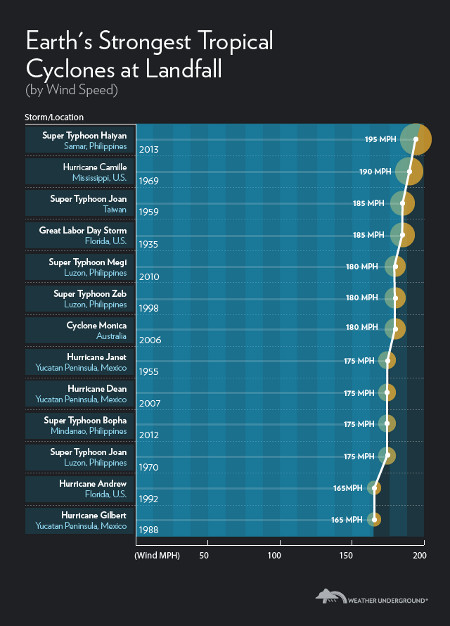
    The 13 strongest tropical cyclones at landfall The 13 strongest tropical cyclones at landfall. 6 have happened since 1998. Source: wunderground.com

    What about Typhoon Intensity Near the Philippines?

    Chapter 2.6.3 of the 2013 IPCC report notes,

    “Time series of cyclone indices such as power dissipation … show upward trends in the North Atlantic and weaker upward trends in the western North Pacific since the late 1970s”

    The hurricane intensity trend in the western North Pacific (where the Philippines are located) isn’t crystal clear. One recent paper finds that over the past few decades their intensity has slightly fallen (but has grown for the planet as a whole), while others suggest it’s slightly risen, or that there are fewer but stronger hurricanes in that western North Pacific region.

    However, a paper published earlier this year in the Proceedings of the National Academy of Sciences by MIT hurricane expert Kerry Emanuel found that future “Increases in tropical cyclone activity are most prominent in the western North Pacific.” So while we’re not certain about the trend over the past few decades, the evidence indicates that hurricanes near the Philippines will both become stronger and form more frequently in a warmer world.

    Hurricane Frequency Used to Sow Doubt

    The frequency of hurricane formation overall is another story. To this point the evidence does not indicate that hurricanes are forming or making landfall more often than in the past, nor are climate scientists confident how global hurricane frequency will change. Thus it’s not a surprise that climate contrarians have focused on hurricane frequency while ignoring hurricane intensity. This is a clear sign of bias by writers like the Mail on Sunday’s David Rose, who even went as far as to once again repeat the myth of a global warming ‘pause’ (a myth that was comprehensively debunked by a new study last week).

    Similarly, in a piece published in The Guardian Political Science section, Roger Pielke Jr. criticized President Obama, climate scientist Michael Mann, and others for linking extreme weather to climate change. Pielke lamented that those he criticized didn’t reference the 2012 IPCC special report on extreme weather (SREX). However, Pielke’s reading of that report was very selective.

    Climate Change Intensifies Many Types of Extreme Weather

    The IPCC SREX emphasizes that hurricane data include significant uncertainties. However, it’s important to note that absence of evidence is not the same as evidence of absence. For example the fact that the data aren’t good enough to confidently link rising hurricane intensity to human greenhouse gas emissions so far doesn’t mean there isn’t a link. It means we need better data to make a conclusive determination.

    However, the report does note that several types of extreme weather will intensify as climate change continues:

    “Heavy rainfalls associated with tropical cyclones are likely to increase with continued warming.”

    “Average tropical cyclone maximum wind speed is likely to increase.”

    “There is medium confidence that some regions of the world have experienced more intense and longer droughts … There is medium confidence that droughts will intensify in the 21st century in some seasons and areas … This applies to regions including southern Europe and the Mediterranean region, central Europe, central North America, Central America and Mexico, northeast Brazil, and southern Africa.”

    “It is virtually certain that increases in the frequency and magnitude of warm daily temperature extremes and decreases in cold extremes will occur in the 21st century at the global scale. It is very likely that the length, frequency, and/or intensity of warm spells or heat waves will increase over most land areas.”

    When considering all the available evidence, most of the comments about climate change and extreme weather criticized by Pielke were on solid scientific footing. It’s important that we face up to not just the changes in extreme weather that we’ve seen so far, but those which are soon to come if we continue on our current path. It’s not so much the climate change we’ve seen so far that we’re worried about; it’s what’s yet to come.

    What Do We Do About It?

    Some climate contrarians have claimed that climate realists are exploiting the victims of Haiyan by discussing the link between hurricanes and climate change. But it was Yeb Saño, the Philippines’ lead negotiator to this year’s United Nations climate talks who pleaded that we stop procrastinating in addressing climate change.

    As Michael Mann noted, we can’t say for sure what impact climate change had on Haiyan because we only have one planet, and we’re running a dangerous experiment with it. But it’s important to ask the right questions when it comes to extreme events like Haiyan. Asking if global warming caused Haiyan is the wrong question.

    Human-caused climate change makes the impacts of these storms and many other types of extreme weather worse. It fuels hurricanes such that we’ll see superstorms like Haiyan more frequently in the future. Eventually we’ll have to stop denying that reality and start doing something to address it, or these types of extreme weather events will become the new norm.

    Green light
  • Extreme El Niño cause found

    TOP SCIENCE JOBS:
    Extreme El Niño cause found
    The University of New South Wales
    Tuesday, 19 November 2013
    NASA_ElNino

    The image shows sea surface height relative to normal ocean conditions in the Pacific Ocean. Sea surface height is an indicator of the heat content of the ocean.

    Image: NASA

    Unusual El Niños, like those that led to the extraordinary super El Niño years of 1982 and 1997, will occur twice as often under even modest global warming scenarios.

    That is the finding of a new collaborative study, published in the journal Nature and led by researchers from the UNSW Climate Change Research Centre and ARC Centre of Excellence for Climate System Science, which has for the first time revealed the cause of these events.

    These unusual El Niño events differ from the more common kind in that sea surface temperatures start warming in the west of the Pacific Basin and spread eastwards. Under normal El Niños, ocean surface temperatures first warm in the cold eastern Pacific and then expand west, in the direction of the Trade Winds and the ocean currents along the equator.

    “These unusual El Niños appeared for the first time in the available record sometime after the mid 1970s,” says lead author, Dr Agus Santoso, of the UNSW Climate Change Research Centre.

    Scientists have struggled to explain why they occurred and if the frequency would change in the future.

    “The most common theory used to explain these unusual El Niños was that competing air and ocean feedbacks drove the direction of the warming,” says Dr Santoso.

    “But if this was true, La Niñas would have propagated in the same direction. Observations show they do not.”

    In a world first, the researchers found the key to the mystery was the weakening of westward flowing currents along the Equator in the Pacific Ocean. As these currents weakened and even reversed, it allowed the heat during these unusual El Niño events to spread more easily into the eastern Pacific.

    La Niña events didn’t behave in a similar way, because the currents are strong and flow to the west.

    Importantly, using observations and climate models, the researchers were able to determine what this could mean for the future frequency of these unusual El Niños.

    “Using observations we demonstrated the likely role of the weaker currents in the unusual behavior,” says Dr Santoso.

    “These currents are well represented in a number of climate models. Using these models we confirmed, even under modest global warming scenarios, these unusual El Niño events doubled in frequency.“

    Past experience shows that these super El Niño events bring more than just unusual weather conditions – they matter for people and economies.

    The 1982 and 1997 events led to highly unusual weather events worldwide causing disruption in fisheries and agriculture costing tens of billions of dollars and leading to the deaths of tens of thousands of people. During the 1982 event, in the US alone, crop losses were estimated at $10-12 billion (the equivalent of $24-26 billion in current terms).

    “While more frequent eastward propagating El Niños will be a symptom of a warming planet, further research is underway to determine the impact of such events in a climate that is going to be significantly warmer than today,” says co-author, Dr Wenju Cai, a senior scientist at CSIRO.

  • Ban says people feel ‘planet’s wrath’ over warming

    Ban says people feel ‘planet’s wrath’ over warming

    By Alister Doyle and Nina Chestney

    WARSAW Tue Nov 19, 2013 11:37am EST

    • inShare
    • Share this
    • Email
    • Print
    (L-R) Christiana Figueres, executive secretary of the U.N. Framework Convention on Climate Change (COP), U.N. Secretary General Ban Ki-moon and Polish Prime Minister Donald Tusk listen to Polish Environment Minister Marcin Korolec during the COP19 conference at the National Stadium in Warsaw November 19, 2013. REUTERS/Kacper Pempel

    (L-R) Christiana Figueres, executive secretary of the U.N. Framework Convention on Climate Change (COP), U.N. Secretary General Ban Ki-moon and Polish Prime Minister Donald Tusk listen to Polish Environment Minister Marcin Korolec during the COP19 conference at the National Stadium in Warsaw November 19, 2013.

    Credit: Reuters/Kacper Pempel

    (Reuters) – People around the world are feeling the “wrath of a warming planet”, U.N. Secretary-General Ban Ki-moon said on Tuesday, urging almost 200 governments to take tougher action to reach a deal in 2015 on fighting global warming.

    Ban told environment ministers at climate talks in Warsaw they had a steep climb ahead to agree to cut rising greenhouse gas emissions that scientists say fuel more extreme weather.

    The Warsaw talks are struggling to lay the foundations for a new global accord, meant to be agreed in 2015 and enter into force from 2020, that looks likely to be a patchwork of pledges by national governments rather than a strong treaty.

    Many developed nations are more focused on spurring sluggish economic growth than fixing global warming, despite scientists’ increased certainty that human emissions will cause more heatwaves, droughts, floods and rising sea levels.

    Developing nations, led by China and India, insist that the rich must continue to lead while they focus on ending poverty.

    “All around the world, people now face and fear the wrath of a warming planet,” Ban said, referring to extreme weather events such as Typhoon Haiyan that killed more than 3,900 people in the Philippines this month.

    Current pledges for curbing global warming were “simply inadequate”, Ban said. “Here, too, we must set the bar higher.”

    He said governments needed to step up aid to help poor nations slow their rising emissions of greenhouse gases and to adapt to the impacts of warming.

    GLIMMERS OF HOPE

    No major nations have set tougher national goals for cutting greenhouse gases in Warsaw. Japan disappointed many last week by saying it was watering down goals for 2020 after closing its nuclear industry after the 2011 Fukushima disaster.

    A report by 49 experts in 10 nations on Tuesday said that carbon dioxide emissions from burning fossil fuels will rise to a record 36 billion tonnes (1 tonne = 1.102 metric tons) this year.

    “I am deeply concerned that the scale of our actions is still insufficient to limit global temperature rise to below 2 degrees Celsius from pre-industrial levels,” he said.

    Governments agreed the 2C ceiling in 2010 as a maximum permitted to prevent dangerous change. Temperatures have already risen by about 0.8 C (1.4F) from before the Industrial Revolution of the 18th century.

    Ban said there were some signs of hope, pointing to actions by governments, business, cities and farmers to cut emissions.

    Ban has invited world leaders to attend a summit at U.N. headquarters in New York on September 23, 2014. “I ask all who come to bring bold new announcements and action,” he said.

    Polish Prime Minister Donald Tusk, whose country has been skeptical of tougher EU climate targets, urged better cooperation.

    “The match is won by the team. In order to win, players have to collaborate,” he said, in a tent set up on what is usually the pitch in Warsaw’s main soccer stadium.

    (

  • The Caribbean’s Fastest and Slowest-Growing Populations

    The Caribbean’s Fastest and Slowest-Growing Populations

    November 18, 2013 | 5:01 am | Print

    By the Caribbean Journal staff

    We continue our series on the World Bank’s Caribbean data by looking at another statistic: population growth.

    We’ve already looked at the Caribbean’s richest countries by GDP per capita, by population density, by life expectancy and by age of population.

    So what are the Caribbean’s fastest-growing populations?

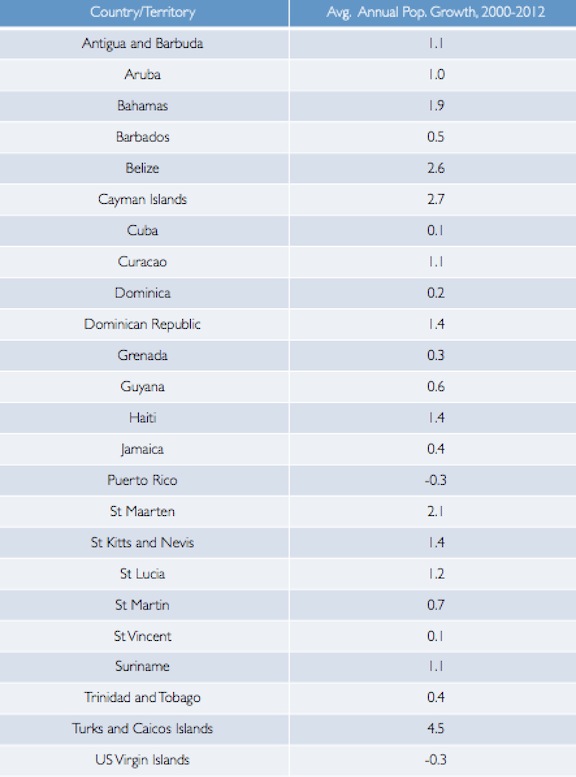
    According to the World Bank, the fastest-growing population in the region is one of the tiniest: the Turks and Caicos Islands, which has seen an average annual growth of 4.5 percent from 2000 to 2012.

    Second was the Cayman Islands, which saw an average annual growth rate of 2.7 percent from 2000 to 2012.

    Among sovereign Caribbean countries, it’s Belize that has the highest growth rate, at 2.6 percent, followed by the Bahamas at 1.9 percent.

    Two US territories were the only populations that saw negative growth — Puerto Rico, with -0.3 percent population growth over the period, and the US Virgin Islands, also at -0.3 percent.

    Note: as has been the case with most of this series, data on several French Caribbean territories and British Overseas territories was not included in the World Bank’s report.

    See below for the full data table by country/territory

  • Ocean acidification set to spiral out of control

    Ocean acidification set to spiral out of control

    Published 18 November 2013 Media coverage Leave a Comment

    [WARSAW] The continued release of greenhouse gases into the air is set to bring about huge changes to land ecosystems as they are forced to adapt to rising temperatures.

    But the marine world — which is just as integral to human existence yet receives little attention during climate negotiations — will endure a similarly tumultuous time as emissions rise, scientists say.

    “Changing oceans will cause massive destruction of coral reefs, which, with their rich biodiversity, are the jungles of the sea,” says Luis Valdes, the head of ocean science at UNESCO’s Intergovernmental Oceanographic Commission (IOC-UNESCO), and co-author of a forthcoming report into ocean acidification.


    This is expected to hit marine species used for food and have knock-on effects on coastal communities, especially in developing countries.

    Business-as-usual carbon dioxide emissions will lead to the acidity levels of oceans rising by 170 per cent by 2100 compared with pre-industrial levels, according to a report to be launched next week at COP 19 (Conference of the UN Framework Convention on Climate Change).

    The report will be published jointly by the International Geosphere-Biosphere Programme, the IOC-UNESCO and the Scientific Committee on Oceanic Research.

    As carbon dioxide levels in the atmosphere rise, some of this extra carbon is absorbed by the oceans and converted into acidic compounds.

    While some organisms such as seagrasses and phytoplankton will likely thrive in increasingly acidic waters, most will not be so lucky.

    Coral reefs and shellfish — both important sources of food — will be hit hard, with higher acidification levels predicted to halt all new further growth of reefs by the end of the century.

    It will be poor coastal communities, especially those in small island states whose existence revolves around coral reefs and fishing, which will bear the brunt of this change, says Valdes.

    “Poor communities are more dependent on the sea and have fewer options to mitigate effects if their current lifestyles become unsustainable,” he adds.

    Creating marine reserves to provide a safe environment away from human pressures to ease species’ transition to this altered world may be a way to minimise the damage, but ultimately the only way to prevent major problems is to halt the carbon emissions, says Valdes.

    But their effect on marine habitats is often absent from climate negotiations and Valdes calls for policymakers to pay more attention to the issue over the next week in Warsaw.

    Jan Piotrowski, SciDevNet, 15 November 2013. Article.

    Rate this:

    Rate This

    Share this post!

  • The rapid pickling of the world’s oceans affects more than just shellfish »

    Ocean acidification set to spiral out of control

    Published 18 November 2013 Media coverage Leave a Comment

    [WARSAW] The continued release of greenhouse gases into the air is set to bring about huge changes to land ecosystems as they are forced to adapt to rising temperatures.

    But the marine world — which is just as integral to human existence yet receives little attention during climate negotiations — will endure a similarly tumultuous time as emissions rise, scientists say.

    “Changing oceans will cause massive destruction of coral reefs, which, with their rich biodiversity, are the jungles of the sea,” says Luis Valdes, the head of ocean science at UNESCO’s Intergovernmental Oceanographic Commission (IOC-UNESCO), and co-author of a forthcoming report into ocean acidification.


    This is expected to hit marine species used for food and have knock-on effects on coastal communities, especially in developing countries.

    Business-as-usual carbon dioxide emissions will lead to the acidity levels of oceans rising by 170 per cent by 2100 compared with pre-industrial levels, according to a report to be launched next week at COP 19 (Conference of the UN Framework Convention on Climate Change).

    The report will be published jointly by the International Geosphere-Biosphere Programme, the IOC-UNESCO and the Scientific Committee on Oceanic Research.

    As carbon dioxide levels in the atmosphere rise, some of this extra carbon is absorbed by the oceans and converted into acidic compounds.

    While some organisms such as seagrasses and phytoplankton will likely thrive in increasingly acidic waters, most will not be so lucky.

    Coral reefs and shellfish — both important sources of food — will be hit hard, with higher acidification levels predicted to halt all new further growth of reefs by the end of the century.

    It will be poor coastal communities, especially those in small island states whose existence revolves around coral reefs and fishing, which will bear the brunt of this change, says Valdes.

    “Poor communities are more dependent on the sea and have fewer options to mitigate effects if their current lifestyles become unsustainable,” he adds.

    Creating marine reserves to provide a safe environment away from human pressures to ease species’ transition to this altered world may be a way to minimise the damage, but ultimately the only way to prevent major problems is to halt the carbon emissions, says Valdes.

    But their effect on marine habitats is often absent from climate negotiations and Valdes calls for policymakers to pay more attention to the issue over the next week in Warsaw.

    Jan Piotrowski, SciDevNet, 15 November 2013. Article.

    Rate this:

    Rate This

    Share this post!

    0 Responses to “Ocean acidification set to spiral out of control”

    1. Leave a Comment

    Leave a Reply

    Subscribe to the RSS feed

    Subscribe to Ocean acidification by