Author: Neville

  • 2013 is seventh hottest year, rising seas worsen typhoon

    2013 is seventh hottest year, rising seas worsen typhoon

    Reuters Alister Doyle and Michael Szabo – November 14, 2013, 9:23 am

    2013 is seventh hottest year, rising seas worsen typhoon
    2013 is seventh hottest year, rising seas worsen typhoon

    WARSAW (Reuters) – This year is the seventh warmest since records began in 1850 and rising sea levels caused by climate change are aggravating the impact of storms such as Typhoon Haiyan in the Philippines, the World Meteorological Organisation (WMO) said.

    More greenhouse gases in the atmosphere meant a warmer future, and more extreme weather, was inevitable, WMO Secretary-General Michel Jarraud said in a statement during November 11-22 climate talks among almost 200 nations in Warsaw.

    The WMO said the first nine months of the year tied with the same period of 2003 as seventh warmest, with average global land and ocean surface temperatures 0.48°C (0.86°F) above the 1961-1990 average.

    “This year once again continues the underlying, long-term trend,” towards higher temperatures caused by global warming that are causing more heatwaves and downpours, Jarraud said.

    Runners pass a heat danger warning sign during the AdventurCORPS Badwater 135 ultra-marathon race. Photo: Getty.

    The WMO said it was likely to end among the top 10 warmest years since records began in 1850.

    Extreme events include super typhoon Haiyan, one of the most intense in history that smashed into the Philippines last Friday, it said. [ID:nL4N0IX5SO] The WMO said, however, that it was impossible to blame climate change for individual storms.

    “The jury is still out on whether tropical cyclones will become more frequent in the future,” Jeremiah Lengoasa, deputy WMO Secretary-General, told a news conference.

    He pointed to wide uncertainties about how they form.

    SEA LEVEL RISE

    But sea level rise, caused by melting ice and an expansion of water as it warms, is worsening storm surges and had been especially rapid in the western Pacific Ocean, driven by local changes in winds and sea currents.

    One tidal gauge at Legaspi in the Philippines showed a rise of 35 cms (14 inches) in average sea levels from 1950-2010, against a global average of 10 cms, WMO data showed.

    President Benigno Aquino said the death toll from the recent typhoon and flooding was closer to 2,000 or 2,500 than the previously reported figure of 10,000.

    Other extremes this year have included record heatwaves in Australia and floods from Sudan to Europe, the WMO said. Japan had its warmest summer on record.

    Apparently bucking a warming trend, sea ice around Antarctica expanded to a record extent. But the WMO said: “Wind patterns and ocean currents tend to isolate Antarctica from global weather patterns, keeping it cold.”

    The WMO said 2010 was the warmest year on record, ahead of 2005 and 1998.

    In September, The United Nations’ Intergovernmental Panel on Climate Change (IPCC) raised the probability that manmade greenhouse gas emissions, largely from burning fossil fuels, were the main cause of warming since 1950 to at least 95 percent from 90 in a previous assessment in 2007.

    The IPCC said the pace of temperature rises at the Earth’s surface has slowed slightly in recent years in what the panel called a “hiatus” that may be linked to big natural variations and factors such as the ocean absorbing more heat.

    The Warsaw talks are working on a long-term deal to confront global warming, which is due to be agreed in 2015 in Paris. Many developed nations are reluctant to step up action at a time when their economies are under strain.

    A thermometer in the sun on the sidewalk indicates a temperature of 120 degrees Fahrenheit during a New York heatwave. Photo: Getty.

    Separately, Christiana Figueres, head of the U.N. Climate Change Secretariat, rejected calls by environmentalists for her to drop plans to speak at a “world coal summit” in Warsaw on November 18-19 to promote cleaner uses of the fossil fuel.

    She said she shared their concern about pollution. “That is precisely why I will be going to speak directly to an industry that must change quickly,” she wrote in a letter. Poland generates about 90 percent of its electricity from coal.


    Explore More

  • The demographics growth challenge

    The demographics growth challenge

    Posted by Unconventional Economist in Australian Economy on November 15, 2013 | 13 comments

    ScreenHunter_185 Nov. 08 08.22

    By Leith van Onselen

    After spending the better part of three years warning about the adverse consequences of Australia’s ageing population, it’s good to see Business Spectator’s new economics writer, Callam Pickering, take up the mantle:

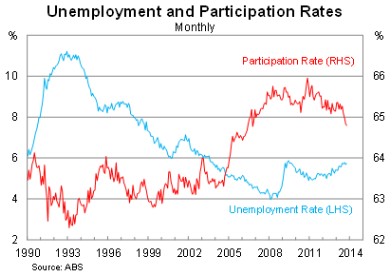
    Australia’s labour market participation rate has fallen sharply over the past few months and is now at its lowest level in seven years. But that pales by comparison with the expected decline resulting from ‘baby boomers’ retiring and the population ageing.

    The participation rate – the share of working age population in the workforce – is a key measure of labour market and economic health. Since peaking towards the end of 2010, the participation rate has declined by 1.2 percentage points to be at its lowest level since October 2006. Part of this is a reflection of weaker labour market conditions, transitional industries and a non-mining sector that could generously be characterised as subdued. But there is also a longer-term trend pushing the participation rate down: an ageing population…

    ScreenHunter_295 Nov. 15 14.03

    A lower participation rate affects most aspects of an economy, including growth, health care expenditure and government revenue. An economy’s output is a function of its resources (labour, capital, land, technology etc) and how those resources are utilised. An ageing population directly reduces the share of productive labour resources in the economy. It also reduces the tax base and GST revenues, given older Australians also consume a lower share of their income/wealth. Combined with rising health costs, the result is a government less able to provide the integral services that an ageing community requires…

    With the possible exception of climate change, the ageing population is the biggest economic challenge that the country faces over the next few decades. The best way to mitigate the problems of an ageing workforce is to increase the fertility rate, boost migration or raise the retirement age. But the reality is that Australians will have to accept lower growth, productivity and standard of living.

    I agree with everything that Pickering has said, except for the suggestion that increasing immigration will help mitigate the ageing conundrum. Immigration only helps to delay population ageing by pushing the problem onto future generations (whilst creating potential problems in other areas). Indeed, when the current batch of migrants inevitably grow old and retire, Australia will find itself in exactly the same position, with policy makers once again seeking to kick-the-can down the road via more immigration.

    Ultimately, the best way to alleviate pressures from an ageing population is to: 1) seek out policies that boost Australia’s productivity; and 2) expand labour force participation (e.g. by raising the retirement age). But even with concerted action in these areas, Australia’s employment-to-population ratio will continue to decline, lowering growth and living standards in the process.

    unconventionaleconomist@hotmail.com

  • Have your say before the 22nd of November

    Why this ad?
    Master’s in Project Mgmttua.edu.au/Project_Management – Online Degree With an Emphasis on Global Projects. Enrol Today!

    Have your say before the 22nd of November

    Inbox
    x
    Coal Terminal Action Group via email.nationbuilder.com
    2:26 PM (27 minutes ago)

    to me

    Coal Terminal Action Group

    The Preferred Project Report (PPR) for the proposed fourth coal terminal (T4) in Newcastle is open for public comment until the end of this week. Can you make a submission right now on the PPR on T4, it will only take a few minutes of your time and you can make a real difference!

    Have your say before the 22nd of November

     
    Port Waratah Coal Services have said there is no immediate need for another coal terminal in Newcastle, and yet they are pushing ahead to get Government approval for their controversial “T4” coal terminal. They have produced a ‘Preferred Project Report’ (PPR), which is supposed to respond to the submissions we all made about the air pollution, noise, biodiversity, traffic, and toxics impacts of the project.

    T4 will be reviewed by a Planning and Assessment Commission in coming months. We are urging community members and groups to participate actively in the PAC hearing.

    But before that, we need all our friends and supporters to make submissions on the PPR to the Department of Planning and Infrastructure to demonstrate why we are opposed to another coal terminal in our community and estuary!

    Closing date for submissions from the public is Friday, 22 November 2013.


    Here’s 10 good reasons to say ‘No’ to T4:

    [I object to this project and believe that the community health, environmental and socioeconomic impacts will have far outweighed any short-term benefits it is claimed it will deliver. These include:]

    1. Global warming: The burning of an additional 70Mt of coal a year will add 174.2Mt of carbon dioxide to the atmosphere. This is equal to 30% of Australia’s total annual GHG emissions. The International Energy Agency predicts that to limit global warming to under 2 degrees Celsius, global coal demand must peak in 2016, at least a year before PWCS indicates T4’s will begin operation.
    2. The Hunter Estuary supports 112 species of waterbirds and nationally and internationally listed threatened species, including the Australasian bittern (Botaurus poiciloptilus), listed as endangered under the Environment Protection and Biodiversity Conservation Act 1999 (EPBC Act).
    3. Deep and Swan Ponds: The Project will wipe out 80% of Deep Pond, which supports at least 11 species of migratory recorded and above the threshold of 0.1 per cent of the Australian flyway population for three migratory shorebird species, and will develop part of Swan Pond which supports three species in numbers that exceed the threshold of 0.1 per cent of the Australian flyway population.
    4. Misuse of public conservation lands: Swan Pond is public land, owned and managed by the National Parks Service under Part 11 of the NSW National Parks and Wildlife Act. It is part of a highly successful long-term restoration project, the Kooragang Wetland Rehabilitation Project (KWRP) and has been the site of significant hours of volunteer labour by the local bird watching club.
    5. Air quality: Newcastle and the Hunter Valley communities are impacted by dust from the mining, transport and stockpiling of coal. An additional 70Mt of coal exported will mean about an additional 7000 trips of 80 wagon trains between the Hunter mines and the port and back again per year, the capacity to export coal from an additional 8 to 10 mega mines and four new 1.5km coal stockpiles will substantially add to PM10 emissions in Newcastle and the Hunter Valley.
    6. Air quality modelling flaws: PWCS’s air quality modelling continues to use 2010 as a base year. NSW Health has suggested that PWCS should have included “a justification for assuming the PM10 levels in 2010 would be a realistic baseline for modelling future particulate levels or alternatively use, as a baseline, average levels over a longer period of time”.  This recommendation is ignored in the PPR.
    7. Particle pollution from rail transport: The PPR does not address air quality issues from rail transport returning to the Upper Hunter Valley. PWCS continues to focus on air quality impacts within 20m of the rail corridor, but there are almost 30,000 people living within 500m of the rail corridor and 23,000 students attend 16 schools in that vicinity. The submission to the EA by NSW Health noted that the contribution of coal dust from coal trains beyond 20m from the rail corridor needs to be carefully considered, but this recommendation is ignored.
    8. Justification for the project: There is no justification for the project. PWCS does not commit to building T4 and only suggests an indicative build date of 2015 with operation maybe in 2017.  During a major downturn in global coal demand, Newcastle’s approved coal export port capacity of 211Mt seems optimistic. Last year only 141Mt of coal was exported meaning 60Mt or 42 per cent of capacity was uninstalled.
    9. Employment:  The 120 Mt facility proposed in the EA identified no additional employment would result from its operation. The revised T4 project of 70Mt million of the RT/PPR is identified as employing 80 additional people. How is this possible? This dubious additional employment is not explained.
    10. Economics: PWCS’s claimed economic benefits to the region are based on a type of economic modelling the Australian Bureau of Statistics calls “biased” and the Productivity Commission says is regularly “abused”, usually to overstate the economic importance of specific projects. The original economic assessment of the T4 project suggests its annual operating costs will only be between $45-50 million a year.  Since that assessment was made, the size of the project has “almost halved”, so the amount of money it will “inject” into the economy has presumably declined considerably. For the terminal to achieve its economic potential, a lot more coal has to be dug up and exported. This means that a lot more bush and agricultural land needs to be turned into coal mines. A lot more coal trains need to pass through Newcastle’s suburbs. At the site of the proposal, a significant wetland would have to be destroyed.  And, of course, the extra coal being burned would contribute to climate change. None of these costs are considered in the economic assessment commissioned by PWCS. (Read Rod Campbell’s economic analysis here.)

    If you made a submission on the Environmental Assessment of T4, we encourage you to read the response to submissions and see if PWCS have addressed your concerns. We do not think they have addressed ours.

    Thank you for your continued support,
  • Griffith by-election 2014

    Griffith by-election 2014

    Likely by-election date
    With the vacancy arising barely five weeks before Christmas, it is not possible to have a by-election this year. Generally it is considered to be undesirable to hold a by-election during the summer holidays, so the by-election will likely take place in February or March 2014.

    Cause of by-election
    Former Prime Minister Kevin Rudd announced his resignation from Parliament and retirement from politics on Wednesday 13 November 2013, after losing power at the September 2013 federal election.

    Read the profile for the seat of Griffith at the 2013 federal election.

    Margin – ALP 3.0%

    Geography
    Southern Brisbane. Griffith covers the suburbs of Brisbane on the south side of the Brisbane river across the river from the Brisbane CBD, including South Brisbane itself, as well as Greenslopes, Holland Park, Kangaroo Point, East Brisbane, Coorparoo, Carina, Seven Hills, Morningside, Balmoral and Bulimba.

    History
    Griffith was created for the 1934 election, replacing the original seat of Oxley which was abolished at that election. Both Oxley and Griffith have been marginal seats, with Griffith swinging back and forth regularly between the Liberal Party and the ALP since 1949, although this has not usually coincided with national changes. The seat has become relatively safe for the ALP since it was won by Kevin Rudd in 1998.

    The seat was first won in 1934 by Labor MP Francis Baker, who had previously won the seat of Oxley off the United Australia Party, ironically at an election when the UAP swept away the federal Labor government.

    Baker was re-elected in 1937, but was killed in a car accident in 1939 at the age of 36. Ironically his father was elected to federal parliament in Maranoa in 1940, after his son’s term in Parliament.

    The 1939 Griffith by-election was won by Labor candidate William Conelan. Conelan held the seat until he lost Griffith to Liberal candidate Douglas Berry in 1949.

    Berry was re-elected in 1951 but lost to the ALP’s Wilfred Coutts. Coutts held on in 1955 but failed to win re-election in 1958, losing to the Liberal Party’s Arthur Chresby, and winning it back in 1961.

    Coutts lost the seat once again in 1966, when the seat was won by Liberal candidate Donald Cameron. Cameron held the seat for eleven years, moving to the new seat of Fadden in 1977. He held Fadden until his defeat in 1983, and returned to Parliament at the 1983 Moreton by-election, which he held until his retirement in 1990.

    The ALP regained Griffith in 1977, with Ben Humphreys winning the seat. Humphreys served as a minister in the Hawke/Keating government from 1987 until 1993, and retired at the 1996 election.

    The ALP preselected Kevin Rudd, but he lost to Graeme McDougall (LIB). McDougall only held on for one term, losing to Rudd in 1998. Rudd joined the ALP shadow ministry in 2001 as Shadow Minister for Foreign Affairs, a role he held for five years.

    Rudd’s profile rose as Shadow Foreign Minister, and he was considered a contender for the ALP leadership when Simon Crean resigned in 2003 and when Mark Latham resigned in 2005, but he waited until late 2006 when he challenged Kim Beazley, and was elected leader, and then proceeded to win the 2007 federal election, becoming Prime Minister.

    Kevin Rudd was removed as Labor leader and Prime Minister in June 2010, and was re-elected in Griffith as a Labor backbencher. He returned to the ministry as Foreign Minister following the election. He returned to the backbench as part of a failed challenge to Julia Gillard’s leadership in February 2012.

    Kevin Rudd defeated Julia Gillard to regain the Labor leadership in June 2013, and led the ALP to defeat at the 2013 federal election.

    Candidates
    Possible Labor candidates include local state MP Di Farmer, local councillor Shayne Sutton and lawyer Terri Butler. The Liberal National Party is expected to run former AMA President Bill Glasson, who ran for the seat in 2013. The Greens are again running 2013 candidate Geoff Ebbs.

    Assessment
    Governments, even new governments, don’t usually gain seats off an opposition.

    Kevin Rudd has always had a strong personal vote, and the loss of that vote could see Glasson gain even more ground in an area where he has a very high profile.

    It is quite easy to see a scenario where Labor loses, but the LNP may not perform as strongly in its new position in government.

    2013 result

    Candidate Party Votes % Swing
    Kevin Rudd ALP 36,481 42.22 +6.42
    Bill Glasson LNP 34,878 40.36 -3.72
    Geoff Ebbs GRN 8,799 10.18 -5.21
    Karin Hunter PUP 2,903 3.36 +3.36
    Greg Sowden IND 705 0.82 +0.82
    Adam Kertesz FF 643 0.74 -0.71
    Luke Murray KAP 595 0.69 +0.69
    Anne Reid SEC 445 0.51 +0.51
    Sherrilyn Church RUA 418 0.48 +0.48
    Liam Flenady SA 377 0.44 +0.44
    Jan McNicol SPP 165 0.19 +0.19

    2013 two-candidate-preferred result

    Candidate Party Votes % Swing
    Kevin Rudd ALP 45,805 53.01 -5.45
    Bill Glasson LNP 40,604 46.99 +5.45

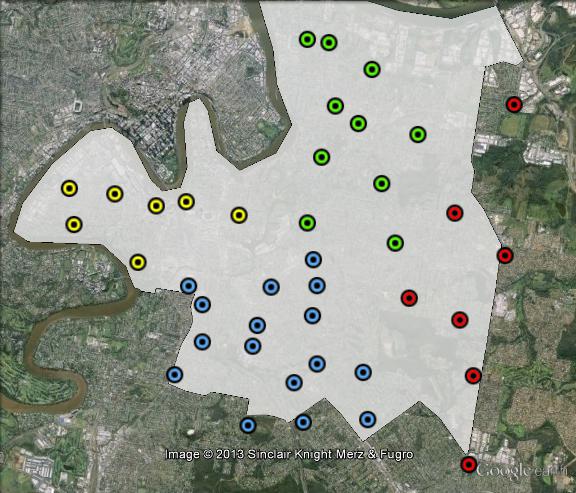
    Polling places in Griffith at the 2013 federal election. Bulimba in green, East in red, Greenslopes in blue, South Brisbane in yellow. Click to enlarge.

    Polling places in Griffith at the 2013 federal election. Bulimba in green, East in red, Greenslopes in blue, South Brisbane in yellow. Click to enlarge.

    Booth breakdown
    Booths have been divided into four areas. Bulimba in the north, Greenslopes in the south, South Brisbane in the west and a series of booths along the eastern boundary.

    The ALP won a majority in three areas, ranging from 54% in the east to just under 60% in South Brisbane. The LNP won a slim majority in Bulimba. The ALP suffered a swing in all four areas, ranging from 2.6% in South Brisbane to 6.6% in Bulimba.

    The Greens vote varies widely, from 6% in the east and 7% in Bulimba up to almost 17% in South Brisbane.

    Voter group GRN % ALP 2PP % ALP swing Total votes % of votes
    Bulimba 7.10 49.42 -6.63 19,116 22.12
    Greenslopes 10.15 54.85 -3.67 18,880 21.85
    South Brisbane 16.93 59.74 -2.62 12,686 14.68
    East 6.21 54.07 -4.28 7,772 8.99
    Other votes 10.35 50.87 -7.45 27,955 32.35

    Two-party-preferred votes in Griffith at the 2013 federal election.

    Two-party-preferred votes in Griffith at the 2013 federal election.

    Greens primary votes in Griffith at the 2013 federal election.

  • Ocean Acidification Summary for Policymakers 2013


    • Nov 14, 2013

      Expert assessment:

      Ocean acidification may increase 170% this century with substantial costs expect…

    • Urban air pollution:
      a new look at an old problem

      Large urban agglomerations inevitably lead to air pollution. But despite the significant impacts on human health and climate, we lack systematic measurements of air pollution in many cities. Megan L Melamed, Tong Zhu and Liisa Jalkanen discuss a new global assessment that illuminates the knowns and unknowns.

    • What to do while the water rises?

      Rising sea levels will eventually threaten many coastal cities. But a dominant focus on the long-term endgame should not unduly restrict our options to deal with the more immediate consequences of climate change, says Richard Little .

    Published: November 14, 2013

    Ocean Acidification Summary for Policymakers 2013

    This summary for policymakers reports on the state of scientific knowledge on ocean acidification, based on the latest research presented at The Third Symposium on the Ocean in a High-CO2 World, held in Monterey, California, in September 2012. Experts present the projected changes from ocean acidification for ecosystems and the people who rely on them, according to levels of confidence for these outcomes.

    Ocean Acidification Summary for Policymakers
    Third Symposium on the Ocean in a High-CO2 World

    Download the full pdf.

    A3 size high resolution jpg of pH infographic (4.7mb)

    A3 size high resolution jpg of Aragonite infographic (4.4mb)


    Download the summary here, as well as the infographics that illustrate the problems that ecosystems and humans face as ocean acidification increases over the next century. The summary addresses outcomes based on whether humans continue to emit carbon dioxide at current rates to the atmosphere, or what could happen if policymakers take action to mitigate these emissions.

    Ocean pH in 2100

    The average pH of ocean surface waters has fallen by about 0.1 units, from 8.2 to 8.1, since the beginning of the industrial revolution. This corresponds to a 26% increase in acidity. Please see original infographic for sources and further information.

    Ocean pH in 1850

    Compared with preindustrial levels shown here, the projected increase in ocean acidity is about 170% by 2100 if high CO2 emissions continue (RCP* 8.5).

    Atmospheric CO2 and ocean pH

    Observations of CO2 (parts per million) in the atmosphere and pH of surface seawater from Mauna Loa and Hawaii Ocean Time-series (HOT) Station Aloha, Hawaii, North Pacific.

    Credit: Adapted from Richard Feely (NOAA), Pieter Tans, NOAA/ESRL (www.esrl.noaa.gov/gmd/ccgg/trends) and Ralph Keeling, Scripps Institution of Oceanography (scrippsco2.ucsd.edu)

    Observed CO2 emissions and emissions scenarios to 2100

    Global CO2 emissions (white dots, uncertainty in grey) from fossil fuel use is following the high emissions trajectory (red line, RCP* 8.5) predicted to lead to a significantly warmer world. Large and sustained emissions reductions (blue line, RCP* 2.6) are required to increase the likelihood of remaining within the internationally agreed policy target of 2°C.

    Credit: Glen Peters and Robbie Andrew (CICERO) and the Global Carbon Project, adapted from Peters et al., 2013 (reference 8). Historic data from Carbon Dioxide Information Analysis Center.

    Ocean surface pH projections to 2100

    Modelled global sea-surface pH from 1870 to 2100. The blue line reflects estimated pH change resulting from very low CO2 emissions to the atmosphere (IPCC Representative Concentration Pathway, RCP* 2.6). The red line reflects pH from high CO2 emissions (the current emissions trajectory, RCP* 8.5).

    Credit: Adapted from Bopp et al., 2013 (reference 9).

    Aragonite saturation in 2100

    This map shows the “saturation state” for the mineral form of calcium carbonate called aragonite.

    If Ω is less than 1 (Ω<1), conditions are corrosive (undersaturated) for aragonite-based shells and skeletons. Coral growth benefits from Ω≥3.

    By 2100, computer model projections show that Ω will be less than 3 in surface waters around tropical reefs if CO2 emissions continue on the current trajectory.

    Aragonite saturation 1850-1860

    Aragonite saturation for surface ocean waters, at the beginning of the industrial revolution.


    • Global Change Magazine No. 81

      This issue’s cover story puts 2000 years of regional temperature histories into perspective. Also featured: two full-spread maps visualising the PAGES 2k regional temperature records and ocean acidifi…


    • Global Change Magazine No. 80

      The cover story in this issue explores the phenomenon of land grabs by taking a closer look at the Southeast Asian nation of Laos. Also featured are articles on resilience in the face of sea-level…

    RECOMMENDED