Author: Neville

  • New USGS Study on Chesapeake Bay: Groundwater Delaying the Effects of Some Water Quality Actions

    New USGS Study on Chesapeake Bay: Groundwater Delaying the Effects of Some Water Quality Actions
    Released: 11/12/2013 9:00:00 AM

    Contact Information:
    U.S. Department of the Interior, U.S. Geological Survey
    Office of Communications and Publishing
    12201 Sunrise Valley Dr, MS 119
    Reston, VA 20192
    Jon Campbell 1-click interview
    Phone: 703-648-4180

    Ward Sanford 1-click interview
    Phone: 703-648-5882

    New research by the U.S. Geological Survey conducted on the Delmarva Peninsula, which forms the Eastern Shore of the Chesapeake Bay, indicates it may take several decades for many water-quality management practices aimed at reducing nitrogen input to the Bay to achieve their full benefit due to the influence of groundwater.

    The USGS findings provide critical information on how long it may take to see the water quality in the Bay improve as more stringent practices are implemented to reduce nutrients and sediment to tidal waters.  Having established a calculation for the total nitrogen, phosphorus, and sediment pollutants that are allowable for the Chesapeake watershed, known as the total maximum daily load (TMDL), the U.S. Environmental Protection Agency (EPA) is working with Maryland, Pennsylvania, Virginia and the four other Bay watershed jurisdictions to ensure that all water-quality practices needed to reduce the flow of nutrients and sediment to the Bay are in place by 2025. 

    “This new understanding of how groundwater affects water-quality restoration in the Chesapeake Bay will help sharpen our focus as many agencies, organizations, and individuals work together to improve conditions for fish and wildlife,” said Lori Caramanian, Department of the Interior Deputy Assistant Secretary for Water and Science.  “In turn, improved environmental conditions will serve to further people’s enjoyment and promote the economic benefits of the Nation’s largest estuary.”

    The responses of watershed systems and ecosystems to environmental management actions at any location can vary from rapid changes (such as the swift beneficial effect of a wastewater treatment plant upgrade) to longer improvement intervals of several decades. In the Chesapeake Bay, “lag response time” refers to the time between implementing management actions and the resulting improvements in water quality. Lag times will vary for nitrogen, phosphorus, and sediment.

    This USGS study focused on nitrogen. Some of the nitrogen will run off directly into a stream, but a large portion on the Delmarva (more than two thirds) is affected by the slow travel times of nutrients moving from their land source through underground aquifers to a receiving stream or estuary.

    Sources of nitrogen include fertilizer and manure applications to agricultural land, wastewater and industrial discharges, runoff from urban areas, domestic septic drain fields, and air emissions. Excess nitrogen contributes to algal blooms that cause low dissolved oxygen in the Bay and related fish kills each summer and impact recreational activities.

    For this study USGS scientist Ward Sanford developed a complex model for water, geology, and chemical interactions that he applied to seven separate watersheds on the Delmarva Peninsula. Based on the concept of nitrogen mass-balance regression, the model was able to reproduce the time history of nitrate concentrations in area streams and wells, including a recent slowdown in the rate of concentration increase in streams. The model was then also used to forecast future nitrogen delivery from the Delmarva Peninsula to the Bay under different nitrogen management scenarios.

    The new study shows that ages of groundwater and associated nitrogen from the Delmarva Peninsula into the Chesapeake Bay range from less than a year to centuries, with median ages ranging from 20 to 40 years. These groundwater age distributions are markedly older than previously estimated for areas west and north of the Bay, which has a median age of 10 years. The older ages occur because the porous, sandy aquifers on the Delmarva yield longer groundwater return times than the fractured-rock areas of the Bay watershed.

    The USGS research found that in some areas of the Delmarva the groundwater currently discharging to streams is gradually transitioning to waters containing higher amounts of nitrate due to fertilizer used during the 1970s through the 1990s. Similarly, the total amount of nitrogen in the groundwater is continuing to rise as a result of the slow groundwater response times.

    Without additional management practices being implemented, the study forecasts about a 12% increase in nitrogen loads from the Delmarva to the Bay by 2050. The study provides several scenarios for reducing nitrogen to the water table and the amount of time needed to see the reductions in groundwater discharging to streams. For example, the model predicts that a 25% reduction in the nitrogen load to the water table will be required to have a 13% reduction in load to the bay.

    However, the results also indicate that nutrient management practices implemented over the past decade or so have begun to work and confirm that the amount of the nitrogen loading to streams in the future will depend on the rigor of water-quality practices implemented to reduce nutrients at present.

    This study highlights the complexities of environmental restoration of the Bay. The findings help refine the expectations of resource managers and citizens alike of how long it may take to see substantial water-quality improvements in the Bay, and they may provide additional insight into the effectiveness of different types of land management practices given the time lag created by local groundwater response times.

    The study was done as part of increased federal efforts under the President’s 2009 Chesapeake Executive Order, which directs Federal agencies, including the EPA and the Department of the Interior, to “begin a new era” in protection and restoration of the Chesapeake Bay. With a watershed that spreads across six states and Washington, DC, the Chesapeake Bay is the largest estuary in the United States and one of the largest and most biologically productive estuaries in the world.

    Learn more

    “Quantifying Groundwater’s Role in Delaying Improvements to Chesapeake Bay Water Quality,” Environmental Science & Technology

    USGS Chesapeake Bay Activities


    USGS provides science for a changing world. Visit USGS.gov, and follow us on Twitter @USGS and our other social media channels.
    Subscribe to our news releases via e-mail, RSS or Twitter.

    Links and contacts within this release are valid at the time of publication.

    ###
  • In the wake of the horror of Haiyan’s devastation, the Philippines government is desperately calling on the world to act urgently to help them now*

    On Thursday, 14 November 2013 2:21 AM, Iain Keith – Avaaz.org <avaaz@avaaz.org> wrote:
    Dear friends,

    Days after a climate induced typhoon devastated the Philippines, three countries are blocking progress on a deal that could stop global warming. The Philippines is desperately calling for urgent action, but Australia, Japan, and Poland are shamefully putting polluters profits before their responsibility to help stop superstorms. Let’s super-charge the Philippines call:

    In the wake of the horror of Haiyan’s devastation, the Philippines government is desperately calling on the world to act urgently to help them now* AND curb the next climate catastrophe. But shockingly three countries are blocking their heart wrenching appeal.

    Haiyan is a byproduct of climate change. Human pollution makes our planet hotter, the storms get more fierce, and the world’s poorest communities often suffer most. Right now a deal is being discussed to cut pollution and help finance vulnerable countries to meet this crisis. But three governments are obstructing negotiations and outrageously proposing to increase pollution: Australia, Japan, and Poland.

    Haiyan has built media and political pressure at the climate summit taking place right now. The Philippines’ delegate said ‘What my country is going through as a result of this extreme climate event is madness. The climate crisis is madness. We can stop this madness.’  Let’s build a million strong petition to back his call for urgent action. Sign now — let’s make sure these three countries put lives over polluters profits:

    http://www.avaaz.org/en/philippines_vs_polluters_1/?bBYMjdb&v=31036

    Haiyan is the latest in an alarming trend of freak weather events being driven by climate change. These events hit the poorest hardest because their communities are not set up to withstand them. But their scope is increasing and now richer countries like the US, Australia and some in the EU are feeling the brunt of a new climate reality.

    Tragically it has taken these disasters to kick life back into a stalling UN process to agree a climate deal. Governments have now agreed that 2015 is our last chance to get an agreement that can save our planet from a maelstrom of superstorms and disaster. The meeting this week in Warsaw is the most important global meeting this year to lay the groundwork for a deal. But Japan and Australia want to backtrack on their commitments to cut emissions, and Poland is blocking Europe’s ambitions.
    If, even in the wake of Haiyan, these countries do the opposite of what the world needs — our chances of success are grim. We’re in a 2 year race to save the world. Haiyan has given us a powerful reminder of what’s at stake. Let’s get behind the Philipines and stop the madness of Australia, Japan and Poland. Sign the petition now:

    http://www.avaaz.org/en/philippines_vs_polluters_1/?bBYMjdb&v=31036

    With more than 29 million members around the world — Avaaz is in a unique position to get behind the Filipino government and deliver a strong wake-up call to the negotiators in Warsaw. Together, we have influenced international summits, world leaders and our parliaments to get firm action on climate change — now out of the tragedy of Haiyan let’s demand countries start doing more.

    With hope,

    Iain, Alice, Pascal, Luis, Caroline and the entire Avaaz team

    PS: There are many ways to support the relief efforts for the victims of Cyclone Haiyan. Check out 350.org’s list of organisations: http://stories.350.org/donate-to-help-victims-of-typhoon-haiyan/?akid=3777.109376.nH0GMi&rd=1&t=1

    Sources:

    In hard-hit Tacloban, children ripped from arms (CNN)
    http://edition.cnn.com/2013/11/09/world/asia/philippines-tacloban/index.html

    Typhoon Haiyan: what really alarms Filipinos is the rich world ignoring climate change (The Guardian)
    http://www.theguardian.com/commentisfree/2013/nov/08/typhoon-haiyan-rich-ignore-climate-change

    Typhoon Haiyan influenced by climate change, scientists say (Sydney Morning Herald)
    http://www.smh.com.au/environment/climate-change/typhoon-haiyan-influenced-by-climate-change-scientists-say-20131111-2xb35.html

    Typhoon Haiyan: Philippines destruction ‘absolute bedlam’ (BBC)
    http://www.bbc.co.uk/news/world-asia-24894529

    Deadly Typhoon Haiyan Devastates the Philippines, Heads for Vietnam (TIME)
    http://world.time.com/2013/11/10/deadly-typhoon-haiyan-devastates-the-philippines-heads-for-vietnam/


    Avaaz.org is a 28-million-person global campaign network
    that works to ensure that the views and values of the world’s people shape global decision-making. (“Avaaz” means “voice” or “song” in many languages.) Avaaz members live in every nation of the world; our team is spread across 18 countries on 6 continents and operates in 17 languages. Learn about some of Avaaz’s biggest campaigns here, or follow us on Facebook or Twitter.

    You are getting this message because you signed “Join Avaaz!” on 2012-06-22 using the email address ngarthurslea@yahoo.com.au.
    To ensure that Avaaz messages reach your inbox, please add avaaz@avaaz.org to your address book. To change your email address, language settings, or other personal information, contact us, or simply go here to unsubscribe.

    To contact Avaaz, please do not reply to this email. Instead, write to us at www.avaaz.org/en/contact or call us at +1-888-922-8229 (US).

  • Seven takeaways for Warsaw climate talks from new IEA report

    Seven takeaways for Warsaw climate talks from new IEA report

    By on 14 November 2013
    Print Friendly

    The Equation

    There’s a distinct lack of optimism here at the Warsaw climate meeting. A recent report from UNEP shows that we are falling far short of the emissions reductions necessary to limit the global temperature increase to no more than 2°C above pre-industrial levels. The IPCC working group 1 report points out the grave implications of our rising carbon emissions. But, like the previous reports, IEA’s World Energy Outlook released Monday shows that, despite the grim emissions trends, we do still have choices: yes, we can cut our emissions sharply and, yes, that means making serious policy decisions now.

    Seven Takeaways from the IEA report

    Here are seven important takeaways from the IEA report relevant for the climate negotiations:

    1. What happens in the energy sector is crucial to our climate future. The sector is responsible for two-thirds of global warming emissions currently, and without significant policy action annual energy-related CO2 emissions will rise by 20% to 37.2 gigatonnes (Gt) by 2035, meaning that we would be headed for a long-term average temperature increase of 3.6 °C.
    2. Policy decisions that countries make right now can make a tremendous difference in how much more carbon we emit. This includes support for renewable energy and energy efficiency and removal of subsidies to fossil fuel producers.
    3. The energy sector is in tremendous flux globally with a lot of new capacity (mainly in China and India) and replacement capacity (mainly as old power plants are retired in the U.S. and Europe) being added. This creates an opportunity to make low carbon choices; taking full advantage of that opportunity is critical to meeting climate goals.
    4. Natural gas use will likely expand globally under a business as usual scenario. (But, as a recent UCS report points out, an overreliance on natural gas comes with significant climate risks.)
    5. The IEA says that under a business as usual scenario, renewable energy will grow significantly, from 20% of electricity generation in 2011 to 31% in 2035, approaching coal as a leading source of power. But this would still mean growing emissions from the power sector (an increase of between 13 to 15 Gt in that timeframe), leaving its share constant at about 40% of global emissions. NREL’s recent 80% by 2050 renewable energy report and the IPCC special report on renewable energy shows we can be much more aggressive in cost-effective renewables deployment both in the U.S. and globally.
    6. The power sector has several affordable low-carbon alternatives available already, including wind and solar energy, and electricity demand is growing rapidly. Therefore policies that encourage renewable electricity and energy efficiency are particularly vital to bending the emissions curve globally.
    7. Globally, nearly 1.3 billion people still lack access to electricity and 2.6 billion still depend on traditional biomass for energy (with grave health and pollution consequences). Global climate talks have to address this fundamental inequity, even as they negotiate a pathway to lower global emissions.

    Opportunities for the U.S.

    Here in the U.S. we have an incredible opportunity to make deep cuts in our power sector emissions. Uneconomic coal-fired power plants are being retired at record levels and renewable energy costs are declining sharply every year. There’s no doubt we can capitalize on this momentum through strong policies, including power plant carbon standards, renewable electricity standards and soon, one hopes, through a national price on carbon. Putting a strong target for emissions reductions on the table shouldn’t be a stretch for the U.S. And that would have a very significant effect on raising the level of ambition of a global climate agreement.

    A chance to snatch opportunity in the face of despair

    “Setting expectations” is a game everyone seems to play at the UNFCCC climate talks. No one wants to seem naïve about what’s possible here at Warsaw. After all, we are in the coal capital of Europe at a conference backed by fossil-heavy corporate sponsors. And bizarrely the Polish government has chosen to have the International Coal and Climate Summit simultaneously in Warsaw during the UNFCCC meeting. (Seriously, you couldn’t make this stuff up!)

    But yesterday we all had a moment of heart-wrenching clarity. As Yeb Saño, the lead negotiator from the Philippines, so powerfully reminded us: “If not us, then who? If not now, then when? If not in Warsaw ,Where?

  • Will Australia cause a slip on the climate change stepping stones in Warsaw?

    Will Australia cause a slip on the climate change stepping stones in Warsaw?

    United Nations climate talks aim to make ground on a new global deal as Australia’s rhetoric turns negative
    Stepping stones across a river after heavy rain<br />

    Stepping stones across a river after heavy rain Photograph: Steve Bentley/Alamy

    The United Nations climate change negotiations taking place in Warsaw have been trivially described as a “stepping stone” towards the next big global deal to cut emissions which, some hope, will be greeted with a giant rubber stamp in Paris in 2015.

    But stepping stones can be slippery buggers – a careless stride, a bad choice of footwear or a shove from a mischievous co-traveller and you’re in the rushing rapids either to sink without trace or to desperately grab for the nearest immoveable object.

    And so it is with the Warsaw talks. Unless the stepping stones are carefully negotiated then the risk of Paris turning into some kind of “Copenhagen II: Failure Strikes Back” will look increasingly likely.

    But as Australia joins the 190-plus other countries navigating the climate stepping stones, it’s hard to know whether the Aussies are wearing rubber thongs (those are flip-flops to foreigners) or appropriately stout walking boots. Australia may even be readying its elbows to nudge a few people off balance.

    Prime Minister Tony Abbott has decided his government will not be sending any ministers to Poland’s capital, leaving the job of negotiating instead to a diplomat – the experienced Justin Lee, the country’s climate change ambassador.

    Many have seen the decision as a reflection of the Abbott Government’s antipathy towards genuine climate change action. Reports suggest that Abbott has also ruled out Australian support  to financially compensate poorer countries for the climate change impacts.

    Question marks on climate policy

    Back in Canberra, the future for domestic climate change and renewable energy policy has got more question marks over it than the Riddler’s wardrobe collection.

    The chief reason for Australia’s politician-free delegation, is that Mr Abbott’s cabinet, including his Environment Minister Greg Hunt, are busy trying to push through laws to repeal the country’s carbon price legislation and replace it with a “direct action plan”.

    Instead of charging the polluters such as coal-fired power generators a market-set price for their emissions and then spending that money on tax cuts and clean energy funding, “direct action” will spend $3.2 billion from taxpayer funds on projects that will help lower emissions.

    The Abbott Government says it is confident the policy will deliver its promised cut of five per cent on Australia’s emissions by 2020 (from the 2000 baseline), but two studies have suggested a few billion more would need to be spent.  Mr Abbott says no more money will be spent, which means the emissions promise will slide.

    Climate Action Tracker – a team of scientists and analysts who monitor the impacts of policies on emissions and global warming – reported yesterday from Warsaw that the Abbott Government’s plans would see Australia’s emissions rise by 12 per cent by 2020.

    This, the report said, was “consistent with a global pathway heading to temperature rises of 3.5 – 4C”. The report doesn’t count Australia’s greatest contribution to the climate problem – all the coal and gas which it drills, mines and exports – but then neither does the government.

    As I discussed on Planet Oz a few days ago, just two recently approved coal mines in Queensland will emit 3.7 billion tonnes of CO2-e over their proposed 30-year life spans – the equivalent of six years worth of the United Kingdom’s greenhouse gas footprint.

    Since being elected in September, the Abbott Government has also defunded its independent Climate Commission (which has re-emerged as the not-for-profit Climate Council), scrubbed the climate change department and slashed about $700 million from an agency to fund renewable energy research, development and deployment.

    Mr Abbott has also backed away from more ambitious targets in the future “in the absence of very serious like binding commitments from other countries” which, in reality, is practically the same position taken by the previous government.

    In signing the Copenhagen Accord, Australia also stands with 140 other countries in agreeing that global warming should be kept below 2C, even though current pledges make achieving this goal unlikely.

    Last December, Australia announced it had signed up for the second commitment period of the Kyoto Protocol where the five per cent cut sits alongside pledges from the rest of the world.  This second stage started in January and will end in 2020, and commits Australia to cutting emissions to 99.5 per cent from their levels in 1990 (consistent with a five per cent cut with a baseline set at 2000).

    This is a target which a review from the country’s Climate Change Authority, tasked by the previous government to advise on targets, described as “not credible”. The CCA will soon be abolished. Yet even this “not credible” target looks credible compared to the remarkable target Australia managed to squeeze from the first incarnation of the Kyoto Protocol.

    Back in 1997, Australia’s delegation pulled what they saw as a masterstroke during post-midnight negotiations on the final day in Japan. Australia insisted on the inclusion of what later became known as the “Australia clause” – a clause which allowed countries with high emissions from land clearing to include those in their greenhouse gas accounts for the year 1990.

    This was significant because 1990 was the baseline year for calculating emissions targets. The Australian delegation knew that the country’s emissions from land clearing dropped dramatically post-1990. This meant that reaching the agreed target of “cutting” emissions by 108% by 2008 to 2012 was, in effect, effortless.

    Shadow environment minister at the time, Duncan Kerr, reportedly compared the “challenge” for Australia as being like a “three inch putt” in golf.

    Warsaw’s key aims

    But back to Warsaw (where I’ll be next week), where the main objective will be to set negotiations rolling towards a new agreement to be signed in 2015 and to take effect in 2020 when Kyoto runs out.

    Countries won’t be asked to lay down targets in Poland (this could come at a meeting of world leaders called by UN Secretary-General Ban Ki-moon for next year) but negotiators will look to develop a methodology that can be used to decide a fair way to calculate future cuts for individual countries.

    Alongside this, negotiators will also be looking to progress on a negotiating track known as “loss and damage” where developing countries (in particular small island states and countries such as the typhoon-ravaged Philippines) are compensated for climate change impacts.

    If recent reports are to be believed, poorer countries around the world will get little sympathy from Australia, one of the world’s biggest coal exporters and where per capita emissions are among the highest on the planet.

    Rhetoric sours on climate

    In a report in The Australian newspaper, the Abbott Government is said to have already decided that it will not contribute money to any “wealth transfer” proposals being discussed in Warsaw.

    Mr Abbott has described such measures as “socialism masquerading as environmentalism“. As for carbon markets, Mr Abbott says they area “a so-called market, in the non-delivery of an invisible substance to no one.”

    Mr Abbott also denies a quarter of a century of science showing the link between global warming and the increased risk of bushfire in Australia, as does his environment minister Greg Hunt.

    When Christiana Figueres, executive secretary of the UN Framework Convention on Climate Change, said there was a clear link between climate change and bush fires, Mr Abbott said she was “talking through her hat“.

    I’m sure that In Warsaw, this negative rhetoric is going down like a thong-wearing Australian crossing a wet algae-covered stepping stone in a cyclone.

  • World Scorns Australian Government For Abandoning Climate Agenda And Cutting Funds For Renewables

    The Untold Story Of The Dangerous New Experiment Coal Companies Want To Bring To America

    The Untold Story Of The Dangerous New Experiment Coal Companies Want To Bring To America

    TransCanada Has Already Had To Fix 125 Dents And Sags In Southern Keystone Pipeline

    TransCanada Has Already Had To Fix 125 Dents And Sags In Southern Keystone Pipeline

    National Geographic Maps Our Coastline After We Melt All Earth's Ice

    National Geographic Maps Our Coastline After We Melt All Earth’s Ice

    World Scorns Australian Government For Abandoning Climate Agenda And Cutting Funds For Renewables

    By Ari Phillips on November 13, 2013 at 2:40 pm

    Australian Prime Minister Tony Abbott. Australian Prime Minister Tony Abbott.CREDIT: Associated Press
    In Australia, temperatures are on track for the hottest year on record. But observing the government’s recent actions and rhetoric on climate change gives another impression entirely.

    Tony Abbott, the staunchly conservative Prime Minister, had an anti-climate agenda throughout his campaign over the summer. Since being elected in early September he has shown every indicator of following through with vows to scrap the country’s hard-won carbon emissions scheme. Then last week he seemingly shunned the UN climate talks, COP19 in Warsaw, by opting not to send a senior elected member of his government — a move that appears purely domestically motivated with little regard for the dire need of international cooperation in confronting climate change.

    Delegates felt similarly about Abbott’s decision, and when Australia further revealed that it would not be putting any new finance commitments towards action on climate mitigation and adaptation programs in third world and developing countries, the country was duly awarded the conference’s very first Fossil of the Day award. The award signifies Australia’s seeming lack of understanding and sense of purpose around the climate talks. The decision was especially salient in the wake of the current tragedy unfolding in the Philippines after the devastating and record-breaking Super Typhoon Haiyan and emotional plea for action on climate change from Philippine representative Naderev “Yeb” Saño at the COP19.

    This week Abbott continued his anti-climate crusade back home by abandoning Australia’s long-held emissions reduction target, taking further steps toward repealing the carbon emissions trading scheme, and even slashing funding for renewable energy.

    Speaking on Wednesday evening, after introducing eight bills that attempt to dismantle the carbon emissions scheme, Abbott confirmed that his government had no intention of reducing Australia’s emissions by more than five percent below 2000 levels by 2020.

    “We accept that climate change happens, that mankind, humanity, makes a contribution to it and it’s important that we take strong and effective action against it,” Abbott said. “This government has made no commitments to go further than that [five percent] and we certainly want to get emissions down as far as we reasonably can. But we are certainly in no way looking to make further binding commitments in the absence of very serious like-binding commitments in other countries and there’s no evidence of that.”

    A recent report by the Climate Change Authority — the independent advisory body set up by the former Labor government — found that the Abbott-led Coalition’s own agreed conditions for a tougher emissions target have been met and that the five percent target will leave Australia facing a near-impossible emissions reduction task after 2020.

    In response to Abbott’s recent moves, John Connor, CEO at the Climate Institute in Australia, said “Other countries aren’t waiting for binding international commitments to reduce pollution and invest in low carbon technologies — they are moving forward on their own accord. Australia has made international commitments to act in light with action of other countries. But our current action, and even five percent reductions, is inadequate when compared to countries like the US and China.”

    Along with emissions reductions targets, renewable energy funding is also getting cut. The details of the Abbott government’s carbon tax repeal legislation revealed that funding for Australia’s AU$3 billion renewable energy agency will be cut by AU$435 million, a nearly 15 percent reduction.

    The Australian Renewable Energy Agency (ARENA), from which the cuts will come, was set up to fund renewable energy projects and research. According to RenewEconomy, while the funding for this year is maintained, the funding for the next two years is barely one fifth of what is was originally meant to be.

    The Clean Energy Council believes that deprivation of funds will hurt both the development of key technologies such as large-scale solar as well as emerging technologies such as solar thermal, marine energy, geothermal, and energy storage.

    “The proposed changes to ARENA’s funding would mean that many renewable energy companies will consider moving off-shore where support for renewable energy innovation is both stronger and more stable,” deputy CEO Kane Thornton said in a statement.

    The Abbott government favors a “direct action” plan over the current carbon emissions scheme, or carbon tax. Direct action includes an incentive fund to pay companies to increase energy efficiency along with other measures such as planting trees.

    John Grimes, Chief Executive of the Australian Solar Council, told Solar Novus Today that he thinks the work that ARENA does is an excellent example of Direct Action.

    “The solar industry takes the government at its word when it says it is committed to tackling climate change and supporting the renewable energy industry in Australia but so far we have only seen one half of the equation — the cuts. Where are the government’s positive policies for direct action on climate change?” Grimes said.

    While most countries observe the Australian government’s recent anti-climate agenda and posturing both domestically and internationally with dismay, the Canadian government, led by Conservative PM Stephen Harper, applauded Abbott’s move to axe the carbon tax.

    Like Abbott, Harper has secured power by catering to fossil-fuel interests and resisting any action the could potentially harm industry growth by limiting emissions in an effort to confront climate change.

    “Canada applauds the decision by Prime Minister Abbott to introduce legislation to repeal Australia’s carbon tax,” Paul Calandra, Parliamentary Secretary to Harper, said in a statement. “The Australian Prime Minister’s decision will be noticed around the world and sends an important message.”

  • Global Warming Since 1997 Underestimated by Half

    RealClimate logo


    Technical Note: We have changed the contact email for the blog to reduce the amount of unsolicited email. If you want to contact us at the blog, please use contact-at-realclimate.org.

    Global Warming Since 1997 Underestimated by Half

    Filed under:

    — stefan @ 13 November 2013

    A new study by British and Canadian researchers shows that the global temperature rise of the past 15 years has been greatly underestimated. The reason is the data gaps in the weather station network, especially in the Arctic. If you fill these data gaps using satellite measurements, the warming trend is more than doubled in the widely used HadCRUT4 data, and the much-discussed “warming pause” has virtually disappeared.

    Obtaining the globally averaged temperature from weather station data has a well-known problem: there are some gaps in the data, especially in the polar regions and in parts of Africa. As long as the regions not covered warm up like the rest of the world, that does not change the global temperature curve.

    But errors in global temperature trends arise if these areas evolve differently from the global mean. That’s been the case over the last 15 years in the Arctic, which has warmed exceptionally fast, as shown by satellite and reanalysis data and by the massive sea ice loss there. This problem was analysed for the first time by Rasmus in 2008 at RealClimate, and it was later confirmed by other authors in the scientific literature.

    The “Arctic hole” is the main reason for the difference between the NASA GISS data and the other two data sets of near-surface temperature, HadCRUT and NOAA. I have always preferred the GISS data because NASA fills the data gaps by interpolation from the edges, which is certainly better than not filling them at all.

    A new gap filler

    Now Kevin Cowtan (University of York) and Robert Way (University of Ottawa) have developed a new method to fill the data gaps using satellite data.

    It sounds obvious and simple, but it’s not. Firstly, the satellites cannot measure the near-surface temperatures but only those overhead at a certain altitude range in the troposphere. And secondly, there are a few question marks about the long-term stability of these measurements (temporal drift).

    Cowtan and Way circumvent both problems by using an established geostatistical interpolation method called kriging – but they do not apply it to the temperature data itself (which would be similar to what GISS does), but to the difference between satellite and ground data. So they produce a hybrid temperature field. This consists of the surface data where they exist. But in the data gaps, it consists of satellite data that have been converted to near-surface temperatures, where the difference between the two is determined by a kriging interpolation from the edges. As this is redone for each new month, a possible drift of the satellite data is no longer an issue.

    Prerequisite for success is, of course, that this difference is sufficiently smooth, i.e. has no strong small-scale structure. This can be tested on artificially generated data gaps, in places where one knows the actual surface temperature values but holds them back ​​in the calculation. Cowtan and Way perform extensive validation tests, which demonstrate that their hybrid method provides significantly better results than a normal interpolation on the surface data as done by GISS.

    The surprising result

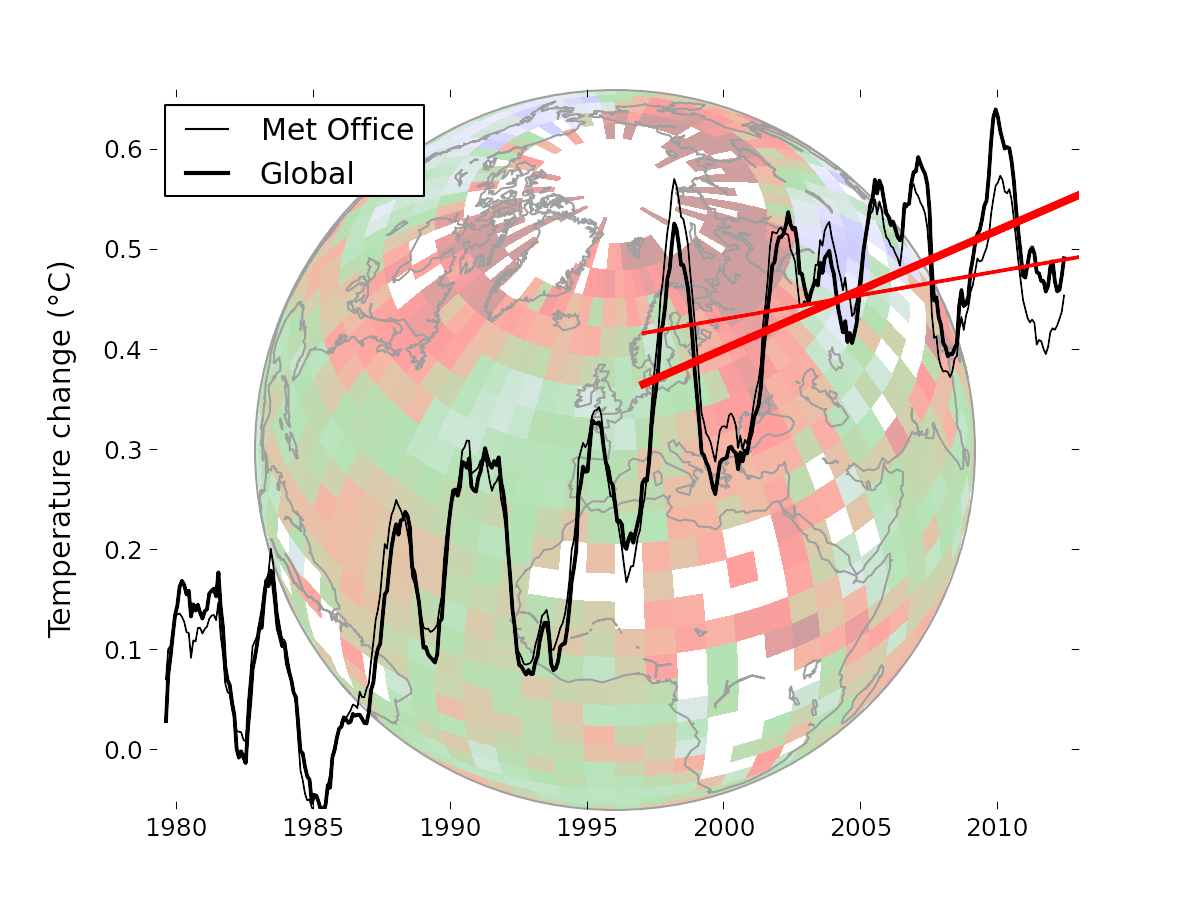
    Cowtan and Way apply their method to the HadCRUT4 data, which are state-of-the-art except for their treatment of data gaps. For 1997-2012 these data show a relatively small warming trend of only 0.05 °C per decade – which has often been misleadingly called a “warming pause”. The new IPCC report writes:

    Due to natural variability, trends based on short records are very sensitive to the beginning and end dates and do not in general reflect long-term climate trends. As one example, the rate of warming over the past 15 years (1998–2012; 0.05 [–0.05 to +0.15] °C per decade), which begins with a strong El Niño, is smaller than the rate calculated since 1951 (1951–2012; 0.12 [0.08 to 0.14] °C per decade).

    But after filling the data gaps this trend is 0.12 °C per decade and thus exactly equal to the long-term trend mentioned by the IPCC.

    Cowtan

    The corrected data (bold lines) are shown in the graph compared to the uncorrected ones (thin lines). The temperatures of the last three years have become a little warmer, the year 1998 a little cooler.

    The trend of 0.12 °C is at first surprising, because one would have perhaps expected that the trend after gap filling has a value close to the GISS data, i.e. 0.08 °C per decade. Cowtan and Way also investigated that difference. It is due to the fact that NASA has not yet implemented an improvement of sea surface temperature data which was introduced last year in the HadCRUT data (that was the transition from the HadSST2 the HadSST3 data – the details can be found e.g. here and here). The authors explain this in more detail in their extensive background material. Applying the correction of ocean temperatures to the NASA data, their trend becomes 0.10 °C per decade, very close to the new optimal reconstruction.

    Conclusion

    The authors write in their introduction:

    While short term trends are generally treated with a suitable level of caution by specialists in the field, they feature significantly in the public discourse on climate change.

    This is all too true. A media analysis has shown that at least in the U.S., about half of all reports about the new IPCC report mention the issue of a “warming pause”, even though it plays a very minor role in the conclusions of the IPCC. Often the tenor was that the alleged “pause” raises some doubts about global warming and the warnings of the IPCC. We knew about the study of Cowtan & Way for a long time, and in the face of such media reporting it is sometimes not easy for researchers to keep such information to themselves. But I respect the attitude of the authors to only go public with their results once they’ve been published in the scientific literature. This is a good principle that I have followed with my own work as well.

    The public debate about the alleged “warming pause” was misguided from the outset, because far too much was read into a cherry-picked short-term trend. Now this debate has become completely baseless, because the trend of the last 15 or 16 years is nothing unusual – even despite the record El Niño year at the beginning of the period. It is still a quarter less than the warming trend since 1980, which is 0.16 °C per decade. But that’s not surprising when one starts with an extreme El Niño and ends with persistent La Niña conditions, and is also running through a particularly deep and prolonged solar minimum in the second half. As we often said, all this is within the usual variability around the long-term global warming trend and no cause for excited over interpretation.