Author: Neville

  • Fire and climate change: don’t expect a smooth ride

    Posted: 21 Oct 2013 03:06 PM PDT

    By Roger Jones, Victoria University, via The Conversation
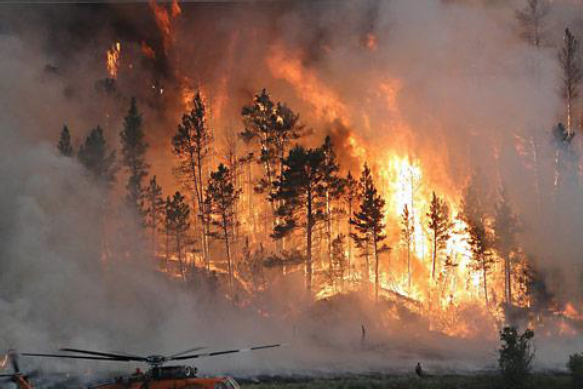
    With fires still burning across New South Wales, it’s time to have a look at the role climate change might have played. Are the conditions we’re seeing natural variation, or part of a long term trend?

    In fact, it doesn’t have to be one or the other.

    Has bushfire risk increased due to climate change?

    In research I did with colleagues earlier this year we looked at the Fire Danger Index calculated by the Bureau of Meteorology, and compared how it changed compared to temperature over time in Victoria.

    South-east Australia saw a temperature change of about 0.8C when we compared temperatures before 1996 and after 1997. We know that it got drier after 1997 too.
    We then compared this data to the Forest Fire Danger Index, to see if it showed the same pattern. We analysed fire data from nine stations in Victoria and did a non-linear analysis.

    We found that fire danger in Victoria increased by over a third after 1996, compared to 1972-1996. The current level of fire danger is equivalent to the worst case projected for 2050, from an earlier analysis for the Climate Institute.

    While it’s impossible to say categorically that the situation is the same in NSW, we know that these changes are generally applicable across south-east Australia. So it’s likely to be a similar case: fire and climate change are linked.

    What is “non-linear” change?

    Climate science has been playing with a paradigm that long-term changes are gradual, and that short-term changes are simply natural climate variability. But there’s another hypothesis that climate change and climate variability actually combine.

    When you analyse long historical time series of temperature, plus climate change from modelled data, it actually goes up like a staircase. The “El Niño of the century” we saw in 1997-98 was one of these steps in the staircase.

    It’s physically impossible for climate change to be entirely gradual, and for natural variability to act independently of that. That’s like saying that some of the heat in the atmosphere is climate change heat, and some is variability heat, and that they behave differently.

    This also relates to the so-called hiatus. This hiatus is normal, and what we’d expect from a climate that evolves in a non-linear manner.

    The models do predict these steps, even if some people claim they don’t. Model data shows periods up to 20 years when there is little or no increase in warming.

    What’s happened to temperature and rainfall in south east Australia?

    Temperature can also be analysed through step changes. Before and after 1996, maximum temperatures went up 0.8C. We can actually date the change to October 1996, when the El Niño started.

    Minimum temperatures have changed in a couple of periods. The first is the late 1960s early 1970s, then again in 1996-1997. In fact global temperatures went up in that period too, by about 0.3C at the same time.

    Rainfall decreased in south-east Australia, and this decrease continued until 2009-2010. Then we got a massive negative Indian Ocean Dipole and La Niña, resulting in record rainfall and flooding. In southern Victoria it’s been quite moist since, but north of the Great Dividing Range it’s dried out very quickly.

    These changes in rainfall and temperature are interrelated. It’s a combination of climate change and climate variability. The warming component, which is non-linear, is climate change.

    What about the weather?

    We can only blame weather conditions on climate change if they are part of a statistically significant pattern. If we see anomalously high temperatures – knowing that there is an anthropogenic component to temperature increases – then there’s definitely an anthropogenic warming component in that.

    Because the damages tend to be non-linear as well, it means the risk is magnified. So the anthropogenic component of the temperature increase magnifies the impacts or the severity of the impacts.

    Why are we so reluctant to talk about climate change?

    This isn’t my line, but someone said on Monday, “there’s never a good time to talk about gun control”.

    Of course when people are hurting and in strife you’ve got to be sensitive to their needs. But after these events we have to seriously think about how we’re going to manage them in the future.

    We can’t consider severe fires as one-offs that happen every few decades. If they’re becoming a systemic part of our environment we have to consider this really seriously.

    There will be a financial cost and a human cost, and we will see it repeated, if we don’t plan ahead. 

    Roger Jones is currently shortlisted and seeking funding from the Bushfire and Natural Hazards Cooperative Research Centre.
    The Conversation
    This article was originally published at The Conversation.

    You are subscribed to email updates from Climate Code Red
    To stop receiving these emails, you may unsubscribe now.
    Email delivery powered by Google
    Google Inc., 20 West Kinzie, Chicago IL US
  • Fiscal Meltdown MONBIOT

    Why this ad?
    Get 3 Solar QuotesSolar-Power-Australia.com.au – Compare 3 Solar Installers. Save Time & Money Now!

    Monbiot.com

    Inbox
    x
    George Monbiot news@monbiot.com via google.com
    6:22 PM (2 hours ago)

    to me

    Monbiot.com


    Fiscal Meltdown

    Posted: 21 Oct 2013 12:27 PM PDT

    The government is betting the farm on a nuclear technology that might soon look as hip as the traction engine.


    By George Monbiot, published in the Guardian 22nd October 2013

    Seven years ago, I collected all the available cost estimates for nuclear power. The US Nuclear Energy Institute suggested a penny a kilowatt hour(1). The Royal Academy of Engineering confidently predicted 2.3p(2). The British government announced that in 2020 the price would be between 3 and 4p(3). The New Economics Foundation guessed that it could be anywhere between 3.4 and 8.3p(4). 8.3 pence was so far beyond what anyone else forecast that I treated it as scarcely credible. It falls a penny short of the price now agreed by the British government(5).

    I still support nuclear power. I believe that to abandon our primary source of low carbon energy during a climate change crisis would be madness. It would mean replacing atomic plants with something much worse.

    We should, of course, cut our profligate demand for power as much as possible. But if transport and heating are to be powered by low-carbon electricity, total demand is likely to rise even with the most parsimonious use of energy(6).

    And we should make as much use as we can of renewables. But the biggest onshore wind schemes could supply only a fraction of the low carbon power a nuclear plant can produce. For example, the controversial deployment in mid-Wales would generate just one 14th of the proposed output of Hinkley C(7). Offshore wind has greater potential, but using it to displace most of our fossil fuel generation is a tough call, even when it’s balanced with a nuclear power baseload. Without that you would explore the limits of feasibility. If every square metre of roof and suitable wall in the UK were covered with solar panels, they would produce 9% of the energy currently provided by fossil fuels(8).

    The harsh reality is that less nuclear means more gas and coal. Coal burning produces, among other toxic emissions, heavy metals, acid sulphates and particulates, which cause a wide range of heart and lung diseases. Even before you take the impacts of climate change into account, coal is likely to kill more people every week than the Chernobyl disaster has killed since 1986(9). It astonishes me to see people fretting about continuing leaks at Fukushima, which present a tiny health risk even to the Japanese(10), while ignoring the carcinogenic pollutants being sprayed across our own country.

    But none of this means that we should accept nuclear power at any cost. And at Hinkley Point the cost is too high.

    Nils Pratley warned in the Guardian last week that “if Hinkley Point’s entire output is tied to the rate of inflation for 40 years, we could be staring at a truly astronomical cost by the end of the contract.”(11) The City analyst he consulted reassured him that “the government surely can’t be that dumb”. Oh yes? Payment to the operators, the government now tells us, will be “fully indexed to the Consumer Price Index.”(12) Guaranteed income for corporations, risk assumed by the taxpayer: this deal looks as bad as any private finance initiative contract(13).

    That’s not the only respect in which the price is too high. A fundamental principle of all development is that we should know how the story ends. In this case no one has the faintest idea. Cumbria – the only local authority which seemed prepared to accept a dump for the nuclear waste from past and future schemes – rejected the proposal in January(14). No one should commission a mess without a plan for clearing it up.

    But this above all is a wasted opportunity. By the time a European pressurised reactor at Hinkley Point is halfway through its operating life, it will look about as hip as a traction engine.

    I understand that, with a project this big and timeframes this long, the government needs to pick a technology, but you would expect it to try to pick a winner. The clunky third-generation power station chosen for Hinkley C already looks outdated, beside the promise of integral fast reactors and liquid fluoride thorium reactors. While other power stations are consuming nuclear waste, Hinkley will be producing it.

    An estimate endorsed by the chief scientific adviser at the government’s energy department suggests that, if integral fast reactors were deployed, the UK’s stockpile of nuclear waste could be used to generate enough low-carbon energy to meet all UK demand for 500 years(15). These reactors would keep recycling the waste until hardly any remained: solving three huge problems – energy supply, nuclear waste and climate change – at once(16). Thorium reactors use an element that’s already extracted in large quantities as an unwanted by-product of other mining industries. They recycle their own waste, leaving almost nothing behind(17).

    To build a plant at Hinkley Point which will still require uranium mining and still produce nuclear waste in 2063 is to commit to 20th-Century technologies through most of the 21st. In 2011 GE Hitachi offered to build a fast reactor to start generating electricity from waste plutonium and (unlike the Hinkley developers) to carry the cost if the project failed(18). I phoned the government on Monday morning to ask what happened to this proposal. I’m still waiting for an answer.

    That global race the prime minister keeps talking about? He plainly intends to lose.

    www.monbiot.com

    References:

    1. Nuclear Energy Institute, 3rd September 2003. Nuclear Power Plants Maintain Lowest Production Cost for Baseload Electricity. http://www.nei.org/News-Media/Media-Room/News-Releases/Nuclear-Power-Plants-Maintain-Lowest-Production-Co

    2. PB Power, March 2004. The Cost of Generating Electricity, page 13. The Royal Academy of Engineering, London. http://www.raeng.org.uk/news/publications/list/reports/cost_of_generating_electricity.pdf

    3. Performance and Innovation Unit, No 10 Downing Street, February 2002. The Energy Review, Annex 6. http://tna.europarchive.org/20080527124022/http:/www.cabinetoffice.gov.uk/strategy/work_areas/~/media/assets/www.cabinetoffice.gov.uk/strategy/theenergyreview%20pdf.ashx

    4. New Economics Foundation, 29th June 2005. Mirage and oasis: energy choices in an age of global warming. http://www.ecocivilization.info/sitebuildercontent/sitebuilderfiles/nefmirageoasis.pdf

    5. https://www.gov.uk/government/news/initial-agreement-reached-on-new-nuclear-power-station-at-hinkley

    6. http://www.zerocarbonbritain.com/

    7. The mid-Wales deployment, if fully realised, would have an installed capacity of  800MW, and a capacity factor of 26%. Hinkley C is a 3.2GW project, with a capacity factor of approximately 90%.

    8. http://www.theguardian.com/environment/georgemonbiot/2012/jan/13/green-deal

    9. http://nextbigfuture.com/2011/03/deaths-per-twh-by-energy-source.html#more

    10. http://www.who.int/ionizing_radiation/pub_meet/fukushima_risk_assessment_2013/en/index.html

    11. http://www.theguardian.com/business/blog/2013/oct/18/hinkley-point-nuclear-power-plant-consumer-bills

    12. https://www.gov.uk/government/news/initial-agreement-reached-on-new-nuclear-power-station-at-hinkley

    13. http://www.monbiot.com/category/privatisation/

    14. http://www.theguardian.com/environment/2013/jan/30/cumbria-rejects-underground-nuclear-storage

    15. http://www.theguardian.com/environment/2012/feb/02/nuclear-reactors-consume-radioactive-waste

    16. http://www.theguardian.com/commentisfree/2011/dec/05/sellafield-nuclear-energy-solution

    17. http://www.aps.org/units/fps/newsletters/201101/hargraves.cfm

    18. http://www.theguardian.com/commentisfree/2011/dec/05/

  • Christiana Figueres says the NSW fires prove the world is “already paying the price of carbon”.

    UN climate chief Christiana Figueres calls for global action amid NSW bushfires

    Updated 3 hours 10 minutes ago

    The United Nations says the New South Wales bushfires are an example of “the doom and gloom” the world may be facing without vigorous action on climate change.

    The executive secretary of the UN Framework Convention on Climate Change, Christiana Figueres, says the fires prove the world is “already paying the price of carbon”.

    “The World Meteorological Organisation has not established the direct link between this wildfire and climate change yet, but what is absolutely clear is that the science is telling us there are increasing heatwaves in Asia, Europe and Australia,” she told CNN.

    “These [heatwaves] will continue. They will continue in their intensity and in their frequency.”

    Her comments come after deputy Greens leader Adam Bandt was accused of politicising the bushfires, when he claimed the Government’s climate policies would lead to more fires in the future.

    Key points

    • UN Climate chief Christiana Figueres says bushfires will be more frequent if no climate action is taken
    • She says the fires are evidence that ‘we are already paying the price of carbon’
    • Greens MP Adam Bandt was accused of politicising the fires after linking them to climate change
    • Other climate scientists have backed Mr Bandt’s position
    • Ms Figueres has criticised the Coalition’s plan to repeal the carbon price


    “It’s October and we’re having a tragic bushfire,” he said last week.

    “Meanwhile, Tony Abbott and his ministers have been… saying that they’re going to take Australia backwards when it comes to combating global warming.”

    Mr Bandt’s remarks prompted a rebuke from Environment Minister Greg Hunt.

    “No one should be politicising these bushfires and I would say that respectfully to the gentleman in question,” he said.

    But several climate scientists have told the ABC’s 7.30 the link between global warming and bushfires has been established and it is time for action.


    The UN climate chief says footage from the fires should prompt international concern on climate.

    “What we have seen are just introductions to the doom and gloom that we could be facing,” Ms Figueres said.


    “But that’s not the only scenario. We could, as humankind, we could take vigorous action and we could have a very different scenario”

    Direct Action ‘could be much more expensive’

    Ms Figueres also criticised the Federal Government’s so-called Direct Action policy on climate change, saying it may prove more expensive than a carbon price.

    “What the new Government in Australia has not done is it has not stepped away from its international commitment on climate change, so what they’re struggling with now is not what are they going to do but how are they going to get there,” she said.


    The Government has vowed to scrap the carbon-pricing scheme and instead pursue a plan that involves a $3 billion emissions reduction fund.

    “They’re going to have to pay a very high political price and a very high financial price,” Ms Figueres said.

    “The route that they are choosing to get to the same target that the previous government had could be much more expensive for them and for the [Australian] population.”

    She says that the world has very little time to minimise the impact of climate change.

    “We are already paying the price of carbon. We’re paying the price with wildfires. We’re paying the price with droughts,” she told the network.

    “We’re paying the price with so many other disturbances to the hydrological cycle. That is all the price we’re paying.

    “So what we need to do is put a price on carbon so that we don’t have to continue to pay the price of carbon.”

    Ms Figueres says in order to effectively combat climate change, global emissions must peak this decade and then begin a downward trajectory.

  • : Response to Malcolm King’s Fortress Australia Article

    From: Hamilton, Tim (K. Thomson, MP) <Tim.Hamilton@aph.gov.au>
    Date: Tue, Oct 22, 2013 at 2:51 PM
    Subject: Response to Malcolm King’s Fortress Australia Article
    To: “Hamilton, Tim (K. Thomson, MP)” <Tim.Hamilton@aph.gov.au>
    Cc: “Cianflone, Anthony (K. Thomson, MP)” <Anthony.Cianflone@aph.gov.au>

    Dear All,


    Malcolm King’s article, Fortress Australia: green wasting the future, in the Sydney Morning Herald makes numerous spurious claims regarding population growth which Kelvin refutes in the following blog.


    http://kelvinthomson.blogspot.com.au/2013/10/malcolm-kings-fortress-australia-article.html


  • “State of the States” Misleading and Shallow

    Monday, October 21, 2013

    “State of the States” Misleading and Shallow

    We often talk about the numerous shortcomings of GDP as a performance indicator, and yet it continues to dominate our airwaves.

    Today the ABC and other media outlets are uncritically reporting a “State of the States” report by CommSec, which purports to rank the performance of the States. The ranking system rewards economic and population growth. As far as I can tell it does not include in its ranking criteria things like protection of habitat, how endangered species are faring, the gap between rich and poor, quality of education, quality of health services, and numerous other important indicators.
    I can’t see any reference to traffic congestion, housing affordability, or the cost of living pressures on older people arising from population growth. It is a pity such reports, which are shallow and misleading, receive such uncritical media acceptance.

    No comments:


    Post a Comment


    Subscribe to: Post Comments (Atom)
  • Live: Emergency warning issued as NSW braces for worse conditions

    Live: Emergency warning issued as NSW braces for worse conditions

    Updated 26 minutes ago

    A massive fire extending from Lithgow to west of Bilpin in the Blue Mountains is causing the most concern for firefighters in New South Wales this evening.

    As crews continue to battle the State Mine blaze, Premier Barry O’Farrell has declared a state of emergency in NSW due to the bushfire crisis.

    “We’re planning for the worst but hoping for the best,” Premier Barry O’Farrell said.

    This afternoon an emergency warning remains in place for residents of Bell, a village along the Bells Line of Road, and the Rural Fire Service (RFS) is advising people to evacuate their homes.

    Along that road, residents west of Bilpin are being advised to relocate. The RFS says if residents east of Bilpin are not prepared for the onset of fire, they should also leave.

    Residents of Bilpin itself are being advised to stay put but are being told they may not be able to leave for the next few days, as the village is expected to become isolated.

    People who live in Mount Wilson and Mount Irvine are advised to remain in place as fires are burning on roads in and out of the village, and the RFS says it is not safe to leave.

    Follow our live coverage of the fires:


    Topics: bushfire, fires, disasters-and-accidents, springwood-2777, nsw, australia, lithgow-2790, wyong-2259

    First posted Sun 20 Oct 2013, 6:16am AEDT