Monbiot.com

|
||||||||||||||
Author: Neville
-
The real threat to the national interest comes from the rich and powerful
-
Current-tracking drone subs to help improve climate predictions
Current-tracking drone subs to help improve climate predictions
14 October 2013 | By Stephen Harris

Underwater drones that can navigate ocean currents are to help British scientists improve climate change predictions as part of a newly funded project.
The UK’s Natural Environment Research Council (NERC) has announced funding for two projects in collaboration with the US to study the circulation of water in the Atlantic that keep Europe’s climate mild and how it could be affected by changing global temperatures.
One of the projects, known as OSNAP, involves mooring monitoring arrays that reach from the bottom to the surface of the ocean at key points across the northern Atlantic, and sending autonomous underwater gliders to gather data from in between.

Dr Sheldon Bacon of the National Oceanography Centre at Southampton University, who is leading the UK team for OSNAP, said this will help them better understand how geographical features of the seabed affect the currents that transfer heat across the Atlantic.
‘If we want models to represent these processes correctly so that we can have betters projection of future climate, if we want to understand regional details like how Britain is likely to be affected in coming decades, we have to understand these features that affect the decadal variability of the ocean,’ he told The Engineer.
The project’s gliders will spend up to four months at a time navigating the ocean currents, following a pre-planned route and surfacing around once a once a week to check its position, correct its course and transmit data back to base.
Each 150cm-long glider uses an external bladder filled and emptied with a reservoir of oil to change the device’s density, in order to sink to around 1km and then rise to the surface. As the glider moves up and down, its wings enable it to move forward at the same time.
The moored arrays will take measurements from the bottom of the ocean that can be used to calculate what happens along the flat part of the seabed. The gliders will navigate the warmer, upper currents in order to study how they are affected by topographical ridges and troughs.
The instruments are due to be deployed next summer and will be changed every one to two years until 2018. ‘These gliders have been around for a number of years but they’re only now becoming mature and reliable enough for long-term missions,’ said Bacon.
Western Europe has a relatively mild climate for a region so far north because of the so-called conveyor belt currents in the Atlantic that bring warm water at the top of the ocean from the tropics northwards.
As the water transfers heat to the atmosphere, it cools, becoming denser and saltier and sinking to the bottom of the ocean – a process known as overturning – where it returns southwards.
Researchers in the other NERC-funded project, known as RAPID, have been studying the conveyor belt between Florida and the Canary Islands using a series of moored arrays for a decade and the programme is now due to run for a further six years.
But in the part of the ocean between Britain and Canada, known as the North Atlantic Subpolar Gyre, the process is more complicated due to the wind-driven horizontal circulation of waters on the surface and the more complex seabed topography.
OSNAP (Overturning in the Subpolar North Atlantic Program) will enable researchers to study the relationship between the horizontal and vertical currents to build a better understanding of how the water returns to the southern Atlantic rather than just circulating in the north.
‘It turns out you get eddies spinning off at great depths and forming a pathway,’ said Bacon. ‘If we want models to represent these processes correctly so we can have a better projection of future climate, we have to understand these features that affect the decadal variability of the ocean.’
Total funding for the projects is worth £44m, supplied by NERC and the US’s National Science Foundation (NSF) and the National Oceanic and Atmospheric Administration (NOAA).
-
Graph of the Day: Climate science for beginners
Graph of the Day: Climate science for beginners
By Lindsay Wilson on 15 October 2013
Does it infuriate you when people conflate measurements of carbon and carbon dioxide? Do you know your ‘equilibrium climate sensitivity’ from your ‘transient climate response’? How about the relative importance of carbon dioxide, carbon monoxide and black carbon in terms of radiative forcing?
No? Join the club.
Very few people understand the nuts and bolts of climate science beyond the scientists themselves. And that is a real shame, because understanding climate change is important for everyone.
This post is an attempt to explain climate science to beginners. And when I say beginners I definitely include myself.
Where should you start?
The newly released summary for policy makers from the Intergovernmental Panel on Climate Change (IPCC) is the best place to read a 20 page summary of what we currently know about climate change. But if you can’t bear the 20 pages of bloodless text, this is a short guide that tries to explain how humans are warming the world. Written for humans.

The world’s atmosphere has warmed about 0.85°C between 1880 and 2012. The oceans are also warming, absorbing 90% of the increased energy stored in the climate system. Ice cover in the Artic, Antarctica and Greenland is declining. Sea levels are rising, the ocean is acidifying and atmospheric concentrations of greenhouse gases are rising.
These are the ‘fingerprints’ of climate change. The measurements that show us the world is changing. The ‘what’ if you will. Climate science is the effort to explain ‘why’ the world is warming, and what we can expect in the future. This is what we are going to try and explain here using three ideas: forcing, sensitivity and pathways.
1: What’s forcing the climate to change?
Climate scientists measure the drivers of climate change using a metric called ‘radiative forcing’. This quantifies the change in energy fluxes at the top of the atmosphere due to different climate drivers. Substances with a positive forcing, like carbon dioxide, are those warming the earth. Whereas substances with negative forcing, like sulphate aerosols, are those cooling the earth.
The new IPCC report estimates total human radiative forcing in 2011 relative to 1750 to be 2.29 watts per square metre (W m–2). The following waterfall chart is an attempt to explain, as simply as possible, what the drivers of climate change are in terms of radiative forcing.
 This charts shows the relative importance of different compounds in heating and cooling the earth since 1750.
Emissions of carbon dioxide have been responsible for over half of the warming influences to date. Methane, carbon monoxide, halo-carbons and nitrous oxide also have a significant warming influence. The major cooling influences are NOx gases, aerosols (like sulphates and organic carbon) and changes in land albedo (how shiny it is). The effect aerosols have on clouds also has a large cooling effect, though there is significant uncertainty in quantifying this.
To keep this graphic as digestible as possible I have limited it to primary emitted compounds and point estimates for each forcing. The complete picture is much more nuanced and includes the varying levels of certainty, confidence intervals, drivers that result from each compound and differing atmospheric residences. You can read all that fun stuff in the summary for policymakers.
2: How sensitive is the climate?
Now that we have an idea of what is driving climate change, it is time to discuss how much these ‘forcings’ will change the earth’s surface temperature. For that we’ll have to drop the S-bomb: ‘sensitivity’.
Sensitivity is how much we expect the world to warm for a given forcing, often defined as a doubling of atmospheric CO2 (4 W m–2). Using a mix of paleoclimate data, observations and computer models climate scientists estimate how sensitive the climate is to a given climate forcing.
If you ever find yourself discussing climate sensitivity in a pub, be sure to define it before you get too many drinks in. Because you don’t want to confuse transient climate response (decades), with equilibrium climate sensitivity (centuries) and earth system sensitivity (millennia).
To keep this explanation simple, we’ll just look at two types of sensitivity, equilibrium climate sensitivity (ECS) and transient climate response (TCR).
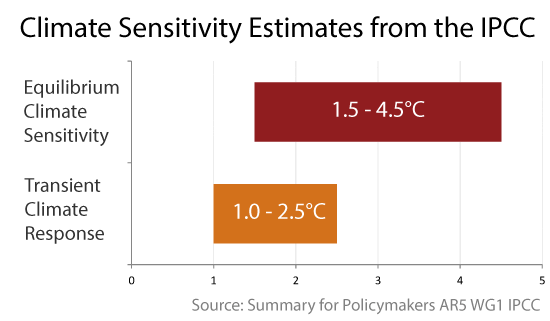 Equilibrium climate sensitivity is how much we would expect the world to warm if we doubled atmospheric CO2 and waited a few hundred years for the climate reach a new equilibrium. The IPCC’s latest estimate is:
likely in the range 1.5°C to 4.5°C
Transient climate response is the temperature we expect at the time carbon dioxide concentrations have doubled if they increase at 1% per year. The IPCC says it is:
likely in the range of 1.0°C to 2.5°C
If you are interested in looking at what is happening over the coming decades then TCR is more relevant. Whereas for discussions about climate stabilization targets ECS is the preferred metric.
A major reason for the difference between these two values is the slow speed with which heat absorbed by the oceans is eventually released to warm the atmosphere. The uncertainty for each involves things like the ocean mixing of heat, differences between surface and atmospheric warming, water vapor and cloud formation feedbacks.
For any estimate of climate sensitivity it is crucial to understand the time frame and which feedbacks are included.
3: Which pathway will we choose?
The world is going to warm this century, considerably. That is what the science tells us. But just how much it is going to warm is uncertain due to a number of things.
These uncertainties include the future path of emissions of greenhouse gases and aerosols, land and ocean sink function, ocean heat mixing and the extent of various feedbacks.
To give us an idea of what to expect this century the IPCC’s fifth assessment report uses what they called representative concentration pathways (RCP). Each of the four RCPs are named after their approximate total radiative forcing (W m–2) in 2100 relative to 1750. The four RCPs are 2.6, 4.0, 6.5 and 8.5 W m–2. Each of which are higher than the 2011 estimate of 2.29 W m–2 we saw earlier.
In simple terms these pathways range from rapid mitigation (RCP 2.6) to runaway emissions (RCP 8.5). Bringing together a wide ensemble of climate models that involve different forcing and sensitivity estimates the IPCC has given us an idea of how much it thinks the world could warm this century for each pathway.
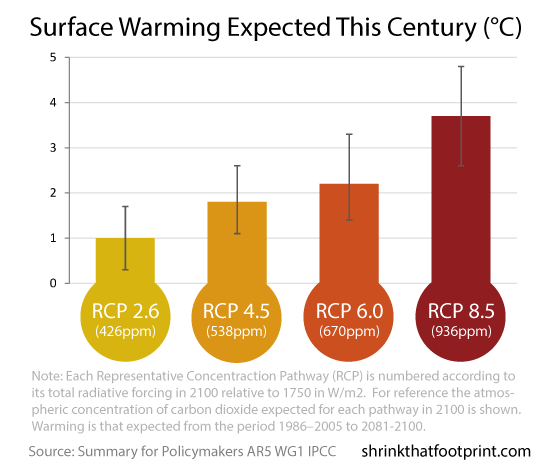 For the rapid mitigation pathway (RCP 2.6) the expected warming this century is 1.0°C (the likely range is shown in the bars).
For the fast stabilization pathway (RCP 4.5) they expect 1.8°C of warming.
For the slower stabilization pathway (RCP 4.5) the mean estimate is 2.2°C.
And for the runaway emissions scenario (RCP 8.5) it is 3.7°C.
This warming is on top of the 0.6°C observed up to the 1986-2005 reference period, so in every case but the rapid mitigation scenario (RCP 2.6) the temperature is expected to warm beyond 2°C above the pre-industrial period. It is also worth remembering these are surface averages, so areas over land and northern latitudes would likely fare far worse (See figure SPM.8).
So there you have it. Climate science works out what is ‘forcing’ the climate to change. Estimates how ‘sensitive’ the climate is to those changes. And models how much warming might occur under different emissions ‘pathways’.
Clear as mud? Time for that drink.
-
Kelvin Thompson’s speech to the Fenner Conference.
Hamilton, Tim (K. Thomson, MP)10:02 AM (1 minute ago)to TimDear All,
Please see attached Kelvin’s speech to the Fenner Conference on Population, Resources & Climate Change – implications for Australia’s near future.
Regards,
Tim Hamilton
Electorate Officer
Office of Kelvin Thomson
Federal Member for Wills
131011 Speech to the Fenner Conference.pdf
29K View Download -
India Must Rename Cyclone Phailin and Call Attention to Global Warming

Subhankar Banerjee
Founder, ClimateStoryTellers.org
GET UPDATES FROM Subhankar Banerjee16India Must Rename Cyclone Phailin and Call Attention to Global Warming
Posted: 10/11/2013 10:07 pmFollow Get Green Newsletters:
Last month I wrote two articles (here, here), gave an interview to The Real News Network (here), and an interview to Uprising Radio (here) about the devastating floods in Colorado. With Boulder as its epicenter, the floods damaged more than 2,000 squares miles along the Colorado Front Range–from Colorado Springs to Fort Collins. Ten people were killed, nearly 18,000 homes were damaged or destroyed, hundreds of miles of road were washed out, and thousands of oil and gas wells flooded resulting in environmental contamination from toxic fracking fluids and nearly 40,000 gallons of spilled oil. Boulder got nearly its annual average rainfall in just five days, and it happened at a wrong time–September, not July/August, when rain usually falls in the desert southwest.
My main contribution was to raise the noise level that the corporate media had failed miserably in its reporting of the Colorado floods. Not a single journalist had raised the question on corporate TV: Did global warming play a part in causing or intensifying the Colorado floods?
Bamboozled by the lure of technology, humans have become deeply amnesic. We forget a tragedy soon after the corporate media stops reporting on a particular catastrophe. In a globally warmed Earth, however, before amnesia sets in, the next assault arrives.
This morning I woke up to the news of super cyclone Phailin in the Bay of Bengal that will make landfall tomorrow in the east coast of India. “Odisha and Andhra Pradesh braced for the “very severe” cyclone that is expected to hit the east coast with winds gusting up to 220 kmph [136 mph] tomorrow evening, as lakhs [1 lakh=100,000] of people were being evacuated to safer places and the military kept on standby,” The Hindu reports.
I had lived in the American southwest for eleven years, and I was born and grew up in Bengal. So, the recent Colorado floods and the super cyclone in the Bay of Bengal are personal.
There are already many news articles on the India cyclone that you can read: The Hindu here, Times of India here, India Today here, BBC here, Washington Post here. I won’t go into the details; instead, I’ll focus on bringing attention to two things: naming and blaming.
Apparently Phailin was named by Thailand and it means sapphire in Thai. What nonsense. Some humans do desire the precious stone, but no one, I’d think, is desiring Phailin. India should rename this meaningless obfuscation and call attention to global warming immediately.
There was also some confusion about whether this is a ‘cyclone’ or a ‘super cyclone’. On Thursday the India Meteorological Department had “indicated that the wind speed would be limited to 185 kmph.” But now the forecast is at 220 kmph, and the US Navy has indicated that the “wind speed will be above 240 kmph.” So before the cyclone makes a landfall, it will turn into a deadly super cyclone–yet another example of extreme weather event.
The India Today has posted a very useful article “What is a super cyclone?” The article gives an excellent explanation of the 1999 Odisha super cyclone, also known as Cyclone 05B. “It struck the coast of Odisha with a height of [ocean water] 26 feet (8 meters). Approximately 275,000 homes were destroyed leaving 1.67 million people homeless. Another 19.5 million people were affected by the super cyclone to some degree. A total of 9,803 people officially died from the storm. Though it is believed that 15,000 people died,” the India Today reports. The article also mentions how the rescue operation proceeded. By placing this article in the context of the impending super cyclone in the exact same landscape, journalists in India are doing a better job than how the Colorado floods were reported last month. But it could be better, it needs to better, and make an explicit connection to global warming.
India Today explained: “Tropical cyclones typically form over large bodies of relatively warm water. They derive their energy from the evaporation of water from the ocean surface, which ultimately recondenses into clouds and rain when moist air rises and cools to saturation.” There is our clue–connection of the impending super cyclone with global warming. All the articles I have come across on the impending Bay of Bengal cyclone, however, avoided using the phrase–global warming.
The anthropogenic global warming caused by accumulation of greenhouse gases is making the oceans warmer, which in turn is causing more frequent and more intense cyclones/hurricanes and floods.
The UN IPCC Fifth Assessment Report’s (AR5) first part, the Summary for Policymakers (SPM), was released two weeks ago. More than a 1,000 scientists from all over the world contributed to the report, and the team worked for six years. The SPM was approved by 190 nations. All that means that the IPCC AR5 is a conservative estimate of global warming. The reality will likely be worse than what the IPCC is saying.
Having said all that, the IPCC reports states: “Ocean warming dominates the increase in energy stored in the climate system, accounting for more than 90% of the energy accumulated between 1971 and 2010 (high confidence). It is virtually certain that the upper ocean (0−700 m) warmed from 1971 to 2010…”
India-based Dr. Rajendra Pachauri has been, since 2002, the chairperson of IPCC, which was awarded the Nobel Peace Prize in 2007. I’d urge Dr. Pachauri to go on TV and explain the anthropogenic warming of oceans and its relevance to the impending super cyclone in the Bay of Bengal that will undoubtedly bring massive deaths–humans and nonhuman species–and devastation.
India must rename Phailin and connect the impending super cyclone to global warming.
Subhankar Banerjee’s most recent book Arctic Voices: Resistance at the Tipping Point will be published in paperback on October 22, 2013 (Seven Stories Press).
-
Northern China is running out of water, but the government’s remedies are potentially disastrous
Northern China is running out of water, but the government’s remedies are potentially disastrous
CHINA endures choking smog, mass destruction of habitats and food poisoned with heavy metals. But ask an environmentalist what is the country’s biggest problem, and the answer is always the same. “Water is the worst,” says Wang Tao, of the Carnegie-Tsinghua Centre in Beijing, “because of its scarcity, and because of its pollution.” “Water,” agrees Pan Jiahua, of the Chinese Academy of Social Sciences. “People can’t survive in a desert.” Wang Shucheng, a former water minister, once said: “To fight for every drop of water or die: that is the challenge facing China.”
He was not exaggerating. A stock image of China is a fisherman and his cormorant on a placid lake. The reality is different. The country uses 600 billion cubic metres (21,200 billion cubic feet) of water a year, or about 400 cubic metres a person—one-quarter of what the average American uses and less than half the international definition of water stress.
The national average hides an even more alarming regional disparity. Four-fifths of China’s water is in the south, notably the Yangzi river basin. Half the people and two-thirds of the farmland are in the north, including the Yellow River basin. Beijing has the sort of water scarcity usually associated with Saudi Arabia: just 100 cubic metres per person a year. The water table under the capital has dropped by 300 metres (nearly 1,000 feet) since the 1970s.
China is using up water at an unsustainable rate. Thanks to overuse, rivers simply disappear. The number of rivers with significant catchment areas has fallen from more than 50,000 in the 1950s to 23,000 now. As if that were not bad enough, China is polluting what little water it has left. The Yellow River is often called the cradle of Chinese civilisation. In 2007 the Yellow River Conservancy Commission, a government agency, surveyed 13,000 kilometres (8,000 miles) of the river and its tributaries and concluded that a third of the water is unfit even for agriculture. Four thousand petrochemical plants are built on its banks.
The water available for use is thus atrocious. Song Lanhe, chief engineer for urban water-quality monitoring at the housing ministry, says only half the water sources in cities are safe to drink. More than half the groundwater in the north China plain, according to the land ministry, cannot be used for industry, while seven-tenths is unfit for human contact, ie, even for washing. In late 2012 the Chinese media claimed that 300 corpses were found floating in the Yellow River near Lanzhou, the latest of roughly 10,000 victims—most of them (according to the local police) suicides—whose bodies have been washing downstream since the 1960s.
In 2009 the World Bank put the overall cost of China’s water crisis at 2.3% of GDP, mostly reflecting damage to health. Water shortages also imperil plans to expand energy production, threatening economic growth. China is hoping to follow America into a shale-gas revolution. But each shale-gas well needs 15,000 tonnes of water a year to run. China is also planning to build around 450 new coal-fired power stations, burning 1.2 billion tonnes of coal a year. The stations have to be cooled by water and the coal has to be washed. The grand total is 9 billion tonnes of water. China does not have that much available. According to the World Resources Institute, a think-tank in Washington, DC, half the new coal-fired plants are to be built in areas of high or extremely high water stress.
Every drop is precious
The best answer would be to improve the efficiency with which water is used. Only about 40% of water used in industry is recycled, half as much as in Europe. The rest is dumped in rivers and lakes. Wang Zhansheng of Tsinghua University argues that China is neglecting its urban water infrastructure (sewerage, pipes and water-treatment plants), leading to more waste. Water prices in most cities are only about a tenth of the level in big European cities, yet the government is reluctant to raise them, for fear of a popular backlash.
The result is that China’s “water productivity” is low. For each cubic metre of water used, China gets $8-worth of output. The average for European countries is $58 per cubic metre. Of course, these countries are richer—but they are not seven times richer.
Rather than making sensible and eminently doable reforms in pricing and water conservation, China is focusing on increasing supplies. For decades the country has been ruled by engineers, many of them hydraulic engineers (including the previous president, Hu Jintao). Partly as a result, Communist leaders have reacted to water problems by building engineering projects on a mind-boggling scale.
The best known such project is the Three Gorges dam on the Yangzi. But this year an even vaster project is due to start. Called the South-North Water Diversion Project, it will link the Yangzi with the Yellow River, taking water from the humid south to the parched north. When finished, 3,000km of tunnels and canals will have been drilled through mountains, across plains and under rivers. Its hydrologic and environmental consequences could be enormously harmful.
The project links China’s two great rivers through three new channels. The eastern, or downstream one is due to open by the end of this year (see map). It would pump 14.8 billion cubic metres along 1,160km of canals, using in part a 1,500-year-old waterway, the Grand Canal. The water pumped so far has been so polluted that a third of the cost has gone on water treatment. A midstream link, with 1,300km of new canals, is supposed to open by October 2014. That is also when work on the most ambitious and controversial link, the upstream one across the fragile Himalayan plateau, is due to begin. Eventually the South-North project is intended to deliver 45 billion cubic metres of water a year and to cost a total of 486 billion yuan ($79.4 billion). It would be cheaper to desalinate the equivalent amount of seawater.

The environmental damage could be immense. The Yangzi river is already seriously polluted. Chen Jiyu of the Chinese Academy of Engineering told South Weekly, a magazine, in 2012 that the project so far has reduced the quantity of plankton in the Yangzi by over two-thirds and the number of benthic organisms (those living on the river bottom) by half. And that was before it even opened. Ma Jun, China’s best known environmental activist, says the government’s predilection for giant engineering projects only makes matters worse, “causing us to hit the limits of our water resources”.
But the biggest damage could be political. Proposed dams on the upper reaches of the Brahmaputra, Mekong and other rivers are bound to have an impact on downstream countries, including India, Bangladesh and Vietnam. The Chinese say they would take only 1% of the run-off from the giant Brahmaputra. But if all these projects were operational—and the engineering challenges of one or two of them are so daunting that even the Chinese might balk at them—they would affect the flow of rivers on which a billion people depend. Hence the worries for regional stability. And all this would increase China’s water supplies by a mere 7%. The water

 Share
Share
Have your say