Author: Neville

  • Communism in mining – Liberal Party style

    Communism in mining – Liberal Party style

    The Australian today carries the story ‘Use it or lose it, miners warned by the Coalition’ ,reporting that incoming industry Minister Ian Macfarlane is warning companies that if they put resource extraction projects on hold they could have their retention leases revoked by the government.

    Macfarlane told The Australian: “I want to put the industry on notice that if the deposits are able to be developed they’ve got to be developed”.

    And in terms that will alarm those concerned about climate change he also said: “We’ve got to make sure that every molecule of gas that can come out of the ground does so.”

    Trying to rush resource development projects faster than private sector wishes is dumb economics. There are good reasons for why economic wealth is likely to be maximised over the long term by allowing the private sector to be free to choose which time to progress their project.

    This is an area where market-oriented economists and environmentalists can probably agree, while politicians of both political persuasions will fervently disagree (Labor are similar to the Liberals on this topic).

    Rushing resource projects into production is heavily favoured by politicians because they are typically only around for a short period of time. As they say a week is a long time in politics, and politicians have a preponderance to think within the three-year timeframe between elections. At best a minister might hold their portfolio for six years. By nine years the odds are the electorate will grow tired of you even with a good record.

    Accelerating resource development sounds great to a politician because it means they get to see the the jobs, investment and taxation revenue while they’re still in office. Sure, that might come at the expense of benefits down the track but ‘who cares’ says the politician because they won’t be around.

    The problem is that this may not maximise the cash flows of the resource – not just for mining shareholders, but also for the Australian people who tend to be around for 70-plus years. By allowing companies to make their own decisions about when to develop projects it can actually help the community as a whole because of two reasons related to companies maximising profit:

    1) Companies will generally look to maximise price for the resource. Bringing a project on too soon can lead to oversupply which depresses prices. This flows directly through to the broader Australian community through state government royalties which are often tied to prices. It also hurts Federal Government tax revenues which are tied to profits (although the Coalition wishes to abolish the Minerals Resource Rent Tax, which is a type of profits tax).
    2) Companies will also be focused on minimising costs to construct the project. If you try to bring on too many projects all at the same time you don’t actually improve overall employment, you just end up hitting capacity constraints. This leads to cost inflation which while it might benefit some construction workers’ wages for a period of time, hurts the cost-competitiveness of the rest of the economy and increases the cost of living. It also hurts federal government tax revenue which is tied to company and project profit.

    We’ve already seen that there are limits to how many gas resource projects we can bring online at the same time before we see cost blowouts. The rush of LNG projects in northern WA and Gladstone, Queensland have all experienced serious capacity constraints in construction personnel and capability. In addition we’ve seen how the mining and LNG boom has led to crowding out of other sectors of the economy. Some of these sectors may provide greater longevity of employment and income than a construction boom, but have struggled to survive through its short-term inflationary spike in costs.

    If anything this illustrates that even the private sector tends to rush resource projects too fast. That’s because they are in a competitive situation with other miners, and won’t be thinking to maximise long-term cashflows for the entire Australian resource base. So the last thing we need is governments trying to push them even faster, unless of course we’d like to be charitable to India, China, Japan and Korea by giving them cheaper commodities.

    Studies of human psychology find that people feel a loss of income far more severely than a gain. Also people experience rapidly diminishing returns with further gains in income. For these reasons a steady but maybe slow rise in incomes is far better for people’s sense of welfare than a rapid rise in income followed by a bust.

    Politicians trying to impose their own preferred timetables for resource development is more akin to Soviet Russia than liberal free markets. And it’s equally bad for the Australian community.

    More from Business Spectator

  • Hansen Study: Climate Sensitivity Is High, Burning All Fossil Fuels Would Make Most Of Planet ‘Uninhabitable’ HANSEN

    Hansen Study: Climate Sensitivity Is High, Burning All Fossil Fuels Would Make Most Of Planet ‘Uninhabitable’

    By Joe Romm on September 17, 2013 at 3:46 pm

    scorched earth

    James Hansen, the country’s most prescient climatologist, is out with another must-read paper, “Climate sensitivity, sea level and atmospheric carbon dioxide.” The paper, co-authored by a number of Hansen’s former colleagues at NASA, is an antidote to the rosy scenarios the mainstream media have recently been pushing.

    The key findings are

    • The Earth’s actual sensitivity to a doubling of CO2 levels from preindustrial levels (to 550 ppm) — including slow feedbacks — is likely to be larger than 3–4°C (5.4-7.2°F).
    • Given that we are headed towards a tripling (820 ppm) or quadrupling (1100 ppm) of atmospheric CO2 levels, inaction is untenable.
    • “Burning all fossil fuels” would warm land areas on average about 20°C (36°F) and warm the poles a stunning 30°C (54°F). This “would make most of the planet uninhabitable by humans, thus calling into question strategies that emphasize adaptation to climate change.”

    Burning all or even most fossil fuels would be a true scorched Earth policy.

    Given that James Hansen has been right about global warming for more than 3 decades, his climate warnings need to be taken seriously.

    The article makes two crucial point that so many media reports on climate sensitivity ignore. First, we are headed well past a doubling of CO2 levels. Second, “slow feedbacks, especially change of ice sheet size and atmospheric CO2, amplify the total Earth system sensitivity by an amount that depends on the time scale considered.” We know from recent research that two CO2 feedbacks alone — thawing permafrost and ocean acidification — have been projected to increase total global warming by 2100 as much as 2°F!

    If we stay anywhere near our current emissions path, we face catastrophic levels of warming. Indeed, if we ultimately burn all of fossil fuels, Hansen et al find almost unimaginable consequences:

    Our calculated global warming in this case is 16°C, with warming at the poles approximately 30°C. Calculated warming over land areas averages approximately 20°C. Such temperatures would eliminate grain production in almost all agricultural regions in the world. Increased stratospheric water vapour would diminish the stratospheric ozone layer.

    More ominously, global warming of that magnitude would make most of the planet uninhabitable by humans. The human body generates about 100 W of metabolic heat that must be carried away to maintain a core body temperature near 37°C, which implies that sustained wet bulb temperatures above 35°C can result in lethal hyperthermia. Today, the summer temperature varies widely over the Earth’s surface, but wet bulb temperature is more narrowly confined by the effect of humidity, with the most common value of approximately 26–27°C and the highest approximately of 31°C. A warming of 10–12°C would put most of today’s world population in regions with wet a bulb temperature above 35°C…. Note also that increased heat stress due to warming of the past few decades is already enough to affect health and workplace productivity at low latitudes, where the impact falls most heavily on low- and middle-income countries

    Climate Progress has previously written on the literature projecting a collapse in labor productivity from business as usual global warming. But the scorched Earth would have a vastly smaller carrying capacity than our current one, and avoiding mass starvation would become the primary task of humanity.

    Hansen et al. note that this may not even require burning all of fossil fuels. It could happen on our current emissions path — if the slower (decadal) feedbacks are as strong as some paleoclimate analysis suggests. Back in 2011 we reported on a paleoclimate paper in Science that found we are headed towards CO2 levels in 2100 last seen when the Earth was 29°F (16°C) hotter.

    In that sense, Hansen et al. is a conservative analysis. Their whole paper is worth reading. The authors conclude:

    Most of the remaining fossil fuel carbon is in coal and unconventional oil and gas. Thus, it seems, humanity stands at a fork in the road. As conventional oil and gas are depleted, will we move to carbon-free energy and efficiency—or to unconventional fossil fuels and coal? If fossil fuels were made to pay their costs to society, costs of pollution and climate change, carbon-free alternatives might supplant fossil fuels over a period of decades. However, if governments force the public to bear the external costs and even subsidize fossil fuels, carbon emissions are likely to continue to grow, with deleterious consequences for young people and future generations.

    It seems implausible that humanity will not alter its energy course as consequences of burning all fossil fuels become clearer. Yet strong evidence about the dangers of human-made climate change have so far had little effect. Whether governments continue to be so foolhardy as to allow or encourage development of all fossil fuels may determine the fate of humanity.

    Scorched Earth image via durn.newgrounds.com

  • Case for climate change is overwhelming, say scientists

    Case for climate change is overwhelming, say scientists

    Eleven days before the IPCC publishes its latest report, a group of eminent scientists says there is massive evidence of human responsibility

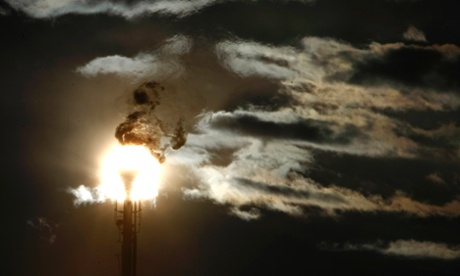
    A flare stack emitting fire is silhouetted against the sun at an oil refinery in Melbourne June 24, 2009. A senator crucial to Australia's plans for carbon trading said on Wednesday he did not believe climate change was real, delivering what could be a fatal blow to government plans to slash industrial gas emissions. REUTERS/Mick Tsikas (AUSTRALIA POLITICS ENERGY ENVIRONMENT BUSINESS IMAGES OF THE DAY) :rel:d:bm:GF2E56O0NFZ01

    Scientists say that if humans continue with business as usual, using fossil fuels and pumping out excessive amounts of greenhouse gases, the world will be on track for a planet that is 4C warmer by the end of this century Photograph: Mick Tsikas/Reuters
    With the IPCC report not yet published, there is already heated debate about what it will say, and about the implications of its findings for human development.

    The scientists’ statement is unequivocal, and is not based on whatever the IPCC may publish. They say: “The body of evidence indicating that our civilisation has already caused significant global warming is overwhelming.”

    The statement comes from 12 members of the recently established Earth League, which describes itself as “a voluntary alliance of leading scientists and institutions dealing with planetary processes and sustainability issues”.

    They say that if humans continue with business as usual, using fossil fuels and pumping out excessive amounts of greenhouse gases, the world will be on track for a planet that is 4C warmer by the end of this century, or even earlier.

    The group says assertions that there has been no warming this century are simply wrong. “Regardless of the… (erroneous) claim that global warming has already stopped, evidence is that once well-known impacts from El Niño, volcanic aerosols and solar variability are removed from the observations, the warming trend of the ocean-atmosphere system is unbroken; and that it will continue (potentially towards 4°C) unless serious mitigation action is taken.

    “That global warming continues unabated over the last decade is confirmed by ocean measurements. Ninety per cent of the additional heat that the Earth system absorbs due to the increase in greenhouse gases is stored in the oceans, and the global array of thousands of scientific measurement robots in the oceans proves that they keep heating up at a steady pace. Meanwhile satellites show that sea levels also keep rising steadily.”

    The statement says a 4°C rise would drastically change the Earth. Some coastlines and entire islands would be submerged by rising sea levels, and more extreme heat waves would cause crop failures and loss of life.

    It says powerful feedback processes that would very probably raise the warming even higher could be triggered, and might prove irreversible: “Four degrees of planetary warming means some 8°C change close to the Arctic, which will cause even larger impacts on the Eurasian and North American land mass and the surrounding seas.”

    “…our societies seem to be willing to impose immense risks on future generations.”

    Already, it says, there is persuasive evidence that immense changes may be under way: “The last two decades were… punctuated by devastating floods (like the Pakistan deluge in 2010) that may be related to an incipient restructuring of the atmospheric circulation.

    “The signs on the climate wall as expressed by the accelerated melting of Arctic sea ice and by the retreat of the overwhelming majority of glaciers worldwide are there for all to see. Yet this is just the beginning.”

    The scientists say: “Although climate science only tells us what might happen and not what to do about it, we feel that inaction is an unacceptable prospect.

    “Nations go to war, implement mass vaccinations of their populations and organise expensive insurance and security systems (such as anti-terror measures) to address much fainter threats. However, our societies seem to be willing to impose immense risks on future generations.”

    The 12 signatories recognise that some people believe it is impossible for human activities to produce a 4°C temperature rise. Others, they say, are already acknowledging defeat by maintaining that the international policy goal of limiting warming to less than 2°C is a lost case.

    They write that there is “ample evidence” that the world can hold a 2°C line, and say technology shows that global sustainability is attainable. But they add: “… the evidence demonstrates that the time frame to achieve this is rapidly shrinking.”

    The signatories of the statement include Professor Hans Joachim Schellnhuber, of the Potsdam Institute for Climate Impact Research, Germany, and Professor Sir Brian Hoskins, Director of the Grantham Institute for Climate Change at Imperial College London. The link above lists all 12 signatories.

  • Sign Amy’s Petition Below (repeated)

    AMY HAS 350.000 SIGNATURES BUT NEEDS MORE
    Home  »  Uncategorized   »   Sign Amy’s Petition Below

    Sign Amy’s Petition Below

    Posted in Uncategorized By Neville On September 13, 2013

    NEVILLE –

    Doctors can’t tell me exactly how long my husband has to live. Our oncologist said it could be as little as two weeks however our neurosurgeon said, given he is fit and strong, it could be 3 to 6 months.

    Nick has exhausted all the commercially available treatment options for Stage 4 melanoma and is just not qualifying for the new ‘breakthrough’ PD-1 drug trials – he needs access to PD-1 urgently, however the pharmaceutical companies, Bristol-Myers Squibb and Merck, each of whom make a version of PD-1 have not, to date, agreed to grant Nick access to the drug on a compassionate basis. They insist that he should enter a trial but they know that he does not qualify for any trials.

    I can’t imagine life without Nick. I can’t imagine telling our son Locky he has to watch the big game alone, telling Hayley that Daddy can’t take her bike-riding anymore, or knowing that my youngest son won’t even remember his dad.

    This treatment is our family’s last hope. That’s why we started a petition on change.org asking Bristol-Myers Squibb and Merck to give Nick compassionate access to the PD-1 cancer drug. Please click here to sign our petition.

    Merck and Bristol-Myers Squibb have the power to grant Nick single patient access to PD-1 right away under compassionate use laws. They even have policies for providing development drugs to people where it is their only hope. PD-1 is being trialled right now and they’ve given patients compassionate access to drugs like this before so I can’t see any reason why they shouldn’t this time – but so far they’re refusing to hear our case.

    Nick is determined to beat this so our children — Locky (7), Hayley (5), and Evan (1) — can grow up with Dad beside them. Nick takes on each new battle with melanoma with audacity — determined to win and constantly assuring others that he will jump the next hurdle. And he always does.

    Nick can jump this last hurdle, I know it — but only if Merck and Bristol-Myers Squibb give him that chance.

    Please join Locky, Hayley, Evan, and me in asking Merck and Bristol-Myers Squibb to provide the cancer drug PD-1 to Nick, so he can win against melanoma.

    Thank you so much for your help,

    Amy Auden


  • Post election strategy: Hit Abbott’s weak spot

    Why this ad?
    Protect Control Networkswww.sourcefire.com/SCADANetworks – Address cybersecurity threats with Sourcefire. Free Whitepaper.

    Post election strategy: Hit Abbott’s weak spot

    Inbox
    x
    Aaron Packard – 350.org Australia <aaron@350.org>
    5:36 PM (3 minutes ago)

    to me
    Images are not displayed. Display images below – Always display images from aaron@350.org

    Dear Friend,

    I think we all know that the outcome of the election was not a success for tackling climate change, and if we’re to be honest, it’s probably most adequately described as a climate disaster.

    You do have to wonder if Tony Abbott’s blood oath to repeal the carbon price counts for anything as there was actually no blood involved. But here at 350.org Australia, we’ve concluded that while a price on carbon is and has been a very important step for Australia, Abbott’s plan to cut it is likely to be a distraction* from the area we can actually win in – their weak spot: coal expansion. We need to win this one, big time.

    Here’s how.

    The Government is fighting a losing battle to expand coal exports

    Abbott and the Premier of Queensland, Campbell Newman are desperate to rapidly expand Australia’s coal exports. But they’re going to have a tough time. The international price of coal is low and is likely to remain low as demand for coal is not growing as fast as the industry predicted it would. China for one is busy putting in new legislation to decommission coal power plants and ramp up alternatives – meaning that the country is on track to peak it’s demand for coal much earlier than the consensus outlook had prothesised. The international price pressure, coupled with the divestment pressure, and the great work community groups around Australia are doing to fight these projects is making financing big coal projects increasingly risky and undesirable. Just last week, Glencore Xtrata shelved it’s massive Wandoan coal project for these very reasons.

    Over the coming year, we’ll continue to build momentum and pressure with Divestment campaigning. We’ll also issue a direct challenge to the fossil fuel industry – through Summer Heat Australia (more to come soon).

    Alongside those two, we’re going to be figuring out ways to challenge the ideology of extraction that would see Australia dug up no matter the social or environmental cost. Naomi Klein defines that ideology as ‘extractivism’:

    It’s an approach to the world based on taking and taking without giving back. Taking as if there are no limits to what can be taken – no limits to what a functioning society can take, no limits to what the planet can take. When crisis hits, there is only ever one solution: take some more, faster. On all fronts. So that is their story – the one we’re trapped in. The one they use as a weapon against all of us.

    We mustn’t just target Abbott and Newman for their extractivist agenda, we must target the small number of powerful people in Australia pushing extractivism. We must name it and shame it, and at the same time push forward strongly with the progressive, science-based path of development that treats the planet and people like they actually matter. That’s a big project, but it’s time to begin it. We’re always keen to hear your ideas – just hit reply to this email, or post them on our Facebook page!

    There’s a few other parts to our strategy, which we’ve summarised in this post-election climate organising checklist:

    1. Rational argument won’t win the day – the Coalition is deeply ideological. It’s a power fight.
    2. Government lobbying won’t work. We have to challenge power with power.
    3. Divestment is now more important than ever – it’s our most effective strategy to fight the extra power the coal and gas industry has just received with the change in government, because it gets to the financial base of the industry. We don’t have to faff about with the Government.
    4. Things will move fast. We need to get ready to respond. But we mustn’t get caught up with just responding. We need to go on the offensive.
    5. Support alternative media. Create alternative media. We have to divest ourselves from reading and believing the Murdoch press. Invest our desire for news into media that is fact-based and unbiased.
    6. Be ready for non-violent direct action
    If this resonates with you, the main thing we want you to do is stay active and stand with us over the coming months. The other thing that helps a lot is if you would become a monthly donor to 350.org Australia. Click here to find out how. We are a small team, and treasure every dollar that comes our way. Your ongoing support will enable us to rise to this challenge.
    Thanks for all that you do, onwards!
    Aaron, Blair, Charlie, for 350.org Australia
    *We’re not saying that people shouldn’t stand up for the carbon price – but our analysis is that it will draw considerable effort for questionable results, and we’d rather put that effort into the weak
  • Liberal MP Dennis Jensen slams Coalition for dumping science portfolio

    Liberal MP Dennis Jensen slams Coalition for dumping science portfolio

    No science minister ‘disconcerting’

    Nobel prize winning astrophysicist Brian Schmidt says it will take six to eight weeks to determine how committed the Abbott government is to science.

    A vocal climate sceptic who wanted to be science minister has hit out at Tony Abbott’s decision not to appoint a dedicated minister to the area.

    Western Australian Liberal Dennis Jensen’s criticism came as the country’s peak science bodies expressed concern over Mr Abbott’s new ministry, which has omitted a dedicated science minister for the first time in more than 50 years.

    WA MP Dr Dennis Jensen wants to be science minister in the Abbott government.Liberal MP Dr Dennis Jensen is critical of the Abbott government’s decision to omit a science minister.

    Dr Jensen, who had publicly put himself forward as a potential science minister, said on Tuesday the omission of a specific portfolio was incoherent.

    Advertisement

    “I’m somewhat confused about what happened to the science portfolio,” he told ABC News 24.

    The backbencher, who has a master’s degree in physics and a PhD in material science and is outspoken in his doubts about mainstream science on climate change, said splitting responsibility for science between the industry and education ministries would “make it a somewhat schizophrenic policy area”.

    Ian MacFarlaneIan MacFarlane Photo: Max Mason-Hubers

    “We’ve got a minister for sport, for God’s sake, but we don’t have a minister for science,” he said.

    “I guess this is a problem with not having people of scientific bent in decision-making processes.”

    Dr Jensen cited problems with the Australian Research Council’s process of awarding grants and a lack of quality students entering the field at university.

    “Science is in crisis, quite frankly,” he said.

    Dr Jensen made the comments in an interview in which he repeated criticisms that Mr Abbott’s paid parental leave scheme was too expensive and had not been properly thought through.

    He said the scheme should be referred to the Productivity Commission for examination.

    Asked whether he could see himself voting for the scheme, Dr Jensen said he would ‘‘have to wait and see where the policy goes’’ but he currently had problems with it.

    The country’s peak science bodies have expressed concern over Tony Abbott’s new ministry, which has omitted a dedicated science minister for the first time in more than 50 years.

    Not since 1931 has an Australian government been without a science minister.

    Universities Australia said it would work with the Abbott government to ensure it did not neglect “the critical areas of science, research and innovation”.

    Under the incoming Abbott government, the minister for industry, Ian MacFarlane, will be responsible for some areas of science, including The Commonwealth Scientific and Industrial Research Organisation.

    Mr Abbott said on Monday science would “largely be in the industry portfolio”.

    “I am trying to avoid a situation where unless something is specifically mentioned in someone’s title it is unimportant,” Mr Abbott said.

    “Everything that is significant is obviously of concern to an Australian government but it is possible to take things very, very seriously indeed without feeling they need to be included in people’s titles because we are just getting to a situation of title inflation and frankly I want to avoid title inflation.

    “Thankfully I think we’ve got some title deflation as a result of this ministry.”

    The Australian Academy of Science said it was disappointed.

    ”A scientifically literate society is a society which is equipped to hold informed debate and make intelligent decisions about big issues that affect us all,” the Academy’s secretary for science policy, Les Field, said.

    The head of Science and Technology Australia, Catriona Jackson, said the nation’s scientists were confused by the absence of a science minister.

    ”Science and technology are central to virtually everything government does, from industry to universities, to agriculture to health, to creating the kind of jobs that will ensure a prosperous future,” she said.

    But leading scientists including Nobel prize-winning physicist Brian Schmidt, and immunologist Sir Gustav Nossal, were reluctant to judge the new ministry until further details were released.

    Professor Schmidt said as long as the minister in charge of science had passion and influence.

    Sir Gustav said he was not too concerned, but would like the new government to continue to support the major science organisations, including the CSIRO, Australian Nuclear Science and Technology Organisation, and the Defence Science and Technology Organisation.

    with Nicky Phillips, Bridie Smith


    Ads by Google

    Dental Implant Warnings

    symptomfind.com/CosmeticDentalCare

    What You Should Know Before Getting Dental Implants. Read Expert Advice

    Gold Stocks To Buy

    www.FatProphets.com.au

    Australian Stock Market – Get Free Access To The Latest Free Report

    Don’t Sell Your Timeshare

    TimeshareOut.com/9-Mistakes-Report

    Until you read our special report. Get it today.

    Recommended
    8 Miley Cyrus memes to cleanse the palate

    8 Miley Cyrus memes to cleanse the palate
    Demi Moore is reportedly dating her ex's father

    Demi Moore is reportedly dating her ex’s father
    Bandt facing defeat in prized seat, poll finds

    Bandt facing defeat in prized seat, poll finds
    Sad loss for Jack and Lisa

    Sad loss for Jack and Lisa
    Australia-China trade no longer just a resource story

    From the web
    Australia-China trade no longer just a resource story
    Financial Review
    8 Miley Cyrus memes to cleanse the palate
    Demi Moore is reportedly dating her ex's father
    Bandt facing defeat in prized seat, poll finds
    Sad loss for Jack and Lisa
    Australia-China trade no longer just a resource story
    Advertisement
    Featured advertisers
    &lt;!– UI NOTE: Make iframed content accessible: –&gt; &lt;a href=”http://assets.betterbills.com/widgets/AGE-VIC.html”&gt;View these special offers by BetterBills.&lt;/a&gt;
    Advertisement

    Readers’ most viewed