Author: Neville

  • Sixth senate spot shapes as main electoral battleground in SA

    Sixth senate spot shapes as main electoral battleground in SA

    By Nick Harmsen

    Posted 3 hours 29 minutes ago

    There aren’t many contests to capture the nation’s interest in South Australia this election, but the Senate race will be one.

    A battle between the Greens and high profile Independent Nick Xenophon for first preference votes could shape the balance of power, imposing its influence on the next government.

    At 25, Greens candidate Sarah Hanson-Young made history as the youngest Senator when she was elected in 2007.

    Five years later, she faces the risk of early and involuntary political retirement.

    “Tony Abbott wants this seat so that he can get effective control of the Parliament,” she says.

    “And he’s doing everything he can to do it. So I’ve got a fight on my hands.”

    Megaphone negotiations are not a good way to deal with these issues.

    Independent Senator Nick Xenophon responds to Bob Brown


    Her prospects aren’t helped by the presence of Nick Xenophon.

    He may not have the backing of a party machine, but the ‘No Pokies’ campaigner has built a large public profile in his experience in the Senate and the Legislative Council of the South Australian Parliament.

    “I’m having to do this as a grassroots campaign, going to community centres, appealing for volunteers,” he says.

    “Because my biggest challenge is to have enough people at polling booths to hand out how-to-vote cards for me.”

    Watching Senator Xenophon campaign, recognition seems to be the last of his worries.

    He won 14.78 per cent of first preference votes at the 2007 election, securing a quota in his own right.

    Several of his opponents expect that vote to grow towards 20 per cent, a figure he secured when re-elected to the state parliament in 2006.

    Because my seat is on such a knife edge, [Nick Xenophon has] effectively preferenced the Liberal Party over the Greens, giving Tony Abbott a leg up to control the Parliament.

    Greens Senator Sarah Hanson Young


    So dominant is the Xenophon juggernaut, the Greens – through former Leader Bob Brown – made a public pitch to secure the independent’s preferences, but the bid backfired.

    “Megaphone negotiations are not a good way to deal with these issues,” Senator Xenophon says.

    He has instead decided to run a split preference ticket, meaning his excess votes would flow to Labor and Liberal candidates before the Greens.


    That’s a worry for Sarah Hanson-Young.

    “Because my seat is on such a knife edge, he’s effectively preferenced the Liberal Party over the Greens, giving Tony Abbott a leg up to control the Parliament.”

    Coalition control of both houses of Parliament is a mathematical impossibility according to South Australian Liberal Senator Simon Birmingham.

    But he does acknowledge the re-election of Nick Xenophon, coupled with Sarah Hanson-Young losing to a Liberal, could deliver real benefits to a Coalition government.

    “South Australia is critical to breaking the Labor-Greens stranglehold. Absolutely essential,” he says.

    “And we really would rather not have to govern in a situation where the Labor and Greens alliance in the Senate can still hold us to ransom.”

    Topics: federal-elections, federal-parliament, government-and-politics, greens, sa, adelaide-5000

  • Flying low over Greenland, Icepod tracks changes in the ice sheet

    Flying low over Greenland, Icepod tracks changes in the ice sheet

    A suite of radar and imaging systems is helping scientists to find out how melting happens and detect early signs of instability in the ice – useful as cracks in the landing strip become a hazard

    Link to video: Scientists track Greenland’s melting ice sheets with ‘Icepod’The LC-130 Hercules flew low over the ice sheet in a tight grid pattern, Teflon-coated landing skis barely 300 metres above the soft upper layer of snow. At the rear of the plane, scientists clustered round a monitor displaying a regular pattern of dark red waves generated by a radar signal.

    Somewhere in the vast, white emptiness below were two tiny cracks – barely 10cm (4in) across – imperceptible to the naked eye from this altitude, especially beneath fresh snow.

    But the cracks ran across an ice runway providing the only access to Camp Raven, a research outpost and extreme weather training centre for the US military, perched atop 1.25 miles (2km) of ice on one of the highest, coldest points on the Greenland ice sheet. If the researchers could detect cracks that small, it would constitute a scientific triumph.

    The 10-strong team from the Lamont-Doherty Earth Observatory at Columbia University are testing a suite of airborne radar and imaging systems known as IcePod, designed to track changes in the Greenland ice sheet. It would also confirm early signs of instability in the ice.

    The latest research into how melting happens has proved more interesting and complicated than researchers initially thought – not just gusts of warm air or dramatic spectacles of chunks of ice calving into the sea. It is now clear that melting has been happening rapidly in some parts of Greenland, and that meltwater can itself bring about new melting. All this matters because ice melt in Greenland is the single largest cause of global sea level rise, which is affecting coastlines around the world.

    Last month, Greenland had its warmest day since records began in the late 1950s, with the weather station at Maniitsoq (Sugar Loaf) on the south-western coast registering 78.6F (26C) on the afternoon of 30 July, the Danish Meteorological Institute reported.

    And on 11-12 July last year, gusts of warm air caused melting on virtually the entire surface of the ice sheet. The meltwater pouring off the glaciers washed out the main bridge at the town of Kangerlussuaq, the hub for scientists studying the Greenland ice sheet. All this is straining the ice sheet in various locations.

    “The ice is failing. The ice is getting stretched,” said Robin Bell, the geophysicist leading the IcePod mission.

    The LC-130s, the military’s cargo haulers, had landed at Camp Raven all season without incident, but the ice sheet is weakening, she said.

    “Ice is like silly putty. If you move it slowly it goes like this,” she said, drawing her hands slowly apart. “But if you yank it, it will snap … That is what is happening with the ice sheet.”

    The cracks at Raven would eventually turn into big crevasses, she said. Would the radar be able to discern those cracks? “If we could see 10cm cracks I would be really jazzed,” Bell said.

    It was during the extraordinary melt last year that crew at the New York Air National Guard, walking on the ice runway, discovered the cracks at Camp Raven.

    “They are in close proximity to the ski way, but are not affecting any of our operations right now,” said Major Joshua Hicks, as he flew the C-130 in a series of passes over the runway. “We’re not talking large crevasses, that would be a problem. We are talking small, small cracks that we are monitoring.”

    But they can become a hazard. Some years ago, in Antarctica, the landing ski of a US air national guard aircraft became caught in a crevasse beneath the snow and the aircraft sank into the ice. “We want to watch for them to make sure they are not going to get any larger,” Hicks said. The camp sits on the flanks of the central mountain range. The site has a year-round population of two. The only permanent structure is an abandoned cold war-era domed radar installation which once guarded against a possible Soviet missile attack on North America.

    But Raven is used during the summer by researchers and the New York Air National Guard to test pilots on the ice strip landings used in Greenland and Antarctica.

    The pace of change has turned Greenland into a destination for scientists gathering evidence of climate change in real time and trying to predict its consequences. Satellite evidence indicates that Greenland has experienced continuous melting and ice loss for the past 22 years. The researchers aim to understand what this will mean for the ice sheet and what impact the melting will have globally.

    In high summer, Kangerlussuaq in the south-west of the island is overrun by scientists. On their side of town, in a row of barracks-type buildings, researchers study every aspect of ice sheets and glaciers and how they change: how they calve, what happens when ice meets fjord, snow crystal structures and sediment deposits. Some of those changes were clearly visible from the bubble observation window at the rear of the IcePod team’s LC-130, and on the feeds from the instruments bolted to a capsule on the side of the plane.

    The IcePod project combines five instrument sets: a scanning laser to measure the ice surface, a radar trained at the upper crust of the ice sheet, another radar to penetrate to the bedrock up to 2,700 metres beneath the ice, a visual camera and an infrared camera producing thermal images. The instruments were shrunk and installed in a capsule bolted to the left of the plane.

    The idea was to produce a regular data record of changes in the ice sheet, in far greater detail than is possible with satellite picture resolution, and covering far more ground than a traditional expedition.

    The pod was also designed to be self-contained. “Traditionally, we built our systems into the plane structure,” said Nick Frearson, the senior engineer for the project.

    With IcePod, however, he added: “We can piggyback on missions. The Air National Guard can bolt the pod on to the plane, and we can kind of get that data for free.”

    As the plane flew low over the ice sheet on a test run last month, from Russell glacier towards the interior of Greenland, the ice at lower elevations was grimy from dirt forcing its way to the surface, the snow cut by countless black creases.

    Deeper inland, the ice sheet turned cleaner and whiter, the surface cut by occasional long and winding channels of water or pools in a startling bright turquoise. Near Summit camp, the highest point on the ice sheet, there was nothing to see but white. But even at those elevations, the ice was moving, albeit at only a few centimetres every year.

    On the edges of the ice – especially where ice meets water – the team saw ice melt proceeding rapidly. On the west of the island, Jakobshavn glacier was sliding into the fjord at an average of seven miles a year. Petermann glacier in north-west Greenland last year shed an iceberg twice the size of Manhattan.

    And at the top of Greenland, where the ice is two miles deep, it is not melting because of the sun alone, said Kirsty Tinto, a Lamont geologist with the IcePod team. “It has become increasingly clear that it isn’t just the balance of solar radiation that is melting the ice,” she said.

    The instruments inside the IcePod capsule provided a closer view of those changes occurring at the surface than existing satellite images.

    The researchers hoped to study the waterways at the top of the ice sheet, which transport water across the ice or funnel it down towards the bedrock.

    Some formations, known as moulins, have been known to drain entire glacier lakes in a matter of hours, drawing the water right down to the bedrock. That water layer beneath the ice in turn speeds the ice sheet’s slide towards the ocean.

    Scientists are also studying what happens when glaciers meet ocean, and how the mixing of fresh and salt water accelerates ice loss. And they hope to track those changes across the seasons, through regular flights.

    “It is sort of being able to capture the pulse of the ice sheet several times a year,” said Bell. “We used to think it happened slowly. Now we know it is happening on a human time scale.”

    In 2007, an international team of scientists set out to map 2,700-metre (8,900ft) mountains beneath the snow and ice of eastern Antarctica.

    The survey of the Gamburtsev range involved scientists from seven countries, camped for months on either side of the range. Their only direct connection to the outside world was through military cargo planes, which flew in supplies and performed 17 airdrops of fuel.

    The high-altitude and dangerous enterprise took two years and cost about $25m (£16m), and when the survey was complete some researchers asked themselves: why not use a plane?

    The scale of that ambitious exercise was the inspiration for IcePod. The $5.9m initiative was launched in 2009 with a grant from Barack Obama’s recovery act. It represents the latest effort to study the vast expanses of the Greenland and Antarctica ice sheets using satellite data and aircraft mounted systems instead of boots on the ground – or boats in a fjord clogged with icebergs.

    ‘It’s no mean feat shoehorning these things into a small cigar-shaped box’

    “You don’t bring an ice breaker up into these fjords to do traditional oceanography because there are so many icebergs. It’s not a place you want to go. It’s not a very safe environment,” said Chris Zappa, an oceanographer with the project. “The beauty of this instrument package is that we can do this cutting edge science and learn more about how the process occurs.”

    The IcePod suite deploys five instrument systems in combination to generate more targeted and higher resolution images than available by satellite. Unlike earlier systems, the IcePod is entirely self-contained, and can be swapped out on to different aircraft.

    The use of aircraft also allows for more regular data collection, with researchers planning three visits a season to Greenland.

    Scientists increasingly are looking for such targetted images, Zappa said. “Until now people have studied the whole ice sheet,” he said. But he added: “It’s becoming more and more important to understand the surface processes.”

    Other projects have used similar instruments to track the changes in the ice sheets, but Lamont’s version was the first time an entire suite of instruments had been collapsed in size and deployed together, the scientists said.

    The biggest challenge was shrinking the instruments so they would fit inside a capsule measuring 8ft by 2ft .

    “It is no mean feat trying to shoehorn all these things into a small cigar-shaped box, and to try and get a good data reference set from it,” said Nick Frearson, the senior engineer on the project.

    Then there was the matter of compensating for the movement and vibration of the host aircraft to avoid blurred images, or data crashes from disconnecting cables.

    “The plane pitches and rolls. It is not flying in dedicated straight lines. These are all things that have to be accounted for,” Frearson said.

    The suite includes a scanning lasar to measure the ice surface, a radar trained at the upper crust of the ice sheet, about 100 to 200 yards, another radar to penetrate through 2 miles of ice to the bedrock below, a visual camera, and an infrared camera.

    The infrared camera produces thermal images of the ice sheet, enabling researchers to track temperature changes deep down inside crevasses on the surface of the ice sheet, or trace the circulation patterns of icebergs as they float off into the fjord.

  • Norris, Garth (R. Oakeshott, MP)

    Norris, Garth (R. Oakeshott, MP) <Garth.Norris@aph.gov.au>
    1:26 PM (24 minutes ago)

    to Garth

    Good afternoon,


    I have received a number of inquiries since the announcement of Rob’s retirement regarding the continuation of work at the federal level to address the ongoing coastal erosion issues at Old Bar.


    Given the effort that has gone into getting this issue on to the political agenda federally, we are determined to ensure the incoming Member for Lyne has all the information he needs (sadly, there are no female candidates!) to pick up where we have left off. To this end, I have written a cover note with the attached briefing and attached it to the inch-thick file we have containing the various reports and correspondence we have kept over the past five years in relation to this issue.  The file does not contain correspondence from individual constituents, ensuring your privacy is protected, but rather reports from government, council, Worley Parsons etc. and formal correspondence from the Old Bar Beach Sand Replenishment Group.


    We encourage you to continue pressuring your local MPs on this issue and sincerely thank you for the time, effort and energy you have invested in trying to achieve the best possible outcome for your community. On a personal note, it has been a great privilege to work with all of you.

    Best wishes,

    Garth


    Garth Norris

    Electorate Officer

    Lyne Electorate Office

    Ph. 6584-2911

    Fax. 6584-2922

    E: garth.norris@aph.gov.au


  • EPA orders air pollution controls for fracked gas wells

    EPA orders air pollution controls for fracked gas wells

    By Renee Schoof – McClatchy Newspapers

    WASHINGTON —

    Air pollution from thousands of natural gas wells that are “fracked” every year will be reduced under regulations that the Environmental Protection Agency issued on Wednesday.

    It’s the first time the EPA has required air pollution controls at hydraulically fractured, or fracked, wells. The new rule targets smog-forming volatile organic compounds and air toxics that increase cancer risks. The same equipment also would trap methane, a potent heat-trapping gas in the atmosphere.

    President Barack Obama has called for expansion of natural gas production with fracking, but he has said it should be done without harming health and safety. While water pollution has gotten most of the attention, natural gas production, processing and delivery also produce large amounts of air pollution.

    The rule mainly would require companies to capture the burst of emissions that occurs as a well is being prepared for commercial production.

    Beginning in 2015, all fracked wells will be required to use “green completions.” The process involves truck-mounted equipment that captures the waste that flows for about three to 10 days after water, sand and chemicals are injected into a well. The captured gas and liquid hydrocarbons can be separated, treated and sold.

    Fort Worth, Texas, and other cities already require green completions, as do Colorado and Wyoming. The EPA estimates the equipment is used voluntarily in about 50 percent of wells today.

    “This levels the playing field,” said EPA air administrator Gina McCarthy. She said the rule was designed to promote responsible production of natural gas and to protect the public, and it will “do it in a way that more than pays for itself.”

    The American Petroleum Institute, the industry’s lobby group, had argued that the EPA underestimated the cost of the equipment and had asked for an exemption for many wells. The EPA didn’t grant that exemption but accepted the industry’s request for more time to build the equipment needed for green completions.

    The institute had no immediate comment about costs because it needed to review the details, said spokesman Carlton Carroll. “We were pleased that they recognized the need for a phase-in period,” he said.

    But the Western Energy Alliance, another trade group, said in a statement that the EPA overestimated the benefits and underestimated the costs of compliance. It said the rule would result in minimal environmental benefit and higher energy costs.

    Environmental groups said the benefits were broad.

    “These important rules start to cut down on air pollution that harms people living near wells, creates smog and warms the climate,” David McCabe, senior scientist with Clean Air Task Force, said in a statement. “They are a solid start, but we need to keep working to reduce pollution from the gas industry all the way from the well to the customer. People who live near compressors and equipment already in use need to see their air cleaned up as well. Unfortunately, these rules won’t do that.”

    The new rule doesn’t address much of the pollution from compressor stations, storage tanks and other equipment used in the natural gas industry.

    The Natural Resources Defense Council in a statement said it welcomed the requirement for green completions but was disappointed that they wouldn’t be required for 2 1/2 years, arguing that the equipment to capture the emissions could be built in less time.

    During the phase-in period until 2015, companies that don’t use green completions voluntarily will be required to burn off the gas instead. Large flares, up to 80 feet tall, burn off much of the volatile organic compounds, one of the components that make smog, but they produce nitrogen oxides, another smog-forming pollutant.

    The EPA’s McCarthy said that the requirement for flaring during the phase-in period before 2015 would “significantly help” reduce the smog that forms from natural gas production. Green completions, required for all wells after Jan. 1, 2015, will reduce smog more because, unlike flaring, it adds no additional pollutants, she said.

    The EPA said that green completions reduce the volatile organic compounds released to the air by nearly 95 percent.

    The Natural Resources Defense Council said in a report last month that green completions were only one of a number of technologies that should be required to control emissions of methane, the main component of natural gas, and other pollutants.

    The new regulation reduces methane as a co-benefit of reducing the other pollutants. McCarthy said that the EPA had no plans for more extensive requirements for methane reductions. Methane is 25 times more potent than carbon dioxide, the primary greenhouse gas, in driving climate change.

    The EPA was under a court order to issue the new pollution standards. The agency is required to review them every eight years by law. The existing standards were issued in 1985. Environmental groups sued the agency in 2009, saying it had failed to review the standards. The U.S. District Court for the District of Columbia required the EPA to take final action by Tuesday.

    (email: rschoof(at)mcclatchydc.com)
  • Global dimming

    Global dimming

    Posted by: Global Warming in NEWS 14 hours ago 0 6 Views

    Global dimming is an environmental phenomenon is much less known, but real, comes as a result of air pollution that occurs from the burning of fossil fuels for internal combustion engines in the industry and residences.

    Will collect and store the heat produced by the sun in our atmosphere, which made a kind of pollution called particulate emissions, especially sulfur dioxide, soot and ash also by the release of carbon dioxide. When these particles in the atmosphere absorb solar energy and reflect sunlight, which bound to the surface of the earth and take them into space.

    Particle pollution also changes the properties of the clouds form as “brown clouds” that are more reflective and produce less precipitation than their white counterparts. The reduction in the heat reaches the earth’s surface as a result of the two methods is what the researchers called global dimming.

    This phenomenon sounds like an ironic savior to climate change problems. It is believed that global dimming caused the droughts in Ethiopia in the 1970s and 80s where millions died, because the northern hemisphere oceans were not warm enough to allow rain formation.

    Global dimming is also hiding the true power of global warming: This phenomenon occurs due to impurities without limits greenhouse gas emissions, rapid warming has been observed and human health has been compromised without omitting disaster ecological, as indicated by the heat wave in Europe in 2003, the thousands killed by people occupied.

    How big a problem is global dimming? … According to studies done at the University of Columbia is a reduction of about 4% of the amount of solar radiation reaching the earth’s surface over a period 1961-1990, a time when the particulate emissions began to rise worldwide.

    However, a 2007 study by the National Aeronautics and Space Administration (NASA) found a decreasing level of the phenomenon of global dimming since 1990, probably due to the stringent standards adopted against pollution caused by the U.S. and Europe since that time.

    Click here to submit your review.


    Submit your review
    * Required Field


    Related Posts

    2013-08-27

  • Help us say goodbye to coal

    1 of 2
    Why this ad?
    iStockphoto20% Off – Today Only! – Save 20% off Credits at iStockphoto!

    Help us say goodbye to coal

    Inbox
    x
    Charlie Wood – 350.org Australia <charlie@350.org>
    10:02 AM (7 minutes ago)

    to me

    Dear friends,

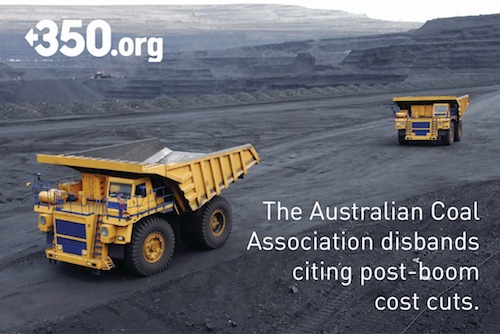
    In case you hadn’t heard, the Australian Coal Association (ACA) disbanded last week and their CEO Nikki Williams (who characterized Bill McKibben as a “threat to our economy”) has lost her job.

    A sign of decline, this is also a last-ditch effort by the industry to consolidate its power. In being absorbed by the Minerals Council, the ACA’s lobbying power will be centralised and it’ll be harder to tell what they’re up to.

    [click on this infographic to like and share it with friends]

    But, as the coal industry starts to wane, it’s critical that we keep them in the spotlight. That’s why, as we approach the season where companies hold their Annual General Meetings (AGM), we’re joining forces with friends in the climate movement to pressure the big banks and fossil fuel companies to come clean.

    If you’re someone with shares or simply someone who cares – we need you. Click here to volunteer to ask questions or attend actions during this year’s AGM season

    We’ll be shining a light on fossil fuel investments and asking how investors plan to exit an industry that is playing havoc with our communities, ecosystems and the climate.

    And we have the numbers on our side…

    • As the industry scrambles to increase its output, Australia is now swimming in a glut of coal and prices are at their lowest in four years.
    • Coal price forecasts are dropping by the day and production cuts are imminent. According to Goldman Sachs, investing in coal is an increasingly risky business.
    • It’s no wonder then that major investors like the World Bank and the European Investment Bank are restricting their funding of new coal.
    • Nor is it surprising that BHP will no longer fund new coal and, along with Rio Tinto, is starting to divest from its existing coal operations.
    • In fact, $US29 billion worth of coal projects have been deferred.
    • As the industry’s decline gains momentum, it’s time we turned our attention to the new kid on the block – renewables – which, compared to new coal and gas in Australia, are already cheaper and offer far more jobs.

    But, as Gandhi reminds us, a win seldom comes without a fight. Over the coming months, the industry will be lobbying hard to undermine Government regulation.

    That’s why we need you to help us expose the absurdities of expanding an industry that, increasingly, can no longer be financially and morally justified.

    We’ll help draw public attention to damaging new projects through our Summer Heat campaign. We’ll work hard to erode the industry’s social license through our divestment campaigns. And from October through to December, we’ll go direct to the heart of the industry – by putting the hard word on fossil fuel companies and investors during the upcoming AGM season.

    A clean energy future is within our reach.

    Join us this AGM season to help farewell coal and welcome in that beautiful, clean and safe future we all deserve.

    Yours with hope,

    Charlie, Blair, Aaron, Simon and the 350.org Australia team


    350.org is building a global movement to solve the climate crisis. Connect with us on Facebook and Twitter, and sign up for email alerts. You can help power our work by getting involved locally, sharing your story, and donating here. To change your email address or update your contact info, click here.